
Computer Networks Chapter 2 The Physical Layer CN
- Slides: 86
Computer Networks Chapter 2 The Physical Layer CN 5 E by Tanenbaum & Wetherall, © Pearson Education-Prentice Hall and D. Wetherall, 2011, modified by SJF 2014 1
The Physical Layer Chapter 2 • Theoretical Basis for Data Communications • Guided Transmission Media • Wireless Transmission • Communication Satellites • Digital Modulation and Multiplexing • Public Switched Telephone Network • Mobile Telephone System • Cable Television Revised: August 2011 CN 5 E by Tanenbaum & Wetherall, © Pearson Education-Prentice Hall and D. Wetherall, 2011, modified by SJF 2014
Theoretical Basis for Data Transmission • There are physical limits to what can be sent over a channel. • Three types of transmission media- each with different properties and performance capabiities: • Guided (copper wire and fiber) • Wireless (radio frequency) • Satellite • Digital modulation - how analog signals are converted into digital bits and back again. • Multiplexing to put multiple conversation on the same transmission medium without interfering with one another. • 3 examples of communication systems: telephone, mobile phone and cable TV. CN 5 E by Tanenbaum & Wetherall, © Pearson Education-Prentice Hall and D. Wetherall, 2011, modified by SJF 2014 3
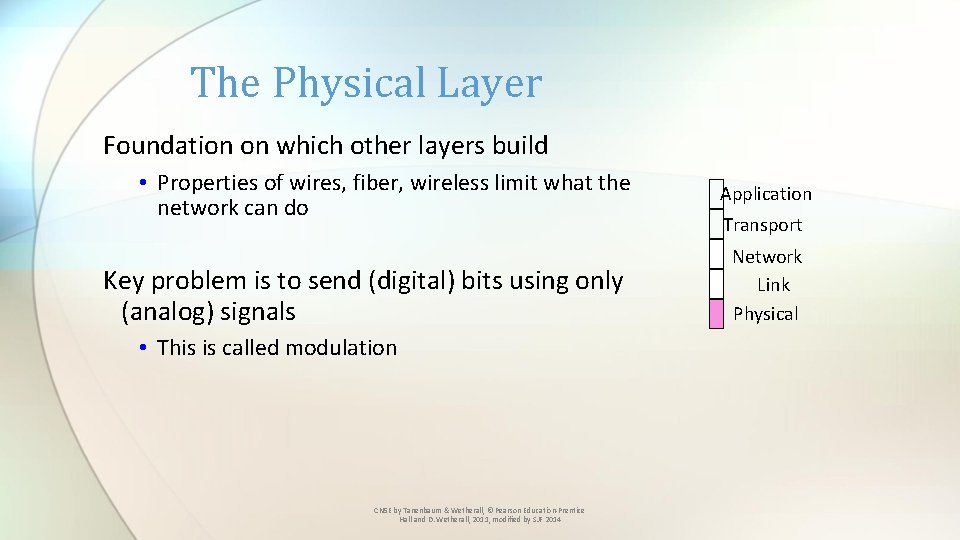
The Physical Layer Foundation on which other layers build • Properties of wires, fiber, wireless limit what the network can do Key problem is to send (digital) bits using only (analog) signals • This is called modulation CN 5 E by Tanenbaum & Wetherall, © Pearson Education-Prentice Hall and D. Wetherall, 2011, modified by SJF 2014 Application Transport Network Link Physical
Theoretical Basis for Data Communication rates have fundamental limits • Fourier analysis » • Bandwidth-limited signals » • Maximum data rate of a channel » CN 5 E by Tanenbaum & Wetherall, © Pearson Education-Prentice Hall and D. Wetherall, 2011, modified by SJF 2014
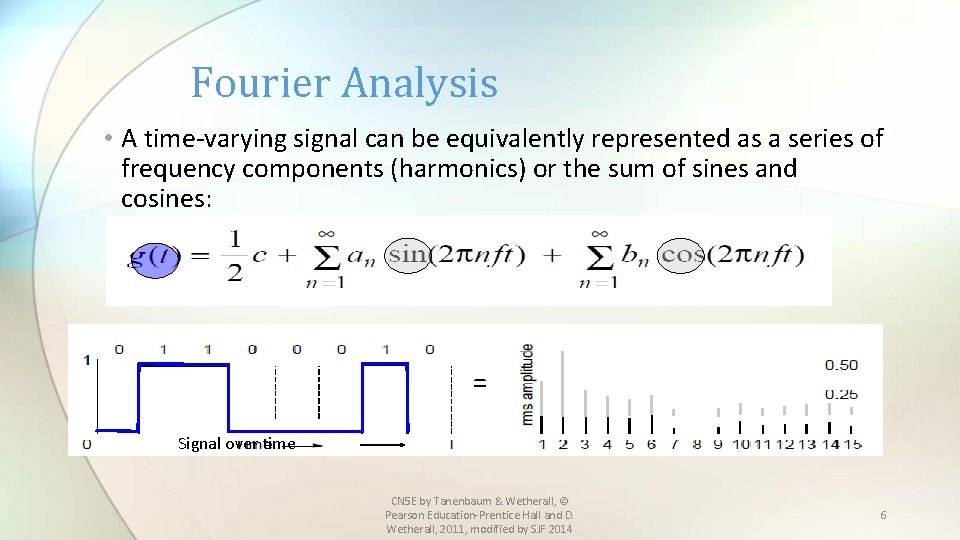
Fourier Analysis • A time-varying signal can be equivalently represented as a series of frequency components (harmonics) or the sum of sines and cosines: = Signal over time a, b weights of harmonics CN 5 E by Tanenbaum & Wetherall, © Pearson Education-Prentice Hall and D. Wetherall, 2011, modified by SJF 2014 6
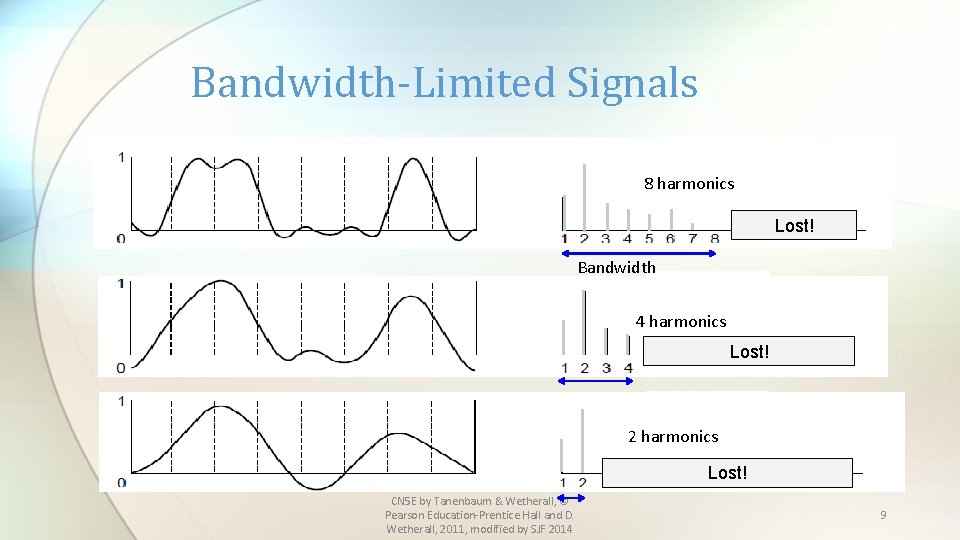
Fourier Analysis • Transmitted signals lose some power as they are transmitted. • Transmission facilities diminish different Fourier components by different amounts introducing distorenuatedtion. • For a wire, amplitudes are transmitted mostly undiminished from 0 up to some frequency f. Frequencies above this frequency f are attenuated (reduced). • The width of this frequency range is called the bandwidth. • Baseband run from 0 to some max frequency • Passband- shifted to occupy higher frequencies such as wireless CN 5 E by Tanenbaum & Wetherall, © Pearson Education-Prentice Hall and D. Wetherall, 2011, modified by SJF 2014 7
Bandwidth • Bandwidth is a physical property of the transmission medium such as the construction, thickness and length of the wire or fiber. • Limiting the bandwidth, limits the data rate. • Goal for digital transmission is to receive a signal with enough fidelity to reconstruct the sequence of bits that was sent. • Bandwidth – to Electrical Engineers –(analog) means – a quantity measured in Hz ( cycles per second) • Bandwidth – to Computer Scientists – (digital) means – the maximum data rate of a channel ( bits/second) CN 5 E by Tanenbaum & Wetherall, © Pearson Education-Prentice Hall and D. Wetherall, 2011, modified by SJF 2014 8
Bandwidth-Limited Signals • Having less bandwidth (harmonics) degrades the signal 8 harmonics Lost! Bandwidth 4 harmonics Lost! 2 harmonics Lost! CN 5 E by Tanenbaum & Wetherall, © Pearson Education-Prentice Hall and D. Wetherall, 2011, modified by SJF 2014 9
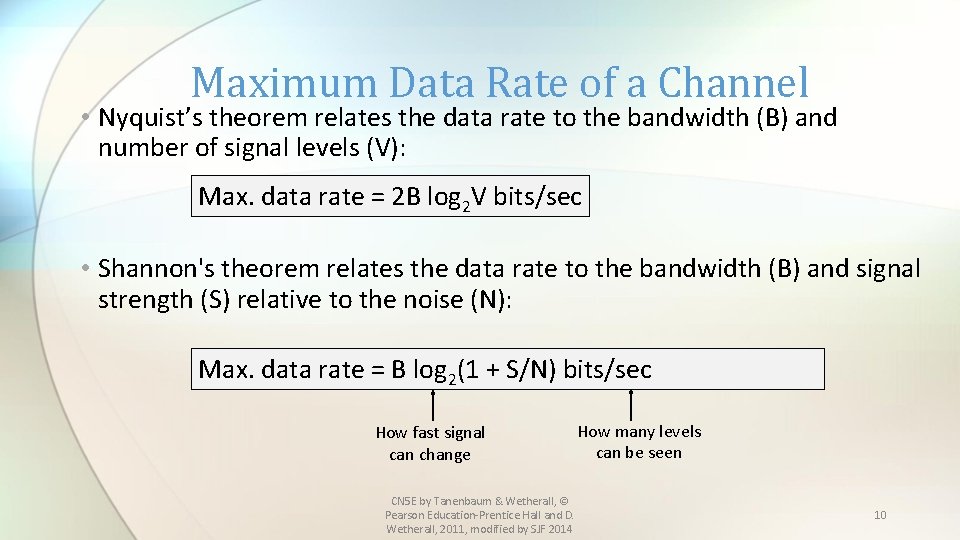
Maximum Data Rate of a Channel • Nyquist’s theorem relates the data rate to the bandwidth (B) and number of signal levels (V): Max. data rate = 2 B log 2 V bits/sec • Shannon's theorem relates the data rate to the bandwidth (B) and signal strength (S) relative to the noise (N): Max. data rate = B log 2(1 + S/N) bits/sec How fast signal can change CN 5 E by Tanenbaum & Wetherall, © Pearson Education-Prentice Hall and D. Wetherall, 2011, modified by SJF 2014 How many levels can be seen 10
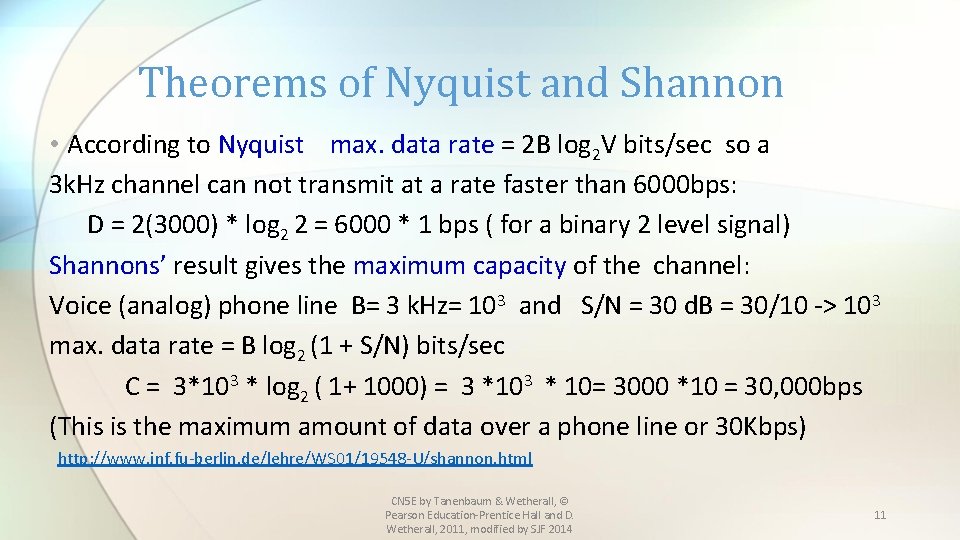
Theorems of Nyquist and Shannon • According to Nyquist max. data rate = 2 B log 2 V bits/sec so a 3 k. Hz channel can not transmit at a rate faster than 6000 bps: D = 2(3000) * log 2 2 = 6000 * 1 bps ( for a binary 2 level signal) Shannons’ result gives the maximum capacity of the channel: Voice (analog) phone line B= 3 k. Hz= 103 and S/N = 30 d. B = 30/10 -> 103 max. data rate = B log 2 (1 + S/N) bits/sec C = 3*103 * log 2 ( 1+ 1000) = 3 *103 * 10= 3000 *10 = 30, 000 bps (This is the maximum amount of data over a phone line or 30 Kbps) http: //www. inf. fu-berlin. de/lehre/WS 01/19548 -U/shannon. html CN 5 E by Tanenbaum & Wetherall, © Pearson Education-Prentice Hall and D. Wetherall, 2011, modified by SJF 2014 11
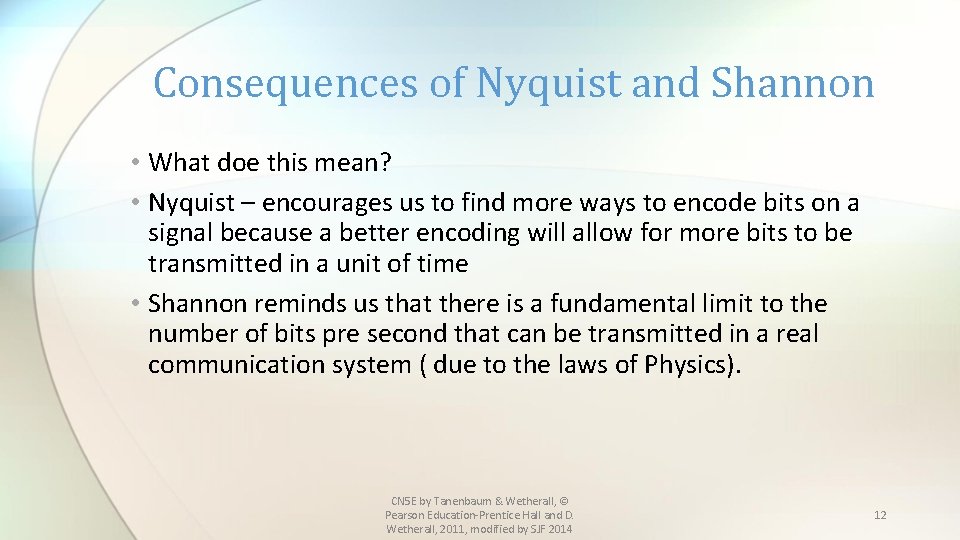
Consequences of Nyquist and Shannon • What doe this mean? • Nyquist – encourages us to find more ways to encode bits on a signal because a better encoding will allow for more bits to be transmitted in a unit of time • Shannon reminds us that there is a fundamental limit to the number of bits pre second that can be transmitted in a real communication system ( due to the laws of Physics). CN 5 E by Tanenbaum & Wetherall, © Pearson Education-Prentice Hall and D. Wetherall, 2011, modified by SJF 2014 12
Guided Transmission (Wires & Fiber) Media have different properties, hence performance • Reality check • Storage media » • Wires: • Twisted pairs » • Coaxial cable » • Power lines » • Fiber cables » CN 5 E by Tanenbaum & Wetherall, © Pearson Education-Prentice Hall and D. Wetherall, 2011, modified by SJF 2014
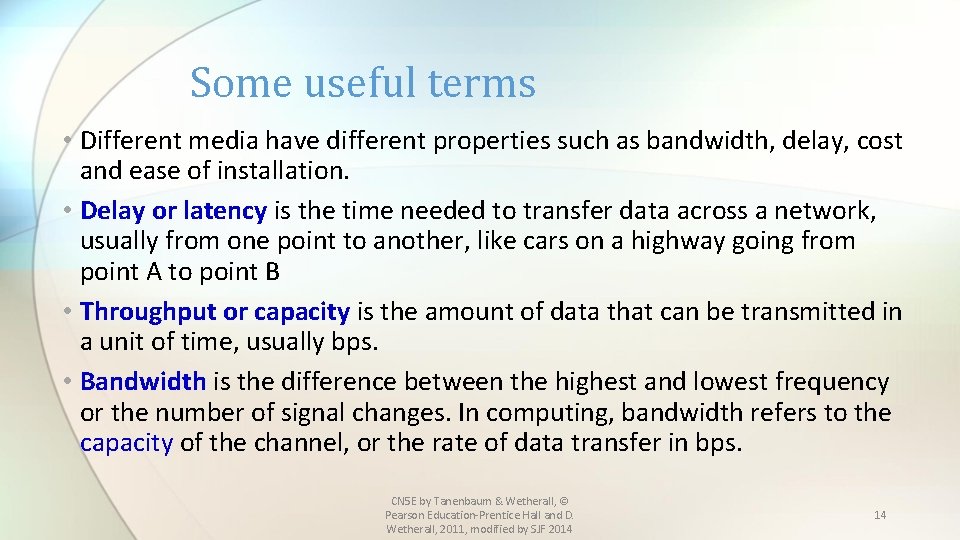
Some useful terms • Different media have different properties such as bandwidth, delay, cost and ease of installation. • Delay or latency is the time needed to transfer data across a network, usually from one point to another, like cars on a highway going from point A to point B • Throughput or capacity is the amount of data that can be transmitted in a unit of time, usually bps. • Bandwidth is the difference between the highest and lowest frequency or the number of signal changes. In computing, bandwidth refers to the capacity of the channel, or the rate of data transfer in bps. CN 5 E by Tanenbaum & Wetherall, © Pearson Education-Prentice Hall and D. Wetherall, 2011, modified by SJF 2014 14
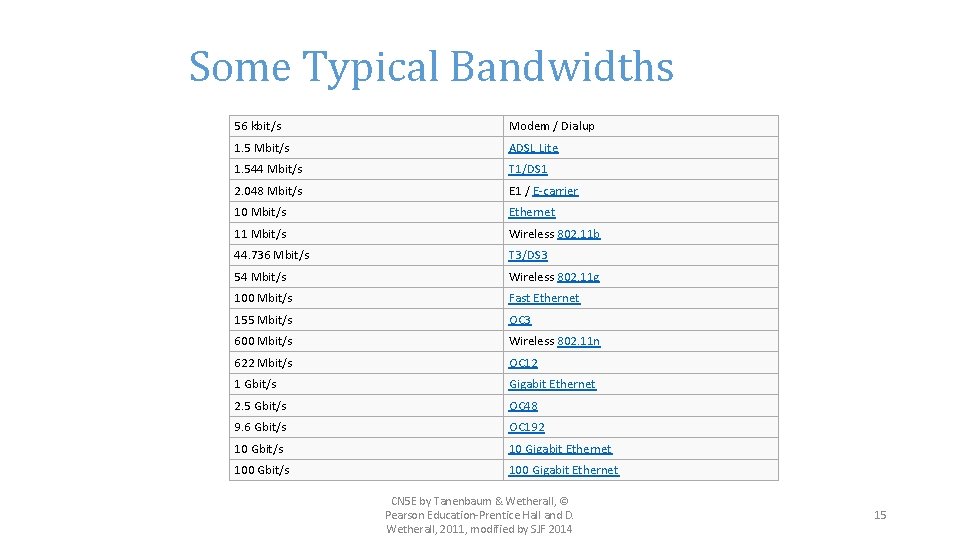
Some Typical Bandwidths 56 kbit/s Modem / Dialup 1. 5 Mbit/s ADSL Lite 1. 544 Mbit/s T 1/DS 1 2. 048 Mbit/s E 1 / E-carrier 10 Mbit/s Ethernet 11 Mbit/s Wireless 802. 11 b 44. 736 Mbit/s T 3/DS 3 54 Mbit/s Wireless 802. 11 g 100 Mbit/s Fast Ethernet 155 Mbit/s OC 3 600 Mbit/s Wireless 802. 11 n 622 Mbit/s OC 12 1 Gbit/s Gigabit Ethernet 2. 5 Gbit/s OC 48 9. 6 Gbit/s OC 192 10 Gbit/s 10 Gigabit Ethernet 100 Gbit/s 100 Gigabit Ethernet CN 5 E by Tanenbaum & Wetherall, © Pearson Education-Prentice Hall and D. Wetherall, 2011, modified by SJF 2014 15
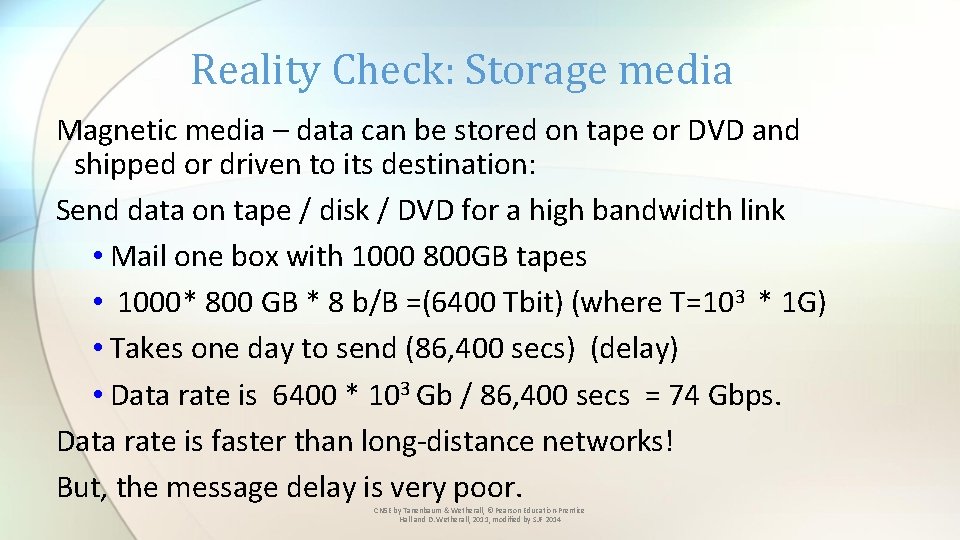
Reality Check: Storage media Magnetic media – data can be stored on tape or DVD and shipped or driven to its destination: Send data on tape / disk / DVD for a high bandwidth link • Mail one box with 1000 800 GB tapes • 1000* 800 GB * 8 b/B =(6400 Tbit) (where T=103 * 1 G) • Takes one day to send (86, 400 secs) (delay) • Data rate is 6400 * 103 Gb / 86, 400 secs = 74 Gbps. Data rate is faster than long-distance networks! But, the message delay is very poor. CN 5 E by Tanenbaum & Wetherall, © Pearson Education-Prentice Hall and D. Wetherall, 2011, modified by SJF 2014
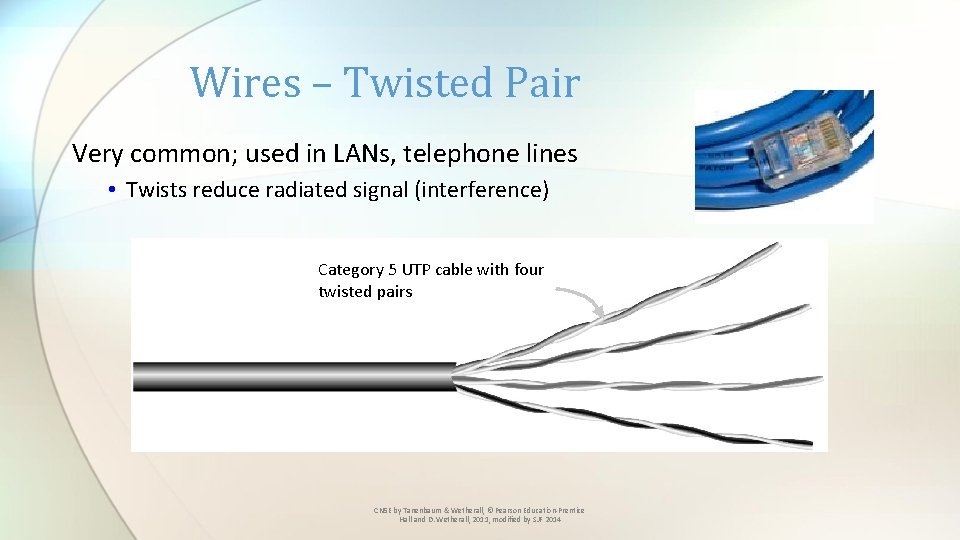
Wires – Twisted Pair Very common; used in LANs, telephone lines • Twists reduce radiated signal (interference) Category 5 UTP cable with four twisted pairs CN 5 E by Tanenbaum & Wetherall, © Pearson Education-Prentice Hall and D. Wetherall, 2011, modified by SJF 2014
Link Terminology Full-duplex link • Used for transmission in both directions at once • e. g. , use different twisted pairs for each direction (phone) Half-duplex link • Both directions, but not at the same time • e. g. , senders take turns on a wireless channel (eg. Walkie-talkie) Simplex link • Only one fixed direction at all times; not common (older TV) CN 5 E by Tanenbaum & Wetherall, © Pearson Education-Prentice Hall and D. Wetherall, 2011, modified by SJF 2014
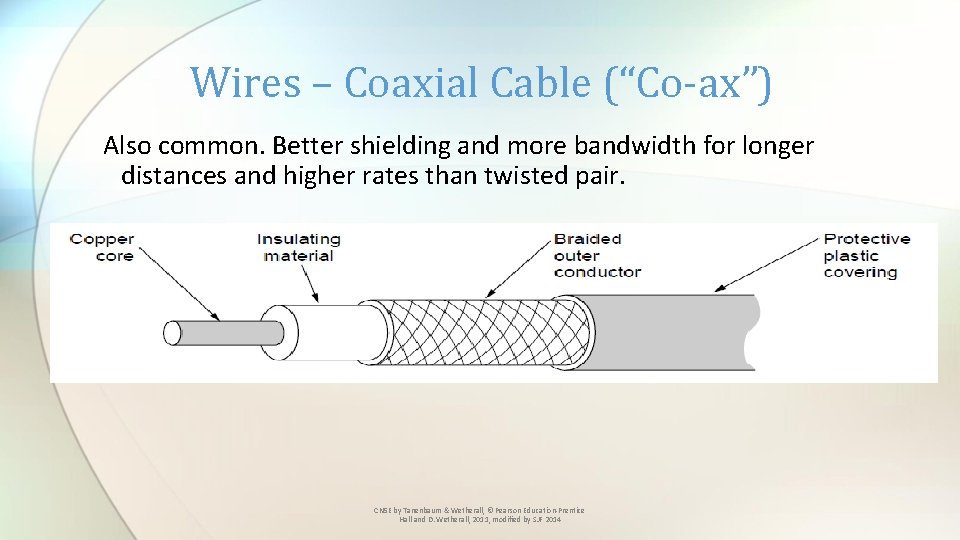
Wires – Coaxial Cable (“Co-ax”) Also common. Better shielding and more bandwidth for longer distances and higher rates than twisted pair. CN 5 E by Tanenbaum & Wetherall, © Pearson Education-Prentice Hall and D. Wetherall, 2011, modified by SJF 2014
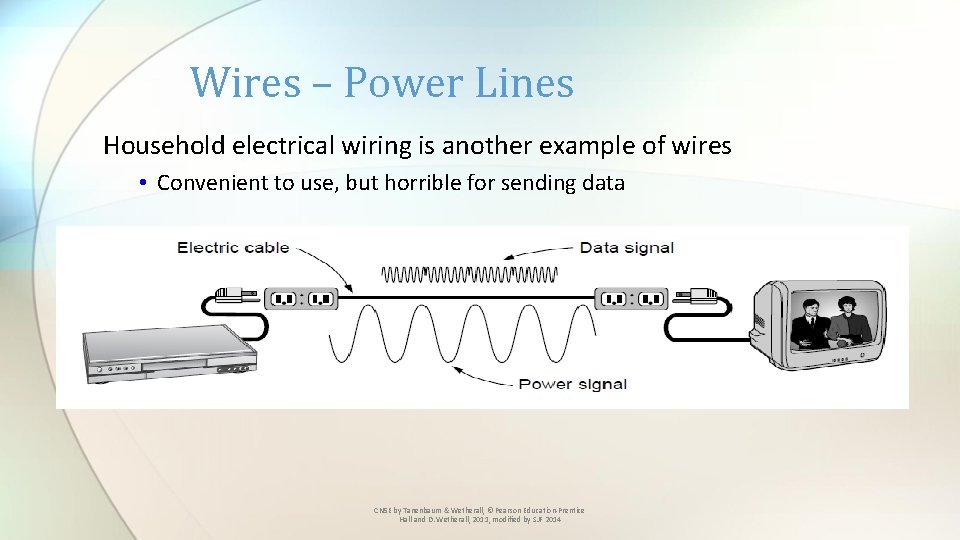
Wires – Power Lines Household electrical wiring is another example of wires • Convenient to use, but horrible for sending data CN 5 E by Tanenbaum & Wetherall, © Pearson Education-Prentice Hall and D. Wetherall, 2011, modified by SJF 2014
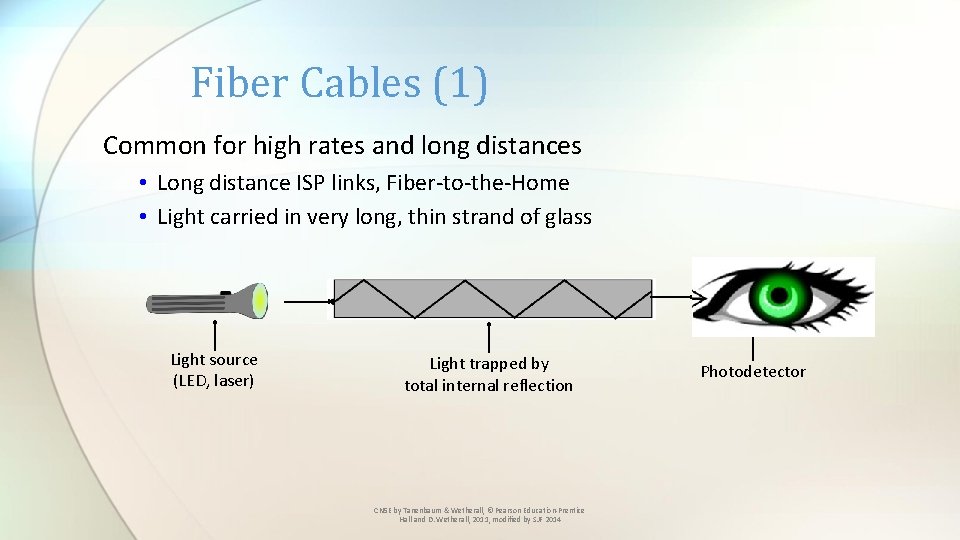
Fiber Cables (1) Common for high rates and long distances • Long distance ISP links, Fiber-to-the-Home • Light carried in very long, thin strand of glass Light source (LED, laser) Light trapped by total internal reflection CN 5 E by Tanenbaum & Wetherall, © Pearson Education-Prentice Hall and D. Wetherall, 2011, modified by SJF 2014 Photodetector
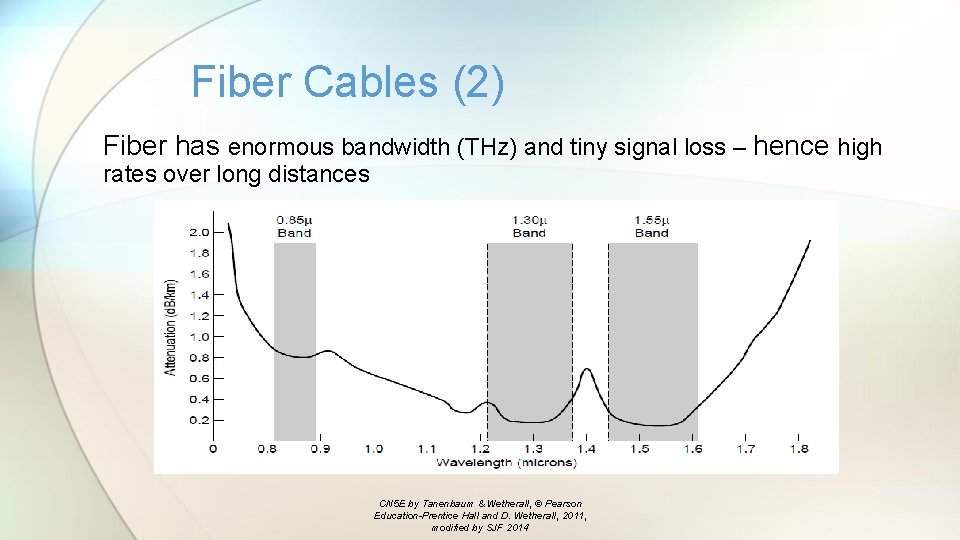
Fiber Cables (2) Fiber has enormous bandwidth (THz) and tiny signal loss – hence high rates over long distances CN 5 E by Tanenbaum & Wetherall, © Pearson Education-Prentice Hall and D. Wetherall, 2011, modified by SJF 2014
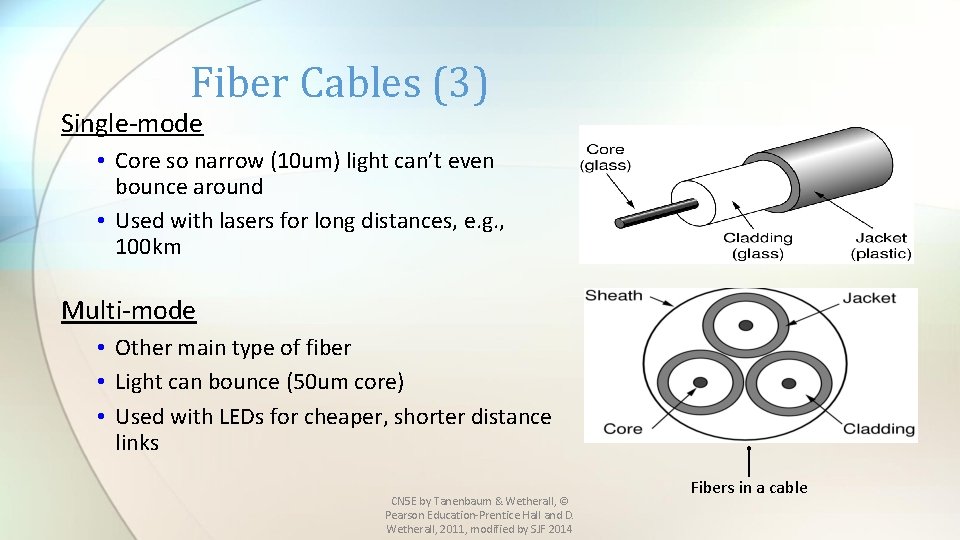
Fiber Cables (3) Single-mode • Core so narrow (10 um) light can’t even bounce around • Used with lasers for long distances, e. g. , 100 km Multi-mode • Other main type of fiber • Light can bounce (50 um core) • Used with LEDs for cheaper, shorter distance links CN 5 E by Tanenbaum & Wetherall, © Pearson Education-Prentice Hall and D. Wetherall, 2011, modified by SJF 2014 Fibers in a cable
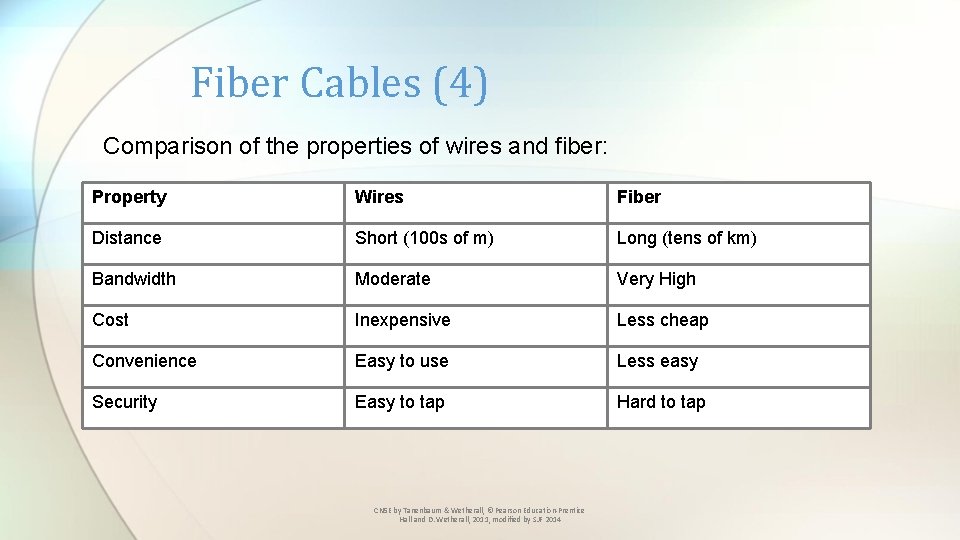
Fiber Cables (4) Comparison of the properties of wires and fiber: Property Wires Fiber Distance Short (100 s of m) Long (tens of km) Bandwidth Moderate Very High Cost Inexpensive Less cheap Convenience Easy to use Less easy Security Easy to tap Hard to tap CN 5 E by Tanenbaum & Wetherall, © Pearson Education-Prentice Hall and D. Wetherall, 2011, modified by SJF 2014
Wireless Transmission • • • Electromagnetic Spectrum » Radio Transmission » Microwave Transmission » Light Transmission » Wireless vs. Wires/Fiber » CN 5 E by Tanenbaum & Wetherall, © Pearson Education-Prentice Hall and D. Wetherall, 2011, modified by SJF 2014
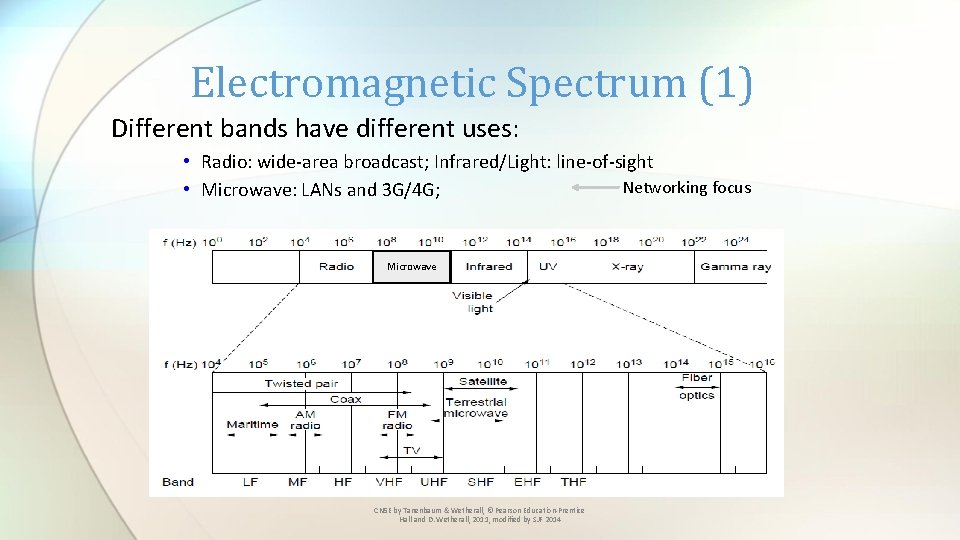
Electromagnetic Spectrum (1) Different bands have different uses: • Radio: wide-area broadcast; Infrared/Light: line-of-sight Networking focus • Microwave: LANs and 3 G/4 G; Microwave CN 5 E by Tanenbaum & Wetherall, © Pearson Education-Prentice Hall and D. Wetherall, 2011, modified by SJF 2014
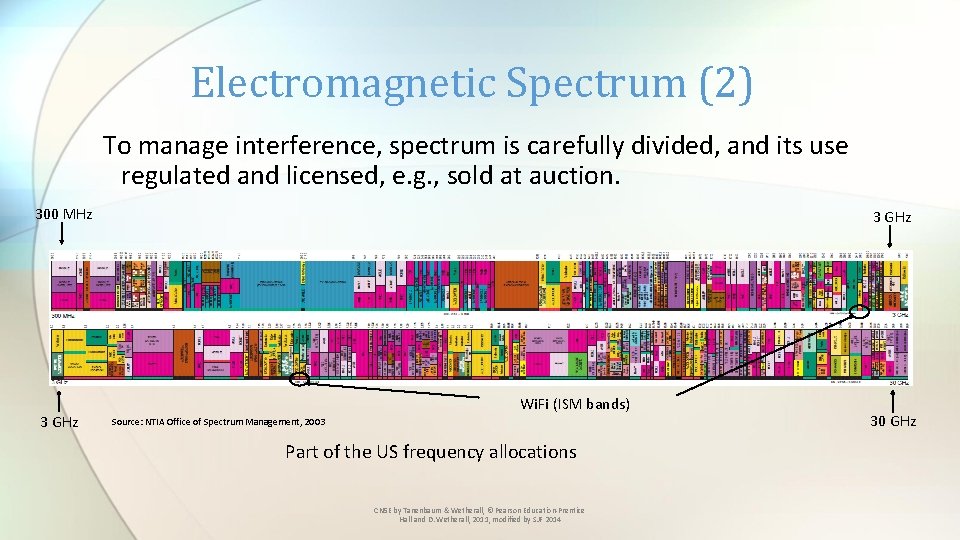
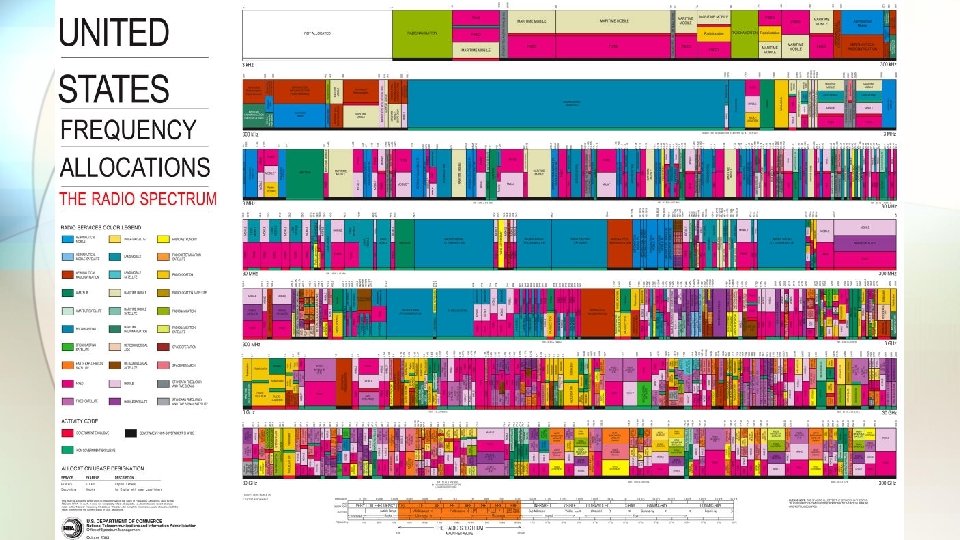
Electromagnetic Spectrum (2) To manage interference, spectrum is carefully divided, and its use regulated and licensed, e. g. , sold at auction. 300 MHz 3 GHz Wi. Fi (ISM bands) Source: NTIA Office of Spectrum Management, 2003 Part of the US frequency allocations CN 5 E by Tanenbaum & Wetherall, © Pearson Education-Prentice Hall and D. Wetherall, 2011, modified by SJF 2014 30 GHz
CN 5 E by Tanenbaum & Wetherall, © Pearson Education-Prentice Hall and D. Wetherall, 2011, modified by SJF 2014 28
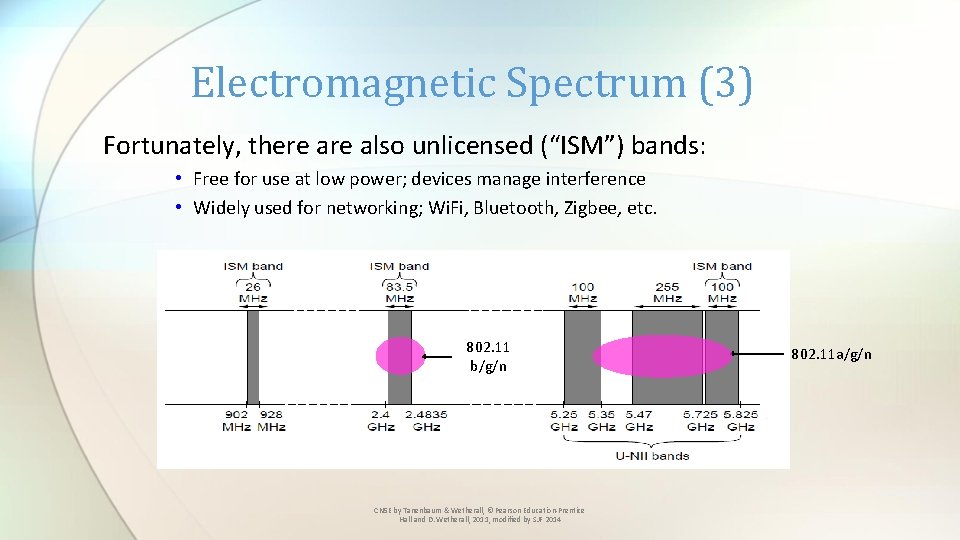
Electromagnetic Spectrum (3) Fortunately, there also unlicensed (“ISM”) bands: • Free for use at low power; devices manage interference • Widely used for networking; Wi. Fi, Bluetooth, Zigbee, etc. 802. 11 b/g/n CN 5 E by Tanenbaum & Wetherall, © Pearson Education-Prentice Hall and D. Wetherall, 2011, modified by SJF 2014 802. 11 a/g/n
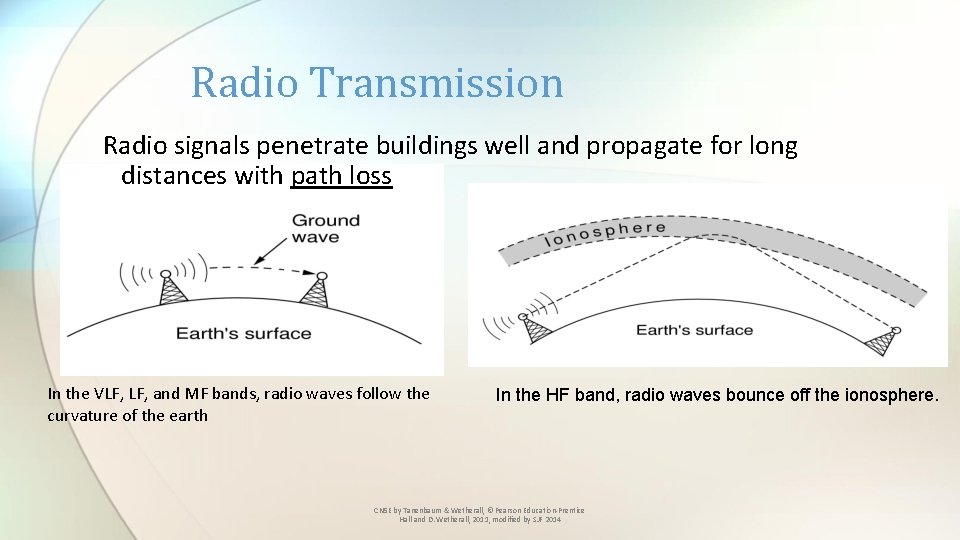
Radio Transmission Radio signals penetrate buildings well and propagate for long distances with path loss In the VLF, and MF bands, radio waves follow the curvature of the earth In the HF band, radio waves bounce off the ionosphere. CN 5 E by Tanenbaum & Wetherall, © Pearson Education-Prentice Hall and D. Wetherall, 2011, modified by SJF 2014
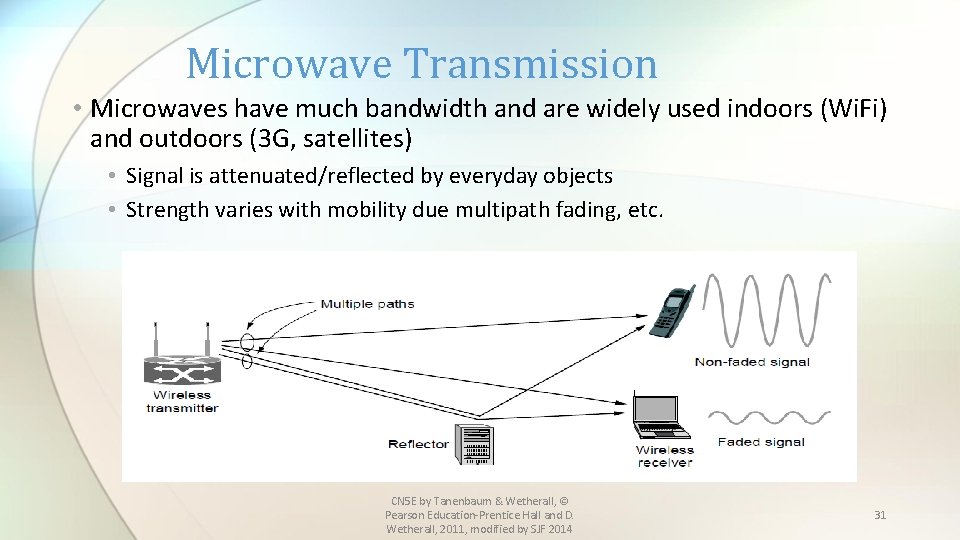
Microwave Transmission • Microwaves have much bandwidth and are widely used indoors (Wi. Fi) and outdoors (3 G, satellites) • Signal is attenuated/reflected by everyday objects • Strength varies with mobility due multipath fading, etc. CN 5 E by Tanenbaum & Wetherall, © Pearson Education-Prentice Hall and D. Wetherall, 2011, modified by SJF 2014 31
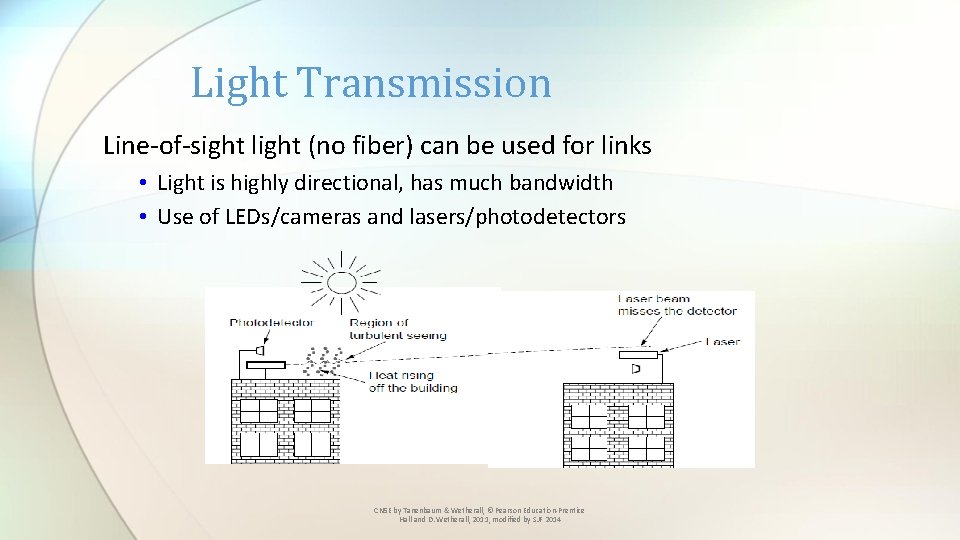
Light Transmission Line-of-sight light (no fiber) can be used for links • Light is highly directional, has much bandwidth • Use of LEDs/cameras and lasers/photodetectors CN 5 E by Tanenbaum & Wetherall, © Pearson Education-Prentice Hall and D. Wetherall, 2011, modified by SJF 2014
Wireless vs. Wires/Fiber Wireless: + Easy and inexpensive to deploy + Naturally supports mobility + Naturally supports broadcast • Transmissions interfere and must be managed • Signal strengths hence data rates vary greatly Wires/Fiber: + Easy to engineer a fixed data rate over point-to-point links • Can be expensive to deploy, esp. over distances • Doesn’t readily support mobility or broadcast CN 5 E by Tanenbaum & Wetherall, © Pearson Education-Prentice Hall and D. Wetherall, 2011, modified by SJF 2014
Communication Satellites are effective for broadcast distribution and anywhere/anytime communications • Kinds of Satellites » • Geostationary (GEO) Satellites » • Low-Earth Orbit (LEO) Satellites » • Satellites vs. Fiber » CN 5 E by Tanenbaum & Wetherall, © Pearson Education-Prentice Hall and D. Wetherall, 2011, modified by SJF 2014
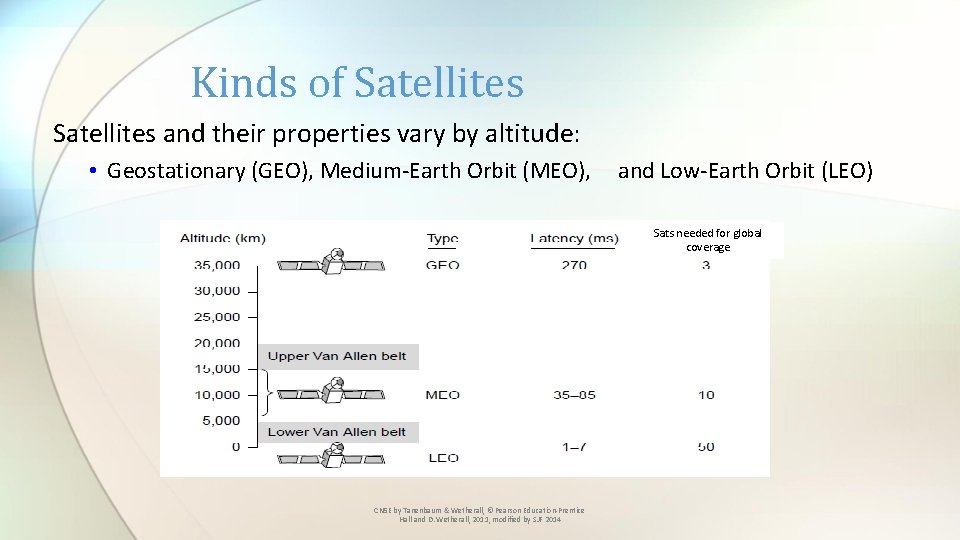
Kinds of Satellites and their properties vary by altitude: • Geostationary (GEO), Medium-Earth Orbit (MEO), and Low-Earth Orbit (LEO) Sats needed for global coverage CN 5 E by Tanenbaum & Wetherall, © Pearson Education-Prentice Hall and D. Wetherall, 2011, modified by SJF 2014
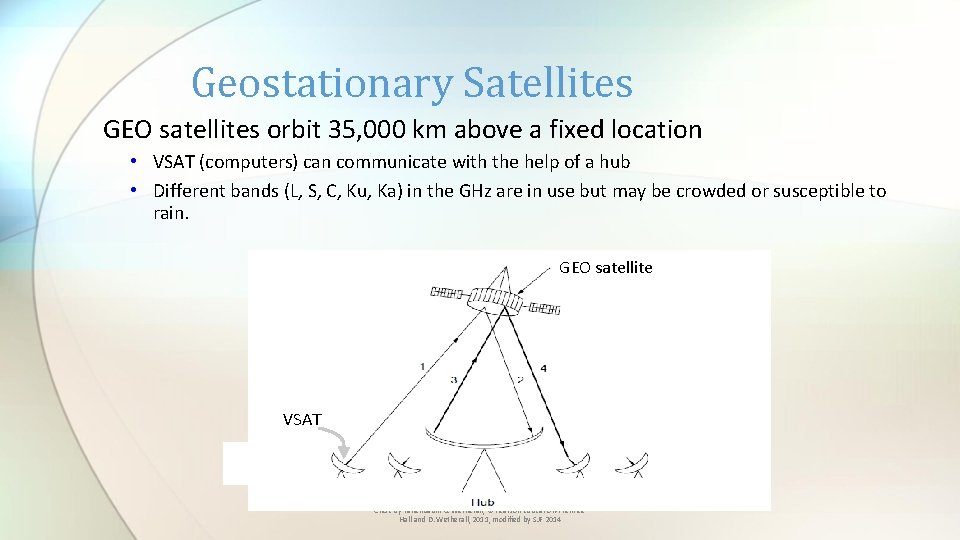
Geostationary Satellites GEO satellites orbit 35, 000 km above a fixed location • VSAT (computers) can communicate with the help of a hub • Different bands (L, S, C, Ku, Ka) in the GHz are in use but may be crowded or susceptible to rain. GEO satellite VSAT CN 5 E by Tanenbaum & Wetherall, © Pearson Education-Prentice Hall and D. Wetherall, 2011, modified by SJF 2014
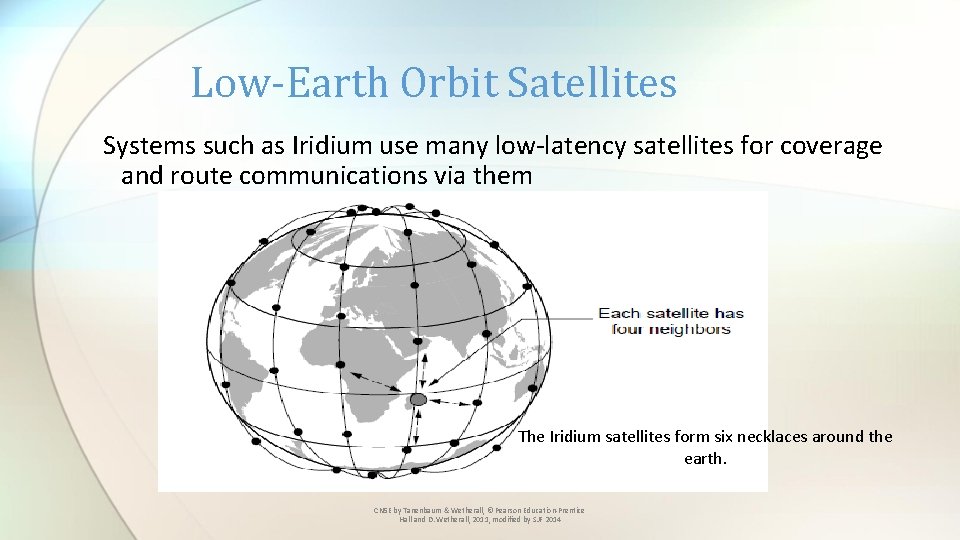
Low-Earth Orbit Satellites Systems such as Iridium use many low-latency satellites for coverage and route communications via them The Iridium satellites form six necklaces around the earth. CN 5 E by Tanenbaum & Wetherall, © Pearson Education-Prentice Hall and D. Wetherall, 2011, modified by SJF 2014
Satellite vs. Fiber Satellite: +Can rapidly set up anywhere/anytime communications (after satellites have been launched) +Can broadcast to large regions • Limited bandwidth and interference to manage Fiber: +Enormous bandwidth over long distances • Installation can be more expensive/difficult CN 5 E by Tanenbaum & Wetherall, © Pearson Education-Prentice Hall and D. Wetherall, 2011, modified by SJF 2014
Digital Modulation and Multiplexing Modulation schemes send bits as signals; multiplexing schemes share a channel among users. • Baseband Transmission » • Passband Transmission » • Frequency Division Multiplexing » • Time Division Multiplexing » • Code Division Multiple Access » CN 5 E by Tanenbaum & Wetherall, © Pearson Education-Prentice Hall and D. Wetherall, 2011, modified by SJF 2014
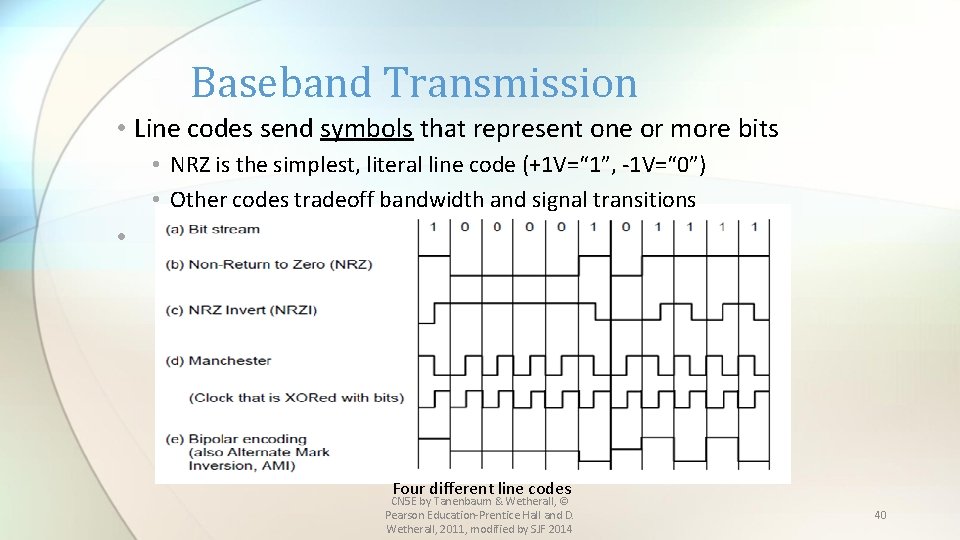
Baseband Transmission • Line codes send symbols that represent one or more bits • NRZ is the simplest, literal line code (+1 V=“ 1”, -1 V=“ 0”) • Other codes tradeoff bandwidth and signal transitions • Four different line codes CN 5 E by Tanenbaum & Wetherall, © Pearson Education-Prentice Hall and D. Wetherall, 2011, modified by SJF 2014 40
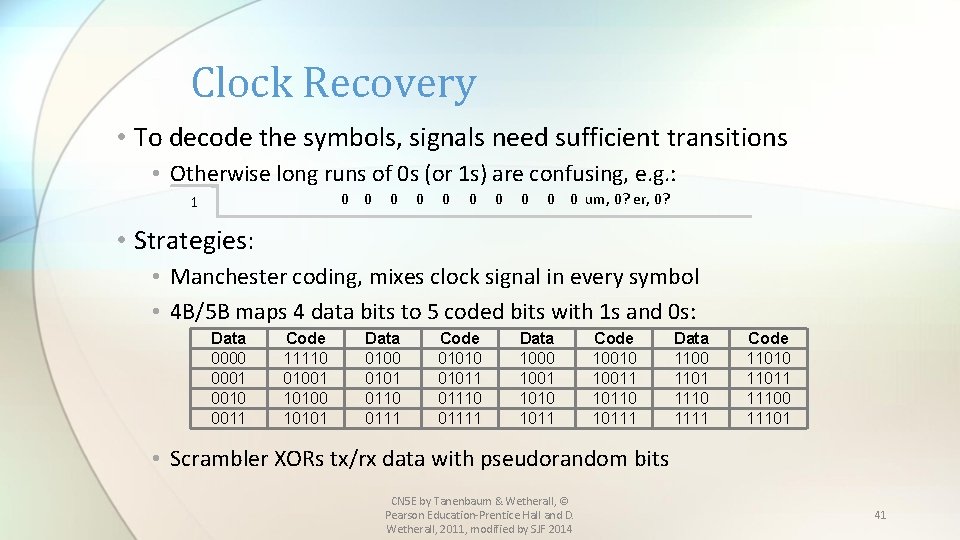
Clock Recovery • To decode the symbols, signals need sufficient transitions • Otherwise long runs of 0 s (or 1 s) are confusing, e. g. : 0 0 1 0 0 0 0 um, 0? er, 0? • Strategies: • Manchester coding, mixes clock signal in every symbol • 4 B/5 B maps 4 data bits to 5 coded bits with 1 s and 0 s: Data 0000 0001 0010 0011 Code 11110 01001 10100 10101 Data 0100 0101 0110 0111 Code 01010 01011 01110 01111 Data 1000 1001 1010 1011 Code 10010 10011 10110 10111 Data 1100 1101 1110 1111 Code 11010 11011 11100 11101 • Scrambler XORs tx/rx data with pseudorandom bits CN 5 E by Tanenbaum & Wetherall, © Pearson Education-Prentice Hall and D. Wetherall, 2011, modified by SJF 2014 41
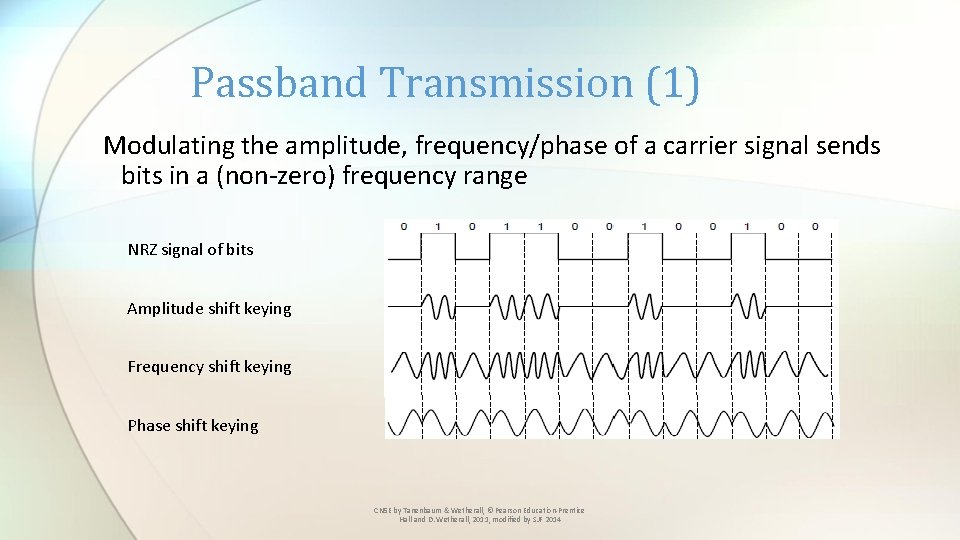
Passband Transmission (1) Modulating the amplitude, frequency/phase of a carrier signal sends bits in a (non-zero) frequency range NRZ signal of bits Amplitude shift keying Frequency shift keying Phase shift keying CN 5 E by Tanenbaum & Wetherall, © Pearson Education-Prentice Hall and D. Wetherall, 2011, modified by SJF 2014
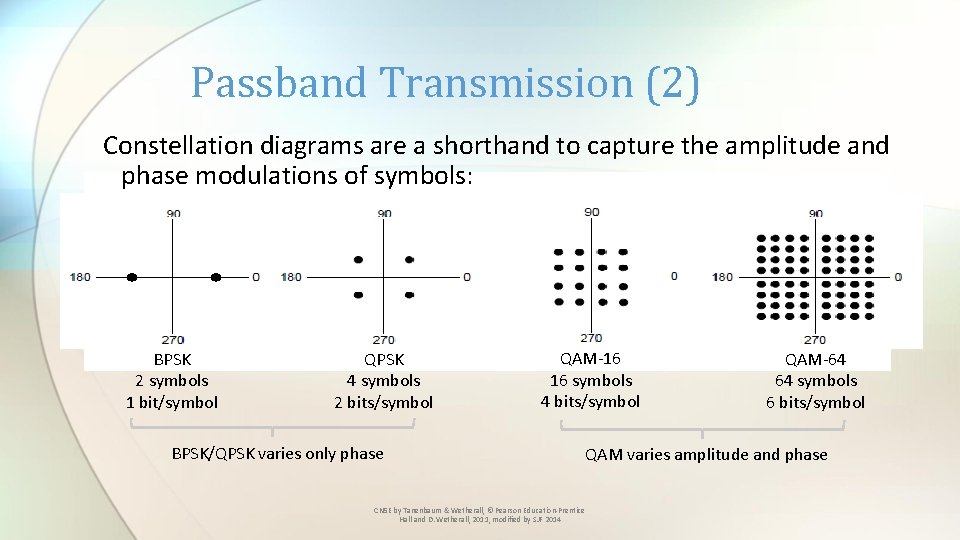
Passband Transmission (2) Constellation diagrams are a shorthand to capture the amplitude and phase modulations of symbols: BPSK 2 symbols 1 bit/symbol QPSK 4 symbols 2 bits/symbol BPSK/QPSK varies only phase QAM-16 16 symbols 4 bits/symbol QAM-64 64 symbols 6 bits/symbol QAM varies amplitude and phase CN 5 E by Tanenbaum & Wetherall, © Pearson Education-Prentice Hall and D. Wetherall, 2011, modified by SJF 2014
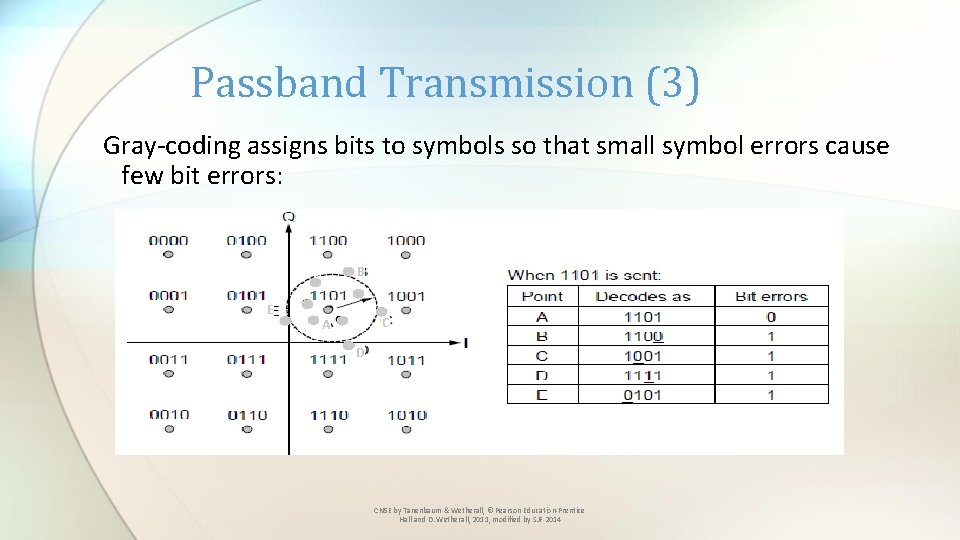
Passband Transmission (3) Gray-coding assigns bits to symbols so that small symbol errors cause few bit errors: B E C A D CN 5 E by Tanenbaum & Wetherall, © Pearson Education-Prentice Hall and D. Wetherall, 2011, modified by SJF 2014
The Basic Types of Multiplexing • There are four basic approaches to multiplexing that each have a set of variations and implementations • • Frequency Division Multiplexing (FDM) Wavelength Division Multiplexing (WDM) Time Division Multiplexing (TDM) Code Division Multiplexing (CDM) • TDM and FDM are widely used • WDM is a form of FDM used for optical fiber • CDM is a mathematical approach used in cell phone mechanisms © 2009 Pearson Education Inc. , Upper Saddle River, NJ. All rights reserved. 45
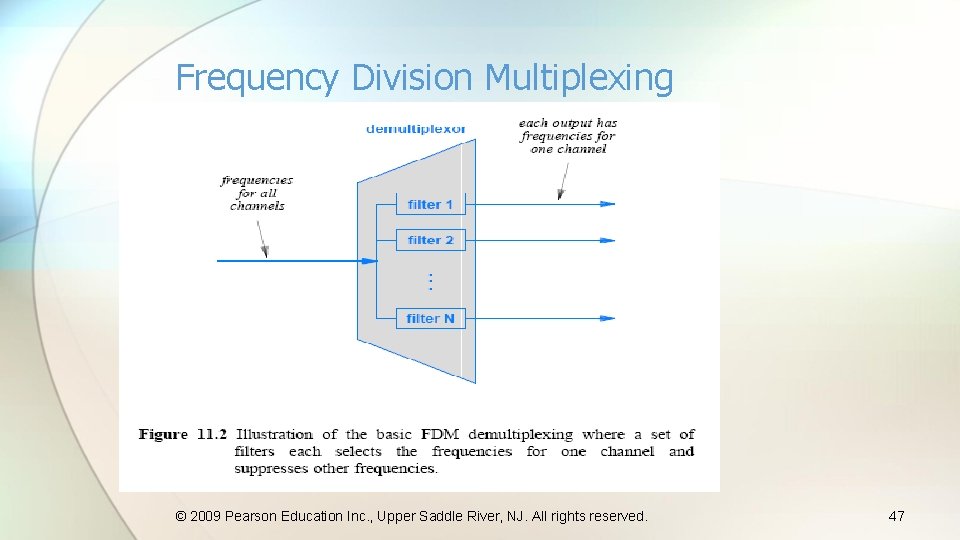
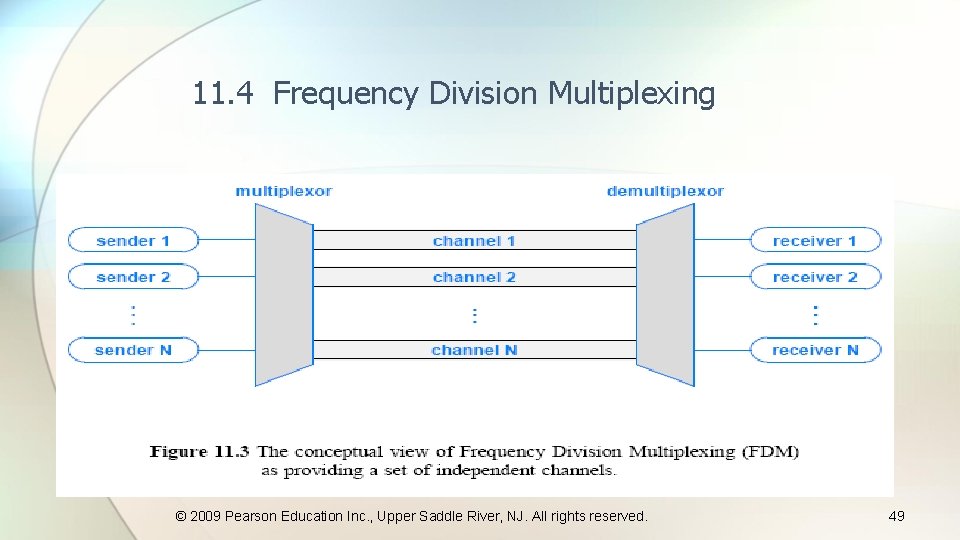
Frequency Division Multiplexing • A set of radio stations can transmit electromagnetic signals simultaneously • without interference provided, they each use a separate channel (i. e. , carrier frequency) • It is possible to send simultaneously multiple carrier waves over a single copper wire • A demultiplexor applies a set of filters that each extract a small range of frequencies near one of the carrier frequencies © 2009 Pearson Education Inc. , Upper Saddle River, NJ. All rights reserved. 46
Frequency Division Multiplexing © 2009 Pearson Education Inc. , Upper Saddle River, NJ. All rights reserved. 47
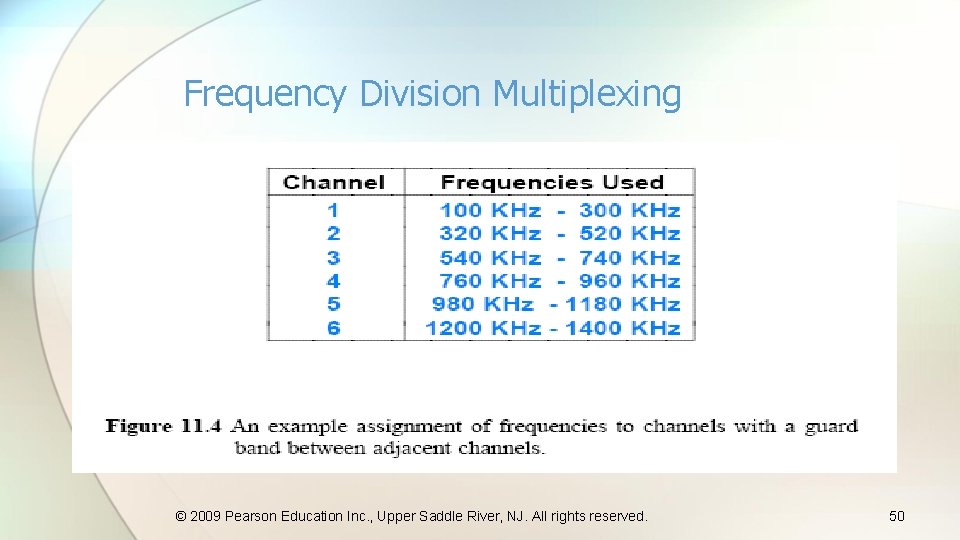
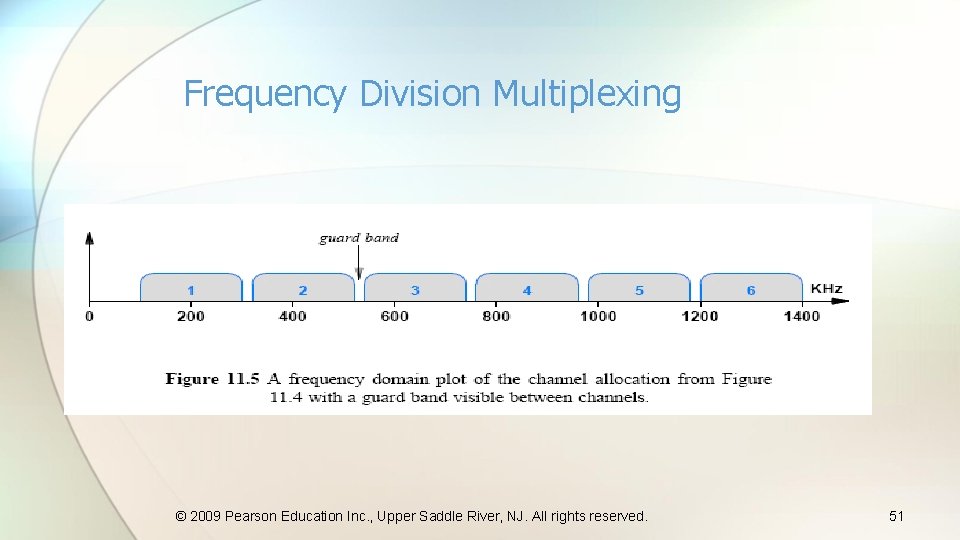
Frequency Division Multiplexing • Practical FDM systems - there are some limitations • If the frequencies of two channels are too close, interference can occur • Furthermore, demultiplexing hardware that receives a combined signal must be able to divide the signal into separate carriers • FCC in USA regulates stations to insure adequate spacing occurs between the carriers • Designers choosing a set of carrier frequencies with a gap between them known as a guard band • Figures 11. 4 and 11. 5 show an example • that allocates 200 KHz to each of 6 channels with a guard band of 20 KHz between each © 2009 Pearson Education Inc. , Upper Saddle River, NJ. All rights reserved. 48
11. 4 Frequency Division Multiplexing © 2009 Pearson Education Inc. , Upper Saddle River, NJ. All rights reserved. 49
Frequency Division Multiplexing © 2009 Pearson Education Inc. , Upper Saddle River, NJ. All rights reserved. 50
Frequency Division Multiplexing © 2009 Pearson Education Inc. , Upper Saddle River, NJ. All rights reserved. 51
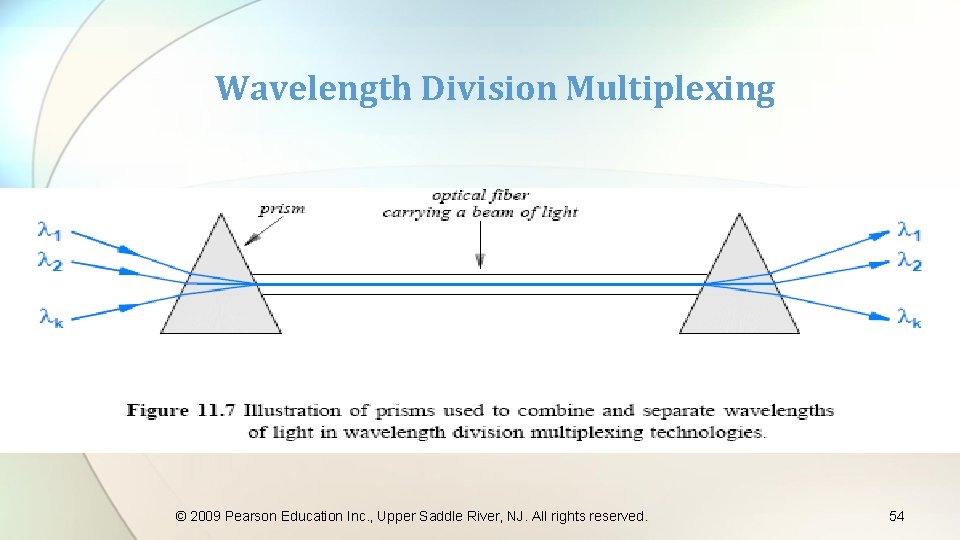
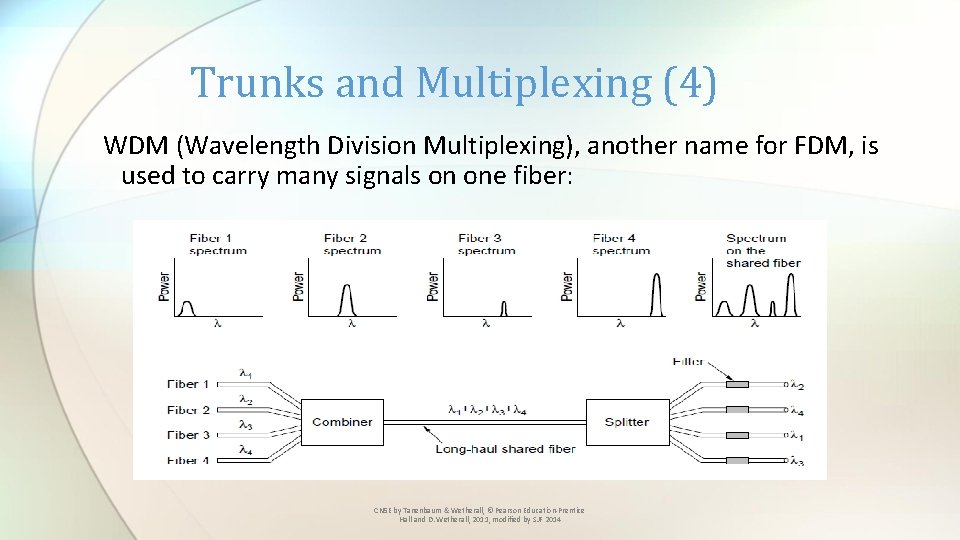
Wavelength Division Multiplexing (WDM) • WDM refers to the application of FDM to optical fiber • some sources use the term Dense WDM (DWDM) to emphasize that many wavelengths of light can be employed • The inputs and outputs of such multiplexing are wavelengths of light • denoted by the Greek letter λ, and informally called colors © 2009 Pearson Education Inc. , Upper Saddle River, NJ. All rights reserved. 52
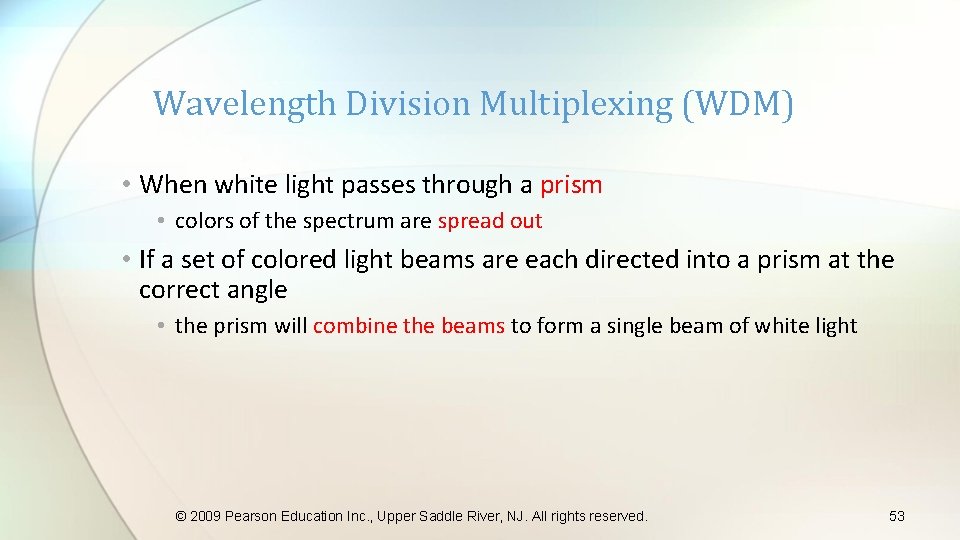
Wavelength Division Multiplexing (WDM) • When white light passes through a prism • colors of the spectrum are spread out • If a set of colored light beams are each directed into a prism at the correct angle • the prism will combine the beams to form a single beam of white light © 2009 Pearson Education Inc. , Upper Saddle River, NJ. All rights reserved. 53
Wavelength Division Multiplexing © 2009 Pearson Education Inc. , Upper Saddle River, NJ. All rights reserved. 54
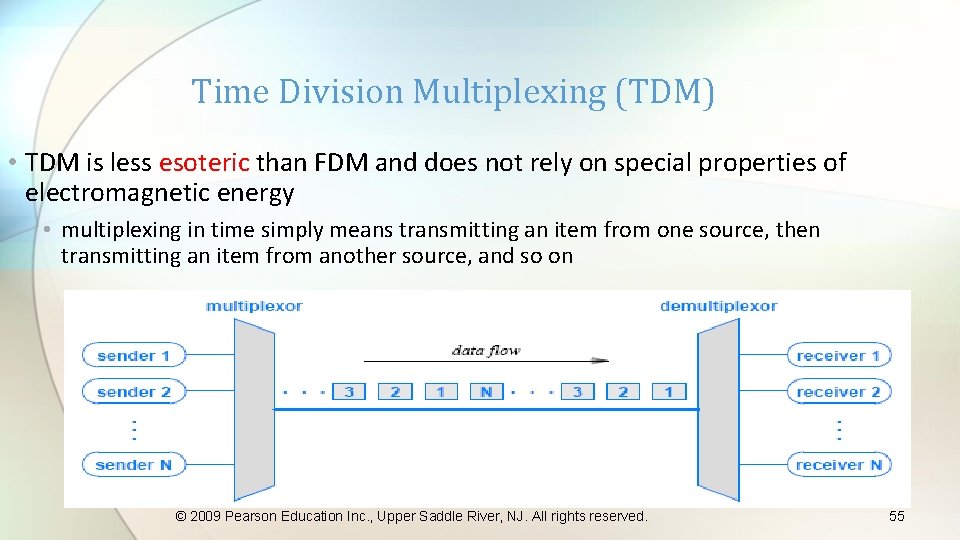
Time Division Multiplexing (TDM) • TDM is less esoteric than FDM and does not rely on special properties of electromagnetic energy • multiplexing in time simply means transmitting an item from one source, then transmitting an item from another source, and so on © 2009 Pearson Education Inc. , Upper Saddle River, NJ. All rights reserved. 55
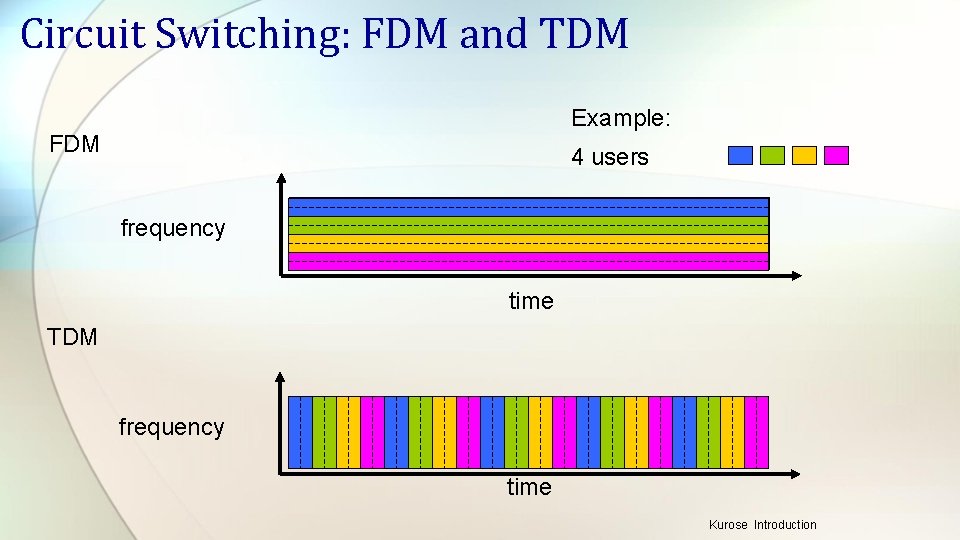
Circuit Switching: FDM and TDM Example: FDM 4 users frequency time TDM frequency time Kurose Introduction
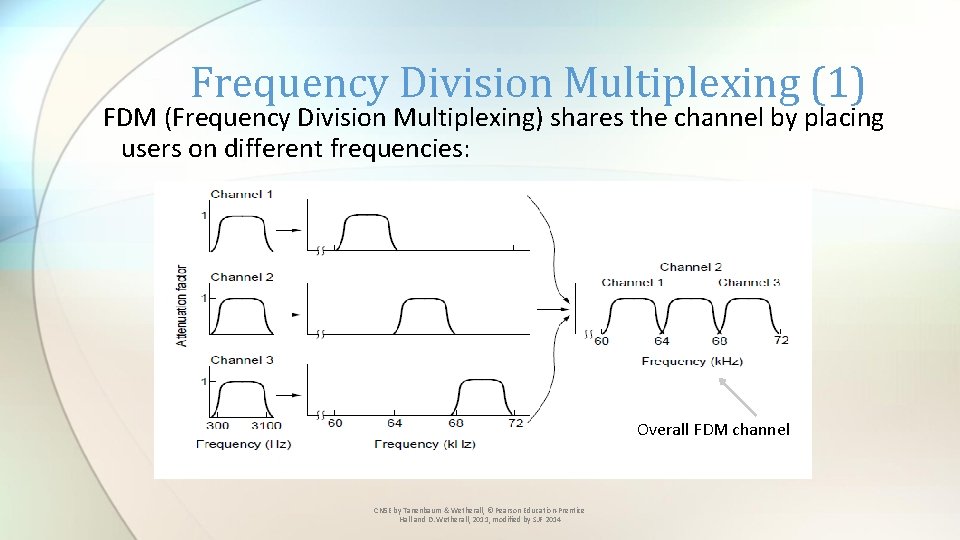
Frequency Division Multiplexing (1) FDM (Frequency Division Multiplexing) shares the channel by placing users on different frequencies: Overall FDM channel CN 5 E by Tanenbaum & Wetherall, © Pearson Education-Prentice Hall and D. Wetherall, 2011, modified by SJF 2014
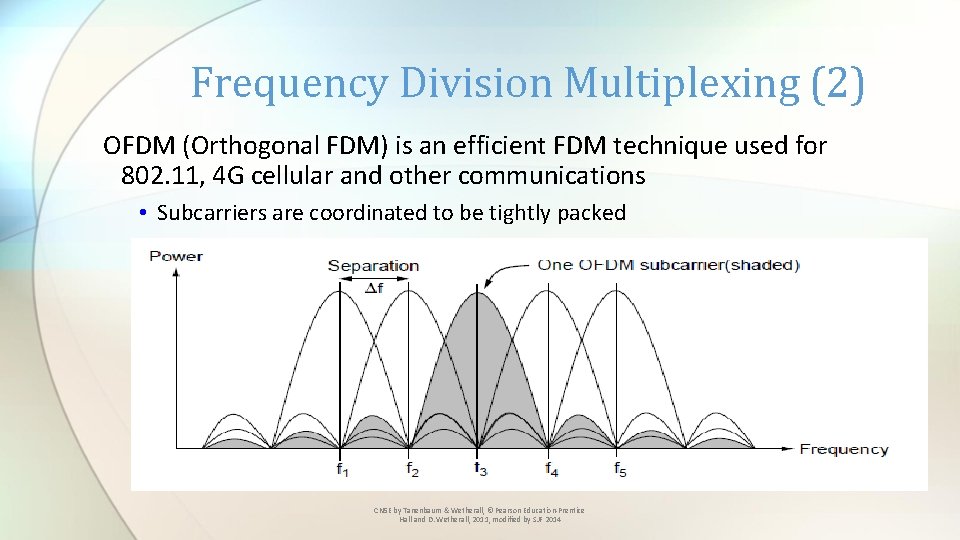
Frequency Division Multiplexing (2) OFDM (Orthogonal FDM) is an efficient FDM technique used for 802. 11, 4 G cellular and other communications • Subcarriers are coordinated to be tightly packed CN 5 E by Tanenbaum & Wetherall, © Pearson Education-Prentice Hall and D. Wetherall, 2011, modified by SJF 2014
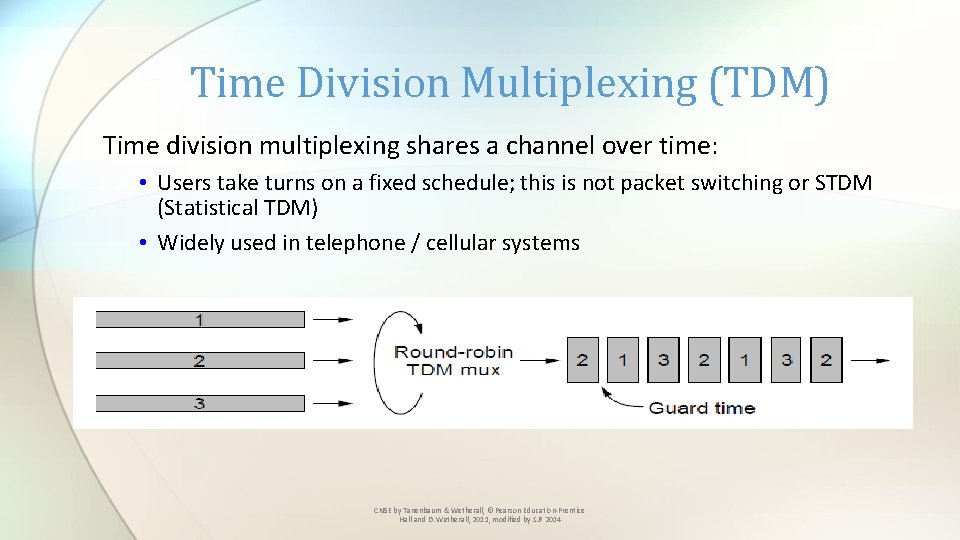
Time Division Multiplexing (TDM) Time division multiplexing shares a channel over time: • Users take turns on a fixed schedule; this is not packet switching or STDM (Statistical TDM) • Widely used in telephone / cellular systems CN 5 E by Tanenbaum & Wetherall, © Pearson Education-Prentice Hall and D. Wetherall, 2011, modified by SJF 2014
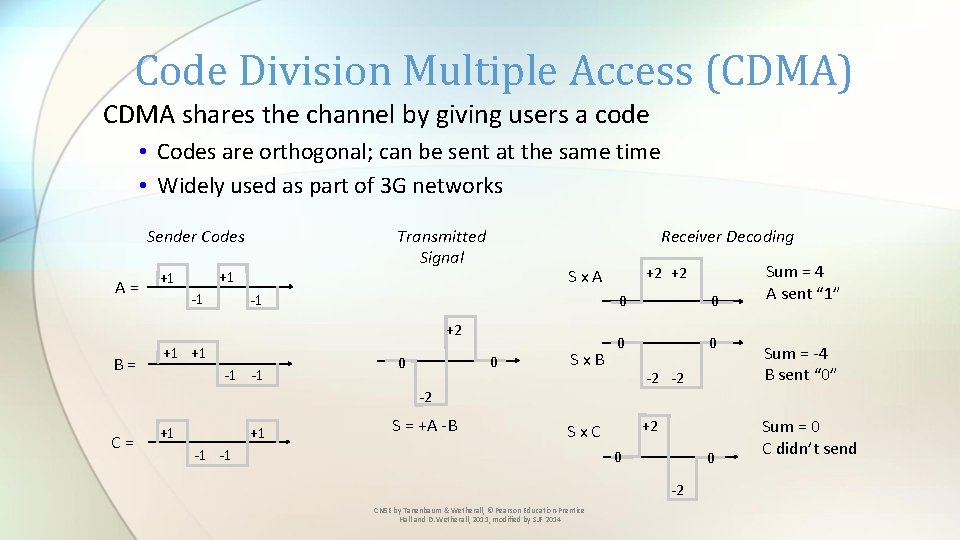
Code Division Multiple Access (CDMA) CDMA shares the channel by giving users a code • Codes are orthogonal; can be sent at the same time • Widely used as part of 3 G networks A= +1 +1 -1 Receiver Decoding Transmitted Signal Sender Codes -1 +2 B= +1 +1 -1 -1 0 0 +2 +2 Sx. A Sx. B 0 0 -2 -2 -2 C= +1 +1 S = +A -B +2 Sx. C -1 -1 0 0 -2 CN 5 E by Tanenbaum & Wetherall, © Pearson Education-Prentice Hall and D. Wetherall, 2011, modified by SJF 2014 Sum = 4 A sent “ 1” Sum = -4 B sent “ 0” Sum = 0 C didn’t send
The Public Switched Telephone Network • Structure of the telephone system » • Politics of telephones » • Local loop: modems, ADSL, and FTTH » • Trunks and multiplexing » • Switching » CN 5 E by Tanenbaum & Wetherall, © Pearson Education-Prentice Hall and D. Wetherall, 2011, modified by SJF 2014
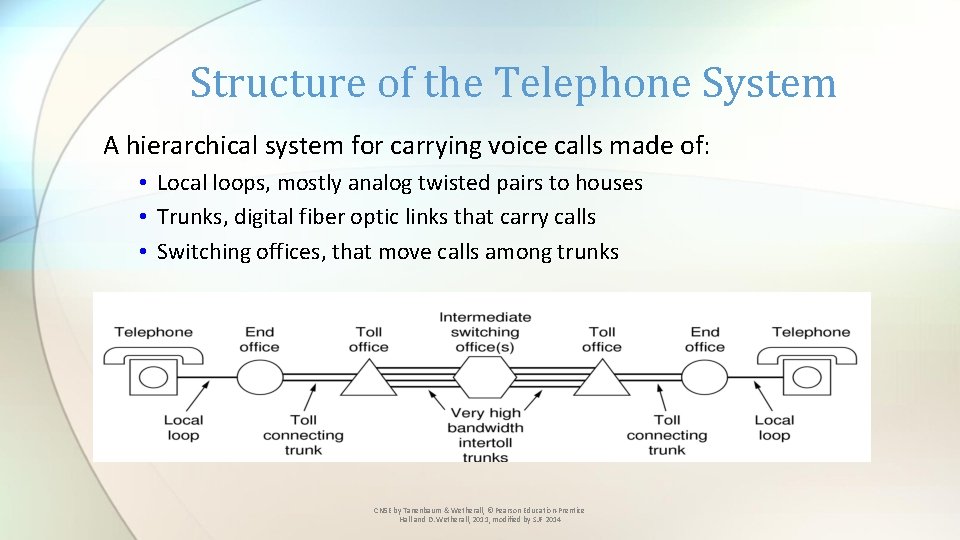
Structure of the Telephone System A hierarchical system for carrying voice calls made of: • Local loops, mostly analog twisted pairs to houses • Trunks, digital fiber optic links that carry calls • Switching offices, that move calls among trunks CN 5 E by Tanenbaum & Wetherall, © Pearson Education-Prentice Hall and D. Wetherall, 2011, modified by SJF 2014
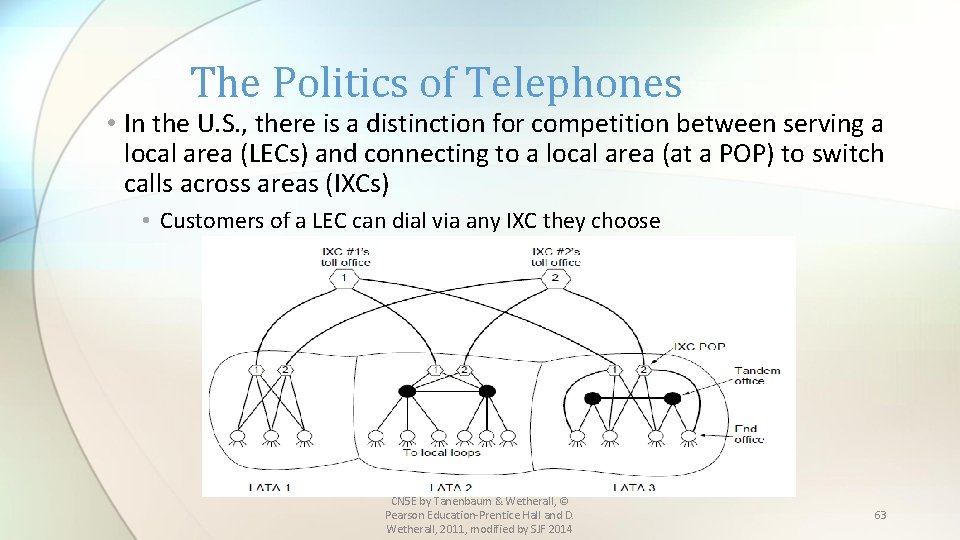
The Politics of Telephones • In the U. S. , there is a distinction for competition between serving a local area (LECs) and connecting to a local area (at a POP) to switch calls across areas (IXCs) • Customers of a LEC can dial via any IXC they choose CN 5 E by Tanenbaum & Wetherall, © Pearson Education-Prentice Hall and D. Wetherall, 2011, modified by SJF 2014 63
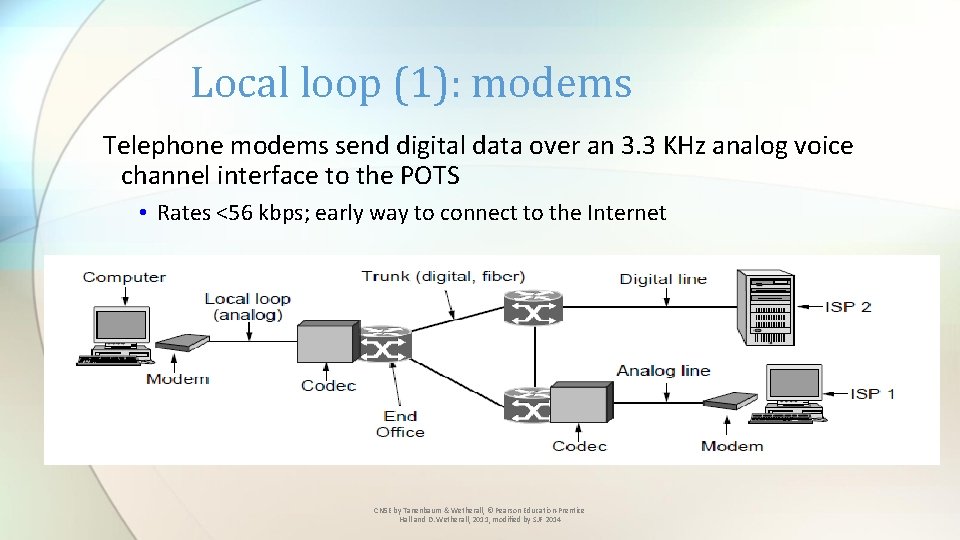
Local loop (1): modems Telephone modems send digital data over an 3. 3 KHz analog voice channel interface to the POTS • Rates <56 kbps; early way to connect to the Internet CN 5 E by Tanenbaum & Wetherall, © Pearson Education-Prentice Hall and D. Wetherall, 2011, modified by SJF 2014
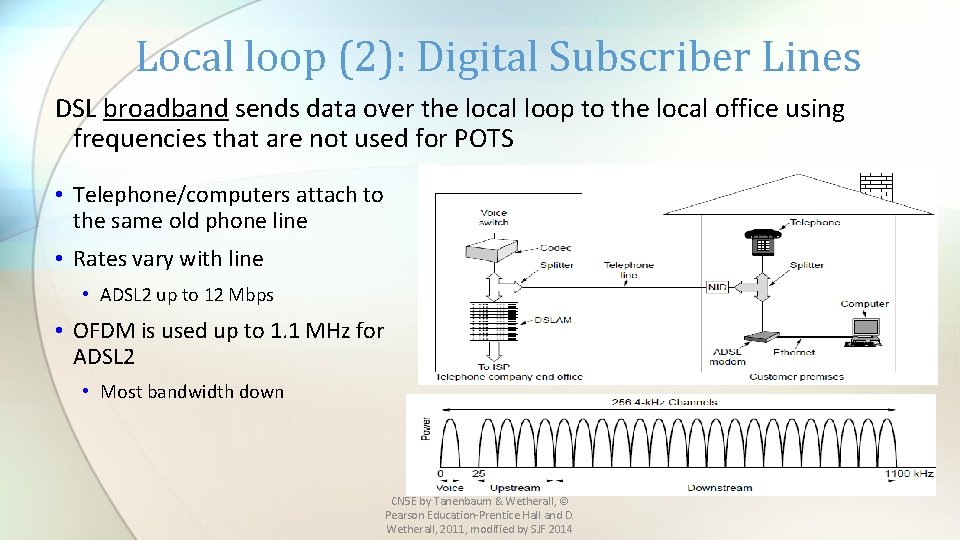
Local loop (2): Digital Subscriber Lines DSL broadband sends data over the local loop to the local office using frequencies that are not used for POTS • Telephone/computers attach to the same old phone line • Rates vary with line • ADSL 2 up to 12 Mbps • OFDM is used up to 1. 1 MHz for ADSL 2 • Most bandwidth down CN 5 E by Tanenbaum & Wetherall, © Pearson Education-Prentice Hall and D. Wetherall, 2011, modified by SJF 2014
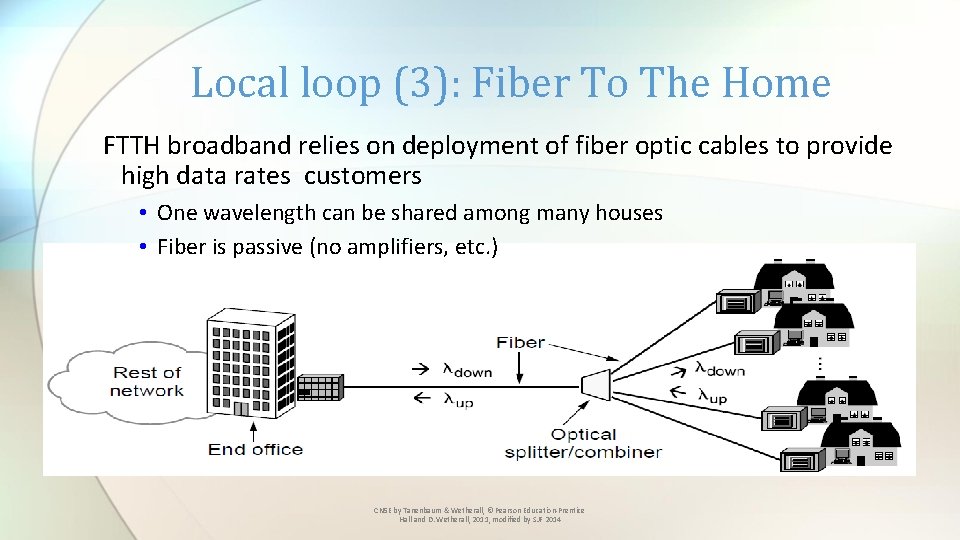
Local loop (3): Fiber To The Home FTTH broadband relies on deployment of fiber optic cables to provide high data rates customers • One wavelength can be shared among many houses • Fiber is passive (no amplifiers, etc. ) CN 5 E by Tanenbaum & Wetherall, © Pearson Education-Prentice Hall and D. Wetherall, 2011, modified by SJF 2014
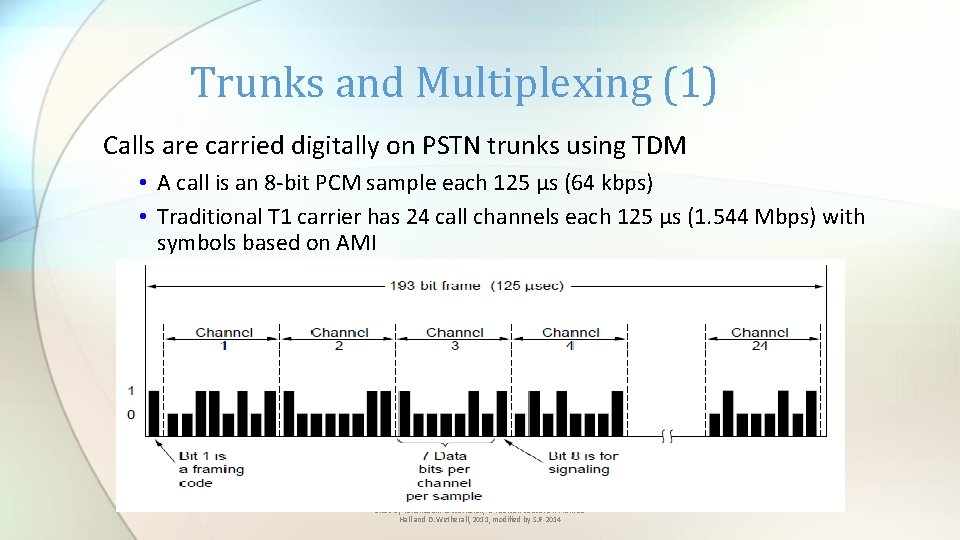
Trunks and Multiplexing (1) Calls are carried digitally on PSTN trunks using TDM • A call is an 8 -bit PCM sample each 125 μs (64 kbps) • Traditional T 1 carrier has 24 call channels each 125 μs (1. 544 Mbps) with symbols based on AMI CN 5 E by Tanenbaum & Wetherall, © Pearson Education-Prentice Hall and D. Wetherall, 2011, modified by SJF 2014
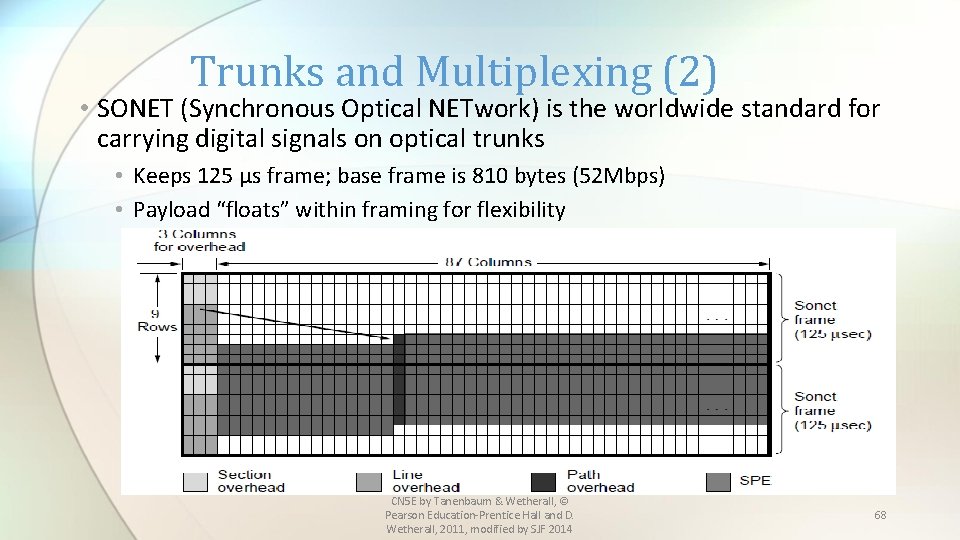
Trunks and Multiplexing (2) • SONET (Synchronous Optical NETwork) is the worldwide standard for carrying digital signals on optical trunks • Keeps 125 μs frame; base frame is 810 bytes (52 Mbps) • Payload “floats” within framing for flexibility CN 5 E by Tanenbaum & Wetherall, © Pearson Education-Prentice Hall and D. Wetherall, 2011, modified by SJF 2014 68
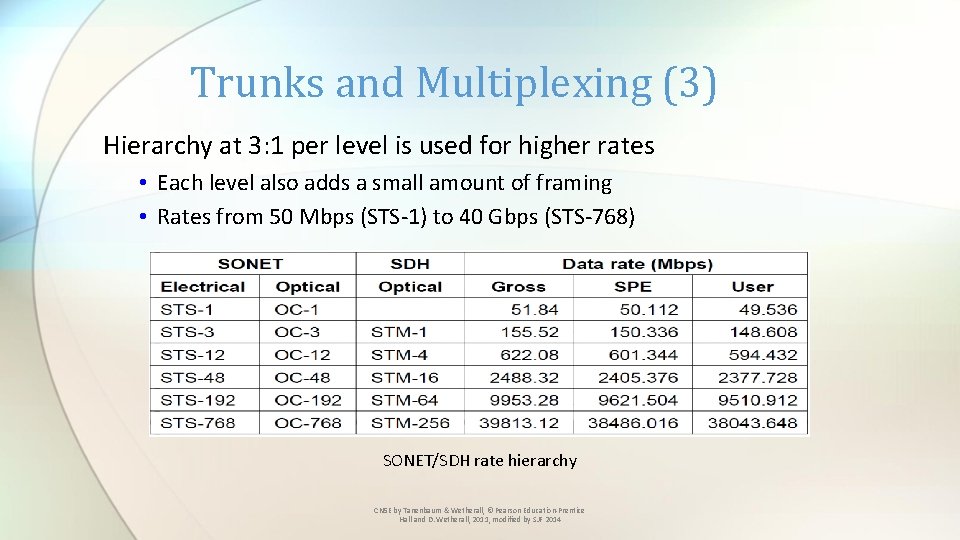
Trunks and Multiplexing (3) Hierarchy at 3: 1 per level is used for higher rates • Each level also adds a small amount of framing • Rates from 50 Mbps (STS-1) to 40 Gbps (STS-768) SONET/SDH rate hierarchy CN 5 E by Tanenbaum & Wetherall, © Pearson Education-Prentice Hall and D. Wetherall, 2011, modified by SJF 2014
Trunks and Multiplexing (4) WDM (Wavelength Division Multiplexing), another name for FDM, is used to carry many signals on one fiber: CN 5 E by Tanenbaum & Wetherall, © Pearson Education-Prentice Hall and D. Wetherall, 2011, modified by SJF 2014
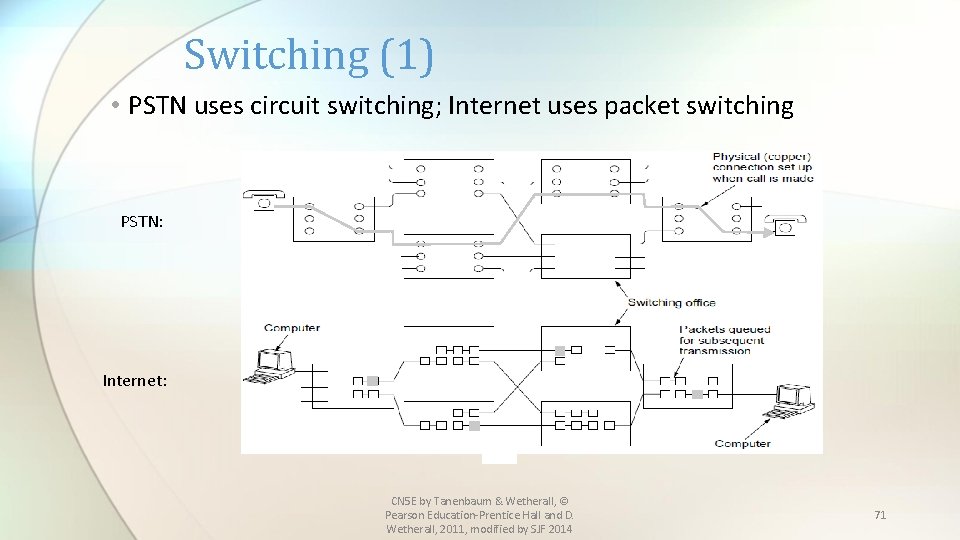
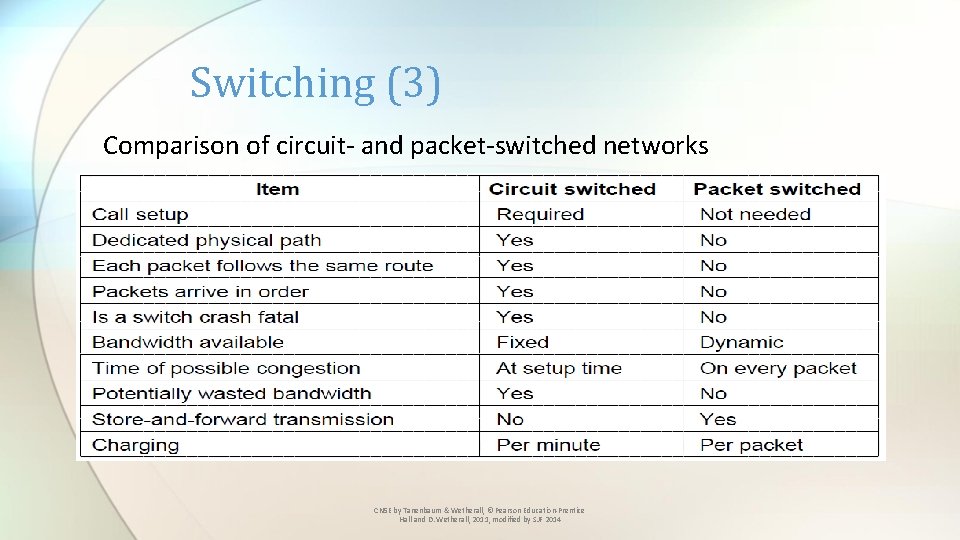
Switching (1) • PSTN uses circuit switching; Internet uses packet switching PSTN: Internet: CN 5 E by Tanenbaum & Wetherall, © Pearson Education-Prentice Hall and D. Wetherall, 2011, modified by SJF 2014 71
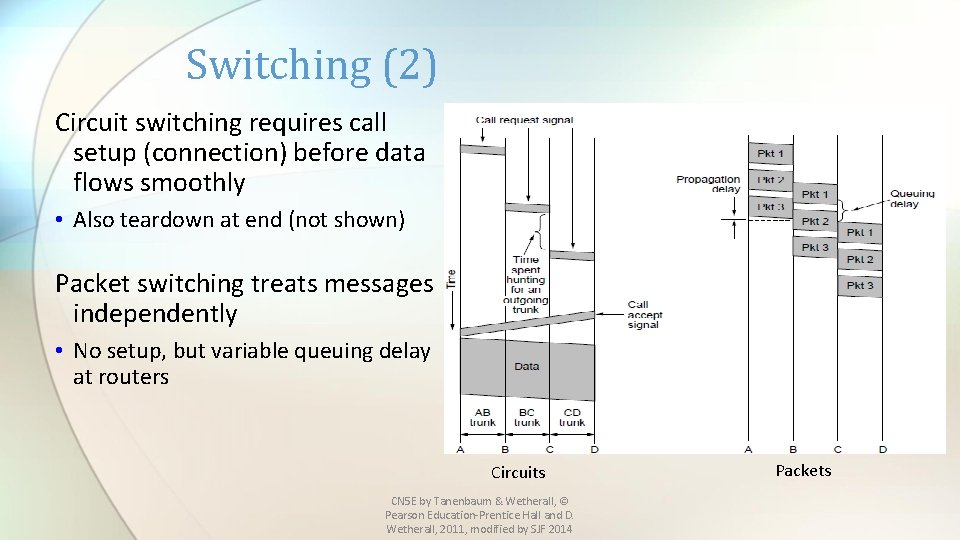
Switching (2) Circuit switching requires call setup (connection) before data flows smoothly • Also teardown at end (not shown) Packet switching treats messages independently • No setup, but variable queuing delay at routers Circuits CN 5 E by Tanenbaum & Wetherall, © Pearson Education-Prentice Hall and D. Wetherall, 2011, modified by SJF 2014 Packets
Switching (3) Comparison of circuit- and packet-switched networks CN 5 E by Tanenbaum & Wetherall, © Pearson Education-Prentice Hall and D. Wetherall, 2011, modified by SJF 2014
Mobile Telephone System • Generations of mobile telephone systems » • Cellular mobile telephone systems » • GSM, a 2 G system » • UMTS, a 3 G system » CN 5 E by Tanenbaum & Wetherall, © Pearson Education-Prentice Hall and D. Wetherall, 2011, modified by SJF 2014
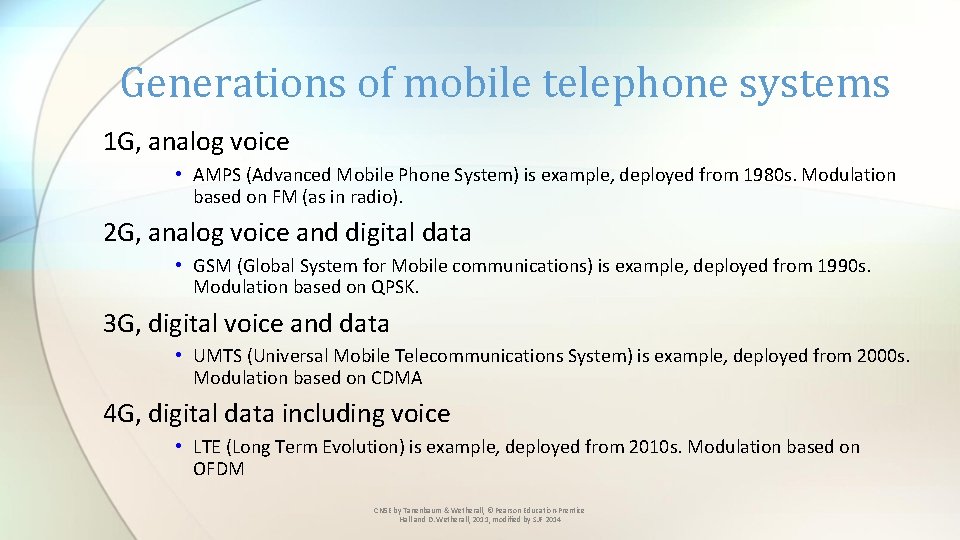
Generations of mobile telephone systems 1 G, analog voice • AMPS (Advanced Mobile Phone System) is example, deployed from 1980 s. Modulation based on FM (as in radio). 2 G, analog voice and digital data • GSM (Global System for Mobile communications) is example, deployed from 1990 s. Modulation based on QPSK. 3 G, digital voice and data • UMTS (Universal Mobile Telecommunications System) is example, deployed from 2000 s. Modulation based on CDMA 4 G, digital data including voice • LTE (Long Term Evolution) is example, deployed from 2010 s. Modulation based on OFDM CN 5 E by Tanenbaum & Wetherall, © Pearson Education-Prentice Hall and D. Wetherall, 2011, modified by SJF 2014
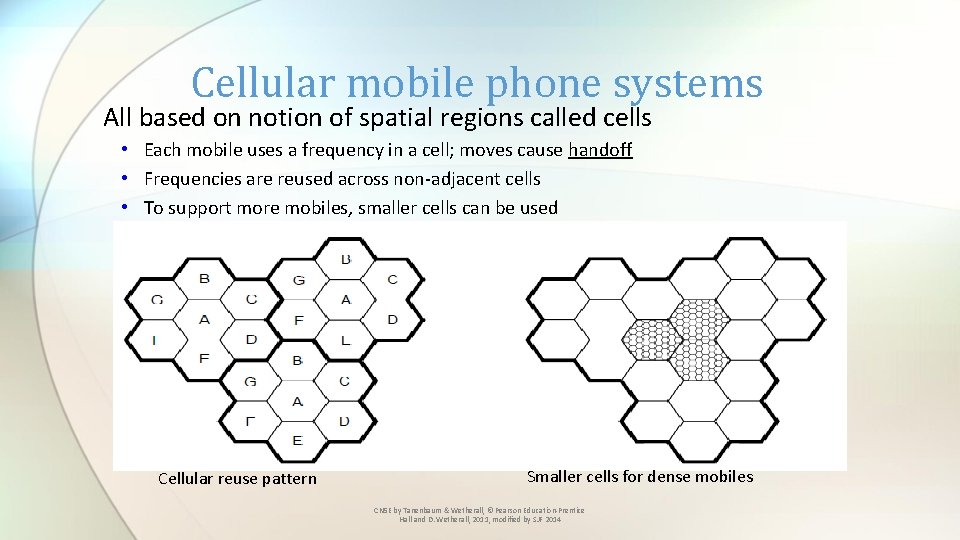
Cellular mobile phone systems All based on notion of spatial regions called cells • Each mobile uses a frequency in a cell; moves cause handoff • Frequencies are reused across non-adjacent cells • To support more mobiles, smaller cells can be used Cellular reuse pattern Smaller cells for dense mobiles CN 5 E by Tanenbaum & Wetherall, © Pearson Education-Prentice Hall and D. Wetherall, 2011, modified by SJF 2014
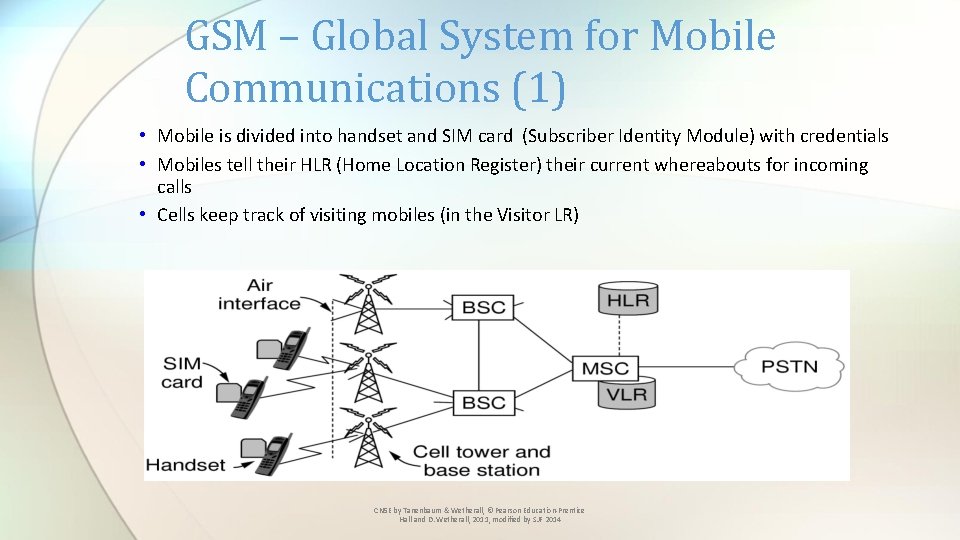
GSM – Global System for Mobile Communications (1) • Mobile is divided into handset and SIM card (Subscriber Identity Module) with credentials • Mobiles tell their HLR (Home Location Register) their current whereabouts for incoming calls • Cells keep track of visiting mobiles (in the Visitor LR) CN 5 E by Tanenbaum & Wetherall, © Pearson Education-Prentice Hall and D. Wetherall, 2011, modified by SJF 2014
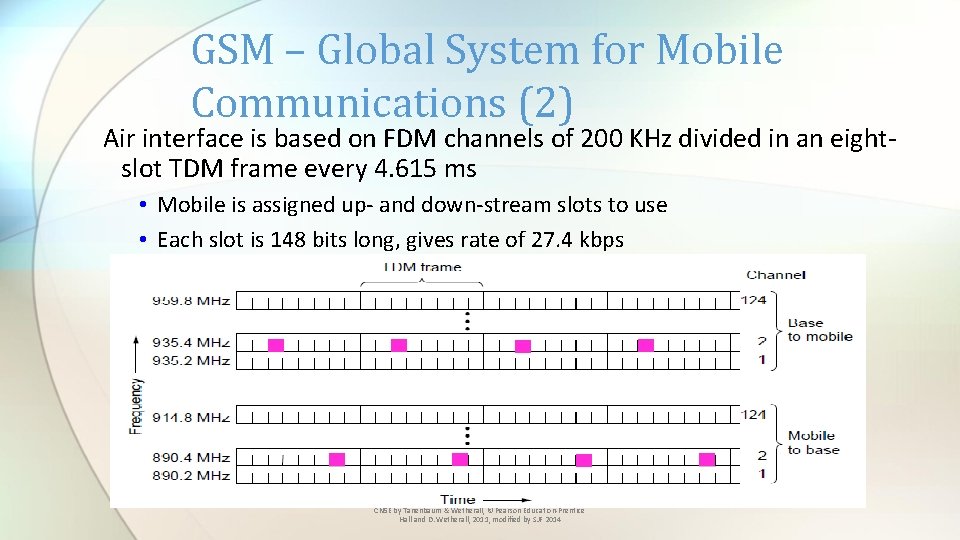
GSM – Global System for Mobile Communications (2) Air interface is based on FDM channels of 200 KHz divided in an eightslot TDM frame every 4. 615 ms • Mobile is assigned up- and down-stream slots to use • Each slot is 148 bits long, gives rate of 27. 4 kbps CN 5 E by Tanenbaum & Wetherall, © Pearson Education-Prentice Hall and D. Wetherall, 2011, modified by SJF 2014
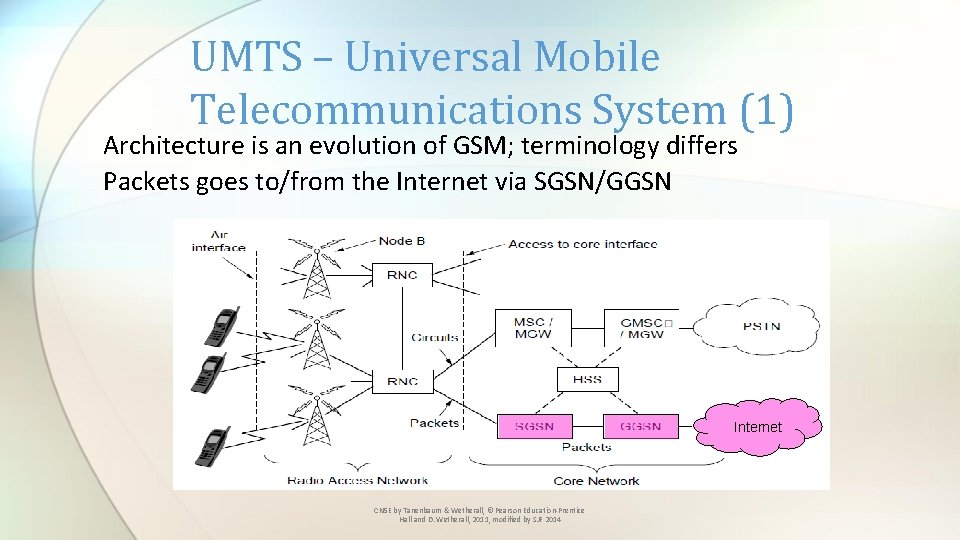
UMTS – Universal Mobile Telecommunications System (1) Architecture is an evolution of GSM; terminology differs Packets goes to/from the Internet via SGSN/GGSN Internet CN 5 E by Tanenbaum & Wetherall, © Pearson Education-Prentice Hall and D. Wetherall, 2011, modified by SJF 2014
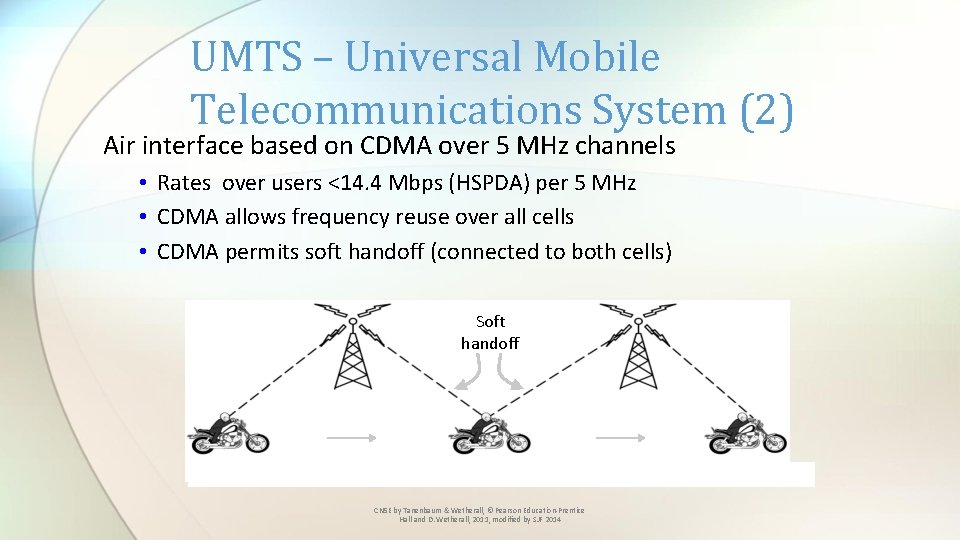
UMTS – Universal Mobile Telecommunications System (2) Air interface based on CDMA over 5 MHz channels • Rates over users <14. 4 Mbps (HSPDA) per 5 MHz • CDMA allows frequency reuse over all cells • CDMA permits soft handoff (connected to both cells) Soft handoff CN 5 E by Tanenbaum & Wetherall, © Pearson Education-Prentice Hall and D. Wetherall, 2011, modified by SJF 2014
Cable Television • Internet over cable » • Spectrum allocation » • Cable modems » • ADSL vs. cable » CN 5 E by Tanenbaum & Wetherall, © Pearson Education-Prentice Hall and D. Wetherall, 2011, modified by SJF 2014
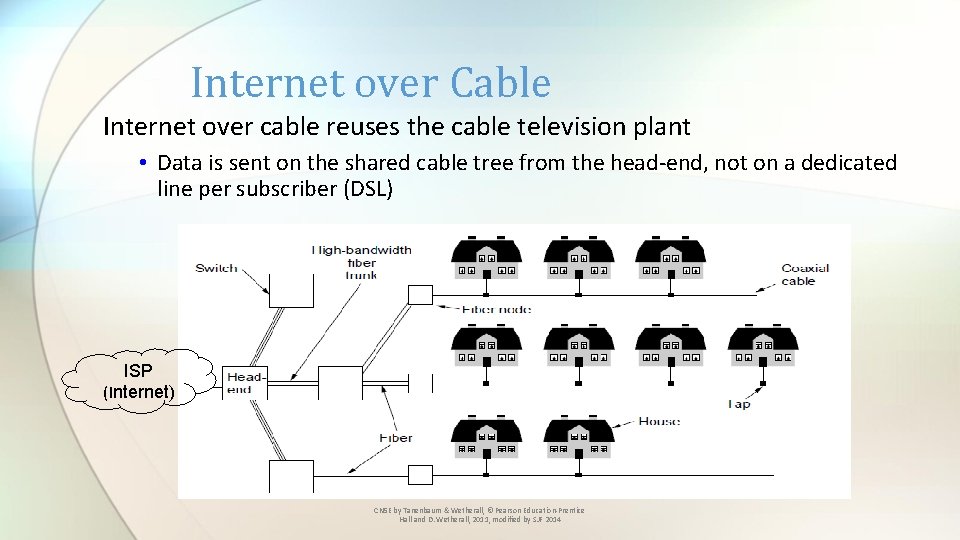
Internet over Cable Internet over cable reuses the cable television plant • Data is sent on the shared cable tree from the head-end, not on a dedicated line per subscriber (DSL) ISP (Internet) CN 5 E by Tanenbaum & Wetherall, © Pearson Education-Prentice Hall and D. Wetherall, 2011, modified by SJF 2014
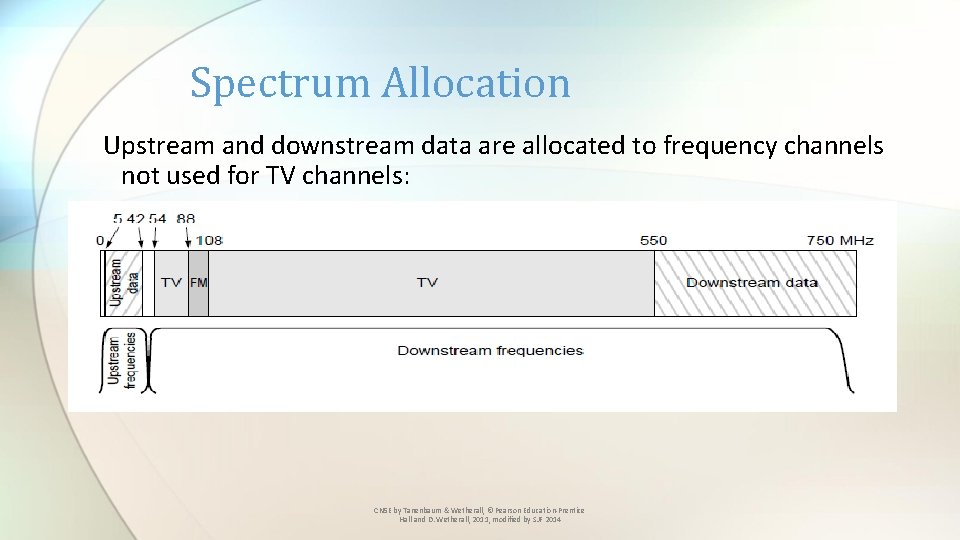
Spectrum Allocation Upstream and downstream data are allocated to frequency channels not used for TV channels: CN 5 E by Tanenbaum & Wetherall, © Pearson Education-Prentice Hall and D. Wetherall, 2011, modified by SJF 2014
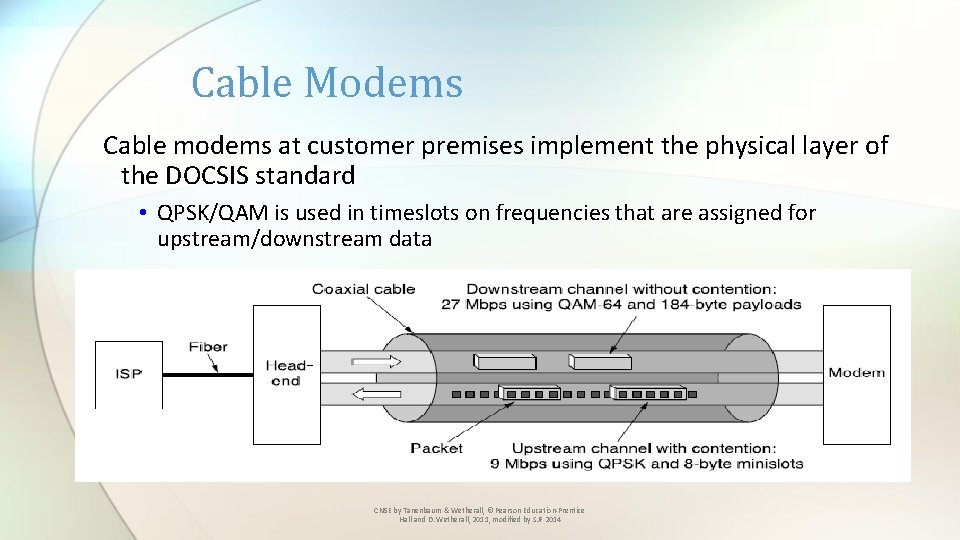
Cable Modems Cable modems at customer premises implement the physical layer of the DOCSIS standard • QPSK/QAM is used in timeslots on frequencies that are assigned for upstream/downstream data CN 5 E by Tanenbaum & Wetherall, © Pearson Education-Prentice Hall and D. Wetherall, 2011, modified by SJF 2014
Cable vs. ADSL Cable: + Uses coaxial cable to customers (good bandwidth) • Data is broadcast to all customers (less secure) • Bandwidth is shared over customers so may vary ADSL: + Bandwidth is dedicated for each customer + Point-to-point link does not broadcast data • Uses twisted pair to customers (lower bandwidth) CN 5 E by Tanenbaum & Wetherall, © Pearson Education-Prentice Hall and D. Wetherall, 2011, modified by SJF 2014
End Chapter 2 CN 5 E by Tanenbaum & Wetherall, © Pearson Education-Prentice Hall and D. Wetherall, 2011, modified by SJF 86