
Computer Networks Bhushan Trivedi Director MCA Programme at
Computer Networks Bhushan Trivedi, Director, MCA Programme, at the GLS Institute of Computer Technology, Ahmadabad © Oxford University Press 2011
Chapter 2 Network Fundamentals © Oxford University Press 2011
Definition A computer network can be defined as a collection of computing devices (nodes) interconnected by wires or wireless means and governed by a set of standards (protocols) in order to share data and resources. © Oxford University Press 2011

Division based on scope • PAN or Personal Area Network or the wireless version WPAN (Wireless PAN) • LAN or Local Area Network which is usually confined to a moderately large building. • MAN or Metropolitan Area Network which is confined to a city or a part of it. • WAN or Wide Area Network which can span multiple countries. © Oxford University Press 2011
Other Types • • • Wired Wireless MANet Sensor Broadcast Point to point © Oxford University Press 2011
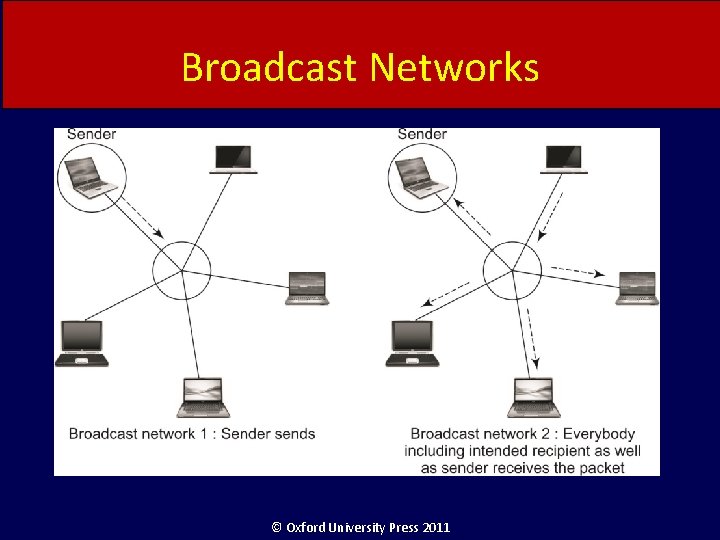
Broadcast Networks © Oxford University Press 2011
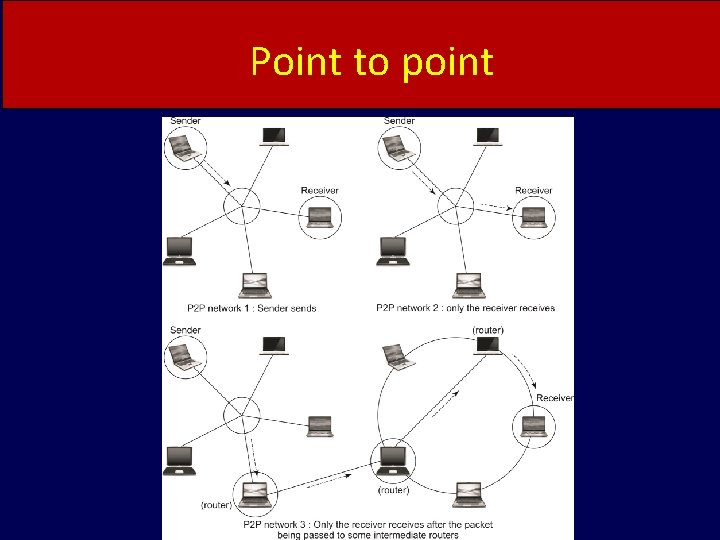
Point to point © Oxford University Press 2011

Broadcast © Oxford University Press 2011
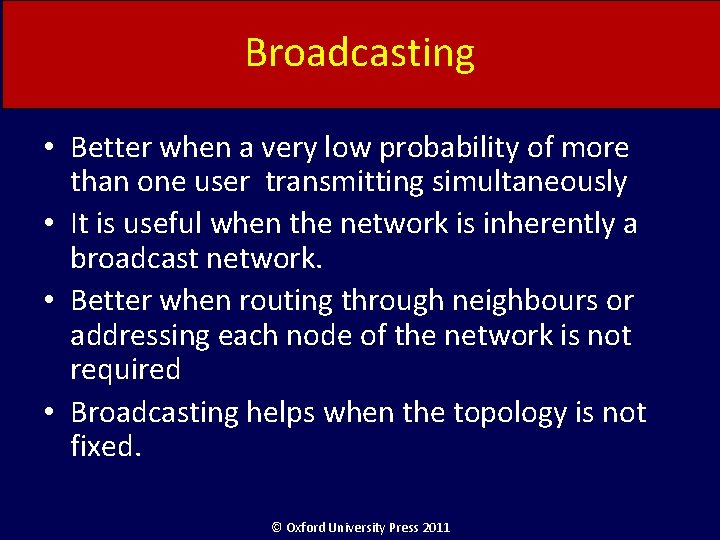
Broadcasting • Better when a very low probability of more than one user transmitting simultaneously • It is useful when the network is inherently a broadcast network. • Better when routing through neighbours or addressing each node of the network is not required • Broadcasting helps when the topology is not fixed. © Oxford University Press 2011
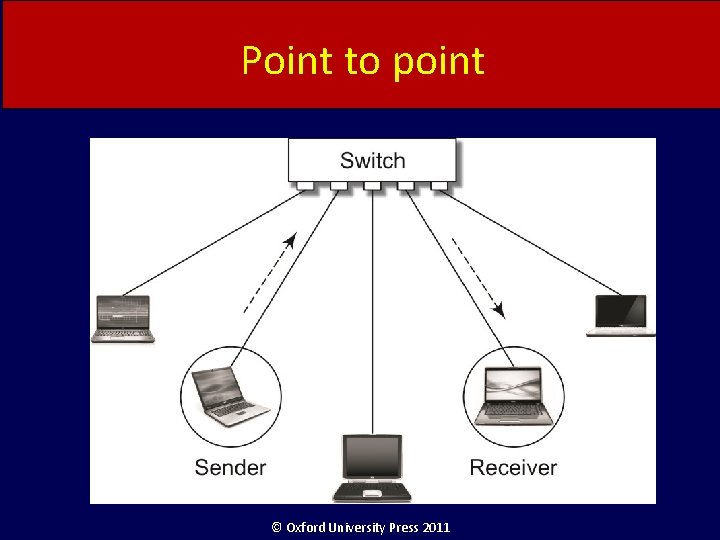
Point to point © Oxford University Press 2011
P 2 P Issues • P 2 P requires to know where the recipient is • Sender must know where each router is • Similarly each router must be aware of where other routers are located • For inherently broadcast network P 2 P communication is not possible. • Little advantage for high bandwidth case © Oxford University Press 2011
Sensors and MANets • • • Sensors are usually very large Sensor can be immobile. Size, power and memory Sensor may not be individually addressable. Power consumption is severe in Sensors Sensor nodes may captured © Oxford University Press 2011
Home Networking Applications • • Refrigerator reminds about buying vegetables Stranger trying to break into your house Babysitter is sleeping TV has a serious problem and it conveys Electric bulb tells us if it is going down Lamp dims itself when you are asleep Night lamp automatically switches on and off © Oxford University Press 2011
Home Networking Applications • Smart spectacles helps old people • Smart Keys • A phone receiver transfers the call automatically • Control house via Internet or phone. • The shower adjusts the temperature • Single remote control for many home devices © Oxford University Press 2011
Home Networking issues • • Robustness Cost Security issues Regular upgrades Maintenance and availability Wired or Wireless Holding the vendor responsible © Oxford University Press 2011
Network Components • • The Network Interface Card Cable for wired connection Frequency band for wireless transmission The servers and the nodes © Oxford University Press 2011
Interconnecting devices • • • Hub Switch Repeater Bridge Router © Oxford University Press 2011
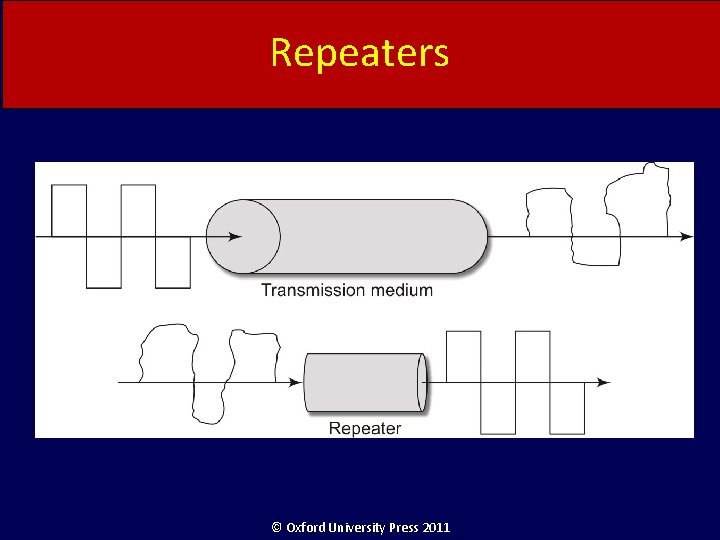
Repeaters © Oxford University Press 2011
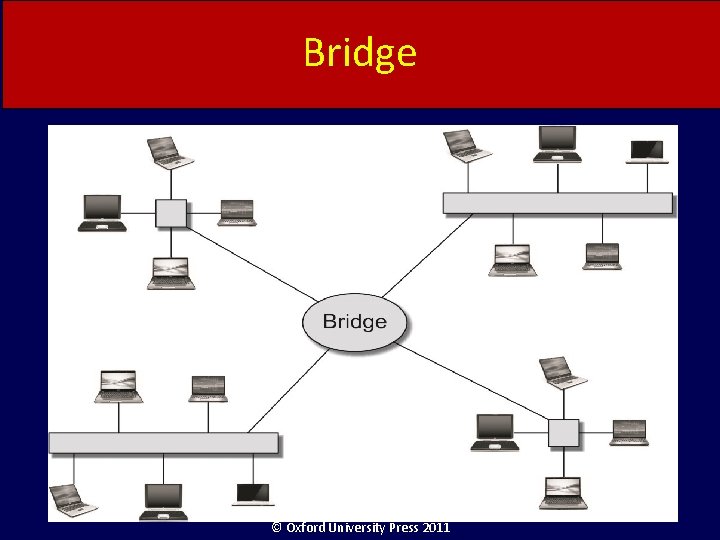
Bridge © Oxford University Press 2011
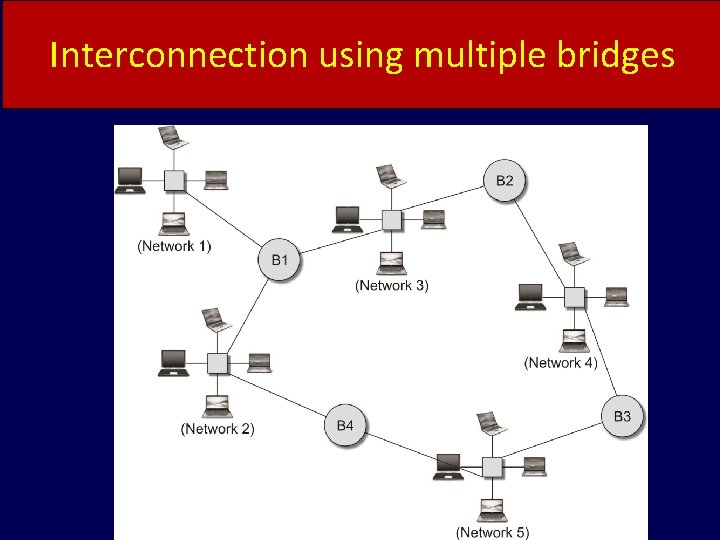
Interconnection using multiple bridges © Oxford University Press 2011
Other types of Connection • • • Serial connection Parallel connection Connection using a modem Universal Serial Bus (USB) connection The Logical Connection © Oxford University Press 2011
The Logical Connection • Connection-Oriented connection • Connectionless connection • Connection-oriented connection on top of connectionless connection • Connectionless connection on top of connectionless connection • Addressing issues © Oxford University Press 2011
Advantage of CO connection • Order • Quality of service • Reliable data transfer © Oxford University Press 2011
Layers and service • Each layer, using the services of the layer immediately below it, interacts with its peers. • Each layer sends and receives data in a format understood by the peer in the recipient. • Ideally, there is no dependency among the layers • Each layer, while talking to a peer, uses a specific protocol to communicate. © Oxford University Press 2011
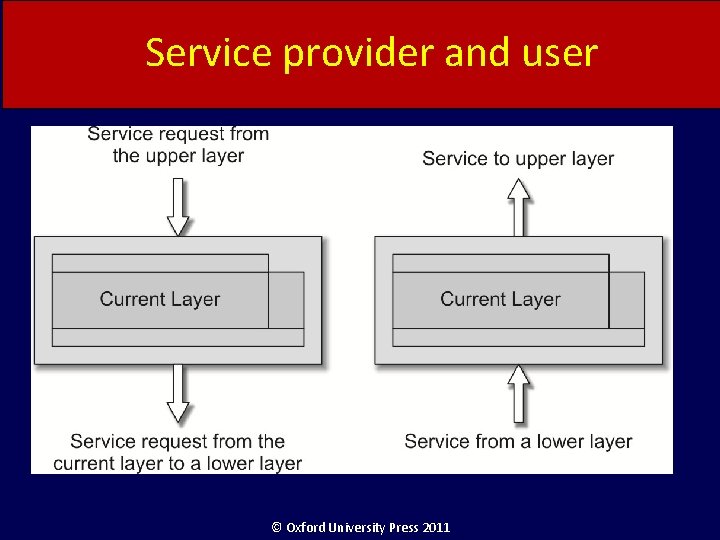
Service provider and user © Oxford University Press 2011
Application level design issues • API or GUI • User Friendliness • Concurrency control © Oxford University Press 2011
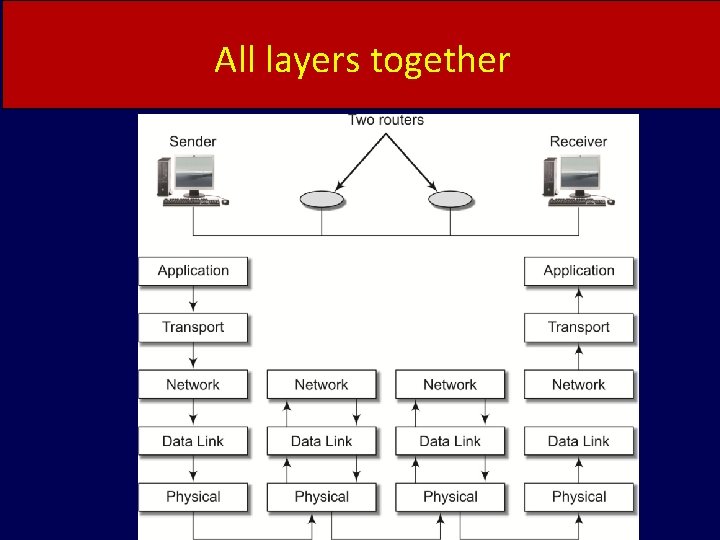
All layers together © Oxford University Press 2011
The protocols • There are multiple parties involved. Usually there is only one sender and one receiver. • The sender knows what to send and in which sequence. • The receiver also expects the messages in a particular sequence. • Two paths of communication, accepting or rejecting © Oxford University Press 2011
Other issues • The standardization bodies • Connection and protocol • Connectionless and Connection-Oriented Protocols © Oxford University Press 2011

Layers and protocols • Interfaces and protocols • Need for peers to communicate • Applications of computer networks – Home Networking Applications – Mobile Networking Applications – Wireless Networking Applications © Oxford University Press 2011
Security issues • Hidden Dangers – No priority to security measures – Design of Communication protocols – Features vs security – Mindset of users • Policy issues • User convenience vs. secure network • Social Engineering © Oxford University Press 2011
- Slides: 31