
Computer Networking Lecture 25 Wireless AdHoc Networks Sensor
- Slides: 35
Computer Networking Lecture 25: Wireless, Ad-Hoc Networks, Sensor Networks Dejian Ye, Liu Xin
Scenarios and Roadmap • Point to point wireless networks • Example: Your laptop to CMU wireless • Challenges: • Poor and variable link quality (makes TCP unhappy) • Many people can hear when you talk • Pretty well defined. • Ad hoc networks (wireless++) • Rooftop networks (multi-hop, fixed position) • Mobile ad hoc networks • Adds challenges: routing, mobility • Some deployment + some research • Sensor networks (ad hoc++) • Scatter 100 s of nodes in a field / bridge / etc. • Adds challenge: Serious resource constraints • Current, popular, research. Lecture 25: 11 -30 -2006 2
Wireless Challenges (review) • Need to share airwaves rather than wire • • Don’t know what hosts are involved Host may not be using same link technology No fixed topology of interconnection Interference • Other hosts: collisions, capture, interference • The environment (e. g. , microwaves + 802. 11) • Mobility -> Things change often • Environmental changes do too • How do microwaves work? Relate to 802. 11 absorption. • Other characteristics of wireless • Noisy lots of losses • Slow • Multipath interference Lecture 25: 11 -30 -2006 3
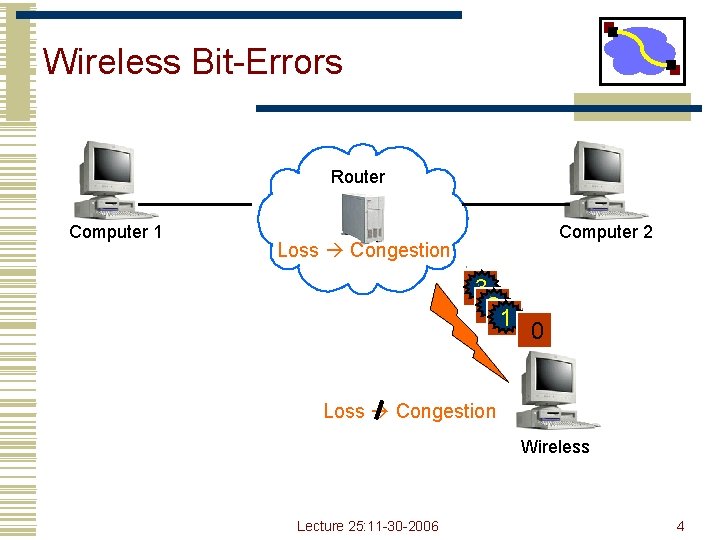
Wireless Bit-Errors Router Computer 1 Computer 2 Loss Congestion 3 2 22 1 0 Loss Congestion Wireless Lecture 25: 11 -30 -2006 4
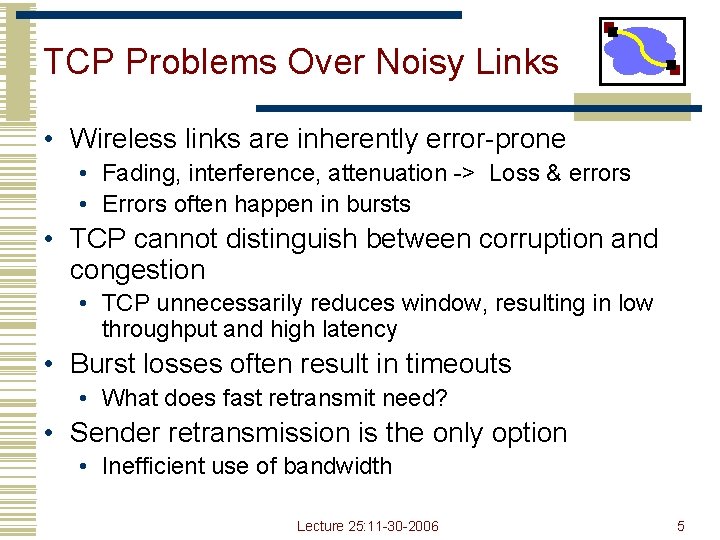
TCP Problems Over Noisy Links • Wireless links are inherently error-prone • Fading, interference, attenuation -> Loss & errors • Errors often happen in bursts • TCP cannot distinguish between corruption and congestion • TCP unnecessarily reduces window, resulting in low throughput and high latency • Burst losses often result in timeouts • What does fast retransmit need? • Sender retransmission is the only option • Inefficient use of bandwidth Lecture 25: 11 -30 -2006 5
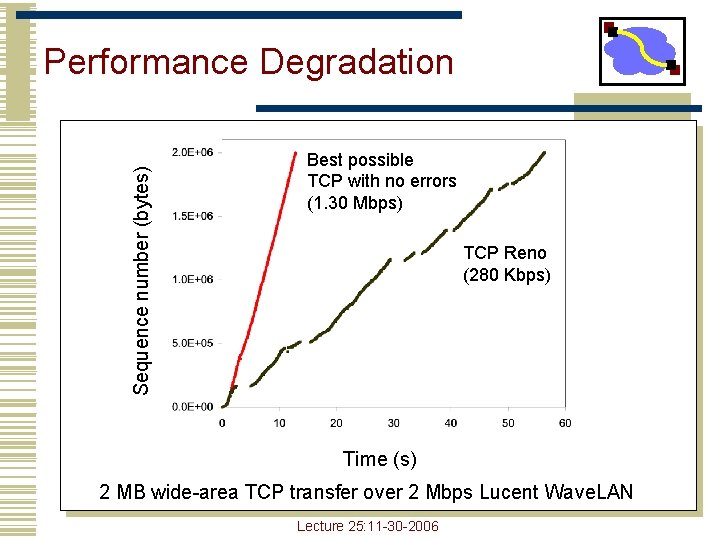
Sequence number (bytes) Performance Degradation Best possible TCP with no errors (1. 30 Mbps) TCP Reno (280 Kbps) Time (s) 2 MB wide-area TCP transfer over 2 Mbps Lucent Wave. LAN Lecture 25: 11 -30 -2006
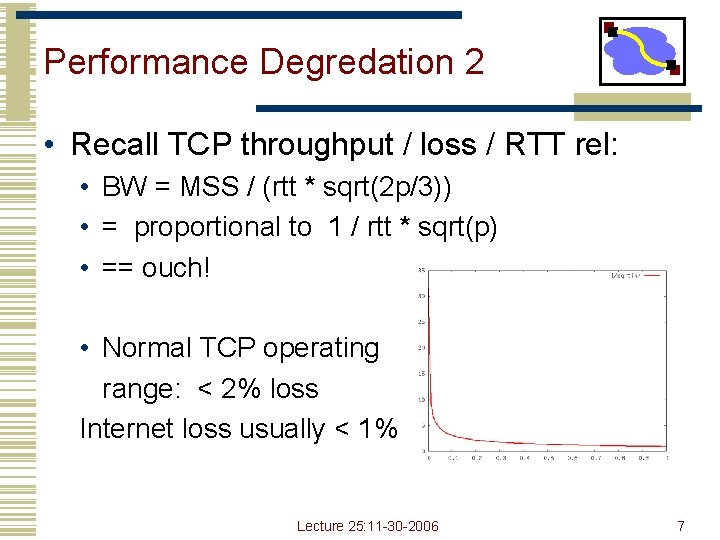
Performance Degredation 2 • Recall TCP throughput / loss / RTT rel: • BW = MSS / (rtt * sqrt(2 p/3)) • = proportional to 1 / rtt * sqrt(p) • == ouch! • Normal TCP operating range: < 2% loss Internet loss usually < 1% Lecture 25: 11 -30 -2006 7
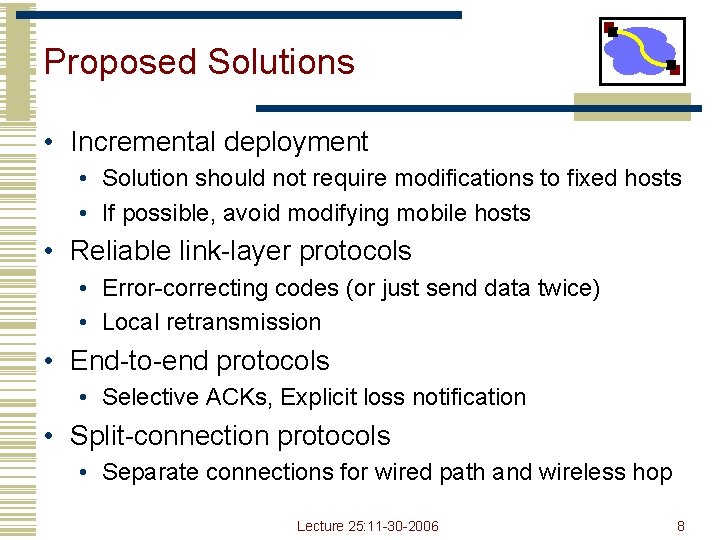
Proposed Solutions • Incremental deployment • Solution should not require modifications to fixed hosts • If possible, avoid modifying mobile hosts • Reliable link-layer protocols • Error-correcting codes (or just send data twice) • Local retransmission • End-to-end protocols • Selective ACKs, Explicit loss notification • Split-connection protocols • Separate connections for wired path and wireless hop Lecture 25: 11 -30 -2006 8
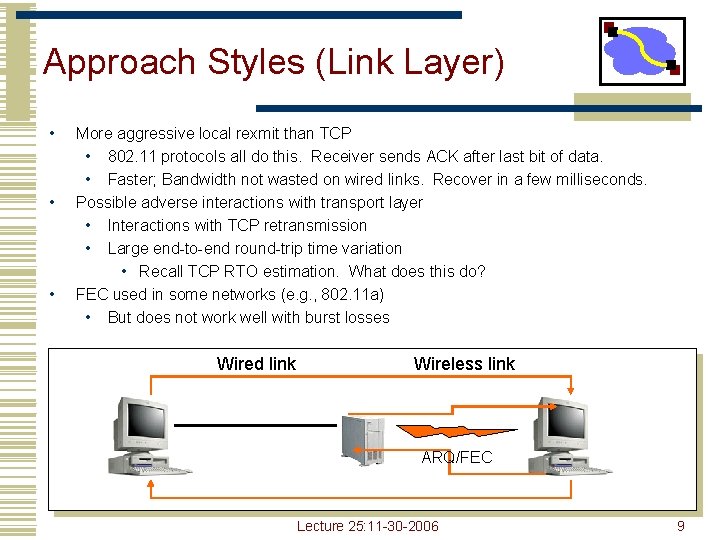
Approach Styles (Link Layer) • • • More aggressive local rexmit than TCP • 802. 11 protocols all do this. Receiver sends ACK after last bit of data. • Faster; Bandwidth not wasted on wired links. Recover in a few milliseconds. Possible adverse interactions with transport layer • Interactions with TCP retransmission • Large end-to-end round-trip time variation • Recall TCP RTO estimation. What does this do? FEC used in some networks (e. g. , 802. 11 a) • But does not work well with burst losses Wired link Wireless link ARQ/FEC Lecture 25: 11 -30 -2006 9
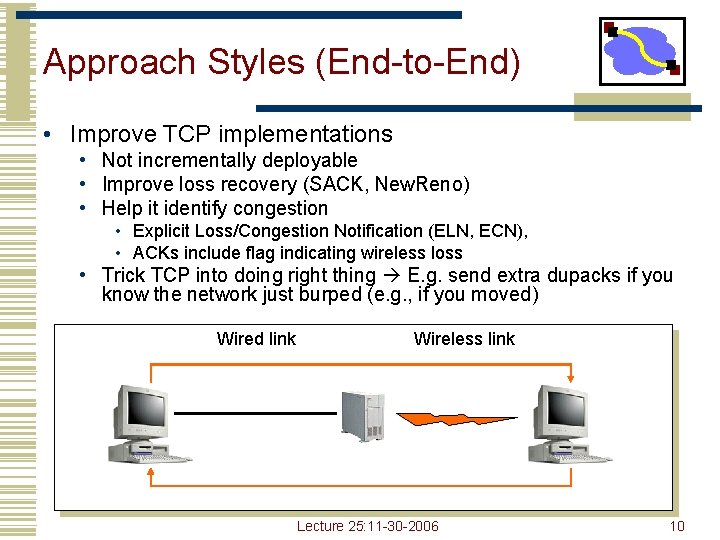
Approach Styles (End-to-End) • Improve TCP implementations • Not incrementally deployable • Improve loss recovery (SACK, New. Reno) • Help it identify congestion • Explicit Loss/Congestion Notification (ELN, ECN), • ACKs include flag indicating wireless loss • Trick TCP into doing right thing E. g. send extra dupacks if you know the network just burped (e. g. , if you moved) Wired link Wireless link Lecture 25: 11 -30 -2006 10
Ad Hoc Networks • All the challenges of wireless, plus some of: • No fixed infrastructure • Mobility (on short time scales) • Chaotically decentralized (: -) • Multi-hop! • Nodes are both traffic sources/sinks and forwarders • The big challenge: Routing Lecture 25: 11 -30 -2006 13
Ad Hoc Routing • Find multi-hop paths through network • Adapt to new routes and movement / environment changes • Deal with interference and power issues • Scale well with # of nodes • Localize effects of link changes Lecture 25: 11 -30 -2006 14
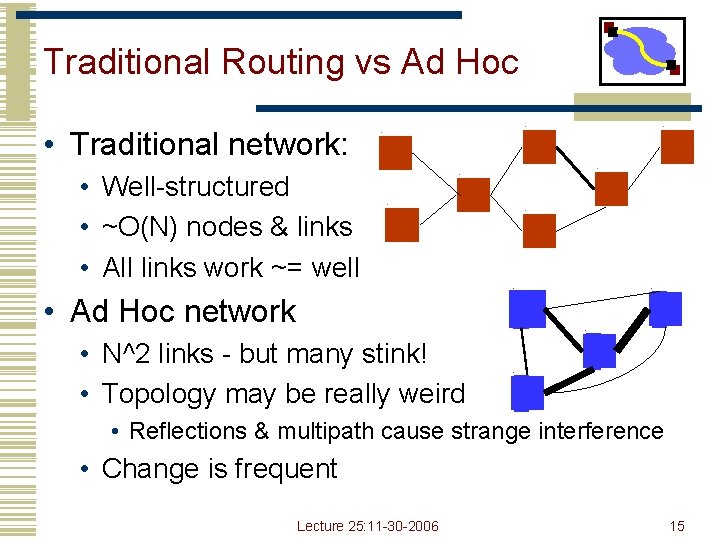
Traditional Routing vs Ad Hoc • Traditional network: • Well-structured • ~O(N) nodes & links • All links work ~= well • Ad Hoc network • N^2 links - but many stink! • Topology may be really weird • Reflections & multipath cause strange interference • Change is frequent Lecture 25: 11 -30 -2006 15
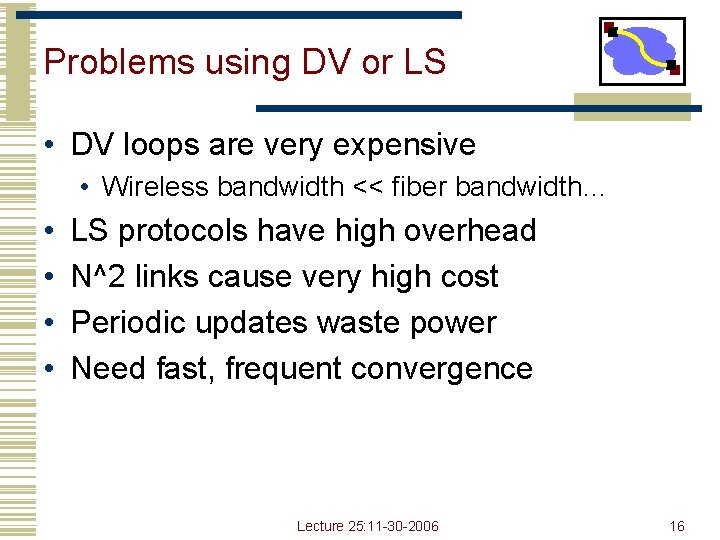
Problems using DV or LS • DV loops are very expensive • Wireless bandwidth << fiber bandwidth… • • LS protocols have high overhead N^2 links cause very high cost Periodic updates waste power Need fast, frequent convergence Lecture 25: 11 -30 -2006 16
Proposed protocols • Destination-Sequenced Distance Vector (DSDV) • Dynamic Source Routing (DSR) • Ad Hoc On-Demand Distance Vector (AODV) • Let’s look at DSR Lecture 25: 11 -30 -2006 17
DSR • Source routing • Intermediate nodes can be out of date • On-demand route discovery • Don’t need periodic route advertisements • (Design point: on-demand may be better or worse depending on traffic patterns…) Lecture 25: 11 -30 -2006 18
DSR Components • Route discovery • The mechanism by which a sending node obtains a route to destination • Route maintenance • The mechanism by which a sending node detects that the network topology has changed and its route to destination is no longer valid Lecture 25: 11 -30 -2006 19
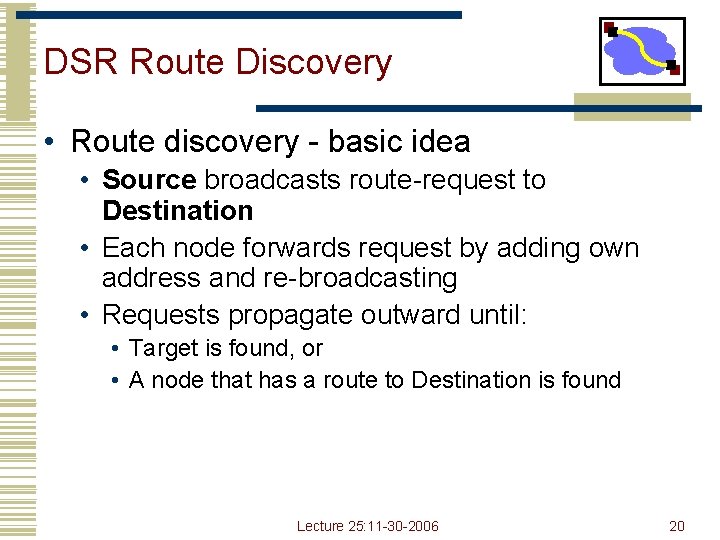
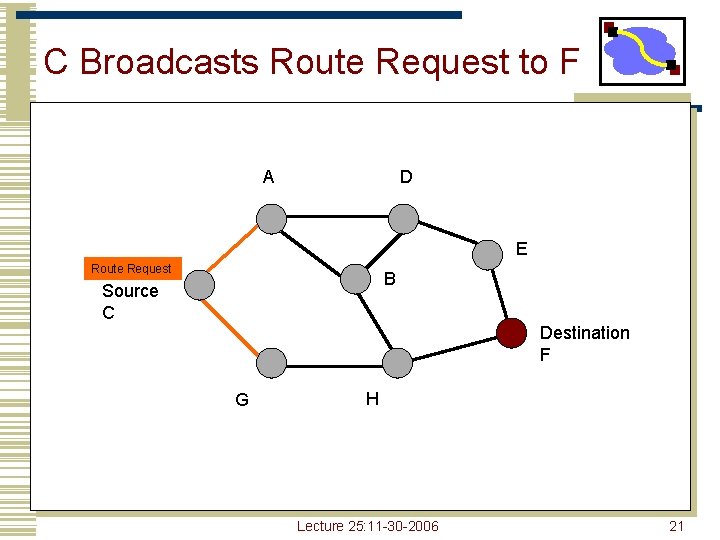
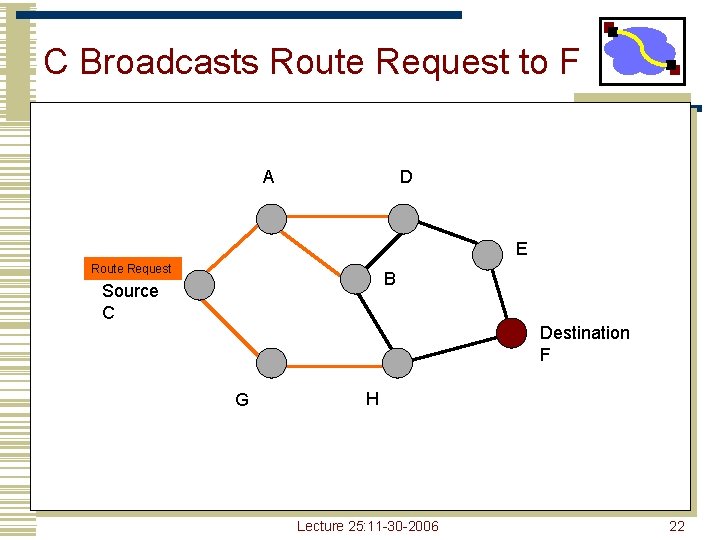
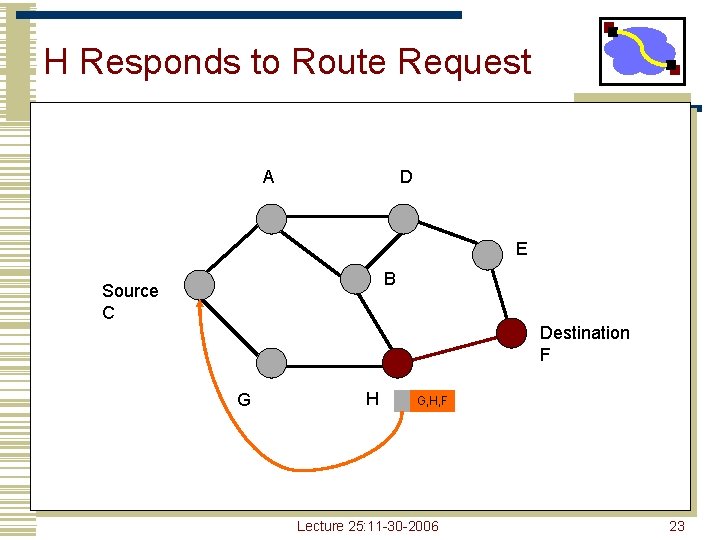
DSR Route Discovery • Route discovery - basic idea • Source broadcasts route-request to Destination • Each node forwards request by adding own address and re-broadcasting • Requests propagate outward until: • Target is found, or • A node that has a route to Destination is found Lecture 25: 11 -30 -2006 20
C Broadcasts Route Request to F A D E Route Request B Source C Destination F G H Lecture 25: 11 -30 -2006 21
C Broadcasts Route Request to F A D E Route Request B Source C Destination F G H Lecture 25: 11 -30 -2006 22
H Responds to Route Request A D E B Source C Destination F G H G, H, F Lecture 25: 11 -30 -2006 23
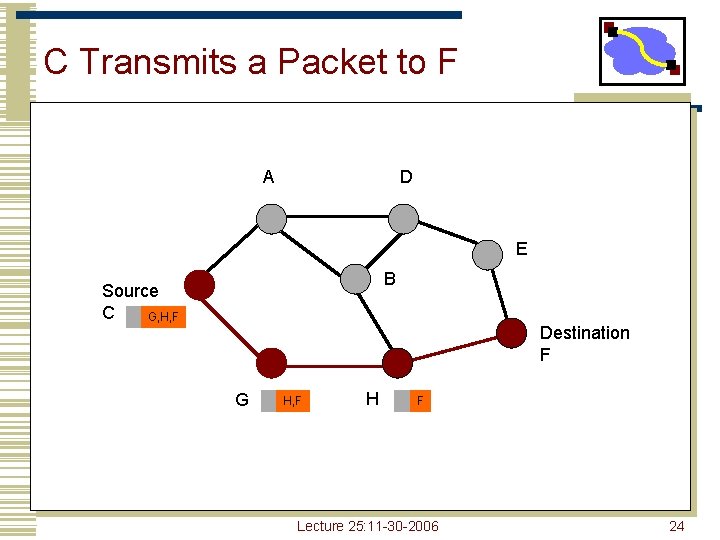
C Transmits a Packet to F A D E B Source C G, H, F Destination F G H, F H F Lecture 25: 11 -30 -2006 24
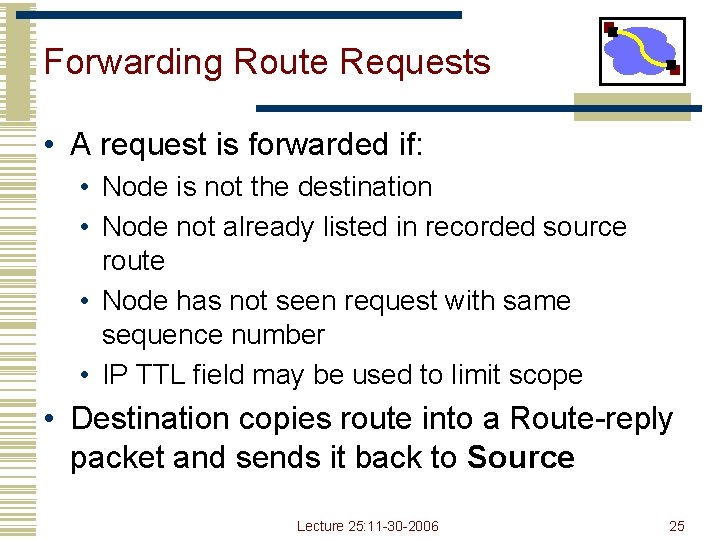
Forwarding Route Requests • A request is forwarded if: • Node is not the destination • Node not already listed in recorded source route • Node has not seen request with same sequence number • IP TTL field may be used to limit scope • Destination copies route into a Route-reply packet and sends it back to Source Lecture 25: 11 -30 -2006 25
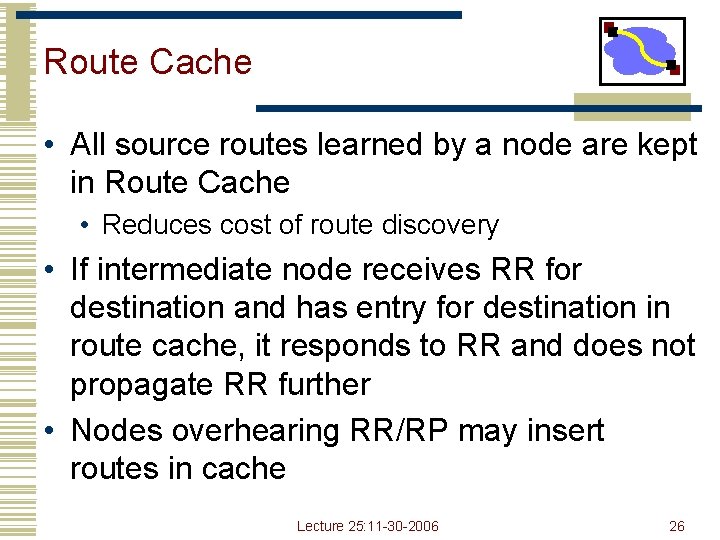
Route Cache • All source routes learned by a node are kept in Route Cache • Reduces cost of route discovery • If intermediate node receives RR for destination and has entry for destination in route cache, it responds to RR and does not propagate RR further • Nodes overhearing RR/RP may insert routes in cache Lecture 25: 11 -30 -2006 26
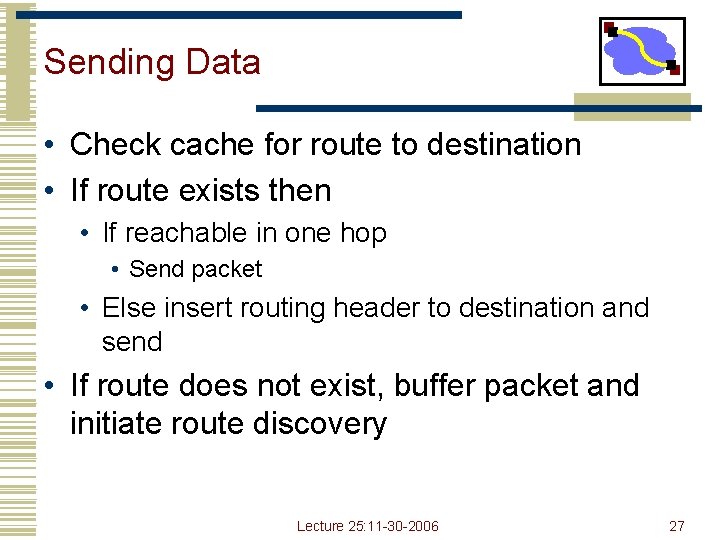
Sending Data • Check cache for route to destination • If route exists then • If reachable in one hop • Send packet • Else insert routing header to destination and send • If route does not exist, buffer packet and initiate route discovery Lecture 25: 11 -30 -2006 27
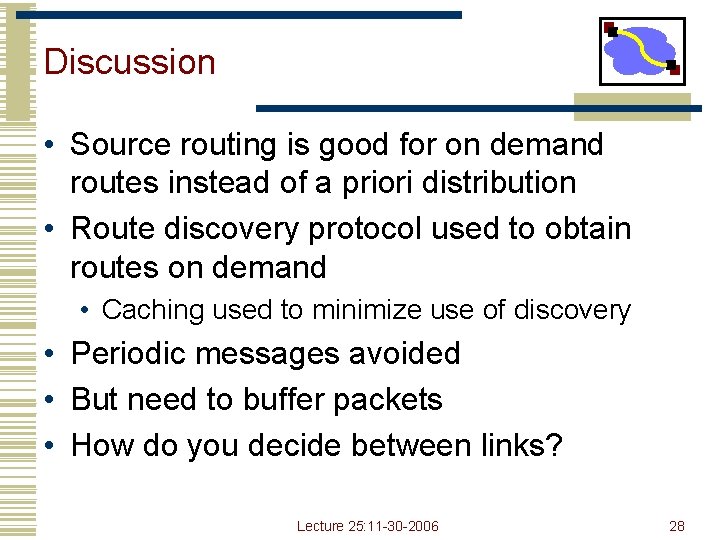
Discussion • Source routing is good for on demand routes instead of a priori distribution • Route discovery protocol used to obtain routes on demand • Caching used to minimize use of discovery • Periodic messages avoided • But need to buffer packets • How do you decide between links? Lecture 25: 11 -30 -2006 28
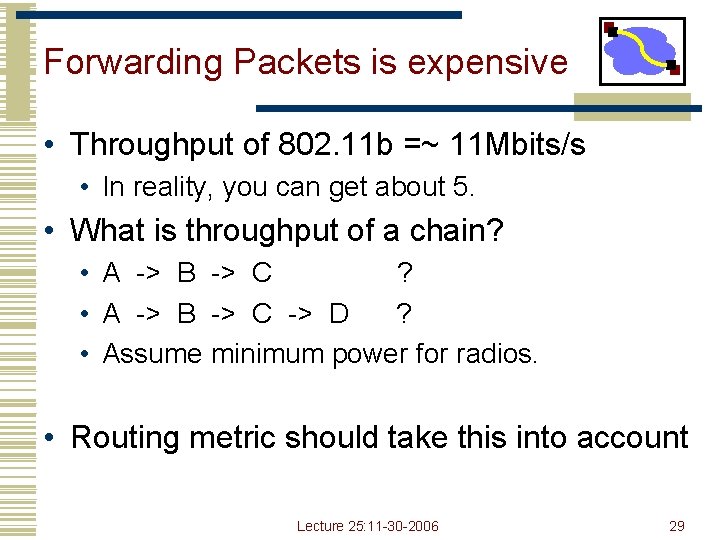
Forwarding Packets is expensive • Throughput of 802. 11 b =~ 11 Mbits/s • In reality, you can get about 5. • What is throughput of a chain? • A -> B -> C -> D ? • Assume minimum power for radios. • Routing metric should take this into account Lecture 25: 11 -30 -2006 29
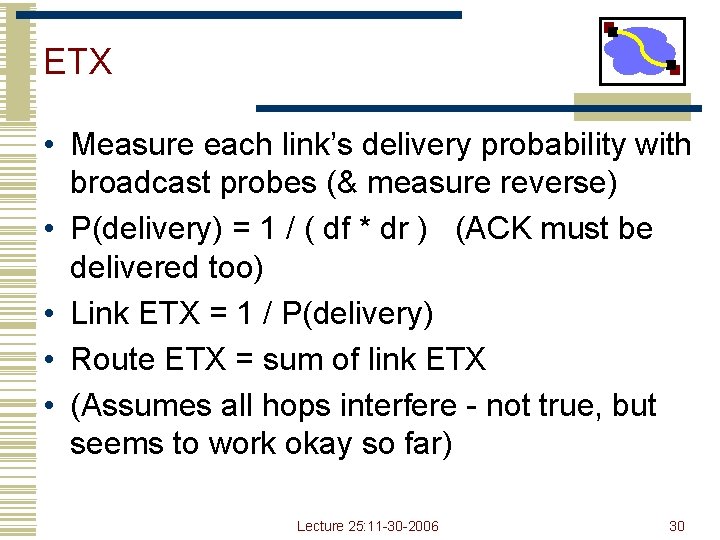
ETX • Measure each link’s delivery probability with broadcast probes (& measure reverse) • P(delivery) = 1 / ( df * dr ) (ACK must be delivered too) • Link ETX = 1 / P(delivery) • Route ETX = sum of link ETX • (Assumes all hops interfere - not true, but seems to work okay so far) Lecture 25: 11 -30 -2006 30
Capacity of multi-hop network • Assume N nodes, each wants to talk to everyone else. What total throughput (ignore previous slide to simplify things) • • O(n) concurrent transmissions. Great! But: Each has length O(sqrt(n)) (network diameter) So each Tx uses up sqrt(n) of the O(n) capacity. Per-node capacity scales as 1/sqrt(n) • Yes - it goes down! More time spent Tx’ing other peoples packets… • But: If communication is local, can do much better, and use cool tricks to optimize • Like multicast, or multicast in reverse (data fusion) • Hey, that sounds like … a sensor network! Lecture 25: 11 -30 -2006 31
Sensor Networks - smart devices • First introduced in late 90’s by groups at UCB/UCLA/USC • Small, resource limited devices • CPU, disk, power, bandwidth, etc. • Simple scalar sensors – temperature, motion • Single domain of deployment • farm, battlefield, bridge, rain forest • for a targeted task • find the tanks, count the birds, monitor the bridge • Ad-hoc wireless network Lecture 25: 11 -30 -2006 32
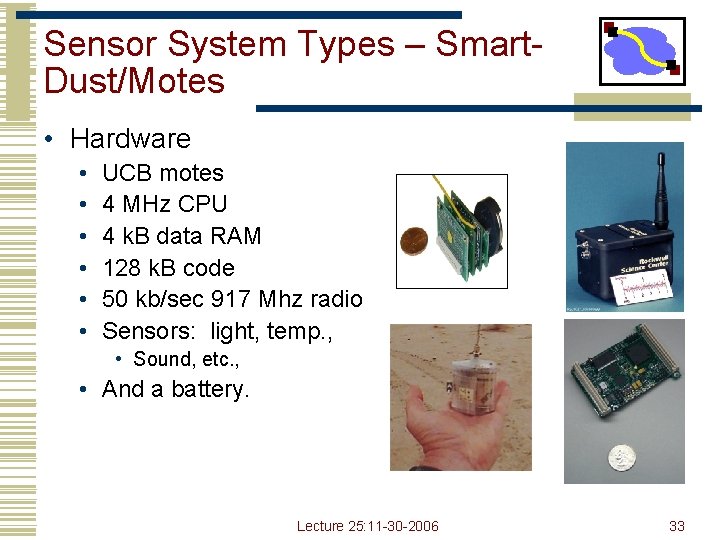
Sensor System Types – Smart. Dust/Motes • Hardware • • • UCB motes 4 MHz CPU 4 k. B data RAM 128 k. B code 50 kb/sec 917 Mhz radio Sensors: light, temp. , • Sound, etc. , • And a battery. Lecture 25: 11 -30 -2006 33
Sensors and power and radios • Limited battery life drives most goals • Radio is most energy-expensive part. • 800 instructions per bit. 200, 000 instructions per packet. (!) • That’s about one message per second for ~2 months if no CPU. • Listening is expensive too. : ( Lecture 25: 11 -30 -2006 34
Sensor nets goals • Replace communication with computation • Turn off radio receiver as often as possible • Keep little state (4 KB isn’t your pentium 4 ten bazillion gigahertz with five ottabytes of DRAM). Lecture 25: 11 -30 -2006 35
Power • Which uses less power? • Direct sensor -> base station Tx • Total Tx power: distance^2 • Sensor -> sensor -> base station? • Total Tx power: n * (distance/n) ^2 =~ d^2 / n • Why? Radios are omnidirectional, but only one direction matters. Multi-hop approximates directionality. • Power savings often makes up for multi-hop capacity • These devices are *very* power constrained! • Reality: Many systems don’t use adaptive power control. This is active research, and fun stuff. Lecture 25: 11 -30 -2006 36
Example: Aggregation • Find avg temp in 8 th floor of Wean. • Strawman: • Flood query, let a collection point compute avg. • Huge overload near the CP. Lots of loss, and local nodes use lots of energy! • Better: • Take local avg. first, & forward that. • Send average temp + # of samples • Aggregation is the key to scaling these nets. • The challenge: How to aggregate. • How long to wait? • How to aggregate complex queries? • How to program? Lecture 25: 11 -30 -2006 37