
Computer Networking Concepts Frame Structure Basic Frame Structure

Computer Networking Concepts: Frame Structure
Basic Frame Structure • The Generic Packet X is used as an introduction to Synchronous Data Transmission. • As we explore more standards and protocols, we find that we can expand the frame structure (packet) into better defined sections that will allow easier understanding of different frame types (Ethernet, Token Ring, SDLC, HDLC, Frame Relay, ATM, Cell Relay, etc. . . ). • It also will provide a point of reference.
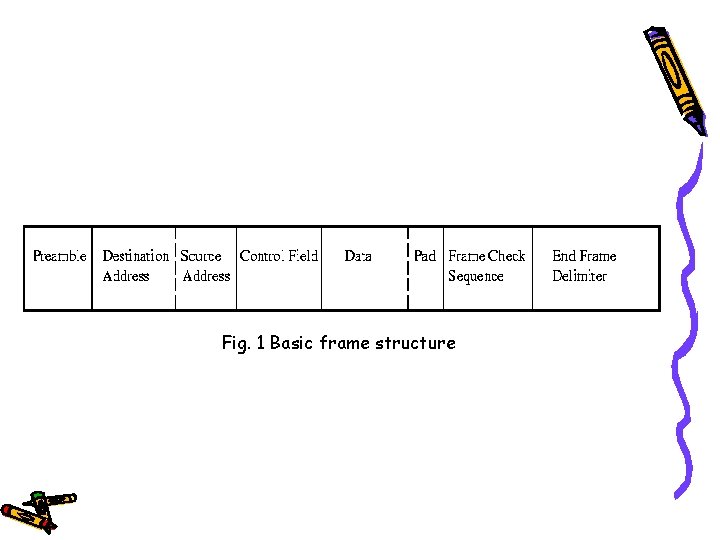
Fig. 1 Basic frame structure
Preamble: Starting Delimiter/Alert Burst/Start of Header • At the beginning of each frame (packet), there will be a sequence of octets (8 bit words), called the Preamble. The Preamble is used to: – Inform the receiving station that a new packet is arriving – Synchronize the receive clock with the transmitted clock
Preamble: Starting Delimiter/Alert Burst/Start of Header cont’d • The Preamble is a series of octets with a specific bit pattern that is used only by the Preamble. • Names used by other protocols for the Preamble are: Starting Delimiter, Alert Burst and Start of Header. • All perform the same 2 basic functions.
Address Field(s): Source and/or Destination • The Address Field consists of a Source Address and/or a Destination Address. • The Source and Destination Addresses are hexadecimal numbers that identify the sender - Source and receiver Destination. • The Network Addresses reside in either the Network Interface Card's firmware or can be either assigned during the initialization of the NIC.
Address Field(s): Source and/or Destination cont’d • The purpose of the Source Address is to identify to the network who is sending data. • The purpose of the Destination Address is to identify to the network who should be receiving the data. • Under some protocols, there may not be both Source and Destination Addresses. • Only one address may be present.
Control Field • The Control Field is used to indicate the Type of Information being sent as Data. • The Type of Information can be Control information used when establishing a connection (handshaking) or it can be Data such as file transfers between clients and servers. • The purpose of the Control Field is to identify what the purpose of the packet or frame is: Control or Data. It can also be used to indicate the size of the packet and Data. •
Data/Message and Optional Pad • The Data Field or Message is the actual information that is being transmitted. • It can contain Control Information for handshaking or actual Data used by applications. • The Control Field would indicate the Data Field size. The Data field is also called the Info field by some protocols. • The optional Pad is used to pad the data field when the protocol has a fixed Data Field size.
Data/Message and Optional Pad con’t • If the Data Field size is fixed at 1200 octets and only 300 octets of information is available then the Pad will fill in the remaining 900 octets with characters (e. g. 900 octets of 00 h). • The protocol may also use the Pad to ensure a minimum Data field size.
CRC/ Frame Check Sequence • The CRC / Frame Check Sequence (FCS) contains an error checking number that the Destination can use to verify that the packet is okay and error-free. • CRC is an abbreviation for Cyclic Redundancy Checking. The Frame Check Sequence typically incorporates a 32 Bit CRC check. • Checksums work similarly but use a different algorithm. • As each packet is sent, the Source calculates a check number from the data using a predetermined algorithm (formula).
CRC/ Frame Check Sequence con’t • As each packet is sent, the Source calculates a check number from the data using a predetermined algorithm (formula). • The result of this calculation is appended to the packet in the Frame Check Sequence (FCS) field. At the Destination, the same calculation is performed and the result is compared to the transmitted Frame Check Sequence. • If the result generated at the Destination is identical to the FCS, then it is assumed that the packet is error free at the bit level.
End Frame Delimiter • The End Frame Delimiter is a series of octets that have a specific bit pattern that identifies the end of the packet to the Destination. • Not all protocols have End Frame Delimiters fields, protocols with fixed packet size may not need the End Frame Delimiter field as the Destination may simply count the number of octets it has received.
References Introduction to Data Communications Copyleft Sept. 1999 - Jan 2005 TCP/IP Tutorial and Technical Overview An IBM Redbooks publication Published 19 December 2006 Computer Networking: A Top-Down Approach (7 th Edition) James Kurose & Keith Ross
- Slides: 14