
Computer Network Architecture Lecture 10 IP Addressing II

- Slides: 16
Computer Network Architecture Lecture 10: IP Addressing II 26/1/2013 1
Addressing Types of Communication • There are three communication: types of Addressing in • Unicast communication • Broadcast communication • Multicast communication 2
Addressing Types of Communication(Con. ) • In an IPv 4 network, the hosts can communicate in one of three different ways: • Unicast communication: The process of sending a packet from one host to an individual host. • Broadcast communication: The process of sending a packet from one host to all hosts in the network. • Multicast communication: The process of sending a packet from one host to a selected group of hosts. 3
Unicast Communication and Addresses • The most common type of communication is unicast. • This is the normal host-to-host communication in both a client/server and a peer-to-peer network. • For unicast communication, the host addresses assigned to the two end devices are used as the source and destination IPv 4 addresses. • During the encapsulation process, the source host places its IPv 4 address in the unicast packet header as the source host address and the IPv 4 address of the destination host in the packet header as the destination address. 4
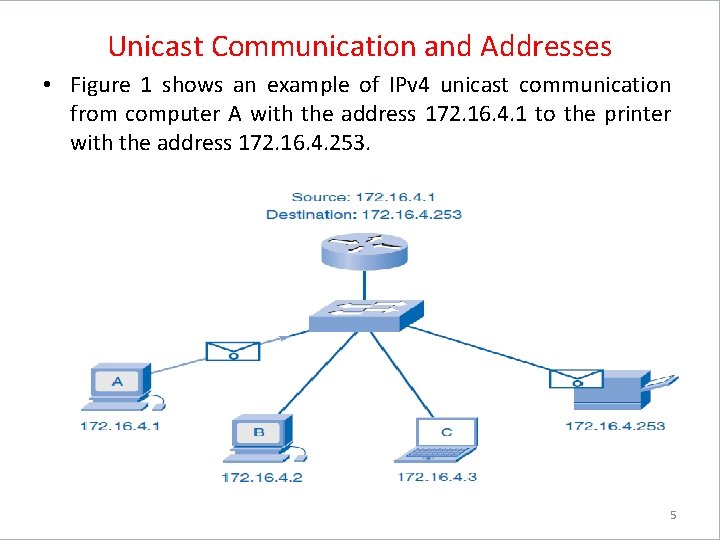
Unicast Communication and Addresses • Figure 1 shows an example of IPv 4 unicast communication from computer A with the address 172. 16. 4. 1 to the printer with the address 172. 16. 4. 253. 5
Broadcast Communication and Addresses • broadcast communication is the process of sending a packet from one host to all hosts in the network. • broadcast communication use special addresses as the destination address. This special address, called the broadcast address, allows all the receiving hosts to accept the packet. • There are two types of broadcasts: directed broadcast and limited broadcast. Each of these two types of broadcasts uses a different method of IPv 4 addressing. 6
Directed Broadcast • A directed broadcast is sent to all hosts on a specific network. This type of broadcast is useful for sending a broadcast to all hosts on a nonlocal network. • The used address in directed broadcast is with 1 value in all the host bits. • For example, for a host outside the network to communicate with the hosts within the 172. 16. 4. 0 network, the broadcast address of the packet would be 172. 16. 4. 255. 7
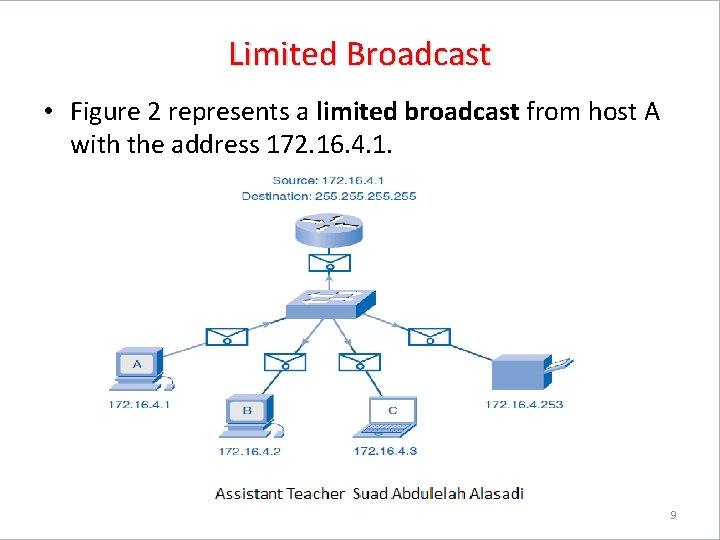
Limited Broadcast • The limited broadcast is used for communication that is limited to the hosts on the local network. These packets use a destination IPv 4 address of all 1 s (255. 255). • As an example, a host within the 172. 16. 4. 0 network would broadcast to all the hosts in its network using a packet with a destination address of 255. 8
Limited Broadcast • Figure 2 represents a limited broadcast from host A with the address 172. 16. 4. 1. 9
Multicast Communication and Addresses • The multicast communication reduces traffic by allowing a host to send a single packet to a selected set of hosts. • IPv 4 has set aside a special block of addresses from 224. 0. 0. 0 to 239. 255 as addresses for multicast groups. 10
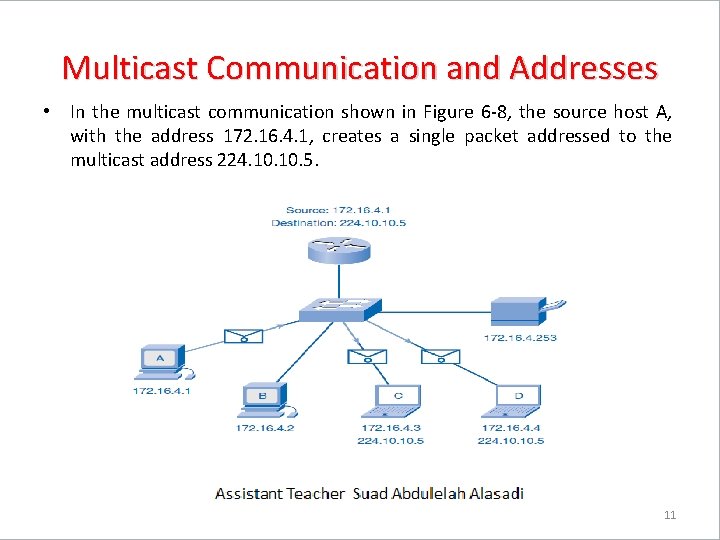
Multicast Communication and Addresses • In the multicast communication shown in Figure 6 -8, the source host A, with the address 172. 16. 4. 1, creates a single packet addressed to the multicast address 224. 10. 5. 11
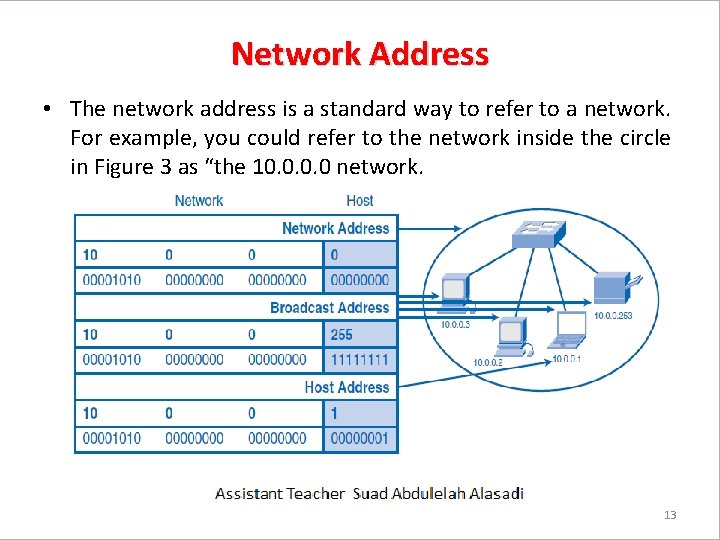
Types of Addresses in an IPv 4 Network • Within each IPv 4 network, there are three types of addresses: ■ Network address: A special address that refers to the network ■ Broadcast address: A special address used to send data to all hosts in the network ■ Host addresses: The unicast addresses assigned to the end devices in the network 12
Network Address • The network address is a standard way to refer to a network. For example, you could refer to the network inside the circle in Figure 3 as “the 10. 0 network. 13
Broadcast Address • The IPv 4 broadcast address within a network is the directed broadcast address. • Unlike the network address, this address is used in communication to all the hosts in a network. • This special address for each network allows a single packet to communicate to all the hosts in that network. • For example in Figure 3 in the preceding section, to communicate with all the hosts in this network, use a destination address 10. 0. 0. 255, which is the broadcast address for the network. 14
Host Address • Host Addresses As described previously, every end device requires a unique unicast address to deliver a packet to that host. • In IPv 4 addresses, you can assign the values between the network address and the broadcast address to the devices in that network. • In Figure 3, the addresses between the network address of 10. 0 and the broadcast address of 10. 0. 0. 255 are the host addresses. This means that the addresses 10. 0. 0. 1 to 10. 0. 0. 254 can be assigned to the host address. 15
Thank You 16