
Computer Literacy and Generations of Computers Artificial Intelligence
- Slides: 21
Computer Literacy and Generations of Computers Artificial Intelligence Section 1 Mr. Sciame
What is a computer? • • Definition Types Programs/Programmers Hardware
Computer Organization • All computers may be envisioned as being divided into 6 logical units: – Input Unit – Output Unit – Memory Unit – Arithmetic/Logic Unit – Central Processing Unit – Secondary Storage
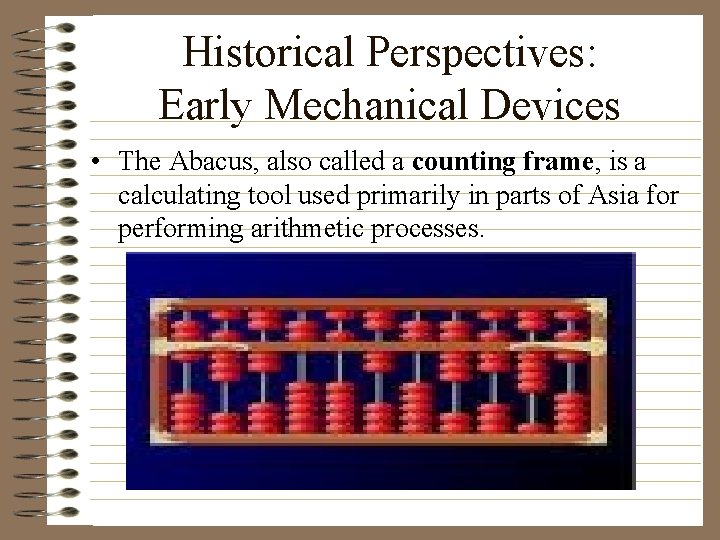
Historical Perspectives: Early Mechanical Devices • The Abacus, also called a counting frame, is a calculating tool used primarily in parts of Asia for performing arithmetic processes.
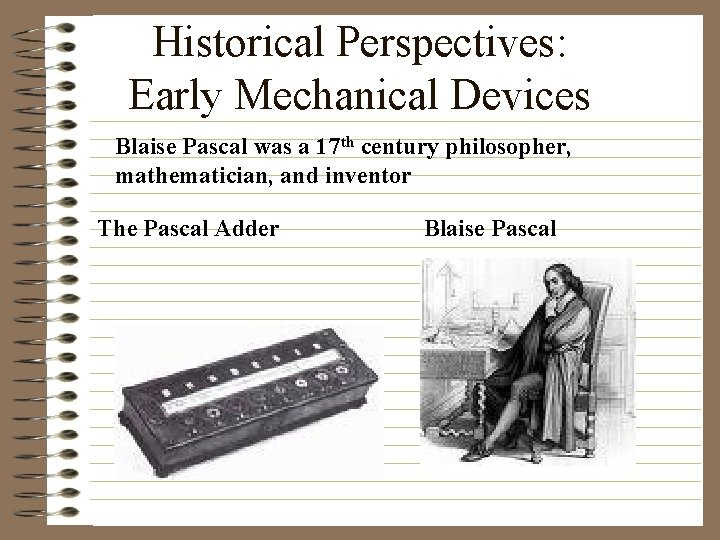
Historical Perspectives: Early Mechanical Devices Blaise Pascal was a 17 th century philosopher, mathematician, and inventor The Pascal Adder Blaise Pascal
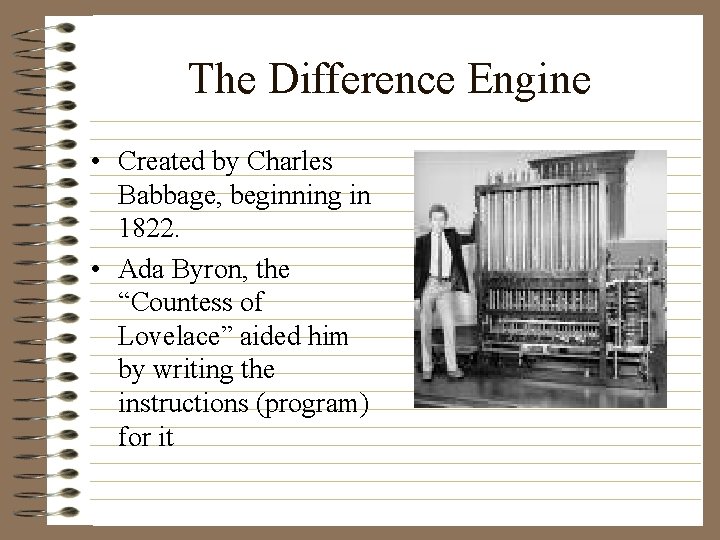
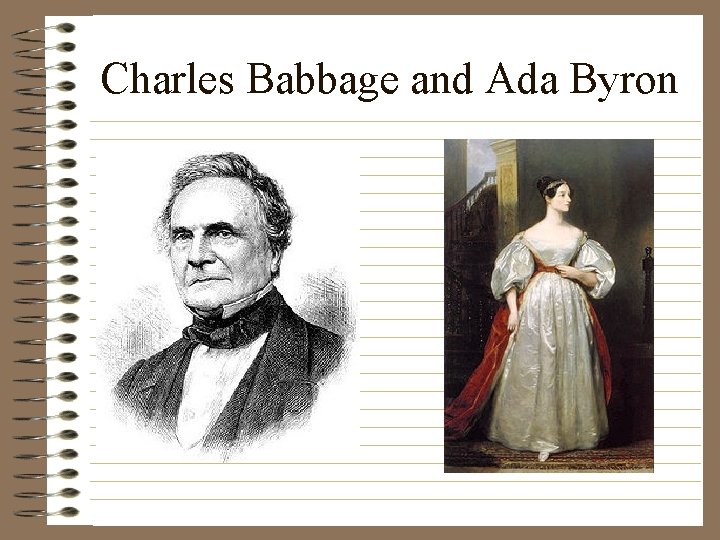
The Difference Engine • Created by Charles Babbage, beginning in 1822. • Ada Byron, the “Countess of Lovelace” aided him by writing the instructions (program) for it
Charles Babbage and Ada Byron
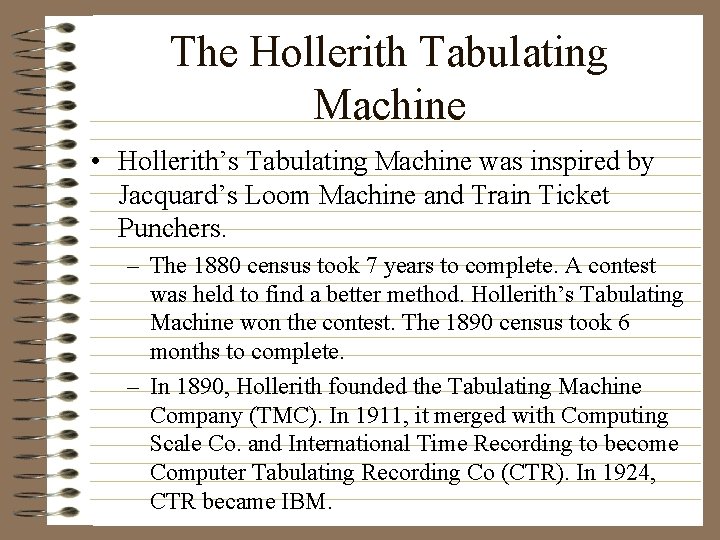
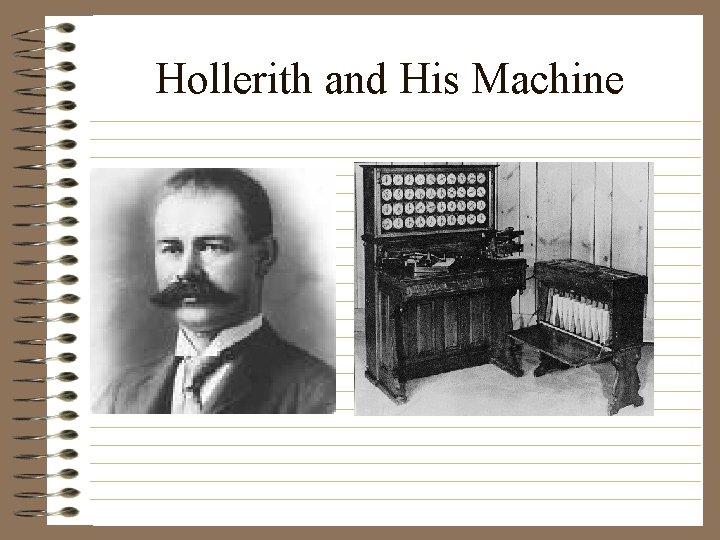
The Hollerith Tabulating Machine • Hollerith’s Tabulating Machine was inspired by Jacquard’s Loom Machine and Train Ticket Punchers. – The 1880 census took 7 years to complete. A contest was held to find a better method. Hollerith’s Tabulating Machine won the contest. The 1890 census took 6 months to complete. – In 1890, Hollerith founded the Tabulating Machine Company (TMC). In 1911, it merged with Computing Scale Co. and International Time Recording to become Computer Tabulating Recording Co (CTR). In 1924, CTR became IBM.
Hollerith and His Machine
Early Electronic Computers • Howard Aiken and Grace Hopper designed the MARK series of computers at Harvard University. • The MARK series of computers began with the Mark I in 1944. • Used by the US Navy for gunnery and ballistic calculations, the Mark I was in operation until 1959.
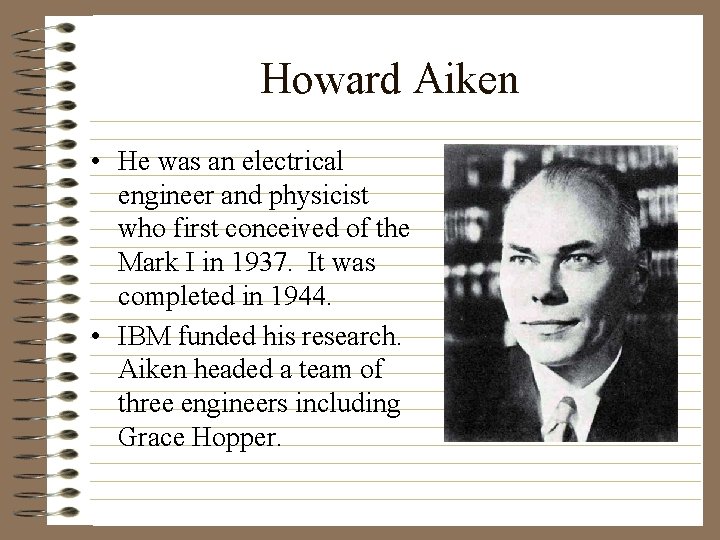
Howard Aiken • He was an electrical engineer and physicist who first conceived of the Mark I in 1937. It was completed in 1944. • IBM funded his research. Aiken headed a team of three engineers including Grace Hopper.
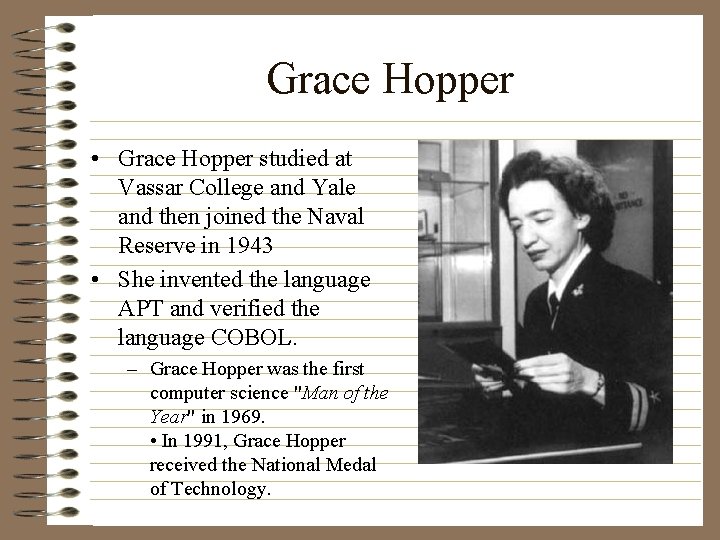
Grace Hopper • Grace Hopper studied at Vassar College and Yale and then joined the Naval Reserve in 1943 • She invented the language APT and verified the language COBOL. – Grace Hopper was the first computer science "Man of the Year" in 1969. • In 1991, Grace Hopper received the National Medal of Technology.
Notable Quotes • Howard Aiken loved computers, but even he had no idea of their eventual widespread appeal. "Only six electronic digital computers would be required to satisfy the computing needs of the entire United States, " he said in 1947. • Grace Hopper is responsible for the term 'bug' for a computer fault. The original 'bug' was a moth, which caused a hardware fault in the Mark I. Hopper was the first person to 'debug' a computer.
Historical Perspectives • Early Mechanical Devices – The Abacus – The Pascal Adder – The Difference Engine – The Hollerith Tabulating Machine • Early Electronic Computers – Mark I – ABC – ENIAC
The First Generation • 1951 -58 • Characteristics – The UNIVAC – Vacuum Tubes – Binary (Machine Code)
Second Generation • 1958 -64 • Characteristics: – Transistor replaces vacuum tube – Introduction of Programming Languages – Split between Business and Scientific Usage
Third Generation • 1964 -70 • Characteristics – Integrated Circuits (Chips) – Proliferation of Languages
Fourth Generation • 1970 - 95 • Characteristics: – PC – Packaged Programs
Fifth Generation • Today • Characteristics: – Internet – Multimedia – CD usage
Evolution of Operating Systems 1. Batch Processing – One job at a time, a single program at a time, processing data in groups or batches 2. Multiprogramming – Sharing computers resources (efficiency) “simultaneous” operation of many jobs. Computer shares resources vying for attention. 3. Timesharing – Computer accessed through terminals. Computer goes from user to user, appearing to be simultaneous.
Evolution of Operating Systems 4. Personal Computing – Standalone 5. Local Area Networks – Computer networks linking pc’s to the network 6. Distributed Computing – Computing is no longer at one site, but distributed elsewhere