
Computer Graphics Ray tracing Step 2 Outline multiple


- Slides: 21
Computer Graphics Ray tracing Step 2
Outline • multiple sphere (at lease 3 big and 6 small sphere) • recursive intersection with refraction and transmission • material attribute (Kd, n_t in Snell’s Law, w_r, …. ) • bonus
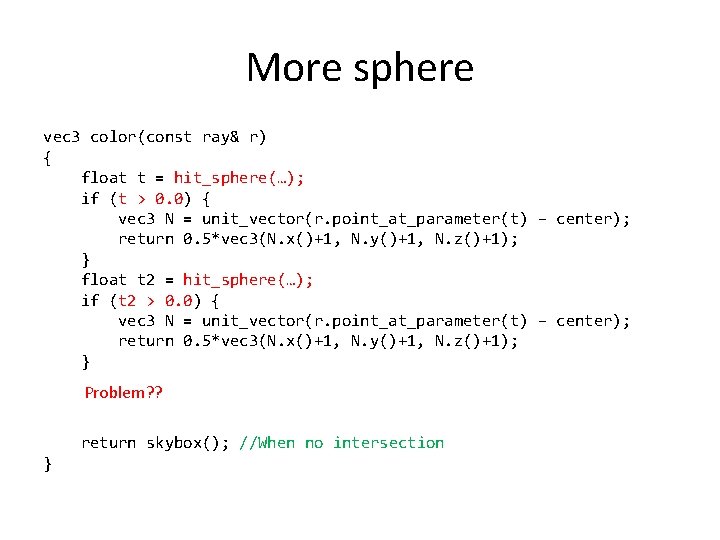
More sphere vec 3 color(const ray& r) { float t = hit_sphere(…); if (t > 0. 0) { vec 3 N = unit_vector(r. point_at_parameter(t) – center); return 0. 5*vec 3(N. x()+1, N. y()+1, N. z()+1); } float t 2 = hit_sphere(…); if (t 2 > 0. 0) { vec 3 N = unit_vector(r. point_at_parameter(t) – center); return 0. 5*vec 3(N. x()+1, N. y()+1, N. z()+1); } Problem? ? return skybox(); //When no intersection }
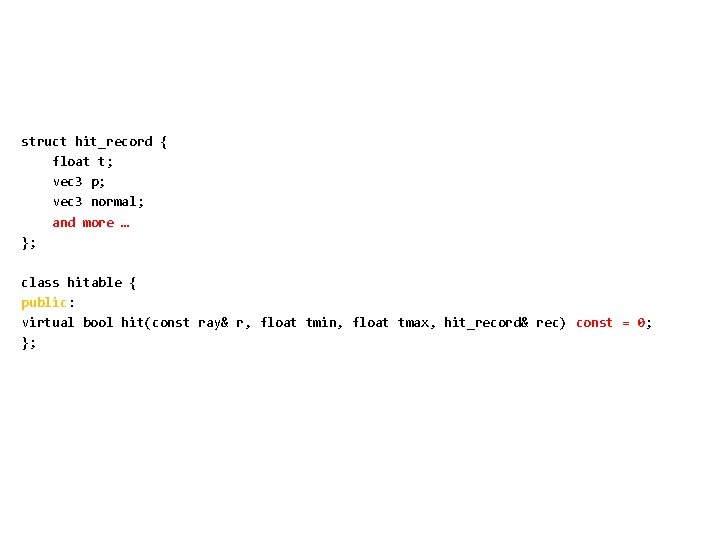
struct hit_record { float t; vec 3 p; vec 3 normal; and more … }; class hitable { public: virtual bool hit(const ray& r, float tmin, float tmax, hit_record& rec) const = 0; };
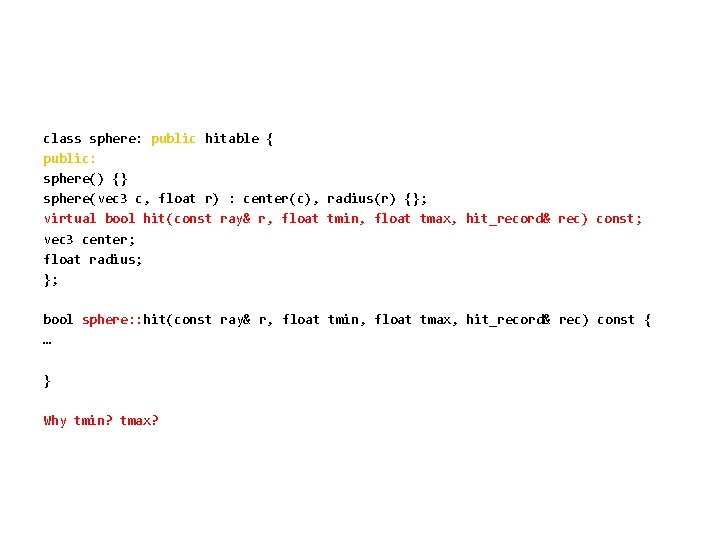
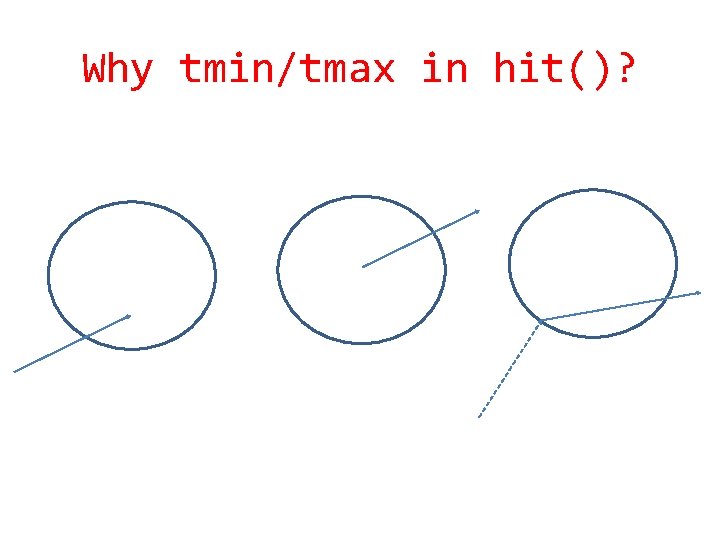
class sphere: public hitable { public: sphere() {} sphere(vec 3 c, float r) : center(c), radius(r) {}; virtual bool hit(const ray& r, float tmin, float tmax, hit_record& rec) const; vec 3 center; float radius; }; bool sphere: : hit(const ray& r, float tmin, float tmax, hit_record& rec) const { … } Why tmin? tmax?
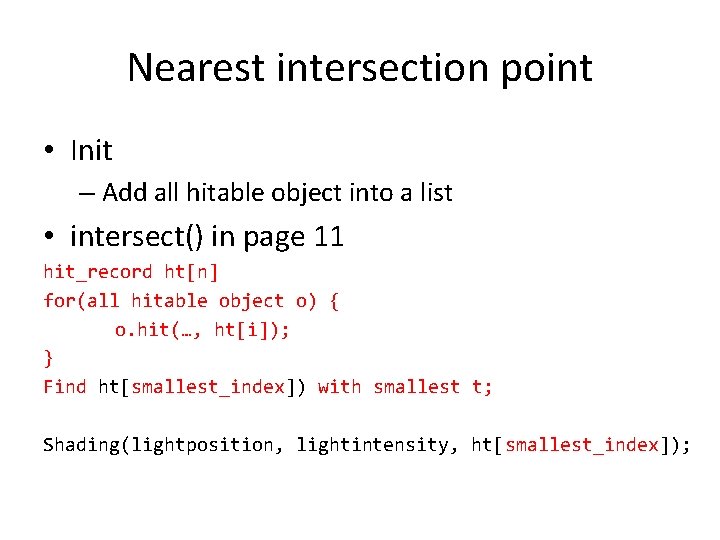
Nearest intersection point • Init – Add all hitable object into a list • intersect() in page 11 hit_record ht[n] for(all hitable object o) { o. hit(…, ht[i]); } Find ht[smallest_index]) with smallest t; Shading(lightposition, lightintensity, ht[smallest_index]);
Why tmin/tmax in hit()?
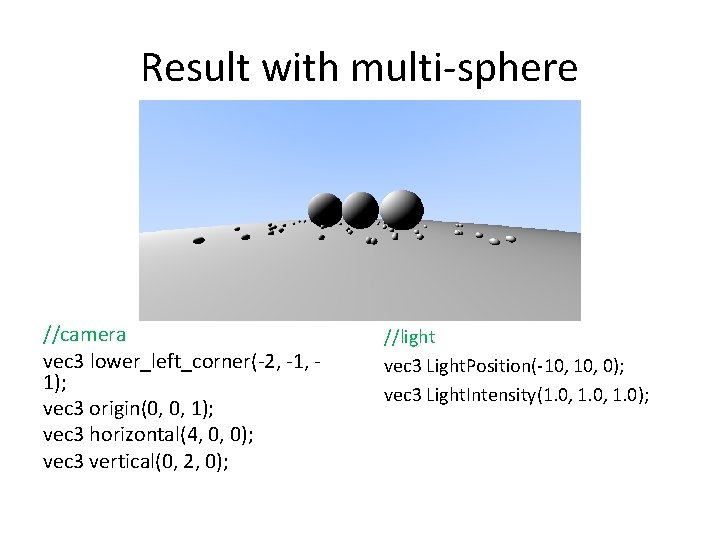
Result with multi-sphere //camera vec 3 lower_left_corner(-2, -1, 1); vec 3 origin(0, 0, 1); vec 3 horizontal(4, 0, 0); vec 3 vertical(0, 2, 0); //light vec 3 Light. Position(-10, 0); vec 3 Light. Intensity(1. 0, 1. 0);
RECURSIVE INTERSECTION WITH REFRACTION AND TRANSMISSION
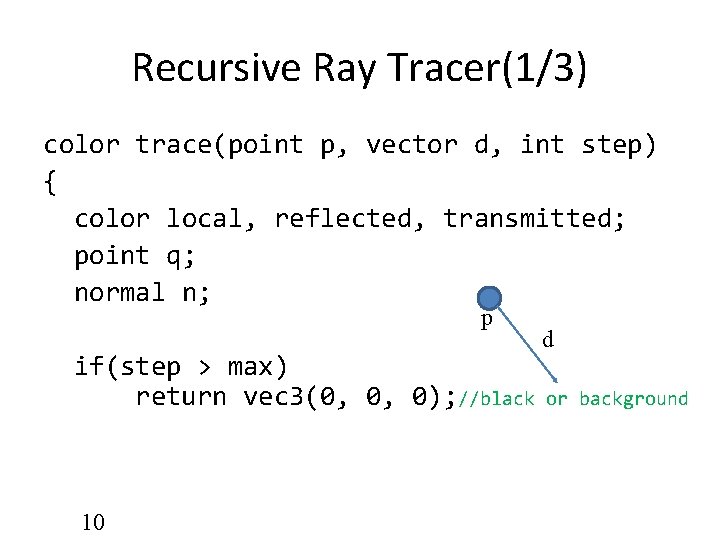
Recursive Ray Tracer(1/3) color trace(point p, vector d, int step) { color local, reflected, transmitted; point q; normal n; p if(step > max) return vec 3(0, 0, 0); //black 10 d or background
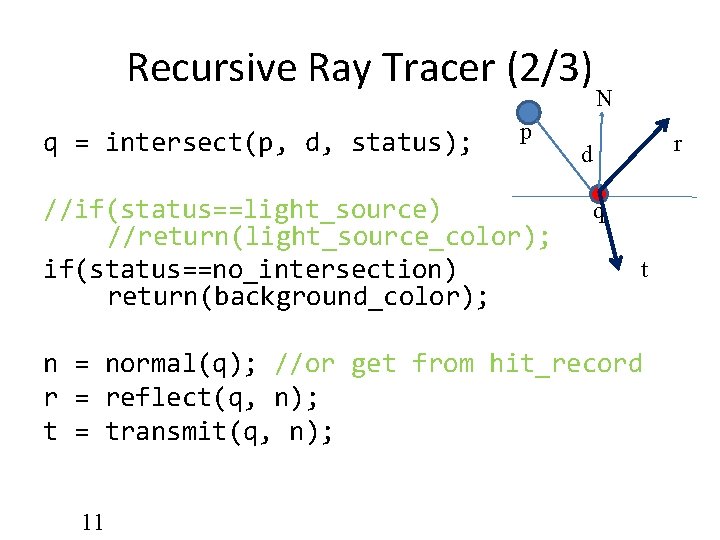
Recursive Ray Tracer (2/3) q = intersect(p, d, status); p //if(status==light_source) //return(light_source_color); if(status==no_intersection) return(background_color); N r d q t n = normal(q); //or get from hit_record r = reflect(q, n); t = transmit(q, n); 11
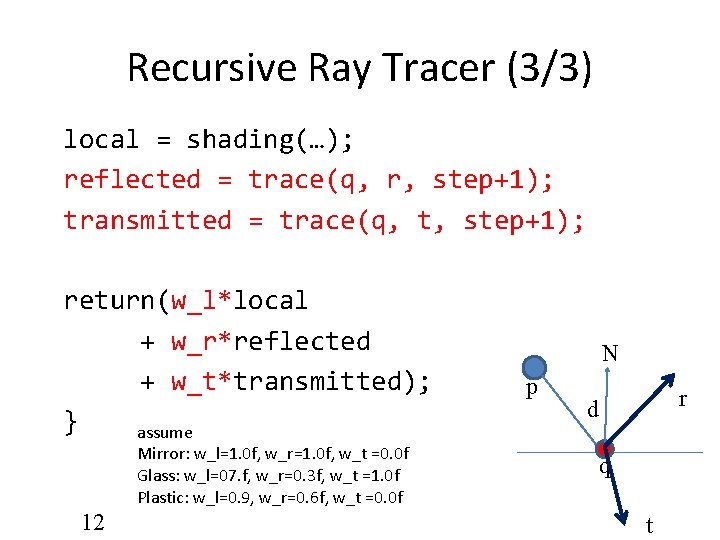
Recursive Ray Tracer (3/3) local = shading(…); reflected = trace(q, r, step+1); transmitted = trace(q, t, step+1); return(w_l*local + w_r*reflected + w_t*transmitted); } assume Mirror: w_l=1. 0 f, w_r=1. 0 f, w_t =0. 0 f Glass: w_l=07. f, w_r=0. 3 f, w_t =1. 0 f Plastic: w_l=0. 9, w_r=0. 6 f, w_t =0. 0 f 12 N p r d q t
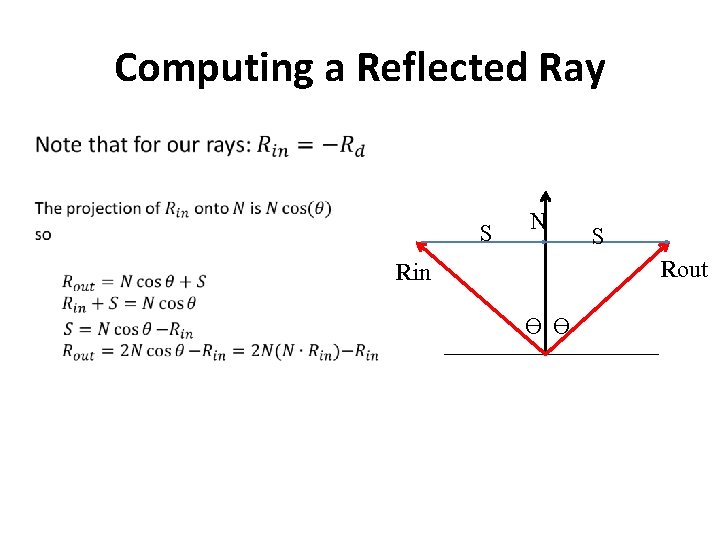
Computing a Reflected Ray • S N S Rout Rin Ɵ Ɵ
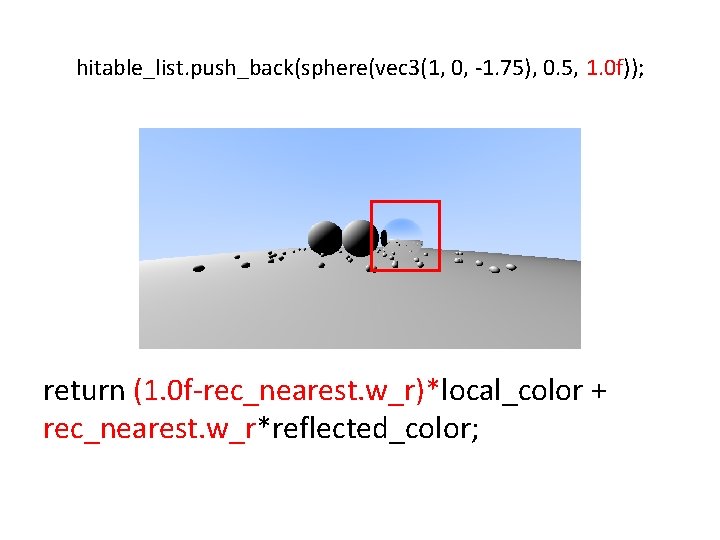
hitable_list. push_back(sphere(vec 3(1, 0, -1. 75), 0. 5, 1. 0 f)); return (1. 0 f-rec_nearest. w_r)*local_color + rec_nearest. w_r*reflected_color;
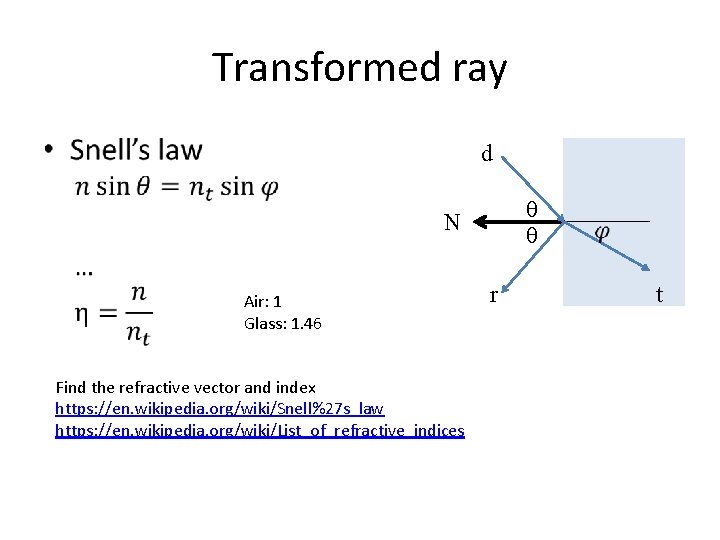
Transformed ray • d θ θ N Air: 1 Glass: 1. 46 Find the refractive vector and index https: //en. wikipedia. org/wiki/Snell%27 s_law https: //en. wikipedia. org/wiki/List_of_refractive_indices r t
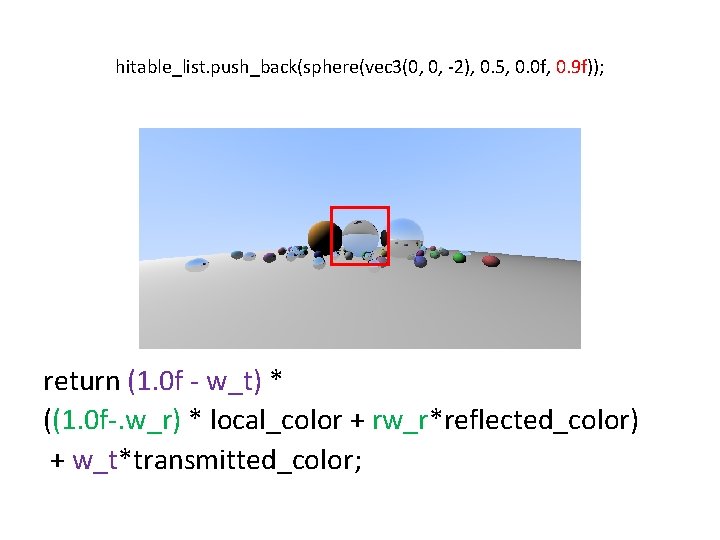
hitable_list. push_back(sphere(vec 3(0, 0, -2), 0. 5, 0. 0 f, 0. 9 f)); return (1. 0 f - w_t) * ((1. 0 f-. w_r) * local_color + rw_r*reflected_color) + w_t*transmitted_color;
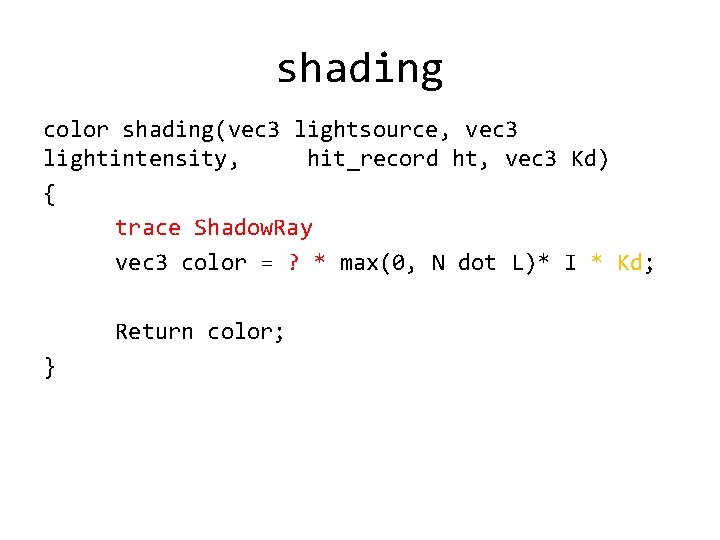
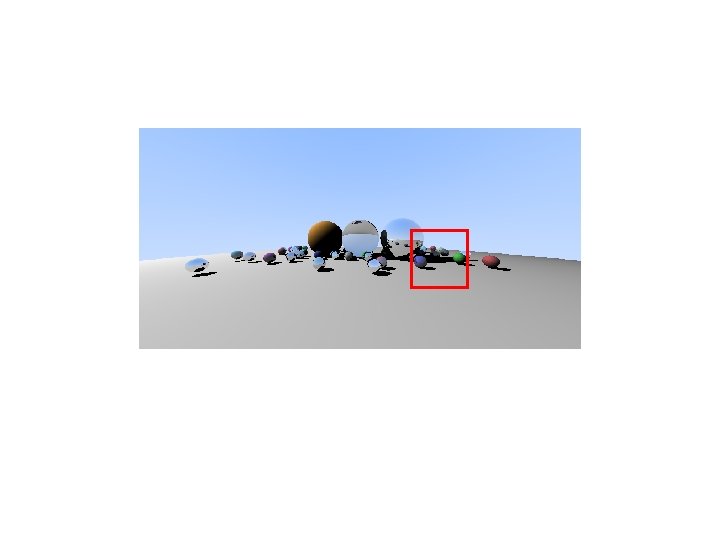
shading color shading(vec 3 lightsource, vec 3 lightintensity, hit_record ht, vec 3 Kd) { trace Shadow. Ray vec 3 color = ? * max(0, N dot L)* I * Kd; Return color; }
Bonus • More image format (bmp, png, …) – Easy for debug • Attenuation
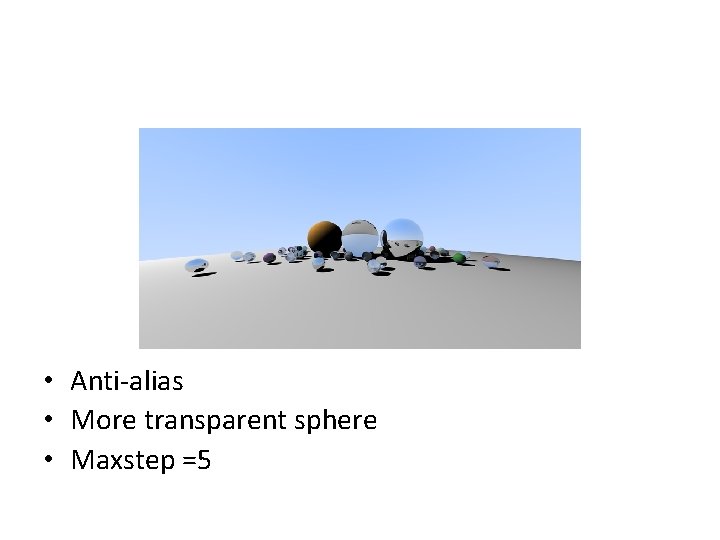
• Anti-alias • More transparent sphere • Maxstep =5
Reference • Chapter 4 in Fundamentals of Computer Graphics, 4/e.