
Computer graphics III Path tracing Jaroslav Kivnek MFF
![No incoming radiance information [Vorba et al. 2014] Bidirectional path tracing (1 h) CG](https://slidetodoc.com/presentation_image_h2/797183f494e502802f4ba045dc09043c/image-10.jpg "No incoming radiance information [Vorba et al. 2014] Bidirectional path tracing (1 h) CG")
![“Guiding” by incoming radiance [Vorba et al. 2014] Guided bidirectional path tracing (1 h)](https://slidetodoc.com/presentation_image_h2/797183f494e502802f4ba045dc09043c/image-11.jpg "“Guiding” by incoming radiance [Vorba et al. 2014] Guided bidirectional path tracing (1 h)")
- Slides: 23
Computer graphics III – Path tracing Jaroslav Křivánek, MFF UK Jaroslav. Krivanek@mff. cuni. cz
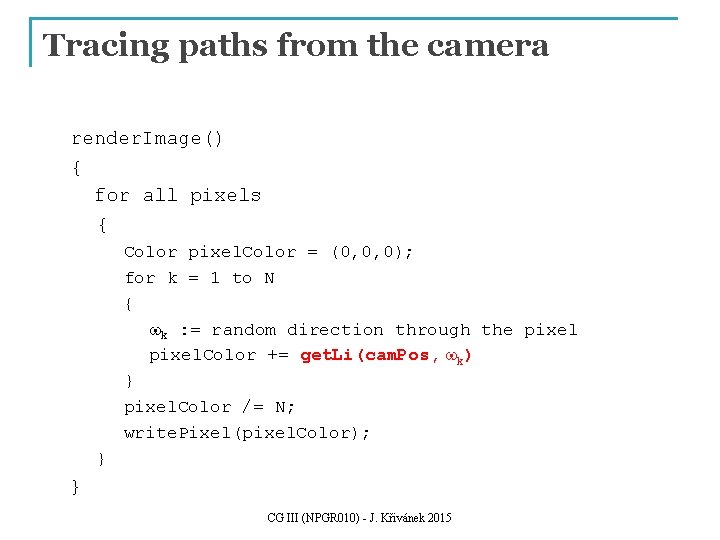
Tracing paths from the camera render. Image() { for all pixels { Color pixel. Color = (0, 0, 0); for k = 1 to N { wk : = random direction through the pixel. Color += get. Li(cam. Pos, wk) } pixel. Color /= N; write. Pixel(pixel. Color); } } CG III (NPGR 010) - J. Křivánek 2015
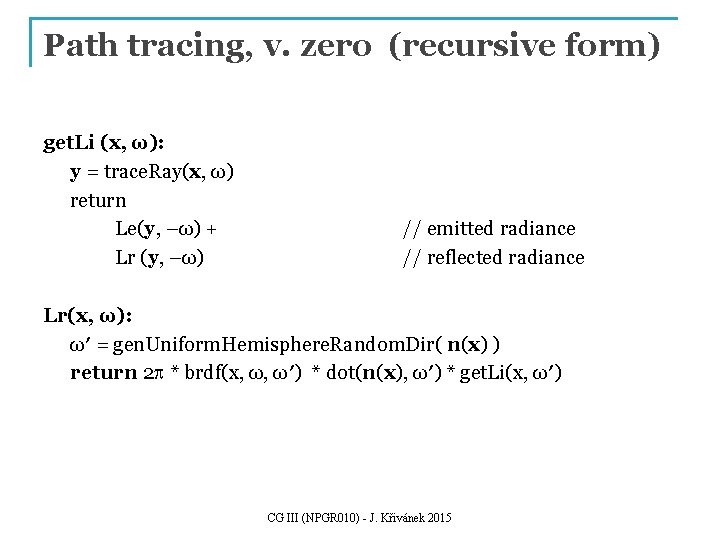
Path tracing, v. zero (recursive form) get. Li (x, ω): y = trace. Ray(x, ω) return Le(y, –ω) + Lr (y, –ω) // emitted radiance // reflected radiance Lr(x, ω): ω′ = gen. Uniform. Hemisphere. Random. Dir( n(x) ) return 2 p * brdf(x, ω, ω′) * dot(n(x), ω′) * get. Li(x, ω′) CG III (NPGR 010) - J. Křivánek 2015
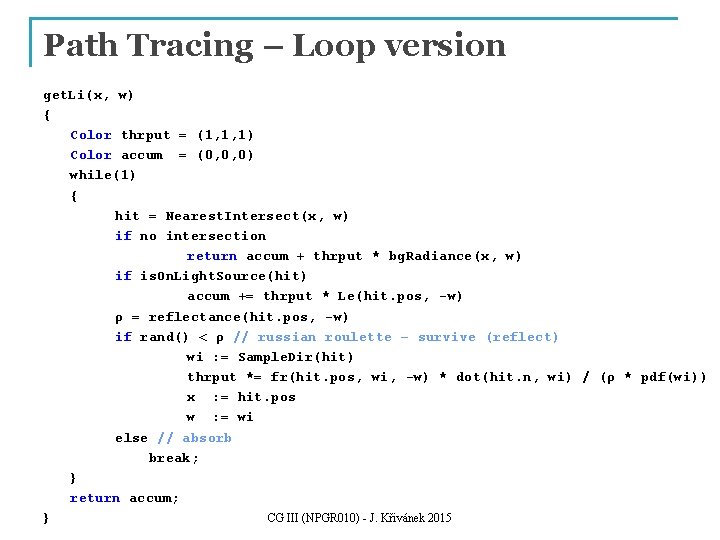
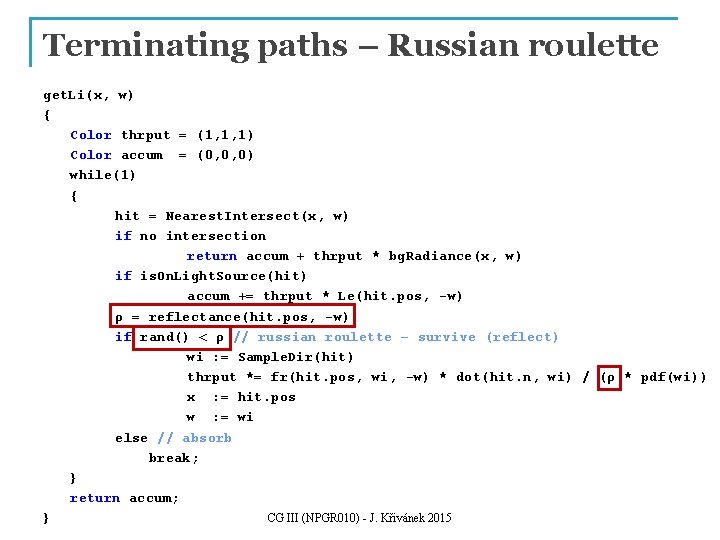
Path Tracing – Loop version get. Li(x, w) { Color thrput = (1, 1, 1) Color accum = (0, 0, 0) while(1) { hit = Nearest. Intersect(x, w) if no intersection return accum + thrput * bg. Radiance(x, w) if is. On. Light. Source(hit) accum += thrput * Le(hit. pos, -w) ρ = reflectance(hit. pos, -w) if rand() < ρ // russian roulette – survive (reflect) wi : = Sample. Dir(hit) thrput *= fr(hit. pos, wi, -w) * dot(hit. n, wi) / (ρ * pdf(wi)) x : = hit. pos w : = wi else // absorb break; } return accum; CG III (NPGR 010) - J. Křivánek 2015 }
Terminating paths – Russian roulette get. Li(x, w) { Color thrput = (1, 1, 1) Color accum = (0, 0, 0) while(1) { hit = Nearest. Intersect(x, w) if no intersection return accum + thrput * bg. Radiance(x, w) if is. On. Light. Source(hit) accum += thrput * Le(hit. pos, -w) ρ = reflectance(hit. pos, -w) if rand() < ρ // russian roulette – survive (reflect) wi : = Sample. Dir(hit) thrput *= fr(hit. pos, wi, -w) * dot(hit. n, wi) / (ρ * pdf(wi)) x : = hit. pos w : = wi else // absorb break; } return accum; CG III (NPGR 010) - J. Křivánek 2015 }
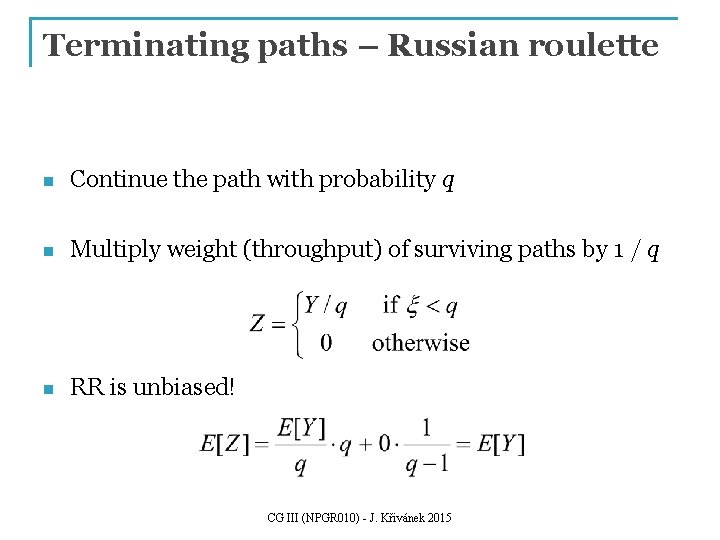
Terminating paths – Russian roulette n Continue the path with probability q n Multiply weight (throughput) of surviving paths by 1 / q n RR is unbiased! CG III (NPGR 010) - J. Křivánek 2015
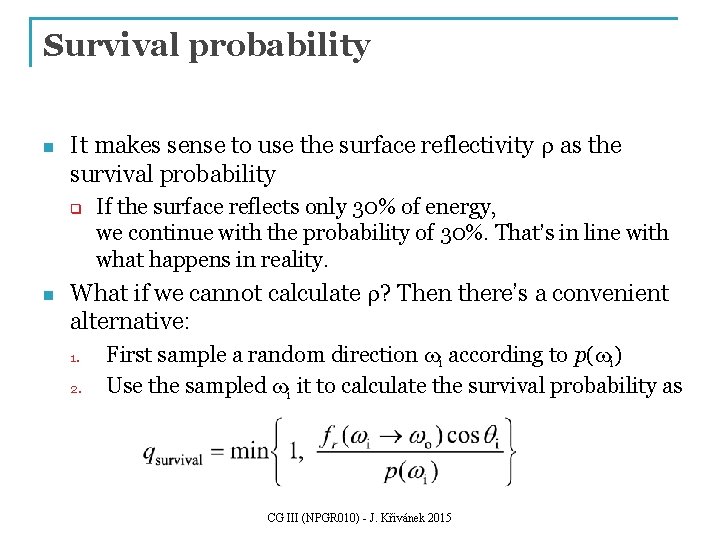
Survival probability n It makes sense to use the surface reflectivity r as the survival probability q n If the surface reflects only 30% of energy, we continue with the probability of 30%. That’s in line with what happens in reality. What if we cannot calculate r? Then there’s a convenient alternative: 1. 2. First sample a random direction wi according to p(wi) Use the sampled wi it to calculate the survival probability as CG III (NPGR 010) - J. Křivánek 2015
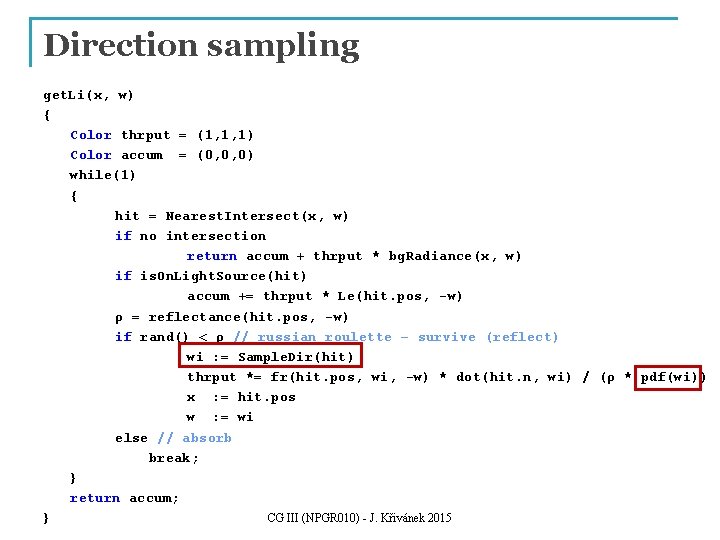
Direction sampling get. Li(x, w) { Color thrput = (1, 1, 1) Color accum = (0, 0, 0) while(1) { hit = Nearest. Intersect(x, w) if no intersection return accum + thrput * bg. Radiance(x, w) if is. On. Light. Source(hit) accum += thrput * Le(hit. pos, -w) ρ = reflectance(hit. pos, -w) if rand() < ρ // russian roulette – survive (reflect) wi : = Sample. Dir(hit) thrput *= fr(hit. pos, wi, -w) * dot(hit. n, wi) / (ρ * pdf(wi)) x : = hit. pos w : = wi else // absorb break; } return accum; CG III (NPGR 010) - J. Křivánek 2015 }
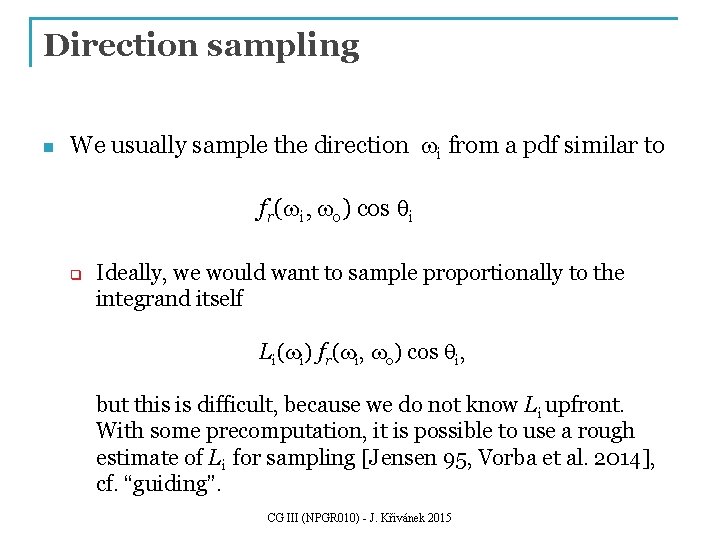
Direction sampling n We usually sample the direction wi from a pdf similar to fr(wi, wo) cos qi q Ideally, we would want to sample proportionally to the integrand itself Li(wi) fr(wi, wo) cos qi, but this is difficult, because we do not know Li upfront. With some precomputation, it is possible to use a rough estimate of Li for sampling [Jensen 95, Vorba et al. 2014], cf. “guiding”. CG III (NPGR 010) - J. Křivánek 2015
No incoming radiance information [Vorba et al. 2014] Bidirectional path tracing (1 h) CG III (NPGR 010) - J. Křivánek 2015 10
“Guiding” by incoming radiance [Vorba et al. 2014] Guided bidirectional path tracing (1 h) CG III (NPGR 010) - J. Křivánek 2015 11
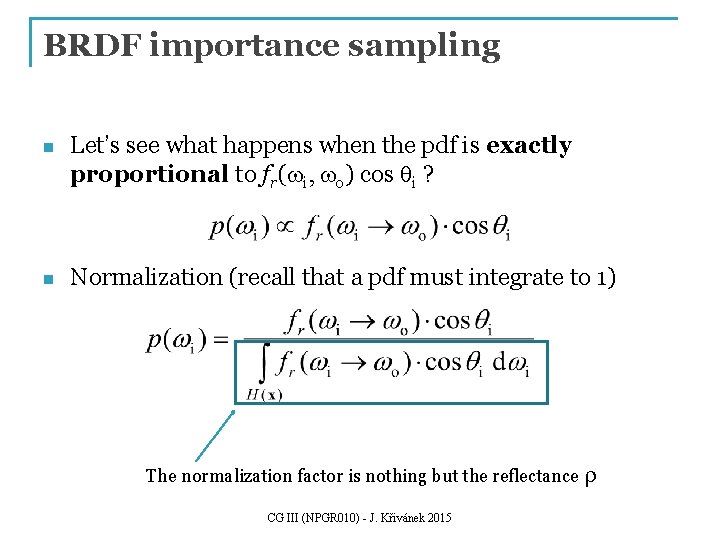
BRDF importance sampling n Let’s see what happens when the pdf is exactly proportional to fr(wi, wo) cos qi ? n Normalization (recall that a pdf must integrate to 1) The normalization factor is nothing but the reflectance r CG III (NPGR 010) - J. Křivánek 2015
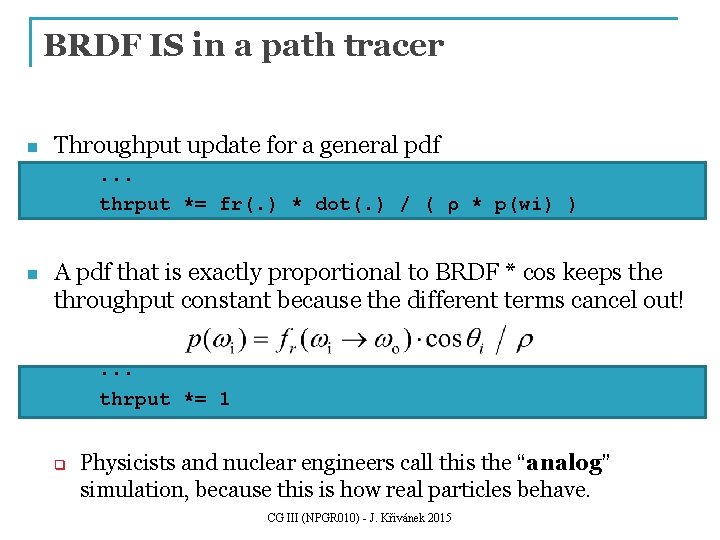
BRDF IS in a path tracer n Throughput update for a general pdf. . . thrput *= fr(. ) * dot(. ) / ( ρ * p(wi) ) n A pdf that is exactly proportional to BRDF * cos keeps the throughput constant because the different terms cancel out!. . . thrput *= 1 q Physicists and nuclear engineers call this the “analog” simulation, because this is how real particles behave. CG III (NPGR 010) - J. Křivánek 2015
Direct illumination calculation in a path tracer
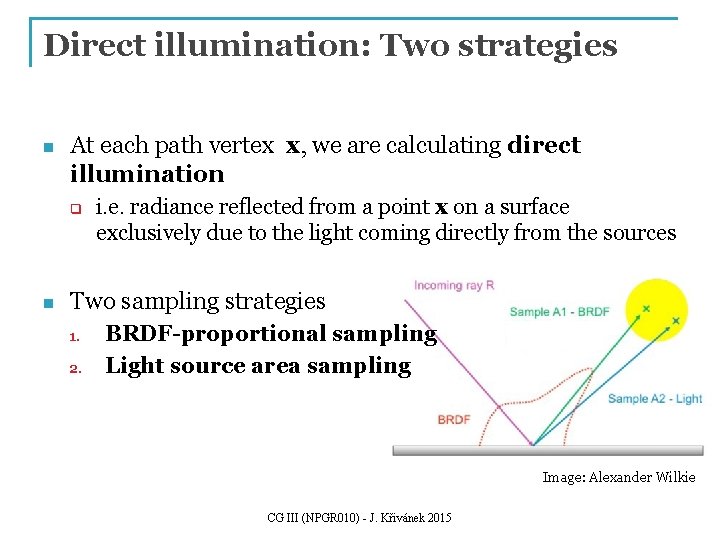
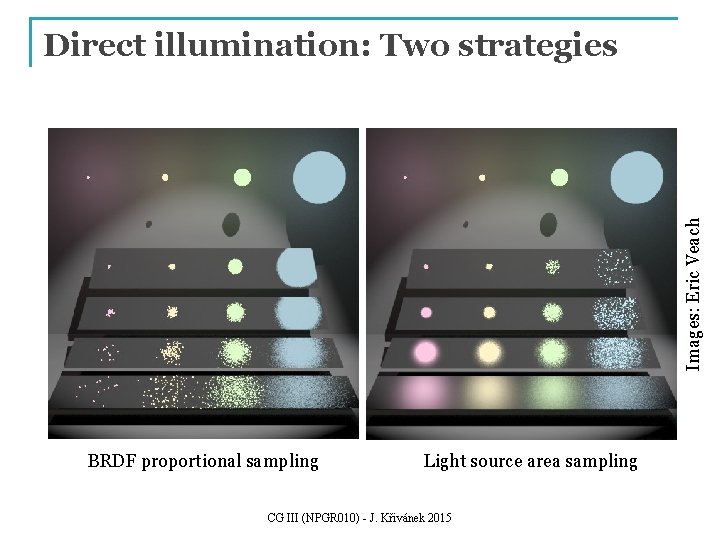
Direct illumination: Two strategies n At each path vertex x, we are calculating direct illumination q n i. e. radiance reflected from a point x on a surface exclusively due to the light coming directly from the sources Two sampling strategies 1. 2. BRDF-proportional sampling Light source area sampling Image: Alexander Wilkie CG III (NPGR 010) - J. Křivánek 2015
Images: Eric Veach Direct illumination: Two strategies BRDF proportional sampling Light source area sampling CG III (NPGR 010) - J. Křivánek 2015
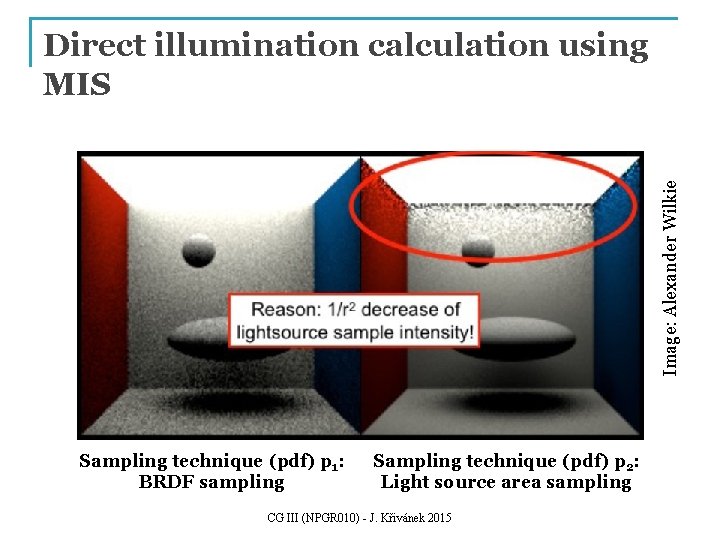
Image: Alexander Wilkie Direct illumination calculation using MIS Sampling technique (pdf) p 1: BRDF sampling Sampling technique (pdf) p 2: Light source area sampling CG III (NPGR 010) - J. Křivánek 2015
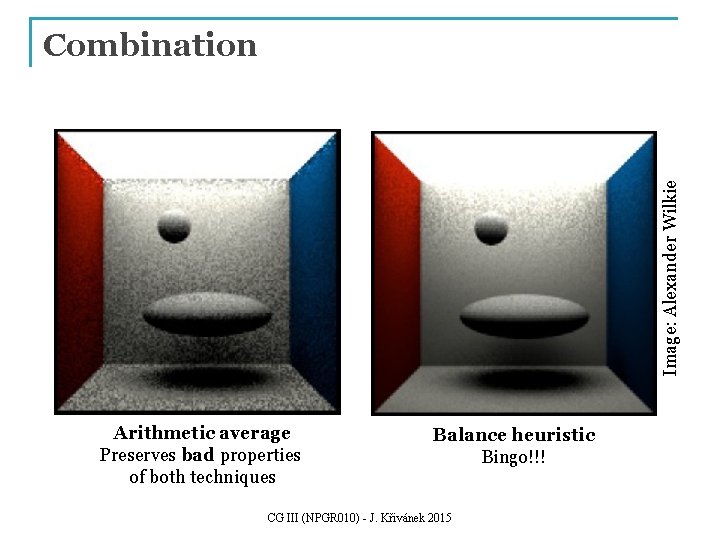
Image: Alexander Wilkie Combination Arithmetic average Preserves bad properties of both techniques Balance heuristic Bingo!!! CG III (NPGR 010) - J. Křivánek 2015
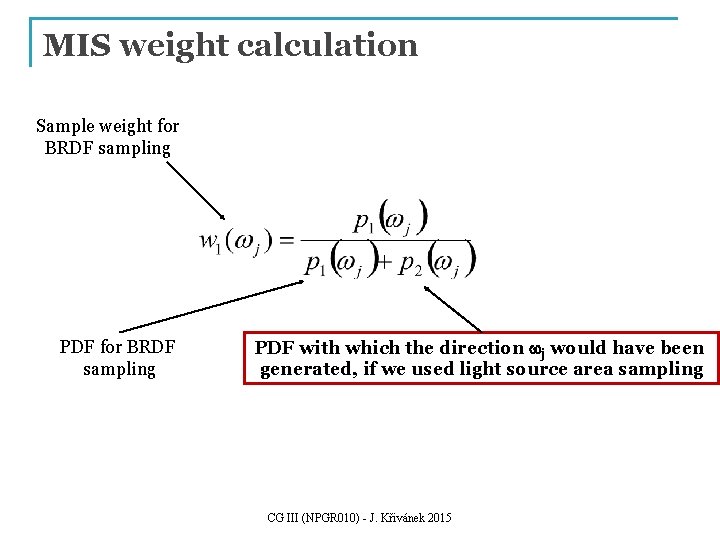
MIS weight calculation Sample weight for BRDF sampling PDF with which the direction wj would have been generated, if we used light source area sampling CG III (NPGR 010) - J. Křivánek 2015
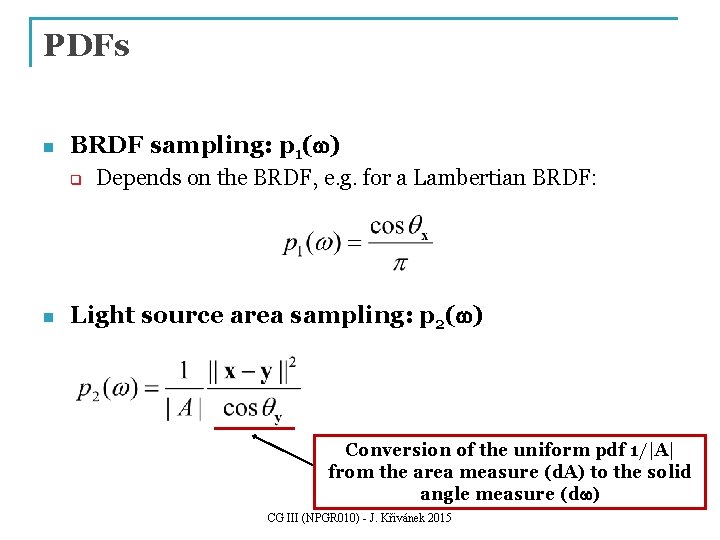
PDFs n BRDF sampling: p 1(w) q n Depends on the BRDF, e. g. for a Lambertian BRDF: Light source area sampling: p 2(w) Conversion of the uniform pdf 1/|A| from the area measure (d. A) to the solid angle measure (dw) CG III (NPGR 010) - J. Křivánek 2015
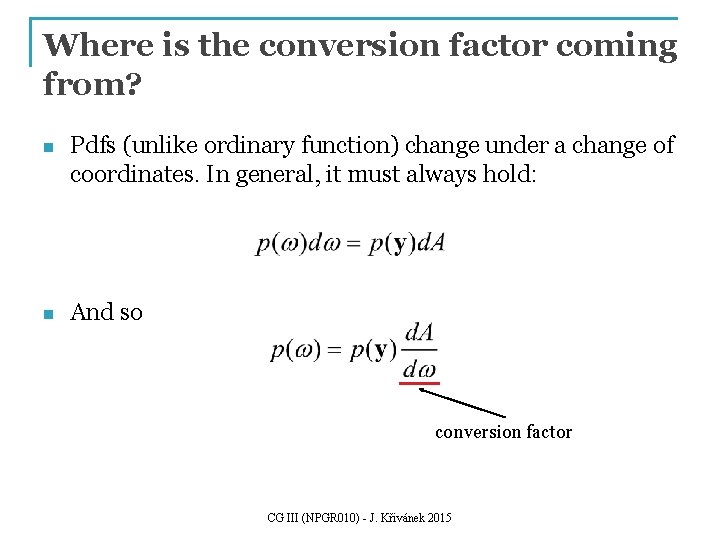
Where is the conversion factor coming from? n Pdfs (unlike ordinary function) change under a change of coordinates. In general, it must always hold: n And so conversion factor CG III (NPGR 010) - J. Křivánek 2015
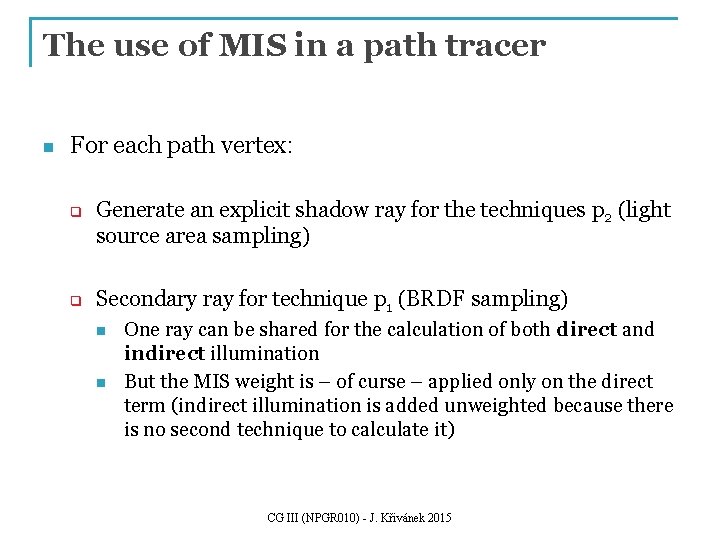
The use of MIS in a path tracer n For each path vertex: q q Generate an explicit shadow ray for the techniques p 2 (light source area sampling) Secondary ray for technique p 1 (BRDF sampling) n n One ray can be shared for the calculation of both direct and indirect illumination But the MIS weight is – of curse – applied only on the direct term (indirect illumination is added unweighted because there is no second technique to calculate it) CG III (NPGR 010) - J. Křivánek 2015
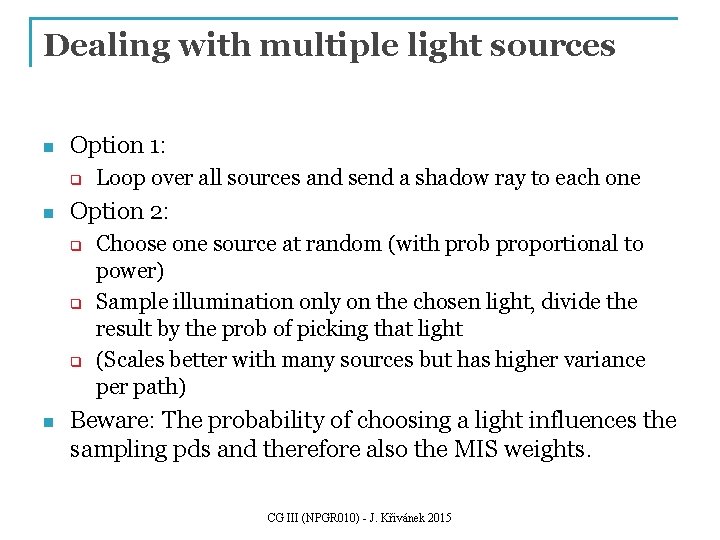
Dealing with multiple light sources n Option 1: q n Option 2: q q q n Loop over all sources and send a shadow ray to each one Choose one source at random (with prob proportional to power) Sample illumination only on the chosen light, divide the result by the prob of picking that light (Scales better with many sources but has higher variance per path) Beware: The probability of choosing a light influences the sampling pds and therefore also the MIS weights. CG III (NPGR 010) - J. Křivánek 2015