
Computer graphics III Multiple Importance Sampling Jaroslav Kivnek
![Multiple Importance Sampling (MIS) [Veach & Guibas, 95] Combined estimator: f(x) pa(x) pb(x) xa](https://slidetodoc.com/presentation_image/20c2c21d14ee20ed6fd93ea696fb9361/image-5.jpg "Multiple Importance Sampling (MIS) [Veach & Guibas, 95] Combined estimator: f(x) pa(x) pb(x) xa")
- Slides: 38
Computer graphics III – Multiple Importance Sampling Jaroslav Křivánek, MFF UK Jaroslav. Krivanek@mff. cuni. cz
Multiple Importance Sampling in a few slides
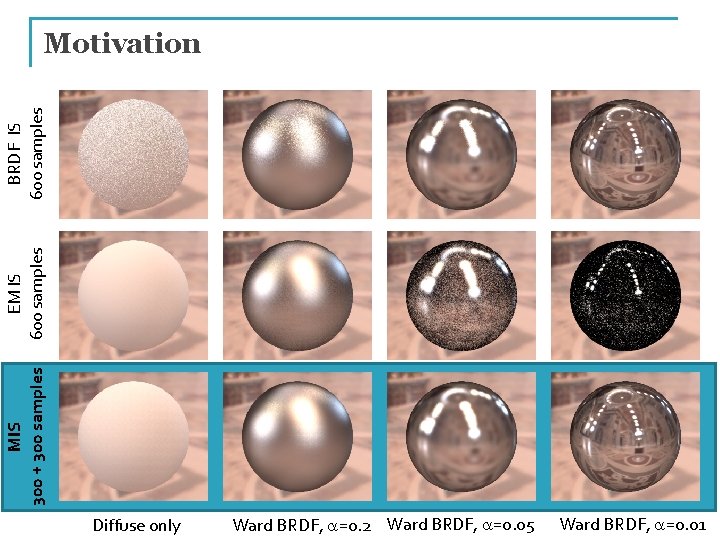
MIS 300 + 300 samples EM IS 600 samples BRDF IS 600 samples Motivation Diffuse only Ward BRDF, a=0. 2 Ward BRDF, a=0. 05 Ward BRDF, a=0. 01
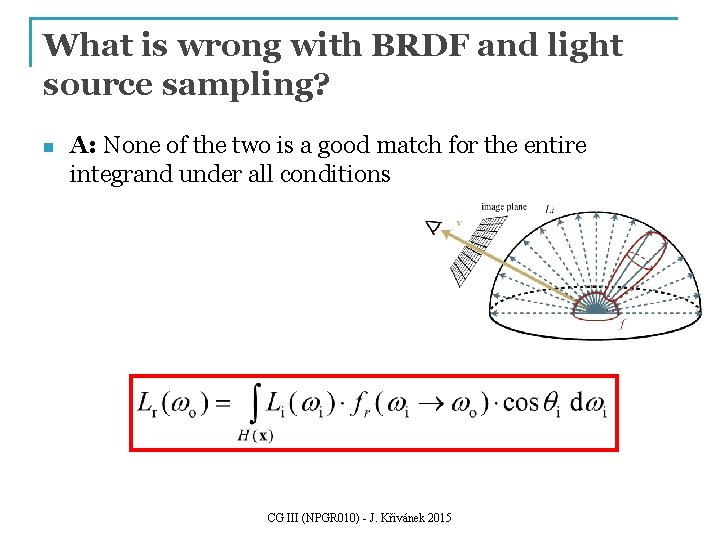
What is wrong with BRDF and light source sampling? n A: None of the two is a good match for the entire integrand under all conditions CG III (NPGR 010) - J. Křivánek 2015
Multiple Importance Sampling (MIS) [Veach & Guibas, 95] Combined estimator: f(x) pa(x) pb(x) xa
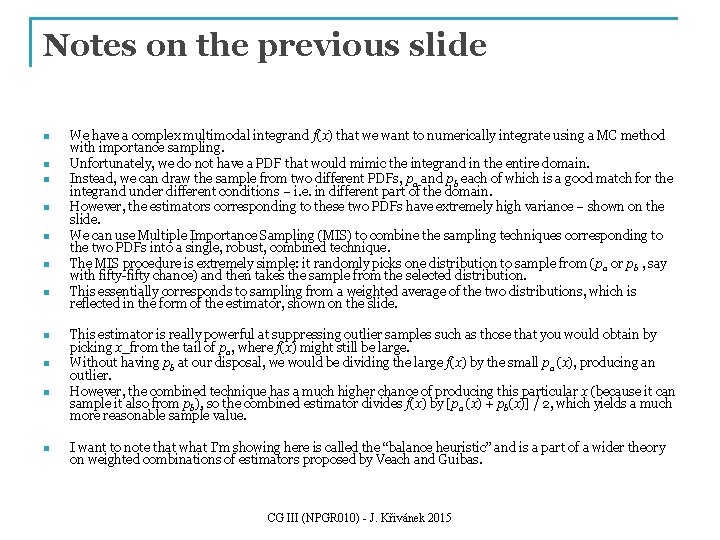
Notes on the previous slide n n n We have a complex multimodal integrand f(x) that we want to numerically integrate using a MC method with importance sampling. Unfortunately, we do not have a PDF that would mimic the integrand in the entire domain. Instead, we can draw the sample from two different PDFs, pa and pb each of which is a good match for the integrand under different conditions – i. e. in different part of the domain. However, the estimators corresponding to these two PDFs have extremely high variance – shown on the slide. We can use Multiple Importance Sampling (MIS) to combine the sampling techniques corresponding to the two PDFs into a single, robust, combined technique. The MIS procedure is extremely simple: it randomly picks one distribution to sample from (pa or pb , say with fifty-fifty chance) and then takes the sample from the selected distribution. This essentially corresponds to sampling from a weighted average of the two distributions, which is reflected in the form of the estimator, shown on the slide. This estimator is really powerful at suppressing outlier samples such as those that you would obtain by picking x_from the tail of pa, where f(x) might still be large. Without having pb at our disposal, we would be dividing the large f(x) by the small pa (x), producing an outlier. However, the combined technique has a much higher chance of producing this particular x (because it can sample it also from pb), so the combined estimator divides f(x) by [pa (x) + pb(x)] / 2, which yields a much more reasonable sample value. I want to note that what I’m showing here is called the “balance heuristic” and is a part of a wider theory on weighted combinations of estimators proposed by Veach and Guibas. CG III (NPGR 010) - J. Křivánek 2015
Application to direct illumination n Two sampling strategies 1. BRDF-proportional sampling - pa 2. Environment map sampling - pb CG III (NPGR 010) - J. Křivánek 2015
… and now the (almost) full story First for general estimators, so please forget the direct illumination problem for a short while.
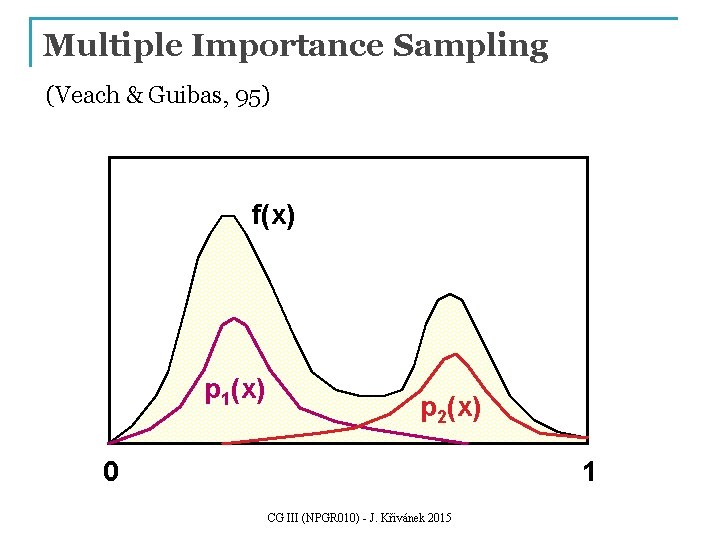
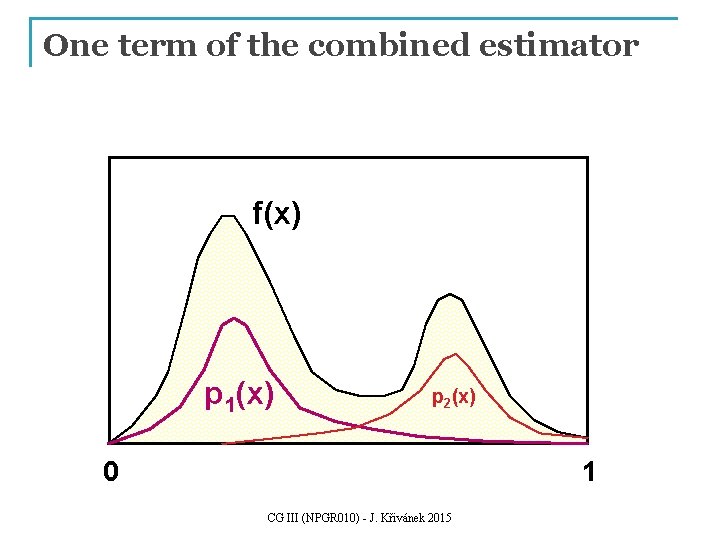
Multiple Importance Sampling (Veach & Guibas, 95) f(x) p 1(x) p 2(x) 0 1 CG III (NPGR 010) - J. Křivánek 2015
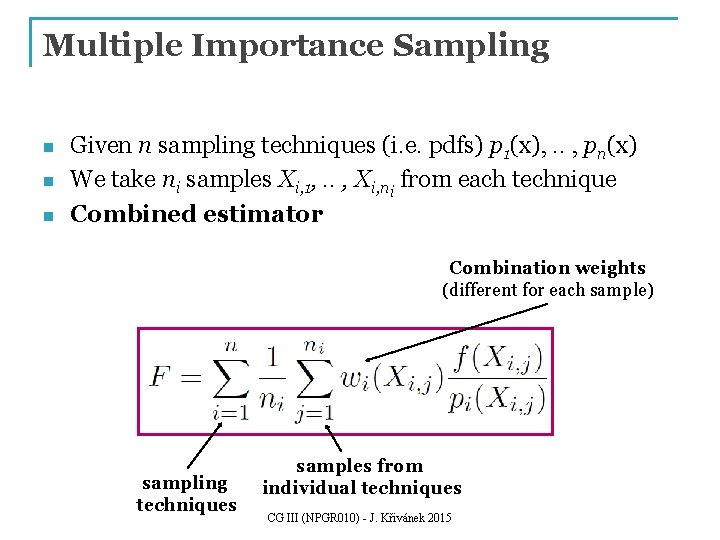
Multiple Importance Sampling n n n Given n sampling techniques (i. e. pdfs) p 1(x), . . , pn(x) We take ni samples Xi, 1, . . , Xi, ni from each technique Combined estimator Combination weights (different for each sample) sampling techniques samples from individual techniques CG III (NPGR 010) - J. Křivánek 2015
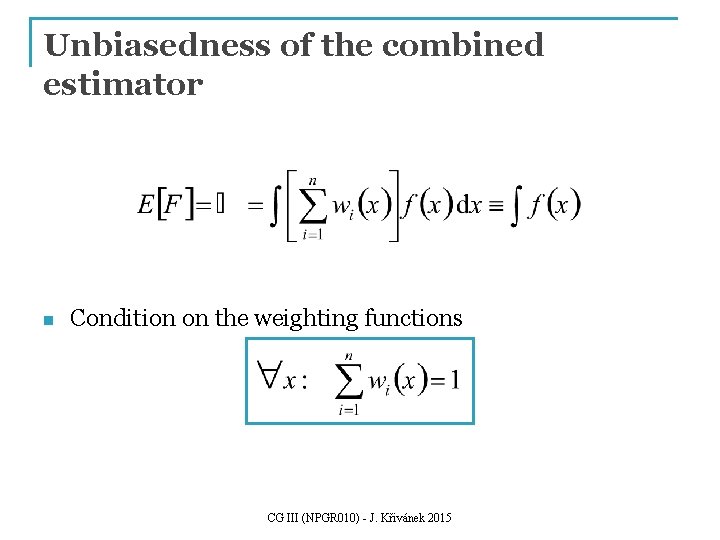
Unbiasedness of the combined estimator n Condition on the weighting functions CG III (NPGR 010) - J. Křivánek 2015
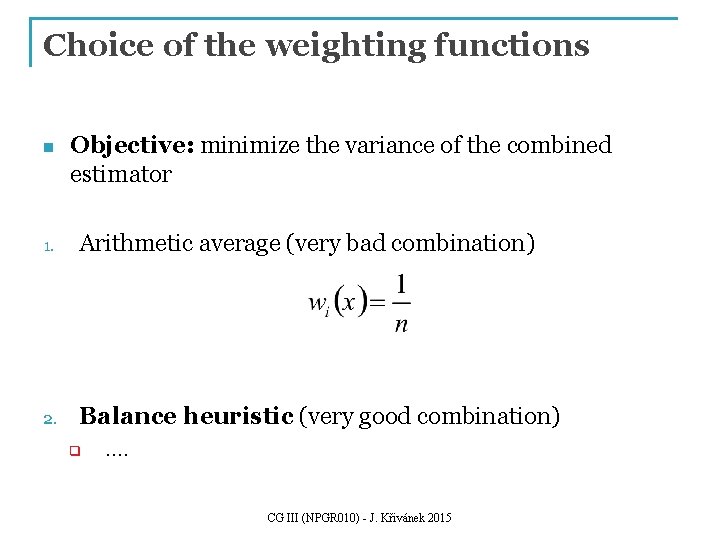
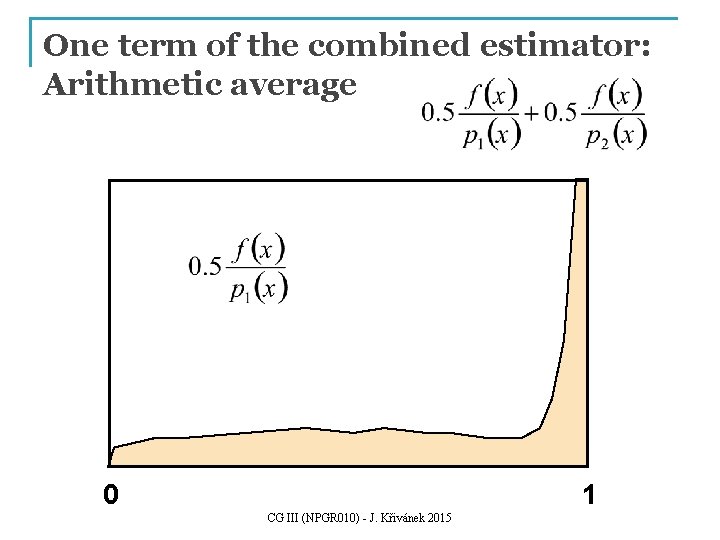
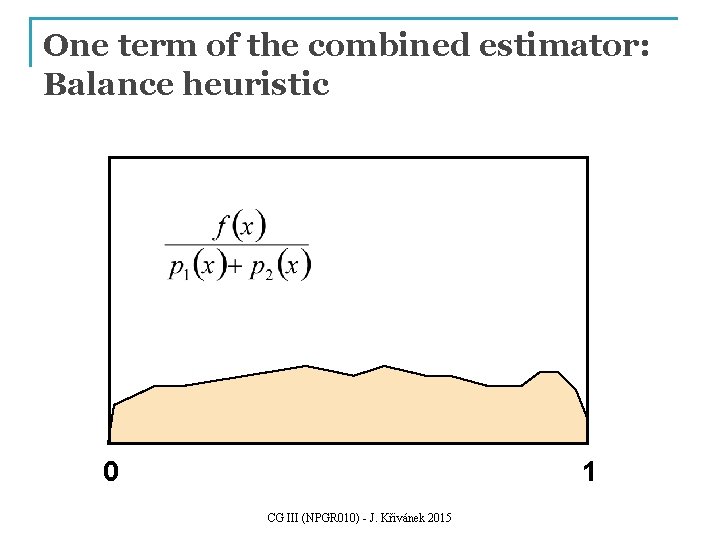
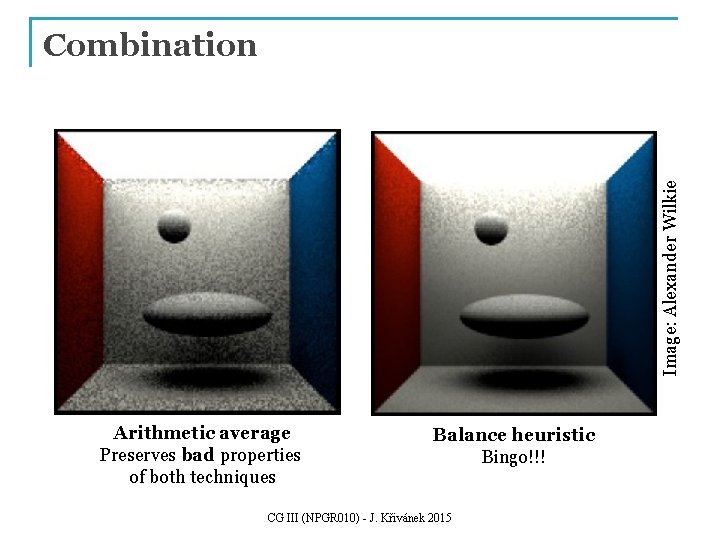
Choice of the weighting functions n Objective: minimize the variance of the combined estimator 1. Arithmetic average (very bad combination) 2. Balance heuristic (very good combination) q …. CG III (NPGR 010) - J. Křivánek 2015
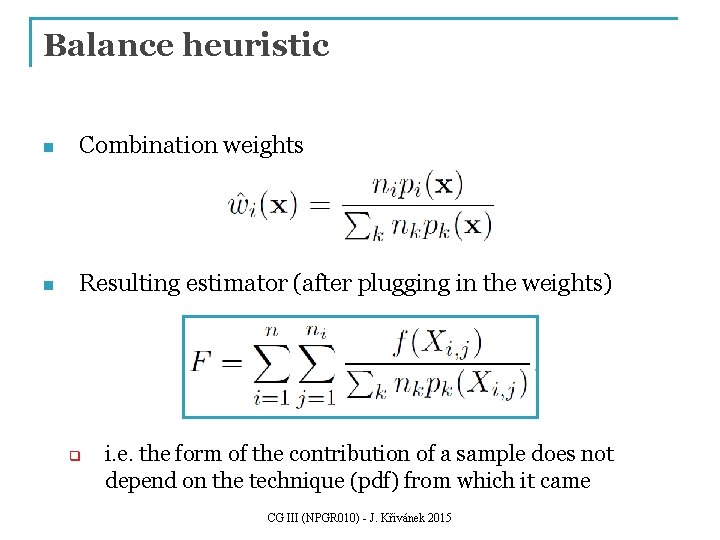
Balance heuristic n Combination weights n Resulting estimator (after plugging in the weights) q i. e. the form of the contribution of a sample does not depend on the technique (pdf) from which it came CG III (NPGR 010) - J. Křivánek 2015
Balance heuristic n The balance heuristic is almost optimal q n No other weighting has variance much lower than the balance heuristic Further possible combination heuristics q q q Power heuristic Maximum heuristics See [Veach 1997] CG III (NPGR 010) - J. Křivánek 2015
One term of the combined estimator f(x) p 1(x) p 2(x) 0 1 CG III (NPGR 010) - J. Křivánek 2015
One term of the combined estimator: Arithmetic average 0 1 CG III (NPGR 010) - J. Křivánek 2015
One term of the combined estimator: Balance heuristic 0 1 CG III (NPGR 010) - J. Křivánek 2015
Direct illumination calculation using MIS We now focus on area lights instead of the motivating example that used environment maps. But the idea is the same.
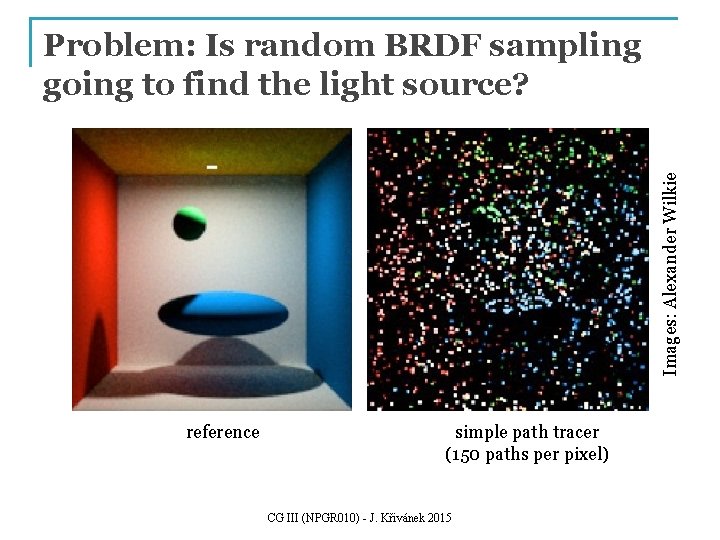
Images: Alexander Wilkie Problem: Is random BRDF sampling going to find the light source? reference simple path tracer (150 paths per pixel) CG III (NPGR 010) - J. Křivánek 2015
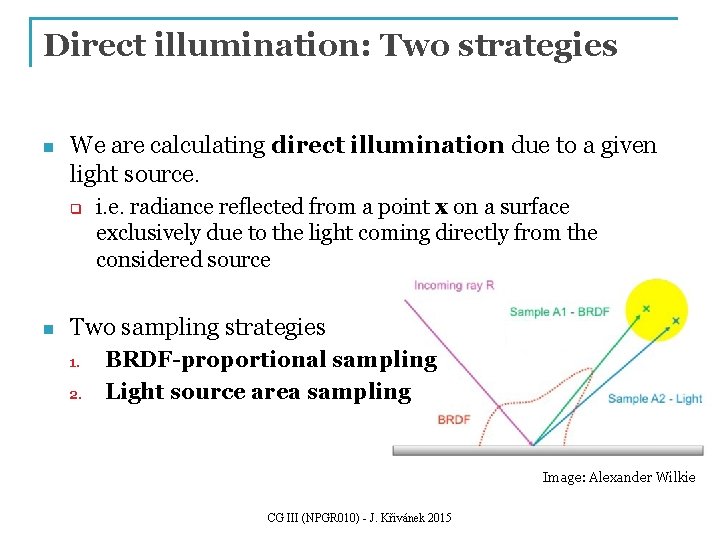
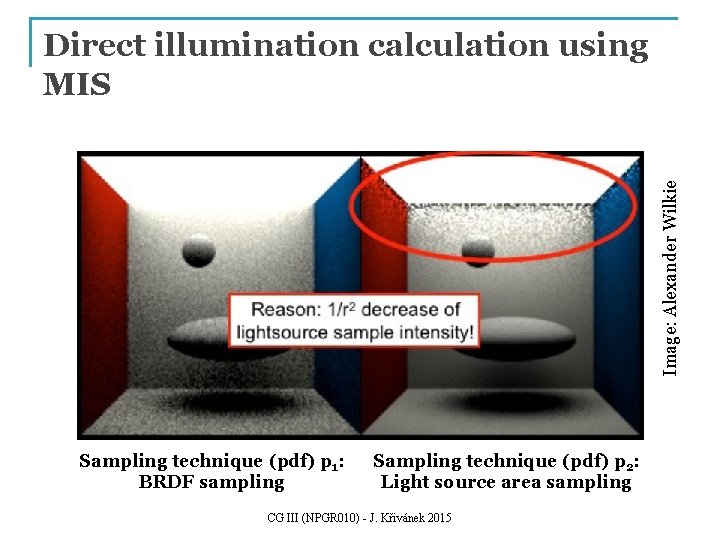
Direct illumination: Two strategies n We are calculating direct illumination due to a given light source. q n i. e. radiance reflected from a point x on a surface exclusively due to the light coming directly from the considered source Two sampling strategies 1. 2. BRDF-proportional sampling Light source area sampling Image: Alexander Wilkie CG III (NPGR 010) - J. Křivánek 2015
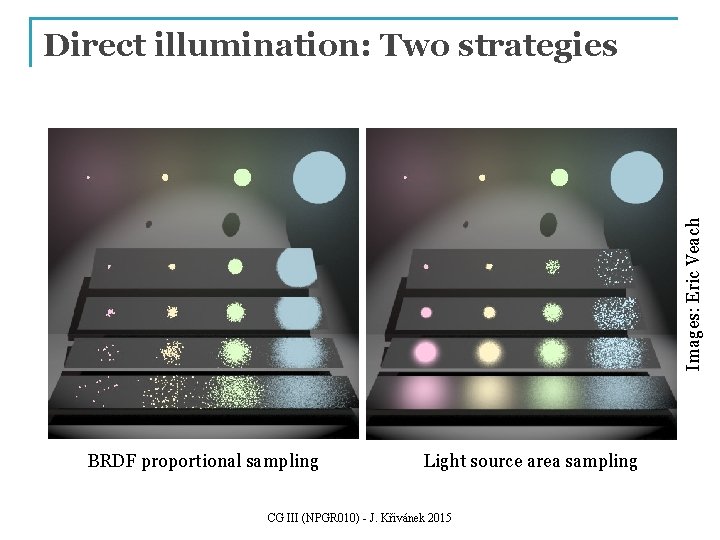
Images: Eric Veach Direct illumination: Two strategies BRDF proportional sampling Light source area sampling CG III (NPGR 010) - J. Křivánek 2015
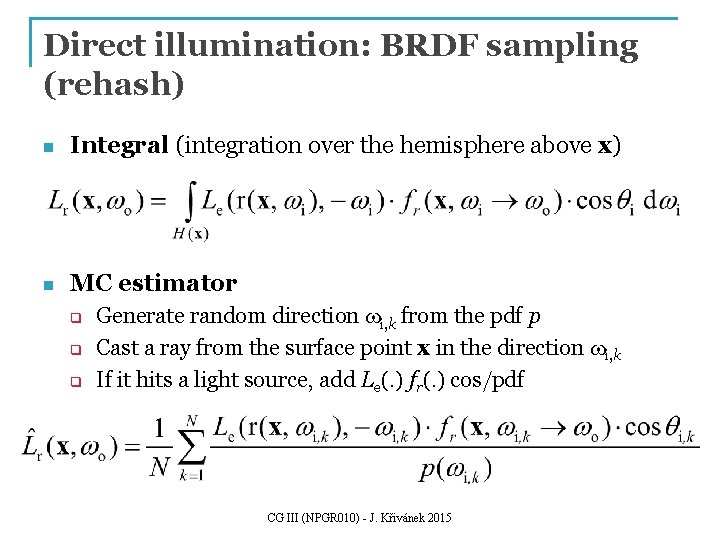
Direct illumination: BRDF sampling (rehash) n Integral (integration over the hemisphere above x) n MC estimator q q q Generate random direction wi, k from the pdf p Cast a ray from the surface point x in the direction wi, k If it hits a light source, add Le(. ) fr(. ) cos/pdf CG III (NPGR 010) - J. Křivánek 2015
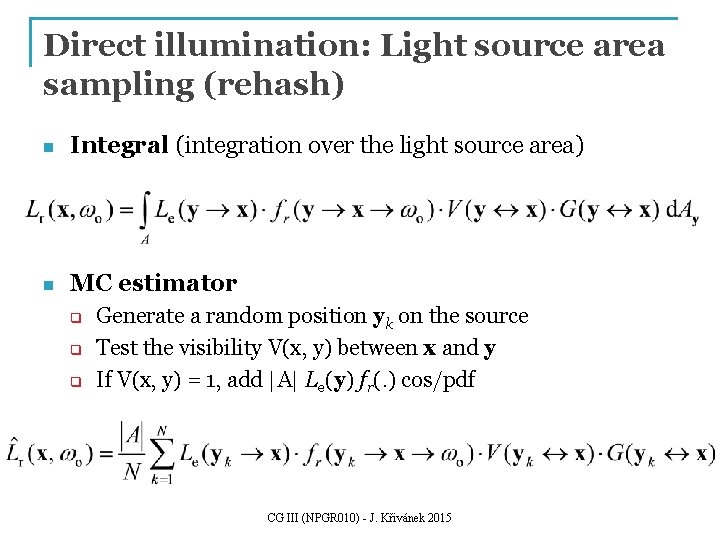
Direct illumination: Light source area sampling (rehash) n Integral (integration over the light source area) n MC estimator q q q Generate a random position yk on the source Test the visibility V(x, y) between x and y If V(x, y) = 1, add |A| Le(y) fr(. ) cos/pdf CG III (NPGR 010) - J. Křivánek 2015
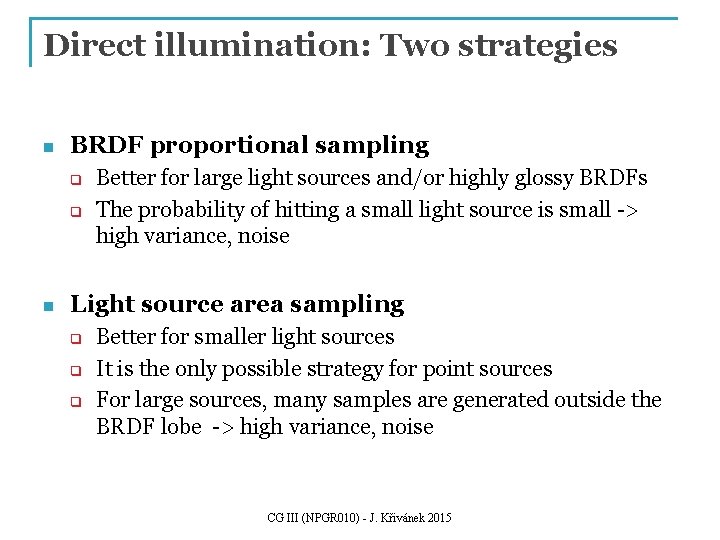
Direct illumination: Two strategies n BRDF proportional sampling q q n Better for large light sources and/or highly glossy BRDFs The probability of hitting a small light source is small -> high variance, noise Light source area sampling q q q Better for smaller light sources It is the only possible strategy for point sources For large sources, many samples are generated outside the BRDF lobe -> high variance, noise CG III (NPGR 010) - J. Křivánek 2015
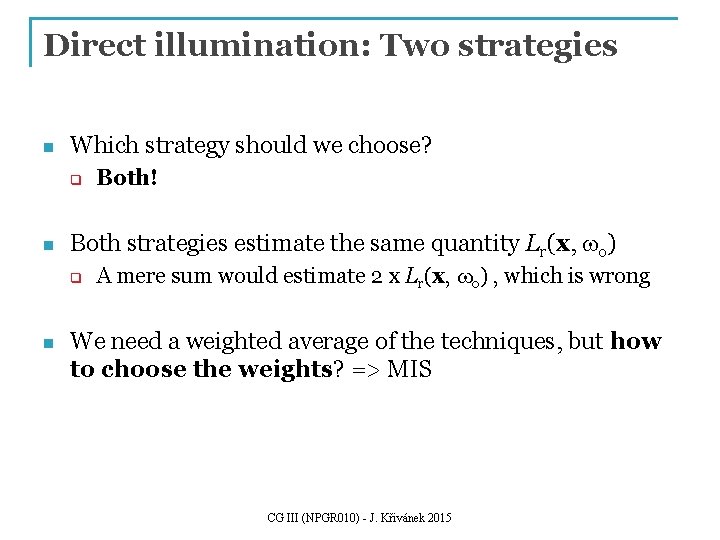
Direct illumination: Two strategies n Which strategy should we choose? q n Both strategies estimate the same quantity Lr(x, wo) q n Both! A mere sum would estimate 2 x Lr(x, wo) , which is wrong We need a weighted average of the techniques, but how to choose the weights? => MIS CG III (NPGR 010) - J. Křivánek 2015
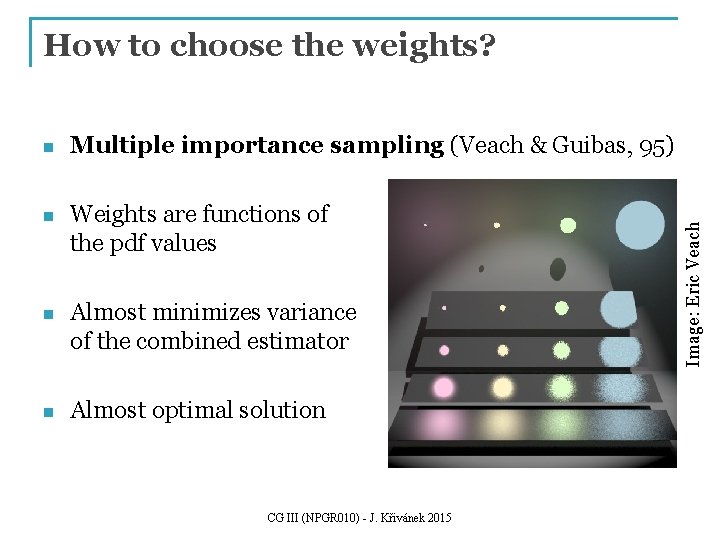
n Multiple importance sampling (Veach & Guibas, 95) n Weights are functions of the pdf values n Almost minimizes variance of the combined estimator n Almost optimal solution CG III (NPGR 010) - J. Křivánek 2015 Image: Eric Veach How to choose the weights?
Image: Alexander Wilkie Direct illumination calculation using MIS Sampling technique (pdf) p 1: BRDF sampling Sampling technique (pdf) p 2: Light source area sampling CG III (NPGR 010) - J. Křivánek 2015
Image: Alexander Wilkie Combination Arithmetic average Preserves bad properties of both techniques Balance heuristic Bingo!!! CG III (NPGR 010) - J. Křivánek 2015
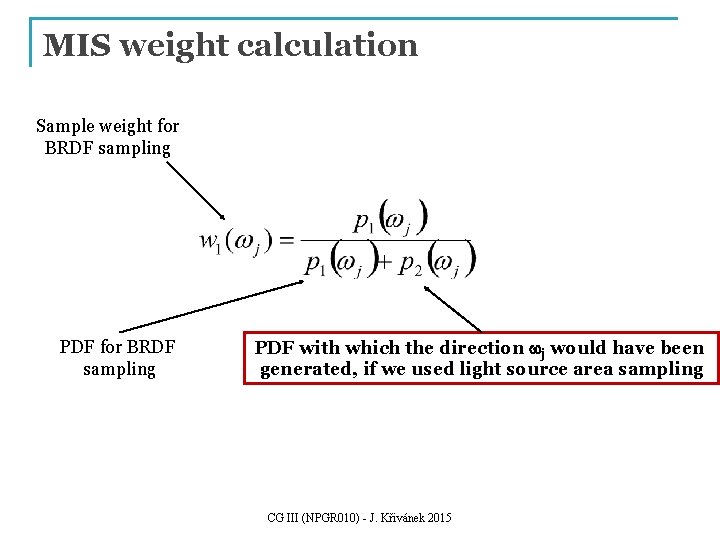
MIS weight calculation Sample weight for BRDF sampling PDF with which the direction wj would have been generated, if we used light source area sampling CG III (NPGR 010) - J. Křivánek 2015
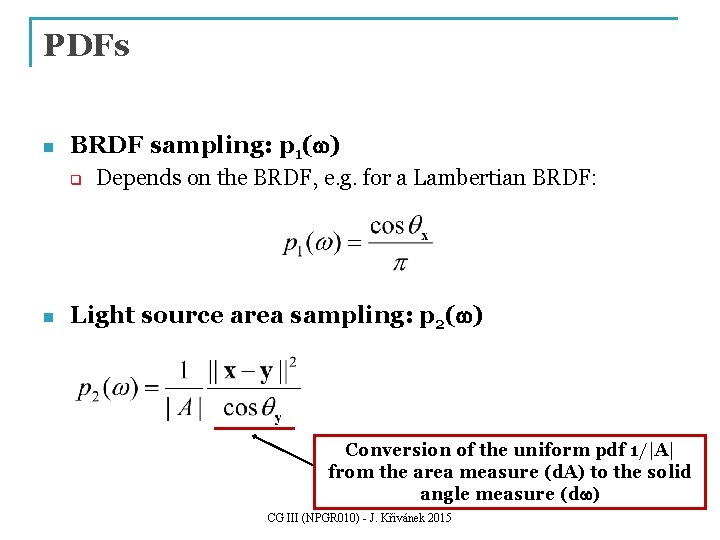
PDFs n BRDF sampling: p 1(w) q n Depends on the BRDF, e. g. for a Lambertian BRDF: Light source area sampling: p 2(w) Conversion of the uniform pdf 1/|A| from the area measure (d. A) to the solid angle measure (dw) CG III (NPGR 010) - J. Křivánek 2015
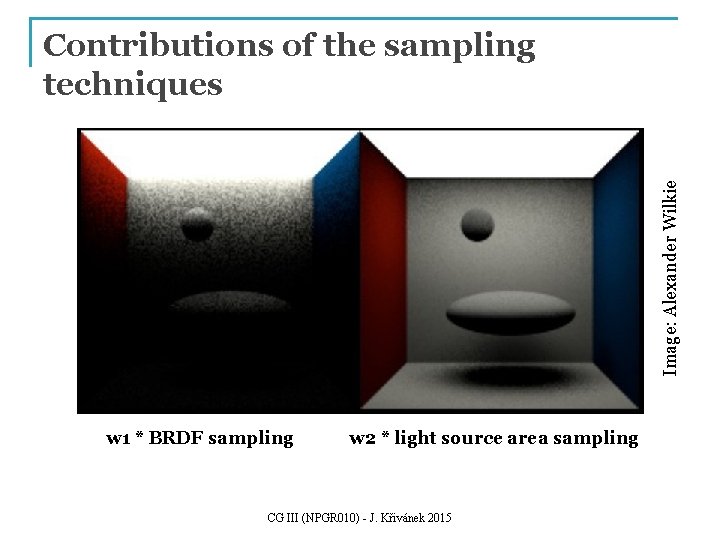
Image: Alexander Wilkie Contributions of the sampling techniques w 1 * BRDF sampling w 2 * light source area sampling CG III (NPGR 010) - J. Křivánek 2015
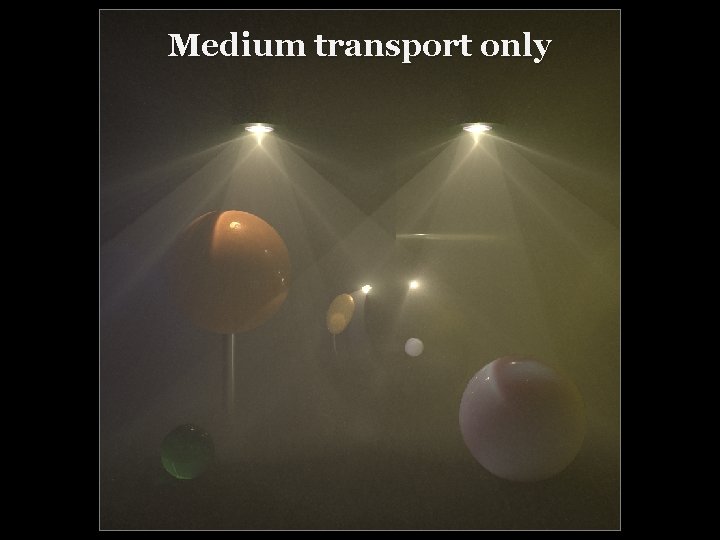
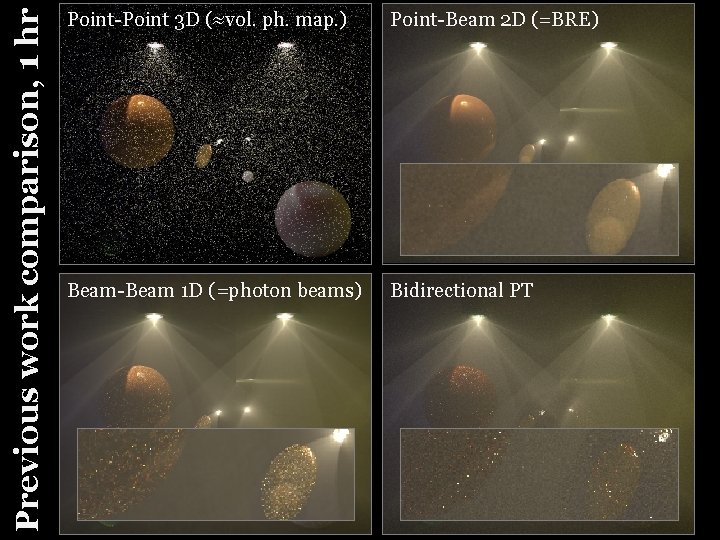
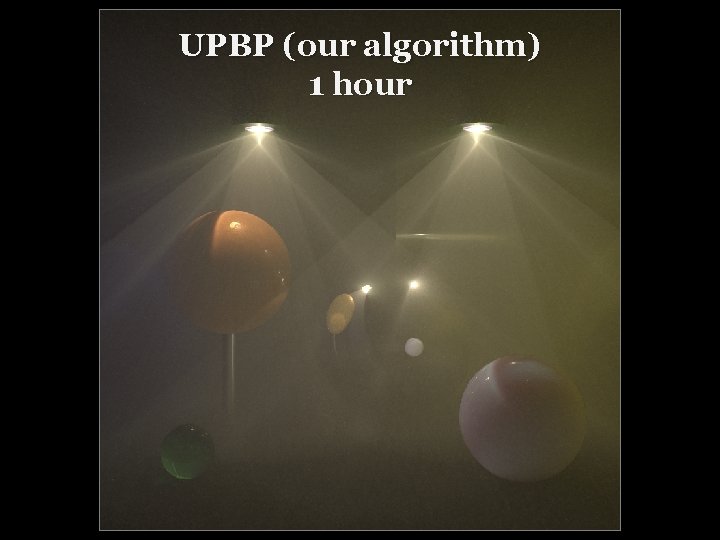
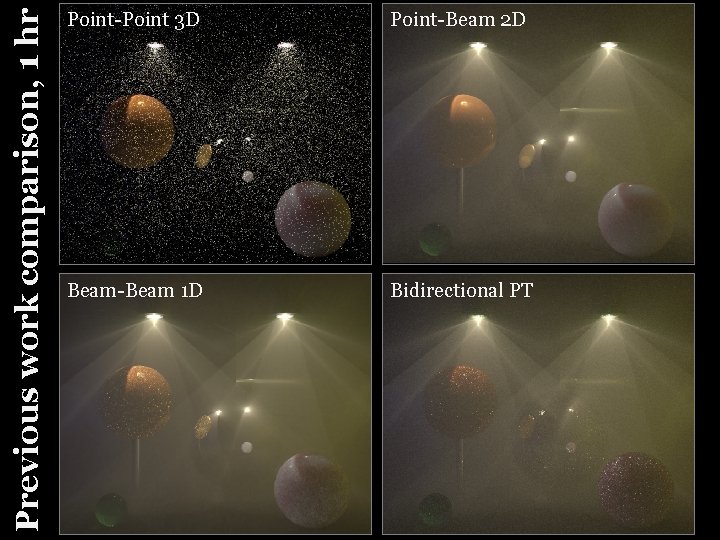
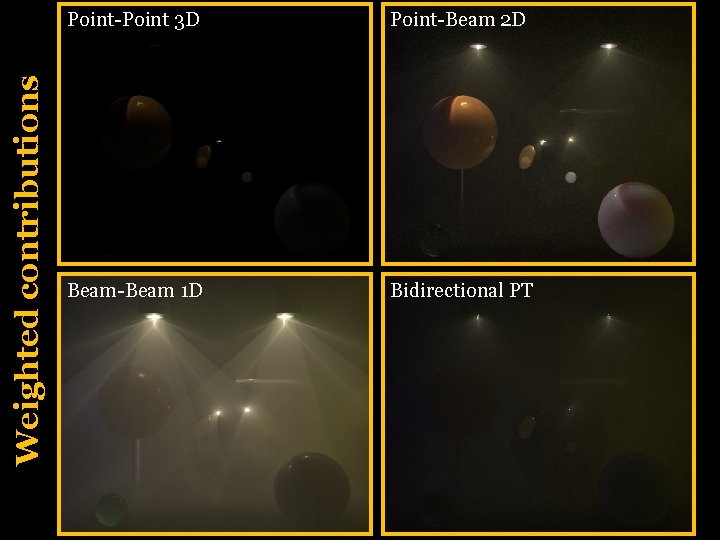
Other examples of MIS applications In the following we apply MIS to combine full path sampling techniques for calculating light transport in participating media.
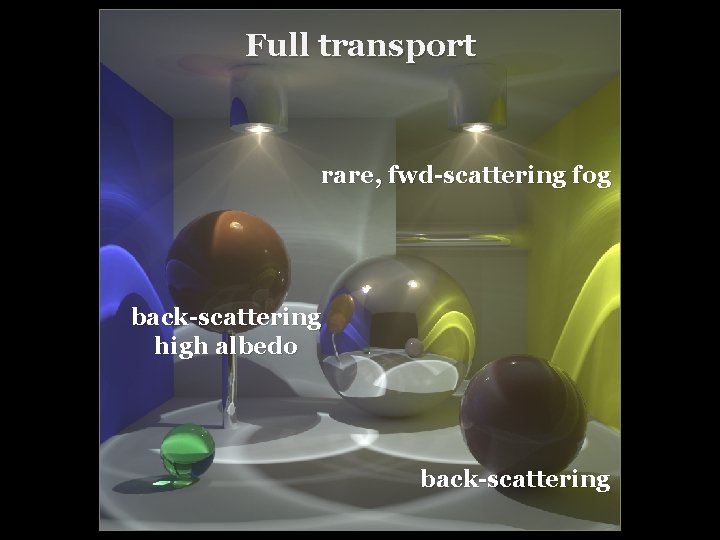
Full transport rare, fwd-scattering fog back-scattering high albedo back-scattering
Medium transport only
Previous work comparison, 1 hr Point-Point 3 D (≈vol. ph. map. ) Point-Beam 2 D (=BRE) Beam-Beam 1 D (=photon beams) Bidirectional PT
UPBP (our algorithm) 1 hour 36
Previous work comparison, 1 hr Point-Point 3 D Point-Beam 2 D Beam-Beam 1 D Bidirectional PT
Weighted contributions Point-Point 3 D Point-Beam 2 D Beam-Beam 1 D Bidirectional PT