
COMPUTER ETHICS The Big Enchilada Advancement of technology
COMPUTER ETHICS The Big Enchilada • • • Advancement of technology brings new ethical dilemmas/questions This presentation focuses on computer ethics and midshipmen But first let’s look at business and ethics in the technology era. Areas: – – – Acquisition of information Access to data/information Information Stewardship Slides courtesy CDR J. Downey 1
Ethics and Information Management • Acquisition of information (we can collect lots of data, easily) – – Should we track or monitor employee activity? [red light camera] Should we read employee emails? Legally, can we? If we collect this data, how should we use it? Collecting sensitive data [Otis] Slides courtesy CDR J. Downey 2
Ethics and Information Management • Access to data/information – – • Who within the company? How about sensitive info? Should line mgrs (division CPOs) have access to such information? Information brokers (outside the company) Who owns the data? ? If a store collects info from customers, do they own it? Can they sell it? [DMV example] Slides courtesy CDR J. Downey 3
Ethics and Information Management • Information Stewardship – – – Accuracy of information (mid data, for example)? How often should credit bureaus check their info? Preventing unauthorized access (what measures should be taken to secure info)? Data recombination (computer matching) [IRS] Slides courtesy CDR J. Downey 4
COMPUTER ETHICS for the Midshipman THE QUESTIONS: 1. Can I print copies of online material? 2. Can I store on my personal PC files that I find elsewhere? 3. Can I download a webpage and give a printed copy of it to a friend? Files = text Slides courtesy CDR J. Downey files, graphics, pictures, images, etc. 5
COMPUTER ETHICS for the Midshipman THE QUESTIONS: 4. Can I incorporate files found elsewhere into my own webpage (or document)? 5. Can I alter files and make those files available online (or in a document)? 6. Can I excerpt material and distribute those excerpts? Each of these questions will be answered Slides courtesy CDR J. Downey 6
THE FUNDAMENTALS Copyright Basics • Foundation is Article I, Section 8, Clause 8 of U. S. Constitution: The Congress shall have power…To promote the Progress of Science and useful Arts, by securing for limited Times to Authors and Inventors the exclusive Right to their respective Writing and Discoveries. • Copyrights are granted to author and artists to protect intellectual property and retain due compensation (and promote creativity) Slides courtesy CDR J. Downey 7

COPYRIGHT BASICS What is Protected? • • Copyrights typically pertain to a written document (including all graphics, etc); compare patents and trademarks All published works (books, magazines, etc) All work on the Internet (because that is publishing), including emails Must be tangible (spoken words can not be copyrighted!) Slides courtesy CDR J. Downey 8
COPYRIGHT BASICS What is Not Protected? Public domain works: – – • Includes all material with an expired copyright Includes any material (such as online work) that includes a specific statement such as “I grant this to the public domain” Are copyright notices (i. e. , © or “all rights reserved”) required for a work to be protected? No, not since April 1989 in the U. S. Facts may not be copyrighted Slides courtesy CDR J. Downey 9
COPYRIGHT BASICS For How Long? • • • Copyrights lasted 14 years in 1792 (and could be renewed for an additional 14 years) In last 40 years, this period has been extended 11 times Sonny Bono Copyright Term Extension Act of 1998 extended it to life of author plus 70 years (95 years if copyright owned by corporation). – Disney Corporation spearheaded this law as Mickey was scheduled to enter the public domain in 2004 Slides courtesy CDR J. Downey 10
INTERNET Personal Use • Given that online material is always copyrighted, in order to use this material, you must: – – • Get specific permission from the owner of the copyright; (or) The webpage (or part thereof) must grant explicit permission for others to use Some websites (i. e. , author) grant explicit permission for use provided no compensation is received Slides courtesy CDR J. Downey 11
INTERNET What does “use” mean? 1. Can I print copies of online materials? Yes, so long as it is for personal use (one copy fine; but not for reuse in your document) 2. Can I store on my PC files found elsewhere? Yes, provided they are not distributed 3. Can I download a web page and mail a print copy to a friend? No, this is duplication and distribution. Unless webpage gives explicit permission to distribute, you cannot. You can send your friend the URL which is legal (the author thus retains control over the site). Slides courtesy CDR J. Downey 12
COPYRIGHT What Happens? – Current law makes copyright violation a felony provided it involves more than ten copies with a value over $2500 – Almost all cases that go to court, however, end up in civil court (not criminal court) • Frequently, the purpose is to remove the offensive material from the website • Sometimes compensation and damages are assessed – Note: plagiarism is not illegal (except as it pertains to copyright) Slides courtesy CDR J. Downey 13
COPYRIGHT The Compensation Issue Is it OK to use another file (say for my own document or webpage) so long as I don’t make money from it? No. Legally, since it doesn’t belong to you, you may not use it without permission. Why? – You may deprive the real owner of profiting from it – The owner no longer maintains control • Example: Napster • Compensation does become important in some civil suits (for damages, not guilt) Slides courtesy CDR J. Downey 14
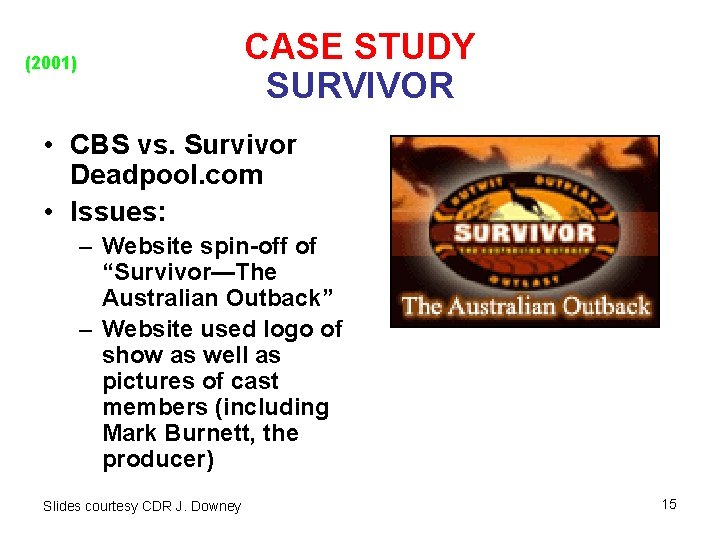
CASE STUDY SURVIVOR (2001) • CBS vs. Survivor Deadpool. com • Issues: – Website spin-off of “Survivor—The Australian Outback” – Website used logo of show as well as pictures of cast members (including Mark Burnett, the producer) Slides courtesy CDR J. Downey 15
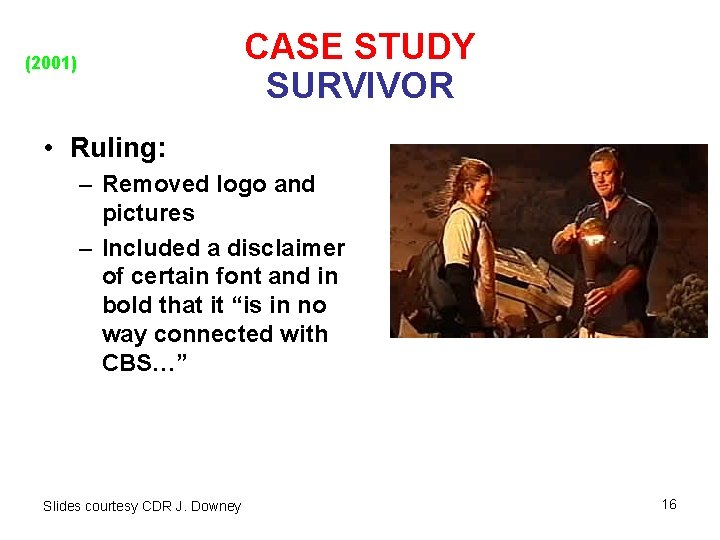
CASE STUDY SURVIVOR (2001) • Ruling: – Removed logo and pictures – Included a disclaimer of certain font and in bold that it “is in no way connected with CBS…” Slides courtesy CDR J. Downey 16
INTERNET Publishing on the Web 4. Can I scan in or copy a file (such as a picture) and use it my personal website? No, it belongs to the author/owner. You can put in a hyperlink to the author’s website (letting the author retain control), or get the author’s permission. 5. Can I alter text files and make those files available online? Maybe. You must acknowledge the source and extent of altering; beware of plagiarism. Slides courtesy CDR J. Downey 17
INTERNET Publishing on the Web 6. Can I significantly alter a picture (or other artwork) and present it as my own? No, law is quite clear about photos and artwork. You may use it with permission or through acknowledgement; you are only permitted to resize it, however. Exception: the “look and feel” of a computer screen is not protected by copyright and can be freely used. Thus (so long as you replace all the content) you may retain all of the html commands that make up a webpage and use it w/o permission. Slides courtesy CDR J. Downey 18
COPYRIGHT Fair Use Guidelines – Any copyrighted material can be used without permission under certain circumstances • • • To academically excerpt from the material To criticize the material (thus movie critics do not need permission to add a film clip) To parody the work – These guidelines are not based on specific law, but on court interpretations (typically on free speech) Slides courtesy CDR J. Downey 19
CASE STUDY Dr. Juice • Dr. Seuss Enterprises vs. The Cat NOT in the Hat! • Issues: – Used parody defense (Fair Use) as it spoofed O. J. Simpson under the framework of Dr. Seuss’ Cat in the Hat • Ruling: – Book banned – There was no “discernable direct comment on the original”, i. e. , Dr. Seuss’ book. Slides courtesy CDR J. Downey 20
COPYRIGHT Fair Use Guidelines • Examples of Fair Use (other than criticism or parody): – Recording a TV program on your VCR to watch later; – Copying a song to a casette, CD, or MP 3 player, provided you purchased the CD from which you are making a copy – Use of excerpted material in teaching a class Slides courtesy CDR J. Downey 21
CASE STUDY Star Trek • Paramount (Viacom) vs. Mr. Henderson • Issues: – Website posted pictures and other graphics concerning Star Trek. – This guy was a “trekkie. ” This is an example of the many fan club websites • Resolution (settled prior to court) – Closed down website Slides courtesy CDR J. Downey 22
- Slides: 22