
Computer Engineering and Systems Group Sunil Khatri Dept
- Slides: 59
Computer Engineering and Systems Group Sunil Khatri Dept. of ECE Texas A&M University
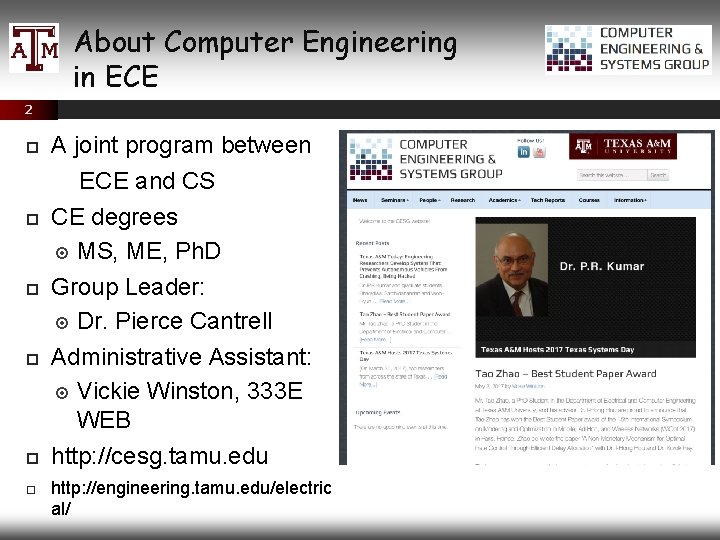
About Computer Engineering in ECE 2 A joint program between ECE and CS CE degrees MS, ME, Ph. D Group Leader: Dr. Pierce Cantrell Administrative Assistant: Vickie Winston, 333 E WEB http: //cesg. tamu. edu http: //engineering. tamu. edu/electric al/
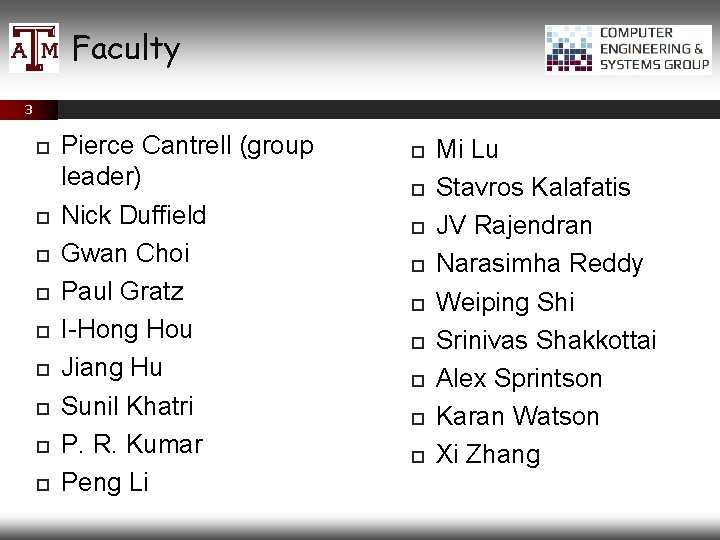
Faculty 3 Pierce Cantrell (group leader) Nick Duffield Gwan Choi Paul Gratz I-Hong Hou Jiang Hu Sunil Khatri P. R. Kumar Peng Li Mi Lu Stavros Kalafatis JV Rajendran Narasimha Reddy Weiping Shi Srinivas Shakkottai Alex Sprintson Karan Watson Xi Zhang
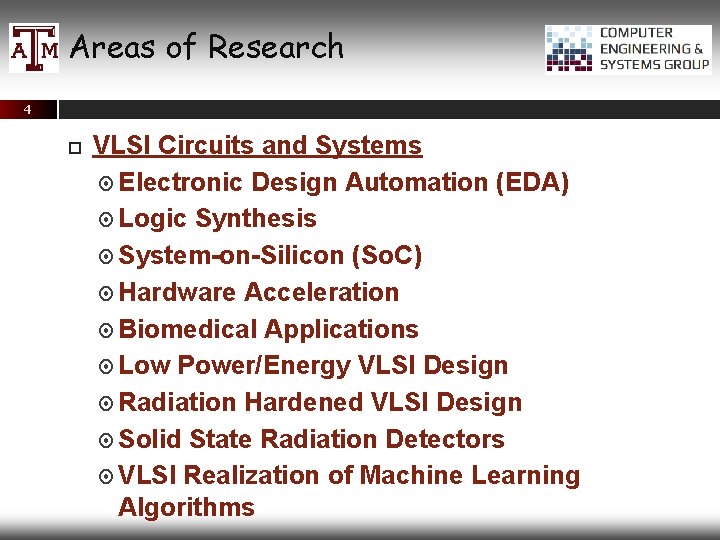
Areas of Research 4 VLSI Circuits and Systems Electronic Design Automation (EDA) Logic Synthesis System-on-Silicon (So. C) Hardware Acceleration Biomedical Applications Low Power/Energy VLSI Design Radiation Hardened VLSI Design Solid State Radiation Detectors VLSI Realization of Machine Learning Algorithms
Areas of Research 5 Computer Systems and Architecture Multi-core Processor Design Processor Microarchitecture Memory Systems Hierarchies System Designs for Emerging Non-volatile Memories Storage Systems Network Processors
Areas of Research 6 Communication Networks Wireless Networks Content Distribution P 2 P Networks Software-Defined Networks Network Security Real-time Communication Network Coding
Areas of Research 7 Cyber-Physical Systems Network and Data Science Measurement and Analysis of Internet Data Big Data Analytics
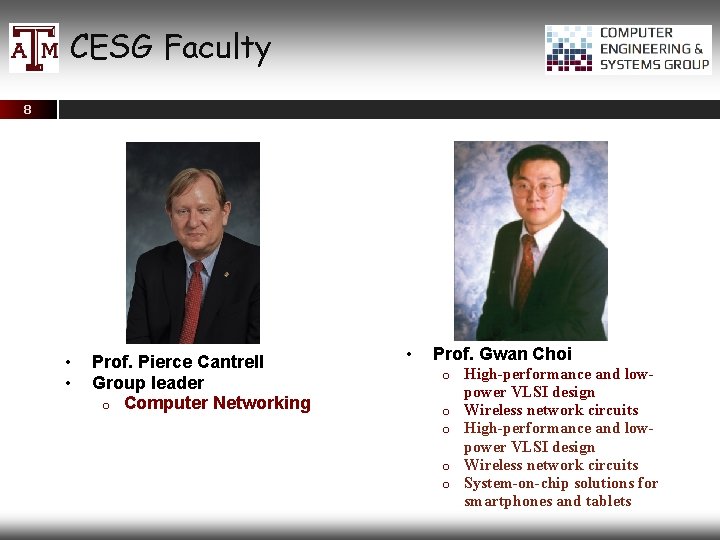
CESG Faculty 8 • • Prof. Pierce Cantrell Group leader o Computer Networking • Prof. Gwan Choi o o o High-performance and lowpower VLSI design Wireless network circuits System-on-chip solutions for smartphones and tablets
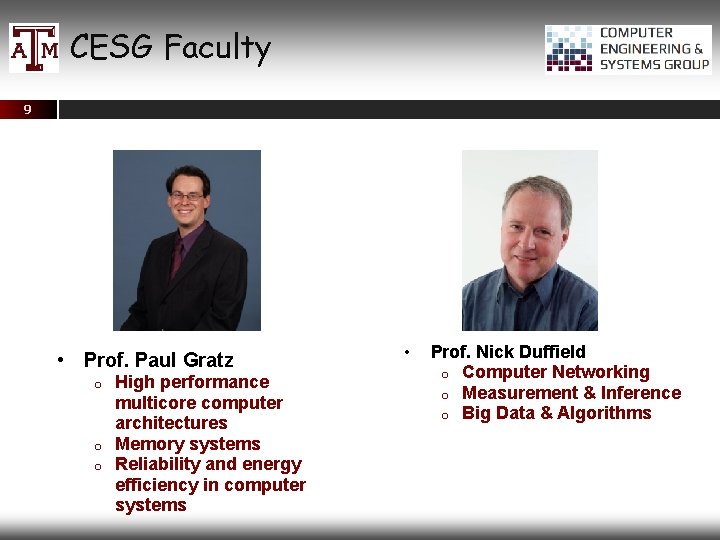
CESG Faculty 9 • Prof. Paul Gratz High performance multicore computer architectures o Memory systems o Reliability and energy efficiency in computer systems o • Prof. Nick Duffield o Computer Networking o Measurement & Inference o Big Data & Algorithms
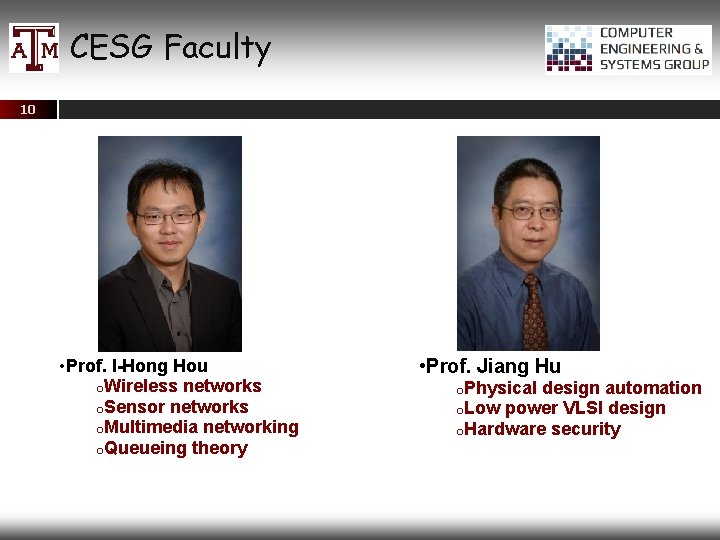
CESG Faculty 10 • Prof. I-Hong Hou o. Wireless networks o. Sensor networks o. Multimedia networking o. Queueing theory • Prof. Jiang Hu o. Physical design automation o. Low power VLSI design o. Hardware security
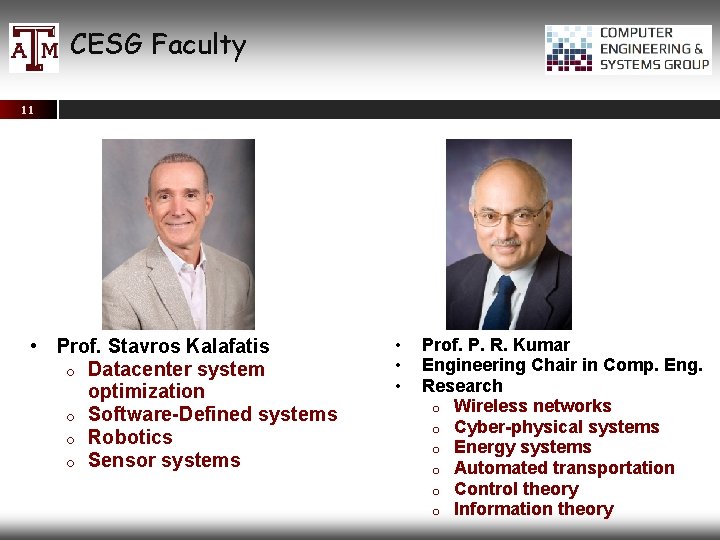
CESG Faculty 11 • Prof. Stavros Kalafatis o Datacenter system optimization o Software-Defined systems o Robotics o Sensor systems • • • Prof. P. R. Kumar Engineering Chair in Comp. Eng. Research o Wireless networks o Cyber-physical systems o Energy systems o Automated transportation o Control theory o Information theory
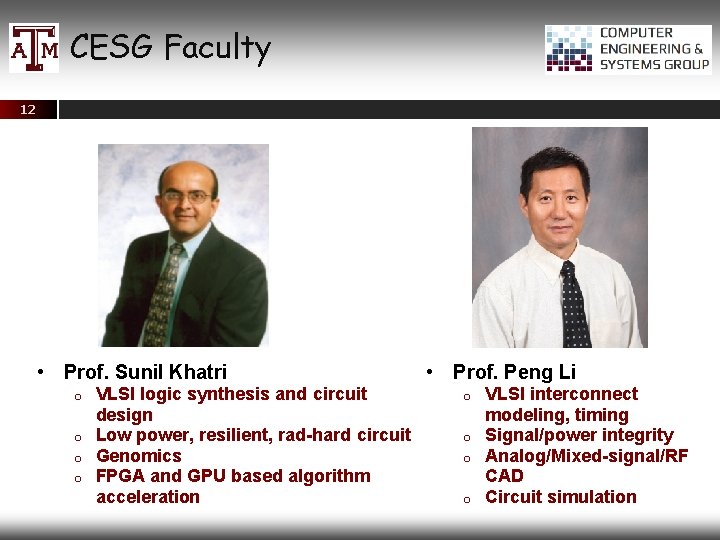
CESG Faculty 12 • Prof. Sunil Khatri VLSI logic synthesis and circuit design o Low power, resilient, rad-hard circuit o Genomics o FPGA and GPU based algorithm acceleration o • Prof. Peng Li VLSI interconnect modeling, timing o Signal/power integrity o Analog/Mixed-signal/RF CAD o Circuit simulation o
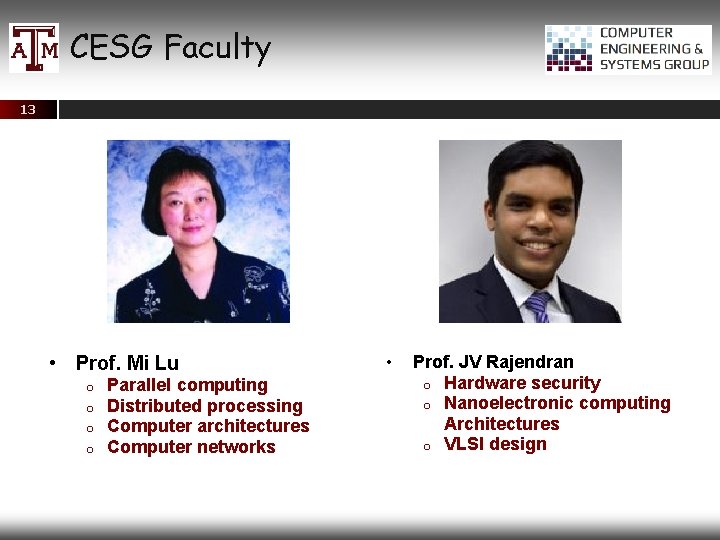
CESG Faculty 13 • Prof. Mi Lu o o Parallel computing Distributed processing Computer architectures Computer networks • Prof. JV Rajendran o Hardware security o Nanoelectronic computing Architectures o VLSI design
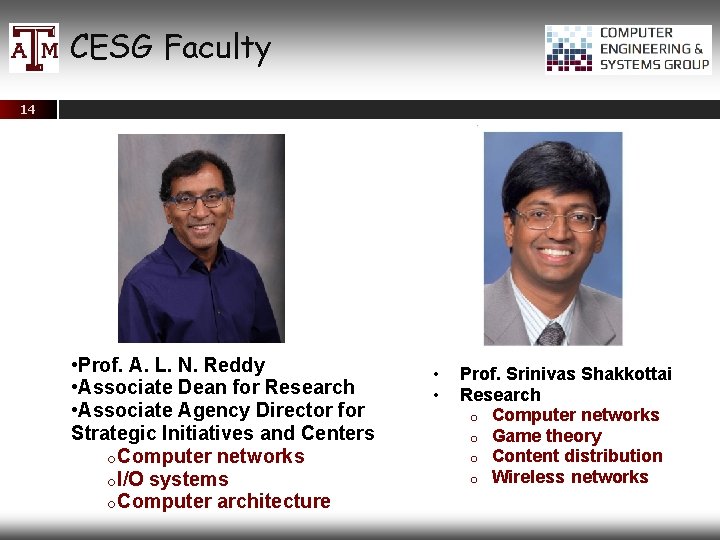
CESG Faculty 14 • Prof. A. L. N. Reddy • Associate Dean for Research • Associate Agency Director for Strategic Initiatives and Centers o. Computer networks o. I/O systems o. Computer architecture • • Prof. Srinivas Shakkottai Research o Computer networks o Game theory o Content distribution o Wireless networks
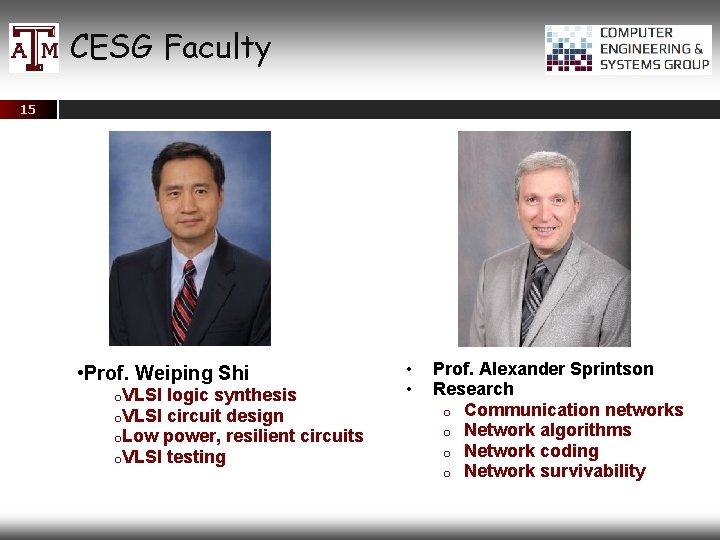
CESG Faculty 15 • Prof. Weiping Shi o. VLSI logic synthesis o. VLSI circuit design o. Low power, resilient circuits o. VLSI testing • • Prof. Alexander Sprintson Research o Communication networks o Network algorithms o Network coding o Network survivability
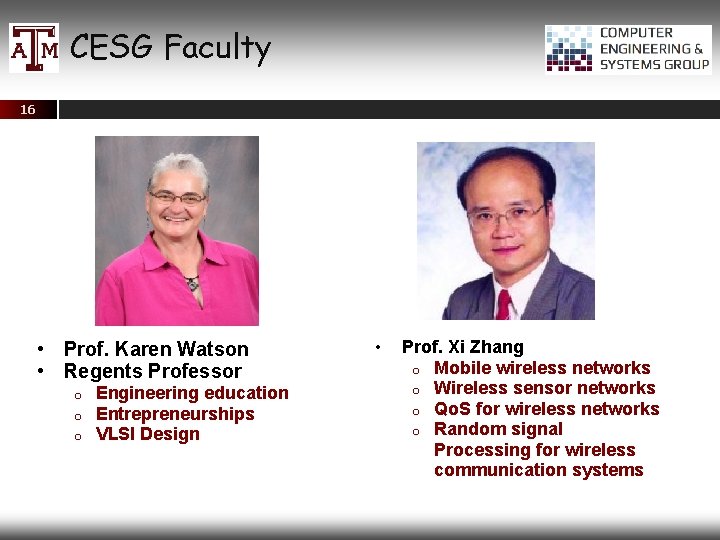
CESG Faculty 16 • Prof. Karen Watson • Regents Professor o o o Engineering education Entrepreneurships VLSI Design • Prof. Xi Zhang o Mobile wireless networks o Wireless sensor networks o Qo. S for wireless networks o Random signal Processing for wireless communication systems
CESG Staff 17 • Vickie Winston Program Specialist II 333 E WEB Phone: 985 -6487 Email: vwinston@tamu. edu
Master of Engineering Outline 18 January 2018 MASTER OF ENGINEERING IN COMPUTER ENGINEERING - ME (Non-Thesis)
Master of Engineering Outline Requirements for Master of Engineering in Computer Engineering (Non-Thesis) Additional Course Requirements (Applies to ME, MS, and Ph. D. ) Foundation and First-Level Graduate Courses Tentative List of Courses for Master of Engineering CEEN Students Must take at least 6 courses from this list Tentative List of Spring 2018 Computer Engineering & Systems Courses Location of Departmental Orientation
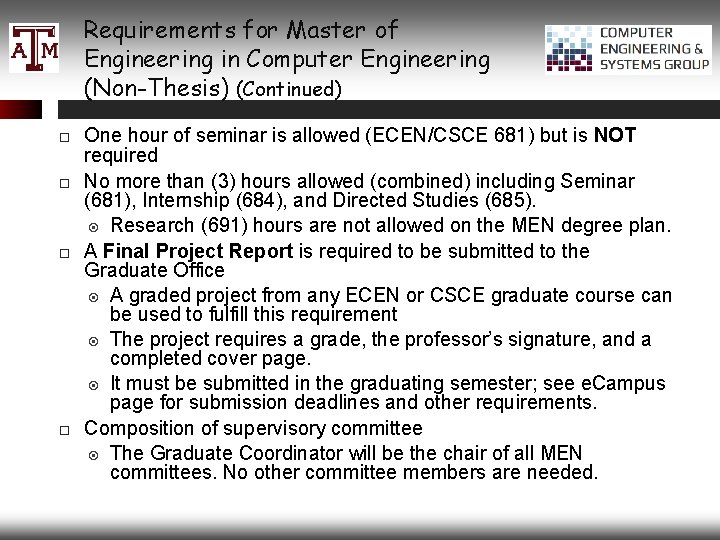
Requirements for Master of Engineering in Computer Engineering (Non-Thesis) Total number of hours (30) A minimum of 27 classroom hours (Excludes 681, 684, & 685). Classroom hours must be taken from courses within the College of Engineering and/or College of Science. One course from the ISYS Dept. in the College of Business is allowed. A minimum of 24 classroom hours from the Departments of CSCE and ECEN At least 13 of these 24 hours must be in ECEN. At least 6 courses from the CEEN Master of Engineering student course list. Transfer hours allowed from another institution (max of 6 hours) Transfer hours must be from a peer institution; they cannot have been used on a previous degree plan. Students must send syllabus, transcript, and TAMU course equivalent to the Graduate Office. Transfer hours are subject to the approval of the GSC. Undergraduate hours allowed (max of 6 hours)
Requirements for Master of Engineering in Computer Engineering (Non-Thesis) (Continued) One hour of seminar is allowed (ECEN/CSCE 681) but is NOT required No more than (3) hours allowed (combined) including Seminar (681), Internship (684), and Directed Studies (685). Research (691) hours are not allowed on the MEN degree plan. A Final Project Report is required to be submitted to the Graduate Office A graded project from any ECEN or CSCE graduate course can be used to fulfill this requirement The project requires a grade, the professor’s signature, and a completed cover page. It must be submitted in the graduating semester; see e. Campus page for submission deadlines and other requirements. Composition of supervisory committee The Graduate Coordinator will be the chair of all MEN committees. No other committee members are needed.
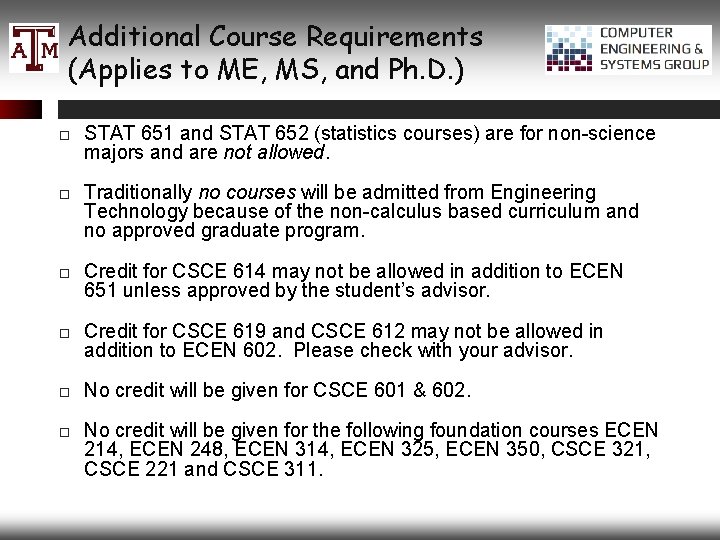
Additional Course Requirements (Applies to ME, MS, and Ph. D. ) STAT 651 and STAT 652 (statistics courses) are for non-science majors and are not allowed. Traditionally no courses will be admitted from Engineering Technology because of the non-calculus based curriculum and no approved graduate program. Credit for CSCE 614 may not be allowed in addition to ECEN 651 unless approved by the student’s advisor. Credit for CSCE 619 and CSCE 612 may not be allowed in addition to ECEN 602. Please check with your advisor. No credit will be given for CSCE 601 & 602. No credit will be given for the following foundation courses ECEN 214, ECEN 248, ECEN 314, ECEN 325, ECEN 350, CSCE 321, CSCE 221 and CSCE 311.
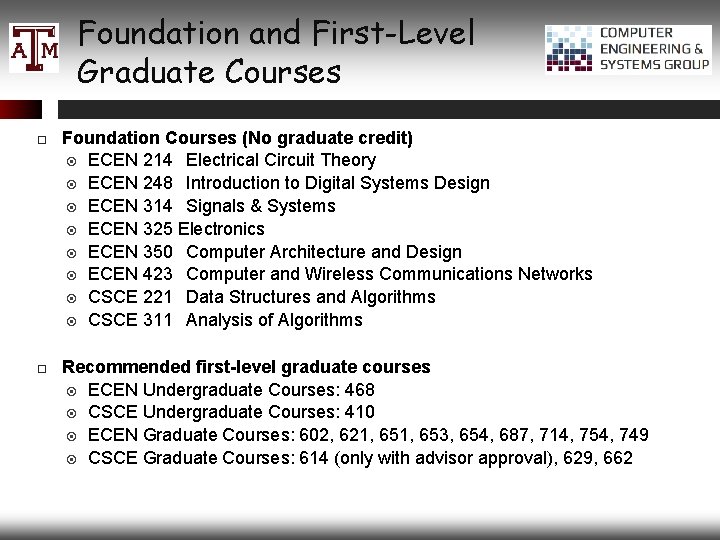
Foundation and First-Level Graduate Courses Foundation Courses (No graduate credit) ECEN 214 Electrical Circuit Theory ECEN 248 Introduction to Digital Systems Design ECEN 314 Signals & Systems ECEN 325 Electronics ECEN 350 Computer Architecture and Design ECEN 423 Computer and Wireless Communications Networks CSCE 221 Data Structures and Algorithms CSCE 311 Analysis of Algorithms Recommended first-level graduate courses ECEN Undergraduate Courses: 468 CSCE Undergraduate Courses: 410 ECEN Graduate Courses: 602, 621, 653, 654, 687, 714, 754, 749 CSCE Graduate Courses: 614 (only with advisor approval), 629, 662
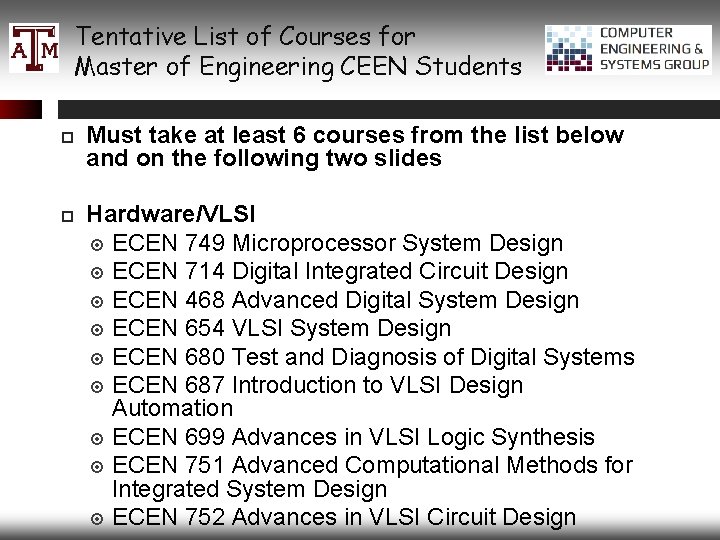
Tentative List of Courses for Master of Engineering CEEN Students Must take at least 6 courses from the list below and on the following two slides Hardware/VLSI ECEN 749 Microprocessor System Design ECEN 714 Digital Integrated Circuit Design ECEN 468 Advanced Digital System Design ECEN 654 VLSI System Design ECEN 680 Test and Diagnosis of Digital Systems ECEN 687 Introduction to VLSI Design Automation ECEN 699 Advances in VLSI Logic Synthesis ECEN 751 Advanced Computational Methods for Integrated System Design ECEN 752 Advances in VLSI Circuit Design
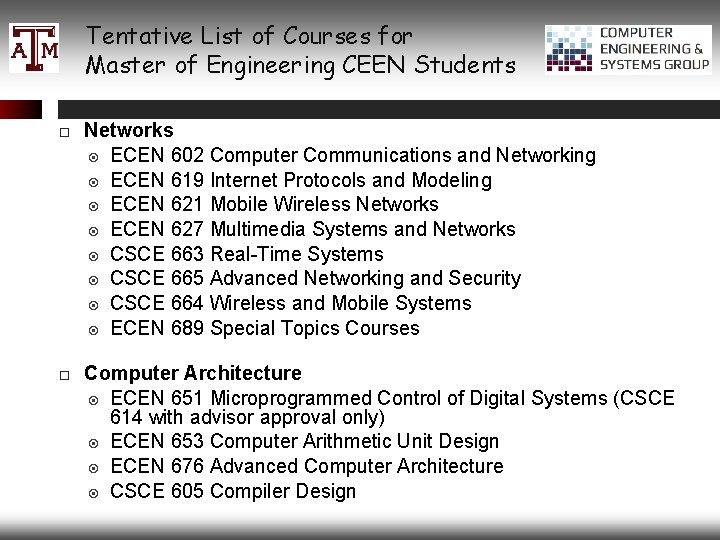
Tentative List of Courses for Master of Engineering CEEN Students Networks ECEN 602 Computer Communications and Networking ECEN 619 Internet Protocols and Modeling ECEN 621 Mobile Wireless Networks ECEN 627 Multimedia Systems and Networks CSCE 663 Real-Time Systems CSCE 665 Advanced Networking and Security CSCE 664 Wireless and Mobile Systems ECEN 689 Special Topics Courses Computer Architecture ECEN 651 Microprogrammed Control of Digital Systems (CSCE 614 with advisor approval only) ECEN 653 Computer Arithmetic Unit Design ECEN 676 Advanced Computer Architecture CSCE 605 Compiler Design
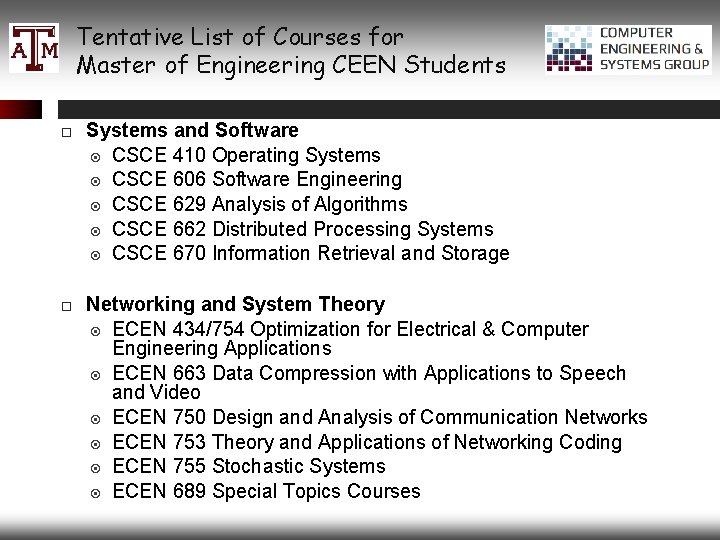
Tentative List of Courses for Master of Engineering CEEN Students Systems and Software CSCE 410 Operating Systems CSCE 606 Software Engineering CSCE 629 Analysis of Algorithms CSCE 662 Distributed Processing Systems CSCE 670 Information Retrieval and Storage Networking and System Theory ECEN 434/754 Optimization for Electrical & Computer Engineering Applications ECEN 663 Data Compression with Applications to Speech and Video ECEN 750 Design and Analysis of Communication Networks ECEN 753 Theory and Applications of Networking Coding ECEN 755 Stochastic Systems ECEN 689 Special Topics Courses
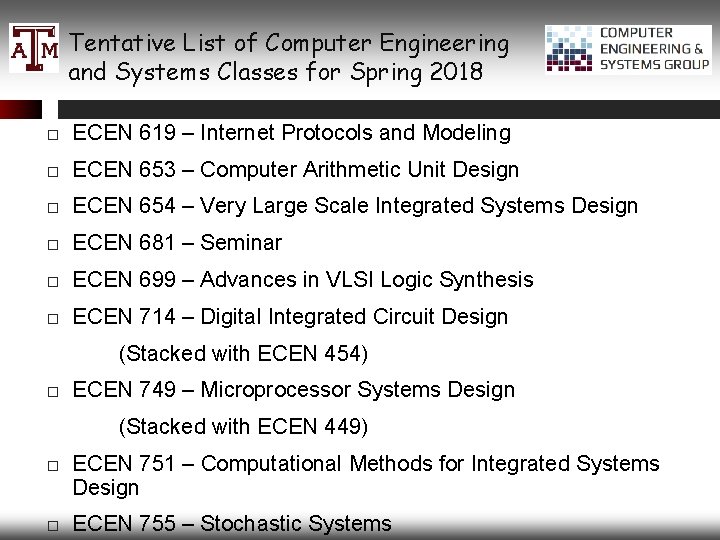
Tentative List of Computer Engineering and Systems Classes for Spring 2018 ECEN 619 – Internet Protocols and Modeling ECEN 653 – Computer Arithmetic Unit Design ECEN 654 – Very Large Scale Integrated Systems Design ECEN 681 – Seminar ECEN 699 – Advances in VLSI Logic Synthesis ECEN 714 – Digital Integrated Circuit Design (Stacked with ECEN 454) ECEN 749 – Microprocessor Systems Design (Stacked with ECEN 449) ECEN 751 – Computational Methods for Integrated Systems Design ECEN 755 – Stochastic Systems
Master of Science 28 January 2018 MASTER OF SCIENCE IN COMPUTER ENGINEERING - MS (Thesis Option)
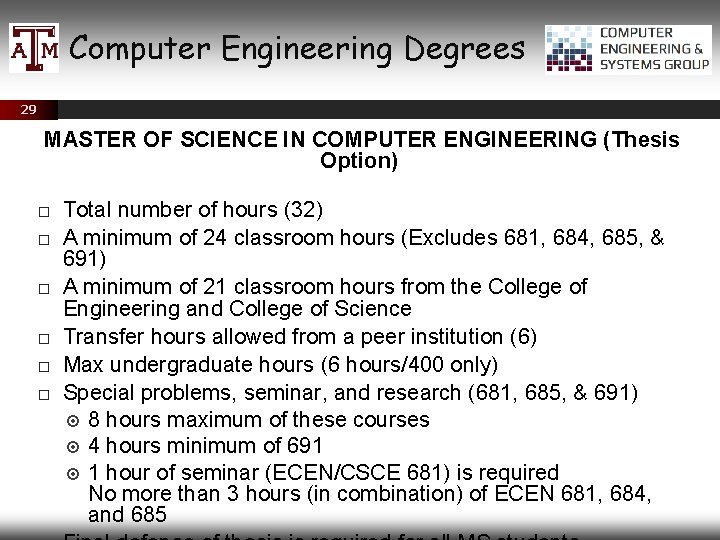
Computer Engineering Degrees 29 MASTER OF SCIENCE IN COMPUTER ENGINEERING (Thesis Option) Total number of hours (32) A minimum of 24 classroom hours (Excludes 681, 684, 685, & 691) A minimum of 21 classroom hours from the College of Engineering and College of Science Transfer hours allowed from a peer institution (6) Max undergraduate hours (6 hours/400 only) Special problems, seminar, and research (681, 685, & 691) 8 hours maximum of these courses 4 hours minimum of 691 1 hour of seminar (ECEN/CSCE 681) is required No more than 3 hours (in combination) of ECEN 681, 684, and 685
Master of Science 30 January 2018 DOCTOR OF PHILOSOPHY IN COMPUTER ENGINEERING – Ph. D.
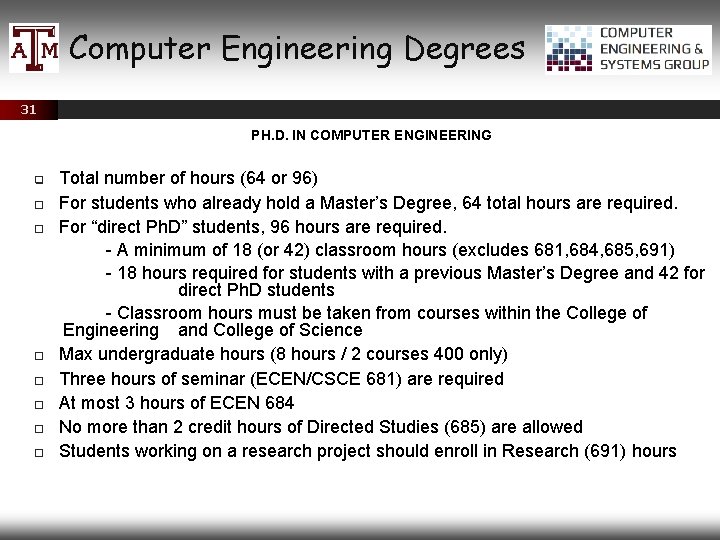
Computer Engineering Degrees 31 PH. D. IN COMPUTER ENGINEERING q Total number of hours (64 or 96) For students who already hold a Master’s Degree, 64 total hours are required. For “direct Ph. D” students, 96 hours are required. - A minimum of 18 (or 42) classroom hours (excludes 681, 684, 685, 691) - 18 hours required for students with a previous Master’s Degree and 42 for direct Ph. D students - Classroom hours must be taken from courses within the College of Engineering and College of Science Max undergraduate hours (8 hours / 2 courses 400 only) Three hours of seminar (ECEN/CSCE 681) are required At most 3 hours of ECEN 684 No more than 2 credit hours of Directed Studies (685) are allowed Students working on a research project should enroll in Research (691) hours
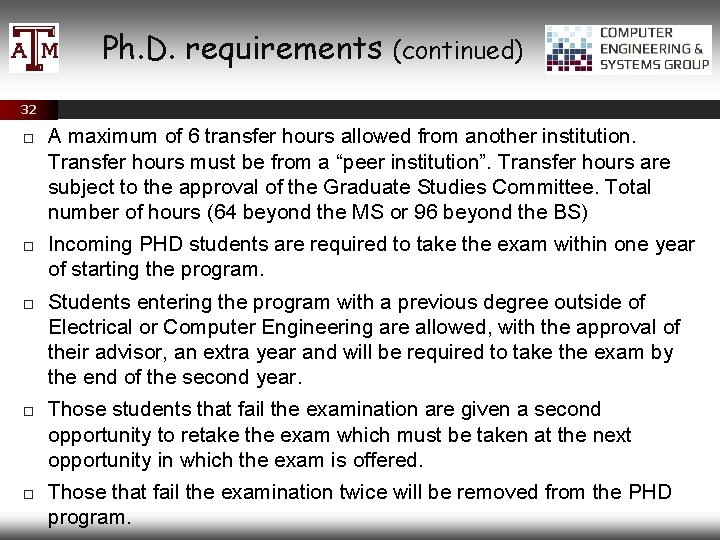
Ph. D. requirements (continued) 32 A maximum of 6 transfer hours allowed from another institution. Transfer hours must be from a “peer institution”. Transfer hours are subject to the approval of the Graduate Studies Committee. Total number of hours (64 beyond the MS or 96 beyond the BS) Incoming PHD students are required to take the exam within one year of starting the program. Students entering the program with a previous degree outside of Electrical or Computer Engineering are allowed, with the approval of their advisor, an extra year and will be required to take the exam by the end of the second year. Those students that fail the examination are given a second opportunity to retake the exam which must be taken at the next opportunity in which the exam is offered. Those that fail the examination twice will be removed from the PHD program.
Ph. D. requirements (continued) 33 Preliminary examination /Prelim Final examination / Defense
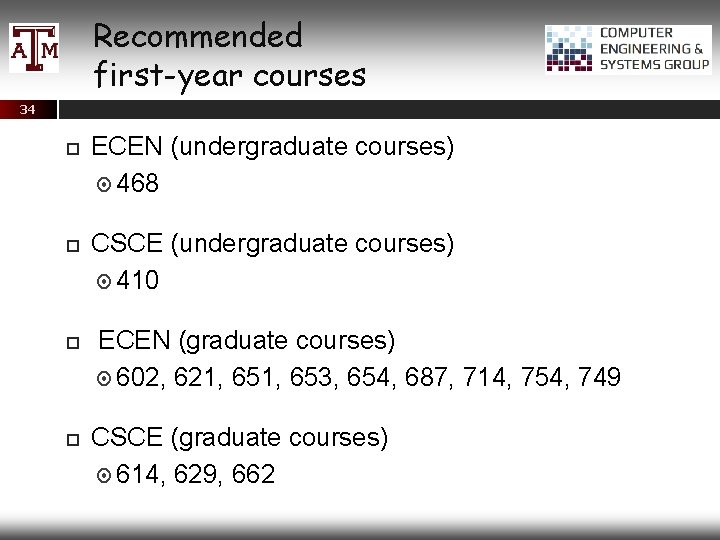
Recommended first-year courses 34 ECEN (undergraduate courses) 468 CSCE (undergraduate courses) 410 ECEN (graduate courses) 602, 621, 653, 654, 687, 714, 754, 749 CSCE (graduate courses) 614, 629, 662
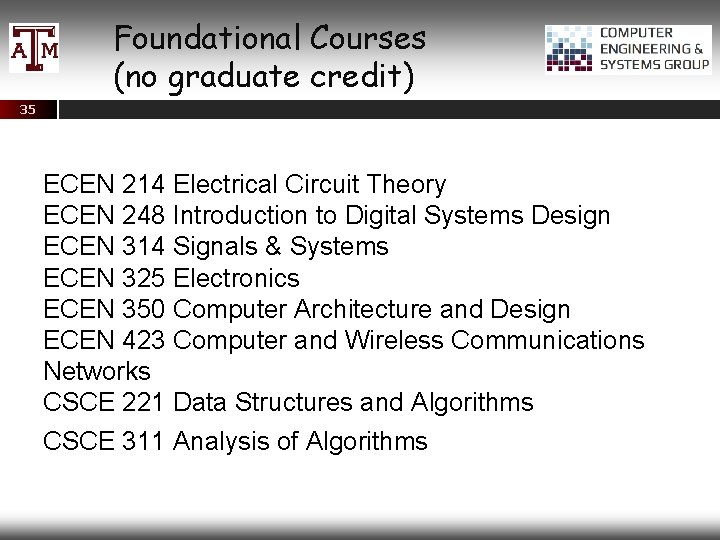
Foundational Courses (no graduate credit) 35 ECEN 214 Electrical Circuit Theory ECEN 248 Introduction to Digital Systems Design ECEN 314 Signals & Systems ECEN 325 Electronics ECEN 350 Computer Architecture and Design ECEN 423 Computer and Wireless Communications Networks CSCE 221 Data Structures and Algorithms CSCE 311 Analysis of Algorithms
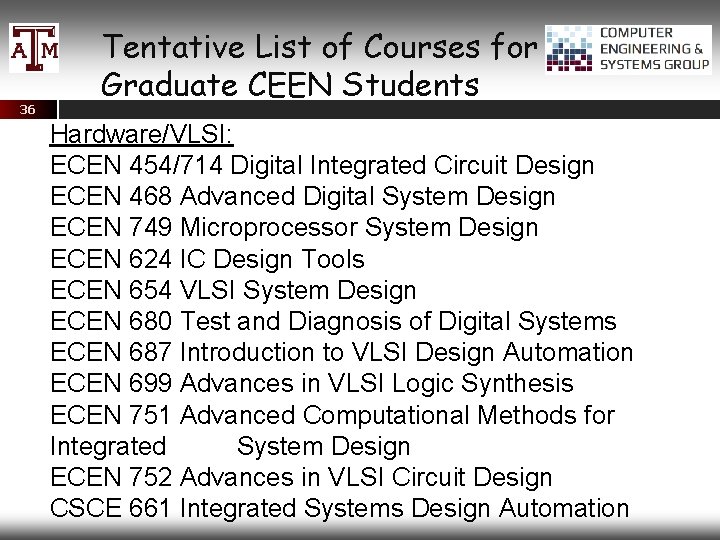
36 Tentative List of Courses for Graduate CEEN Students Hardware/VLSI: ECEN 454/714 Digital Integrated Circuit Design ECEN 468 Advanced Digital System Design ECEN 749 Microprocessor System Design ECEN 624 IC Design Tools ECEN 654 VLSI System Design ECEN 680 Test and Diagnosis of Digital Systems ECEN 687 Introduction to VLSI Design Automation ECEN 699 Advances in VLSI Logic Synthesis ECEN 751 Advanced Computational Methods for Integrated System Design ECEN 752 Advances in VLSI Circuit Design CSCE 661 Integrated Systems Design Automation
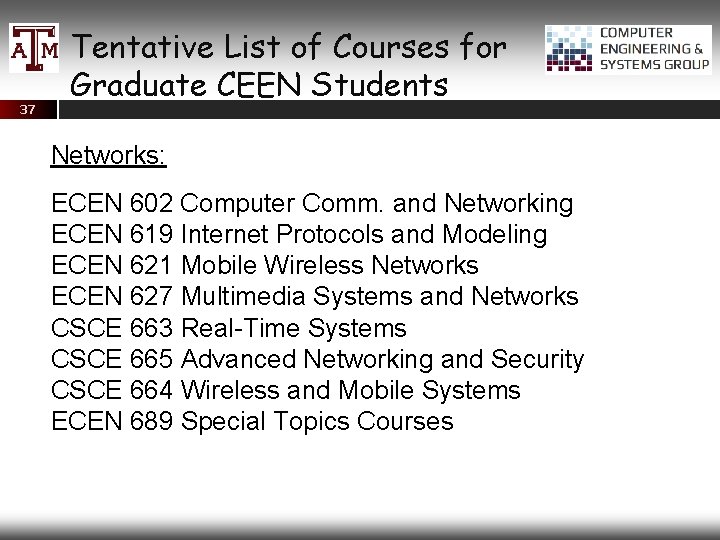
37 Tentative List of Courses for Graduate CEEN Students Networks: ECEN 602 Computer Comm. and Networking ECEN 619 Internet Protocols and Modeling ECEN 621 Mobile Wireless Networks ECEN 627 Multimedia Systems and Networks CSCE 663 Real-Time Systems CSCE 665 Advanced Networking and Security CSCE 664 Wireless and Mobile Systems ECEN 689 Special Topics Courses
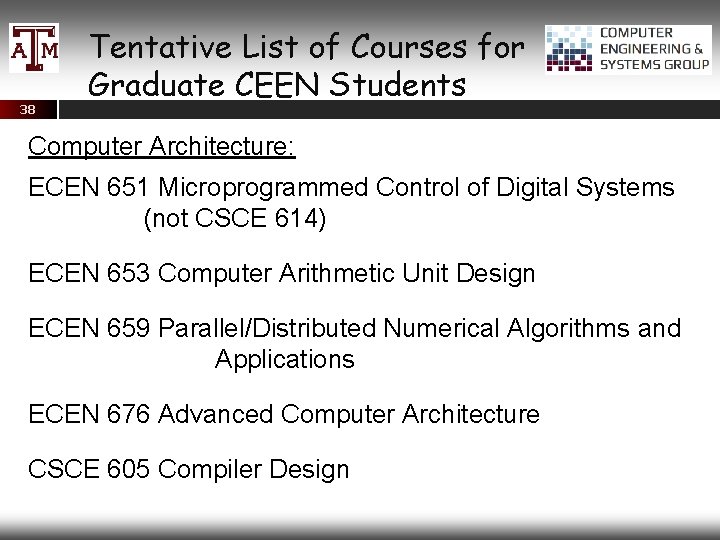
38 Tentative List of Courses for Graduate CEEN Students Computer Architecture: ECEN 651 Microprogrammed Control of Digital Systems (not CSCE 614) ECEN 653 Computer Arithmetic Unit Design ECEN 659 Parallel/Distributed Numerical Algorithms and Applications ECEN 676 Advanced Computer Architecture CSCE 605 Compiler Design
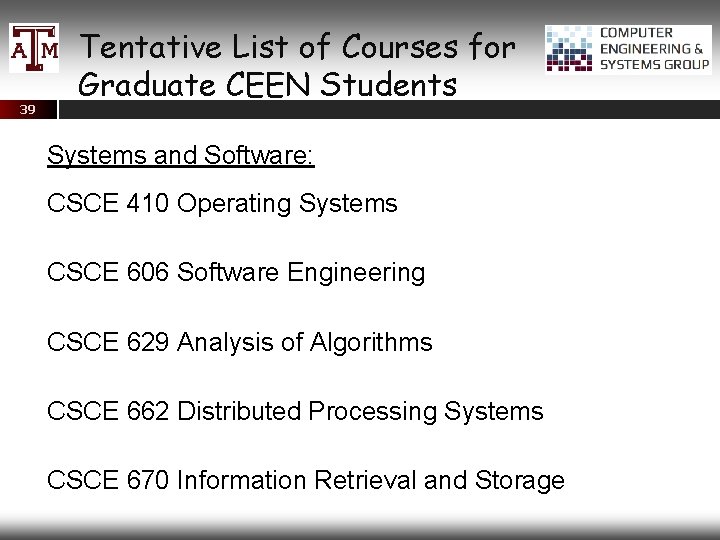
39 Tentative List of Courses for Graduate CEEN Students Systems and Software: CSCE 410 Operating Systems CSCE 606 Software Engineering CSCE 629 Analysis of Algorithms CSCE 662 Distributed Processing Systems CSCE 670 Information Retrieval and Storage
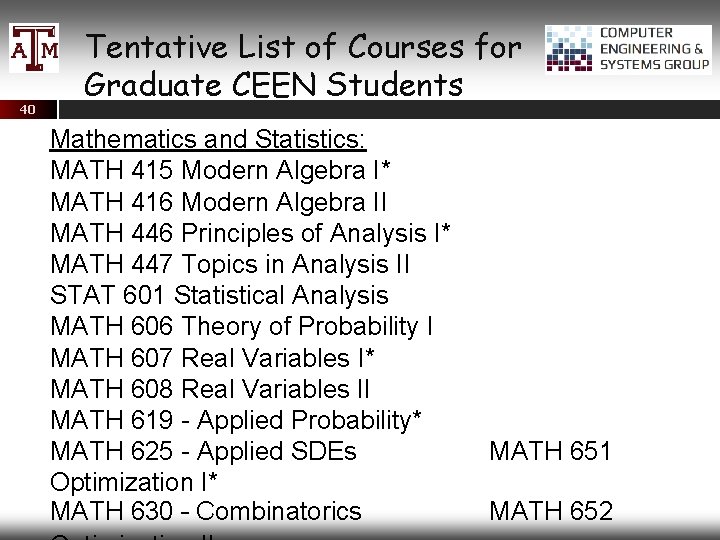
40 Tentative List of Courses for Graduate CEEN Students Mathematics and Statistics: MATH 415 Modern Algebra I* MATH 416 Modern Algebra II MATH 446 Principles of Analysis I* MATH 447 Topics in Analysis II STAT 601 Statistical Analysis MATH 606 Theory of Probability I MATH 607 Real Variables I* MATH 608 Real Variables II MATH 619 - Applied Probability* MATH 625 - Applied SDEs Optimization I* MATH 630 – Combinatorics MATH 651 MATH 652
Tentative List of Courses for Graduate CEEN Students 41 English: ENGL 301 Technical Writing (no graduate credit)* Computer Engineering Seminar ECEN 681 - Seminar
42 Tentative List of Courses for Graduate CEEN Students Networking and System Theory: ECEN 434/754 Optimization for Electrical & Computer Engineering Applications ECEN 663 Data Compression with Applications to Speech and Video ECEN 750 Design and Analysis of Communication Networks ECEN 753 Theory and Applications of Networking Coding ECEN 755 Stochastic Systems ECEN 689 Special Topics Courses
ECEN 689: Introduction to Hardware Security 43 Offered in Spring 2018 Objectives: • Hardware attacks and how to prevent them • Actual implantation of attacks and countermeasures • Make students job ready for hardware security positions • Instructor: Prof. JV Rajendran
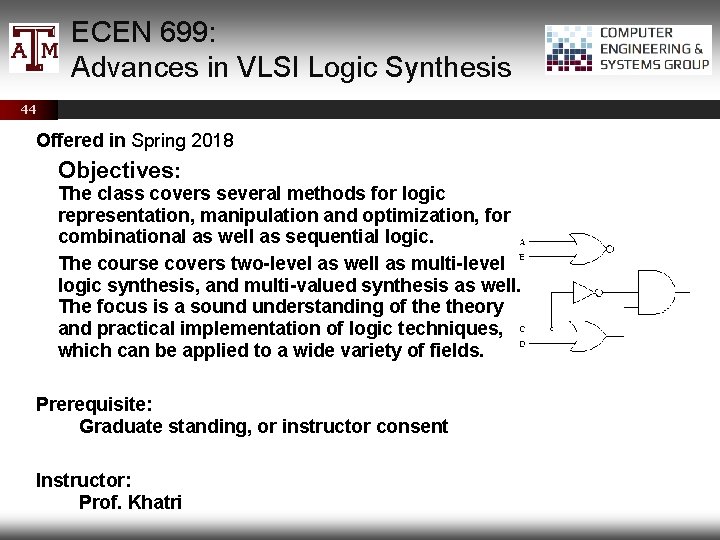
ECEN 699: Advances in VLSI Logic Synthesis 44 Offered in Spring 2018 Objectives: The class covers several methods for logic representation, manipulation and optimization, for combinational as well as sequential logic. The course covers two-level as well as multi-level logic synthesis, and multi-valued synthesis as well. The focus is a sound understanding of theory and practical implementation of logic techniques, which can be applied to a wide variety of fields. Prerequisite: Graduate standing, or instructor consent Instructor: Prof. Khatri
ECEN 651: Microprogrammed Control of Digital Systems 45 Offered in Spring 2018 • Objectives: Hardware and software concepts involved in the design and construction of microprocessorbased digital systems; microprocessor architecture; bussing; interfacing; data input/output; memories; and software development for operation and testing; design projects with microprocessors and related components • Prerequisite: ELEN 350 and 449 or approval of instructor • Instructor: Prof. Lu
ECEN 653: Computer Arithmetic Unit Design 46 Offered in Spring 2018 • Objectives: Design of digit computer arithmetic unit, control and memory. Focusing on microprocessor arithmetic logic unit (ALU) design; high-speed addition, subtraction, multiplication and division algorithms and implementations; design and simulation with integrated circuit components and VLSI circuits. Prerequisite: ECEN 651 Instructor: Prof. Mi Lu
ECEN 602: Computer Communication and Networking 47 Offered in Fall 2018 • Objectives: Computer communication and computer networks; use of the International Standards Organization (ISO) seven-layer Open Systems Interconnection model as basis for systematic approach; operational networks to be included in the study of each layer; homework assignments to make use of a campus computer network. • Prerequisite: Statistical probability background • Instructor: Prof. Pierce Cantrell
ECEN 754: Optimization for Electrical and Computer Engineering Applications 48 Offered in Fall 2018 Objectives: • • • Important applications in electrical and computer engineering require knowledge of linear/nonlinear/convex programming. This course covers applications of importance to Electrical and Computer Engineering, including estimation of signals, routing and congestion control in communication networks, elastic flows in real-time wireless networks, wafer fabrication plants, and economic dispatch in electrical power systems. Students will write their own code for several methods. Prerequisite: Math 304 or 309 or 311; and Math 251; and Graduate standing Instructor: Prof. P. R. Kumar
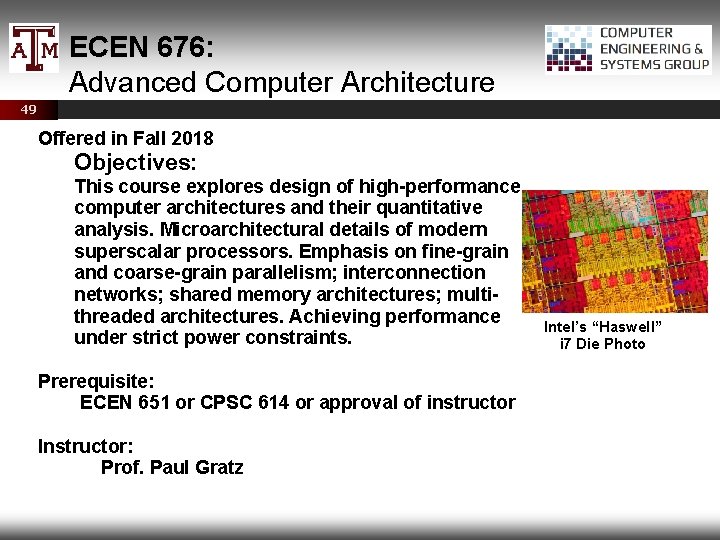
ECEN 676: Advanced Computer Architecture 49 Offered in Fall 2018 Objectives: This course explores design of high-performance computer architectures and their quantitative analysis. Microarchitectural details of modern superscalar processors. Emphasis on fine-grain and coarse-grain parallelism; interconnection networks; shared memory architectures; multithreaded architectures. Achieving performance under strict power constraints. Prerequisite: ECEN 651 or CPSC 614 or approval of instructor Instructor: Prof. Paul Gratz Intel’s “Haswell” i 7 Die Photo
ECEN 755: Stochastic Systems 50 Offered in Spring 2019 Objectives: Important applications in electrical and computer engineering require knowledge of stochastic systems. This course deals with several models of stochastic systems and their analysis. It studies topics including performance evaluation, estimation, control, scheduling, identification and adaptation. It has applications in several fields such as computer engineering, communication networks and control. Prerequisite: Math 411; and Graduate standing Instructor: Prof. P. R. Kumar
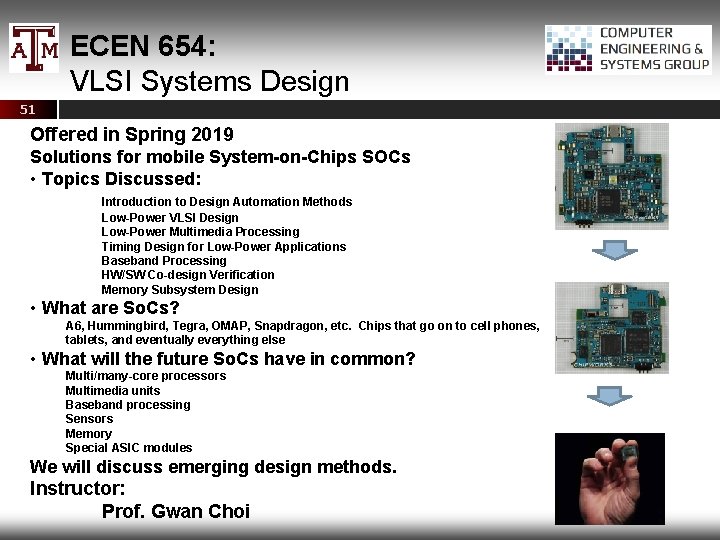
ECEN 654: VLSI Systems Design 51 Offered in Spring 2019 Solutions for mobile System-on-Chips SOCs • Topics Discussed: Introduction to Design Automation Methods Low-Power VLSI Design Low-Power Multimedia Processing Timing Design for Low-Power Applications Baseband Processing HW/SW Co-design Verification Memory Subsystem Design • What are So. Cs? A 6, Hummingbird, Tegra, OMAP, Snapdragon, etc. Chips that go on to cell phones, tablets, and eventually everything else • What will the future So. Cs have in common? Multi/many-core processors Multimedia units Baseband processing Sensors Memory Special ASIC modules We will discuss emerging design methods. Instructor: Prof. Gwan Choi
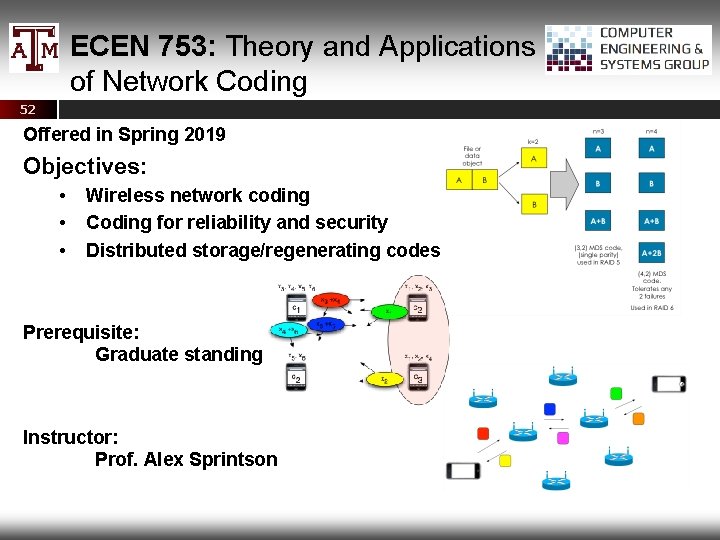
ECEN 753: Theory and Applications of Network Coding 52 Offered in Spring 2019 Objectives: • • • Wireless network coding Coding for reliability and security Distributed storage/regenerating codes Prerequisite: Graduate standing Instructor: Prof. Alex Sprintson
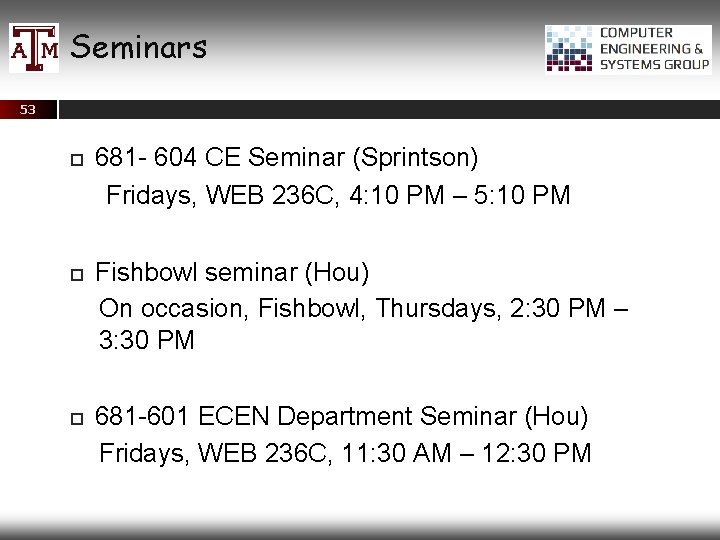
Seminars 53 681 - 604 CE Seminar (Sprintson) Fridays, WEB 236 C, 4: 10 PM – 5: 10 PM Fishbowl seminar (Hou) On occasion, Fishbowl, Thursdays, 2: 30 PM – 3: 30 PM 681 -601 ECEN Department Seminar (Hou) Fridays, WEB 236 C, 11: 30 AM – 12: 30 PM
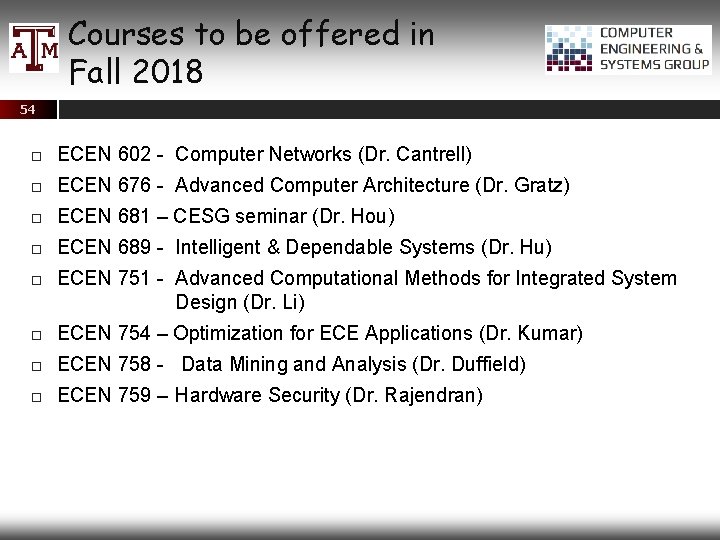
Courses to be offered in Fall 2018 54 ECEN 602 - Computer Networks (Dr. Cantrell) ECEN 676 - Advanced Computer Architecture (Dr. Gratz) ECEN 681 – CESG seminar (Dr. Hou) ECEN 689 - Intelligent & Dependable Systems (Dr. Hu) ECEN 751 - Advanced Computational Methods for Integrated System Design (Dr. Li) ECEN 754 – Optimization for ECE Applications (Dr. Kumar) ECEN 758 - Data Mining and Analysis (Dr. Duffield) ECEN 759 – Hardware Security (Dr. Rajendran)
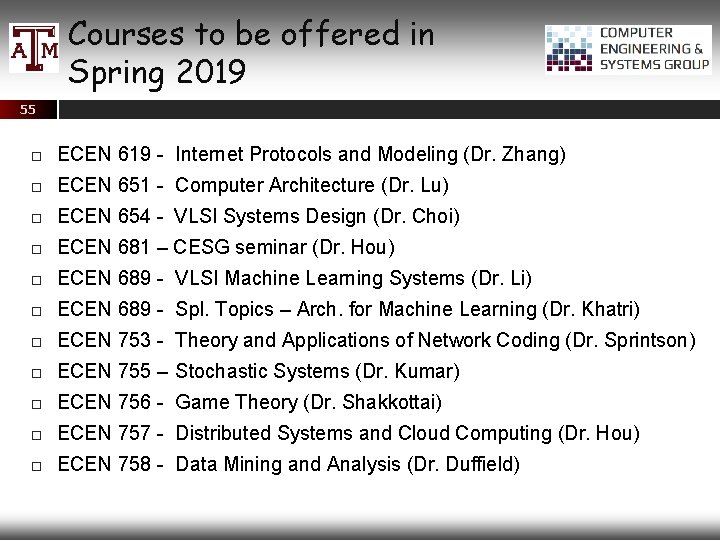
Courses to be offered in Spring 2019 55 ECEN 619 - Internet Protocols and Modeling (Dr. Zhang) ECEN 651 - Computer Architecture (Dr. Lu) ECEN 654 - VLSI Systems Design (Dr. Choi) ECEN 681 – CESG seminar (Dr. Hou) ECEN 689 - VLSI Machine Learning Systems (Dr. Li) ECEN 689 - Spl. Topics – Arch. for Machine Learning (Dr. Khatri) ECEN 753 - Theory and Applications of Network Coding (Dr. Sprintson) ECEN 755 – Stochastic Systems (Dr. Kumar) ECEN 756 - Game Theory (Dr. Shakkottai) ECEN 757 - Distributed Systems and Cloud Computing (Dr. Hou) ECEN 758 - Data Mining and Analysis (Dr. Duffield)
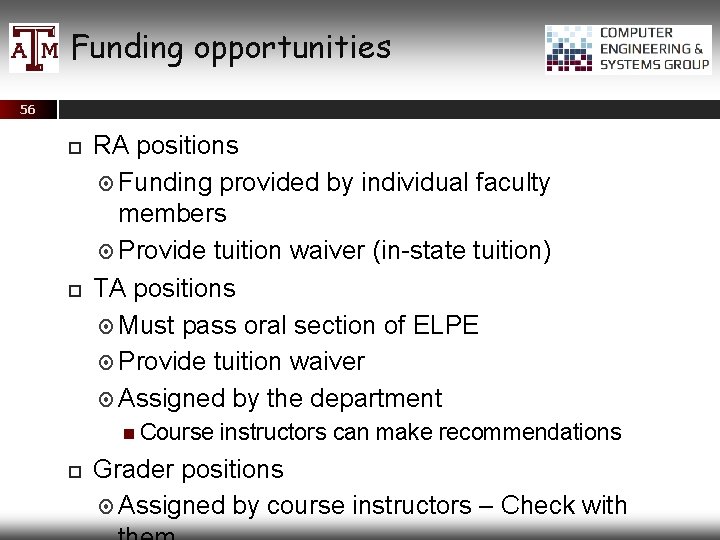
Funding opportunities 56 RA positions Funding provided by individual faculty members Provide tuition waiver (in-state tuition) TA positions Must pass oral section of ELPE Provide tuition waiver Assigned by the department Course instructors can make recommendations Grader positions Assigned by course instructors – Check with
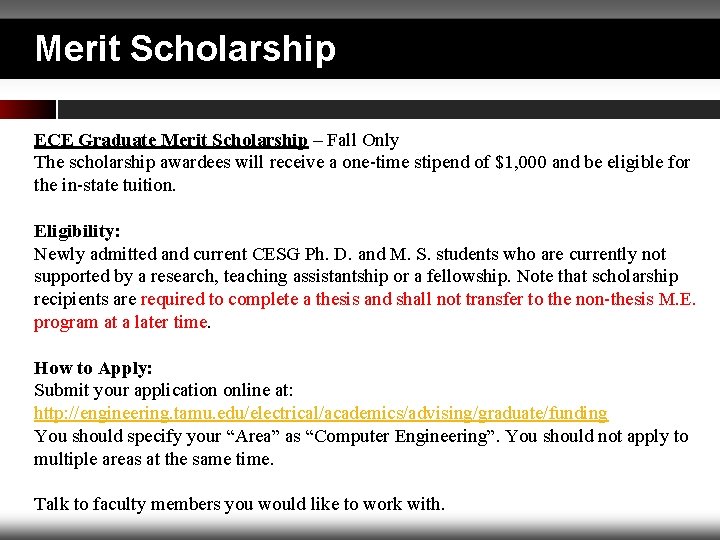
Click. Scholarship to edit Master title style Merit ECE Graduate Merit Scholarship – Fall Only The scholarship awardees will receive a one-time stipend of $1, 000 and be eligible for the in-state tuition. Eligibility: Newly admitted and current CESG Ph. D. and M. S. students who are currently not supported by a research, teaching assistantship or a fellowship. Note that scholarship recipients are required to complete a thesis and shall not transfer to the non-thesis M. E. program at a later time. How to Apply: Submit your application online at: http: //engineering. tamu. edu/electrical/academics/advising/graduate/funding You should specify your “Area” as “Computer Engineering”. You should not apply to multiple areas at the same time. Talk to faculty members you would like to work with.
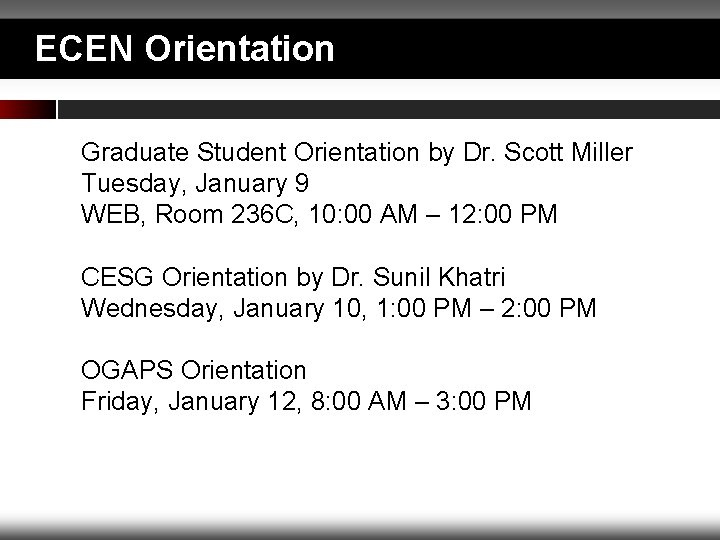
Click Orientation to edit Master title style ECEN Graduate Student Orientation by Dr. Scott Miller Tuesday, January 9 WEB, Room 236 C, 10: 00 AM – 12: 00 PM CESG Orientation by Dr. Sunil Khatri Wednesday, January 10, 1: 00 PM – 2: 00 PM OGAPS Orientation Friday, January 12, 8: 00 AM – 3: 00 PM
Click to edit Master title style Questions