
Computer Assisted Proof of Optimal Approximability Results Uri
Computer Assisted Proof of Optimal Approximability Results Uri Zwick Tel Aviv University SODA’ 02, January 6 -8, San Francisco
Optimal approximability results require the proof of some nasty real inequalities Computerized proof of real inequalities
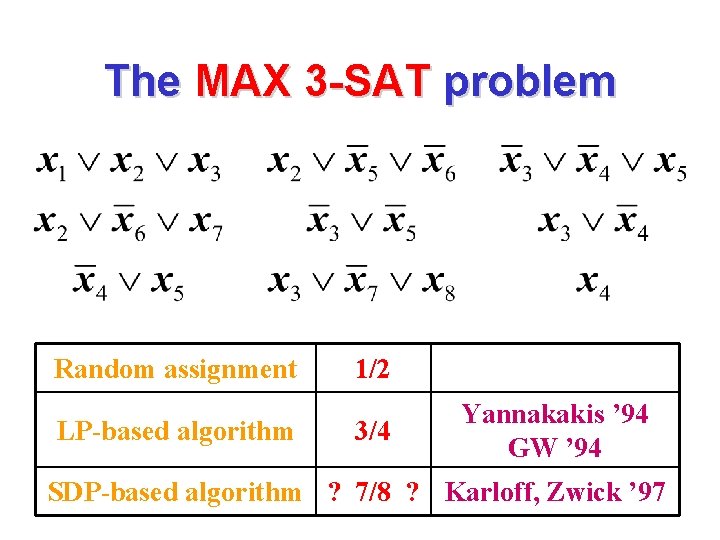
The MAX 3 -SAT problem Random assignment LP-based algorithm 1/2 3/4 Yannakakis ’ 94 GW ’ 94 SDP-based algorithm ? 7/8 ? Karloff, Zwick ’ 97
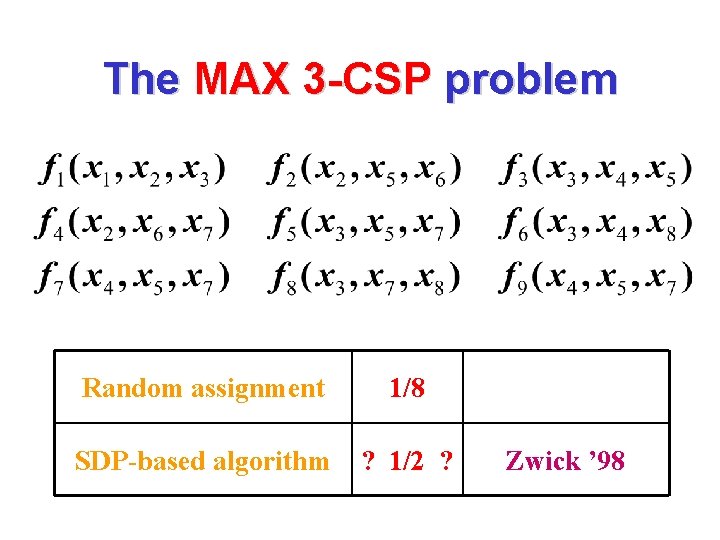
The MAX 3 -CSP problem Random assignment 1/8 SDP-based algorithm ? 1/2 ? Zwick ’ 98
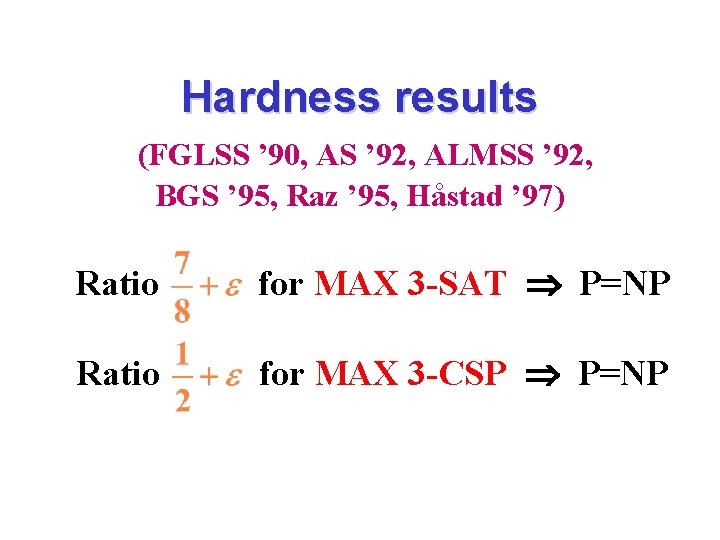
Hardness results (FGLSS ’ 90, AS ’ 92, ALMSS ’ 92, BGS ’ 95, Raz ’ 95, Håstad ’ 97) Ratio for MAX 3 -SAT P=NP Ratio for MAX 3 -CSP P=NP
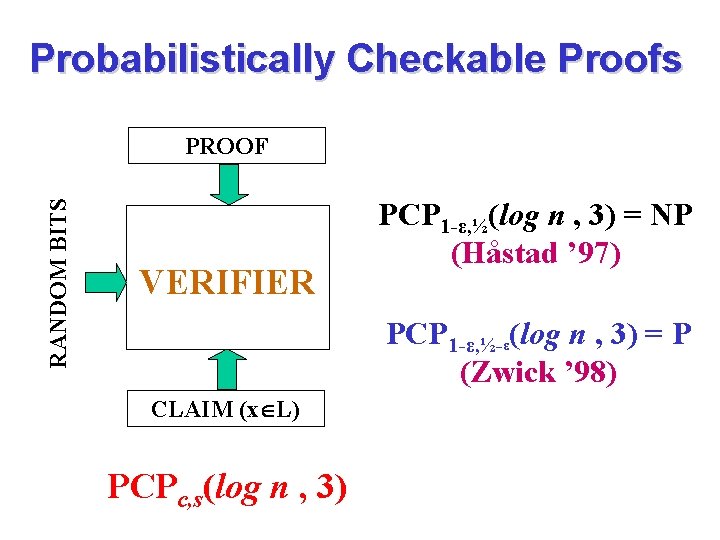
Probabilistically Checkable Proofs RANDOM BITS PROOF VERIFIER PCP 1 -ε, ½(log n , 3) = NP (Håstad ’ 97) PCP 1 -ε, ½-ε(log n , 3) = P (Zwick ’ 98) CLAIM (x L) PCPc, s(log n , 3)
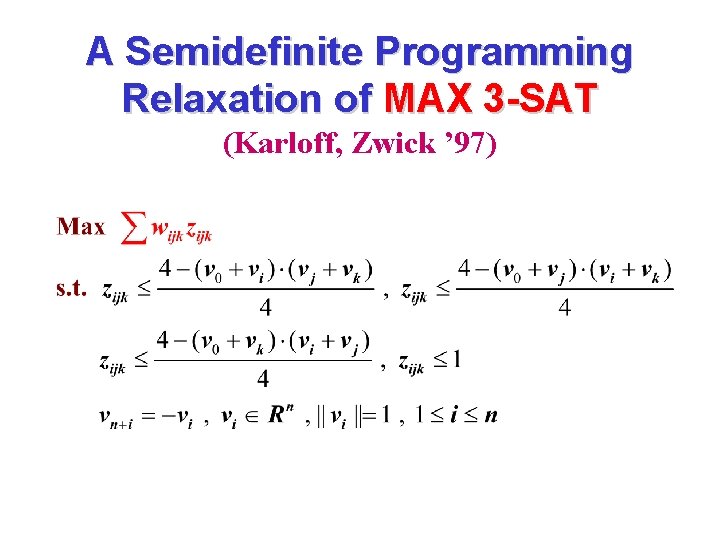
A Semidefinite Programming Relaxation of MAX 3 -SAT (Karloff, Zwick ’ 97)
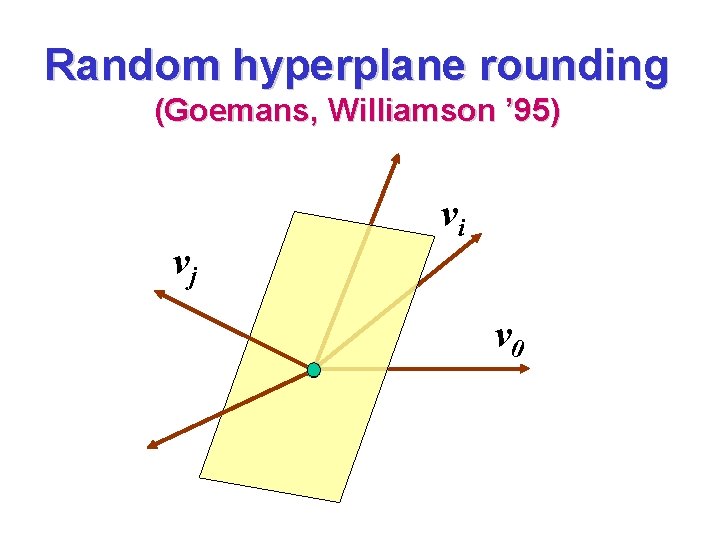
Random hyperplane rounding (Goemans, Williamson ’ 95) vj vi v 0
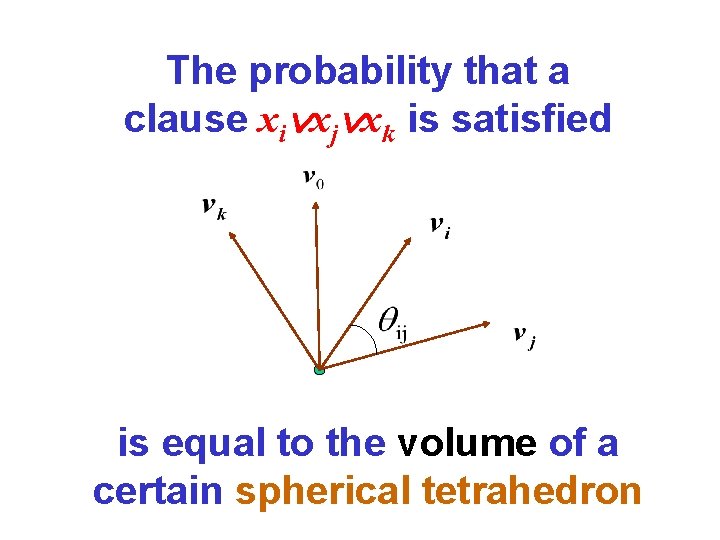
The probability that a clause xi xj xk is satisfied is equal to the volume of a certain spherical tetrahedron
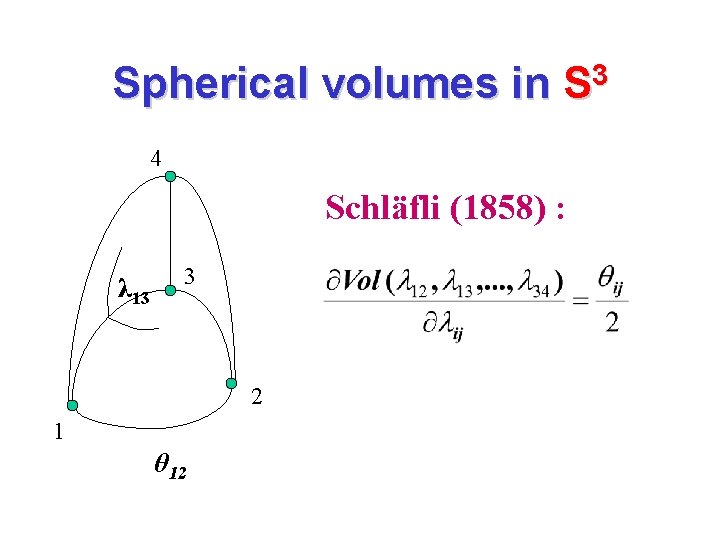
Spherical volumes in S 3 4 Schläfli (1858) : λ 13 3 2 1 θ 12
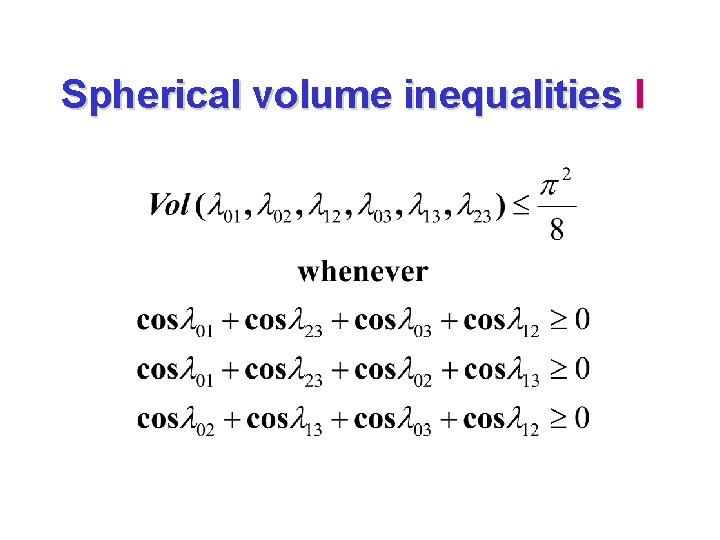
Spherical volume inequalities I
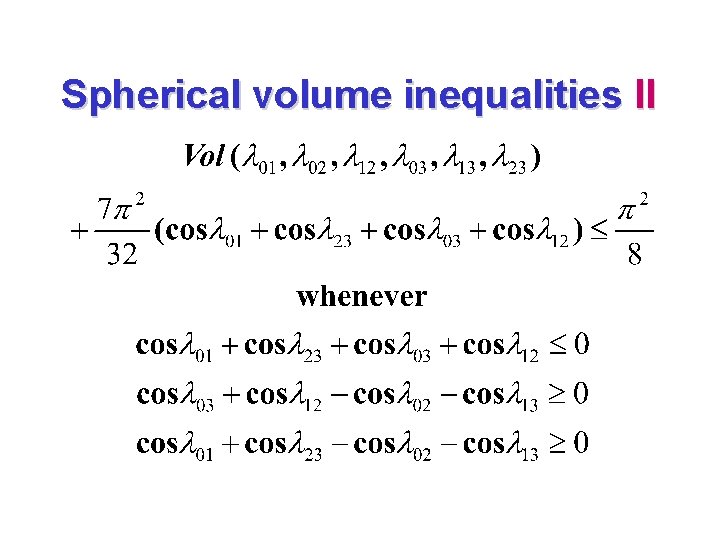
Spherical volume inequalities II
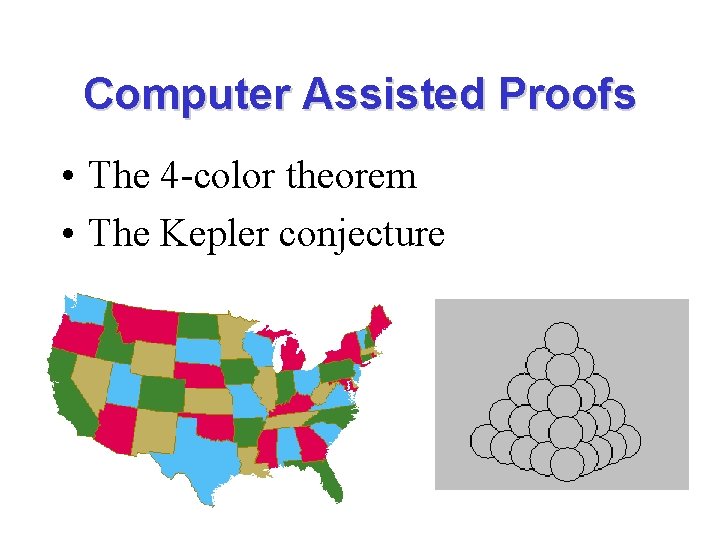
Computer Assisted Proofs • The 4 -color theorem • The Kepler conjecture
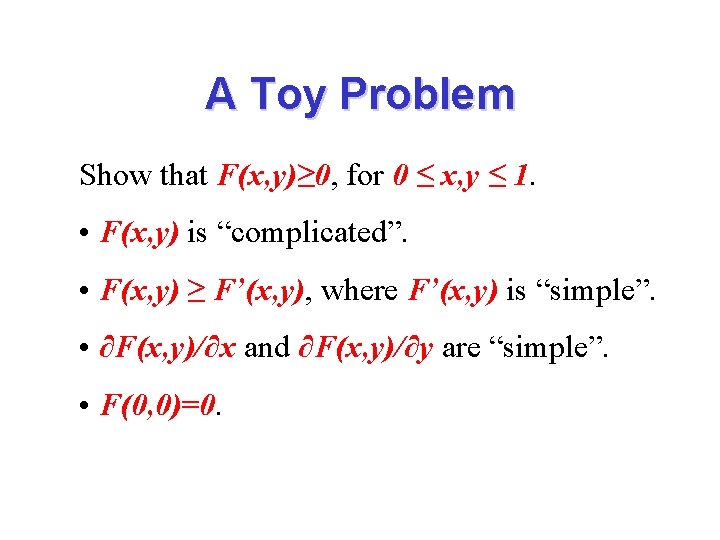
A Toy Problem Show that F(x, y)≥ 0, for 0 ≤ x, y ≤ 1. • F(x, y) is “complicated”. • F(x, y) ≥ F’(x, y), where F’(x, y) is “simple”. • ∂F(x, y)/∂x and ∂F(x, y)/∂y are “simple”. • F(0, 0)=0.
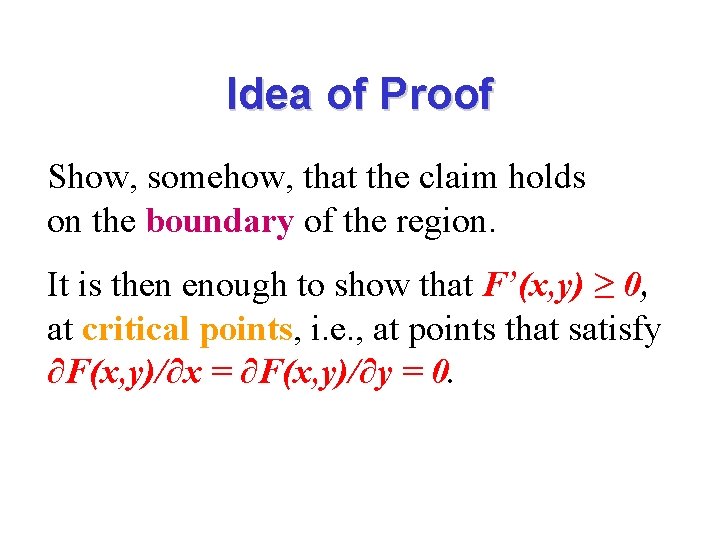
Idea of Proof Show, somehow, that the claim holds on the boundary of the region. It is then enough to show that F’(x, y) ≥ 0, at critical points, i. e. , at points that satisfy ∂F(x, y)/∂x = ∂F(x, y)/∂y = 0.
![“Outline” of proof Partition [0, 1]2 into rectangles, such that in each rectangle, at](http://slidetodoc.com/presentation_image_h2/fed867d261512ceea03b4fcc017feadd/image-16.jpg "“Outline” of proof Partition [0, 1]2 into rectangles, such that in each rectangle, at")
“Outline” of proof Partition [0, 1]2 into rectangles, such that in each rectangle, at least one of the following holds: • F’(x, y) ≥ 0 • ∂F(x, y)/∂x > 0 • ∂F(x, y)/∂x < 0 • ∂F(x, y)/∂y > 0 • ∂F(x, y)/∂y < 0 All that remains is to prove the claim on the boundary of the region.
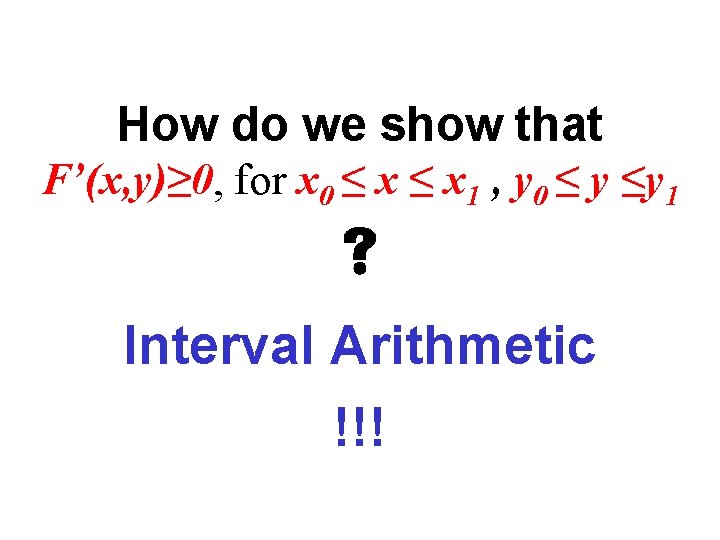
How do we show that F’(x, y)≥ 0, for x 0 ≤ x 1 , y 0 ≤ y ≤y 1 Interval Arithmetic !!!
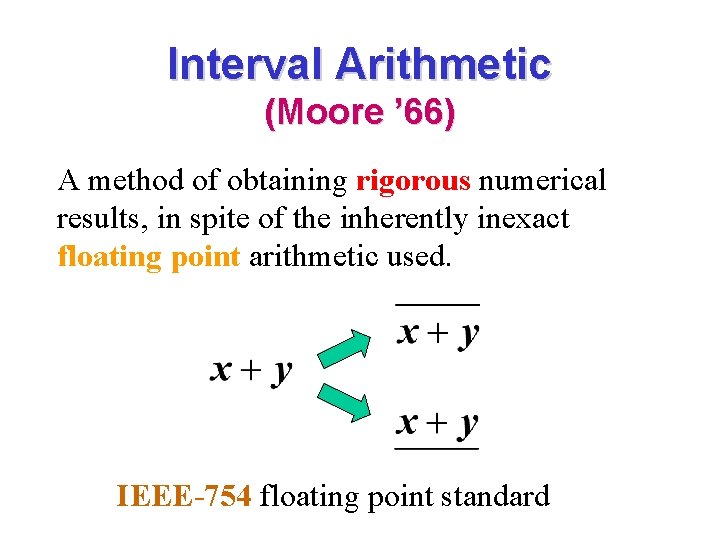
Interval Arithmetic (Moore ’ 66) A method of obtaining rigorous numerical results, in spite of the inherently inexact floating point arithmetic used. IEEE-754 floating point standard
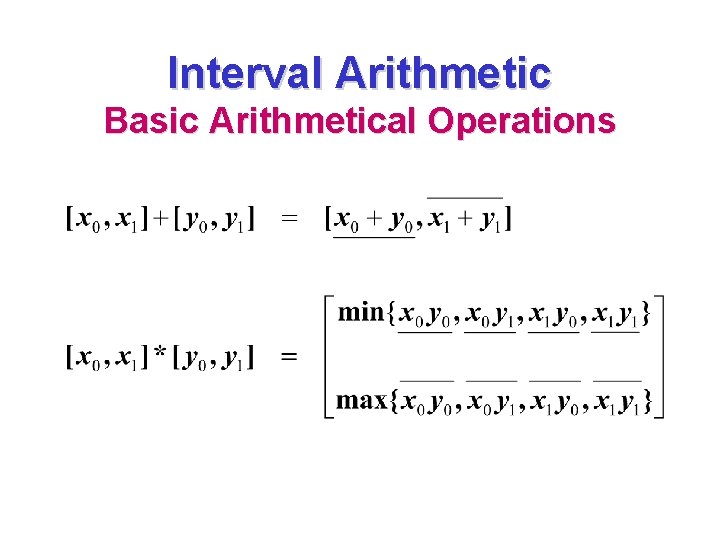
Interval Arithmetic Basic Arithmetical Operations
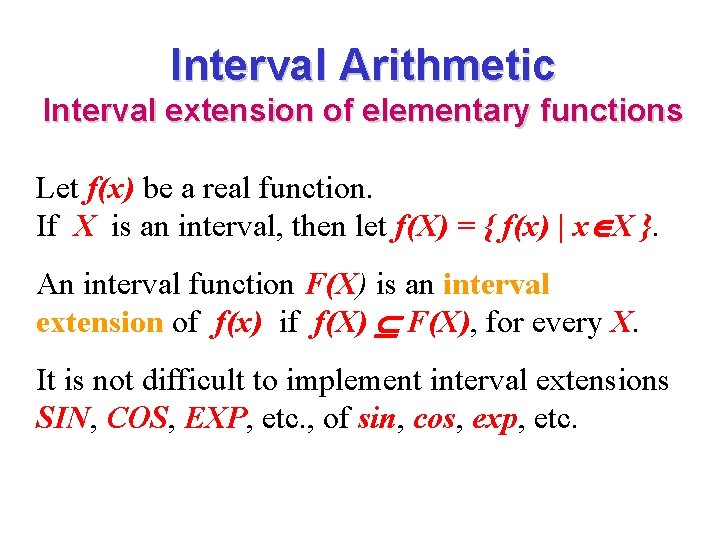
Interval Arithmetic Interval extension of elementary functions Let f(x) be a real function. If X is an interval, then let f(X) = { f(x) | x X }. An interval function F(X) is an interval extension of f(x) if f(X) F(X), for every X. It is not difficult to implement interval extensions SIN, COS, EXP, etc. , of sin, cos, exp, etc.
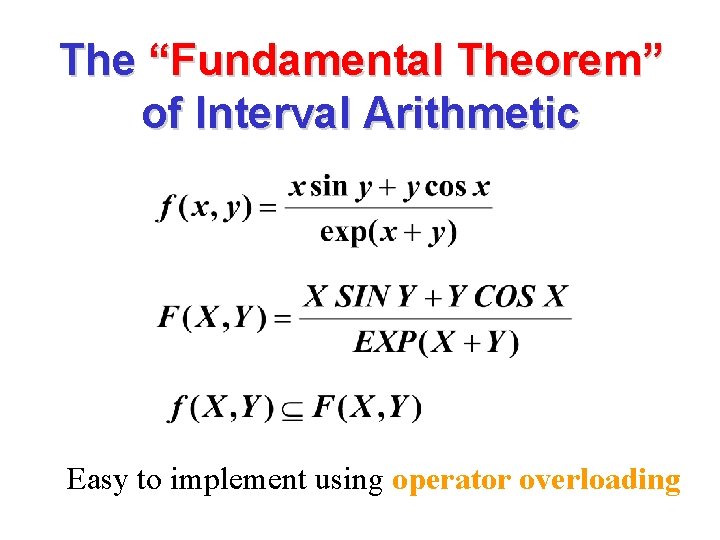
The “Fundamental Theorem” of Interval Arithmetic Easy to implement using operator overloading
The Real. Search system A very naïve system that uses interval arithmetic to verify that given collections of real constraints have no feasible solutions. Used to verify the spherical inequalities needed to obtain proofs of the 7/8 and 1/2 conjectures.
Concluding Remarks • What is a proof? • Need for general purpose tools ( Numerica, Glob. Sol, Real. Search ) • Is there a simple proof?
- Slides: 23