
Computer Architecture We will use a quantitative approach





- Slides: 25
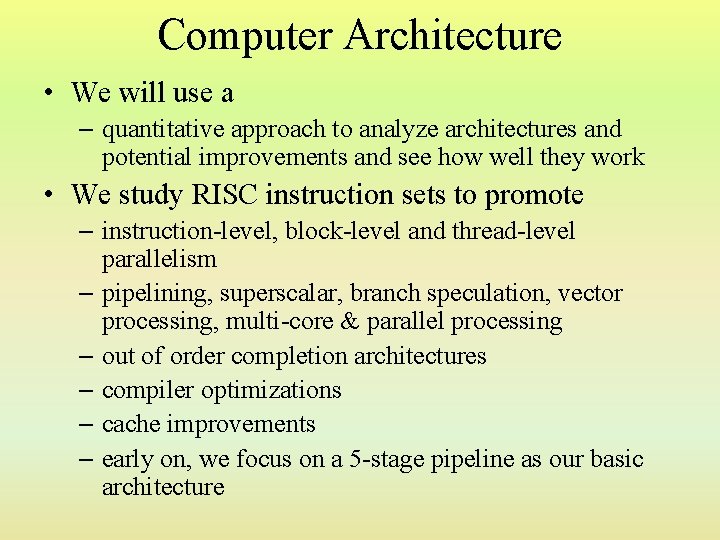
Computer Architecture • We will use a – quantitative approach to analyze architectures and potential improvements and see how well they work • We study RISC instruction sets to promote – instruction-level, block-level and thread-level parallelism – pipelining, superscalar, branch speculation, vector processing, multi-core & parallel processing – out of order completion architectures – compiler optimizations – cache improvements – early on, we focus on a 5 -stage pipeline as our basic architecture
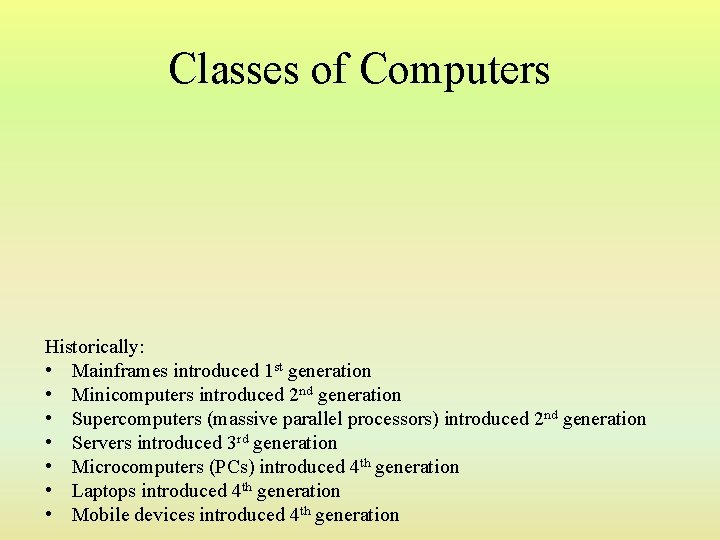
Classes of Computers Historically: • Mainframes introduced 1 st generation • Minicomputers introduced 2 nd generation • Supercomputers (massive parallel processors) introduced 2 nd generation • Servers introduced 3 rd generation • Microcomputers (PCs) introduced 4 th generation • Laptops introduced 4 th generation • Mobile devices introduced 4 th generation
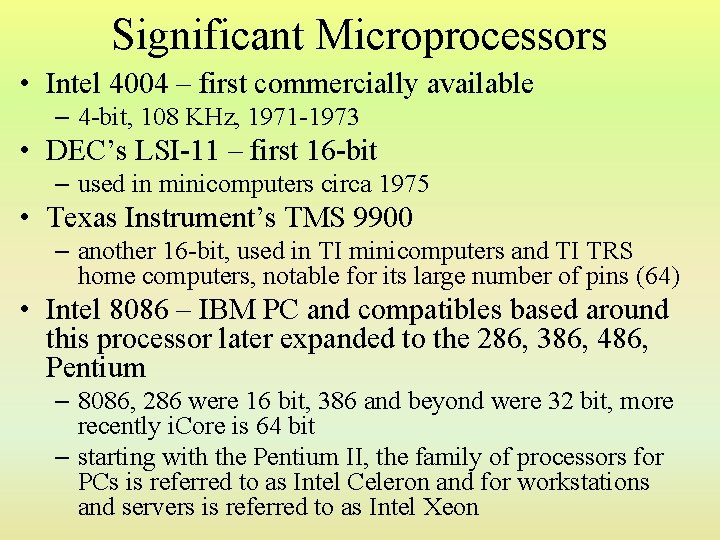
Significant Microprocessors • Intel 4004 – first commercially available – 4 -bit, 108 KHz, 1971 -1973 • DEC’s LSI-11 – first 16 -bit – used in minicomputers circa 1975 • Texas Instrument’s TMS 9900 – another 16 -bit, used in TI minicomputers and TI TRS home computers, notable for its large number of pins (64) • Intel 8086 – IBM PC and compatibles based around this processor later expanded to the 286, 386, 486, Pentium – 8086, 286 were 16 bit, 386 and beyond were 32 bit, more recently i. Core is 64 bit – starting with the Pentium II, the family of processors for PCs is referred to as Intel Celeron and for workstations and servers is referred to as Intel Xeon
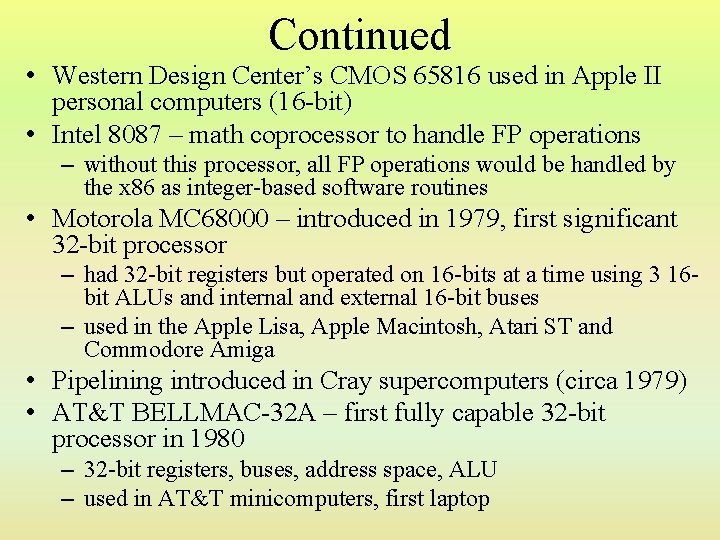
Continued • Western Design Center’s CMOS 65816 used in Apple II personal computers (16 -bit) • Intel 8087 – math coprocessor to handle FP operations – without this processor, all FP operations would be handled by the x 86 as integer-based software routines • Motorola MC 68000 – introduced in 1979, first significant 32 -bit processor – had 32 -bit registers but operated on 16 -bits at a time using 3 16 bit ALUs and internal and external 16 -bit buses – used in the Apple Lisa, Apple Macintosh, Atari ST and Commodore Amiga • Pipelining introduced in Cray supercomputers (circa 1979) • AT&T BELLMAC-32 A – first fully capable 32 -bit processor in 1980 – 32 -bit registers, buses, address space, ALU – used in AT&T minicomputers, first laptop
Continued • Intel and AMD enter 10 year technology exchange (1981) – AM 286 released in 1984 (their version of the 286) and AM 386 released in 1991 • HP Focus – first commercially available 32 -bit microprocessor (1982) • Motorola MC 68020 – used by many small computers to produce “desktop-sized” systems – often used for microcomputers running Unix – 68030 added MMX capabilities, 68040 added an FPU • MIPS R 2000 – first RISC-based processor, 1984 • Acorn Archimedes – ARM processors (RISCbased) began to be released starting in 1985
Continued • SPARC – by Sun Microsystems (now Oracle) to support Sun workstations – first release was 1987, one of the most successful early RISC processors – had 160 general-purpose registers with a group supporting register windows for fast parameter passing and 16 FP registers • Early 90 s saw the initial development of 64 -bit processors (although the PC market waited until the 00 s before investing in them) • Power. PC – RISC-based, released in 1991 and developed by Apple/IBM/Motorola – became the processor for all Apple products until 2006
Continued • IBM released POWER 4 in 2001 – first commercial multi-core processor • x 86 -64 – Intel-based 64 -bit processor expansions to the x 86 line (Sept 2003) – AMD released the AMD 64 – Power. PC expanded to 64 bits around the same time – ARM introduced a 64 -bit processor in 2011 • Sun released Niagara in 2005 – 8 -core, support for multithreading • 2006 – Intel begins releasing i. Core processors – starting with a dual core processor in which one core does nothing!
GPU History • GPUs did not evolve from CPUs – instead, they evolved from graphics accelerators • chips attached to video cards that handled some of the graphics routines like moving, rotating and shading objects – earliest released in 1976 to handle “video shifting” • NEC u. PD 7220 – first graphics display controller as a single chip • The idea for massively parallel GPUs did not arise until the 00 s – NDIVIA was the first to refer to the term GPU – they implemented a GPU platform called CUDA in 2007
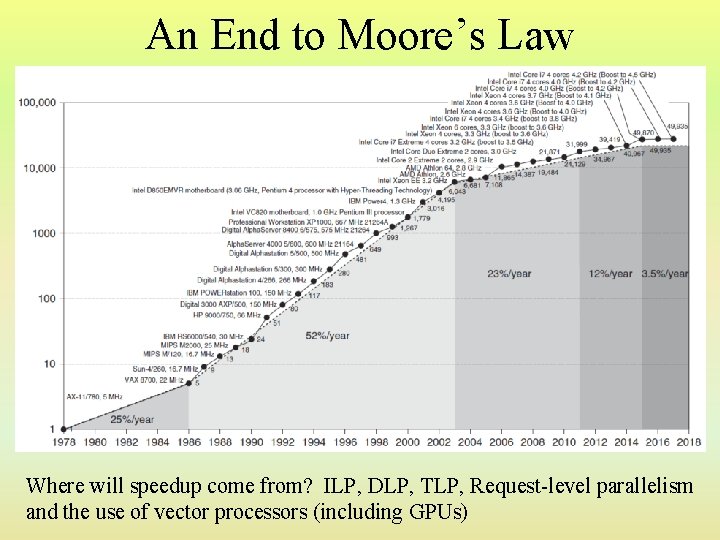
An End to Moore’s Law Where will speedup come from? ILP, DLP, TLP, Request-level parallelism and the use of vector processors (including GPUs)
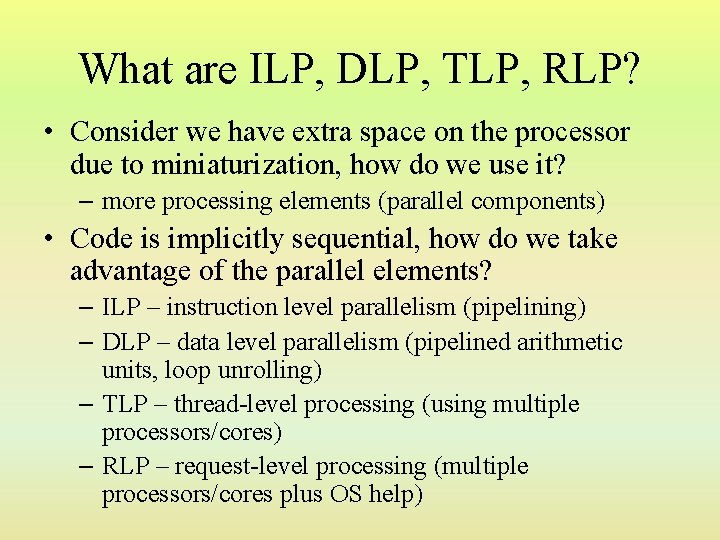
What are ILP, DLP, TLP, RLP? • Consider we have extra space on the processor due to miniaturization, how do we use it? – more processing elements (parallel components) • Code is implicitly sequential, how do we take advantage of the parallel elements? – ILP – instruction level parallelism (pipelining) – DLP – data level parallelism (pipelined arithmetic units, loop unrolling) – TLP – thread-level processing (using multiple processors/cores) – RLP – request-level processing (multiple processors/cores plus OS help)
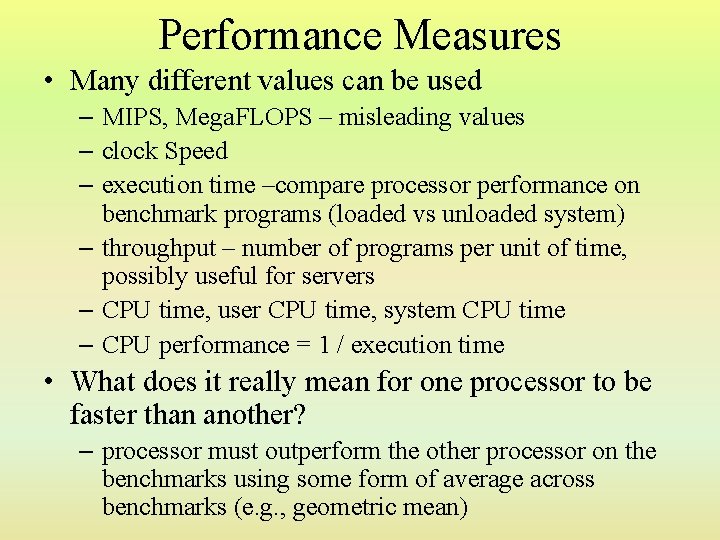
Performance Measures • Many different values can be used – MIPS, Mega. FLOPS – misleading values – clock Speed – execution time –compare processor performance on benchmark programs (loaded vs unloaded system) – throughput – number of programs per unit of time, possibly useful for servers – CPU time, user CPU time, system CPU time – CPU performance = 1 / execution time • What does it really mean for one processor to be faster than another? – processor must outperform the other processor on the benchmarks using some form of average across benchmarks (e. g. , geometric mean)
Benchmark Comparisons
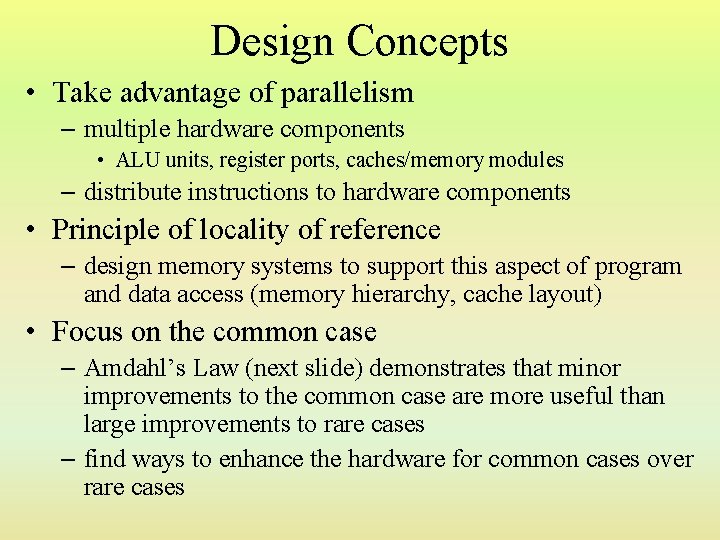
Design Concepts • Take advantage of parallelism – multiple hardware components • ALU units, register ports, caches/memory modules – distribute instructions to hardware components • Principle of locality of reference – design memory systems to support this aspect of program and data access (memory hierarchy, cache layout) • Focus on the common case – Amdahl’s Law (next slide) demonstrates that minor improvements to the common case are more useful than large improvements to rare cases – find ways to enhance the hardware for common cases over rare cases
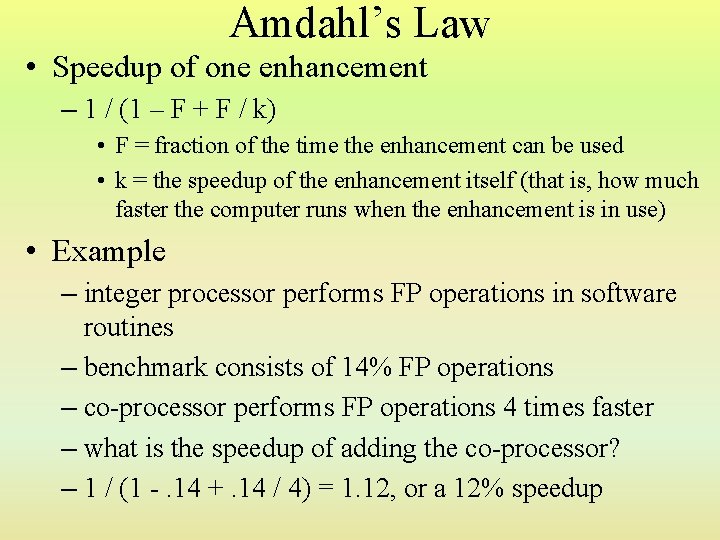
Amdahl’s Law • Speedup of one enhancement – 1 / (1 – F + F / k) • F = fraction of the time the enhancement can be used • k = the speedup of the enhancement itself (that is, how much faster the computer runs when the enhancement is in use) • Example – integer processor performs FP operations in software routines – benchmark consists of 14% FP operations – co-processor performs FP operations 4 times faster – what is the speedup of adding the co-processor? – 1 / (1 -. 14 +. 14 / 4) = 1. 12, or a 12% speedup
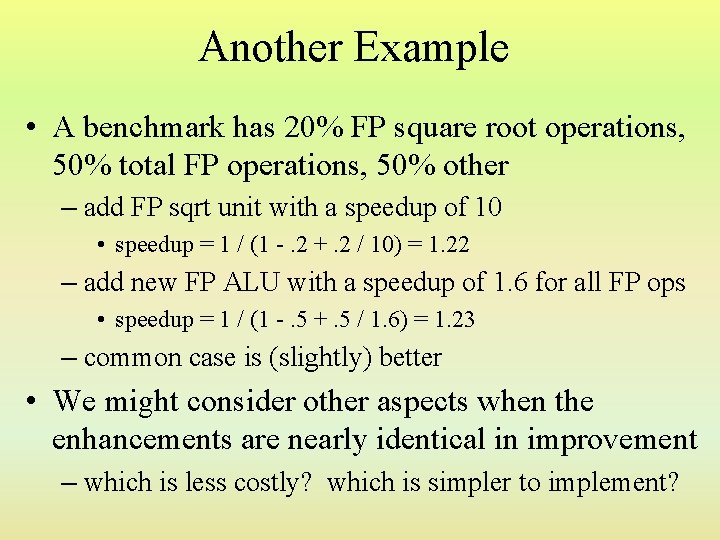
Another Example • A benchmark has 20% FP square root operations, 50% total FP operations, 50% other – add FP sqrt unit with a speedup of 10 • speedup = 1 / (1 -. 2 +. 2 / 10) = 1. 22 – add new FP ALU with a speedup of 1. 6 for all FP ops • speedup = 1 / (1 -. 5 +. 5 / 1. 6) = 1. 23 – common case is (slightly) better • We might consider other aspects when the enhancements are nearly identical in improvement – which is less costly? which is simpler to implement?
Why “Common Case? ” • We have a reciprocal – the smaller the value in the denominator, the greater the speedup • The denominator subtracts F from 1 and adds F / k – –F has a larger impact than F / k • Example • Web server enhancements: – enhancement 1: faster processor (10 times faster) – enhancement 2: faster hard drive (2 times faster) – assume our system spends 30% on computation and 70% on disk access • speedup of enhancement 1 = 1 / (1 -. 3 +. 3 / 10) = 1. 37 (37% speedup) • speedup of enhancement 2= 1 / (1 -. 7 +. 7 / 2) = 1. 54 (74% speedup) – even though the processor’s speedup is a speedup 5 times over the hard drive speedup, the common case wins out
Another Example • Architects have suggested a new feature that can be used 20% of the time and offers a speedup of 3 – one architect feels that she can provide a better enhancement that will offer a 7 time speedup for that particular feature • What percentage of the time would the second feature have to be used to match the first enhancement? – speedup from feature 1 = 1 / (1 -. 2 +. 2 / 3) = 1. 154 – speedup from feature 2 = 1 / (1 – x + x / 7) = 1. 154 • solve for x using some algebra • 1 – x + x / 7 = 1 / 1. 154 =. 867 • 1 -. 867 = x – x / 7 . 133 = 6 x / 7, x = 7 *. 133 / 6 =. 156
CPU Performance Formulae • We can also compare performances by computing CPU time (time it takes CPU to execute a program) – CPU time = CPU clock cycles * clock cycle time • clock cycle time (CCT) = 1 / clock rate • CPU clock cycles = number of elapsed clock cycles = • instruction count (IC) * clock cycles per instruction (CPI) – not all instructions have the same CPI so we can sum up for every instruction type, its CPI * its IC • CPU time = (S CPIi * ICi ) * clock cycle time • To determine speedup given two CPU times, divide the faster by the slower – CPU time slower machine / CPU time faster machine
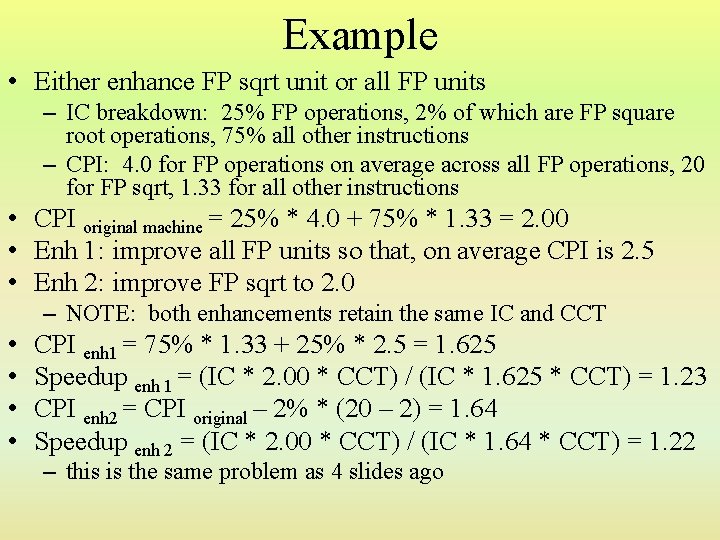
Example • Either enhance FP sqrt unit or all FP units – IC breakdown: 25% FP operations, 2% of which are FP square root operations, 75% all other instructions – CPI: 4. 0 for FP operations on average across all FP operations, 20 for FP sqrt, 1. 33 for all other instructions • CPI original machine = 25% * 4. 0 + 75% * 1. 33 = 2. 00 • Enh 1: improve all FP units so that, on average CPI is 2. 5 • Enh 2: improve FP sqrt to 2. 0 – NOTE: both enhancements retain the same IC and CCT • • CPI enh 1 = 75% * 1. 33 + 25% * 2. 5 = 1. 625 Speedup enh 1 = (IC * 2. 00 * CCT) / (IC * 1. 625 * CCT) = 1. 23 CPI enh 2 = CPI original – 2% * (20 – 2) = 1. 64 Speedup enh 2 = (IC * 2. 00 * CCT) / (IC * 1. 64 * CCT) = 1. 22 – this is the same problem as 4 slides ago
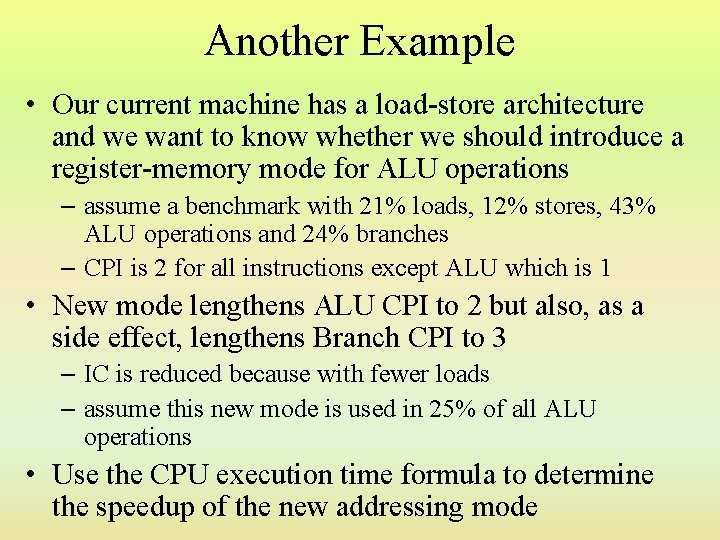
Another Example • Our current machine has a load-store architecture and we want to know whether we should introduce a register-memory mode for ALU operations – assume a benchmark with 21% loads, 12% stores, 43% ALU operations and 24% branches – CPI is 2 for all instructions except ALU which is 1 • New mode lengthens ALU CPI to 2 but also, as a side effect, lengthens Branch CPI to 3 – IC is reduced because with fewer loads – assume this new mode is used in 25% of all ALU operations • Use the CPU execution time formula to determine the speedup of the new addressing mode
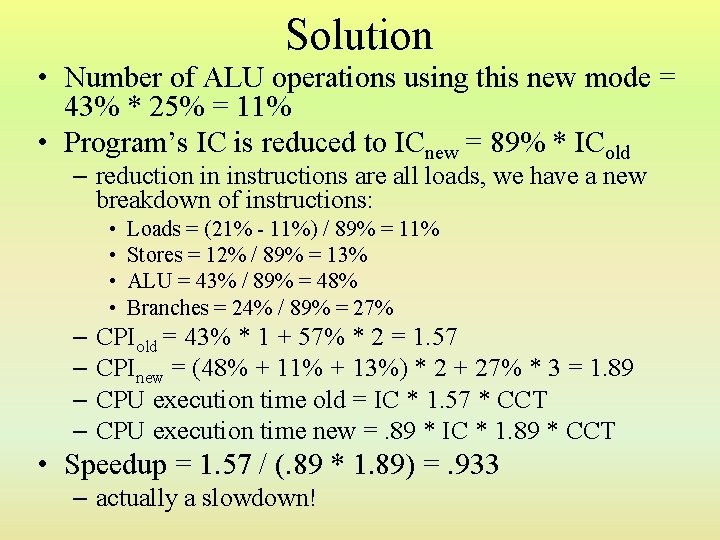
Solution • Number of ALU operations using this new mode = 43% * 25% = 11% • Program’s IC is reduced to ICnew = 89% * ICold – reduction in instructions are all loads, we have a new breakdown of instructions: • • Loads = (21% - 11%) / 89% = 11% Stores = 12% / 89% = 13% ALU = 43% / 89% = 48% Branches = 24% / 89% = 27% – CPIold = 43% * 1 + 57% * 2 = 1. 57 – CPInew = (48% + 11% + 13%) * 2 + 27% * 3 = 1. 89 – CPU execution time old = IC * 1. 57 * CCT – CPU execution time new =. 89 * IC * 1. 89 * CCT • Speedup = 1. 57 / (. 89 * 1. 89) =. 933 – actually a slowdown!
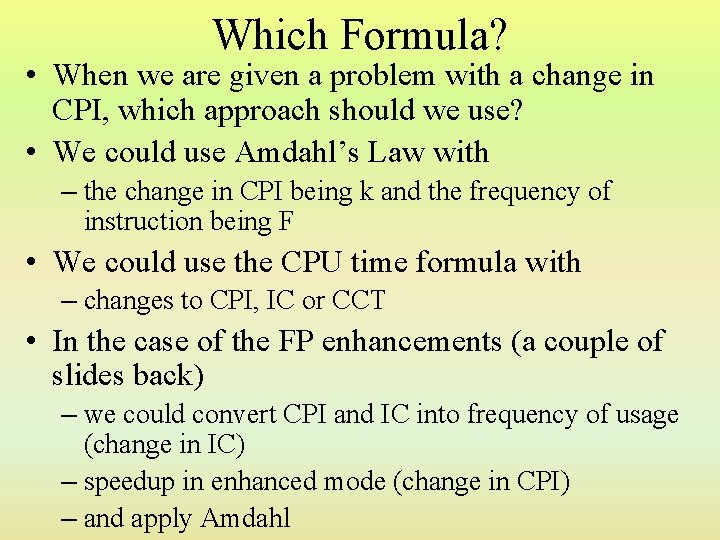
Which Formula? • When we are given a problem with a change in CPI, which approach should we use? • We could use Amdahl’s Law with – the change in CPI being k and the frequency of instruction being F • We could use the CPU time formula with – changes to CPI, IC or CCT • In the case of the FP enhancements (a couple of slides back) – we could convert CPI and IC into frequency of usage (change in IC) – speedup in enhanced mode (change in CPI) – and apply Amdahl
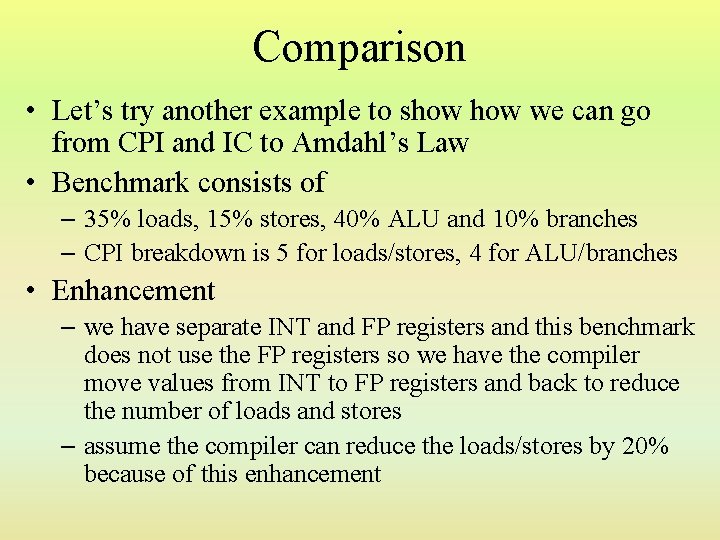
Comparison • Let’s try another example to show we can go from CPI and IC to Amdahl’s Law • Benchmark consists of – 35% loads, 15% stores, 40% ALU and 10% branches – CPI breakdown is 5 for loads/stores, 4 for ALU/branches • Enhancement – we have separate INT and FP registers and this benchmark does not use the FP registers so we have the compiler move values from INT to FP registers and back to reduce the number of loads and stores – assume the compiler can reduce the loads/stores by 20% because of this enhancement
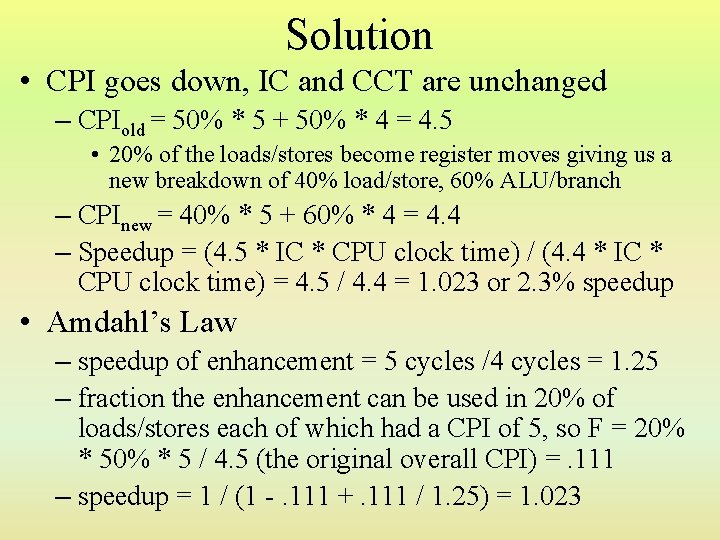
Solution • CPI goes down, IC and CCT are unchanged – CPIold = 50% * 5 + 50% * 4 = 4. 5 • 20% of the loads/stores become register moves giving us a new breakdown of 40% load/store, 60% ALU/branch – CPInew = 40% * 5 + 60% * 4 = 4. 4 – Speedup = (4. 5 * IC * CPU clock time) / (4. 4 * IC * CPU clock time) = 4. 5 / 4. 4 = 1. 023 or 2. 3% speedup • Amdahl’s Law – speedup of enhancement = 5 cycles /4 cycles = 1. 25 – fraction the enhancement can be used in 20% of loads/stores each of which had a CPI of 5, so F = 20% * 5 / 4. 5 (the original overall CPI) =. 111 – speedup = 1 / (1 -. 111 +. 111 / 1. 25) = 1. 023
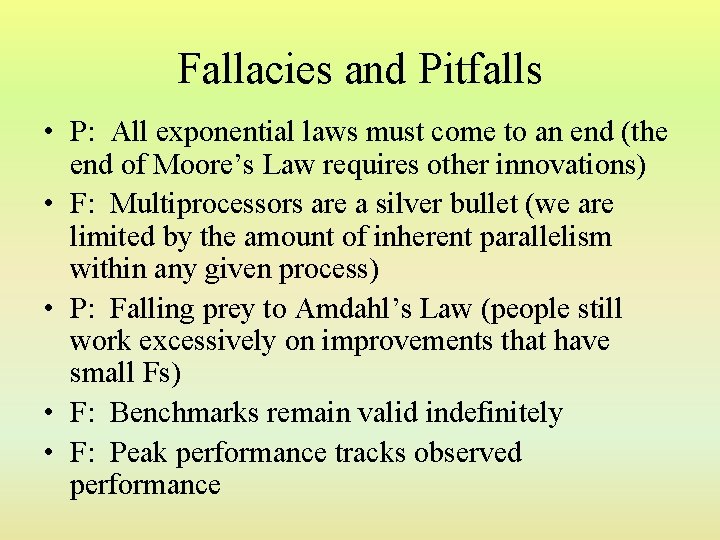
Fallacies and Pitfalls • P: All exponential laws must come to an end (the end of Moore’s Law requires other innovations) • F: Multiprocessors are a silver bullet (we are limited by the amount of inherent parallelism within any given process) • P: Falling prey to Amdahl’s Law (people still work excessively on improvements that have small Fs) • F: Benchmarks remain valid indefinitely • F: Peak performance tracks observed performance