
Computer Architecture Runahead Execution Prof Onur Mutlu Carnegie


- Slides: 82
Computer Architecture: Runahead Execution Prof. Onur Mutlu Carnegie Mellon University
A Note on This Lecture n n These slides are partly from 18 -447 Spring 2013, Computer Architecture, Lecture 28: Runahead Execution Video of that lecture: q http: //www. youtube. com/watch? v=z 8 Ypjq. XQJIA 2
Readings n Required q q n Mutlu et al. , “Runahead execution”, HPCA 2003. Srinath et al. , “Feedback directed prefetching”, HPCA 2007. Optional q q q Mutlu et al. , “Efficient Runahead Execution: Power-Efficient Memory Latency Tolerance, ” ISCA 2005, IEEE Micro Top Picks 2006. Mutlu et al. , “Address-Value Delta (AVD) Prediction, ” MICRO 2005. Armstrong et al. , “Wrong Path Events, ” MICRO 2004. 3
Tolerating Memory Latency
Latency Tolerance n An out-of-order execution processor tolerates latency of multi-cycle operations by executing independent instructions concurrently q q n It does so by buffering instructions in reservation stations and reorder buffer Instruction window: Hardware resources needed to buffer all decoded but not yet retired/committed instructions What if an instruction takes 500 cycles? q q How large of an instruction window do we need to continue decoding? How many cycles of latency can Oo. O tolerate? 5
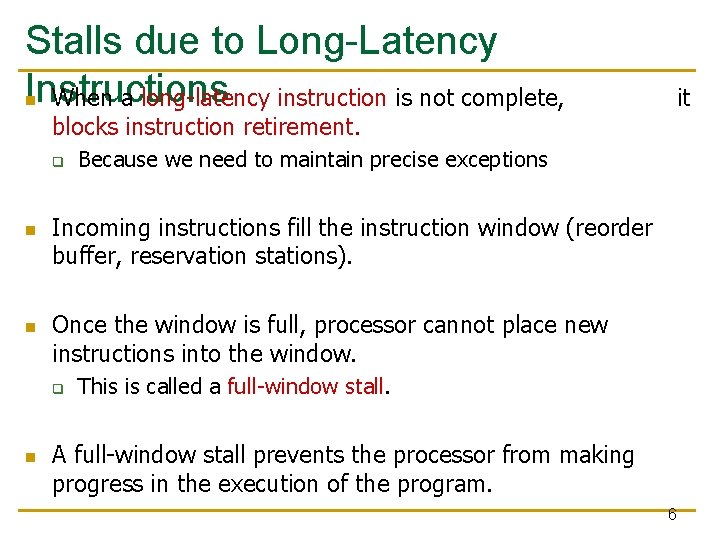
Stalls due to Long-Latency Instructions n When a long-latency instruction is not complete, it blocks instruction retirement. q n n Incoming instructions fill the instruction window (reorder buffer, reservation stations). Once the window is full, processor cannot place new instructions into the window. q n Because we need to maintain precise exceptions This is called a full-window stall. A full-window stall prevents the processor from making progress in the execution of the program. 6
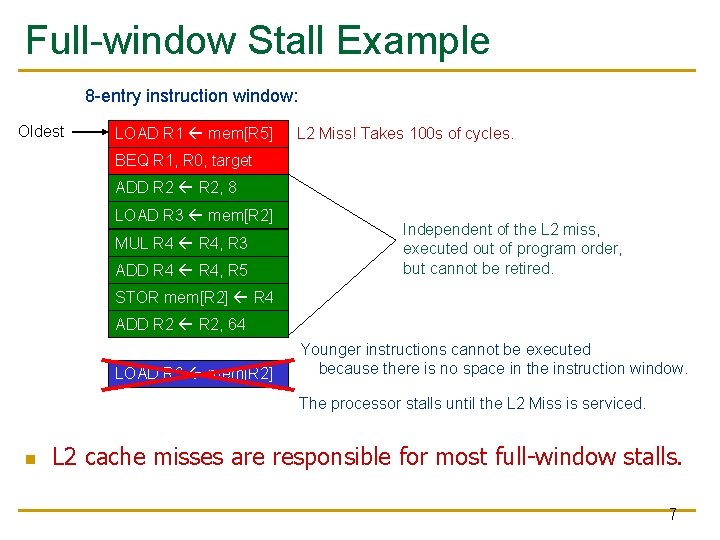
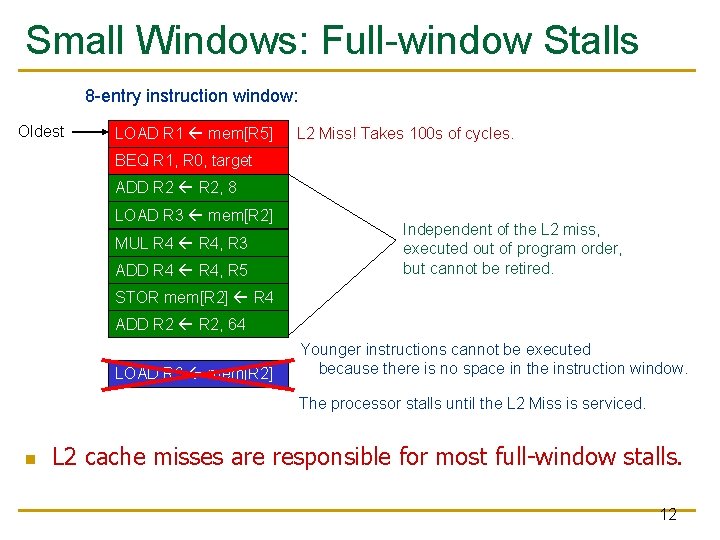
Full-window Stall Example 8 -entry instruction window: Oldest LOAD R 1 mem[R 5] L 2 Miss! Takes 100 s of cycles. BEQ R 1, R 0, target ADD R 2, 8 LOAD R 3 mem[R 2] MUL R 4, R 3 ADD R 4, R 5 Independent of the L 2 miss, executed out of program order, but cannot be retired. STOR mem[R 2] R 4 ADD R 2, 64 LOAD R 3 mem[R 2] Younger instructions cannot be executed because there is no space in the instruction window. The processor stalls until the L 2 Miss is serviced. n L 2 cache misses are responsible for most full-window stalls. 7
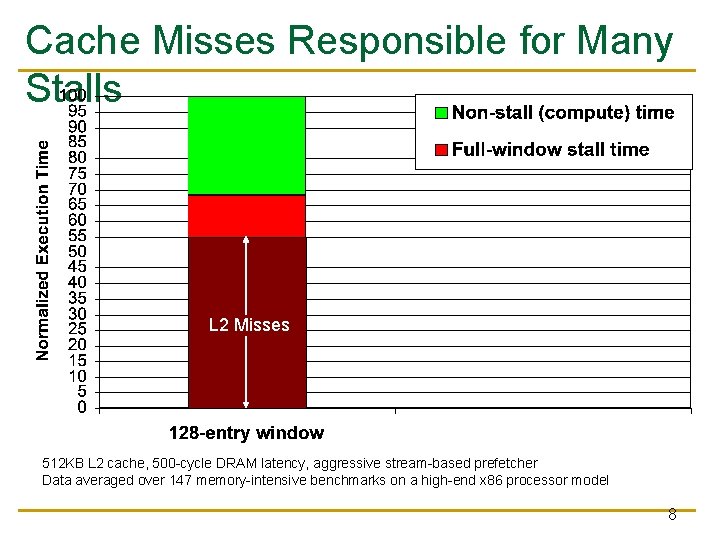
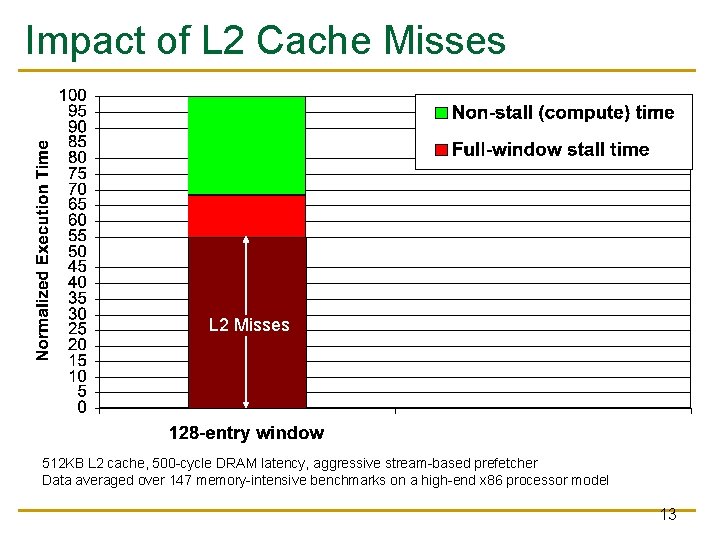
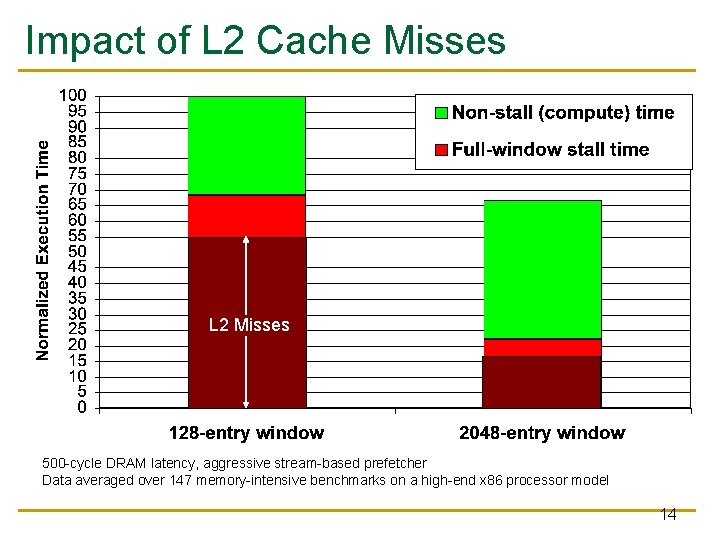
Cache Misses Responsible for Many Stalls L 2 Misses 512 KB L 2 cache, 500 -cycle DRAM latency, aggressive stream-based prefetcher Data averaged over 147 memory-intensive benchmarks on a high-end x 86 processor model 8
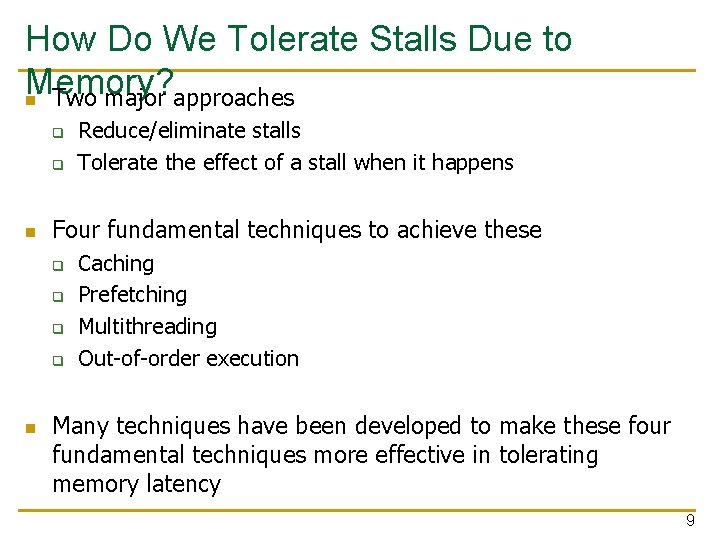
How Do We Tolerate Stalls Due to Memory? n Two major approaches q q n Four fundamental techniques to achieve these q q n Reduce/eliminate stalls Tolerate the effect of a stall when it happens Caching Prefetching Multithreading Out-of-order execution Many techniques have been developed to make these four fundamental techniques more effective in tolerating memory latency 9
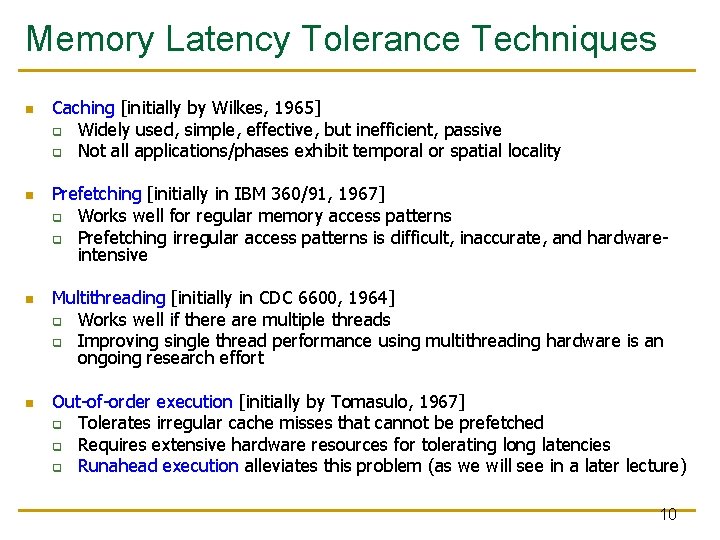
Memory Latency Tolerance Techniques n n Caching [initially by Wilkes, 1965] q Widely used, simple, effective, but inefficient, passive q Not all applications/phases exhibit temporal or spatial locality Prefetching [initially in IBM 360/91, 1967] q Works well for regular memory access patterns q Prefetching irregular access patterns is difficult, inaccurate, and hardwareintensive Multithreading [initially in CDC 6600, 1964] q Works well if there are multiple threads q Improving single thread performance using multithreading hardware is an ongoing research effort Out-of-order execution [initially by Tomasulo, 1967] q Tolerates irregular cache misses that cannot be prefetched q Requires extensive hardware resources for tolerating long latencies q Runahead execution alleviates this problem (as we will see in a later lecture) 10
Runahead Execution
Small Windows: Full-window Stalls 8 -entry instruction window: Oldest LOAD R 1 mem[R 5] L 2 Miss! Takes 100 s of cycles. BEQ R 1, R 0, target ADD R 2, 8 LOAD R 3 mem[R 2] MUL R 4, R 3 ADD R 4, R 5 Independent of the L 2 miss, executed out of program order, but cannot be retired. STOR mem[R 2] R 4 ADD R 2, 64 LOAD R 3 mem[R 2] Younger instructions cannot be executed because there is no space in the instruction window. The processor stalls until the L 2 Miss is serviced. n L 2 cache misses are responsible for most full-window stalls. 12
Impact of L 2 Cache Misses L 2 Misses 512 KB L 2 cache, 500 -cycle DRAM latency, aggressive stream-based prefetcher Data averaged over 147 memory-intensive benchmarks on a high-end x 86 processor model 13
Impact of L 2 Cache Misses L 2 Misses 500 -cycle DRAM latency, aggressive stream-based prefetcher Data averaged over 147 memory-intensive benchmarks on a high-end x 86 processor model 14
The Problem n n n Out-of-order execution requires large instruction windows to tolerate today’s main memory latencies. As main memory latency increases, instruction window size should also increase to fully tolerate the memory latency. Building a large instruction window is a challenging task if we would like to achieve q q q Low power/energy consumption (tag matching logic, ld/st buffers) Short cycle time (access, wakeup/select latencies) Low design and verification complexity 15
Efficient Scaling of Instruction Window Size n n n One of the major research issues in out of order execution How to achieve the benefits of a large window with a small one (or in a simpler way)? How do we efficiently tolerate memory latency with the machinery of out-of-order execution (and a small instruction window)? 16
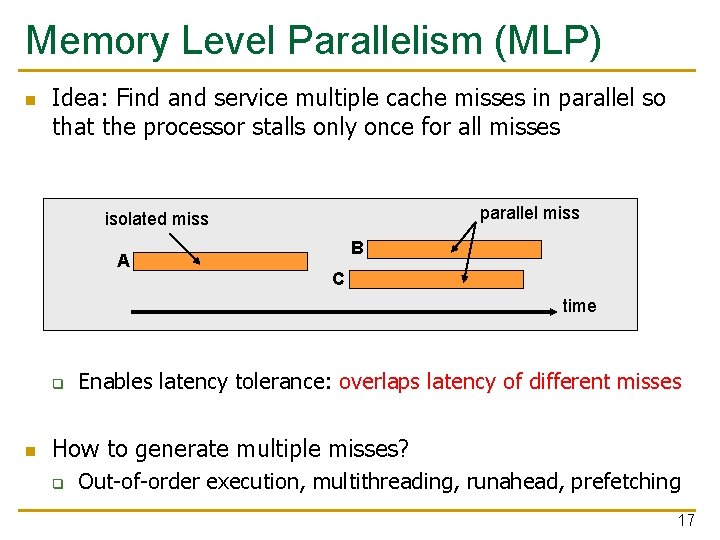
Memory Level Parallelism (MLP) n Idea: Find and service multiple cache misses in parallel so that the processor stalls only once for all misses parallel miss isolated miss A B C time q n Enables latency tolerance: overlaps latency of different misses How to generate multiple misses? q Out-of-order execution, multithreading, runahead, prefetching 17
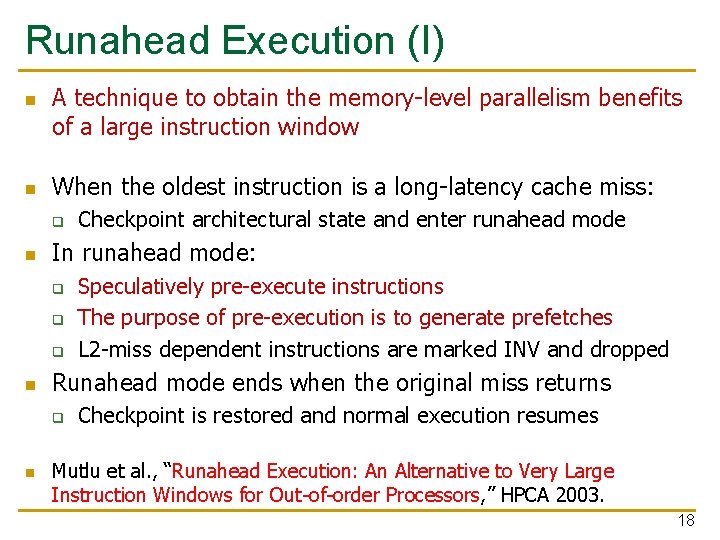
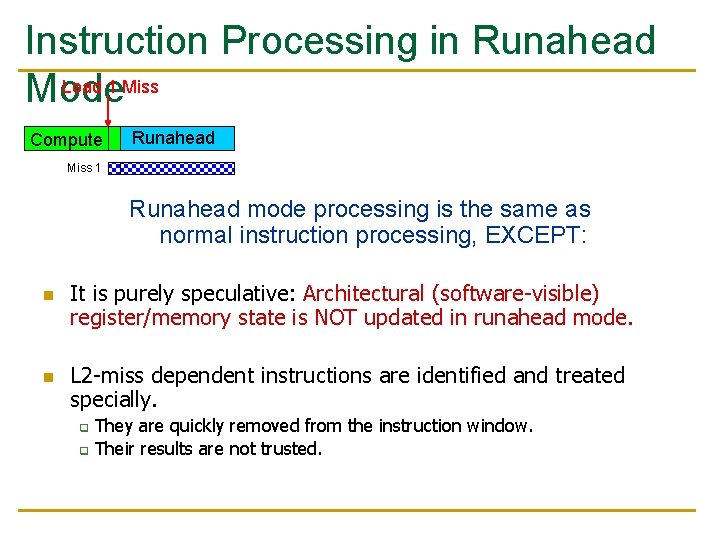
Runahead Execution (I) n n A technique to obtain the memory-level parallelism benefits of a large instruction window When the oldest instruction is a long-latency cache miss: q n In runahead mode: q q q n Speculatively pre-execute instructions The purpose of pre-execution is to generate prefetches L 2 -miss dependent instructions are marked INV and dropped Runahead mode ends when the original miss returns q n Checkpoint architectural state and enter runahead mode Checkpoint is restored and normal execution resumes Mutlu et al. , “Runahead Execution: An Alternative to Very Large Instruction Windows for Out-of-order Processors, ” HPCA 2003. 18
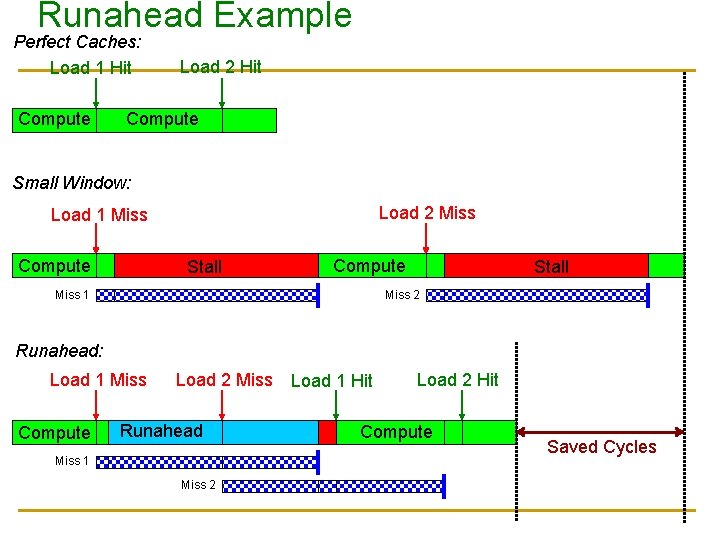
Runahead Example Perfect Caches: Load 1 Hit Compute Load 2 Hit Compute Small Window: Load 2 Miss Load 1 Miss Compute Stall Compute Miss 1 Stall Miss 2 Runahead: Load 1 Miss Compute Load 2 Miss Runahead Miss 1 Miss 2 Load 1 Hit Load 2 Hit Compute Saved Cycles
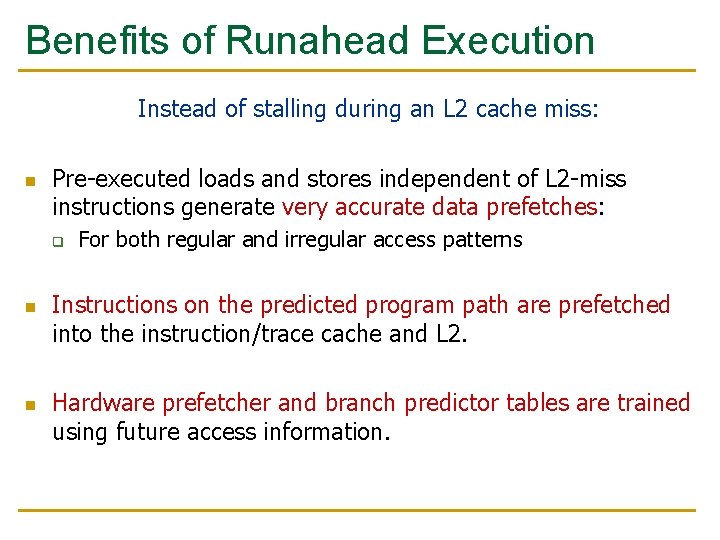
Benefits of Runahead Execution Instead of stalling during an L 2 cache miss: n Pre-executed loads and stores independent of L 2 -miss instructions generate very accurate data prefetches: q n n For both regular and irregular access patterns Instructions on the predicted program path are prefetched into the instruction/trace cache and L 2. Hardware prefetcher and branch predictor tables are trained using future access information.
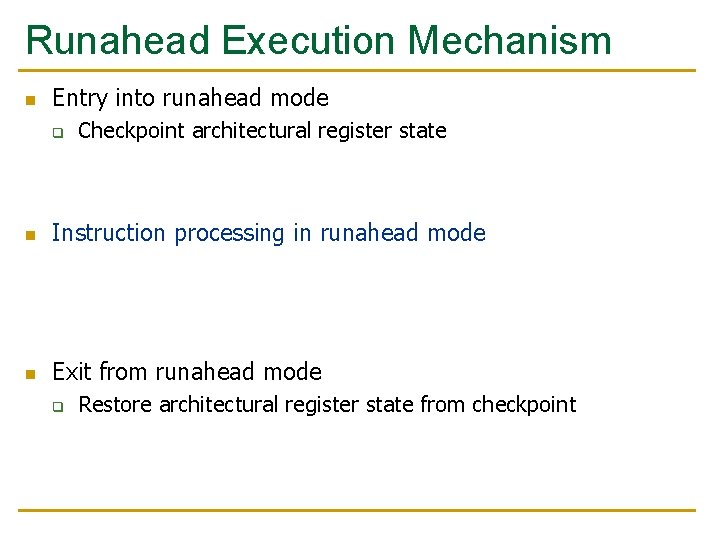
Runahead Execution Mechanism n Entry into runahead mode q Checkpoint architectural register state n Instruction processing in runahead mode n Exit from runahead mode q Restore architectural register state from checkpoint
Instruction Processing in Runahead Load 1 Miss Mode Compute Runahead Miss 1 Runahead mode processing is the same as normal instruction processing, EXCEPT: n n It is purely speculative: Architectural (software-visible) register/memory state is NOT updated in runahead mode. L 2 -miss dependent instructions are identified and treated specially. q q They are quickly removed from the instruction window. Their results are not trusted.
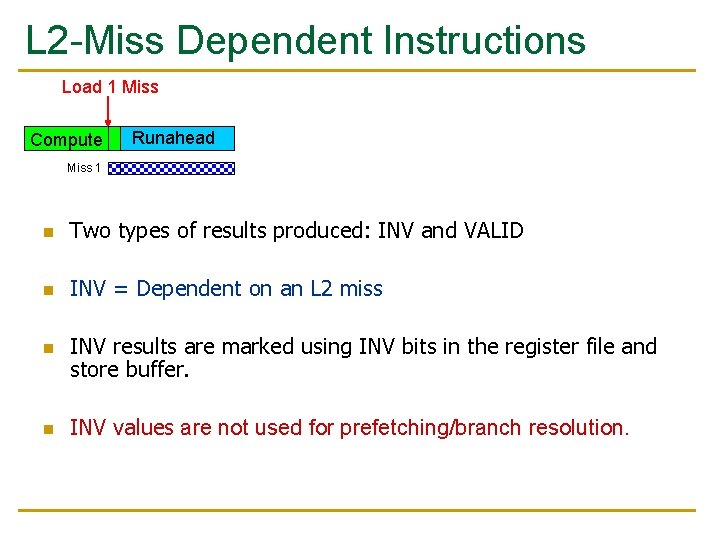
L 2 -Miss Dependent Instructions Load 1 Miss Compute Runahead Miss 1 n Two types of results produced: INV and VALID n INV = Dependent on an L 2 miss n n INV results are marked using INV bits in the register file and store buffer. INV values are not used for prefetching/branch resolution.
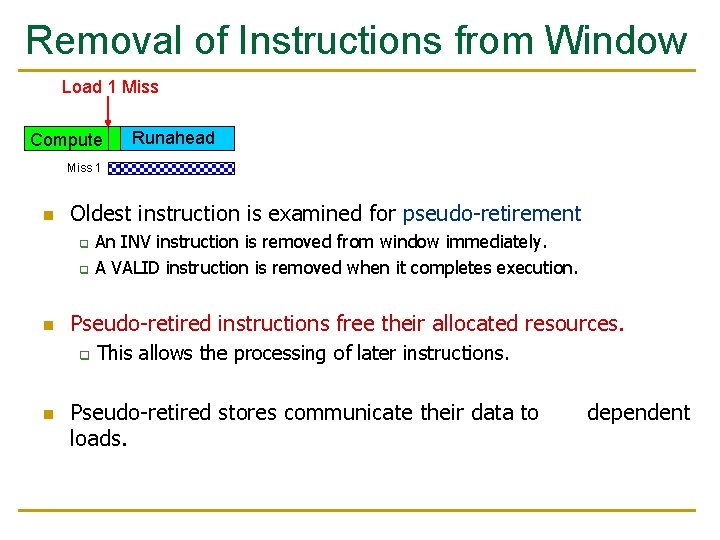
Removal of Instructions from Window Load 1 Miss Compute Runahead Miss 1 n Oldest instruction is examined for pseudo-retirement q q n Pseudo-retired instructions free their allocated resources. q n An INV instruction is removed from window immediately. A VALID instruction is removed when it completes execution. This allows the processing of later instructions. Pseudo-retired stores communicate their data to loads. dependent
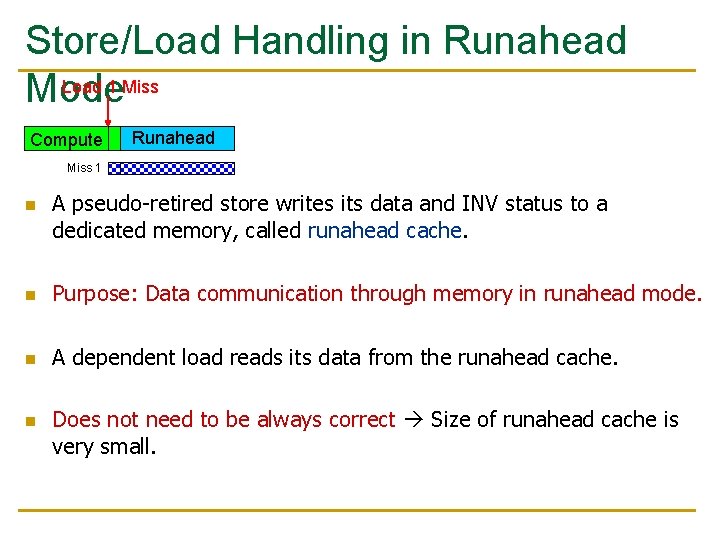
Store/Load Handling in Runahead Load 1 Miss Mode Compute Runahead Miss 1 n A pseudo-retired store writes its data and INV status to a dedicated memory, called runahead cache. n Purpose: Data communication through memory in runahead mode. n A dependent load reads its data from the runahead cache. n Does not need to be always correct Size of runahead cache is very small.
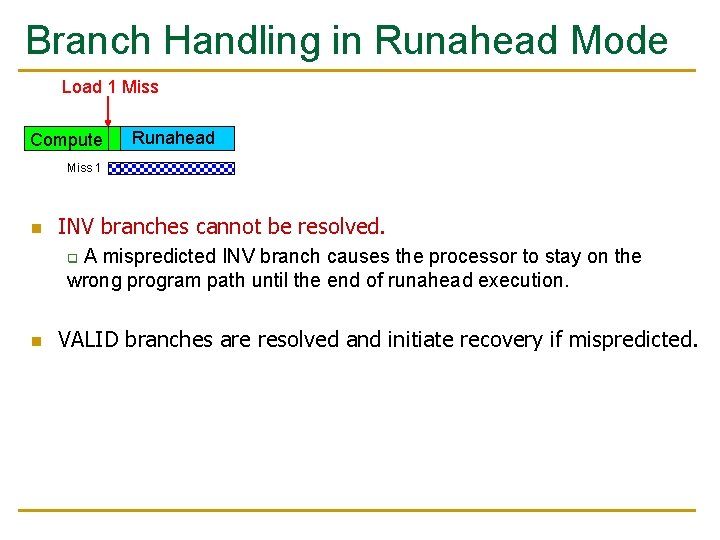
Branch Handling in Runahead Mode Load 1 Miss Compute Runahead Miss 1 n INV branches cannot be resolved. A mispredicted INV branch causes the processor to stay on the wrong program path until the end of runahead execution. q n VALID branches are resolved and initiate recovery if mispredicted.
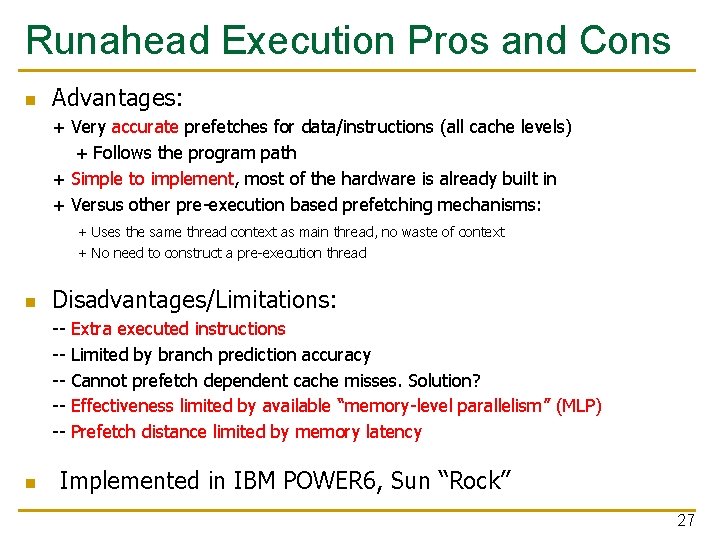
Runahead Execution Pros and Cons n Advantages: + Very accurate prefetches for data/instructions (all cache levels) + Follows the program path + Simple to implement, most of the hardware is already built in + Versus other pre-execution based prefetching mechanisms: + Uses the same thread context as main thread, no waste of context + No need to construct a pre-execution thread n Disadvantages/Limitations: ------ n Extra executed instructions Limited by branch prediction accuracy Cannot prefetch dependent cache misses. Solution? Effectiveness limited by available “memory-level parallelism” (MLP) Prefetch distance limited by memory latency Implemented in IBM POWER 6, Sun “Rock” 27
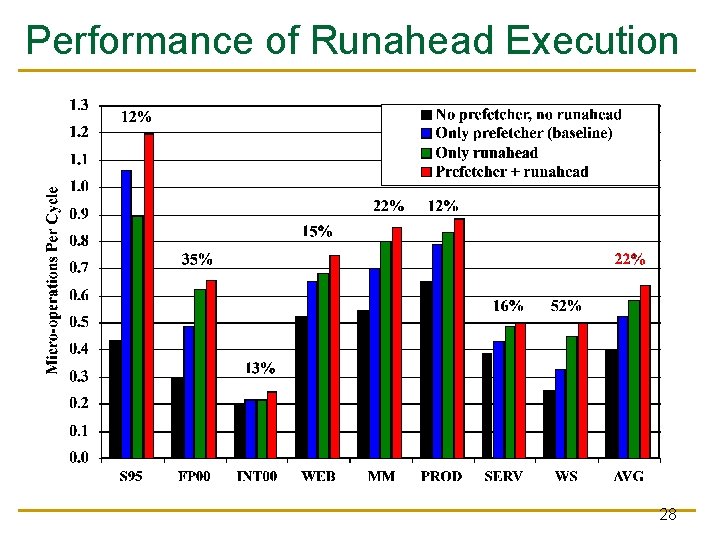
Performance of Runahead Execution 28
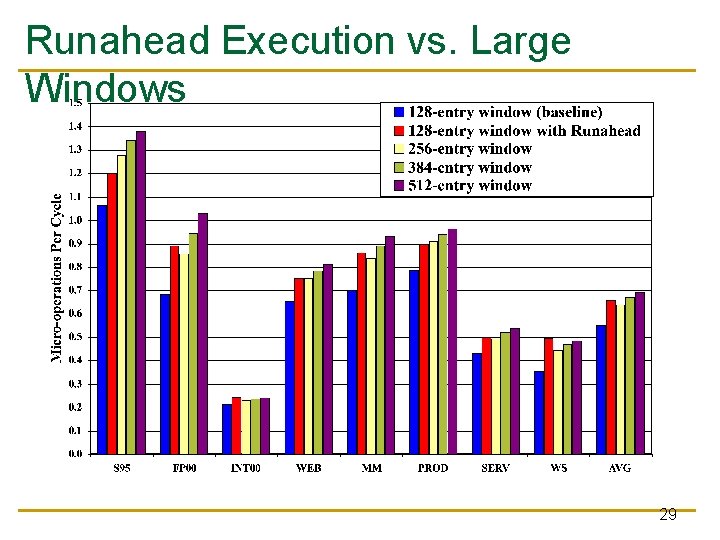
Runahead Execution vs. Large Windows 29
Runahead vs. A Real Large Window n n When is one beneficial, when is the other? Pros and cons of each 30
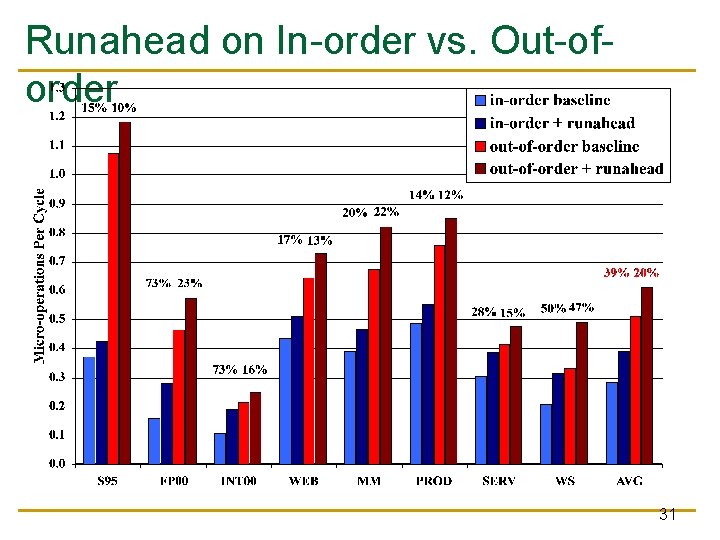
Runahead on In-order vs. Out-oforder 31
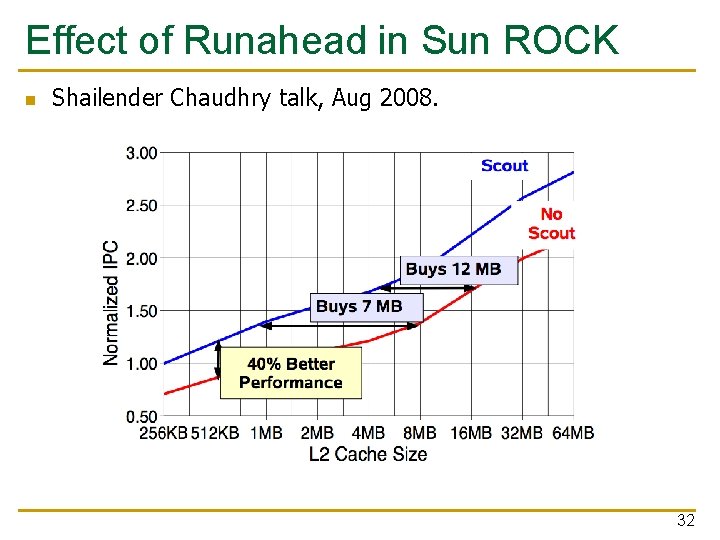
Effect of Runahead in Sun ROCK n Shailender Chaudhry talk, Aug 2008. 32
Runahead Enhancements
Readings n Required q n Mutlu et al. , “Runahead Execution”, HPCA 2003, Top Picks 2003. Recommended q q q Mutlu et al. , “Efficient Runahead Execution: Power-Efficient Memory Latency Tolerance, ” ISCA 2005, IEEE Micro Top Picks 2006. Mutlu et al. , “Address-Value Delta (AVD) Prediction, ” MICRO 2005. Armstrong et al. , “Wrong Path Events, ” MICRO 2004. 34
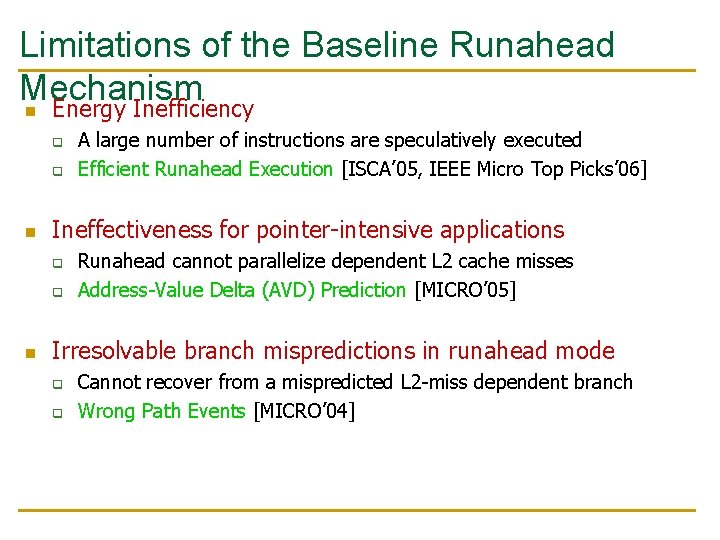
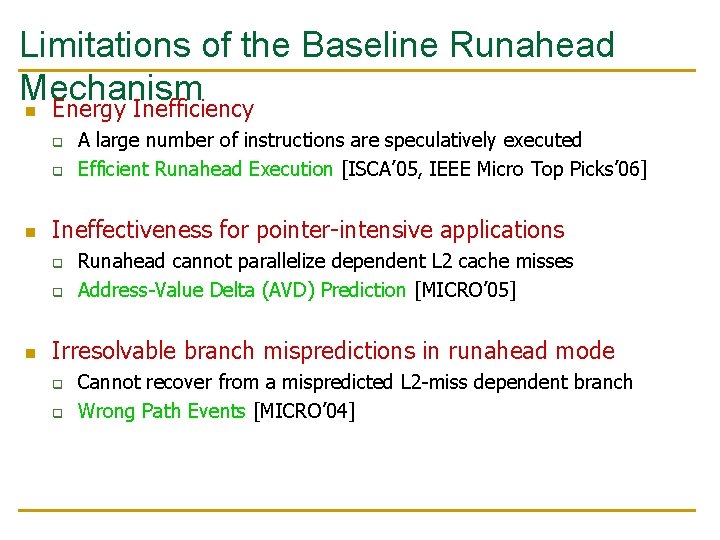
Limitations of the Baseline Runahead Mechanism n Energy Inefficiency q q n Ineffectiveness for pointer-intensive applications q q n A large number of instructions are speculatively executed Efficient Runahead Execution [ISCA’ 05, IEEE Micro Top Picks’ 06] Runahead cannot parallelize dependent L 2 cache misses Address-Value Delta (AVD) Prediction [MICRO’ 05] Irresolvable branch mispredictions in runahead mode q q Cannot recover from a mispredicted L 2 -miss dependent branch Wrong Path Events [MICRO’ 04]
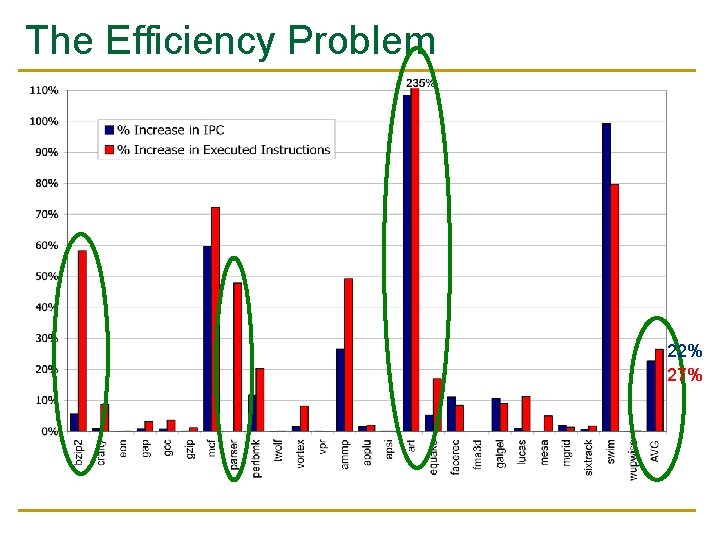
The Efficiency Problem 22% 27%
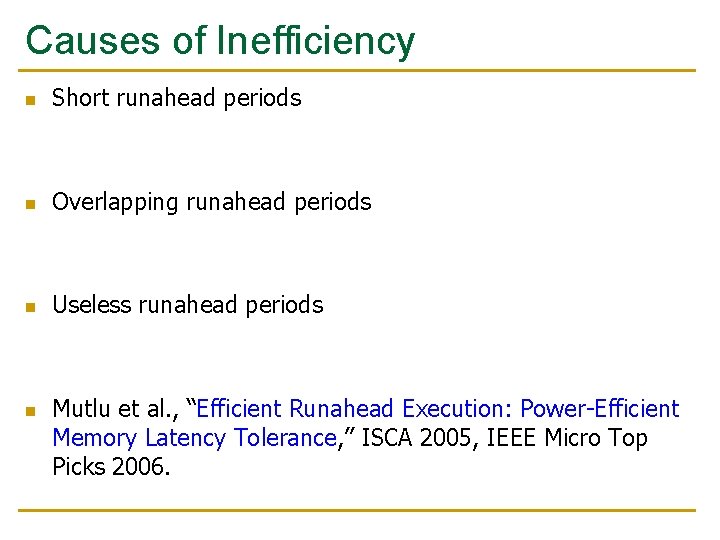
Causes of Inefficiency n Short runahead periods n Overlapping runahead periods n Useless runahead periods n Mutlu et al. , “Efficient Runahead Execution: Power-Efficient Memory Latency Tolerance, ” ISCA 2005, IEEE Micro Top Picks 2006.
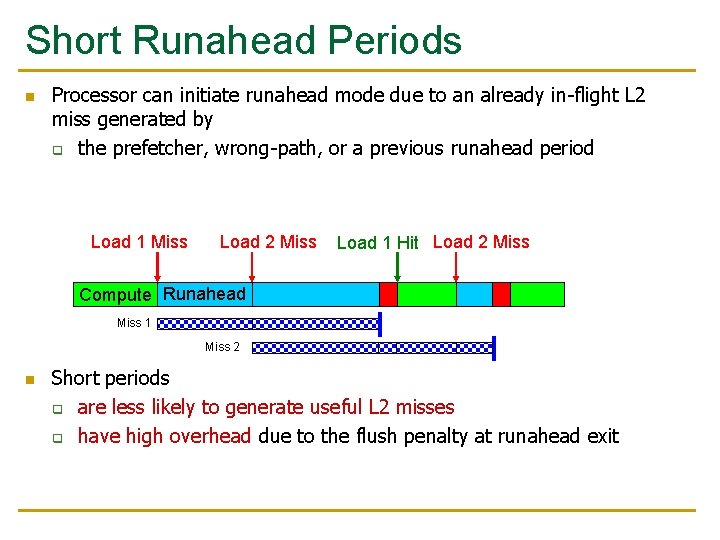
Short Runahead Periods n Processor can initiate runahead mode due to an already in-flight L 2 miss generated by q the prefetcher, wrong-path, or a previous runahead period Load 1 Miss Load 2 Miss Load 1 Hit Load 2 Miss Compute Runahead Miss 1 Miss 2 n Short periods q are less likely to generate useful L 2 misses q have high overhead due to the flush penalty at runahead exit
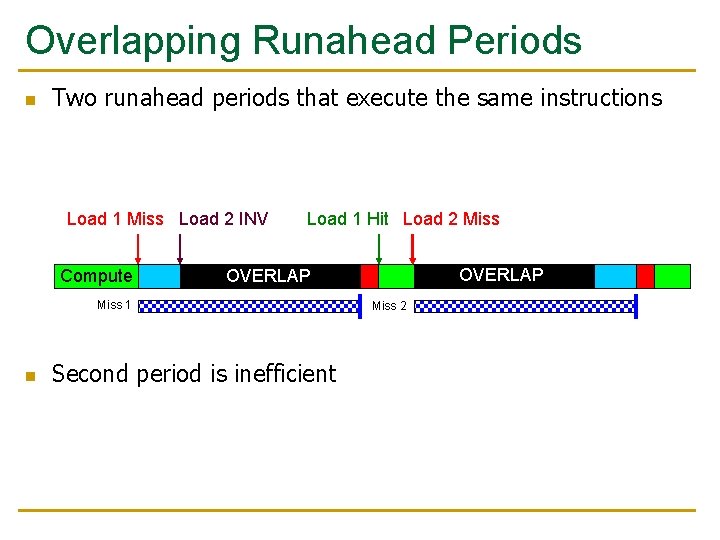
Overlapping Runahead Periods n Two runahead periods that execute the same instructions Load 1 Miss Load 2 INV Compute Load 1 Hit Load 2 Miss 1 n OVERLAP Runahead Second period is inefficient Miss 2
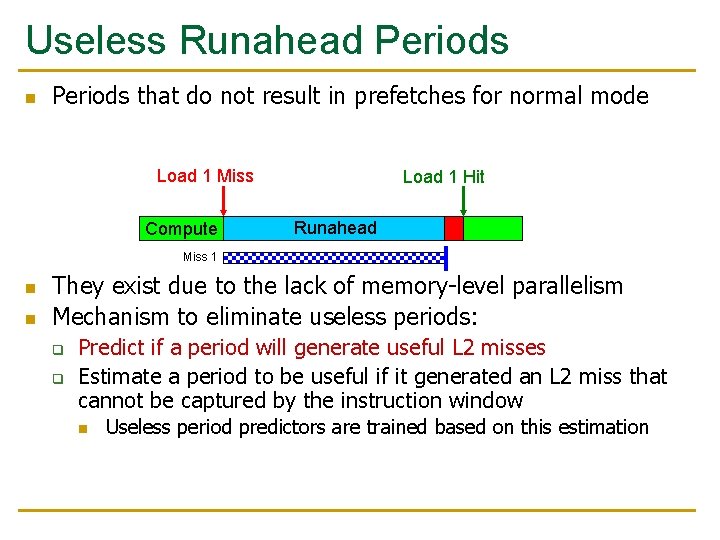
Useless Runahead Periods n Periods that do not result in prefetches for normal mode Load 1 Miss Compute Load 1 Hit Runahead Miss 1 n n They exist due to the lack of memory-level parallelism Mechanism to eliminate useless periods: q q Predict if a period will generate useful L 2 misses Estimate a period to be useful if it generated an L 2 miss that cannot be captured by the instruction window n Useless period predictors are trained based on this estimation
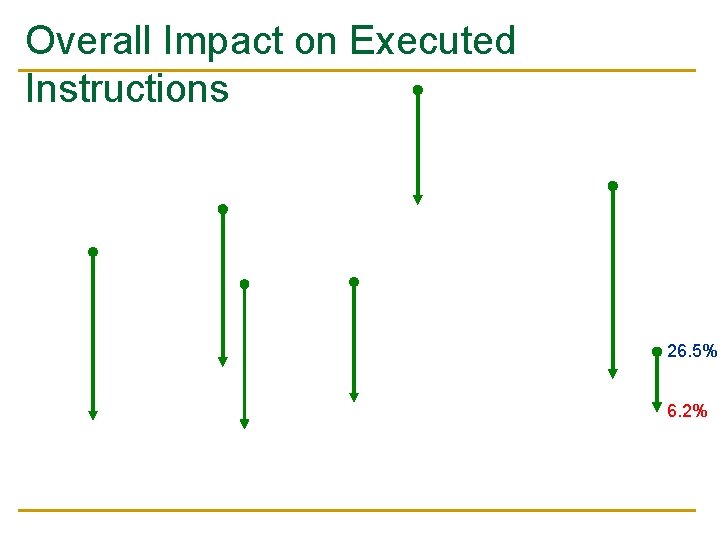
Overall Impact on Executed Instructions 26. 5% 6. 2%
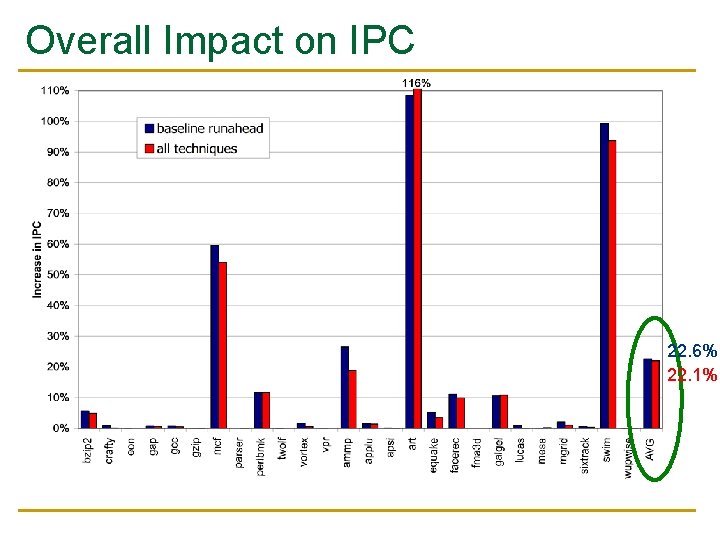
Overall Impact on IPC 22. 6% 22. 1%
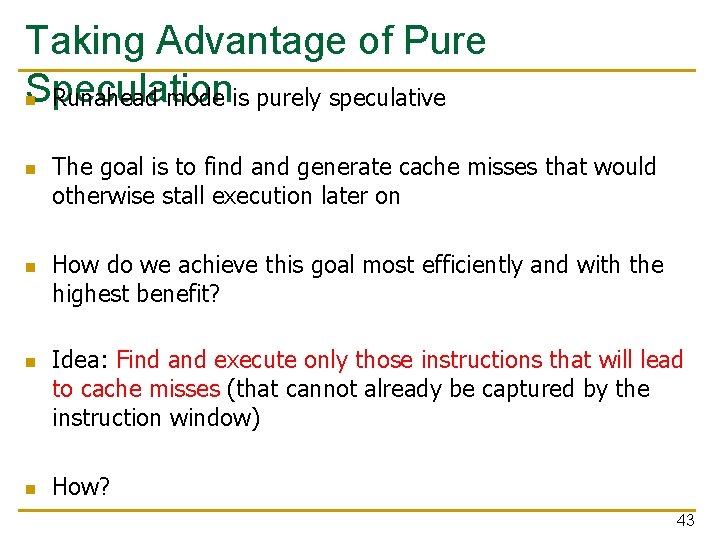
Taking Advantage of Pure Speculation n Runahead mode is purely speculative n n The goal is to find and generate cache misses that would otherwise stall execution later on How do we achieve this goal most efficiently and with the highest benefit? Idea: Find and execute only those instructions that will lead to cache misses (that cannot already be captured by the instruction window) How? 43
Limitations of the Baseline Runahead Mechanism n Energy Inefficiency q q n Ineffectiveness for pointer-intensive applications q q n A large number of instructions are speculatively executed Efficient Runahead Execution [ISCA’ 05, IEEE Micro Top Picks’ 06] Runahead cannot parallelize dependent L 2 cache misses Address-Value Delta (AVD) Prediction [MICRO’ 05] Irresolvable branch mispredictions in runahead mode q q Cannot recover from a mispredicted L 2 -miss dependent branch Wrong Path Events [MICRO’ 04]
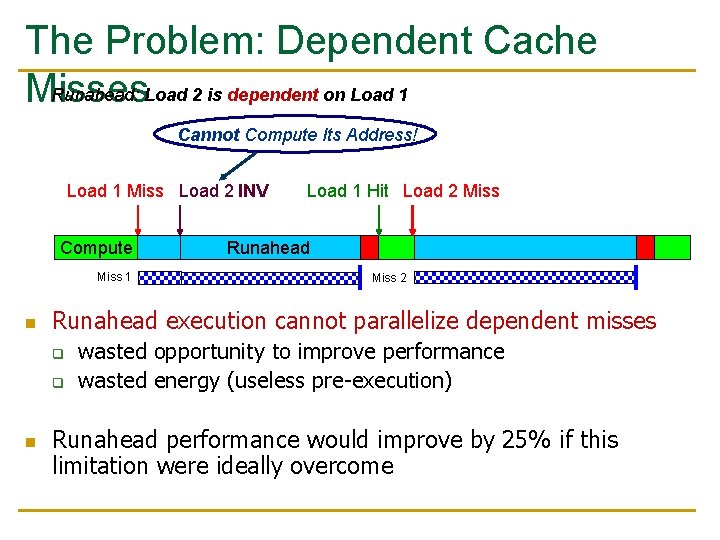
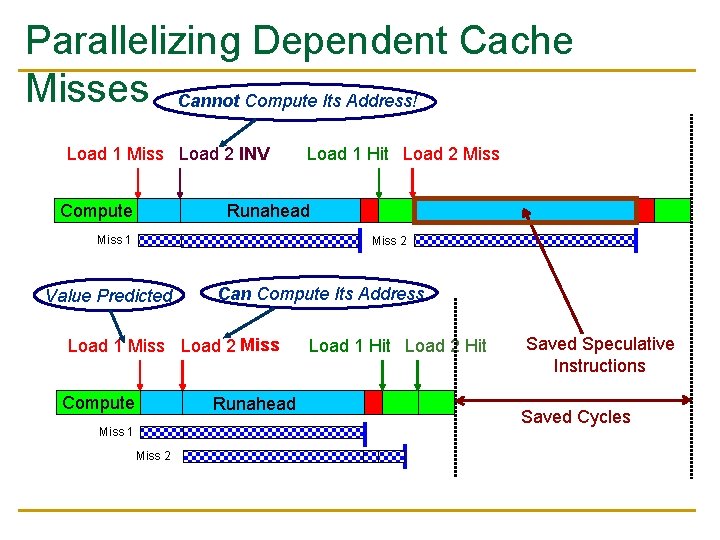
The Problem: Dependent Cache Runahead: Load 2 is dependent on Load 1 Misses Cannot Compute Its Address! Load 1 Miss Load 2 INV Compute Miss 1 n Runahead Miss 2 Runahead execution cannot parallelize dependent misses q q n Load 1 Hit Load 2 Miss wasted opportunity to improve performance wasted energy (useless pre-execution) Runahead performance would improve by 25% if this limitation were ideally overcome
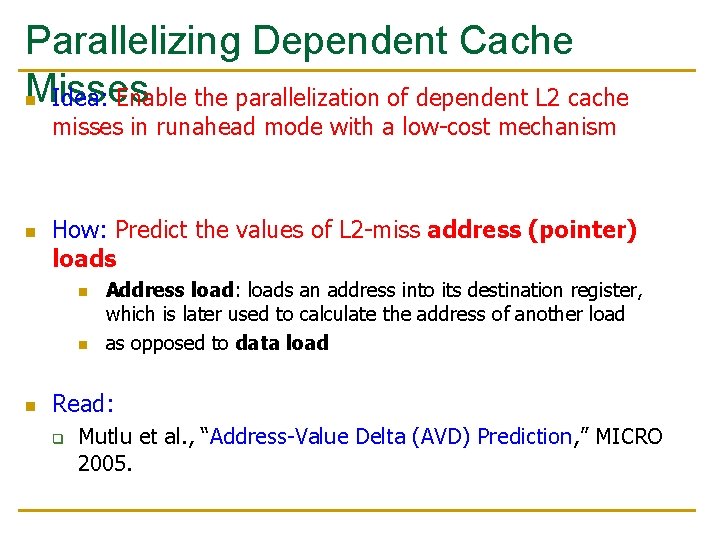
Parallelizing Dependent Cache Misses n Idea: Enable the parallelization of dependent L 2 cache misses in runahead mode with a low-cost mechanism n How: Predict the values of L 2 -miss address (pointer) loads n n n Address load: loads an address into its destination register, which is later used to calculate the address of another load as opposed to data load Read: q Mutlu et al. , “Address-Value Delta (AVD) Prediction, ” MICRO 2005.
Parallelizing Dependent Cache Misses Cannot Compute Its Address! Load 1 Miss Load 2 INV Load 1 Hit Load 2 Miss Runahead Compute Miss 1 Miss 2 Value Predicted Can Compute Its Address Load 1 Miss Load 2 Miss Compute Runahead Miss 1 Miss 2 Load 1 Hit Load 2 Hit Saved Speculative Instructions Saved Cycles
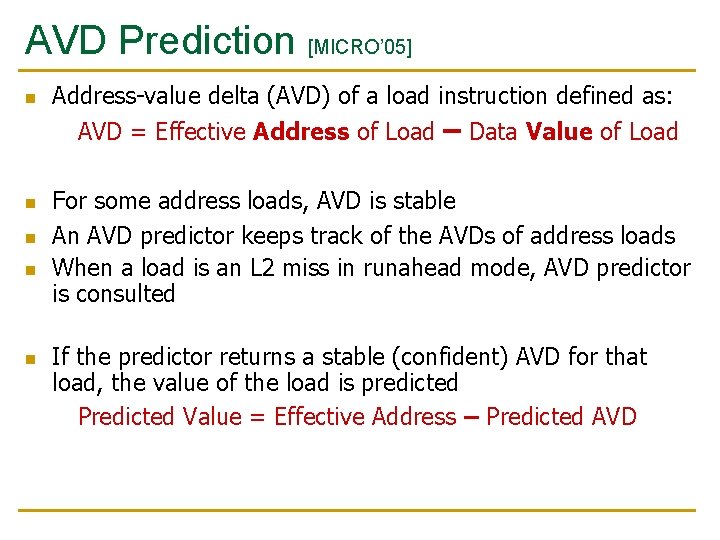
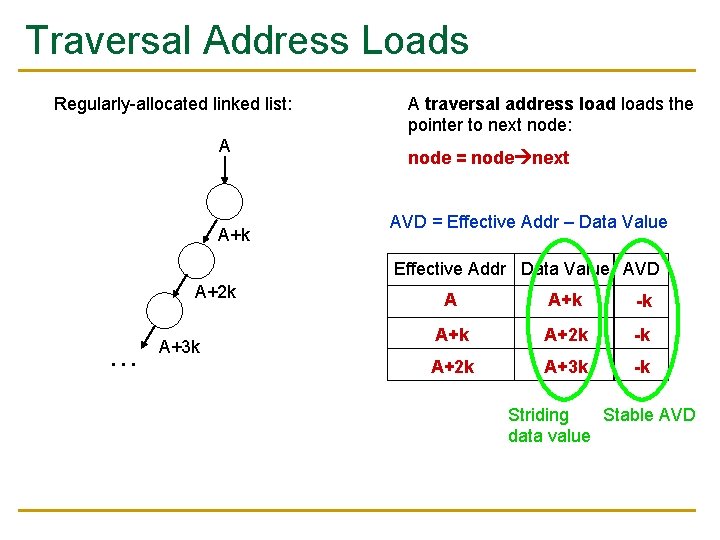
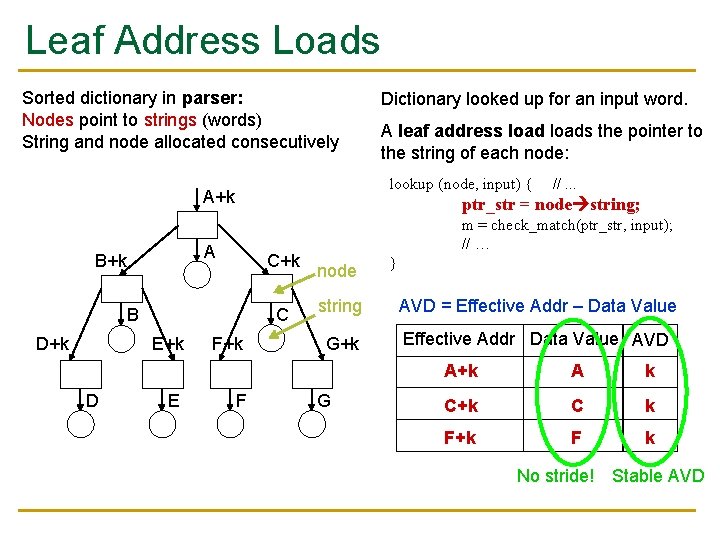
AVD Prediction [MICRO’ 05] n Address-value delta (AVD) of a load instruction defined as: AVD = Effective Address of Load – Data Value of Load n n For some address loads, AVD is stable An AVD predictor keeps track of the AVDs of address loads When a load is an L 2 miss in runahead mode, AVD predictor is consulted If the predictor returns a stable (confident) AVD for that load, the value of the load is predicted Predicted Value = Effective Address – Predicted AVD
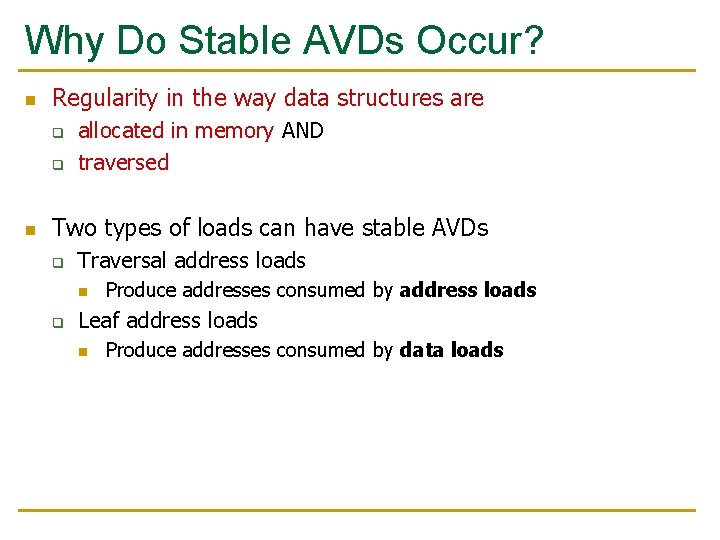
Why Do Stable AVDs Occur? n Regularity in the way data structures are q q n allocated in memory AND traversed Two types of loads can have stable AVDs q Traversal address loads n q Produce addresses consumed by address loads Leaf address loads n Produce addresses consumed by data loads
Traversal Address Loads Regularly-allocated linked list: A A+k A traversal address loads the pointer to next node: node = node next AVD = Effective Addr – Data Value Effective Addr Data Value AVD A+2 k . . . A+3 k A A+k -k A+2 k A+3 k -k Striding Stable AVD data value
Leaf Address Loads Sorted dictionary in parser: Nodes point to strings (words) String and node allocated consecutively A C+k C E+k D E //. . . ptr_str = node string; B D+k A leaf address loads the pointer to the string of each node: lookup (node, input) { A+k B+k Dictionary looked up for an input word. F+k F m = check_match(ptr_str, input); // … node } string AVD = Effective Addr – Data Value G+k Effective Addr Data Value AVD G A+k A k C+k C k F+k F k No stride! Stable AVD
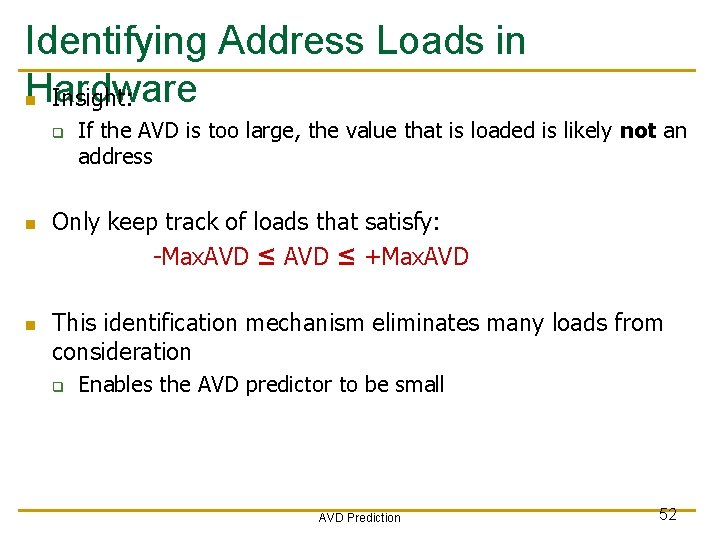
Identifying Address Loads in Hardware n Insight: q n n If the AVD is too large, the value that is loaded is likely not an address Only keep track of loads that satisfy: -Max. AVD ≤ +Max. AVD This identification mechanism eliminates many loads from consideration q Enables the AVD predictor to be small AVD Prediction 52
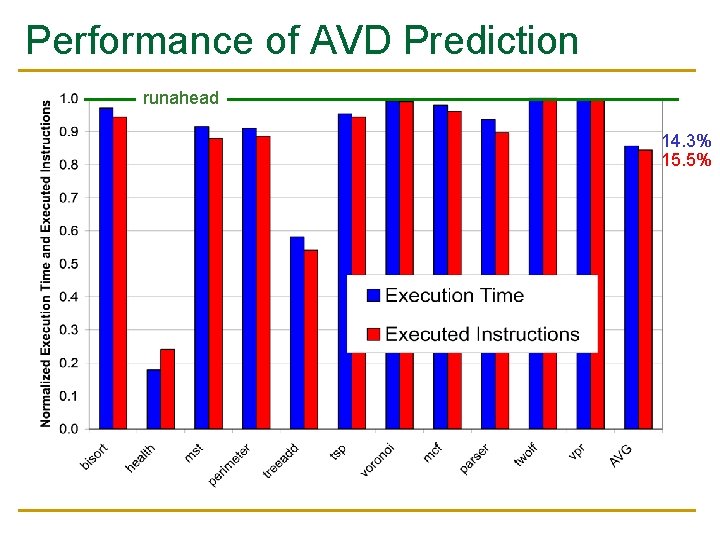
Performance of AVD Prediction runahead 14. 3% 15. 5%
Readings n Required q n Mutlu et al. , “Runahead Execution”, HPCA 2003, Top Picks 2003. Recommended q q q Mutlu et al. , “Efficient Runahead Execution: Power-Efficient Memory Latency Tolerance, ” ISCA 2005, IEEE Micro Top Picks 2006. Mutlu et al. , “Address-Value Delta (AVD) Prediction, ” MICRO 2005. Armstrong et al. , “Wrong Path Events, ” MICRO 2004. 54
We did not cover the following slides in lecture. They are for your benefit.
More on Runahead Enhancements
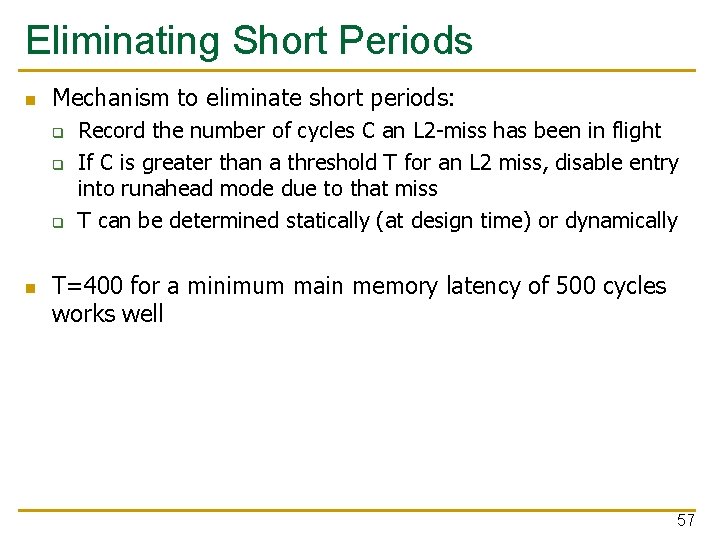
Eliminating Short Periods n Mechanism to eliminate short periods: q q q n Record the number of cycles C an L 2 -miss has been in flight If C is greater than a threshold T for an L 2 miss, disable entry into runahead mode due to that miss T can be determined statically (at design time) or dynamically T=400 for a minimum main memory latency of 500 cycles works well 57
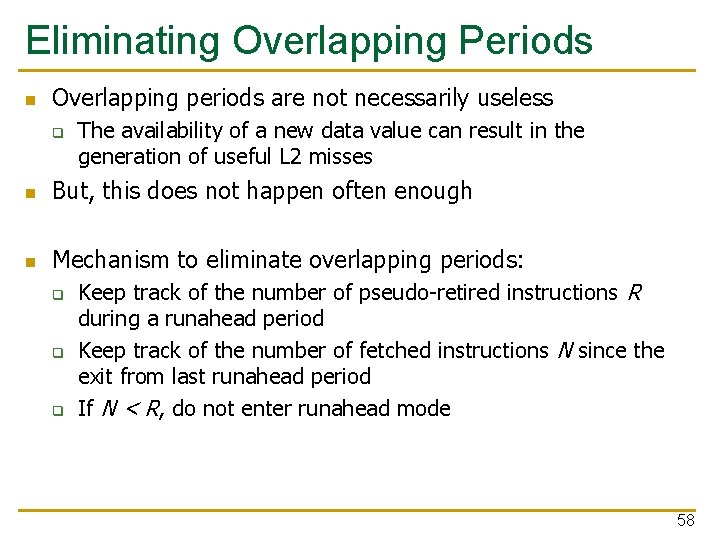
Eliminating Overlapping Periods n Overlapping periods are not necessarily useless q The availability of a new data value can result in the generation of useful L 2 misses n But, this does not happen often enough n Mechanism to eliminate overlapping periods: q q q Keep track of the number of pseudo-retired instructions R during a runahead period Keep track of the number of fetched instructions N since the exit from last runahead period If N < R, do not enter runahead mode 58
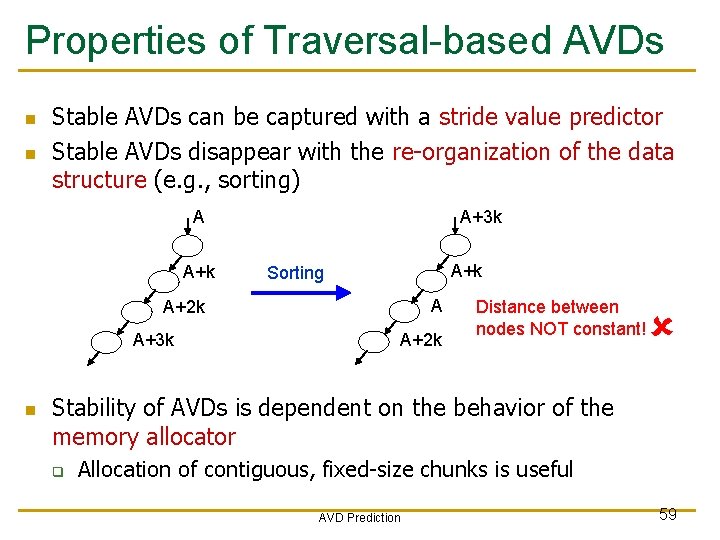
Properties of Traversal-based AVDs n n Stable AVDs can be captured with a stride value predictor Stable AVDs disappear with the re-organization of the data structure (e. g. , sorting) A A+k A+3 k A+k Sorting A A+2 k A+3 k n A+2 k Distance between nodes NOT constant! Stability of AVDs is dependent on the behavior of the memory allocator q Allocation of contiguous, fixed-size chunks is useful AVD Prediction 59
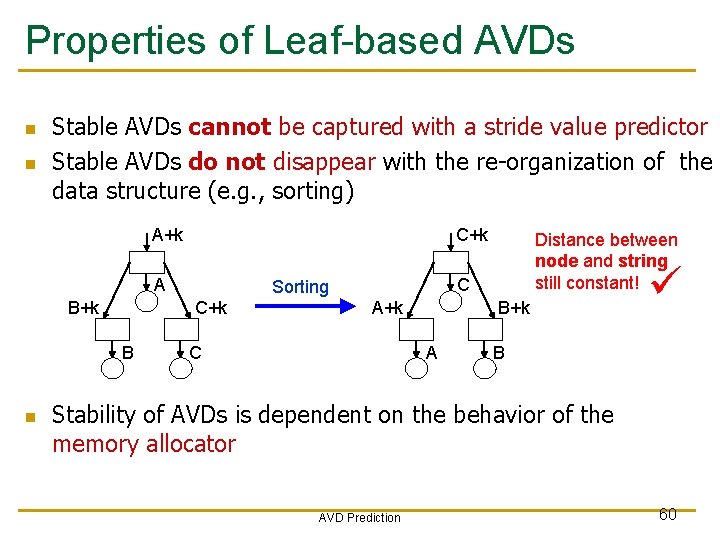
Properties of Leaf-based AVDs n n Stable AVDs cannot be captured with a stride value predictor Stable AVDs do not disappear with the re-organization of the data structure (e. g. , sorting) A+k C+k A B+k B n C Sorting C+k Distance between node and string still constant! A+k C B+k A B Stability of AVDs is dependent on the behavior of the memory allocator AVD Prediction 60
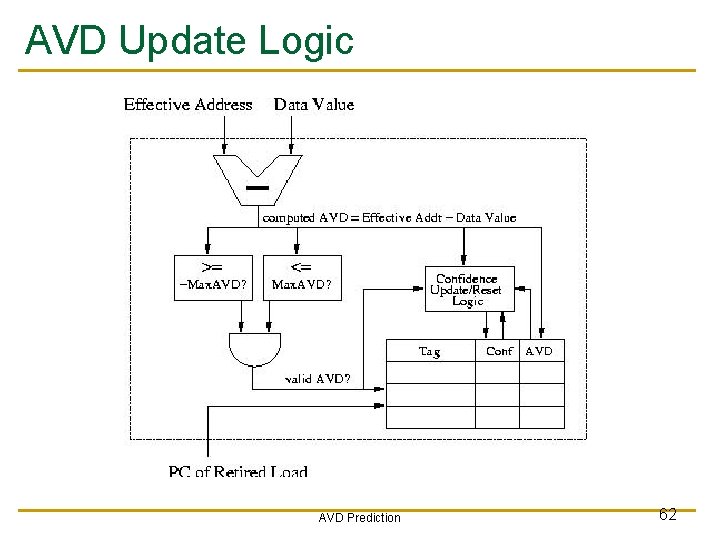
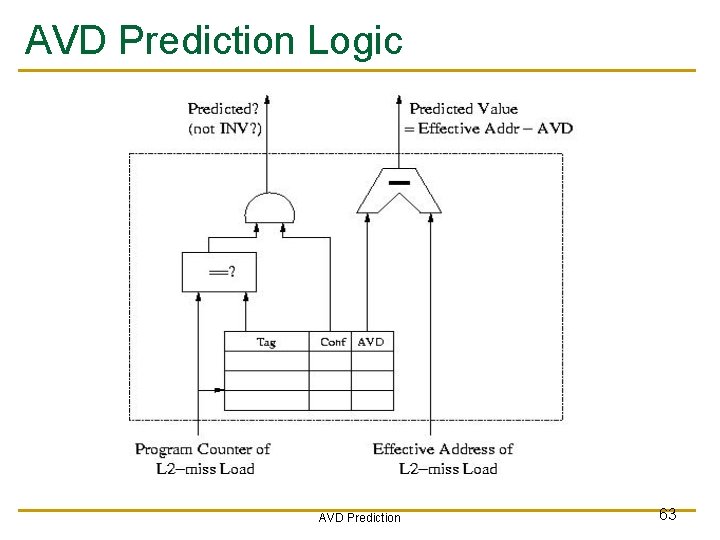
An Implementable AVD Predictor n n Set-associative prediction table Prediction table entry consists of q q q n n n Tag (Program Counter of the load) Last AVD seen for the load Confidence counter for the recorded AVD Updated when an address load is retired in normal mode Accessed when a load misses in L 2 cache in runahead mode Recovery-free: No need to recover the state of the processor or the predictor on misprediction q Runahead mode is purely speculative AVD Prediction 61
AVD Update Logic AVD Prediction 62
AVD Prediction Logic AVD Prediction 63
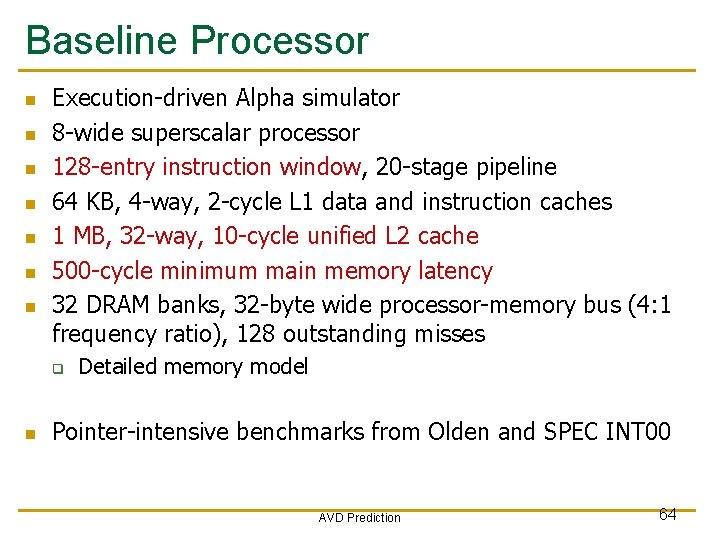
Baseline Processor n n n n Execution-driven Alpha simulator 8 -wide superscalar processor 128 -entry instruction window, 20 -stage pipeline 64 KB, 4 -way, 2 -cycle L 1 data and instruction caches 1 MB, 32 -way, 10 -cycle unified L 2 cache 500 -cycle minimum main memory latency 32 DRAM banks, 32 -byte wide processor-memory bus (4: 1 frequency ratio), 128 outstanding misses q n Detailed memory model Pointer-intensive benchmarks from Olden and SPEC INT 00 AVD Prediction 64
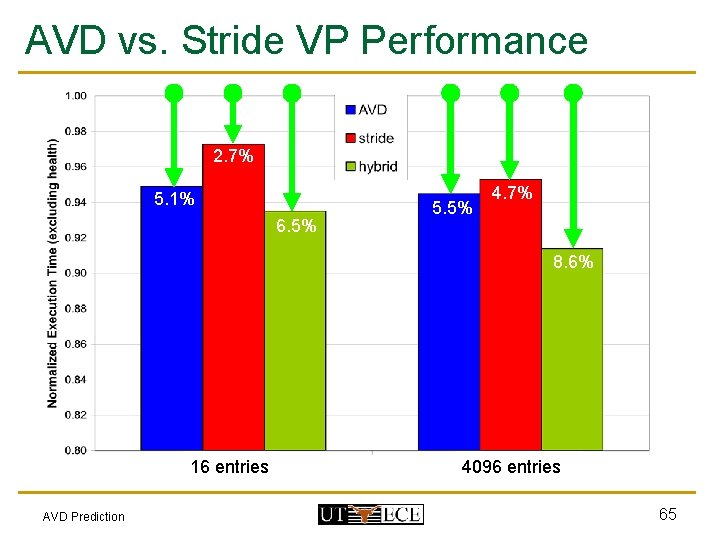
AVD vs. Stride VP Performance 2. 7% 5. 1% 6. 5% 5. 5% 4. 7% 8. 6% 16 entries AVD Prediction 4096 entries 65
Wrong Path Events
An Observation and A Question • In an out-of-order processor, some instructions are executed on the mispredicted path (wrong-path instructions). • Is the behavior of wrong-path instructions different from the behavior of correct-path instructions? – If so, we can use the difference in behavior for early misprediction detection and recovery.
What is a Wrong Path Event? An instance of illegal or unusual behavior that is more likely to occur on the wrong path than on the correct path. Wrong Path Event = WPE Probability (wrong path | WPE) ~ 1
Why Does a WPE Occur? • A wrong-path instruction may be executed before the mispredicted branch is executed. – Because the mispredicted branch may be dependent on a long-latency instruction. • The wrong-path instruction may consume a data value that is not properly initialized.
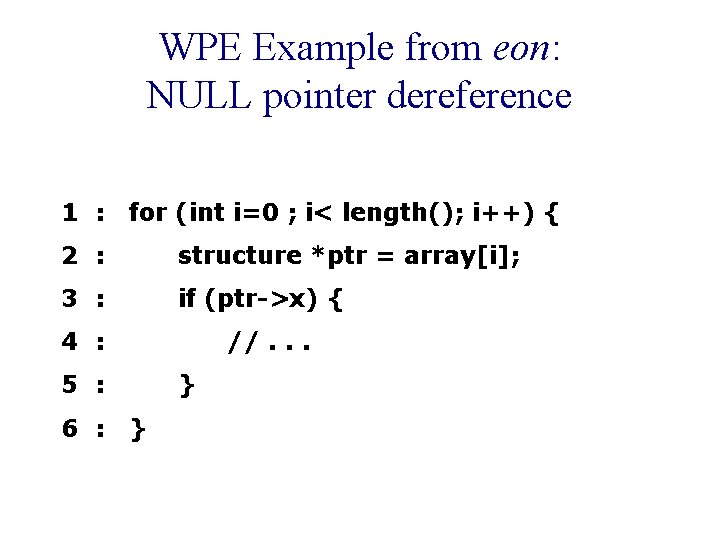
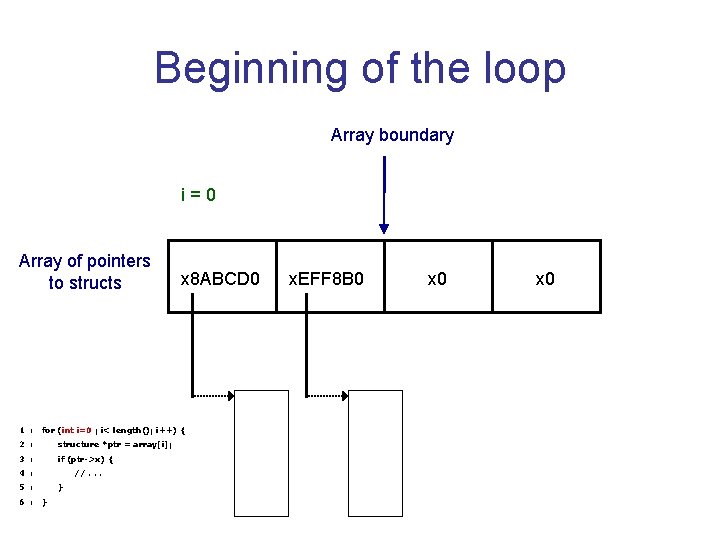
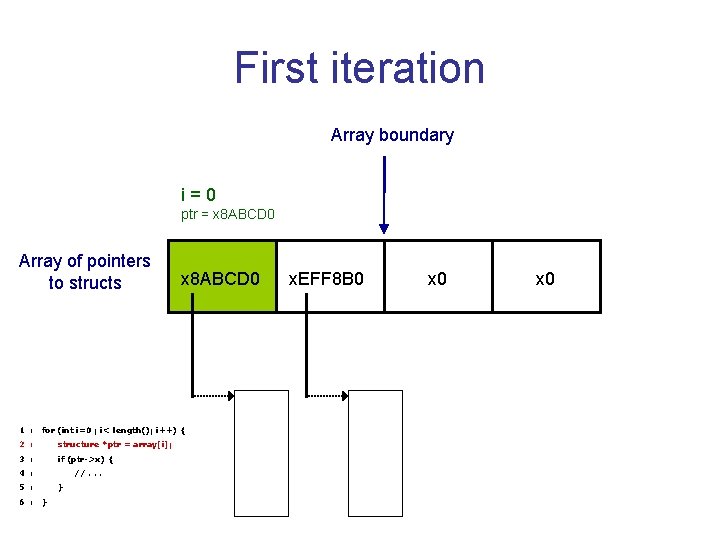
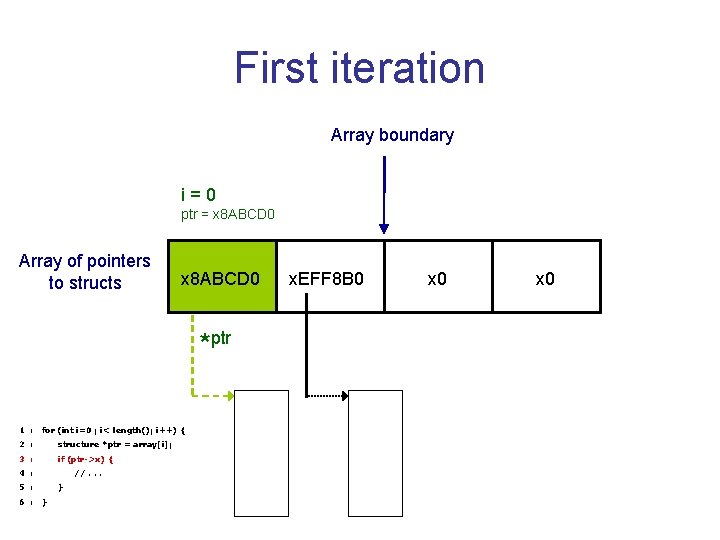
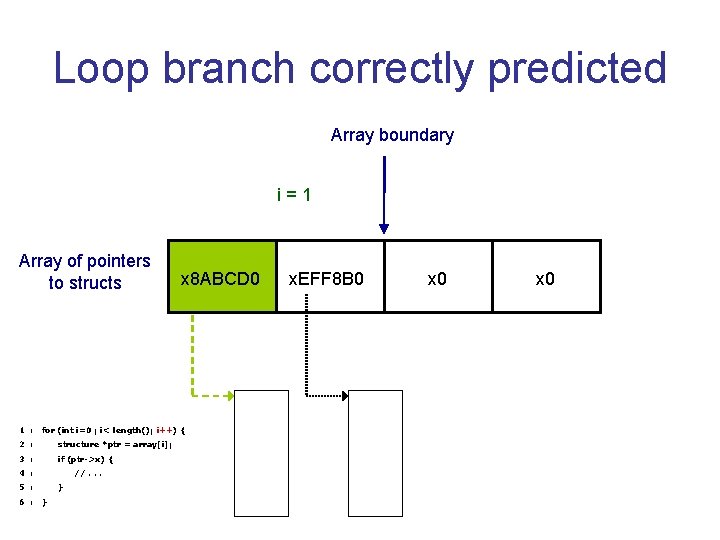
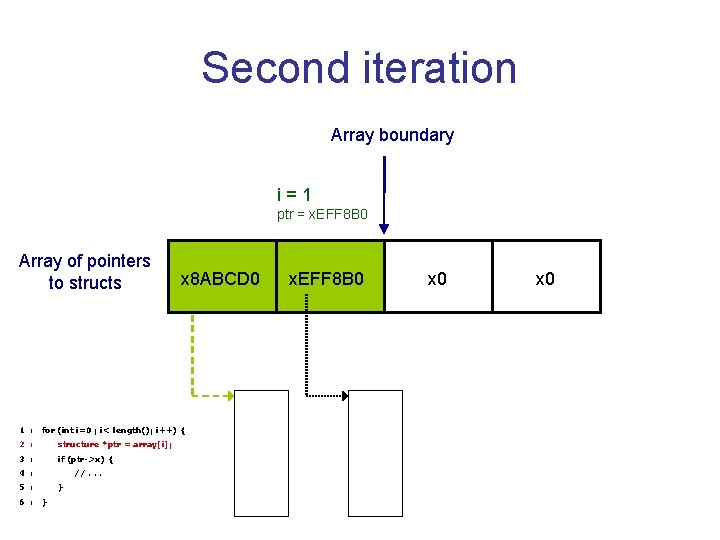
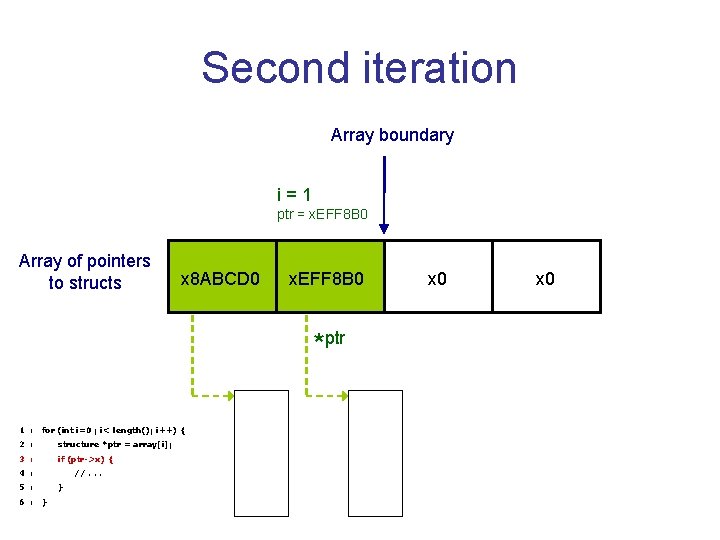
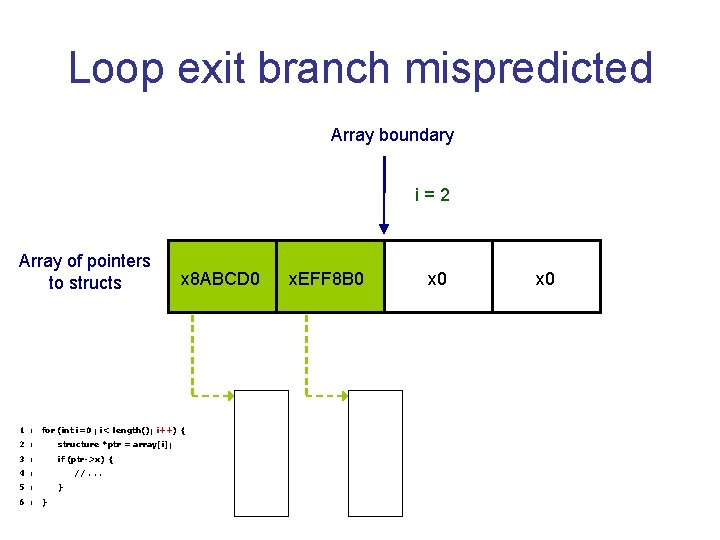
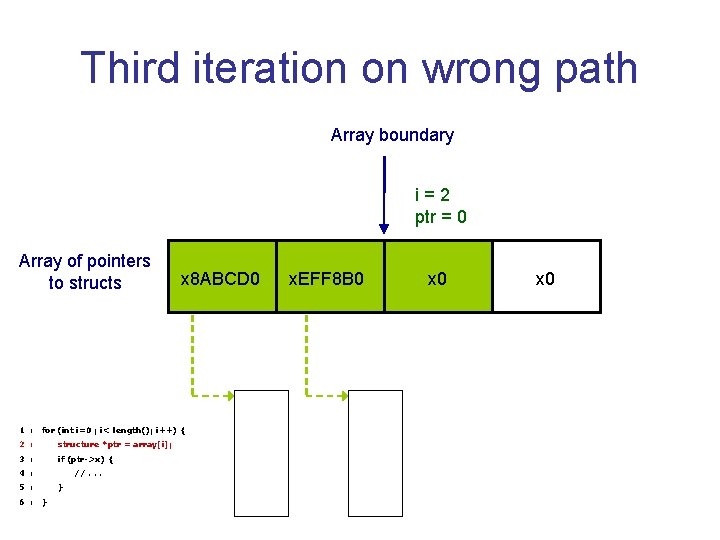
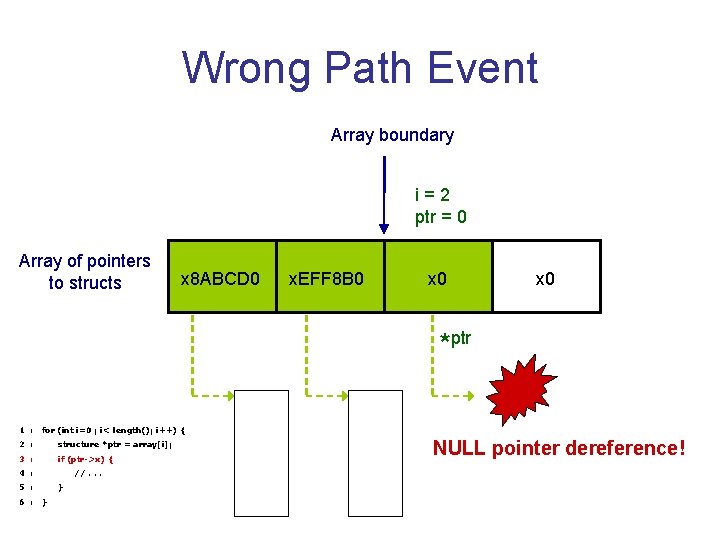
WPE Example from eon: NULL pointer dereference 1 : for (int i=0 ; i< length(); i++) { 2 : structure *ptr = array[i]; 3 : if (ptr->x) { 4 : //. . . 5 : 6 : } }
Beginning of the loop Array boundary i=0 Array of pointers to structs x 8 ABCD 0 1 : for (int i=0 ; i< length(); i++) { 2 : structure *ptr = array[i]; 3 : if (ptr->x) { 4 : //. . . 5 : 6 : } } x. EFF 8 B 0 x 0
First iteration Array boundary i=0 ptr = x 8 ABCD 0 Array of pointers to structs x 8 ABCD 0 1 : for (int i=0 ; i< length(); i++) { 2 : structure *ptr = array[i]; 3 : if (ptr->x) { 4 : //. . . 5 : 6 : } } x. EFF 8 B 0 x 0
First iteration Array boundary i=0 ptr = x 8 ABCD 0 Array of pointers to structs x 8 ABCD 0 *ptr 1 : for (int i=0 ; i< length(); i++) { 2 : structure *ptr = array[i]; 3 : if (ptr->x) { 4 : //. . . 5 : 6 : } } x. EFF 8 B 0 x 0
Loop branch correctly predicted Array boundary i=1 Array of pointers to structs x 8 ABCD 0 1 : for (int i=0 ; i< length(); i++) { 2 : structure *ptr = array[i]; 3 : if (ptr->x) { 4 : //. . . 5 : 6 : } } x. EFF 8 B 0 x 0
Second iteration Array boundary i=1 ptr = x. EFF 8 B 0 Array of pointers to structs x 8 ABCD 0 1 : for (int i=0 ; i< length(); i++) { 2 : structure *ptr = array[i]; 3 : if (ptr->x) { 4 : //. . . 5 : 6 : } } x. EFF 8 B 0 x 0
Second iteration Array boundary i=1 ptr = x. EFF 8 B 0 Array of pointers to structs x 8 ABCD 0 x. EFF 8 B 0 *ptr 1 : for (int i=0 ; i< length(); i++) { 2 : structure *ptr = array[i]; 3 : if (ptr->x) { 4 : //. . . 5 : 6 : } } x 0
Loop exit branch mispredicted Array boundary i=2 Array of pointers to structs x 8 ABCD 0 1 : for (int i=0 ; i< length(); i++) { 2 : structure *ptr = array[i]; 3 : if (ptr->x) { 4 : //. . . 5 : 6 : } } x. EFF 8 B 0 x 0
Third iteration on wrong path Array boundary i=2 ptr = 0 Array of pointers to structs x 8 ABCD 0 1 : for (int i=0 ; i< length(); i++) { 2 : structure *ptr = array[i]; 3 : if (ptr->x) { 4 : //. . . 5 : 6 : } } x. EFF 8 B 0 x 0
Wrong Path Event Array boundary i=2 ptr = 0 Array of pointers to structs x 8 ABCD 0 x. EFF 8 B 0 x 0 *ptr 1 : for (int i=0 ; i< length(); i++) { 2 : structure *ptr = array[i]; 3 : if (ptr->x) { 4 : //. . . 5 : 6 : } } NULL pointer dereference!
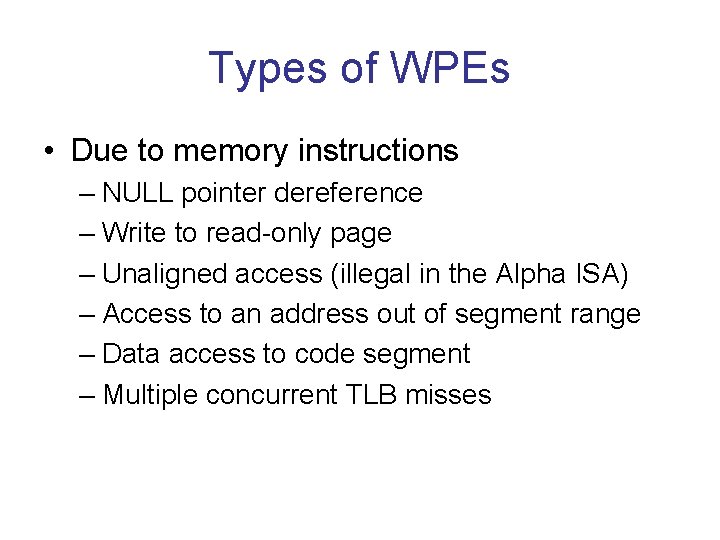
Types of WPEs • Due to memory instructions – NULL pointer dereference – Write to read-only page – Unaligned access (illegal in the Alpha ISA) – Access to an address out of segment range – Data access to code segment – Multiple concurrent TLB misses
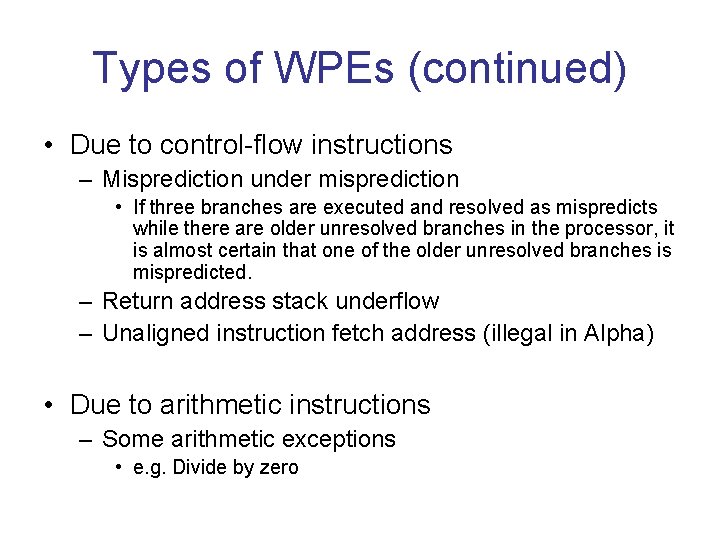
Types of WPEs (continued) • Due to control-flow instructions – Misprediction under misprediction • If three branches are executed and resolved as mispredicts while there are older unresolved branches in the processor, it is almost certain that one of the older unresolved branches is mispredicted. – Return address stack underflow – Unaligned instruction fetch address (illegal in Alpha) • Due to arithmetic instructions – Some arithmetic exceptions • e. g. Divide by zero
Two Empirical Questions 1. How often do WPEs occur? 2. When do WPEs occur on the wrong path?