
Computer Architecture MultiCore Evolution and Design Prof Onur
- Slides: 85
Computer Architecture: Multi-Core Evolution and Design Prof. Onur Mutlu Carnegie Mellon University
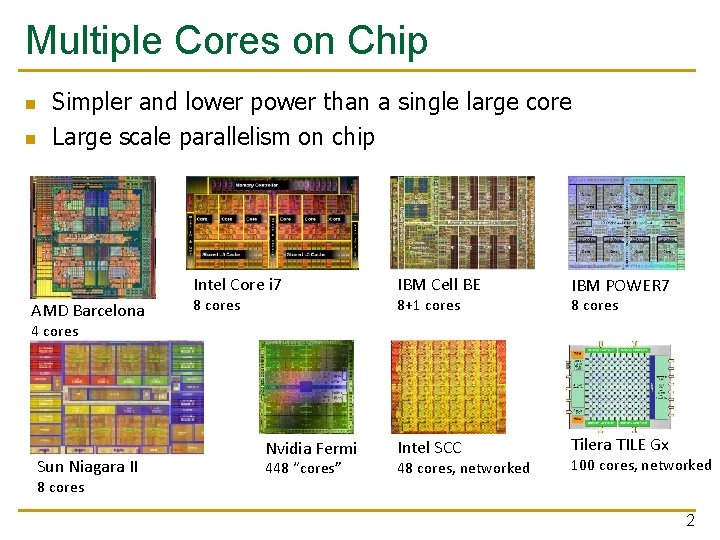
Multiple Cores on Chip n n Simpler and lower power than a single large core Large scale parallelism on chip Intel Core i 7 AMD Barcelona 8 cores IBM Cell BE IBM POWER 7 Intel SCC Tilera TILE Gx 8+1 cores 8 cores 4 cores Sun Niagara II 8 cores Nvidia Fermi 448 “cores” 48 cores, networked 100 cores, networked 2
With Multiple Cores on Chip n What we want: q n N times the performance with N times the cores when we parallelize an application on N cores What we get: q q Amdahl’s Law (serial bottleneck) Bottlenecks in the parallel portion 3
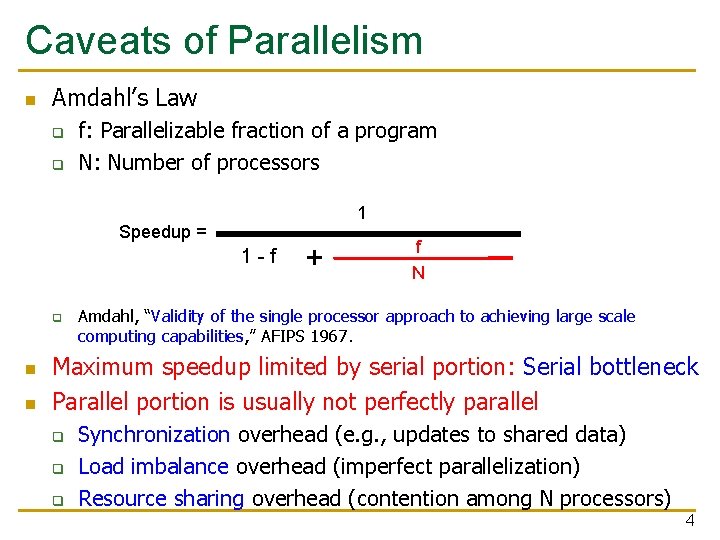
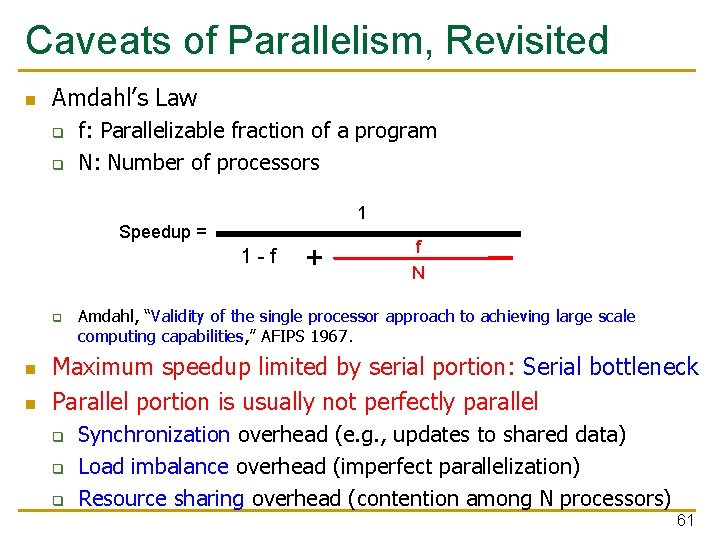
Caveats of Parallelism n Amdahl’s Law q q f: Parallelizable fraction of a program N: Number of processors 1 Speedup = 1 -f q n n + f N Amdahl, “Validity of the single processor approach to achieving large scale computing capabilities, ” AFIPS 1967. Maximum speedup limited by serial portion: Serial bottleneck Parallel portion is usually not perfectly parallel q q q Synchronization overhead (e. g. , updates to shared data) Load imbalance overhead (imperfect parallelization) Resource sharing overhead (contention among N processors) 4
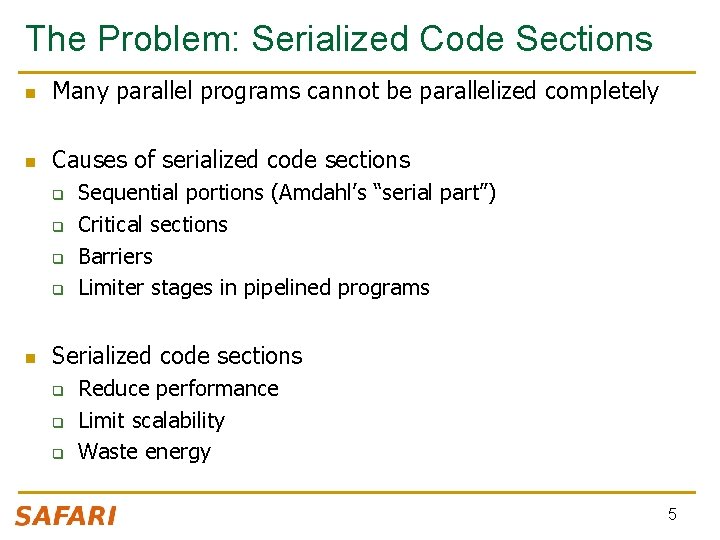
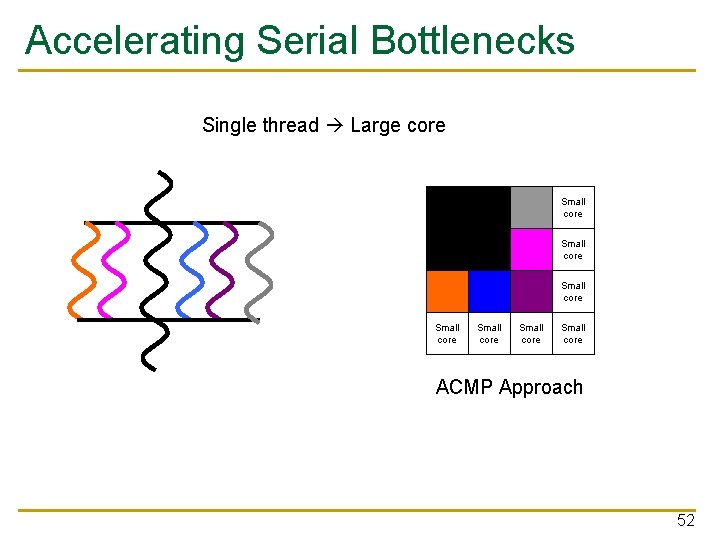
The Problem: Serialized Code Sections n Many parallel programs cannot be parallelized completely n Causes of serialized code sections q q n Sequential portions (Amdahl’s “serial part”) Critical sections Barriers Limiter stages in pipelined programs Serialized code sections q q q Reduce performance Limit scalability Waste energy 5
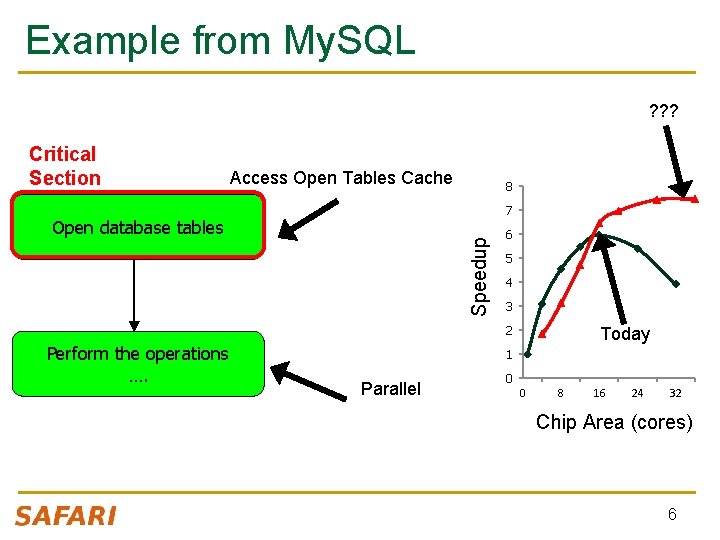
Example from My. SQL ? ? ? Critical Section Access Open Tables Cache 8 7 Speedup Open database tables 6 5 4 3 2 Perform the operations …. Today 1 Parallel 0 0 8 16 24 32 Chip Area (cores) 6
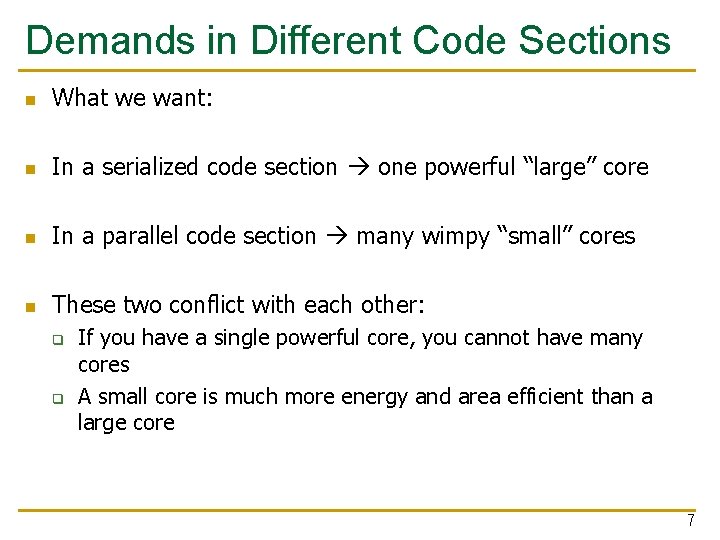
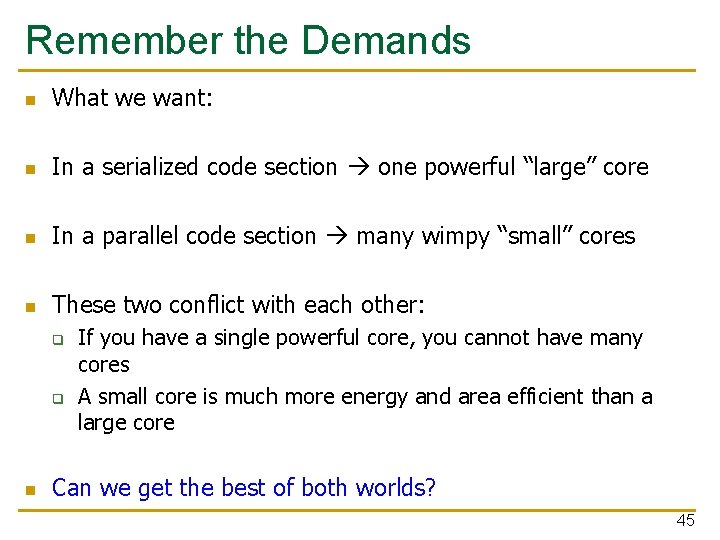
Demands in Different Code Sections n What we want: n In a serialized code section one powerful “large” core n In a parallel code section many wimpy “small” cores n These two conflict with each other: q q If you have a single powerful core, you cannot have many cores A small core is much more energy and area efficient than a large core 7
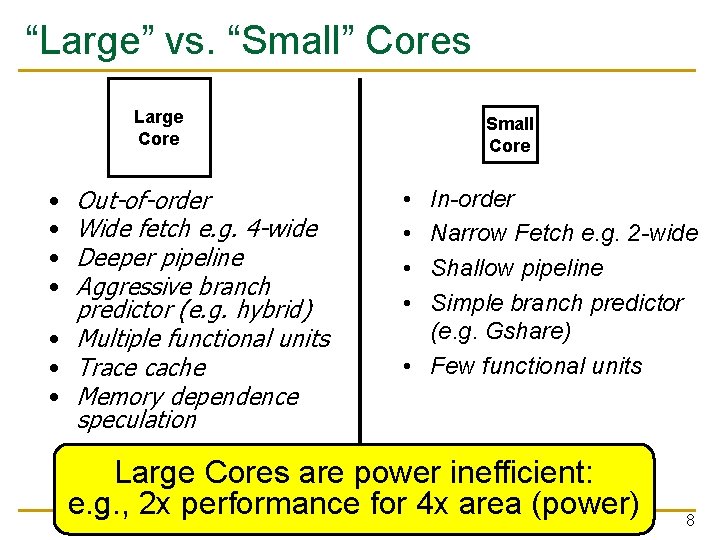
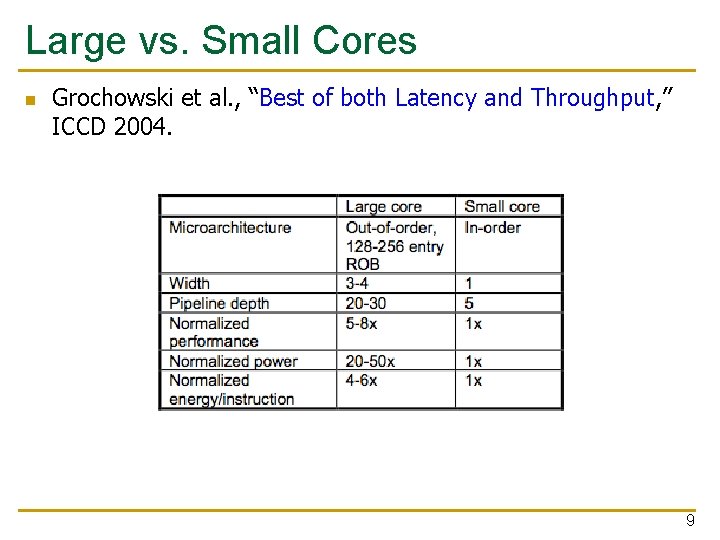
“Large” vs. “Small” Cores Large Core Out-of-order Wide fetch e. g. 4 -wide Deeper pipeline Aggressive branch predictor (e. g. hybrid) • Multiple functional units • Trace cache • Memory dependence speculation • • Small Core • • In-order Narrow Fetch e. g. 2 -wide Shallow pipeline Simple branch predictor (e. g. Gshare) • Few functional units Large Cores are power inefficient: e. g. , 2 x performance for 4 x area (power) 8
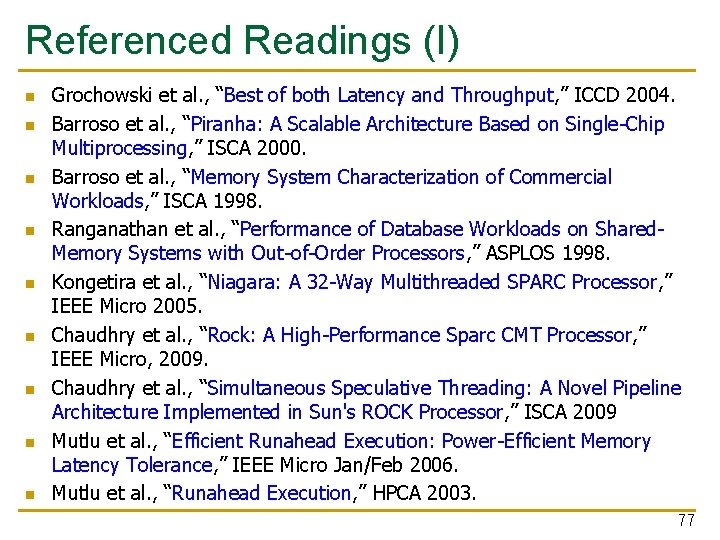
Large vs. Small Cores n Grochowski et al. , “Best of both Latency and Throughput, ” ICCD 2004. 9
Meet Small Cores: Piranha Chip Multiprocessor n Barroso et al. , “Piranha: A Scalable Architecture Based on Single. Chip Multiprocessing, ” ISCA 2000. n An early example of a symmetric multi-core processor Large-scale server based on CMP nodes Designed for commercial workloads n Read: n n q q Barroso et al. , “Memory System Characterization of Commercial Workloads, ” ISCA 1998. Ranganathan et al. , “Performance of Database Workloads on Shared-Memory Systems with Out-of-Order Processors, ” ASPLOS 1998.
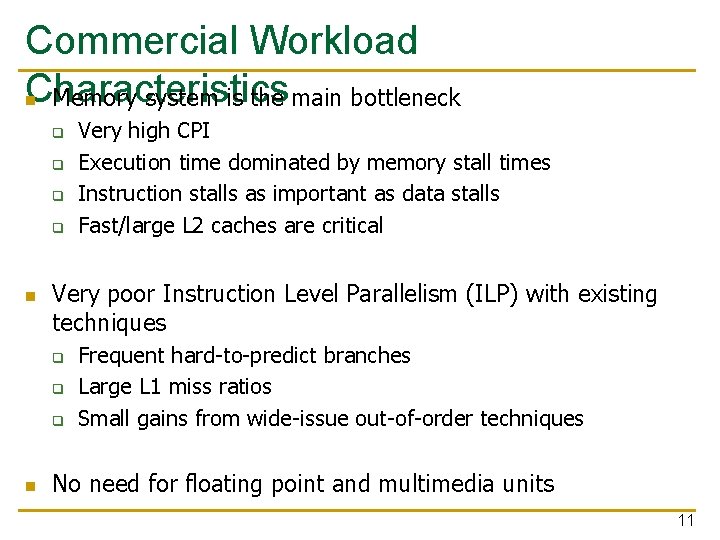
Commercial Workload Characteristics n Memory system is the main bottleneck q q n Very poor Instruction Level Parallelism (ILP) with existing techniques q q q n Very high CPI Execution time dominated by memory stall times Instruction stalls as important as data stalls Fast/large L 2 caches are critical Frequent hard-to-predict branches Large L 1 miss ratios Small gains from wide-issue out-of-order techniques No need for floating point and multimedia units 11
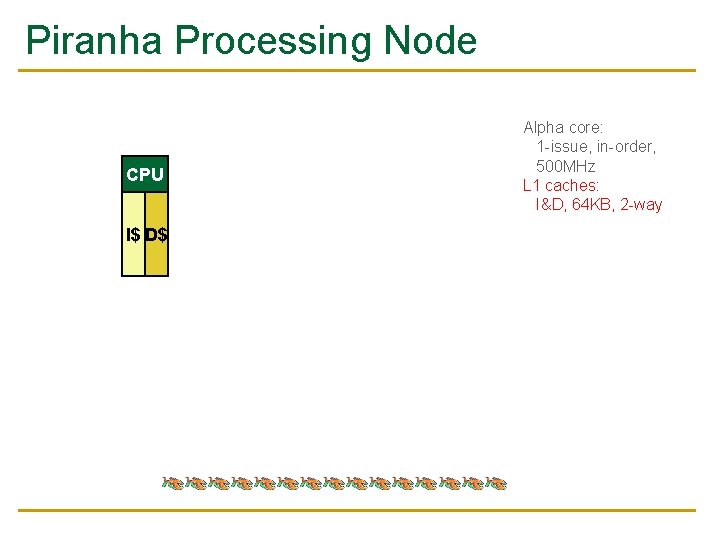
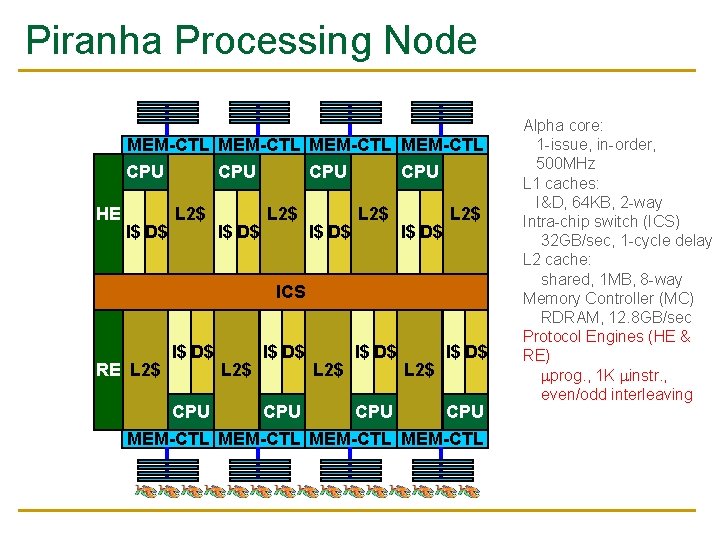
Piranha Processing Node CPU Alpha core: 1 -issue, in-order, 500 MHz Next few slides from Luiz Barroso’s ISCA 2000 presentation of Piranha: A Scalable Architecture Based on Single-Chip Multiprocessing
Piranha Processing Node CPU I$ D$ Alpha core: 1 -issue, in-order, 500 MHz L 1 caches: I&D, 64 KB, 2 -way
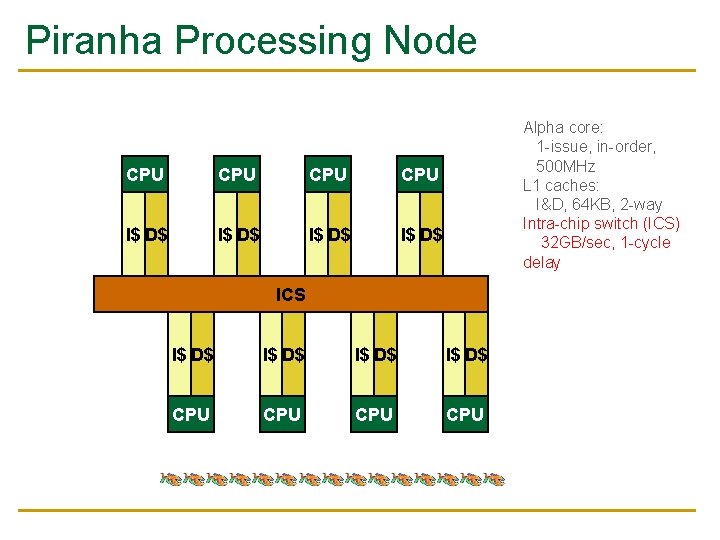
Piranha Processing Node CPU CPU I$ D$ Alpha core: 1 -issue, in-order, 500 MHz L 1 caches: I&D, 64 KB, 2 -way Intra-chip switch (ICS) 32 GB/sec, 1 -cycle delay ICS I$ D$ CPU CPU
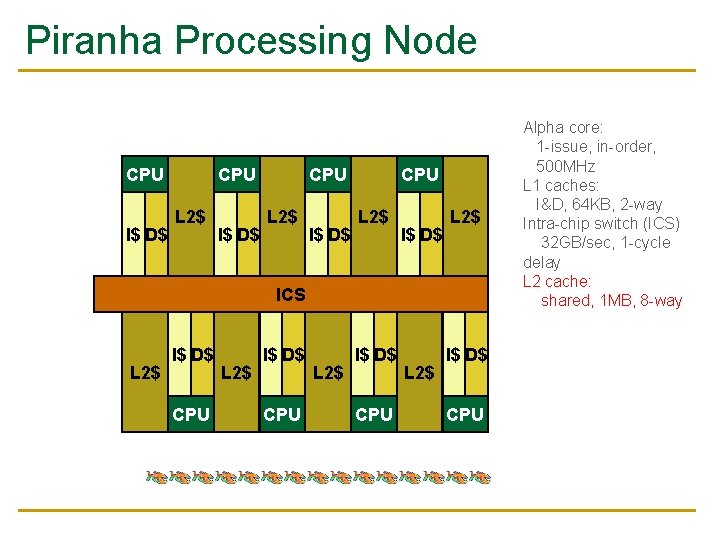
Piranha Processing Node CPU I$ D$ CPU L 2$ I$ D$ L 2$ ICS L 2$ I$ D$ CPU Alpha core: 1 -issue, in-order, 500 MHz L 1 caches: I&D, 64 KB, 2 -way Intra-chip switch (ICS) 32 GB/sec, 1 -cycle delay L 2 cache: shared, 1 MB, 8 -way
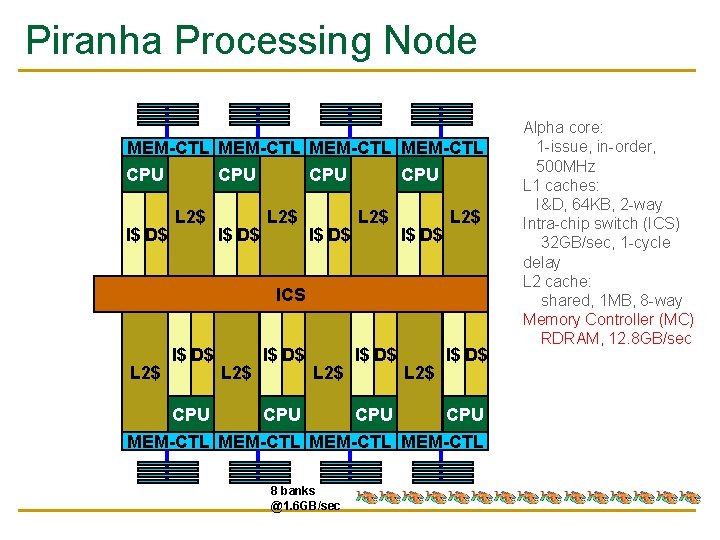
Piranha Processing Node MEM-CTL CPU I$ D$ CPU L 2$ I$ D$ L 2$ ICS L 2$ I$ D$ CPU CPU MEM-CTL 8 banks @1. 6 GB/sec Alpha core: 1 -issue, in-order, 500 MHz L 1 caches: I&D, 64 KB, 2 -way Intra-chip switch (ICS) 32 GB/sec, 1 -cycle delay L 2 cache: shared, 1 MB, 8 -way Memory Controller (MC) RDRAM, 12. 8 GB/sec
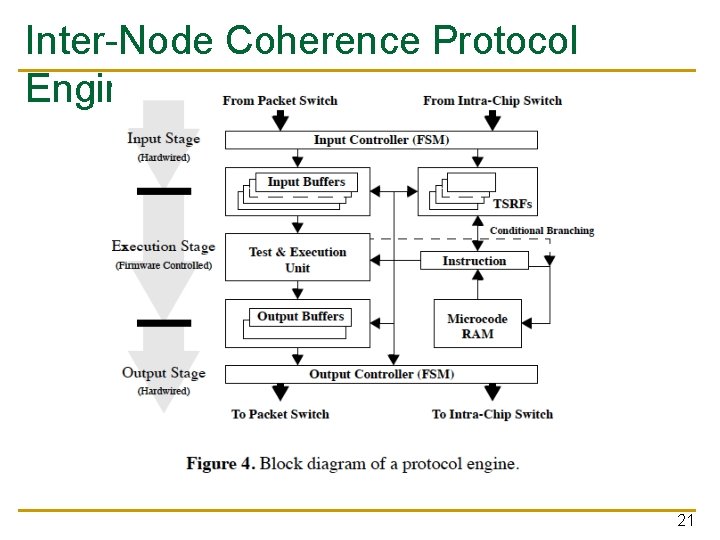
Piranha Processing Node MEM-CTL CPU HE I$ D$ CPU L 2$ I$ D$ L 2$ ICS RE L 2$ I$ D$ CPU CPU MEM-CTL Alpha core: 1 -issue, in-order, 500 MHz L 1 caches: I&D, 64 KB, 2 -way Intra-chip switch (ICS) 32 GB/sec, 1 -cycle delay L 2 cache: shared, 1 MB, 8 -way Memory Controller (MC) RDRAM, 12. 8 GB/sec Protocol Engines (HE & RE) prog. , 1 K instr. , even/odd interleaving
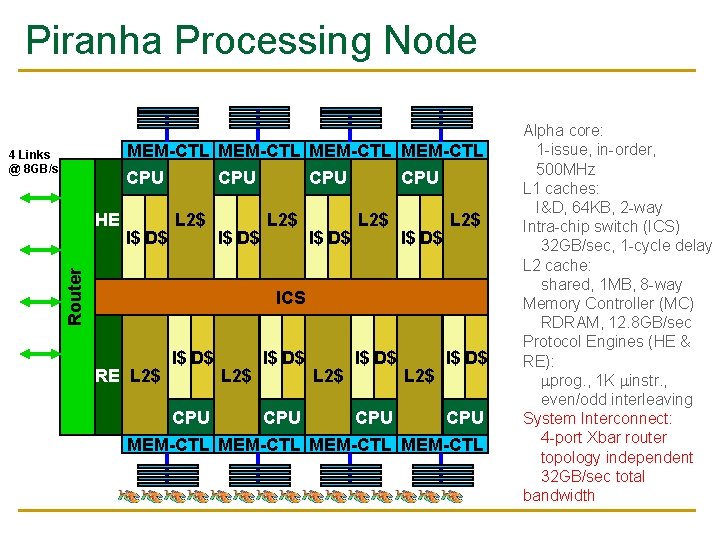
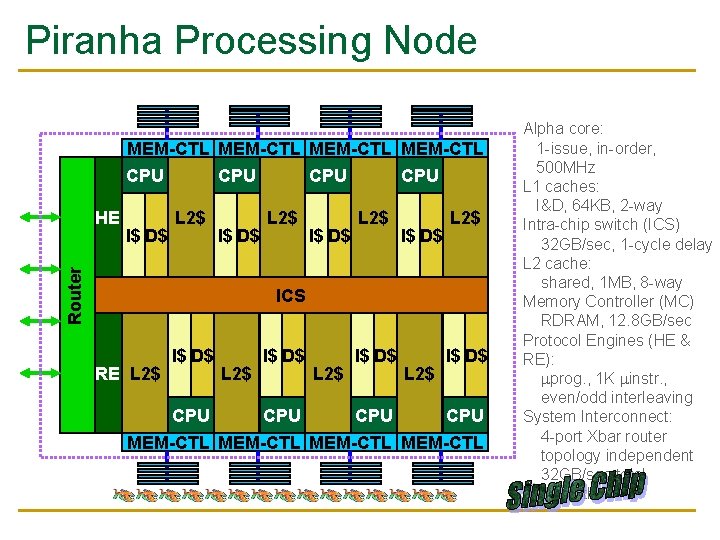
Piranha Processing Node MEM-CTL 4 Links @ 8 GB/s CPU I$ D$ L 2$ I$ D$ Router HE CPU L 2$ I$ D$ L 2$ ICS RE L 2$ I$ D$ CPU CPU MEM-CTL Alpha core: 1 -issue, in-order, 500 MHz L 1 caches: I&D, 64 KB, 2 -way Intra-chip switch (ICS) 32 GB/sec, 1 -cycle delay L 2 cache: shared, 1 MB, 8 -way Memory Controller (MC) RDRAM, 12. 8 GB/sec Protocol Engines (HE & RE): prog. , 1 K instr. , even/odd interleaving System Interconnect: 4 -port Xbar router topology independent 32 GB/sec total bandwidth
Piranha Processing Node MEM-CTL CPU I$ D$ L 2$ I$ D$ Router HE CPU L 2$ I$ D$ L 2$ ICS RE L 2$ I$ D$ CPU CPU MEM-CTL Alpha core: 1 -issue, in-order, 500 MHz L 1 caches: I&D, 64 KB, 2 -way Intra-chip switch (ICS) 32 GB/sec, 1 -cycle delay L 2 cache: shared, 1 MB, 8 -way Memory Controller (MC) RDRAM, 12. 8 GB/sec Protocol Engines (HE & RE): prog. , 1 K instr. , even/odd interleaving System Interconnect: 4 -port Xbar router topology independent 32 GB/sec total bandwidth
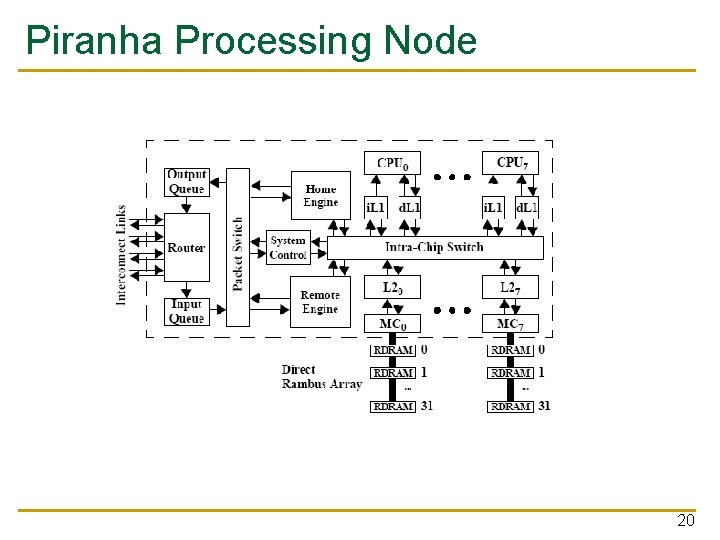
Piranha Processing Node 20
Inter-Node Coherence Protocol Engine 21
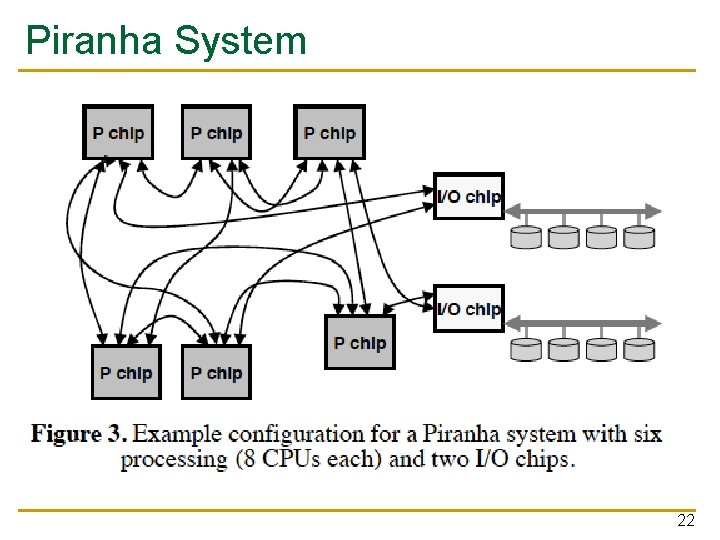
Piranha System 22
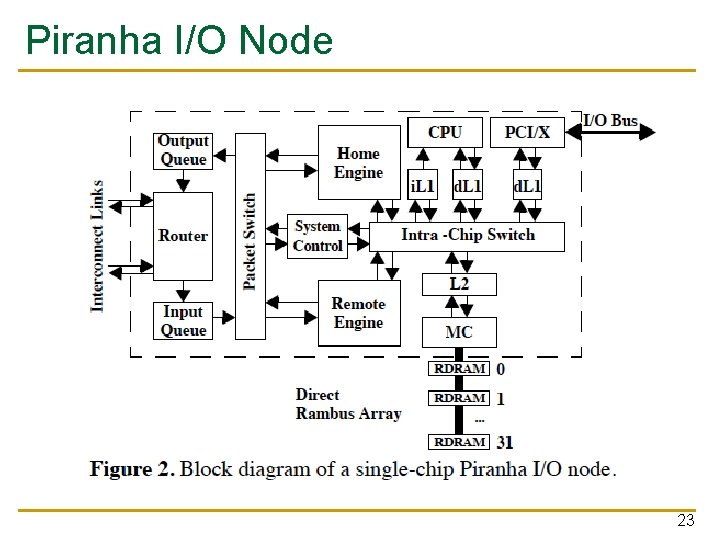
Piranha I/O Node 23
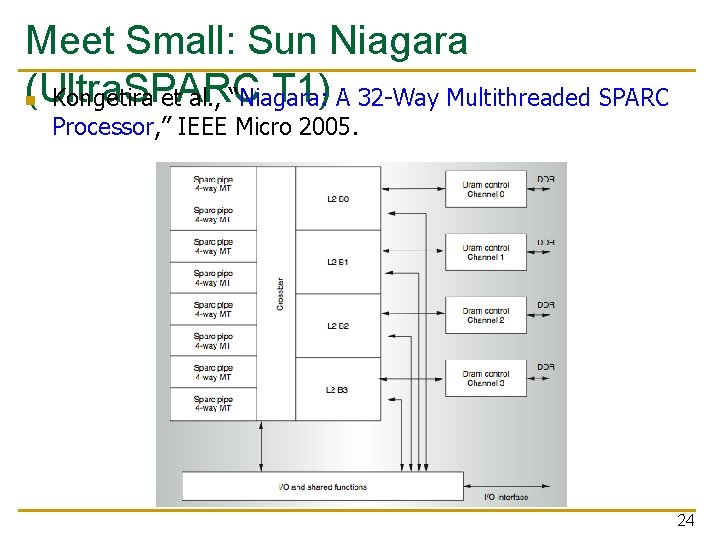
Meet Small: Sun Niagara (Ultra. SPARC T 1) n Kongetira et al. , “Niagara: A 32 -Way Multithreaded SPARC Processor, ” IEEE Micro 2005. 24
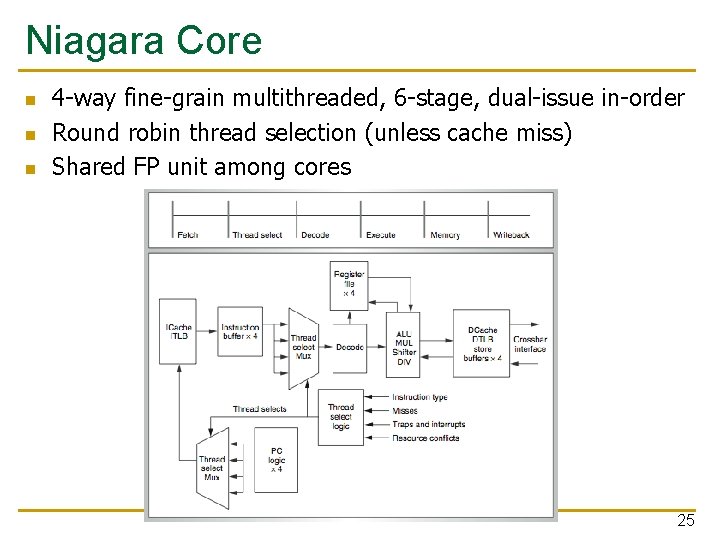
Niagara Core n n n 4 -way fine-grain multithreaded, 6 -stage, dual-issue in-order Round robin thread selection (unless cache miss) Shared FP unit among cores 25
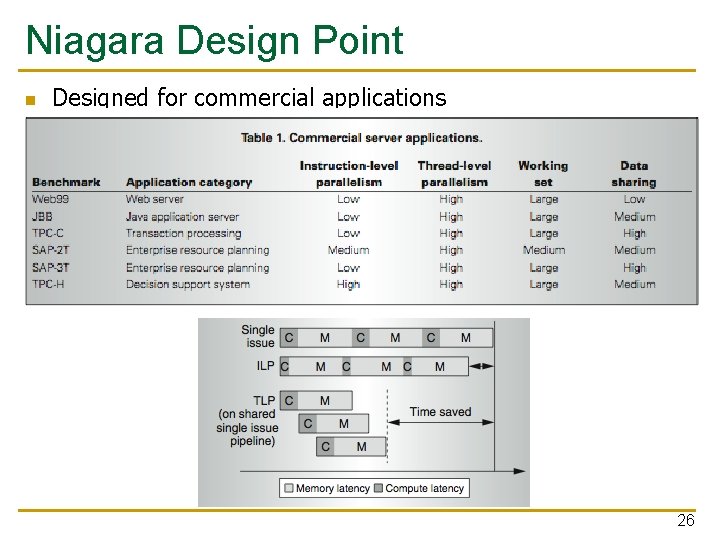
Niagara Design Point n Designed for commercial applications 26
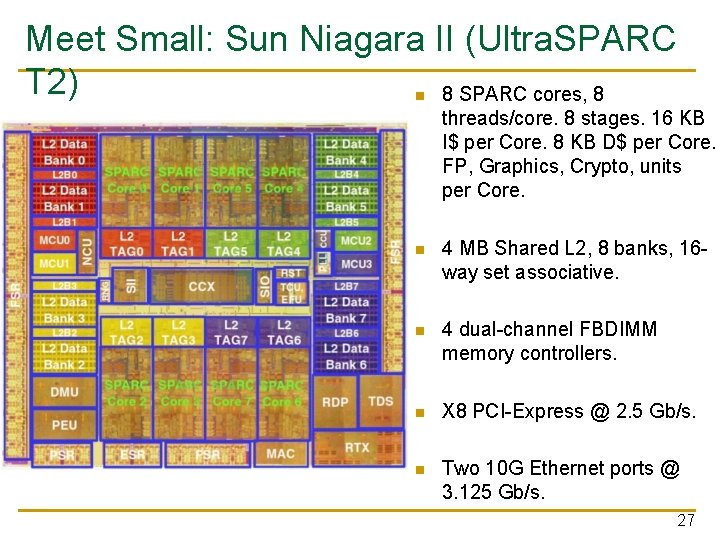
Meet Small: Sun Niagara II (Ultra. SPARC T 2) 8 SPARC cores, 8 n threads/core. 8 stages. 16 KB I$ per Core. 8 KB D$ per Core. FP, Graphics, Crypto, units per Core. n 4 MB Shared L 2, 8 banks, 16 way set associative. n 4 dual-channel FBDIMM memory controllers. n X 8 PCI-Express @ 2. 5 Gb/s. n Two 10 G Ethernet ports @ 3. 125 Gb/s. 27
Meet Small, but Larger: Sun ROCK n n n Chaudhry et al. , “Rock: A High-Performance Sparc CMT Processor, ” IEEE Micro, 2009. Chaudhry et al. , “Simultaneous Speculative Threading: A Novel Pipeline Architecture Implemented in Sun's ROCK Processor, ” ISCA 2009 Goals: q q n Maximize throughput when threads are available Boost single-thread performance when threads are not available and on cache misses Ideas: q q Runahead on a cache miss ahead thread executes missindependent instructions, behind thread executes dependent instructions Branch prediction (gshare) 28
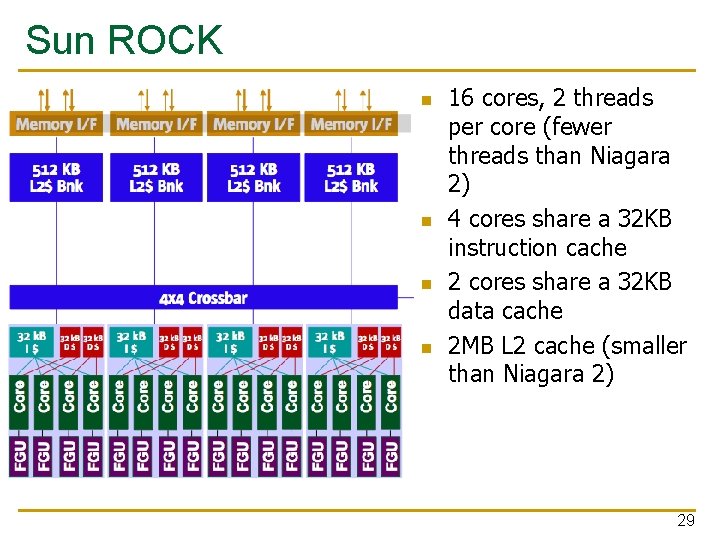
Sun ROCK n n 16 cores, 2 threads per core (fewer threads than Niagara 2) 4 cores share a 32 KB instruction cache 2 cores share a 32 KB data cache 2 MB L 2 cache (smaller than Niagara 2) 29
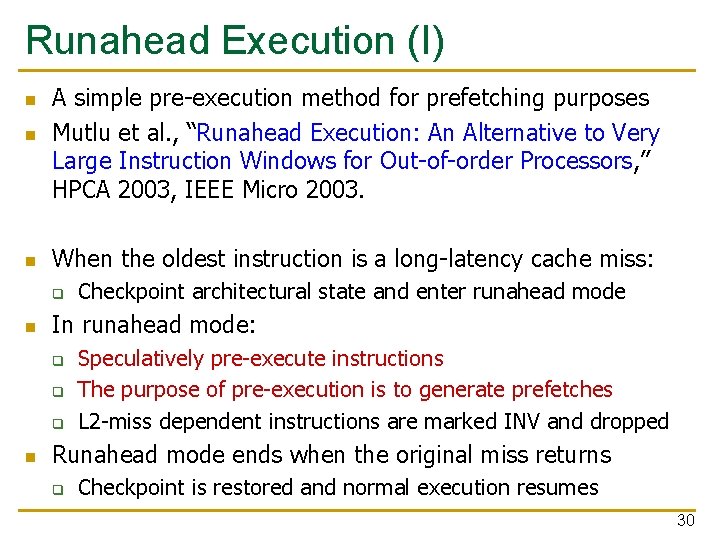
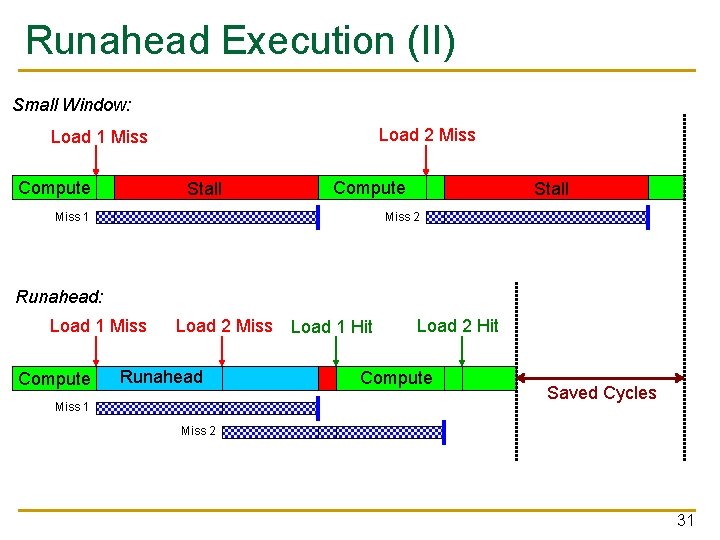
Runahead Execution (I) n A simple pre-execution method for prefetching purposes Mutlu et al. , “Runahead Execution: An Alternative to Very Large Instruction Windows for Out-of-order Processors, ” HPCA 2003, IEEE Micro 2003. n When the oldest instruction is a long-latency cache miss: n q n In runahead mode: q q q n Checkpoint architectural state and enter runahead mode Speculatively pre-execute instructions The purpose of pre-execution is to generate prefetches L 2 -miss dependent instructions are marked INV and dropped Runahead mode ends when the original miss returns q Checkpoint is restored and normal execution resumes 30
Runahead Execution (II) Small Window: Load 2 Miss Load 1 Miss Compute Stall Compute Miss 1 Stall Miss 2 Runahead: Load 1 Miss Compute Load 2 Miss Runahead Miss 1 Load 1 Hit Load 2 Hit Compute Saved Cycles Miss 2 31
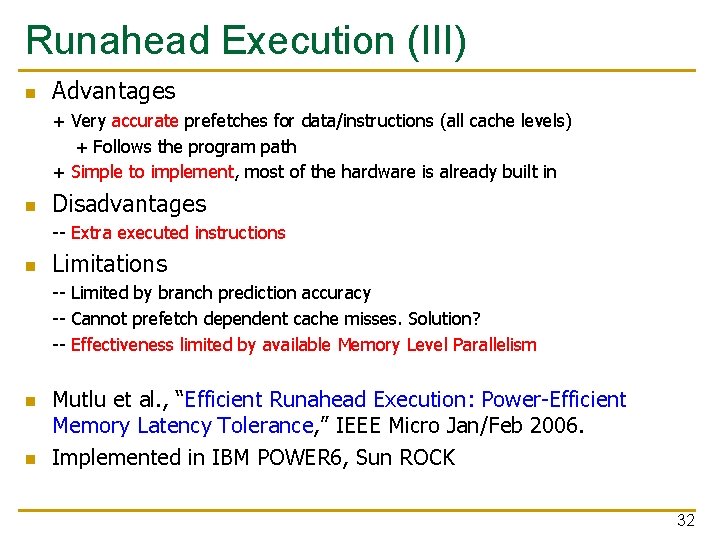
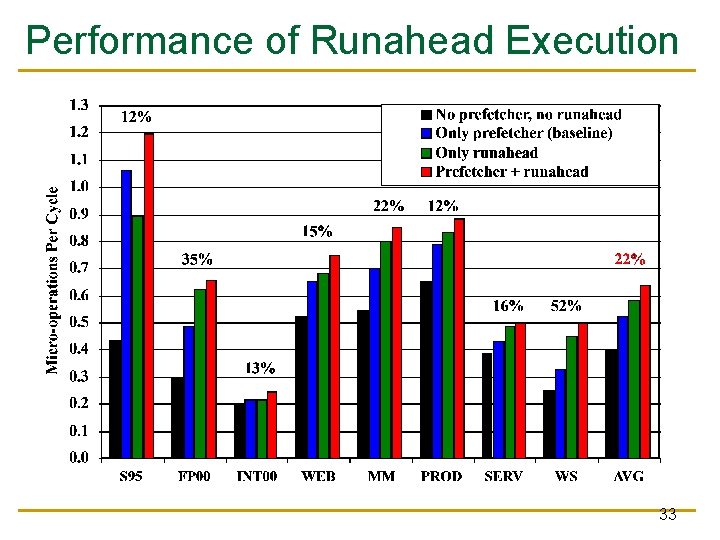
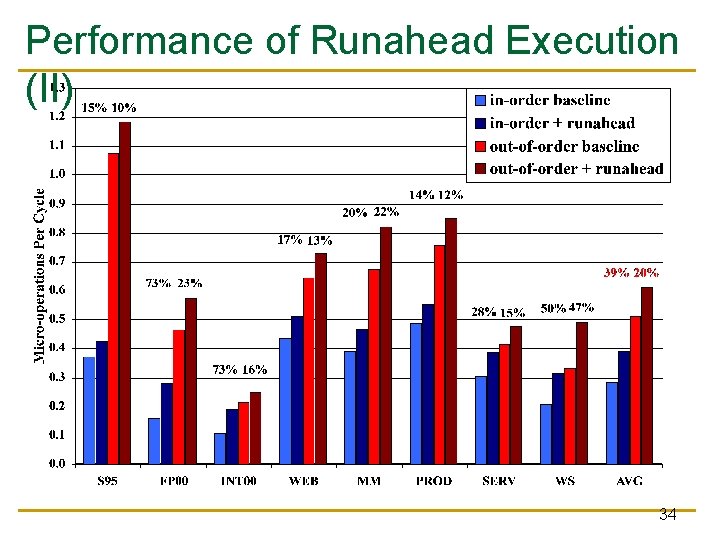
Runahead Execution (III) n Advantages + Very accurate prefetches for data/instructions (all cache levels) + Follows the program path + Simple to implement, most of the hardware is already built in n Disadvantages -- Extra executed instructions n Limitations -- Limited by branch prediction accuracy -- Cannot prefetch dependent cache misses. Solution? -- Effectiveness limited by available Memory Level Parallelism n n Mutlu et al. , “Efficient Runahead Execution: Power-Efficient Memory Latency Tolerance, ” IEEE Micro Jan/Feb 2006. Implemented in IBM POWER 6, Sun ROCK 32
Performance of Runahead Execution 33
Performance of Runahead Execution (II) 34
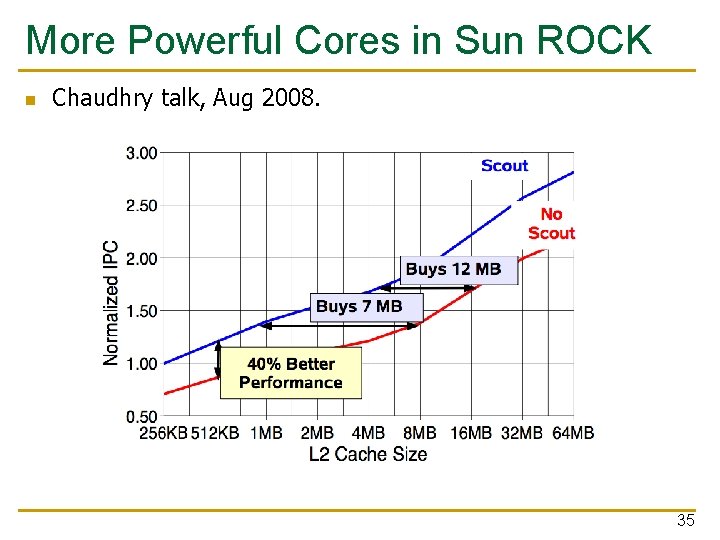
More Powerful Cores in Sun ROCK n Chaudhry talk, Aug 2008. 35
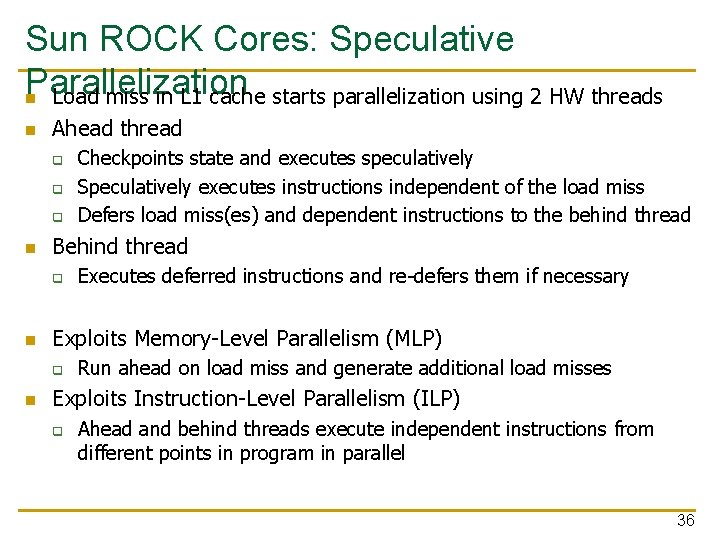
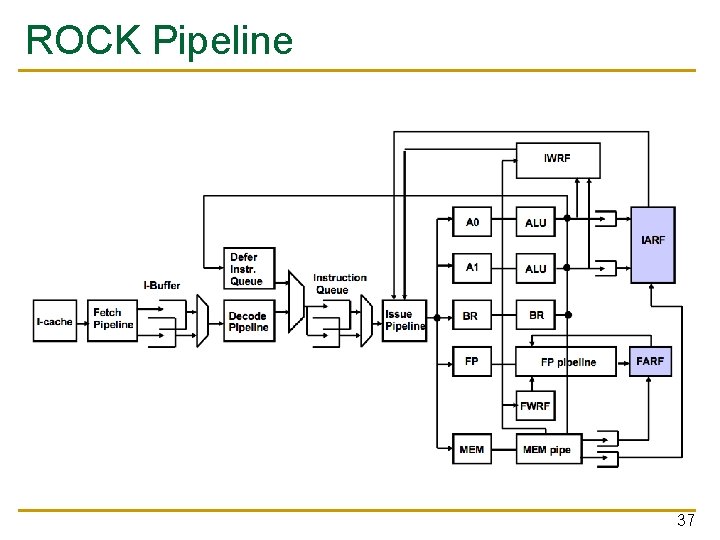
Sun ROCK Cores: Speculative Parallelization n Load miss in L 1 cache starts parallelization using 2 HW threads n Ahead thread q q q n Behind thread q n Executes deferred instructions and re-defers them if necessary Exploits Memory-Level Parallelism (MLP) q n Checkpoints state and executes speculatively Speculatively executes instructions independent of the load miss Defers load miss(es) and dependent instructions to the behind thread Run ahead on load miss and generate additional load misses Exploits Instruction-Level Parallelism (ILP) q Ahead and behind threads execute independent instructions from different points in program in parallel 36
ROCK Pipeline 37
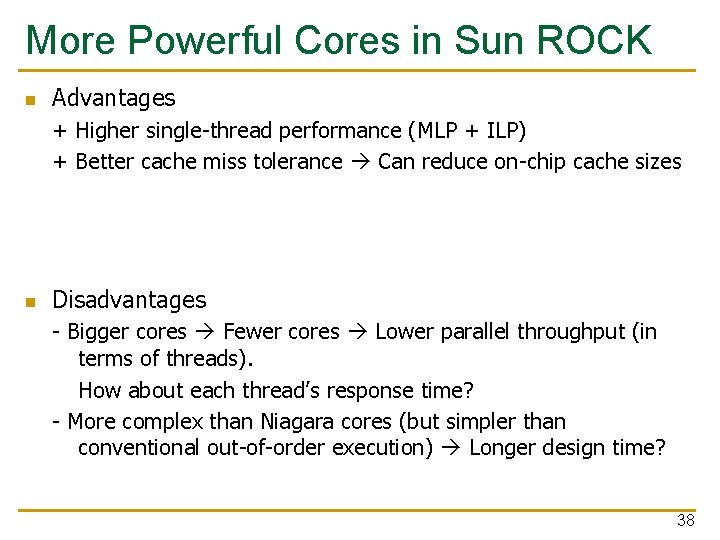
More Powerful Cores in Sun ROCK n Advantages + Higher single-thread performance (MLP + ILP) + Better cache miss tolerance Can reduce on-chip cache sizes n Disadvantages - Bigger cores Fewer cores Lower parallel throughput (in terms of threads). How about each thread’s response time? - More complex than Niagara cores (but simpler than conventional out-of-order execution) Longer design time? 38
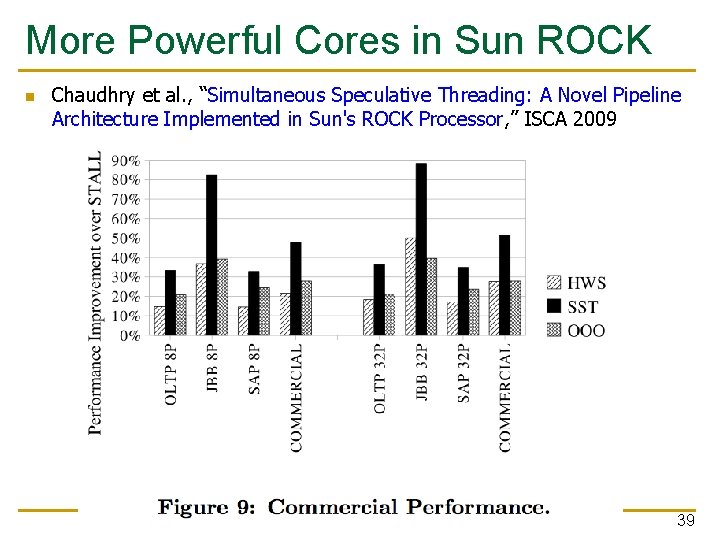
More Powerful Cores in Sun ROCK n Chaudhry et al. , “Simultaneous Speculative Threading: A Novel Pipeline Architecture Implemented in Sun's ROCK Processor, ” ISCA 2009 39
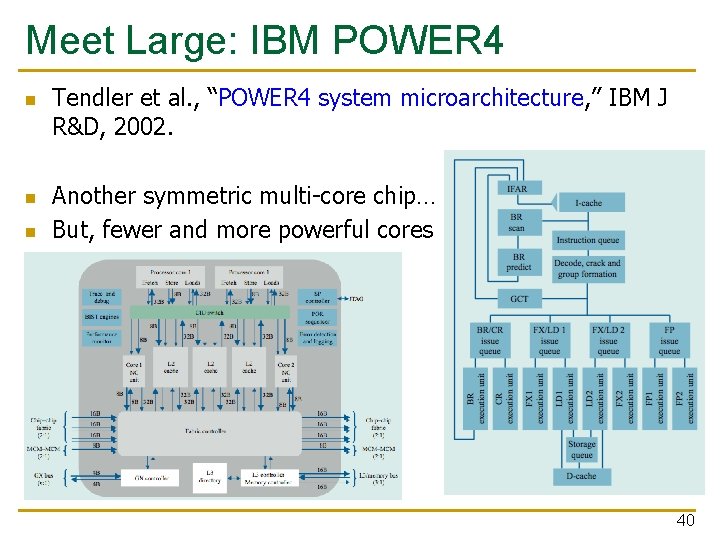
Meet Large: IBM POWER 4 n n n Tendler et al. , “POWER 4 system microarchitecture, ” IBM J R&D, 2002. Another symmetric multi-core chip… But, fewer and more powerful cores 40
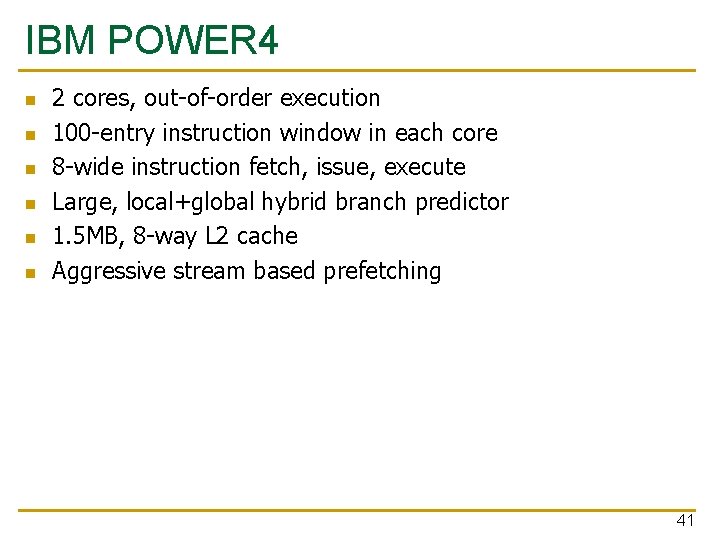
IBM POWER 4 n n n 2 cores, out-of-order execution 100 -entry instruction window in each core 8 -wide instruction fetch, issue, execute Large, local+global hybrid branch predictor 1. 5 MB, 8 -way L 2 cache Aggressive stream based prefetching 41
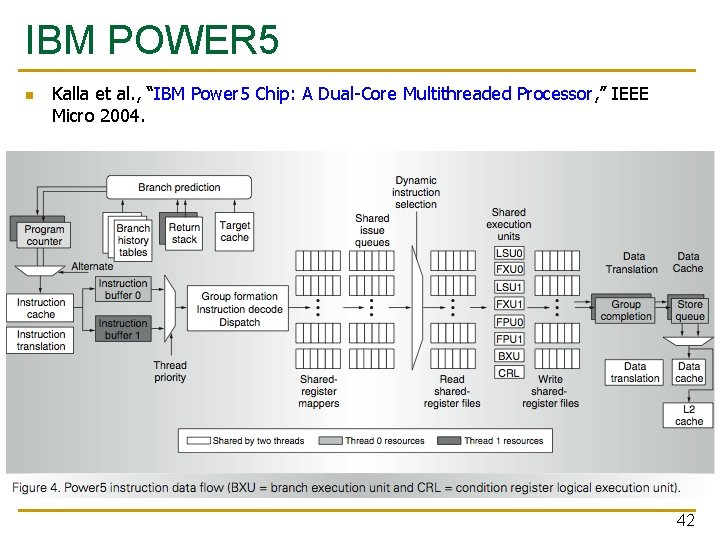
IBM POWER 5 n Kalla et al. , “IBM Power 5 Chip: A Dual-Core Multithreaded Processor, ” IEEE Micro 2004. 42
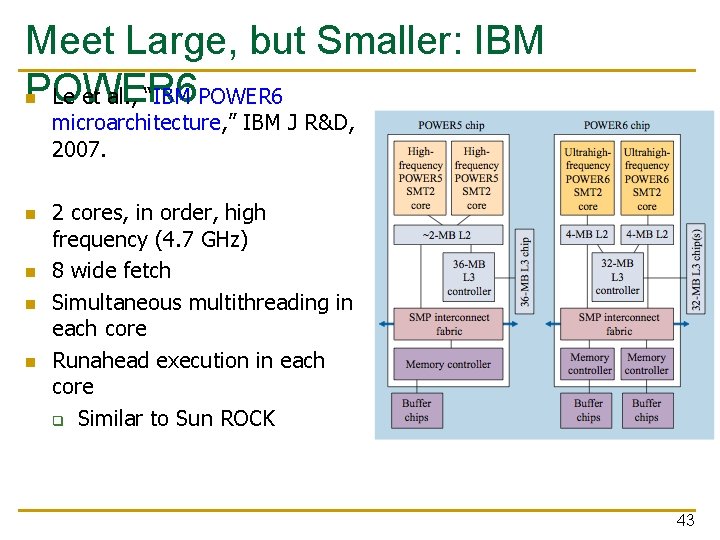
Meet Large, but Smaller: IBM POWER 6 Le et al. , “IBM POWER 6 n microarchitecture, ” IBM J R&D, 2007. n n 2 cores, in order, high frequency (4. 7 GHz) 8 wide fetch Simultaneous multithreading in each core Runahead execution in each core q Similar to Sun ROCK 43
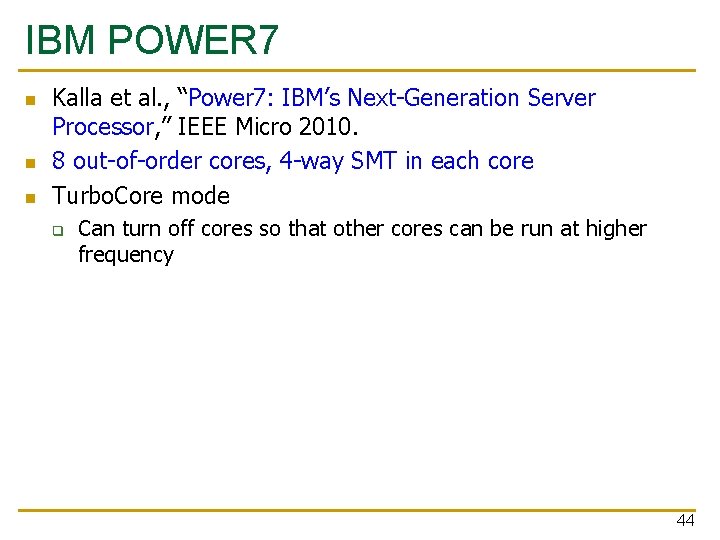
IBM POWER 7 n n n Kalla et al. , “Power 7: IBM’s Next-Generation Server Processor, ” IEEE Micro 2010. 8 out-of-order cores, 4 -way SMT in each core Turbo. Core mode q Can turn off cores so that other cores can be run at higher frequency 44
Remember the Demands n What we want: n In a serialized code section one powerful “large” core n In a parallel code section many wimpy “small” cores n These two conflict with each other: q q n If you have a single powerful core, you cannot have many cores A small core is much more energy and area efficient than a large core Can we get the best of both worlds? 45
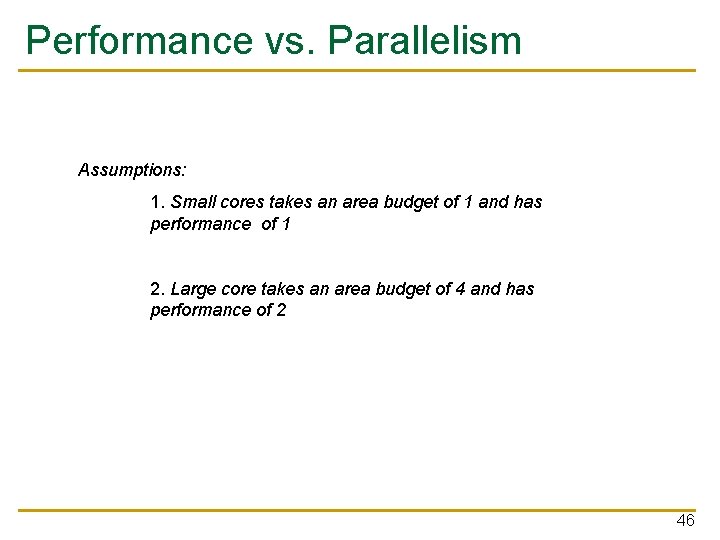
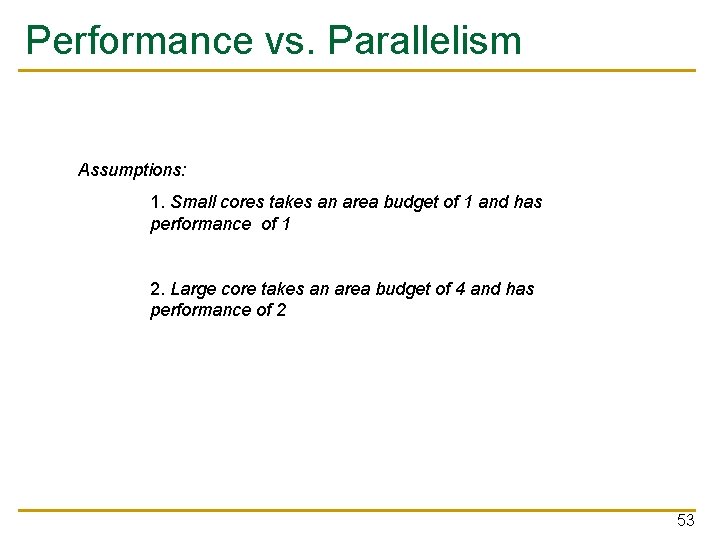
Performance vs. Parallelism Assumptions: 1. Small cores takes an area budget of 1 and has performance of 1 2. Large core takes an area budget of 4 and has performance of 2 46
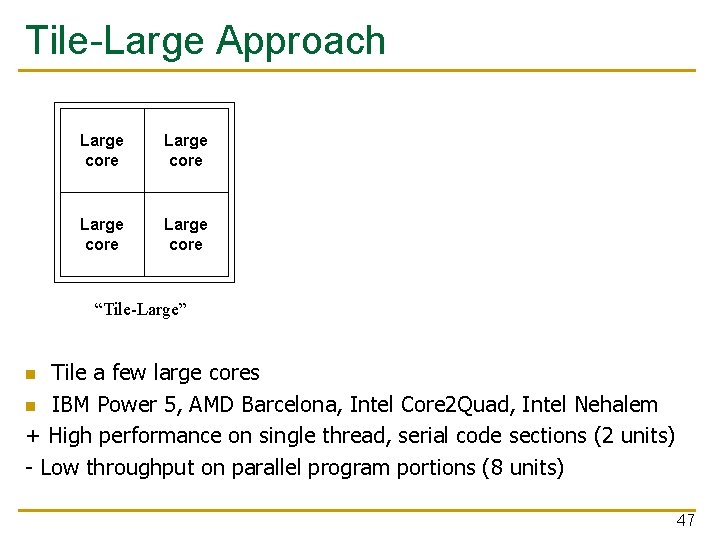
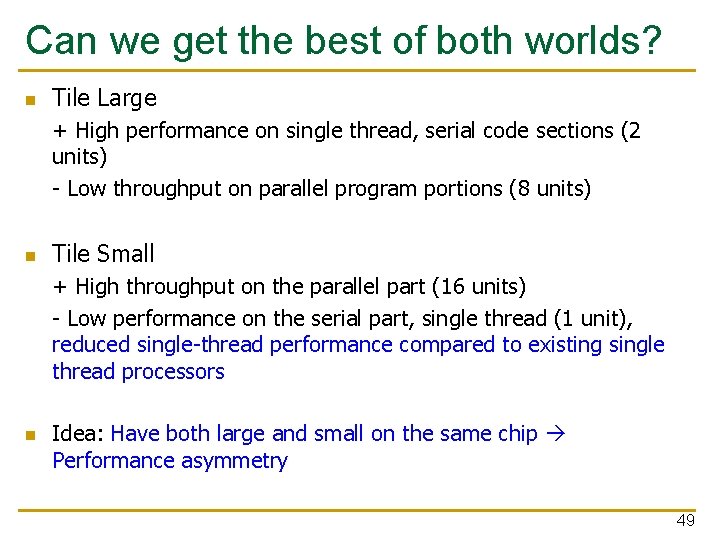
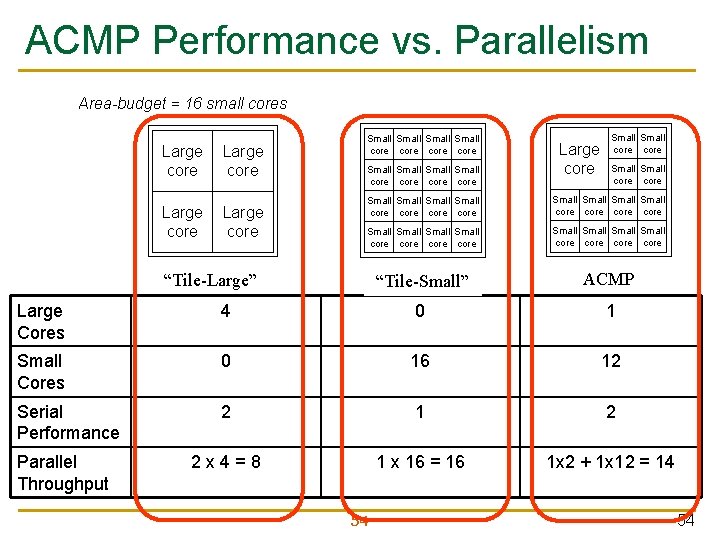
Tile-Large Approach Large core “Tile-Large” Tile a few large cores n IBM Power 5, AMD Barcelona, Intel Core 2 Quad, Intel Nehalem + High performance on single thread, serial code sections (2 units) - Low throughput on parallel program portions (8 units) n 47
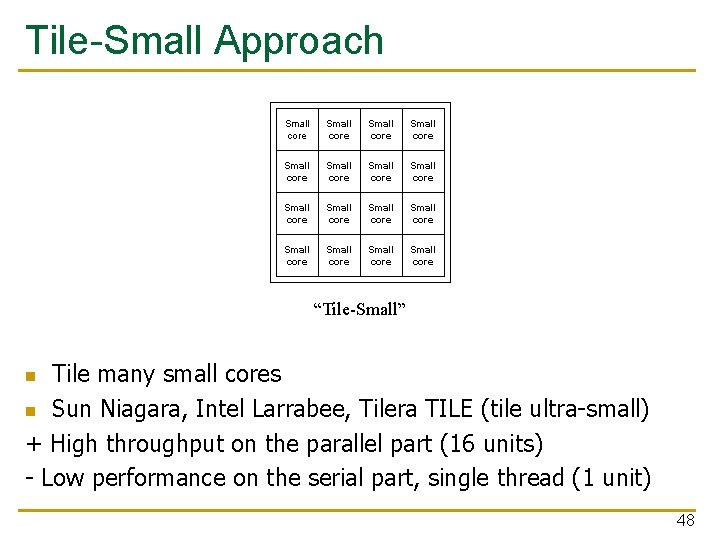
Tile-Small Approach Small core Small core Small core Small core “Tile-Small” Tile many small cores n Sun Niagara, Intel Larrabee, Tilera TILE (tile ultra-small) + High throughput on the parallel part (16 units) - Low performance on the serial part, single thread (1 unit) n 48
Can we get the best of both worlds? n Tile Large + High performance on single thread, serial code sections (2 units) - Low throughput on parallel program portions (8 units) n Tile Small + High throughput on the parallel part (16 units) - Low performance on the serial part, single thread (1 unit), reduced single-thread performance compared to existing single thread processors n Idea: Have both large and small on the same chip Performance asymmetry 49
Asymmetric Multi-Core 50
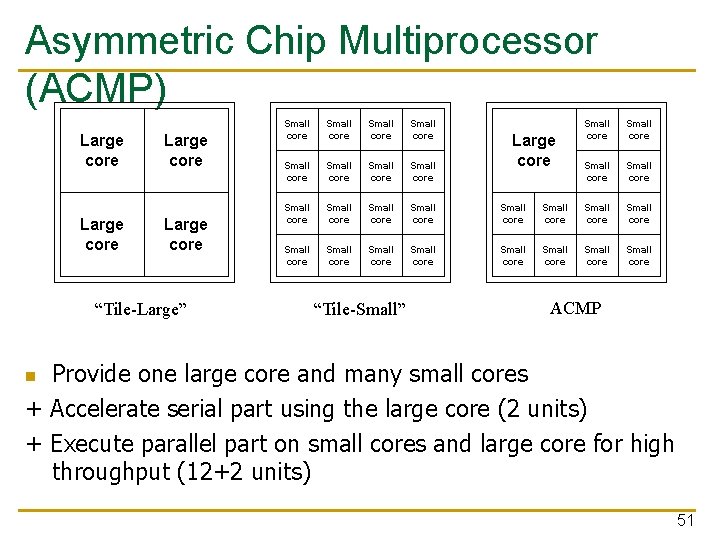
Asymmetric Chip Multiprocessor (ACMP) Large core “Tile-Large” Small core Small core Small core Small core Small core “Tile-Small” Small core Small core Small core Large core ACMP Provide one large core and many small cores + Accelerate serial part using the large core (2 units) + Execute parallel part on small cores and large core for high throughput (12+2 units) n 51
Accelerating Serial Bottlenecks Single thread Large core Small core Small core Small core ACMP Approach 52
Performance vs. Parallelism Assumptions: 1. Small cores takes an area budget of 1 and has performance of 1 2. Large core takes an area budget of 4 and has performance of 2 53
ACMP Performance vs. Parallelism Area-budget = 16 small cores Large core Small Small core core Large core Small core core Small Small Small Small core core core “Tile-Small” ACMP “Tile-Large” Large Cores 4 0 1 Small Cores 0 16 12 Serial Performance 2 1 2 2 x 4=8 1 x 16 = 16 1 x 2 + 1 x 12 = 14 Parallel Throughput 54 54
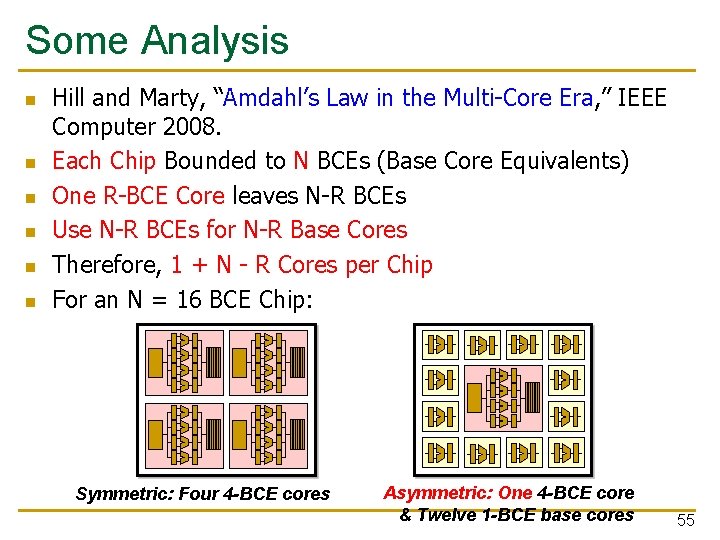
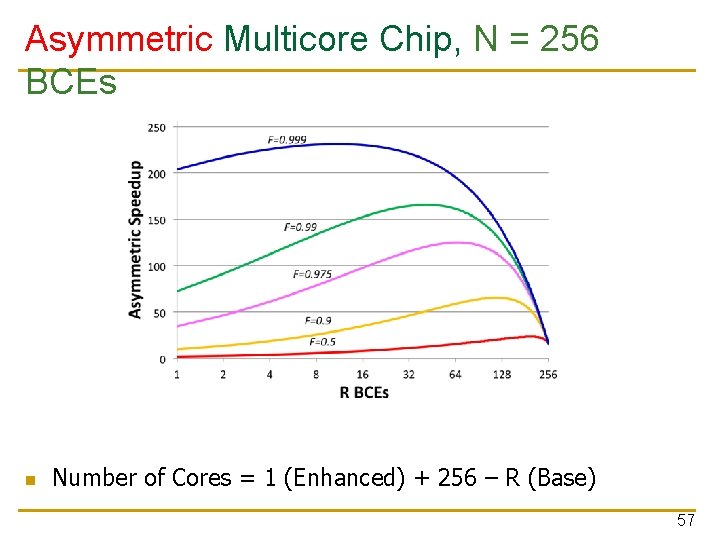
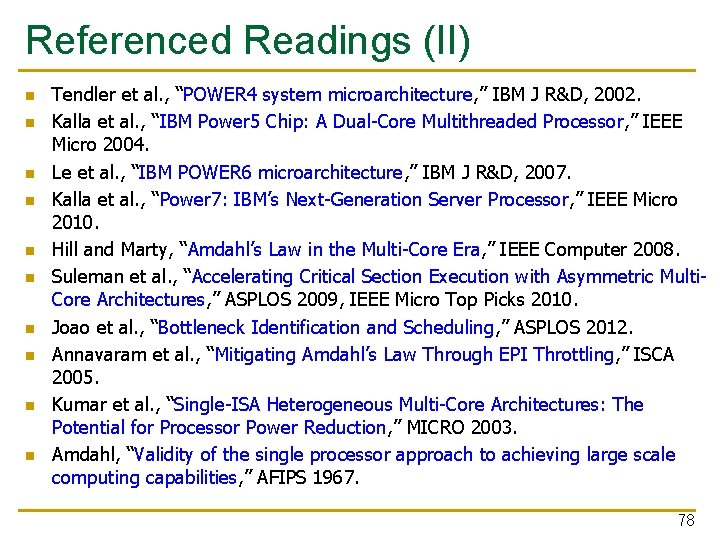
Some Analysis n n n Hill and Marty, “Amdahl’s Law in the Multi-Core Era, ” IEEE Computer 2008. Each Chip Bounded to N BCEs (Base Core Equivalents) One R-BCE Core leaves N-R BCEs Use N-R BCEs for N-R Base Cores Therefore, 1 + N - R Cores per Chip For an N = 16 BCE Chip: Symmetric: Four 4 -BCE cores Asymmetric: One 4 -BCE core & Twelve 1 -BCE base cores 55
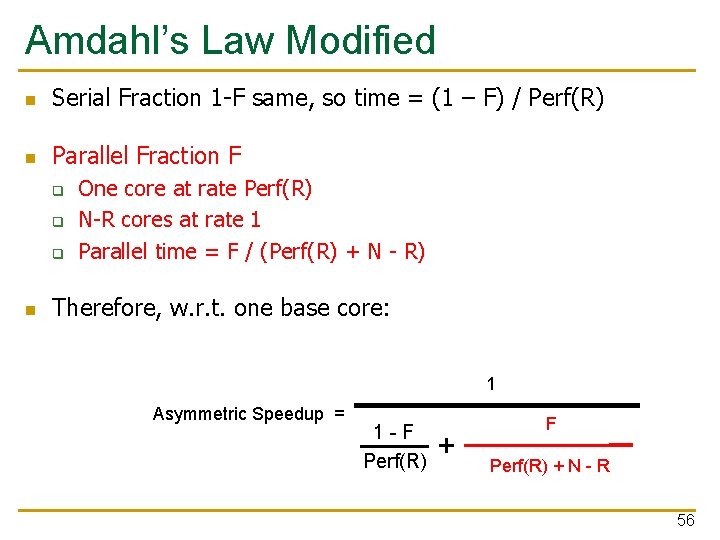
Amdahl’s Law Modified n Serial Fraction 1 -F same, so time = (1 – F) / Perf(R) n Parallel Fraction F q q q n One core at rate Perf(R) N-R cores at rate 1 Parallel time = F / (Perf(R) + N - R) Therefore, w. r. t. one base core: 1 Asymmetric Speedup = 1 -F Perf(R) + N - R 56
Asymmetric Multicore Chip, N = 256 BCEs n Number of Cores = 1 (Enhanced) + 256 – R (Base) 57
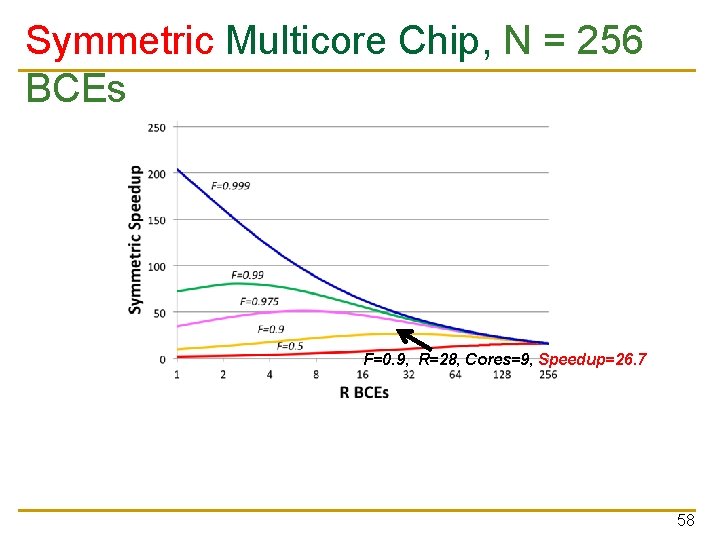
Symmetric Multicore Chip, N = 256 BCEs F=0. 9, R=28, Cores=9, Speedup=26. 7 58
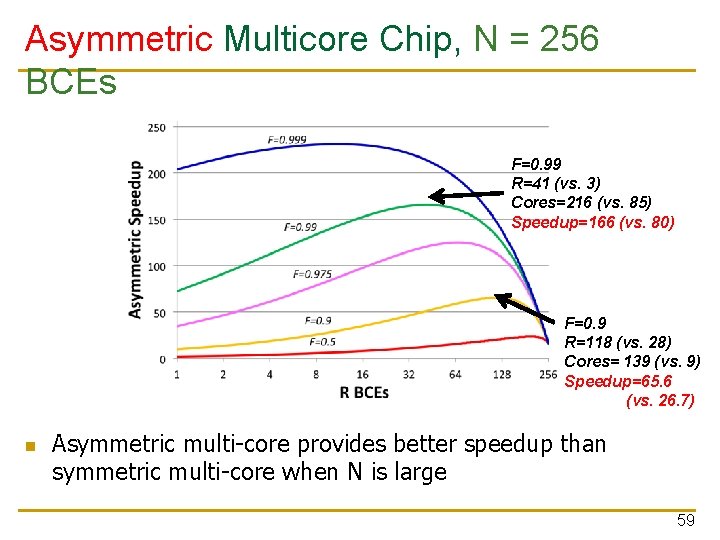
Asymmetric Multicore Chip, N = 256 BCEs F=0. 99 R=41 (vs. 3) Cores=216 (vs. 85) Speedup=166 (vs. 80) F=0. 9 R=118 (vs. 28) Cores= 139 (vs. 9) Speedup=65. 6 (vs. 26. 7) n Asymmetric multi-core provides better speedup than symmetric multi-core when N is large 59
Asymmetric vs. Symmetric Cores n Advantages of Asymmetric + Can provide better performance when thread parallelism is limited + Can be more energy efficient + Schedule computation to the core type that can best execute it n Disadvantages - Need to design more than one type of core. Always? - Scheduling becomes more complicated - What computation should be scheduled on the large core? - Who should decide? HW vs. SW? - Managing locality and load balancing can become difficult if threads move between cores (transparently to software) - Cores have different demands from shared resources 60
Caveats of Parallelism, Revisited n Amdahl’s Law q q f: Parallelizable fraction of a program N: Number of processors 1 Speedup = 1 -f q n n + f N Amdahl, “Validity of the single processor approach to achieving large scale computing capabilities, ” AFIPS 1967. Maximum speedup limited by serial portion: Serial bottleneck Parallel portion is usually not perfectly parallel q q q Synchronization overhead (e. g. , updates to shared data) Load imbalance overhead (imperfect parallelization) Resource sharing overhead (contention among N processors) 61
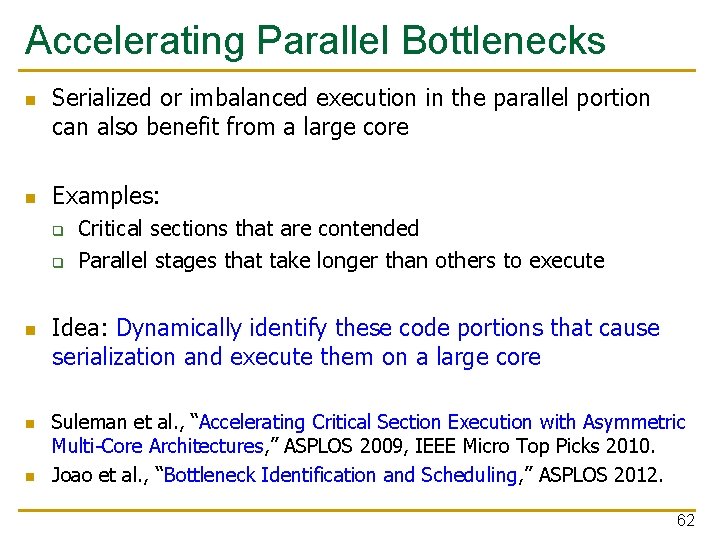
Accelerating Parallel Bottlenecks n n Serialized or imbalanced execution in the parallel portion can also benefit from a large core Examples: q q n n n Critical sections that are contended Parallel stages that take longer than others to execute Idea: Dynamically identify these code portions that cause serialization and execute them on a large core Suleman et al. , “Accelerating Critical Section Execution with Asymmetric Multi-Core Architectures, ” ASPLOS 2009, IEEE Micro Top Picks 2010. Joao et al. , “Bottleneck Identification and Scheduling, ” ASPLOS 2012. 62
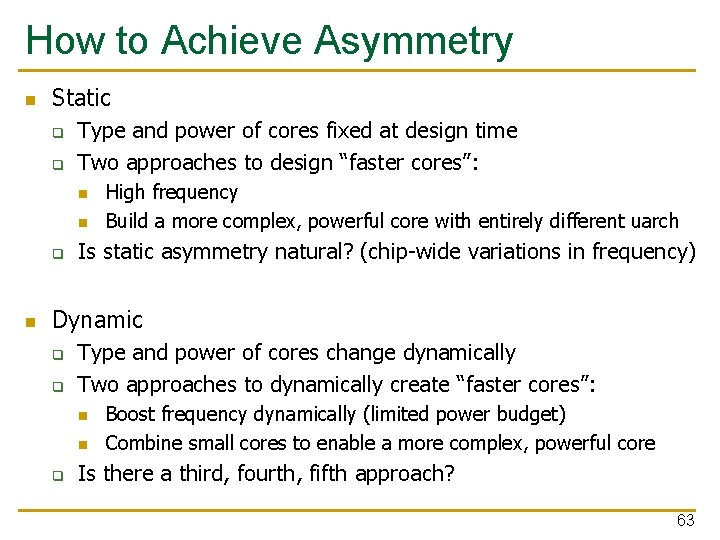
How to Achieve Asymmetry n Static q q Type and power of cores fixed at design time Two approaches to design “faster cores”: n n q n High frequency Build a more complex, powerful core with entirely different uarch Is static asymmetry natural? (chip-wide variations in frequency) Dynamic q q Type and power of cores change dynamically Two approaches to dynamically create “faster cores”: n n q Boost frequency dynamically (limited power budget) Combine small cores to enable a more complex, powerful core Is there a third, fourth, fifth approach? 63
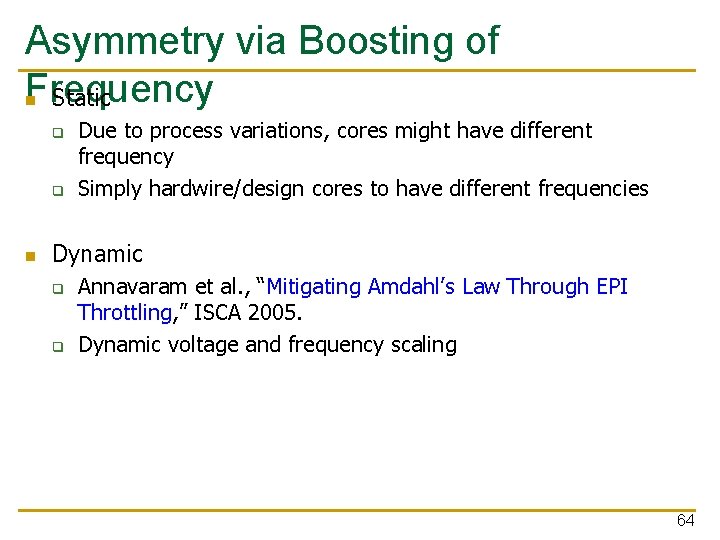
Asymmetry via Boosting of Frequency n Static q q n Due to process variations, cores might have different frequency Simply hardwire/design cores to have different frequencies Dynamic q q Annavaram et al. , “Mitigating Amdahl’s Law Through EPI Throttling, ” ISCA 2005. Dynamic voltage and frequency scaling 64
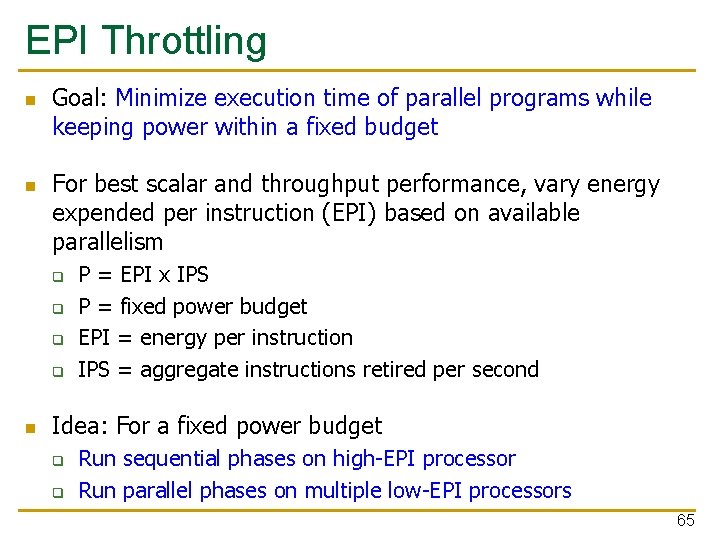
EPI Throttling n n Goal: Minimize execution time of parallel programs while keeping power within a fixed budget For best scalar and throughput performance, vary energy expended per instruction (EPI) based on available parallelism q q n P = EPI x IPS P = fixed power budget EPI = energy per instruction IPS = aggregate instructions retired per second Idea: For a fixed power budget q q Run sequential phases on high-EPI processor Run parallel phases on multiple low-EPI processors 65
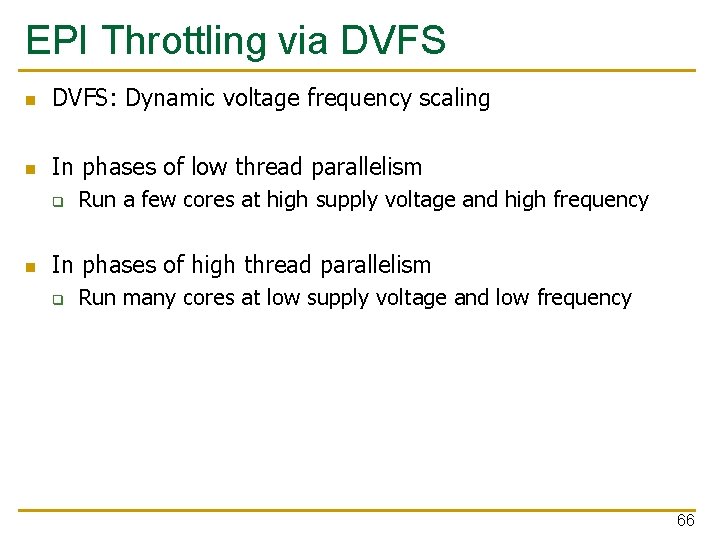
EPI Throttling via DVFS n DVFS: Dynamic voltage frequency scaling n In phases of low thread parallelism q n Run a few cores at high supply voltage and high frequency In phases of high thread parallelism q Run many cores at low supply voltage and low frequency 66
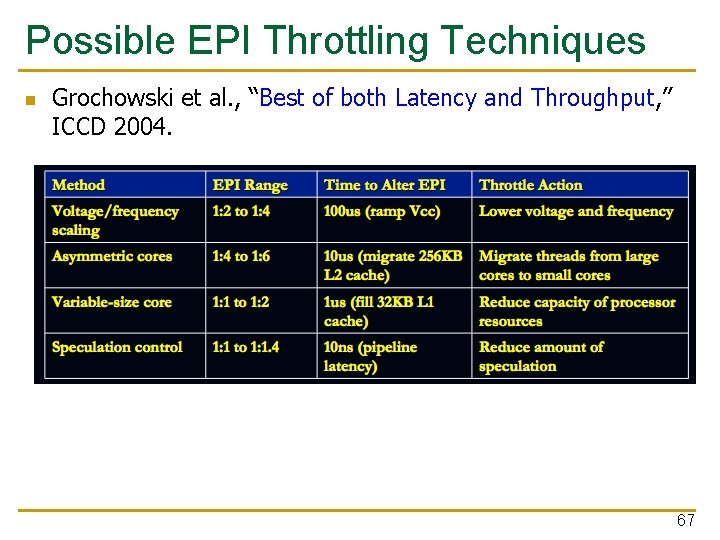
Possible EPI Throttling Techniques n Grochowski et al. , “Best of both Latency and Throughput, ” ICCD 2004. 67
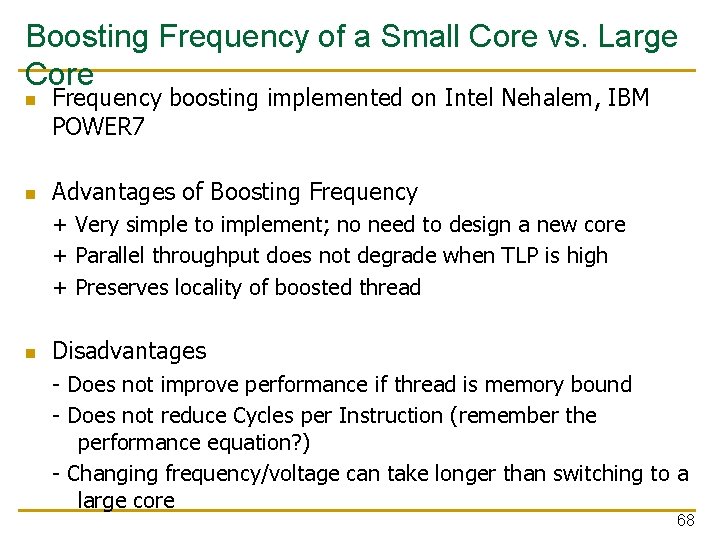
Boosting Frequency of a Small Core vs. Large Core n n Frequency boosting implemented on Intel Nehalem, IBM POWER 7 Advantages of Boosting Frequency + Very simple to implement; no need to design a new core + Parallel throughput does not degrade when TLP is high + Preserves locality of boosted thread n Disadvantages - Does not improve performance if thread is memory bound - Does not reduce Cycles per Instruction (remember the performance equation? ) - Changing frequency/voltage can take longer than switching to a large core 68
Uses of Asymmetry n So far: q n Improvement in serial performance (sequential bottleneck) What else can we do with asymmetry? q q q Energy reduction? Energy/performance tradeoff? Improvement in parallel portion? 69
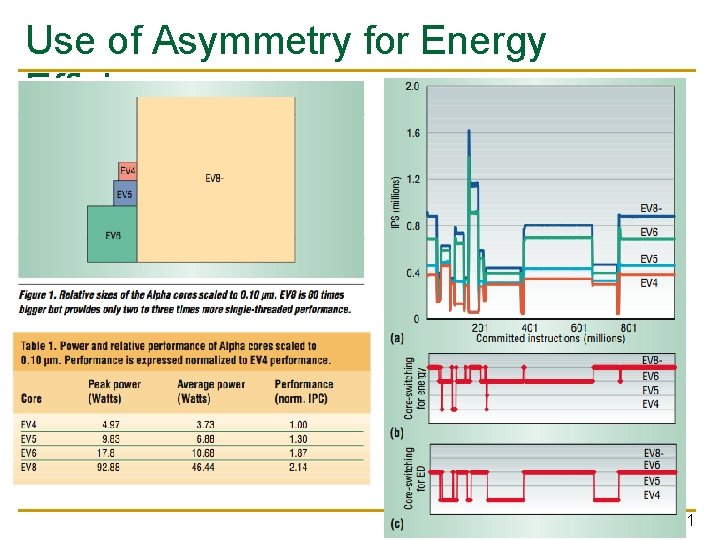
Use of Asymmetry for Energy Efficiency Kumar et al. , “Single-ISA Heterogeneous Multi-Core Architectures: n The Potential for Processor Power Reduction, ” MICRO 2003. n Idea: q q q n Implement multiple types of cores on chip Monitor characteristics of the running thread n e. g. , sample energy/perf on each core periodically Dynamically pick the core that provides the best energy/performance tradeoff for a given phase n “Best core” Depends on optimization metric Example: ARM’s big. LITTLE architecture 70
Use of Asymmetry for Energy Efficiency 71
Use of Asymmetry for Energy Efficiency Advantages n + More flexibility in energy-performance tradeoff + Can execute computation to the core that is best suited for it (in terms of energy) n Disadvantages/issues - Incorrect predictions/sampling wrong core reduced performance or increased energy - Overhead of core switching - Disadvantages of asymmetric CMP (e. g. , design multiple cores) - Need phase monitoring and matching algorithms - What characteristics should be monitored? - Once characteristics known, how do you pick the core? 72
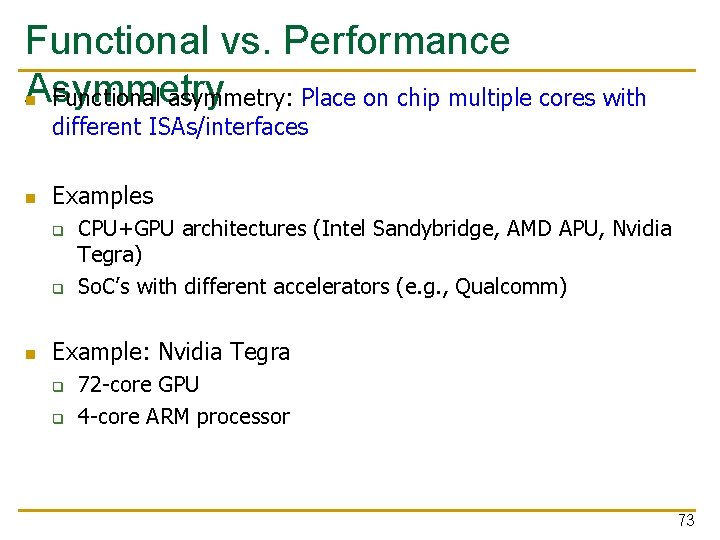
Functional vs. Performance Asymmetry n Functional asymmetry: Place on chip multiple cores with different ISAs/interfaces n Examples q q n CPU+GPU architectures (Intel Sandybridge, AMD APU, Nvidia Tegra) So. C’s with different accelerators (e. g. , Qualcomm) Example: Nvidia Tegra q q 72 -core GPU 4 -core ARM processor 73
Summary: Multi-Core Evolution n Symmetric Multi-core q q q n Evolution of Sun’s and IBM’s Multicore systems and design choices Niagara, Niagara 2, ROCK IBM POWERx Asymmetric Multi-core q q q Motivation Static vs. Dynamic Asymmetry EPI Throttling Use of Asymmetry for Energy Efficiency Functional vs. Performance Asymmetry 74
Computer Architecture: Multi-Core Evolution and Design Prof. Onur Mutlu Carnegie Mellon University
Backup Slides 76
Referenced Readings (I) n n n n n Grochowski et al. , “Best of both Latency and Throughput, ” ICCD 2004. Barroso et al. , “Piranha: A Scalable Architecture Based on Single-Chip Multiprocessing, ” ISCA 2000. Barroso et al. , “Memory System Characterization of Commercial Workloads, ” ISCA 1998. Ranganathan et al. , “Performance of Database Workloads on Shared. Memory Systems with Out-of-Order Processors, ” ASPLOS 1998. Kongetira et al. , “Niagara: A 32 -Way Multithreaded SPARC Processor, ” IEEE Micro 2005. Chaudhry et al. , “Rock: A High-Performance Sparc CMT Processor, ” IEEE Micro, 2009. Chaudhry et al. , “Simultaneous Speculative Threading: A Novel Pipeline Architecture Implemented in Sun's ROCK Processor, ” ISCA 2009 Mutlu et al. , “Efficient Runahead Execution: Power-Efficient Memory Latency Tolerance, ” IEEE Micro Jan/Feb 2006. Mutlu et al. , “Runahead Execution, ” HPCA 2003. 77
Referenced Readings (II) n n n n n Tendler et al. , “POWER 4 system microarchitecture, ” IBM J R&D, 2002. Kalla et al. , “IBM Power 5 Chip: A Dual-Core Multithreaded Processor, ” IEEE Micro 2004. Le et al. , “IBM POWER 6 microarchitecture, ” IBM J R&D, 2007. Kalla et al. , “Power 7: IBM’s Next-Generation Server Processor, ” IEEE Micro 2010. Hill and Marty, “Amdahl’s Law in the Multi-Core Era, ” IEEE Computer 2008. Suleman et al. , “Accelerating Critical Section Execution with Asymmetric Multi. Core Architectures, ” ASPLOS 2009, IEEE Micro Top Picks 2010. Joao et al. , “Bottleneck Identification and Scheduling, ” ASPLOS 2012. Annavaram et al. , “Mitigating Amdahl’s Law Through EPI Throttling, ” ISCA 2005. Kumar et al. , “Single-ISA Heterogeneous Multi-Core Architectures: The Potential for Processor Power Reduction, ” MICRO 2003. Amdahl, “Validity of the single processor approach to achieving large scale computing capabilities, ” AFIPS 1967. 78
Related Videos n Multi-Core Systems and Heterogeneity q q http: //www. youtube. com/watch? v=Ll. Dx. T 0 h. Pl 2 U&list=PLVng. Z 7 Bem. HHV 6 N 0 ej. Hhw. Of. Lw. Tr 8 Q-UKXj&index=1 http: //www. youtube. com/watch? v=Q 0 zy. LVnzkr. M&list=PLVng. Z 7 Bem. HHV 6 N 0 ej. Hhw. Of. Lw. Tr 8 Q-UKXj&index=2 79
More on EPI Throttling 80
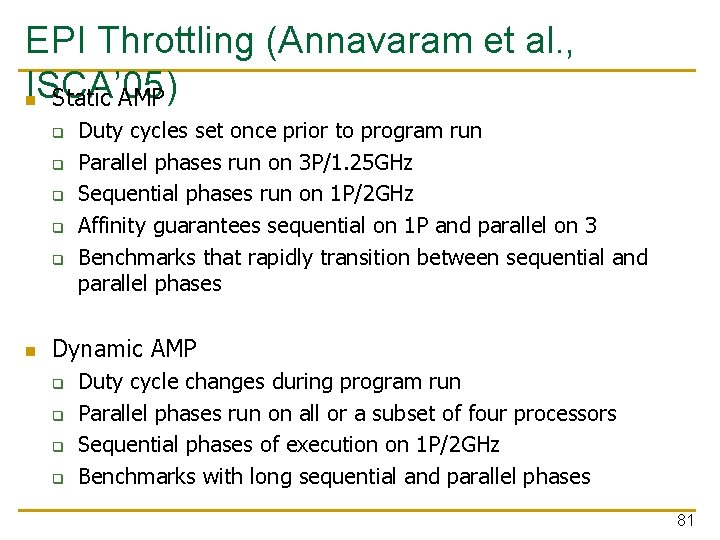
EPI Throttling (Annavaram et al. , ISCA’ 05) n Static AMP q q q n Duty cycles set once prior to program run Parallel phases run on 3 P/1. 25 GHz Sequential phases run on 1 P/2 GHz Affinity guarantees sequential on 1 P and parallel on 3 Benchmarks that rapidly transition between sequential and parallel phases Dynamic AMP q q Duty cycle changes during program run Parallel phases run on all or a subset of four processors Sequential phases of execution on 1 P/2 GHz Benchmarks with long sequential and parallel phases 81
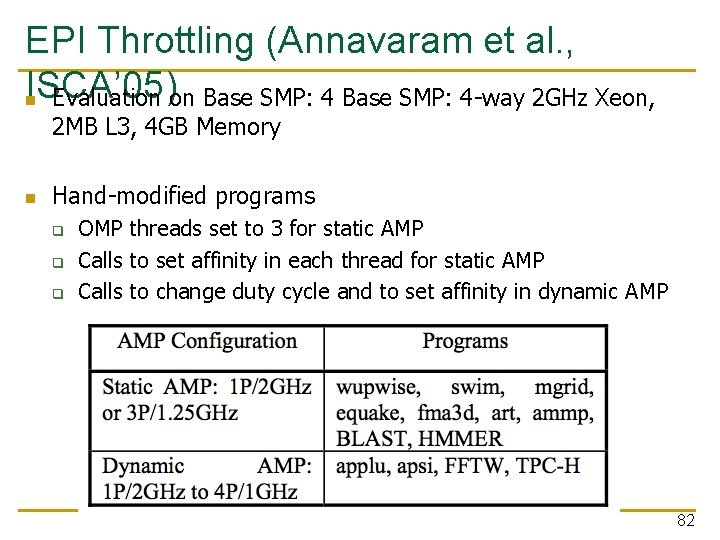
EPI Throttling (Annavaram et al. , ISCA’ 05) n Evaluation on Base SMP: 4 -way 2 GHz Xeon, 2 MB L 3, 4 GB Memory n Hand-modified programs q q q OMP threads set to 3 for static AMP Calls to set affinity in each thread for static AMP Calls to change duty cycle and to set affinity in dynamic AMP 82
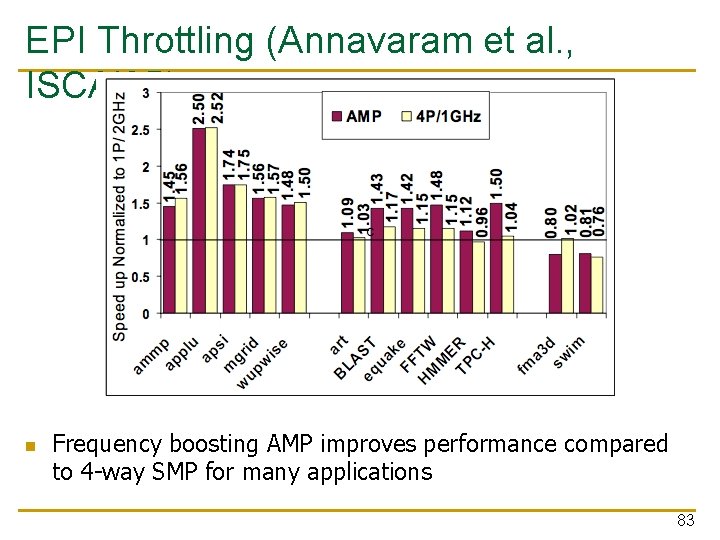
EPI Throttling (Annavaram et al. , ISCA’ 05) n Frequency boosting AMP improves performance compared to 4 -way SMP for many applications 83
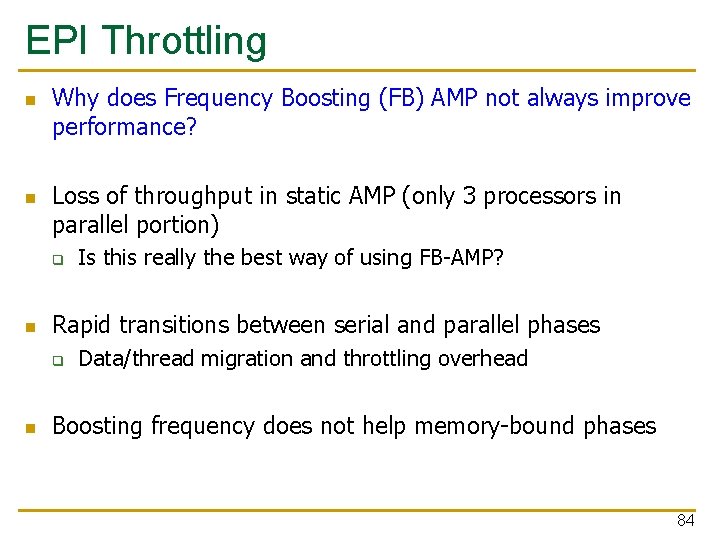
EPI Throttling n n Why does Frequency Boosting (FB) AMP not always improve performance? Loss of throughput in static AMP (only 3 processors in parallel portion) q n Rapid transitions between serial and parallel phases q n Is this really the best way of using FB-AMP? Data/thread migration and throttling overhead Boosting frequency does not help memory-bound phases 84
Use of ACMP to Improve Parallel Portion Performance n Mutual Exclusion: q n n Threads are not allowed to update shared data concurrently Accesses to shared data are encapsulated inside critical sections Only one thread can execute a critical section at a given time Idea: Ship critical sections to a large core Suleman et al. , “Accelerating Critical Section Execution with Asymmetric Multi-Core Architectures, ” ASPLOS 2009, IEEE Micro Top Picks 2010. 85