
Computer Architecture Lecture 6 Introduction to MIPS Decisions
- Slides: 22
Computer Architecture (�算机体系�构) Lecture 6 – Introduction to MIPS : Decisions II Lecturer Yuanqing Cheng 2020 -09 -14
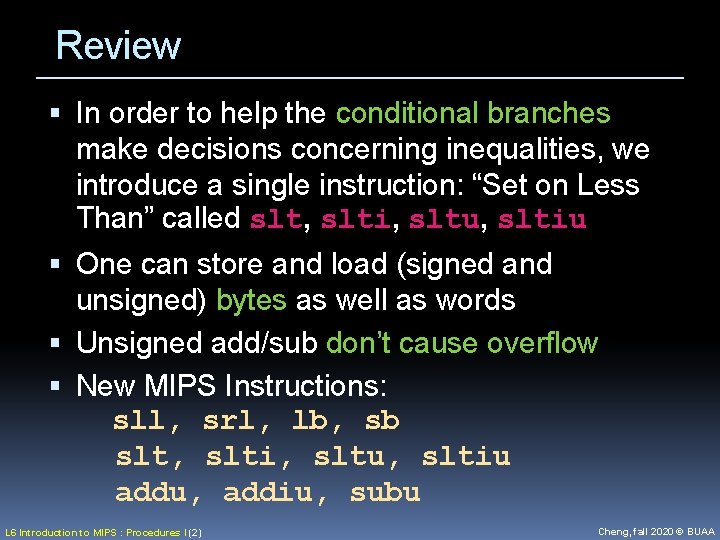
Review In order to help the conditional branches make decisions concerning inequalities, we introduce a single instruction: “Set on Less Than” called slt, slti, sltu, sltiu One can store and load (signed and unsigned) bytes as well as words Unsigned add/sub don’t cause overflow New MIPS Instructions: sll, srl, lb, sb slt, slti, sltu, sltiu addu, addiu, subu L 6 Introduction to MIPS : Procedures I (2) Cheng, fall 2020 © BUAA
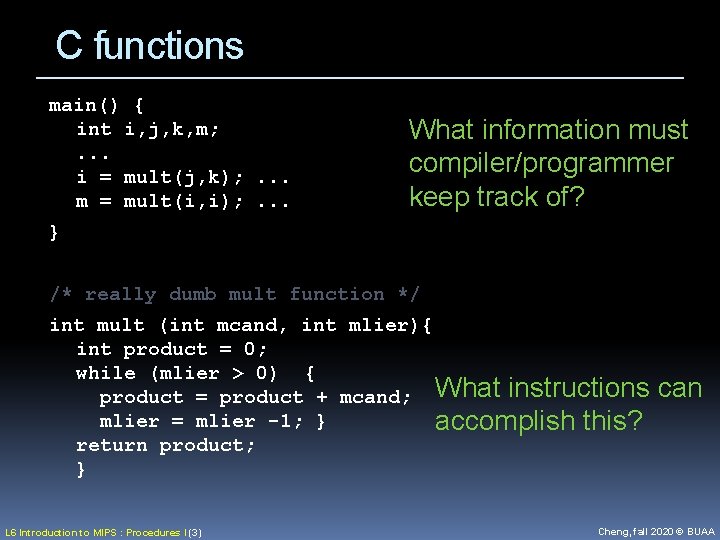
C functions main() { int i, j, k, m; . . . i = mult(j, k); . . . m = mult(i, i); . . . What information must compiler/programmer keep track of? } /* really dumb mult function */ int mult (int mcand, int mlier){ int product = 0; while (mlier > 0) { product = product + mcand; What instructions mlier = mlier -1; } accomplish this? return product; } L 6 Introduction to MIPS : Procedures I (3) can Cheng, fall 2020 © BUAA
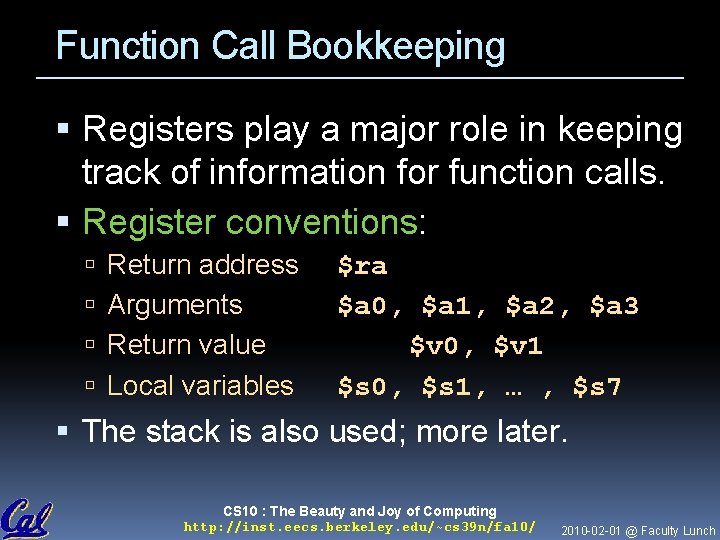
Function Call Bookkeeping Registers play a major role in keeping track of information for function calls. Register conventions: Return address Arguments Return value Local variables $ra $a 0, $a 1, $a 2, $a 3 $v 0, $v 1 $s 0, $s 1, … , $s 7 The stack is also used; more later. CS 10 : The Beauty and Joy of Computing http: //inst. eecs. berkeley. edu/~cs 39 n/fa 10/ 2010 -02 -01 @ Faculty Lunch
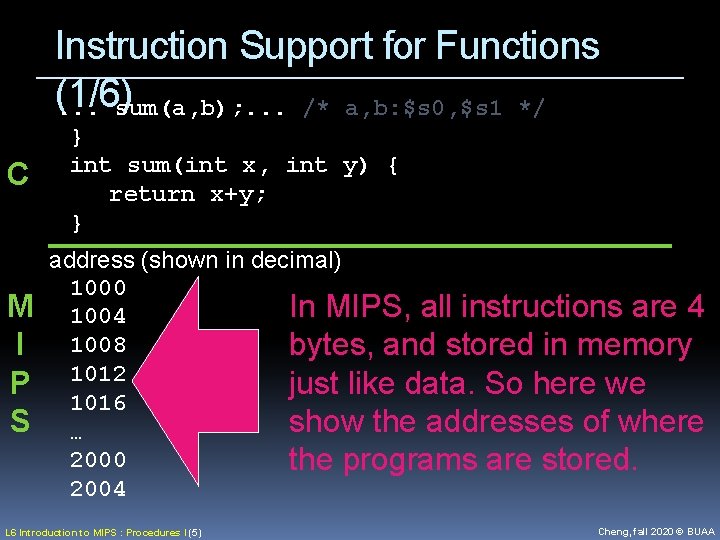
Instruction Support for Functions (1/6). . . sum(a, b); . . . /* a, b: $s 0, $s 1 */ C M I P S } int sum(int x, int y) { return x+y; } address (shown in decimal) 1000 In MIPS, all instructions are 4 1008 bytes, and stored in memory 1012 just like data. So here we 1016 show the addresses of where … 2000 the programs are stored. 2004 L 6 Introduction to MIPS : Procedures I (5) Cheng, fall 2020 © BUAA
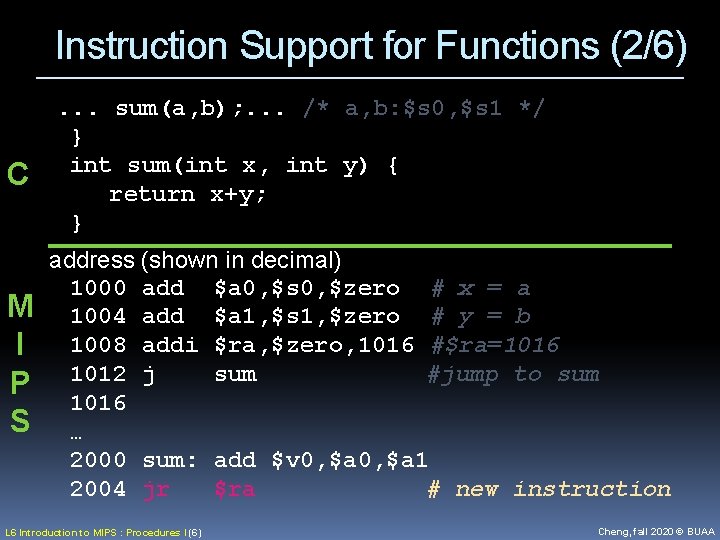
Instruction Support for Functions (2/6) C M I P S . . . sum(a, b); . . . /* a, b: $s 0, $s 1 */ } int sum(int x, int y) { return x+y; } address (shown in decimal) 1000 add $a 0, $s 0, $zero # x = a 1004 add $a 1, $s 1, $zero # y = b 1008 addi $ra, $zero, 1016 #$ra=1016 1012 j sum #jump to sum 1016 … 2000 sum: add $v 0, $a 1 2004 jr $ra # new instruction L 6 Introduction to MIPS : Procedures I (6) Cheng, fall 2020 © BUAA
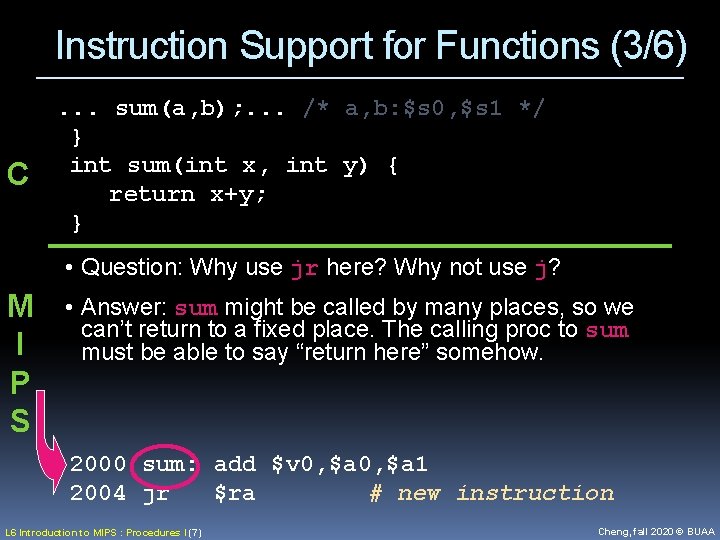
Instruction Support for Functions (3/6) C . . . sum(a, b); . . . /* a, b: $s 0, $s 1 */ } int sum(int x, int y) { return x+y; } • Question: Why use jr here? Why not use j? M I P S • Answer: sum might be called by many places, so we can’t return to a fixed place. The calling proc to sum must be able to say “return here” somehow. 2000 sum: add $v 0, $a 1 2004 jr $ra # new instruction L 6 Introduction to MIPS : Procedures I (7) Cheng, fall 2020 © BUAA
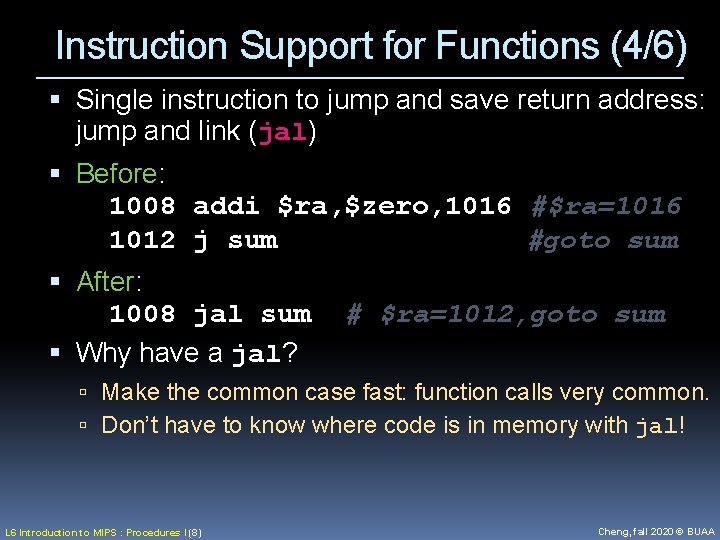
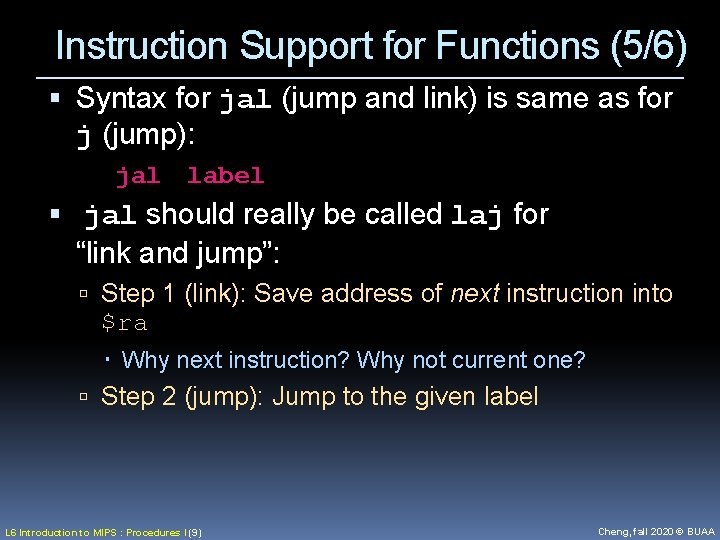
Instruction Support for Functions (4/6) Single instruction to jump and save return address: jump and link (jal) Before: 1008 addi $ra, $zero, 1016 #$ra=1016 1012 j sum #goto sum After: 1008 jal sum Why have a jal? # $ra=1012, goto sum Make the common case fast: function calls very common. Don’t have to know where code is in memory with jal! L 6 Introduction to MIPS : Procedures I (8) Cheng, fall 2020 © BUAA
Instruction Support for Functions (5/6) Syntax for jal (jump and link) is same as for j (jump): jal label jal should really be called laj for “link and jump”: Step 1 (link): Save address of next instruction into $ra Why next instruction? Why not current one? Step 2 (jump): Jump to the given label L 6 Introduction to MIPS : Procedures I (9) Cheng, fall 2020 © BUAA
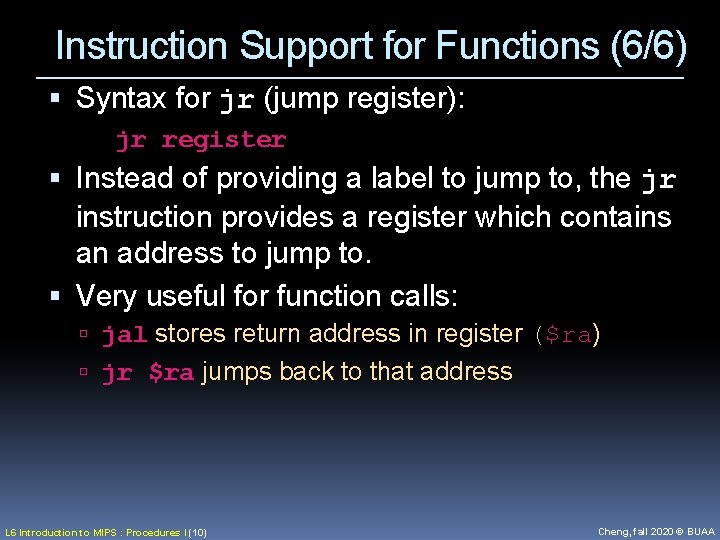
Instruction Support for Functions (6/6) Syntax for jr (jump register): jr register Instead of providing a label to jump to, the jr instruction provides a register which contains an address to jump to. Very useful for function calls: jal stores return address in register ($ra) jr $ra jumps back to that address L 6 Introduction to MIPS : Procedures I (10) Cheng, fall 2020 © BUAA
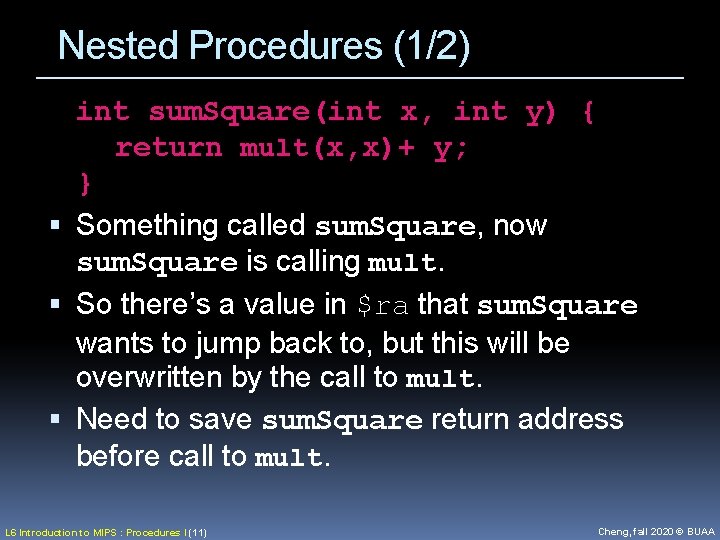
Nested Procedures (1/2) int sum. Square(int x, int y) { return mult(x, x)+ y; } Something called sum. Square, now sum. Square is calling mult. So there’s a value in $ra that sum. Square wants to jump back to, but this will be overwritten by the call to mult. Need to save sum. Square return address before call to mult. L 6 Introduction to MIPS : Procedures I (11) Cheng, fall 2020 © BUAA
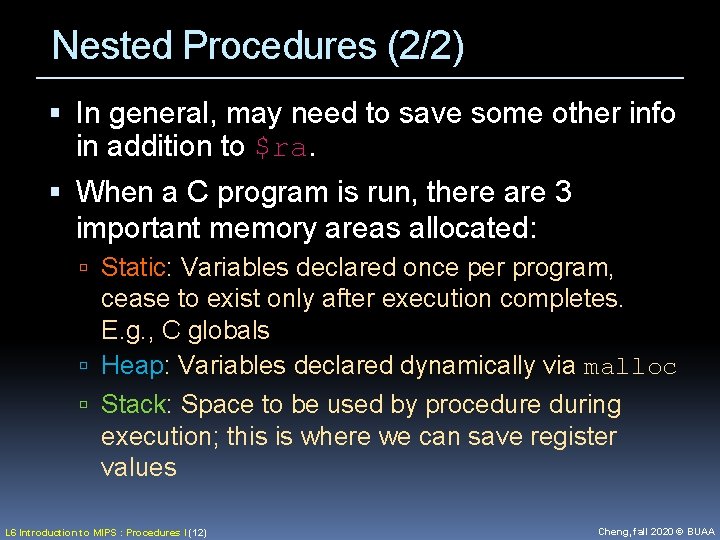
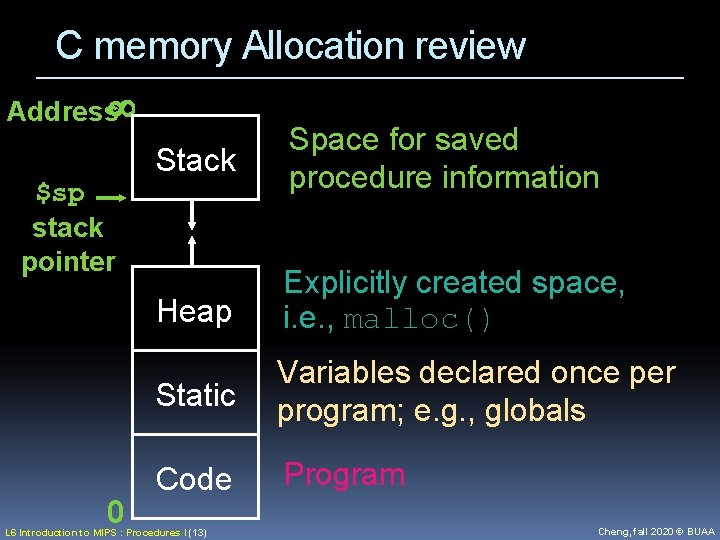
Nested Procedures (2/2) In general, may need to save some other info in addition to $ra. When a C program is run, there are 3 important memory areas allocated: Static: Variables declared once per program, cease to exist only after execution completes. E. g. , C globals Heap: Variables declared dynamically via malloc Stack: Space to be used by procedure during execution; this is where we can save register values L 6 Introduction to MIPS : Procedures I (12) Cheng, fall 2020 © BUAA
C memory Allocation review Address¥ Stack Space for saved procedure information Heap Explicitly created space, i. e. , malloc() Static Variables declared once per program; e. g. , globals Code Program $sp stack pointer 0 L 6 Introduction to MIPS : Procedures I (13) Cheng, fall 2020 © BUAA
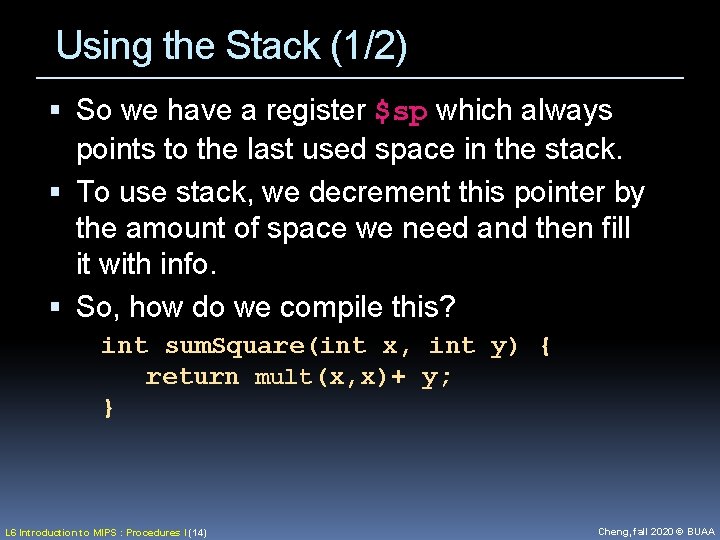
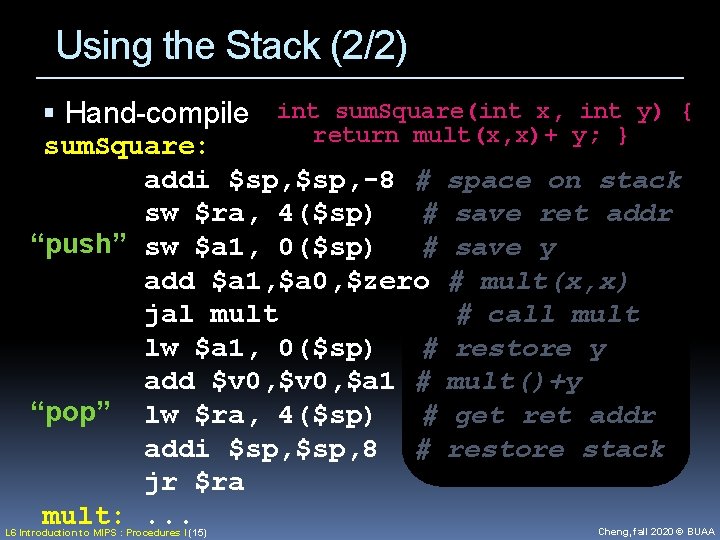
Using the Stack (1/2) So we have a register $sp which always points to the last used space in the stack. To use stack, we decrement this pointer by the amount of space we need and then fill it with info. So, how do we compile this? int sum. Square(int x, int y) { return mult(x, x)+ y; } L 6 Introduction to MIPS : Procedures I (14) Cheng, fall 2020 © BUAA
Using the Stack (2/2) Hand-compile int sum. Square(int x, int y) { return mult(x, x)+ y; } sum. Square: addi $sp, -8 # space on stack sw $ra, 4($sp) # save ret addr “push” sw $a 1, 0($sp) # save y add $a 1, $a 0, $zero # mult(x, x) jal mult # call mult lw $a 1, 0($sp) # restore y add $v 0, $a 1 # mult()+y “pop” lw $ra, 4($sp) # get ret addr addi $sp, 8 # restore stack jr $ra mult: . . . L 6 Introduction to MIPS : Procedures I (15) Cheng, fall 2020 © BUAA
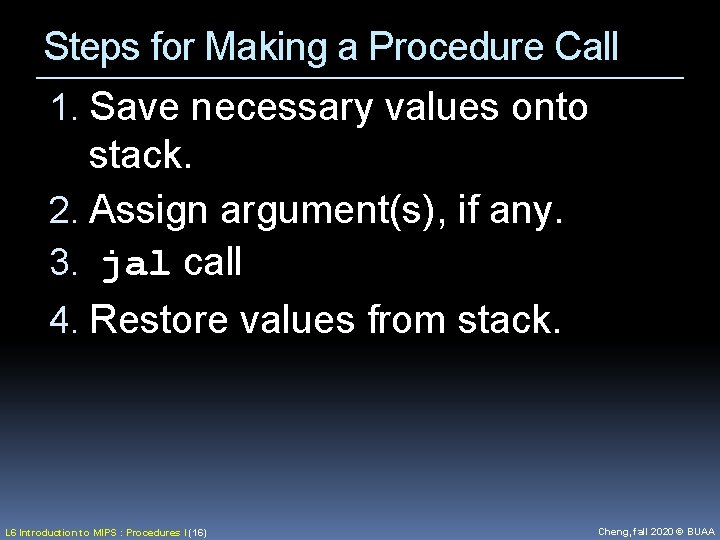
Steps for Making a Procedure Call 1. Save necessary values onto stack. 2. Assign argument(s), if any. 3. jal call 4. Restore values from stack. L 6 Introduction to MIPS : Procedures I (16) Cheng, fall 2020 © BUAA
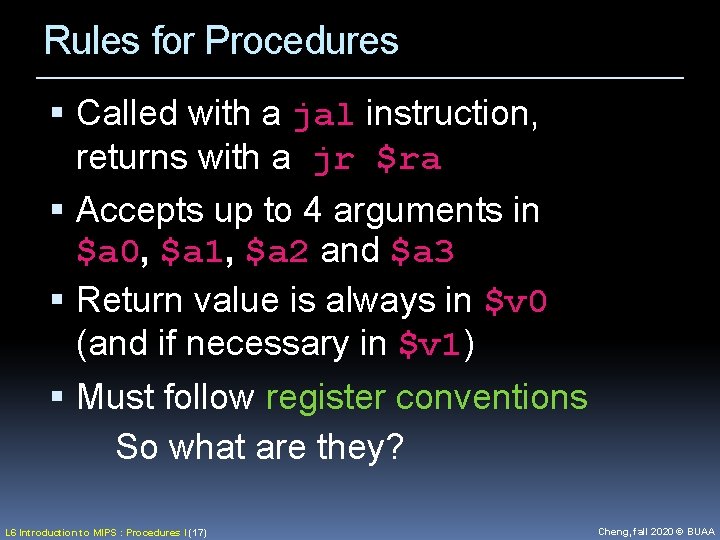
Rules for Procedures Called with a jal instruction, returns with a jr $ra Accepts up to 4 arguments in $a 0, $a 1, $a 2 and $a 3 Return value is always in $v 0 (and if necessary in $v 1) Must follow register conventions So what are they? L 6 Introduction to MIPS : Procedures I (17) Cheng, fall 2020 © BUAA
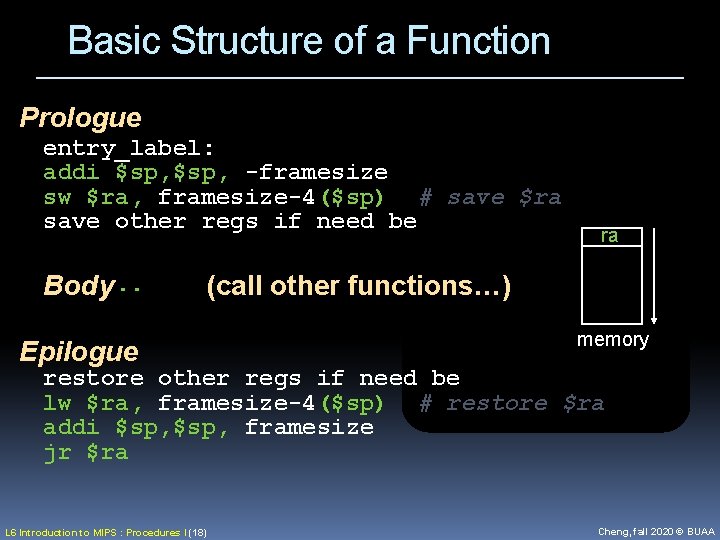
Basic Structure of a Function Prologue entry_label: addi $sp, -framesize sw $ra, framesize-4($sp) # save $ra save other regs if need be Body. . . ra (call other functions…) Epilogue memory restore other regs if need be lw $ra, framesize-4($sp) # restore $ra addi $sp, framesize jr $ra L 6 Introduction to MIPS : Procedures I (18) Cheng, fall 2020 © BUAA
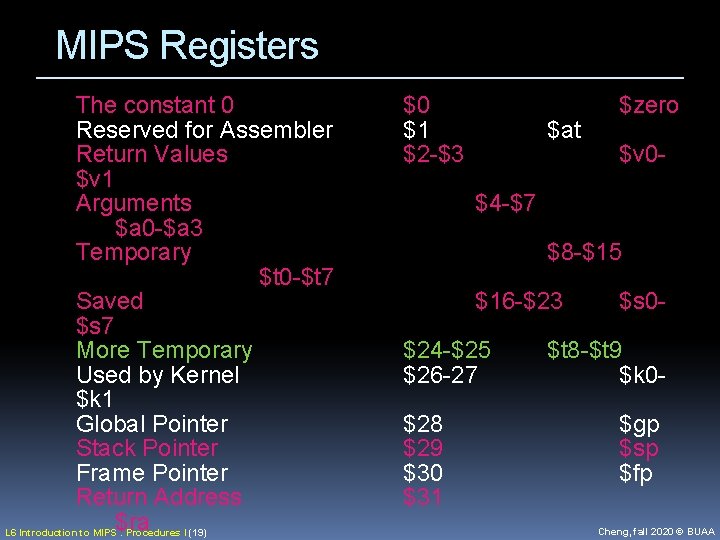
MIPS Registers The constant 0 Reserved for Assembler Return Values $v 1 Arguments $a 0 -$a 3 Temporary $t 0 -$t 7 Saved $s 7 More Temporary Used by Kernel $k 1 Global Pointer Stack Pointer Frame Pointer Return Address $ra L 6 Introduction to MIPS : Procedures I (19) $0 $1 $2 -$3 $at $zero $v 0 - $4 -$7 $8 -$15 $16 -$23 $24 -$25 $26 -27 $28 $29 $30 $31 $s 0 - $t 8 -$t 9 $k 0$gp $sp $fp Cheng, fall 2020 © BUAA
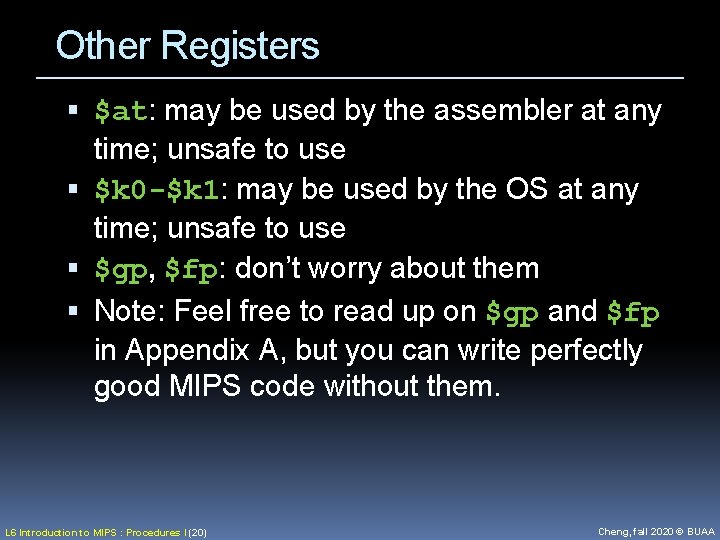
Other Registers $at: may be used by the assembler at any time; unsafe to use $k 0 -$k 1: may be used by the OS at any time; unsafe to use $gp, $fp: don’t worry about them Note: Feel free to read up on $gp and $fp in Appendix A, but you can write perfectly good MIPS code without them. L 6 Introduction to MIPS : Procedures I (20) Cheng, fall 2020 © BUAA
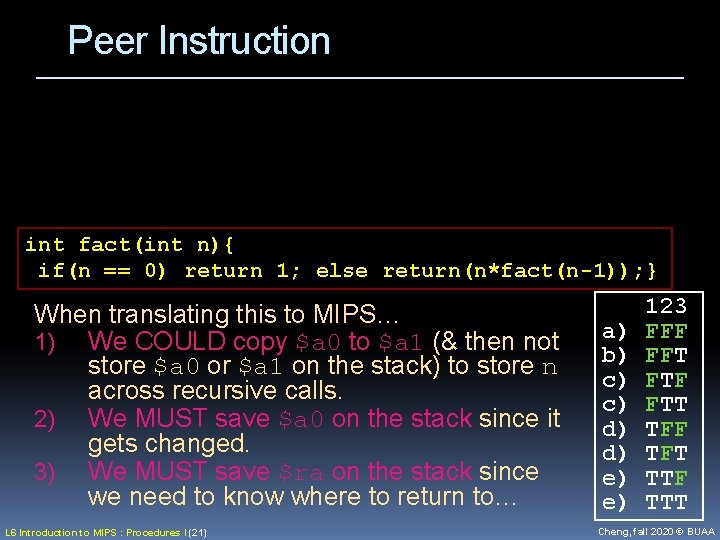
Peer Instruction int fact(int n){ if(n == 0) return 1; else return(n*fact(n-1)); } When translating this to MIPS… 1) We COULD copy $a 0 to $a 1 (& then not store $a 0 or $a 1 on the stack) to store n across recursive calls. 2) We MUST save $a 0 on the stack since it gets changed. 3) We MUST save $ra on the stack since we need to know where to return to… L 6 Introduction to MIPS : Procedures I (21) a) b) c) c) d) d) e) e) 123 FFF FFT FTF FTT TFF TFT TTF TTT Cheng, fall 2020 © BUAA
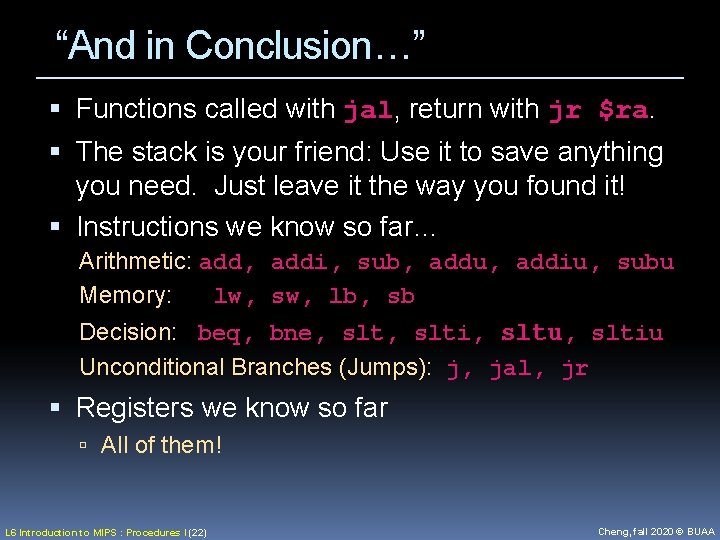
“And in Conclusion…” Functions called with jal, return with jr $ra. The stack is your friend: Use it to save anything you need. Just leave it the way you found it! Instructions we know so far… Arithmetic: add, addi, sub, addu, addiu, subu Memory: lw, sw, lb, sb Decision: beq, bne, slti, sltu, sltiu Unconditional Branches (Jumps): j, jal, jr Registers we know so far All of them! L 6 Introduction to MIPS : Procedures I (22) Cheng, fall 2020 © BUAA