
Computer Architecture Lecture 14 Introduction to Synchronous Digital
![Below the Program • High-level language program (in C) swap } int v[], int](https://slidetodoc.com/presentation_image_h2/65dbbe5fbde0b4c8431f70b870d416d9/image-4.jpg "Below the Program • High-level language program (in C) swap } int v[], int")
- Slides: 18
Computer Architecture (�算机体系�构) Lecture 14 Introduction to Synchronous Digital Systems 2020 -10 -09 Lecturer Yuanqing Cheng www. cadetlab. cn/~courses L 15 Synchronous Digital Systems (1) Cheng, fall 2020 © BUAA
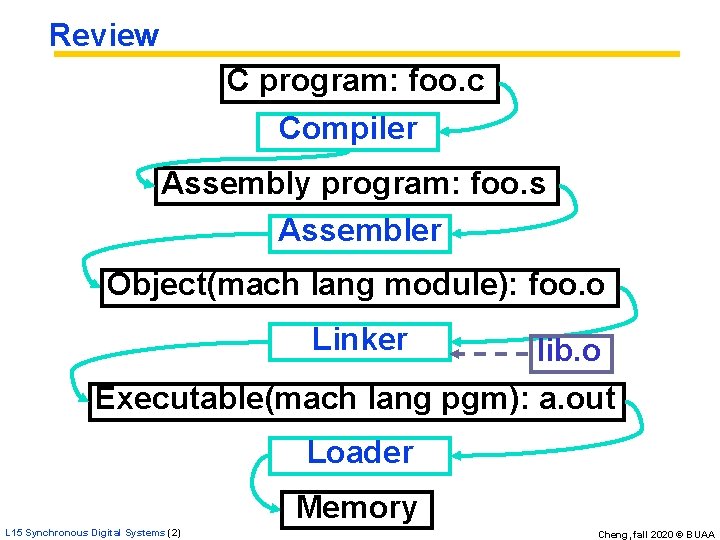
Review C program: foo. c Compiler Assembly program: foo. s Assembler Object(mach lang module): foo. o Linker lib. o Executable(mach lang pgm): a. out Loader Memory L 15 Synchronous Digital Systems (2) Cheng, fall 2020 © BUAA
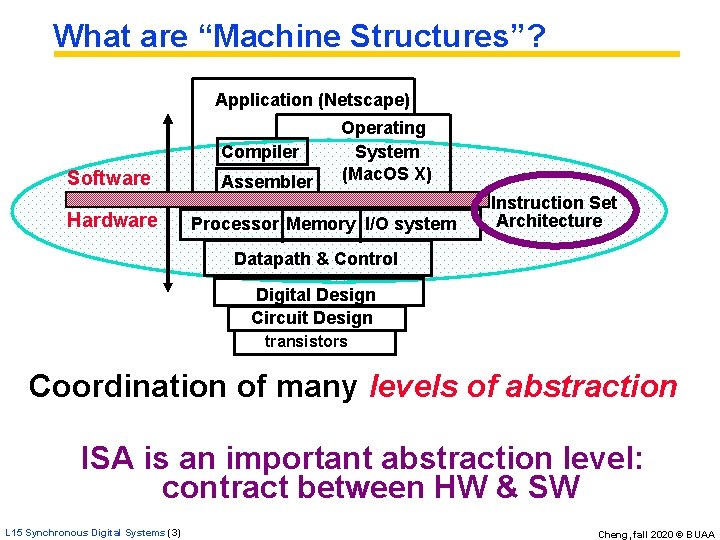
What are “Machine Structures”? Application (Netscape) Compiler Software Hardware Assembler Operating System (Mac. OS X) Processor Memory I/O system Instruction Set Architecture Datapath & Control Digital Design Circuit Design transistors Coordination of many levels of abstraction ISA is an important abstraction level: contract between HW & SW L 15 Synchronous Digital Systems (3) Cheng, fall 2020 © BUAA
Below the Program • High-level language program (in C) swap } int v[], int k){ int temp; temp = v[k]; v[k] = v[k+1]; v[k+1] = temp; C compiler • Assembly language program (for MIPS) swap: sll add lw lw sw sw jr $2, $5, 2 $2, $4, $2 $15, 0($2) $16, 4($2) $16, 0($2) $15, 4($2) $31 assembler • Machine (object) code (for MIPS) 000000 00101 00010000000 00100 0001000000100000 L 15 Synchronous Digital Systems (4) . . . ? Cheng, fall 2020 © BUAA
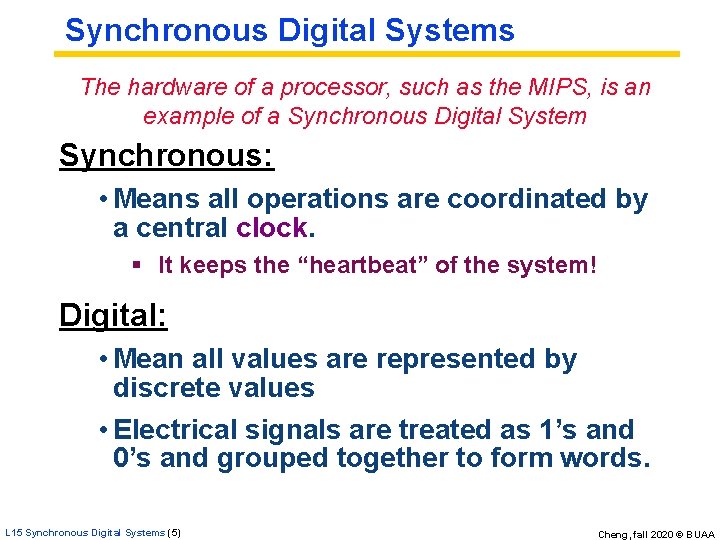
Synchronous Digital Systems The hardware of a processor, such as the MIPS, is an example of a Synchronous Digital System Synchronous: • Means all operations are coordinated by a central clock. § It keeps the “heartbeat” of the system! Digital: • Mean all values are represented by discrete values • Electrical signals are treated as 1’s and 0’s and grouped together to form words. L 15 Synchronous Digital Systems (5) Cheng, fall 2020 © BUAA
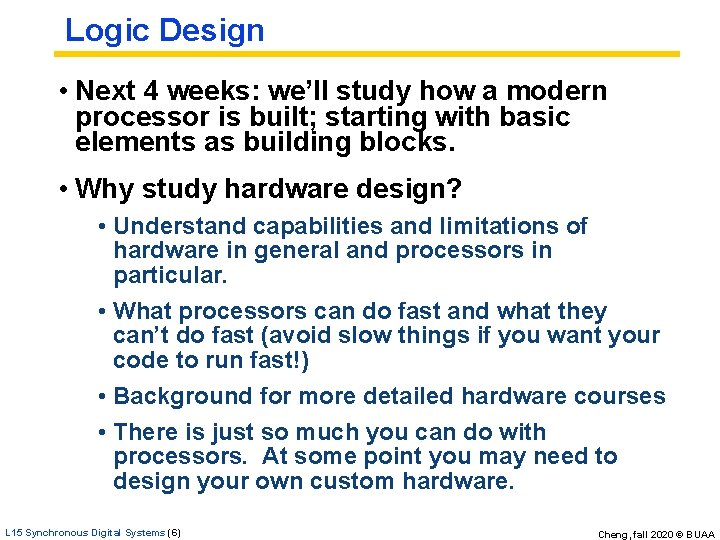
Logic Design • Next 4 weeks: we’ll study how a modern processor is built; starting with basic elements as building blocks. • Why study hardware design? • Understand capabilities and limitations of hardware in general and processors in particular. • What processors can do fast and what they can’t do fast (avoid slow things if you want your code to run fast!) • Background for more detailed hardware courses • There is just so much you can do with processors. At some point you may need to design your own custom hardware. L 15 Synchronous Digital Systems (6) Cheng, fall 2020 © BUAA
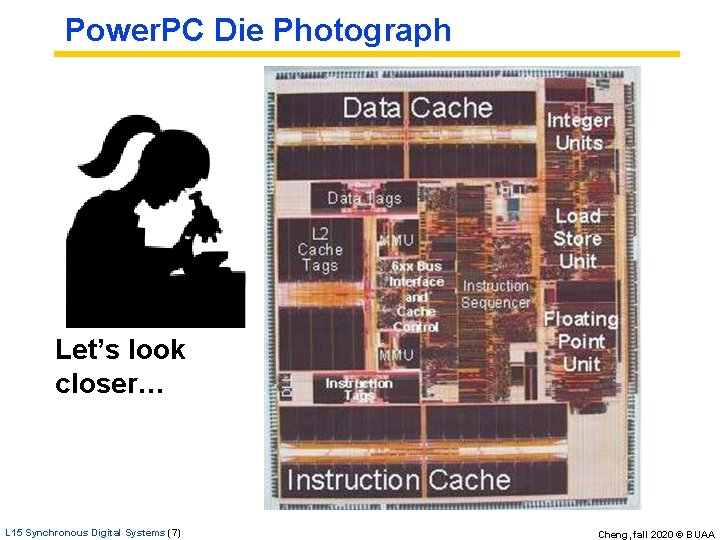
Power. PC Die Photograph Let’s look closer… L 15 Synchronous Digital Systems (7) Cheng, fall 2020 © BUAA
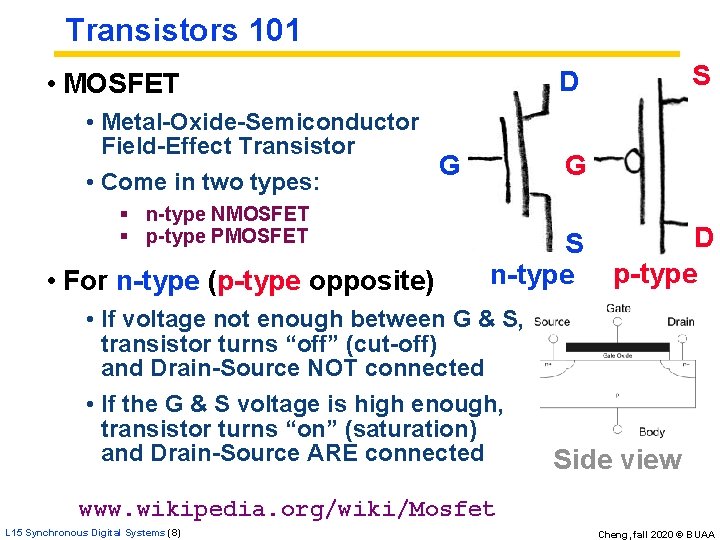
Transistors 101 • Metal-Oxide-Semiconductor Field-Effect Transistor G • Come in two types: § n-type NMOSFET § p-type PMOSFET • For n-type (p-type opposite) S D • MOSFET G S n-type • If voltage not enough between G & S, transistor turns “off” (cut-off) and Drain-Source NOT connected • If the G & S voltage is high enough, transistor turns “on” (saturation) and Drain-Source ARE connected D p-type Side view www. wikipedia. org/wiki/Mosfet L 15 Synchronous Digital Systems (8) Cheng, fall 2020 © BUAA
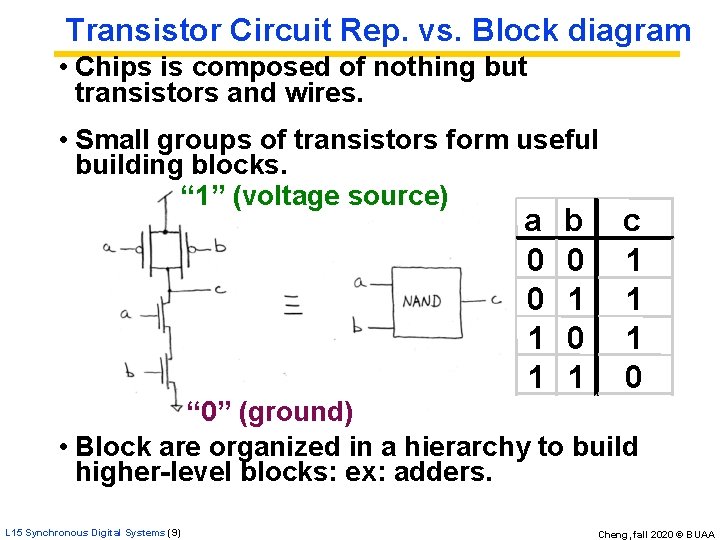
Transistor Circuit Rep. vs. Block diagram • Chips is composed of nothing but transistors and wires. • Small groups of transistors form useful building blocks. “ 1” (voltage source) a 0 0 1 1 b 0 1 c 1 1 1 0 “ 0” (ground) • Block are organized in a hierarchy to build higher-level blocks: ex: adders. L 15 Synchronous Digital Systems (9) Cheng, fall 2020 © BUAA
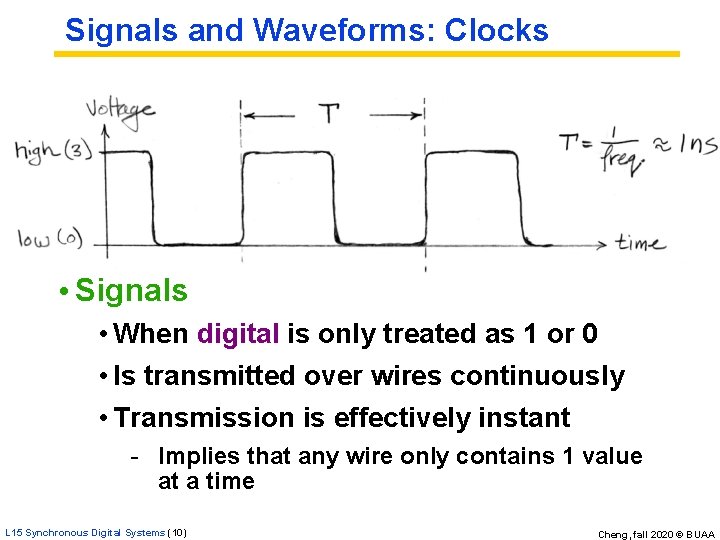
Signals and Waveforms: Clocks • Signals • When digital is only treated as 1 or 0 • Is transmitted over wires continuously • Transmission is effectively instant - Implies that any wire only contains 1 value at a time L 15 Synchronous Digital Systems (10) Cheng, fall 2020 © BUAA
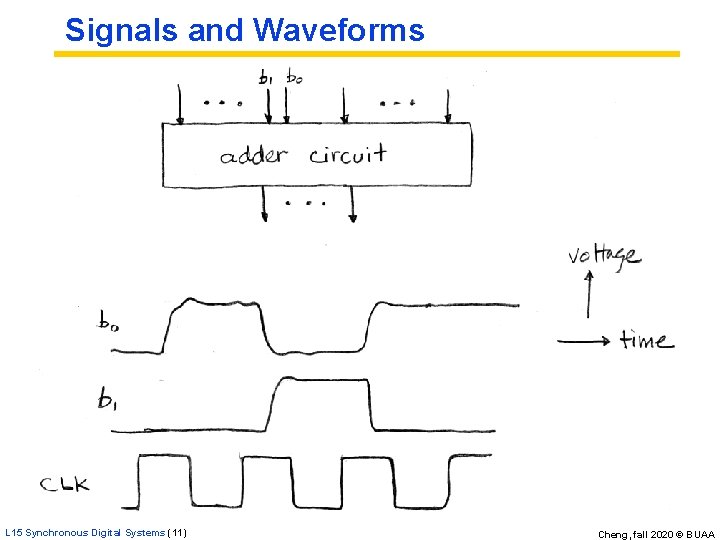
Signals and Waveforms L 15 Synchronous Digital Systems (11) Cheng, fall 2020 © BUAA
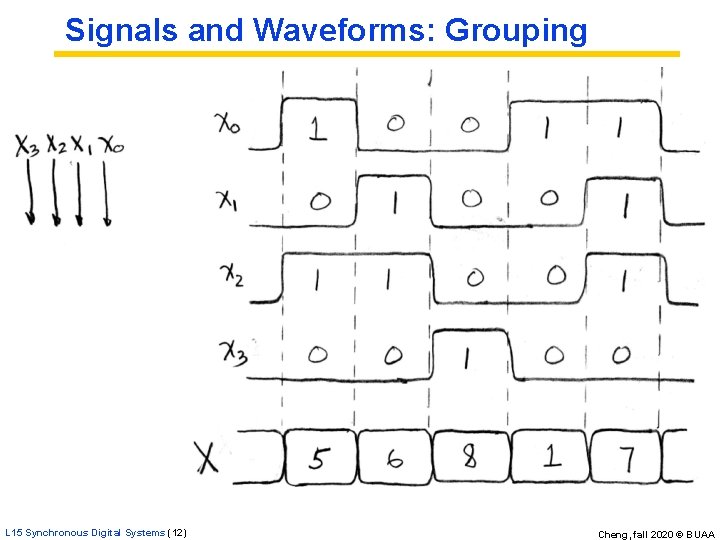
Signals and Waveforms: Grouping L 15 Synchronous Digital Systems (12) Cheng, fall 2020 © BUAA
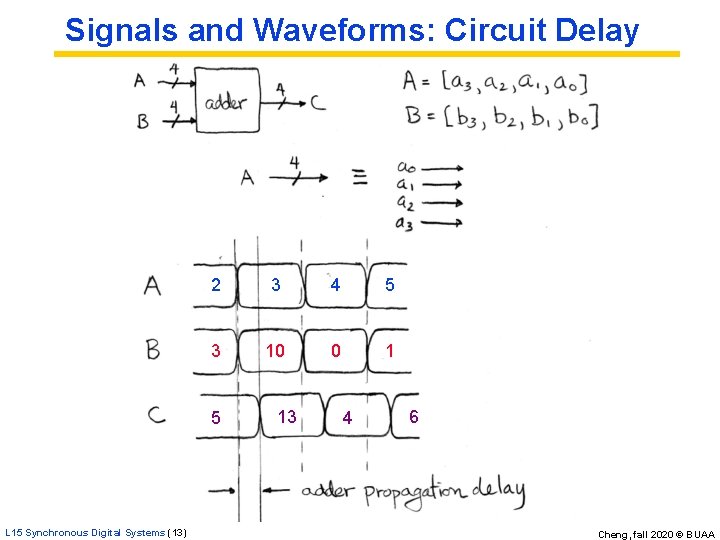
Signals and Waveforms: Circuit Delay 2 3 4 5 3 10 0 1 5 L 15 Synchronous Digital Systems (13) 13 4 6 Cheng, fall 2020 © BUAA
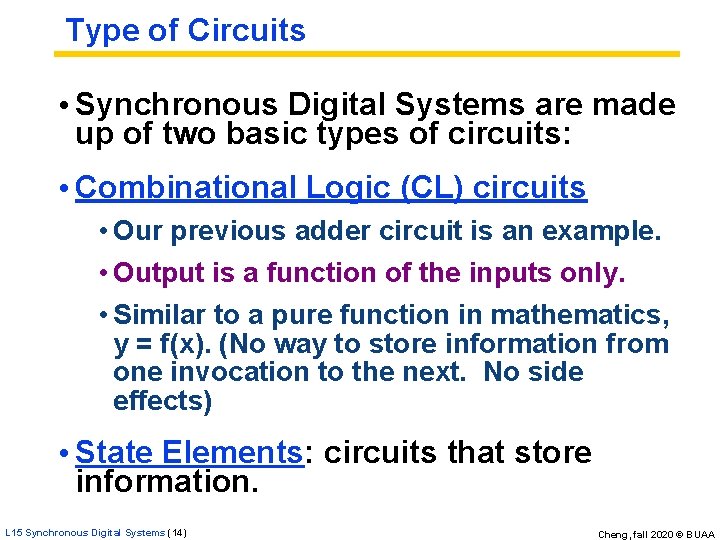
Type of Circuits • Synchronous Digital Systems are made up of two basic types of circuits: • Combinational Logic (CL) circuits • Our previous adder circuit is an example. • Output is a function of the inputs only. • Similar to a pure function in mathematics, y = f(x). (No way to store information from one invocation to the next. No side effects) • State Elements: circuits that store information. L 15 Synchronous Digital Systems (14) Cheng, fall 2020 © BUAA
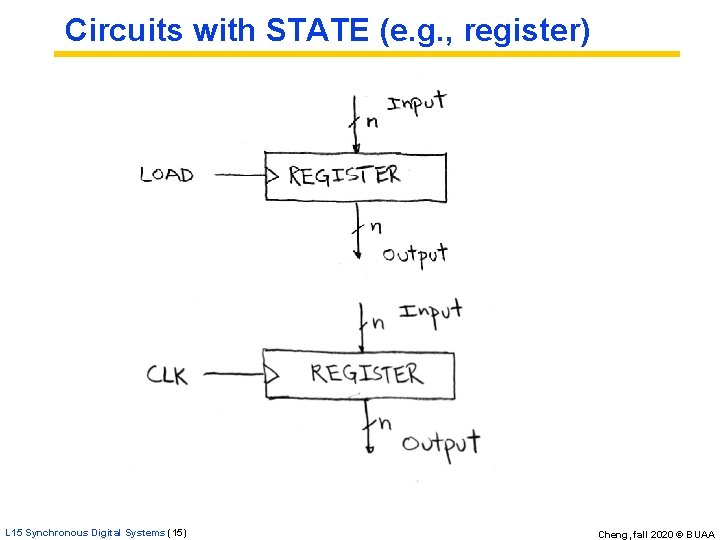
Circuits with STATE (e. g. , register) L 15 Synchronous Digital Systems (15) Cheng, fall 2020 © BUAA
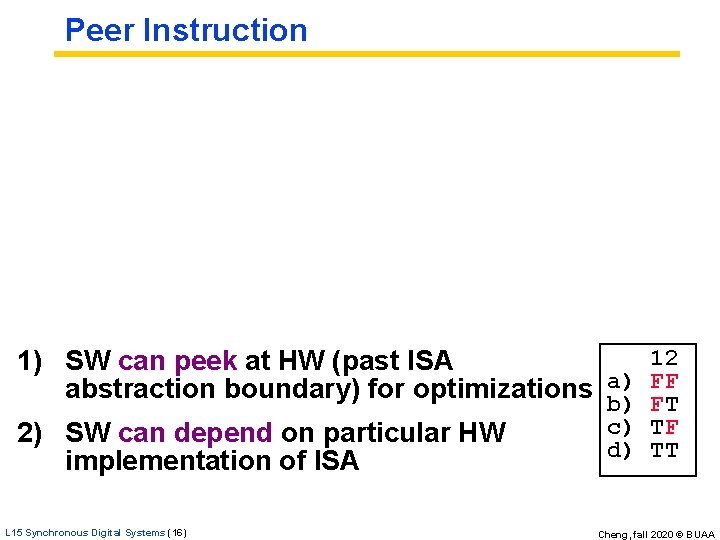
Peer Instruction 12 1) SW can peek at HW (past ISA FF abstraction boundary) for optimizations a) b) FT c) TF 2) SW can depend on particular HW d) TT implementation of ISA L 15 Synchronous Digital Systems (16) Cheng, fall 2020 © BUAA
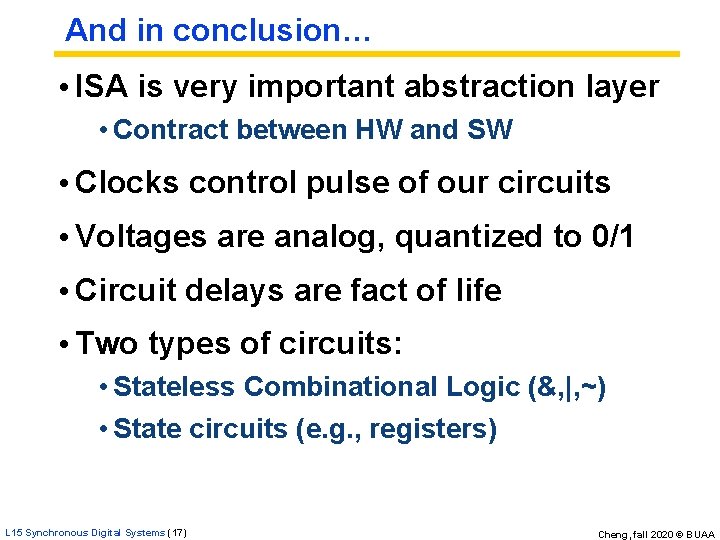
And in conclusion… • ISA is very important abstraction layer • Contract between HW and SW • Clocks control pulse of our circuits • Voltages are analog, quantized to 0/1 • Circuit delays are fact of life • Two types of circuits: • Stateless Combinational Logic (&, |, ~) • State circuits (e. g. , registers) L 15 Synchronous Digital Systems (17) Cheng, fall 2020 © BUAA
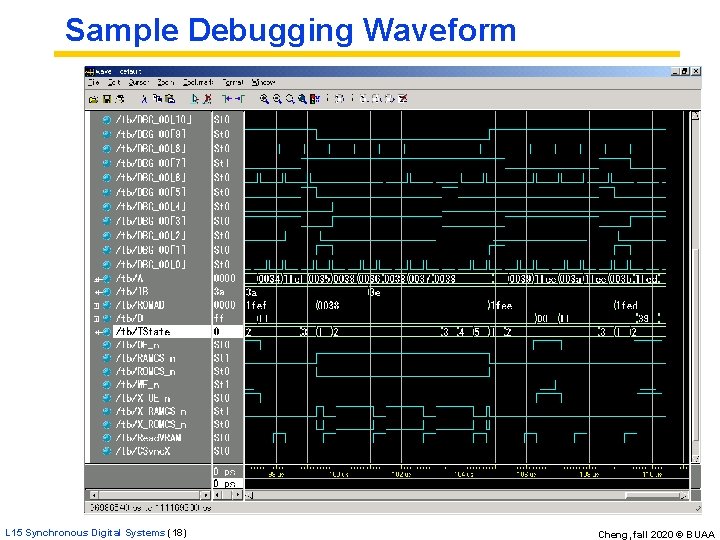
Sample Debugging Waveform L 15 Synchronous Digital Systems (18) Cheng, fall 2020 © BUAA