
Computer Architecture Instruction Set Architecture Lynn Choi Korea

![While Loop C code: while (save[i] == k) i += 1; i in $s](https://slidetodoc.com/presentation_image/ee1c085382adc84abda710f93084e334/image-18.jpg "While Loop C code: while (save[i] == k) i += 1; i in $s")
- Slides: 24
Computer Architecture Instruction Set Architecture Lynn Choi Korea University
Machine Language Programming language High-level programming languages Procedural (imperative) languages: C, PASCAL, FORTRAN Object-oriented languages: C++, Objective-C, Java Functional (declarative) languages: Lisp, Scheme Multiple paradigms (hybrid): Python, C# Assembly programming languages: symbolic machine languages Machine languages: binary (1’s and 0’s), IA 32, IA 64, ARM, MIPS, Power. PC Translator Compiler: translate a high-level language program into a machine language program Assembler: translate an assembly language program into a machine language program A part of a compiler Interpreter: translate and execute programs directly JVM(Java virtual machine): translate/execute Java bytecode to native machine instructions cf. Java compiler translate Java program to Java bytecode
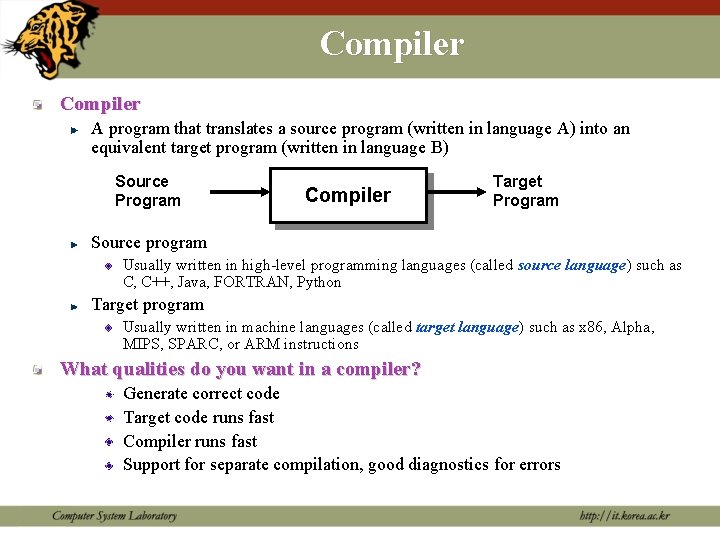
Compiler A program that translates a source program (written in language A) into an equivalent target program (written in language B) Source Program Compiler Target Program Source program Usually written in high-level programming languages (called source language) such as C, C++, Java, FORTRAN, Python Target program Usually written in machine languages (called target language) such as x 86, Alpha, MIPS, SPARC, or ARM instructions What qualities do you want in a compiler? Generate correct code Target code runs fast Compiler runs fast Support for separate compilation, good diagnostics for errors
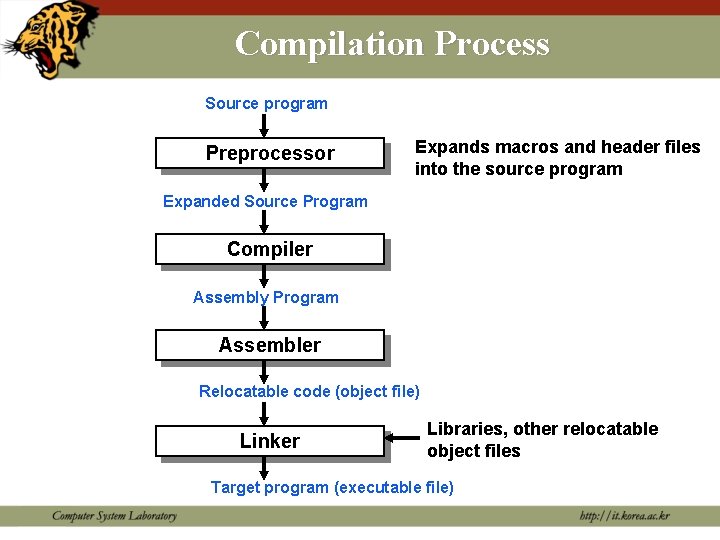
Compilation Process Source program Preprocessor Expands macros and header files into the source program Expanded Source Program Compiler Assembly Program Assembler Relocatable code (object file) Linker Libraries, other relocatable object files Target program (executable file)
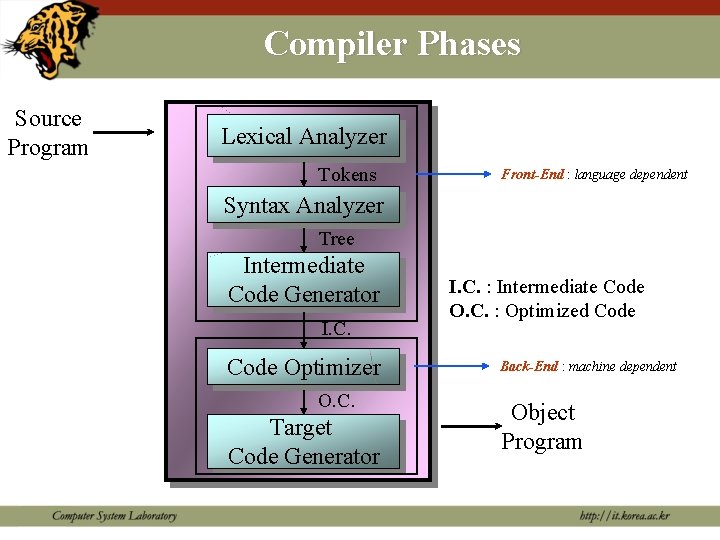
Compiler Phases Source Program Lexical Analyzer Tokens Front-End : language dependent Syntax Analyzer Tree Intermediate Code Generator I. C. Code Optimizer O. C. Target Code Generator I. C. : Intermediate Code O. C. : Optimized Code Back-End : machine dependent Object Program
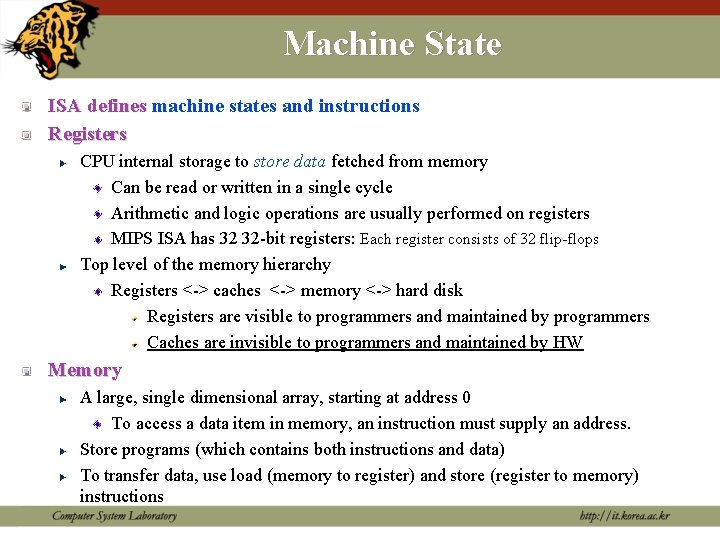
Machine State ISA defines machine states and instructions Registers CPU internal storage to store data fetched from memory Can be read or written in a single cycle Arithmetic and logic operations are usually performed on registers MIPS ISA has 32 32 -bit registers: Each register consists of 32 flip-flops Top level of the memory hierarchy Registers <-> caches <-> memory <-> hard disk Registers are visible to programmers and maintained by programmers Caches are invisible to programmers and maintained by HW Memory A large, single dimensional array, starting at address 0 To access a data item in memory, an instruction must supply an address. Store programs (which contains both instructions and data) To transfer data, use load (memory to register) and store (register to memory) instructions
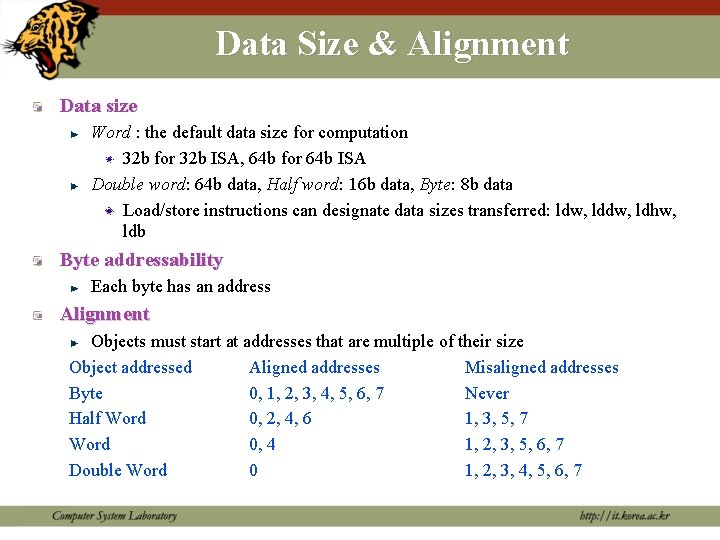
Data Size & Alignment Data size Word : the default data size for computation 32 b for 32 b ISA, 64 b for 64 b ISA Double word: 64 b data, Half word: 16 b data, Byte: 8 b data Load/store instructions can designate data sizes transferred: ldw, ldhw, ldb Byte addressability Each byte has an address Alignment Objects must start at addresses that are multiple of their size Object addressed Aligned addresses Misaligned addresses Byte 0, 1, 2, 3, 4, 5, 6, 7 Never Half Word 0, 2, 4, 6 1, 3, 5, 7 Word 0, 4 1, 2, 3, 5, 6, 7 Double Word 0 1, 2, 3, 4, 5, 6, 7
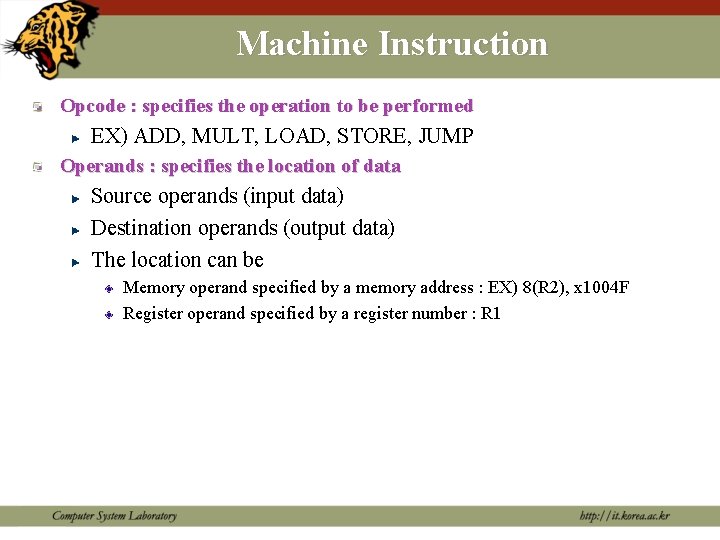
Machine Instruction Opcode : specifies the operation to be performed EX) ADD, MULT, LOAD, STORE, JUMP Operands : specifies the location of data Source operands (input data) Destination operands (output data) The location can be Memory operand specified by a memory address : EX) 8(R 2), x 1004 F Register operand specified by a register number : R 1
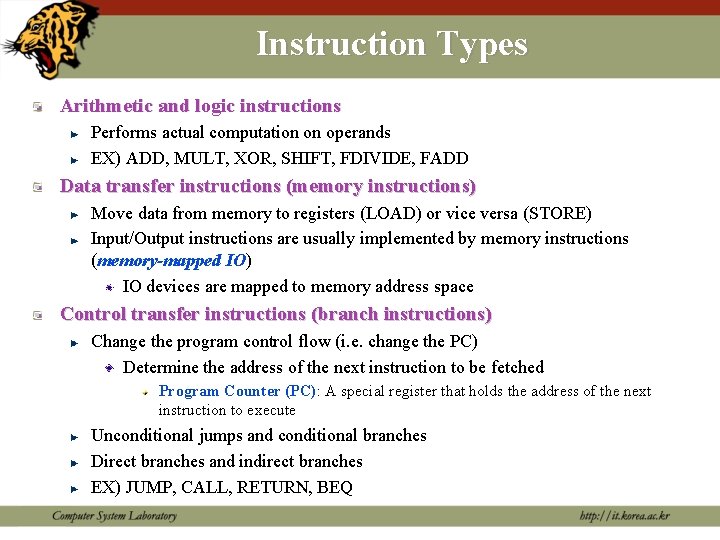
Instruction Types Arithmetic and logic instructions Performs actual computation on operands EX) ADD, MULT, XOR, SHIFT, FDIVIDE, FADD Data transfer instructions (memory instructions) Move data from memory to registers (LOAD) or vice versa (STORE) Input/Output instructions are usually implemented by memory instructions (memory-mapped IO) IO devices are mapped to memory address space Control transfer instructions (branch instructions) Change the program control flow (i. e. change the PC) Determine the address of the next instruction to be fetched Program Counter (PC): A special register that holds the address of the next instruction to execute Unconditional jumps and conditional branches Direct branches and indirect branches EX) JUMP, CALL, RETURN, BEQ
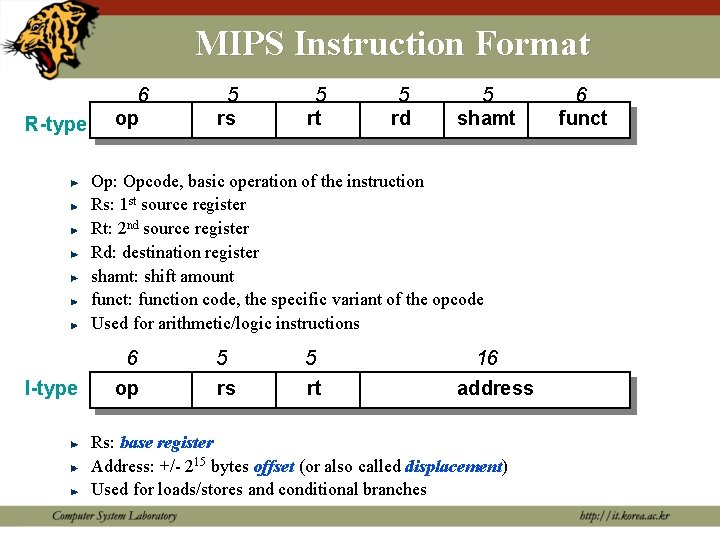
MIPS Instruction Format R-type 6 op 5 rs 5 rt 5 rd 5 shamt Op: Opcode, basic operation of the instruction Rs: 1 st source register Rt: 2 nd source register Rd: destination register shamt: shift amount funct: function code, the specific variant of the opcode Used for arithmetic/logic instructions I-type 6 op 5 rs 5 rt 16 address Rs: base register Address: +/- 215 bytes offset (or also called displacement) Used for loads/stores and conditional branches 6 funct
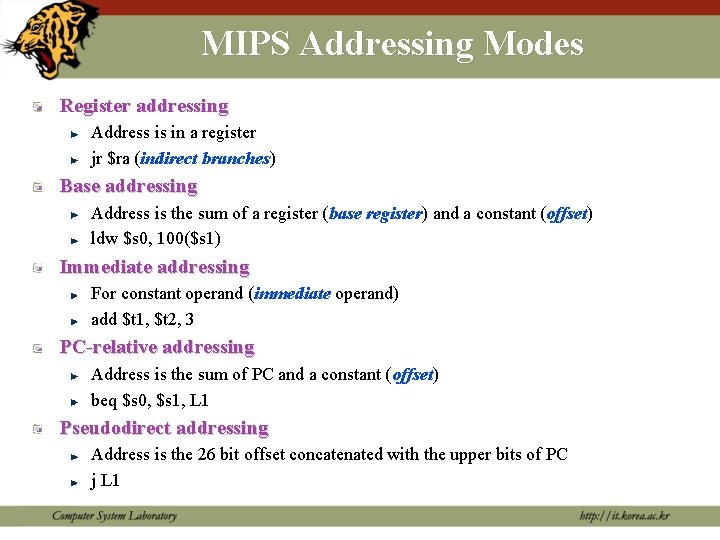
MIPS Addressing Modes Register addressing Address is in a register jr $ra (indirect branches) Base addressing Address is the sum of a register (base register) and a constant (offset) ldw $s 0, 100($s 1) Immediate addressing For constant operand (immediate operand) add $t 1, $t 2, 3 PC-relative addressing Address is the sum of PC and a constant (offset) beq $s 0, $s 1, L 1 Pseudodirect addressing Address is the 26 bit offset concatenated with the upper bits of PC j L 1
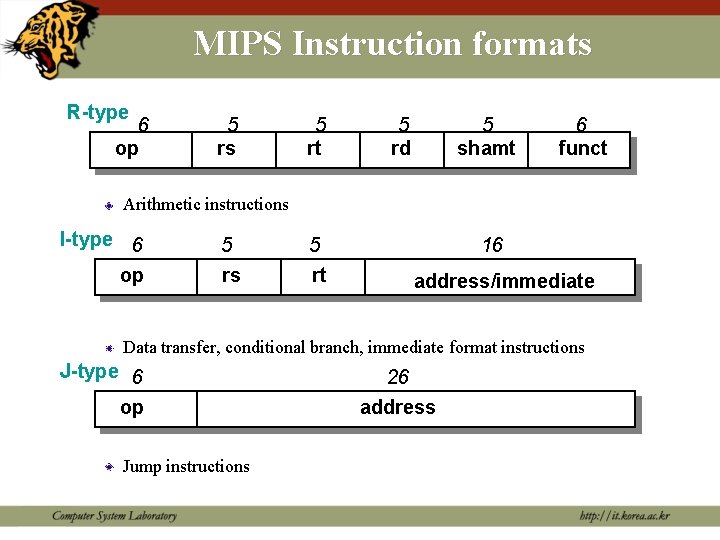
MIPS Instruction formats R-type 6 op 5 rs 5 rt 5 rd 5 shamt 6 funct Arithmetic instructions I-type 6 op 5 rs 5 rt 16 address/immediate Data transfer, conditional branch, immediate format instructions J-type 6 op Jump instructions 26 address
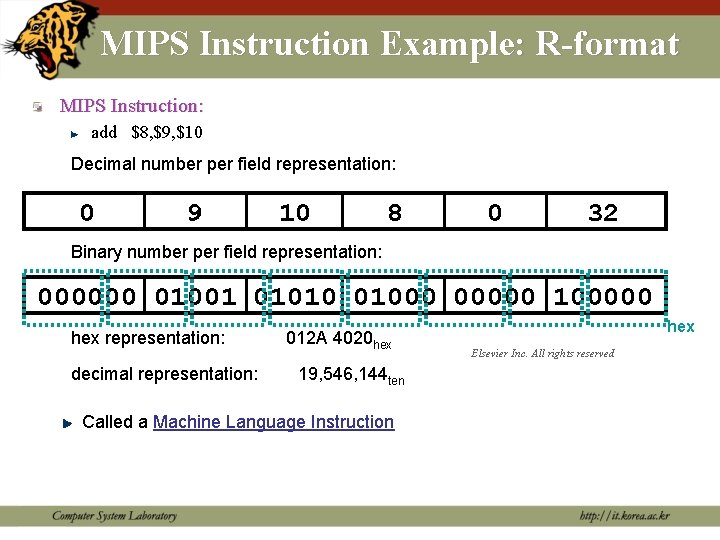
MIPS Instruction Example: R-format MIPS Instruction: add $8, $9, $10 Decimal number per field representation: 0 9 10 8 0 32 Binary number per field representation: 000000 01001 01010 01000 00000 100000 hex representation: decimal representation: 012 A 4020 hex 19, 546, 144 ten Called a Machine Language Instruction hex Elsevier Inc. All rights reserved
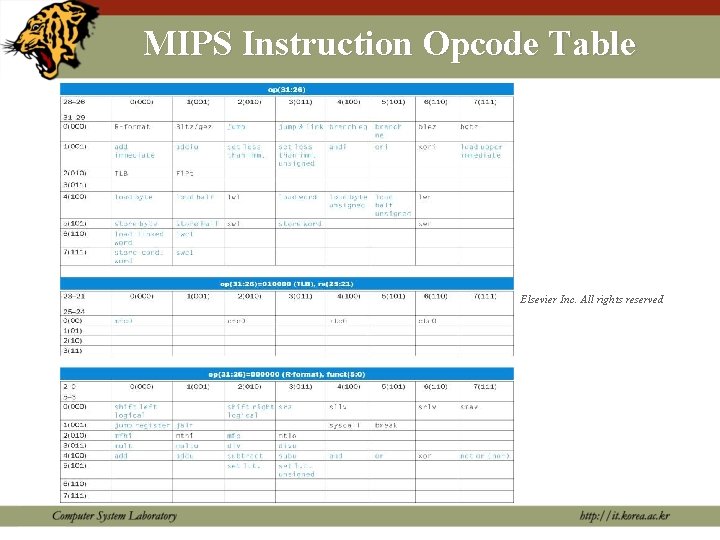
MIPS Instruction Opcode Table Elsevier Inc. All rights reserved
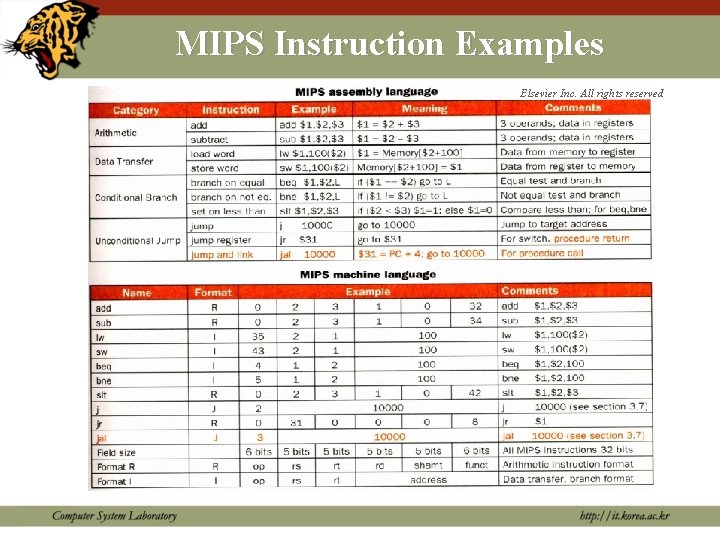
MIPS Instruction Examples Elsevier Inc. All rights reserved
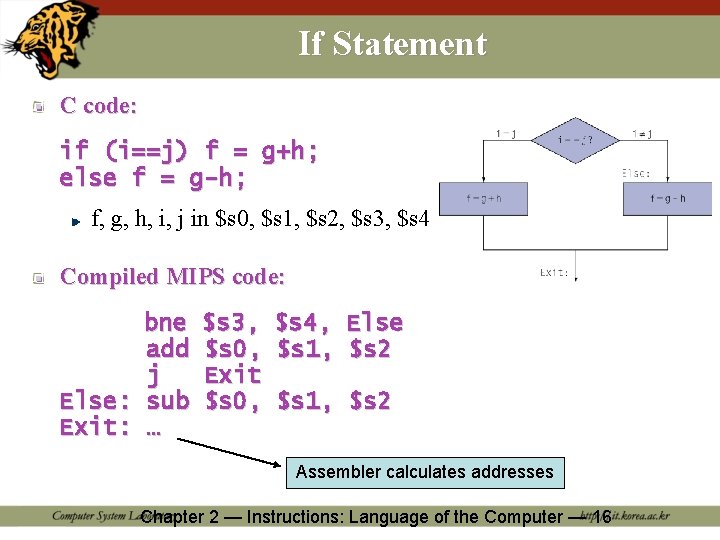
If Statement C code: if (i==j) f = g+h; else f = g-h; f, g, h, i, j in $s 0, $s 1, $s 2, $s 3, $s 4 Compiled MIPS code: bne add j Else: sub Exit: … $s 3, $s 4, Else $s 0, $s 1, $s 2 Exit $s 0, $s 1, $s 2 Assembler calculates addresses Chapter 2 — Instructions: Language of the Computer — 16
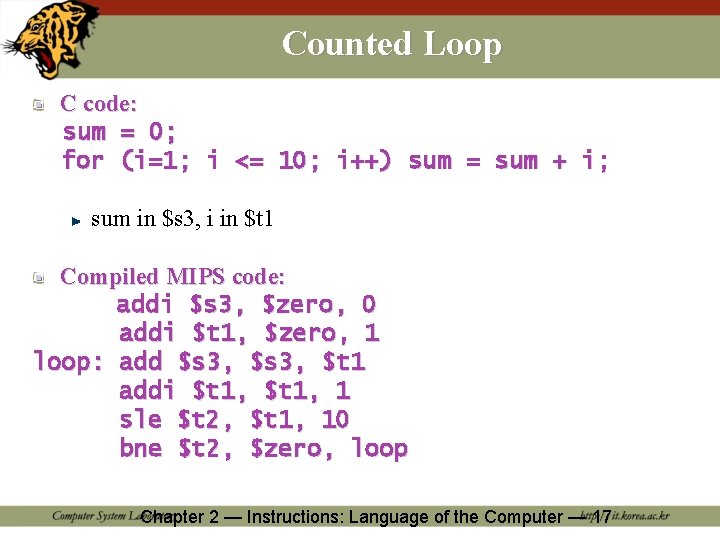
Counted Loop C code: sum = 0; for (i=1; i <= 10; i++) sum = sum + i; sum in $s 3, i in $t 1 Compiled MIPS code: addi $s 3, $zero, 0 addi $t 1, $zero, 1 loop: add $s 3, $t 1 addi $t 1, 1 sle $t 2, $t 1, 10 bne $t 2, $zero, loop Chapter 2 — Instructions: Language of the Computer — 17
While Loop C code: while (save[i] == k) i += 1; i in $s 3, k in $s 5, address of save in $s 6 Compiled MIPS code: Loop: sll add lw bne addi j Exit: … $t 1, $t 0, $s 3, Loop $s 3, 2 $t 1, $s 6 0($t 1) $s 5, Exit $s 3, 1 Chapter 2 — Instructions: Language of the Computer — 18
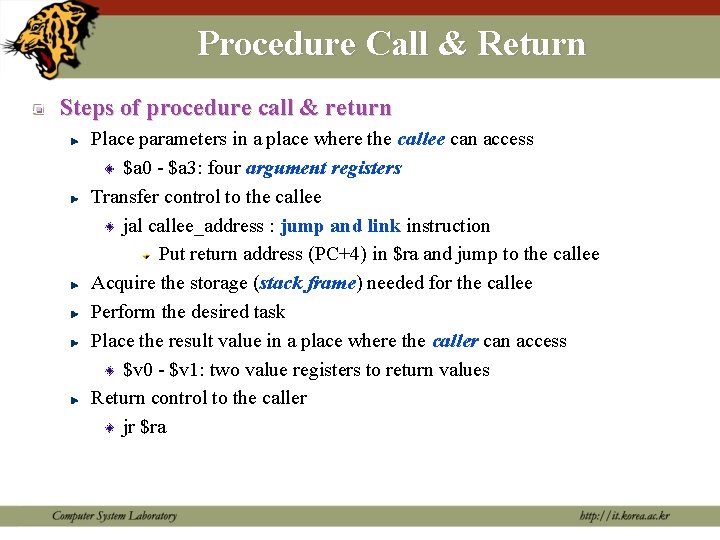
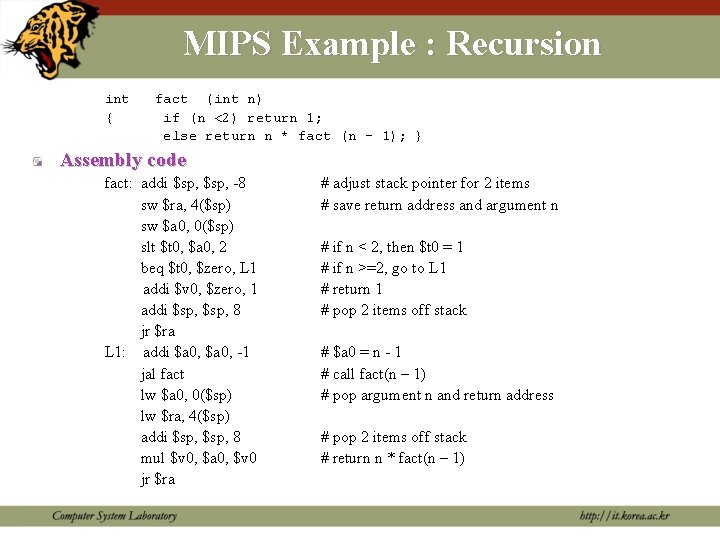
Procedure Call & Return Steps of procedure call & return Place parameters in a place where the callee can access $a 0 - $a 3: four argument registers Transfer control to the callee jal callee_address : jump and link instruction Put return address (PC+4) in $ra and jump to the callee Acquire the storage (stack frame) needed for the callee Perform the desired task Place the result value in a place where the caller can access $v 0 - $v 1: two value registers to return values Return control to the caller jr $ra
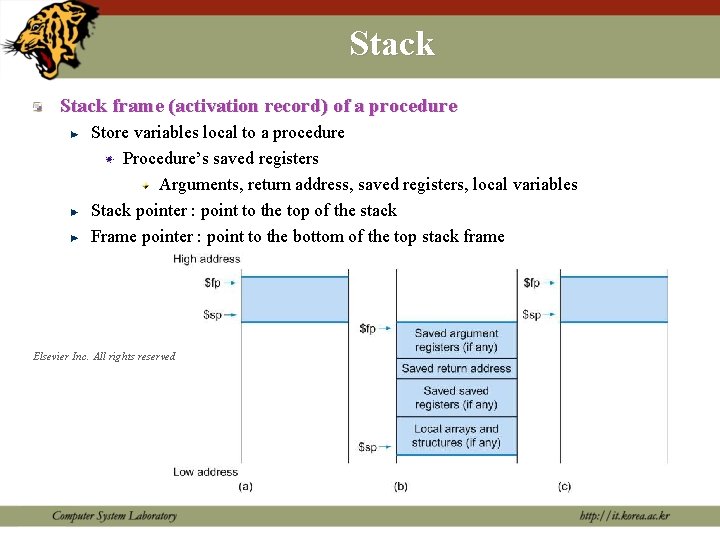
Stack frame (activation record) of a procedure Store variables local to a procedure Procedure’s saved registers Arguments, return address, saved registers, local variables Stack pointer : point to the top of the stack Frame pointer : point to the bottom of the top stack frame Elsevier Inc. All rights reserved
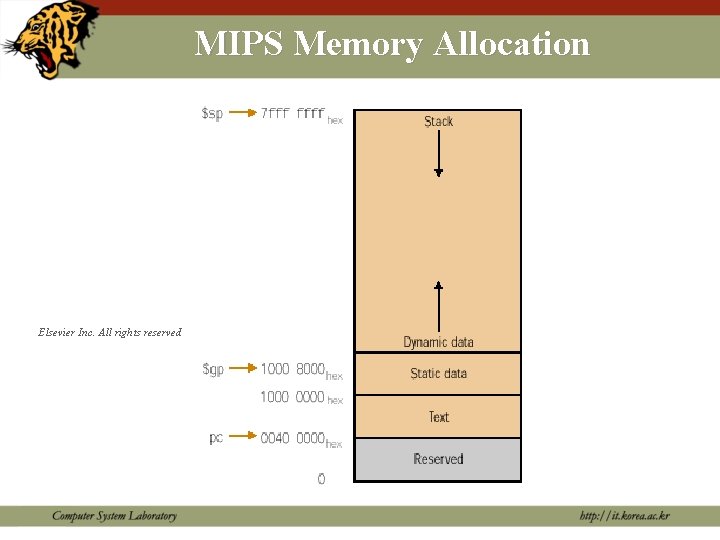
MIPS Memory Allocation Elsevier Inc. All rights reserved
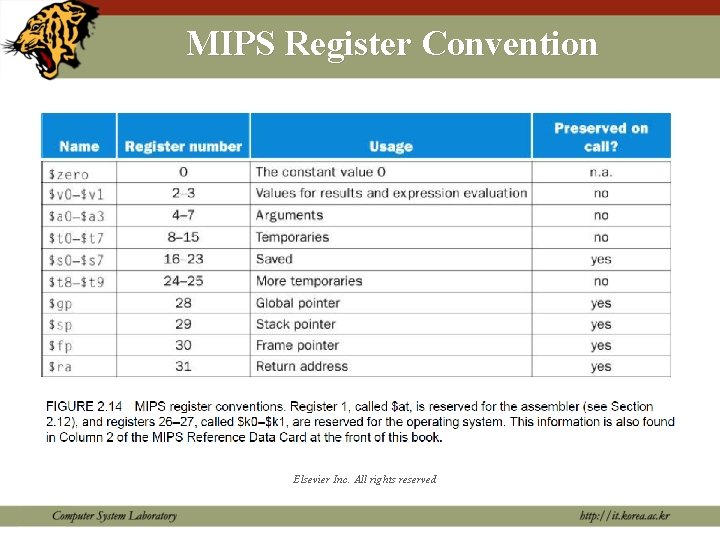
MIPS Register Convention Elsevier Inc. All rights reserved
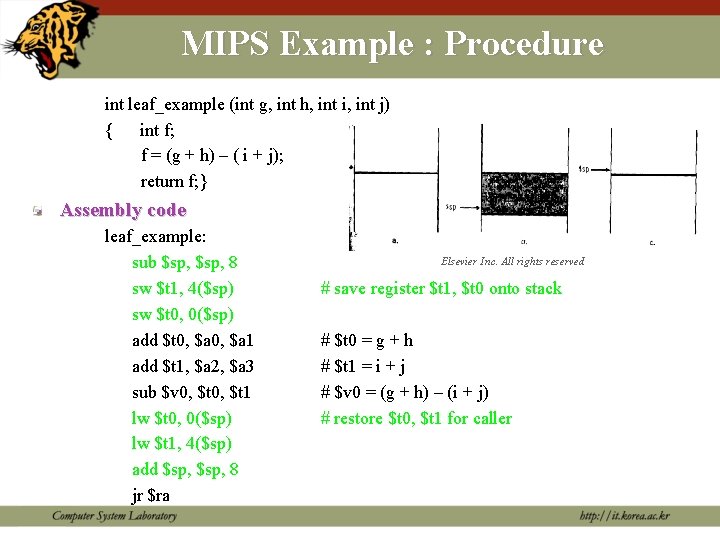
MIPS Example : Procedure int leaf_example (int g, int h, int i, int j) { int f; f = (g + h) – ( i + j); return f; } Assembly code leaf_example: sub $sp, 8 sw $t 1, 4($sp) sw $t 0, 0($sp) add $t 0, $a 1 add $t 1, $a 2, $a 3 sub $v 0, $t 1 lw $t 0, 0($sp) lw $t 1, 4($sp) add $sp, 8 jr $ra Elsevier Inc. All rights reserved # save register $t 1, $t 0 onto stack # $t 0 = g + h # $t 1 = i + j # $v 0 = (g + h) – (i + j) # restore $t 0, $t 1 for caller
MIPS Example : Recursion int { fact (int n) if (n <2) return 1; else return n * fact (n – 1); } Assembly code fact: addi $sp, -8 sw $ra, 4($sp) sw $a 0, 0($sp) slt $t 0, $a 0, 2 beq $t 0, $zero, L 1 addi $v 0, $zero, 1 addi $sp, 8 jr $ra L 1: addi $a 0, -1 jal fact lw $a 0, 0($sp) lw $ra, 4($sp) addi $sp, 8 mul $v 0, $a 0, $v 0 jr $ra # adjust stack pointer for 2 items # save return address and argument n # if n < 2, then $t 0 = 1 # if n >=2, go to L 1 # return 1 # pop 2 items off stack # $a 0 = n - 1 # call fact(n – 1) # pop argument n and return address # pop 2 items off stack # return n * fact(n – 1)