
Computer Architecture and Assembly Language Practical Session 3
Computer Architecture and Assembly Language Practical Session 3
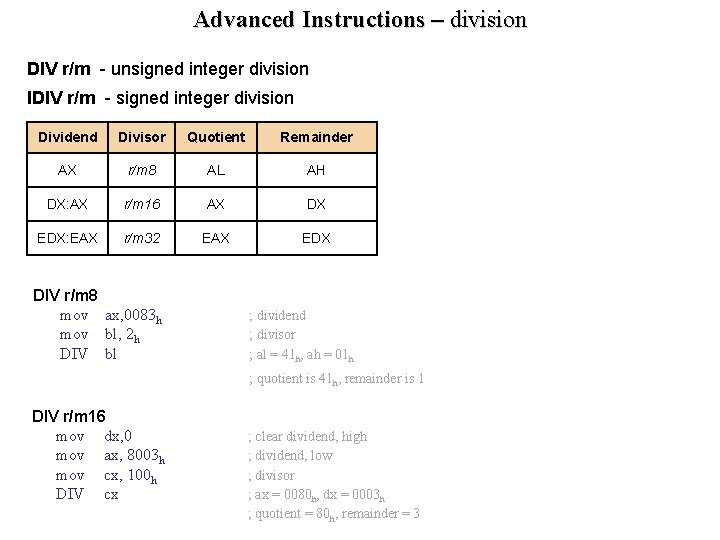
Advanced Instructions – division DIV r/m - unsigned integer division IDIV r/m - signed integer division Dividend Divisor Quotient Remainder AX r/m 8 AL AH DX: AX r/m 16 AX DX EDX: EAX r/m 32 EAX EDX DIV r/m 8 mov ax, 0083 h mov bl, 2 h DIV bl ; dividend ; divisor ; al = 41 h, ah = 01 h ; quotient is 41 h, remainder is 1 DIV r/m 16 mov dx, 0 mov ax, 8003 h mov cx, 100 h DIV cx ; clear dividend, high ; dividend, low ; divisor ; ax = 0080 h, dx = 0003 h ; quotient = 80 h, remainder = 3
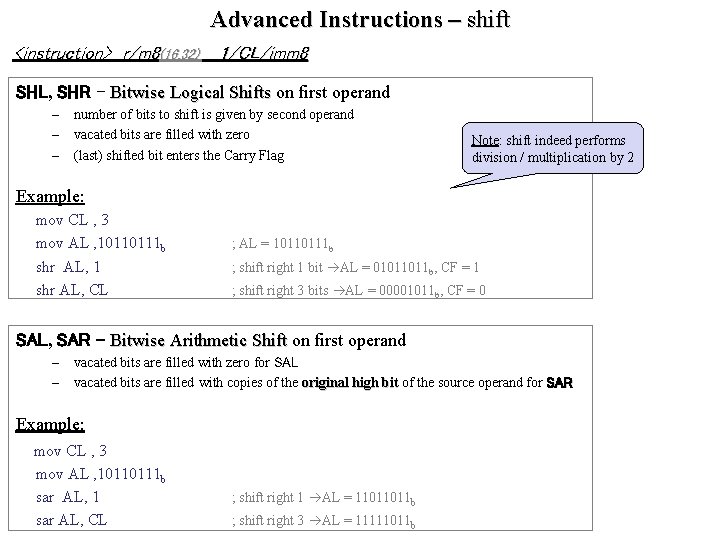
Advanced Instructions – shift <instruction> r/m 8(16, 32) 1/CL/imm 8 SHL, SHR – Bitwise Logical Shifts on first operand – – – number of bits to shift is given by second operand vacated bits are filled with zero (last) shifted bit enters the Carry Flag Note: shift indeed performs division / multiplication by 2 Example: mov CL , 3 mov AL , 10110111 b shr AL, 1 shr AL, CL ; AL = 10110111 b ; shift right 1 bit AL = 01011011 b, CF = 1 ; shift right 3 bits AL = 00001011 b, CF = 0 SAL, SAR – Bitwise Arithmetic Shift on first operand – – vacated bits are filled with zero for SAL vacated bits are filled with copies of the original high bit of the source operand for SAR Example: mov CL , 3 mov AL , 10110111 b sar AL, 1 sar AL, CL ; shift right 1 AL = 11011011 b ; shift right 3 AL = 11111011 b
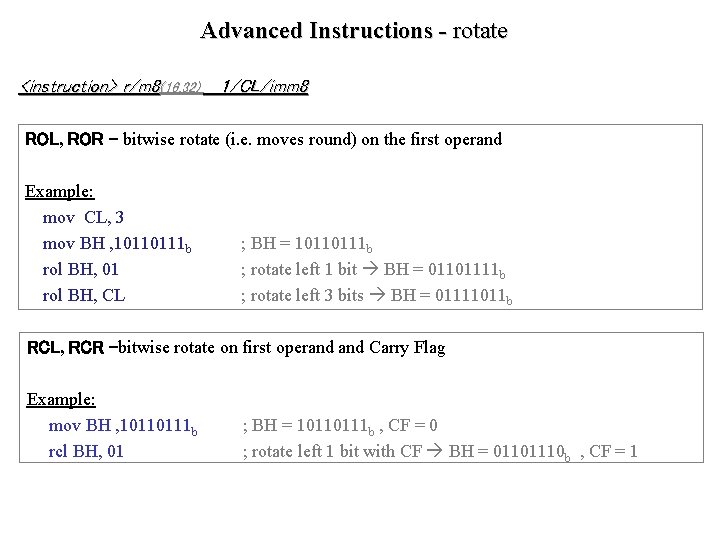
Advanced Instructions - rotate <instruction> r/m 8(16, 32) 1/CL/imm 8 ROL, ROR – bitwise rotate (i. e. moves round) on the first operand Example: mov CL, 3 mov BH , 10110111 b rol BH, 01 rol BH, CL ; BH = 10110111 b ; rotate left 1 bit BH = 01101111 b ; rotate left 3 bits BH = 01111011 b RCL, RCR –bitwise rotate on first operand Carry Flag Example: mov BH , 10110111 b rcl BH, 01 ; BH = 10110111 b , CF = 0 ; rotate left 1 bit with CF BH = 01101110 b , CF = 1

Advanced Instructions - loop LOOP, LOOPE, LOOPZ, LOOPNE, LOOPNZ – loop with counter (CX or ECX) Example: mov ax, 1 mov cx, 3 my_ loop: add ax, ax loop my_ loop, cx 1. decrements its counter register (in this case it is CX register) 2. if the counter does not become zero as a result of this operation, it jumps to the given label LOOPE ≡ LOOPZ: jumps if the counter ≠ 0 and Zero Flag = 1 LOOPNE ≡ LOOPNZ: jumps if the counter ≠ 0 and Zero Flag = 0 Note: LOOP instruction does not set any flags Note: if a counter is not specified explicitly, the BITS setting dictates which is used. The BITS directive specifies whether NASM should generate code designed to run on a processor operating in 16 -bit mode, or code designed to run on a processor operating in 32 -bit mode. The syntax is BITS 16 or BITS 32.
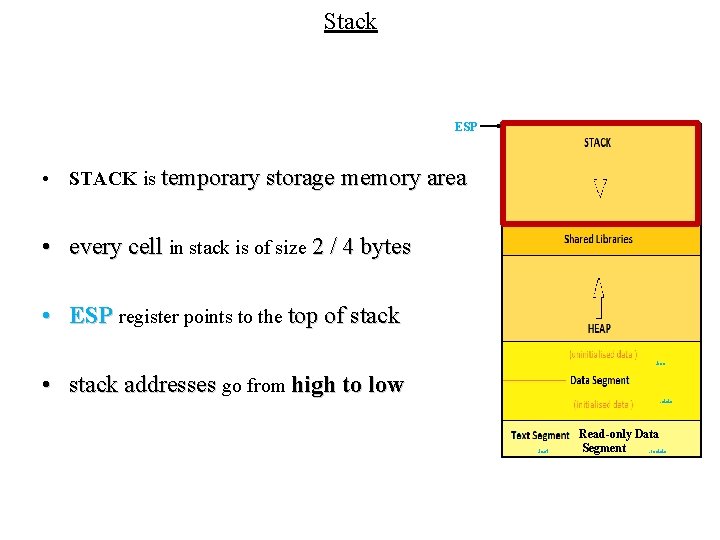
Stack ESP • STACK is temporary storage memory area • every cell in stack is of size 2 / 4 bytes • ESP register points to the top of stack. bss • stack addresses go from high to low. data . text Read-only Data Segment. rodata
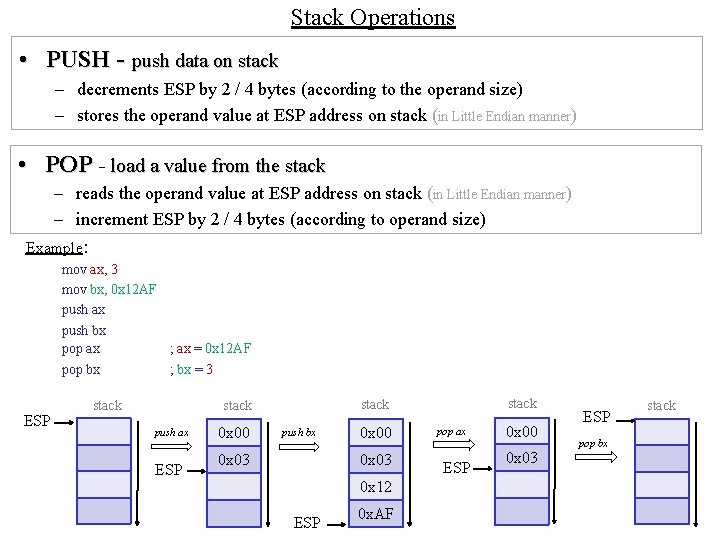
Stack Operations • PUSH - push data on stack – decrements ESP by 2 / 4 bytes (according to the operand size) – stores the operand value at ESP address on stack (in Little Endian manner) • POP - load a value from the stack – reads the operand value at ESP address on stack (in Little Endian manner) – increment ESP by 2 / 4 bytes (according to operand size) Example: mov ax, 3 mov bx, 0 x 12 AF push ax push bx pop ax ; ax = 0 x 12 AF pop bx ; bx = 3 ESP stack push ax ESP 0 x 00 stack push bx 0 x 03 0 x 00 0 x 03 0 x 12 ESP 0 x. AF pop ax ESP 0 x 00 0 x 03 ESP pop bx stack
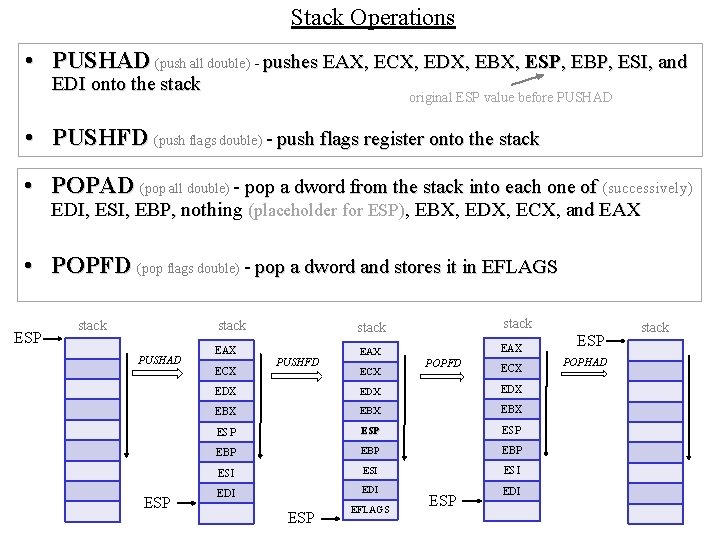
Stack Operations • PUSHAD (push all double) - pushes EAX, ECX, EDX, EBX, ESP, EBP, ESI, and EDI onto the stack original ESP value before PUSHAD • PUSHFD (push flags double) - push flags register onto the stack • POPAD (pop all double) - pop a dword from the stack into each one of (successively) EDI, ESI, EBP, nothing (placeholder for ESP), EBX, EDX, ECX, and EAX • POPFD (pop flags double) - pop a dword and stores it in EFLAGS ESP stack PUSHAD ESP stack EAX EAX ECX PUSHFD ECX POPFD ECX EDX EDX EBX EBX ESP ESP EBP EBP ESI ESI EDI ESP EFLAGS ESP EDI ESP POPHAD stack
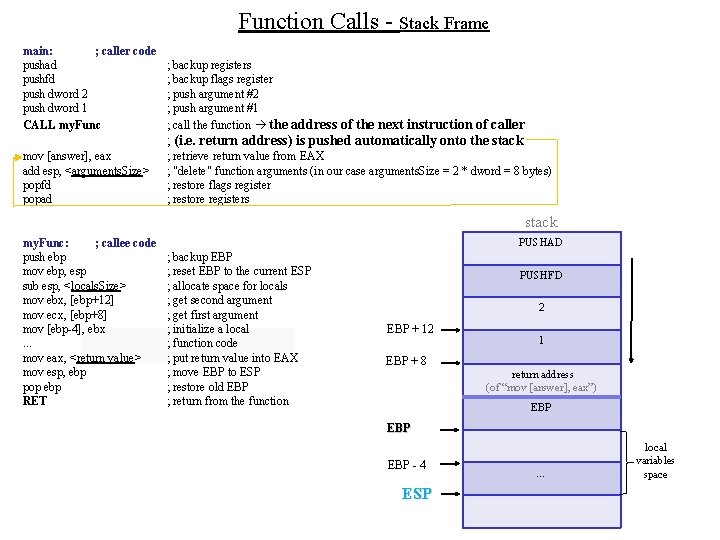
Function Calls - Stack Frame main: ; caller code pushad pushfd push dword 2 push dword 1 CALL my. Func ; backup registers ; backup flags register ; push argument #2 ; push argument #1 ; call the function the address of the next instruction of caller ; (i. e. return address) is pushed automatically onto the stack mov [answer], eax add esp, <arguments. Size> popfd popad ; retrieve return value from EAX ; "delete" function arguments (in our case arguments. Size = 2 * dword = 8 bytes) ; restore flags register ; restore registers stack my. Func: ; callee code push ebp mov ebp, esp sub esp, <locals. Size> mov ebx, [ebp+12] mov ecx, [ebp+8] mov [ebp-4], ebx. . . mov eax, <return value> mov esp, ebp pop ebp RET PUSHAD ; backup EBP ; reset EBP to the current ESP ; allocate space for locals ; get second argument ; get first argument ; initialize a local ; function code ; put return value into EAX ; move EBP to ESP ; restore old EBP ; return from the function PUSHFD 2 EBP + 12 EBP + 8 1 return address (of “mov [answer], eax”) EBP EBP - 4 ESP … local variables space
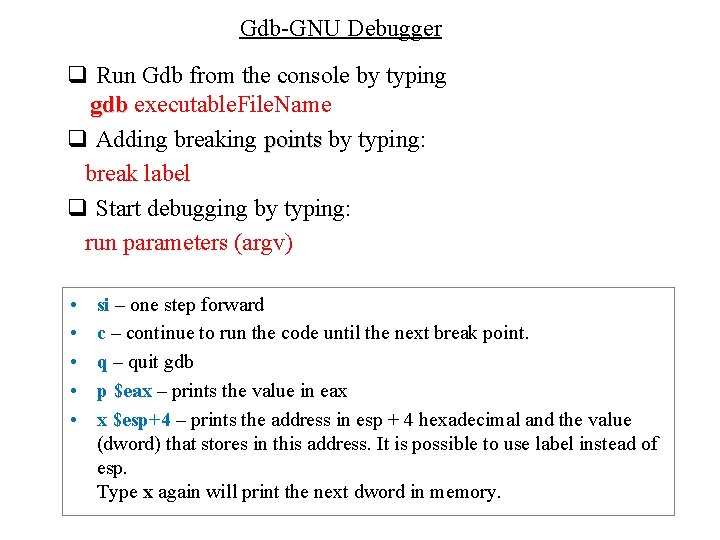
Gdb-GNU Debugger q Run Gdb from the console by typing gdb executable. File. Name q Adding breaking points by typing: break label q Start debugging by typing: run parameters (argv) • • • si – one step forward c – continue to run the code until the next break point. q – quit gdb p $eax – prints the value in eax x $esp+4 – prints the address in esp + 4 hexadecimal and the value (dword) that stores in this address. It is possible to use label instead of esp. Type x again will print the next dword in memory.
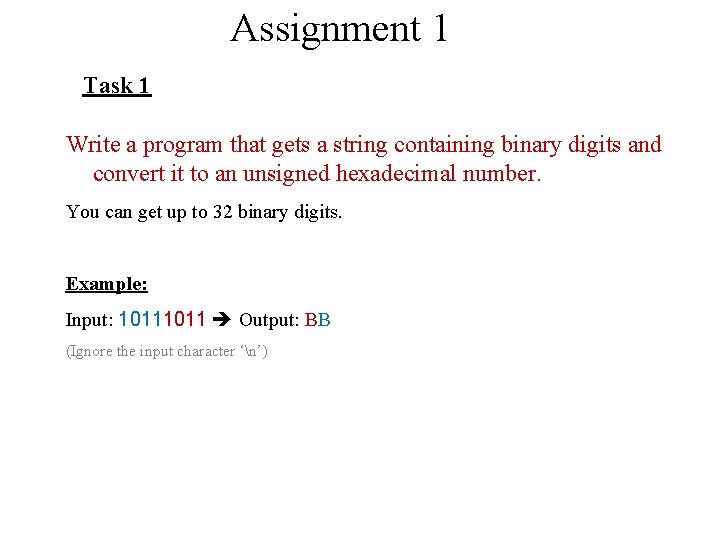
Assignment 1 Task 1 Write a program that gets a string containing binary digits and convert it to an unsigned hexadecimal number. You can get up to 32 binary digits. Example: Input: 1011 Output: BB (Ignore the input character ‘n’)
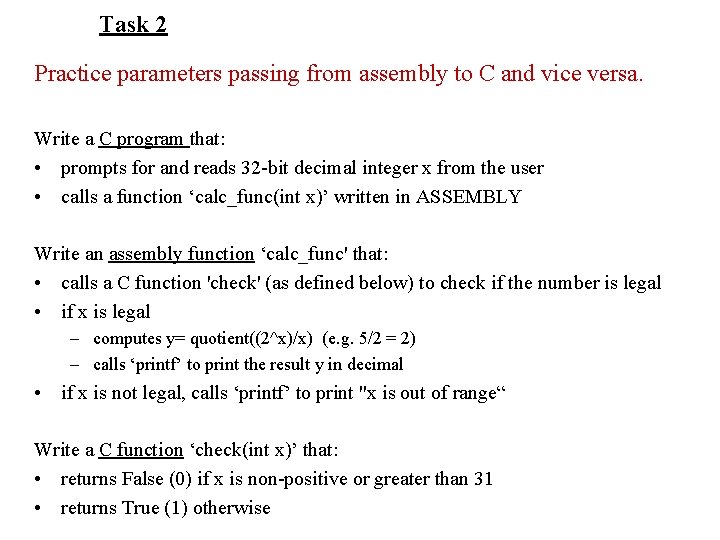
Task 2 Practice parameters passing from assembly to C and vice versa. Write a C program that: • prompts for and reads 32 -bit decimal integer x from the user • calls a function ‘calc_func(int x)’ written in ASSEMBLY Write an assembly function ‘calc_func' that: • calls a C function 'check' (as defined below) to check if the number is legal • if x is legal – computes y= quotient((2^x)/x) (e. g. 5/2 = 2) – calls ‘printf’ to print the result y in decimal • if x is not legal, calls ‘printf’ to print "x is out of range“ Write a C function ‘check(int x)’ that: • returns False (0) if x is non-positive or greater than 31 • returns True (1) otherwise
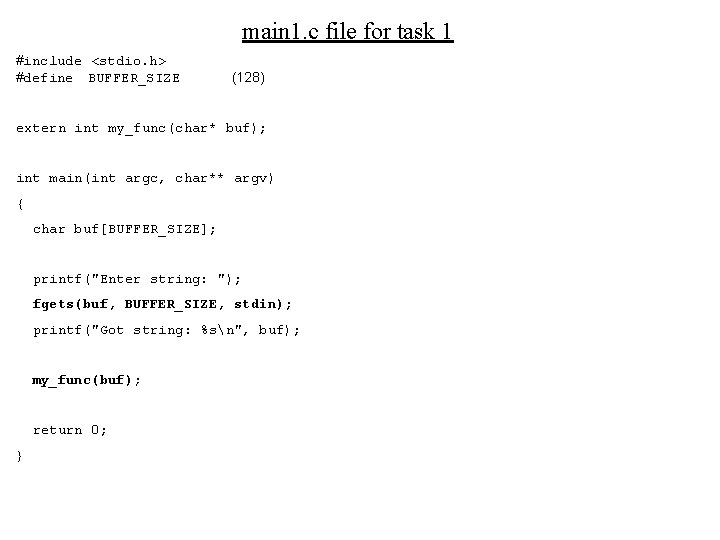
main 1. c file for task 1 #include <stdio. h> #define BUFFER_SIZE (128) extern int my_func(char* buf); int main(int argc, char** argv) { char buf[BUFFER_SIZE]; printf("Enter string: "); fgets(buf, BUFFER_SIZE, stdin); printf("Got string: %sn", buf); my_func(buf); return 0; }
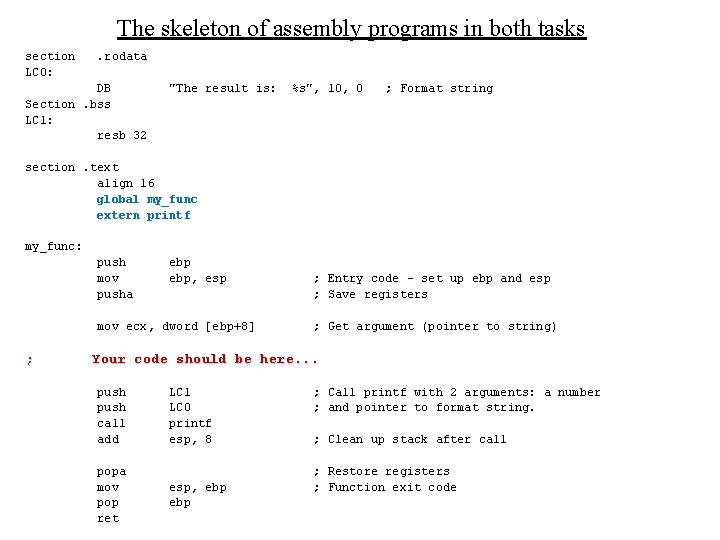
The skeleton of assembly programs in both tasks section LC 0: . rodata DB Section. bss LC 1: resb 32 "The result is: %s", 10, 0 ; Format string section. text align 16 global my_func extern printf my_func: push mov pusha ebp, esp mov ecx, dword [ebp+8] ; ; Entry code - set up ebp and esp ; Save registers ; Get argument (pointer to string) Your code should be here. . . push call add popa mov pop ret LC 1 LC 0 printf esp, 8 esp, ebp ; Call printf with 2 arguments: a number ; and pointer to format string. ; Clean up stack after call ; Restore registers ; Function exit code
- Slides: 14