
Computer Architecture A Quantitative Approach Sixth Edition Chapter
![n Parameters: n n n Dim[i]: number of neurons Dim[i-1]: dimension of input vector](https://slidetodoc.com/presentation_image_h/2bb8bbe3ece0c3604d67ecffa99a85e1/image-8.jpg "n Parameters: n n n Dim[i]: number of neurons Dim[i-1]: dimension of input vector")
![n Parameters: n n n Example: Deep Neural Networks Convolutional Neural Network Dim. FM[i-1]:](https://slidetodoc.com/presentation_image_h/2bb8bbe3ece0c3604d67ecffa99a85e1/image-10.jpg "n Parameters: n n n Example: Deep Neural Networks Convolutional Neural Network Dim. FM[i-1]:")
- Slides: 36
Computer Architecture A Quantitative Approach, Sixth Edition Chapter 7 Domain-Specific Architectures Copyright © 2019, Elsevier Inc. All rights Reserved 1
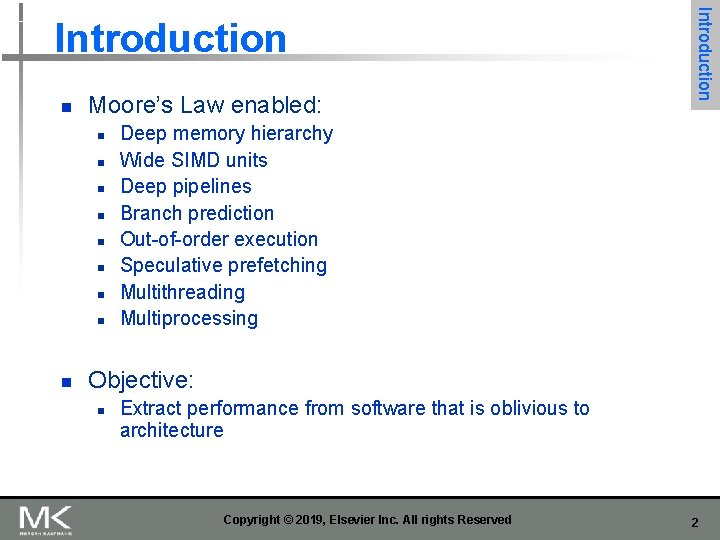
n Moore’s Law enabled: n n n n n Introduction Deep memory hierarchy Wide SIMD units Deep pipelines Branch prediction Out-of-order execution Speculative prefetching Multithreading Multiprocessing Objective: n Extract performance from software that is oblivious to architecture Copyright © 2019, Elsevier Inc. All rights Reserved 2
n Need factor of 100 improvements in number of operations per instruction n Introduction Requires domain specific architectures For ASICs, NRE cannot be amoratized over large volumes FPGAs are less efficient than ASICs Copyright © 2019, Elsevier Inc. All rights Reserved 3
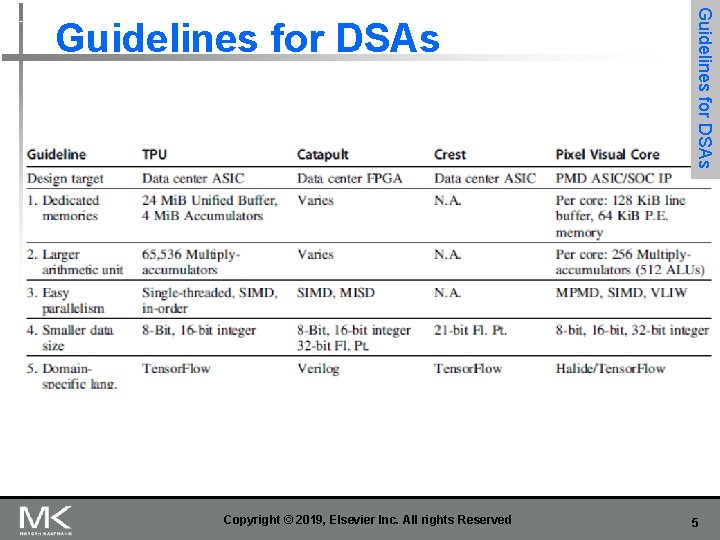
n n n Use dedicated memories to minimize data movement Invest resources into more arithmetic units or bigger memories Use the easiest form of parallelism that matches the domain Reduce data size and type to the simplest needed for the domain Use a domain-specific programming language Copyright © 2019, Elsevier Inc. All rights Reserved Guidelines for DSAs 4
Copyright © 2019, Elsevier Inc. All rights Reserved Guidelines for DSAs 5
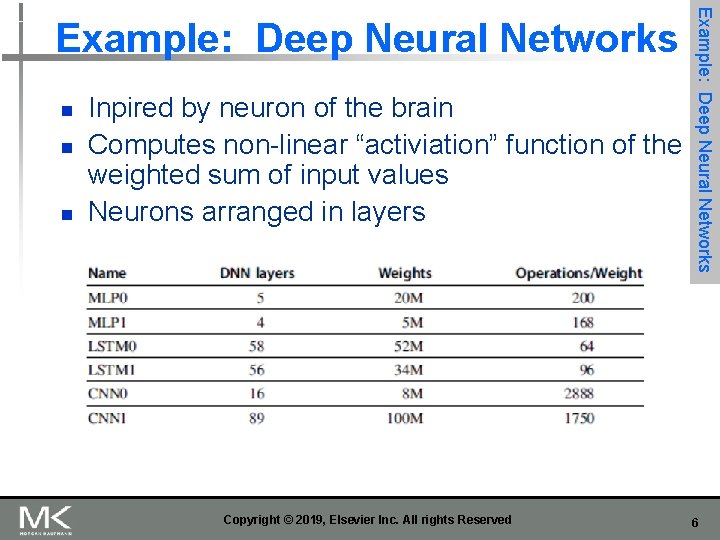
n n n Inpired by neuron of the brain Computes non-linear “activiation” function of the weighted sum of input values Neurons arranged in layers Copyright © 2019, Elsevier Inc. All rights Reserved Example: Deep Neural Networks 6
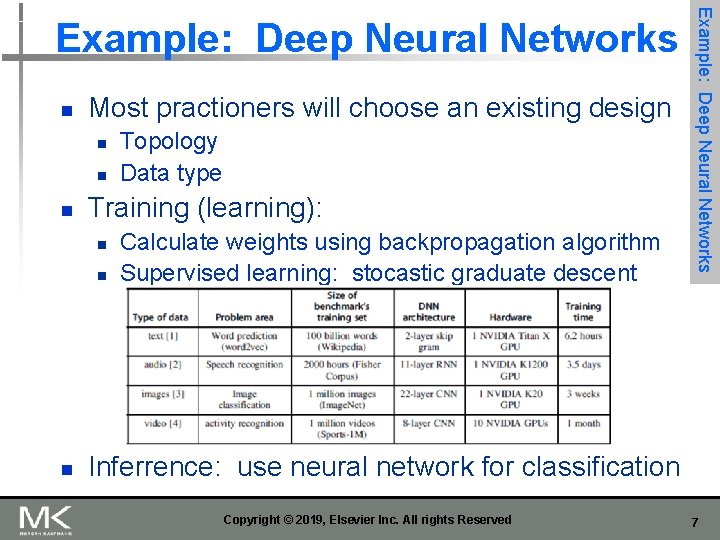
n Most practioners will choose an existing design n Training (learning): n n n Topology Data type Calculate weights using backpropagation algorithm Supervised learning: stocastic graduate descent Example: Deep Neural Networks Inferrence: use neural network for classification Copyright © 2019, Elsevier Inc. All rights Reserved 7
n Parameters: n n n Dim[i]: number of neurons Dim[i-1]: dimension of input vector Number of weights: Dim[i-1] x Dim[i] Operations: 2 x Dim[i-1] x Dim[i] Operations/weight: 2 Copyright © 2019, Elsevier Inc. All rights Reserved Example: Deep Neural Networks Multi-Layer Perceptrons 8
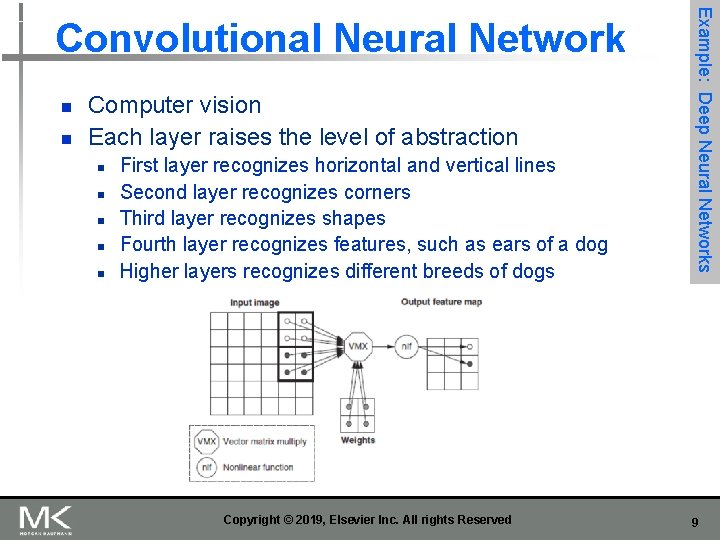
n n Computer vision Each layer raises the level of abstraction n n First layer recognizes horizontal and vertical lines Second layer recognizes corners Third layer recognizes shapes Fourth layer recognizes features, such as ears of a dog Higher layers recognizes different breeds of dogs Copyright © 2019, Elsevier Inc. All rights Reserved Example: Deep Neural Networks Convolutional Neural Network 9
n Parameters: n n n Example: Deep Neural Networks Convolutional Neural Network Dim. FM[i-1]: Dimension of the (square) input Feature Map Dim. FM[i]: Dimension of the (square) output Feature Map Dim. Sten[i]: Dimension of the (square) stencil Num. FM[i-1]: Number of input Feature Maps Num. FM[i]: Number of output Feature Maps Number of neurons: Num. FM[i] x Dim. FM[i]2 Number of weights per output Feature Map: Num. FM[i-1] x Dim. Sten[i]2 Total number of weights per layer: Num. FM[i] x Number of weights per output Feature Map Number of operations per output Feature Map: 2 x Dim. FM[i]2 x Number of weights per output Feature Map Total number of operations per layer: Num. FM[i] x Number of operations per output Feature Map = 2 x Dim. FM[i]2 x Num. FM[i] x Number of weights per output Feature Map = 2 x Dim. FM[i]2 x Total number of weights per layer Operations/Weight: 2 x Dim. FM[i]2 Copyright © 2019, Elsevier Inc. All rights Reserved 10
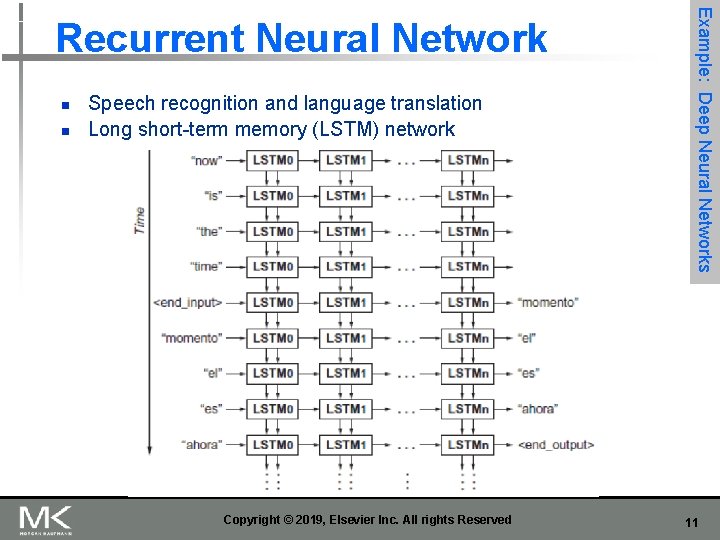
n n Speech recognition and language translation Long short-term memory (LSTM) network Copyright © 2019, Elsevier Inc. All rights Reserved Example: Deep Neural Networks Recurrent Neural Network 11
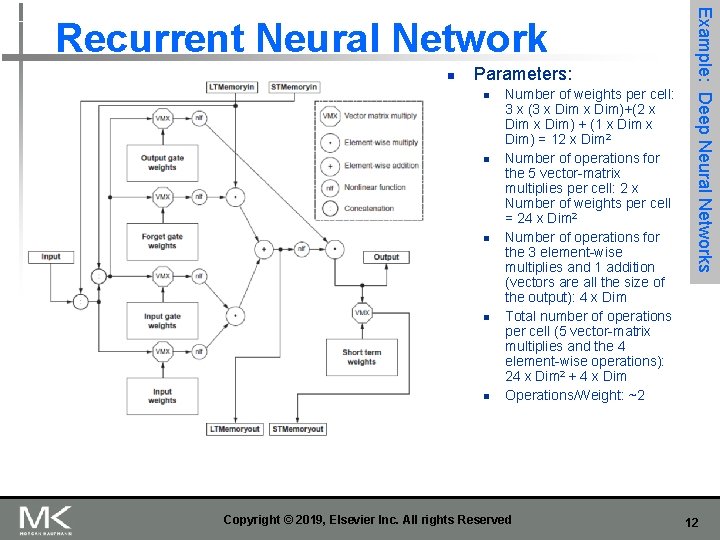
n Parameters: n n n Number of weights per cell: 3 x (3 x Dim)+(2 x Dim) + (1 x Dim) = 12 x Dim 2 Number of operations for the 5 vector-matrix multiplies per cell: 2 x Number of weights per cell = 24 x Dim 2 Number of operations for the 3 element-wise multiplies and 1 addition (vectors are all the size of the output): 4 x Dim Total number of operations per cell (5 vector-matrix multiplies and the 4 element-wise operations): 24 x Dim 2 + 4 x Dim Operations/Weight: ~2 Copyright © 2019, Elsevier Inc. All rights Reserved Example: Deep Neural Networks Recurrent Neural Network 12
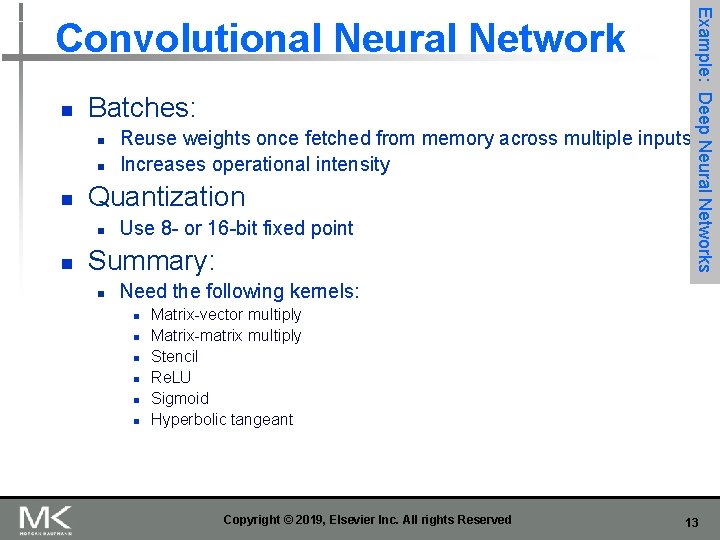
n Batches: n n n Quantization n n Reuse weights once fetched from memory across multiple inputs Increases operational intensity Use 8 - or 16 -bit fixed point Summary: n Example: Deep Neural Networks Convolutional Neural Network Need the following kernels: n n n Matrix-vector multiply Matrix-matrix multiply Stencil Re. LU Sigmoid Hyperbolic tangeant Copyright © 2019, Elsevier Inc. All rights Reserved 13
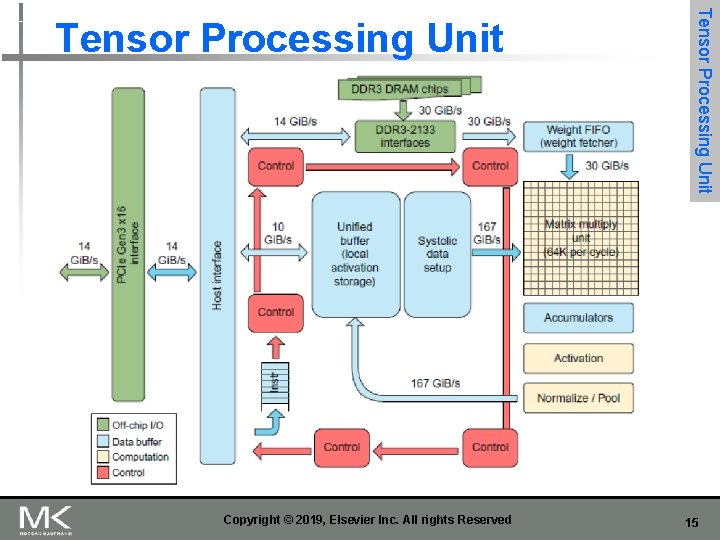
n n Google’s DNN ASIC 256 x 256 8 -bit matrix multiply unit Large software-managed scratchpad Coprocessor on the PCIe bus Copyright © 2019, Elsevier Inc. All rights Reserved Tensor Processing Unit 14
Copyright © 2019, Elsevier Inc. All rights Reserved Tensor Processing Unit 15
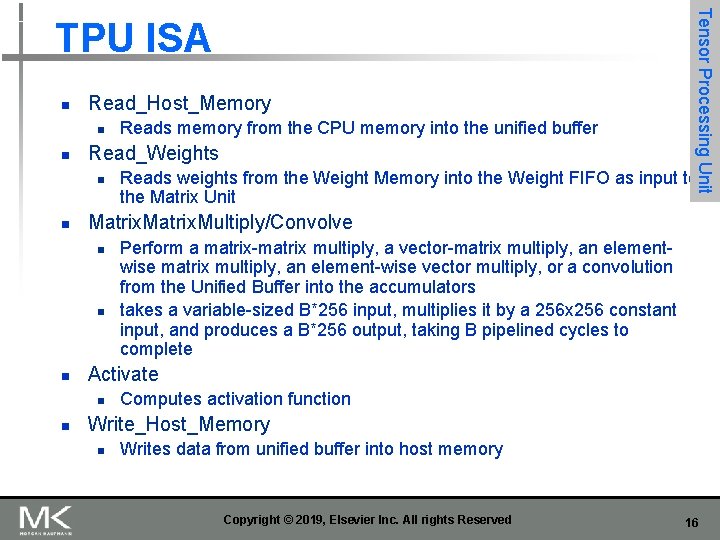
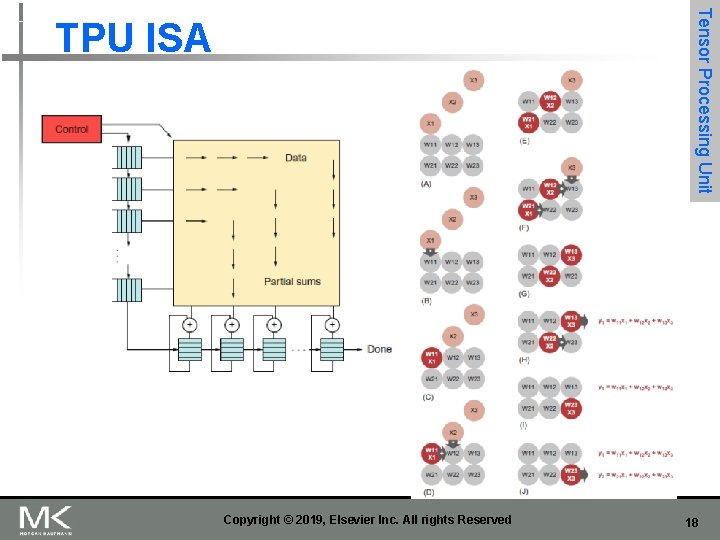
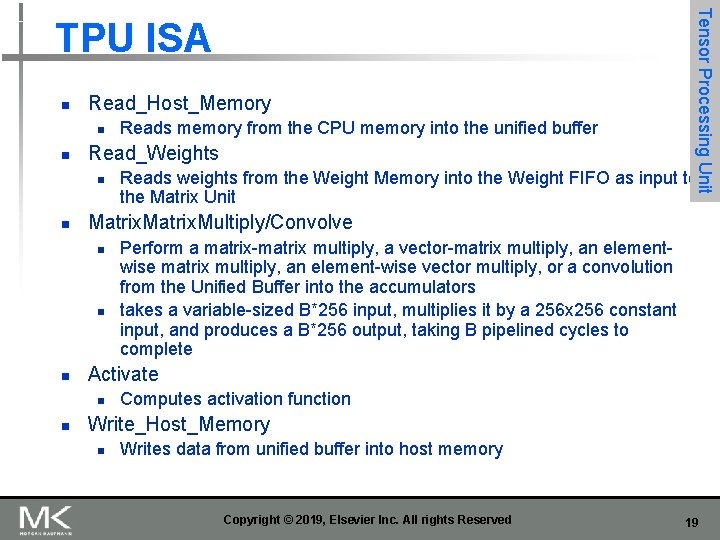
n Read_Host_Memory n n Read_Weights n n n Perform a matrix-matrix multiply, a vector-matrix multiply, an elementwise matrix multiply, an element-wise vector multiply, or a convolution from the Unified Buffer into the accumulators takes a variable-sized B*256 input, multiplies it by a 256 x 256 constant input, and produces a B*256 output, taking B pipelined cycles to complete Activate n n Reads weights from the Weight Memory into the Weight FIFO as input to the Matrix Unit Matrix. Multiply/Convolve n n Reads memory from the CPU memory into the unified buffer Tensor Processing Unit TPU ISA Computes activation function Write_Host_Memory n Writes data from unified buffer into host memory Copyright © 2019, Elsevier Inc. All rights Reserved 16
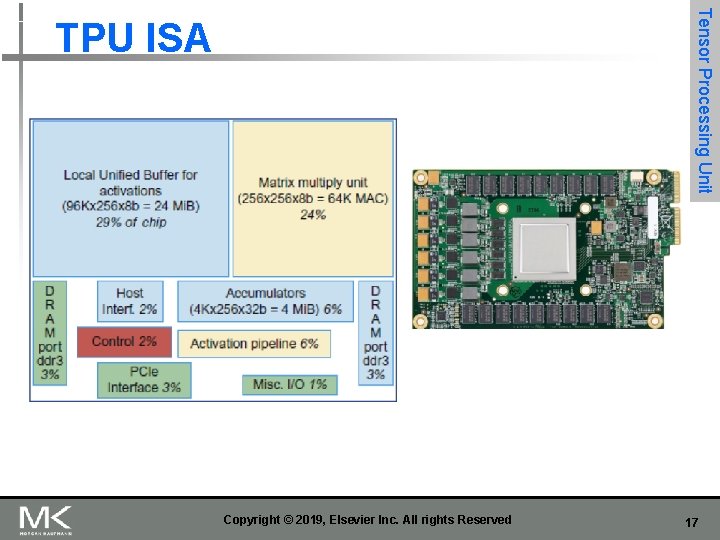
Tensor Processing Unit TPU ISA Copyright © 2019, Elsevier Inc. All rights Reserved 17
Tensor Processing Unit TPU ISA Copyright © 2019, Elsevier Inc. All rights Reserved 18
n Read_Host_Memory n n Read_Weights n n n Perform a matrix-matrix multiply, a vector-matrix multiply, an elementwise matrix multiply, an element-wise vector multiply, or a convolution from the Unified Buffer into the accumulators takes a variable-sized B*256 input, multiplies it by a 256 x 256 constant input, and produces a B*256 output, taking B pipelined cycles to complete Activate n n Reads weights from the Weight Memory into the Weight FIFO as input to the Matrix Unit Matrix. Multiply/Convolve n n Reads memory from the CPU memory into the unified buffer Tensor Processing Unit TPU ISA Computes activation function Write_Host_Memory n Writes data from unified buffer into host memory Copyright © 2019, Elsevier Inc. All rights Reserved 19
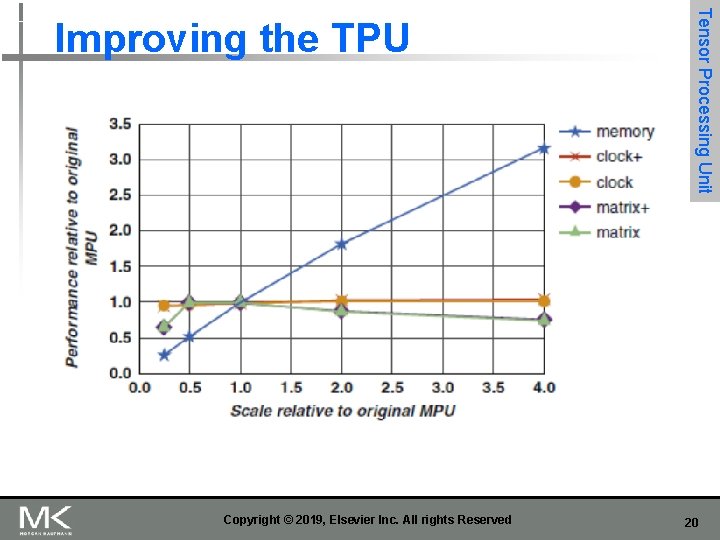
Copyright © 2019, Elsevier Inc. All rights Reserved Tensor Processing Unit Improving the TPU 20
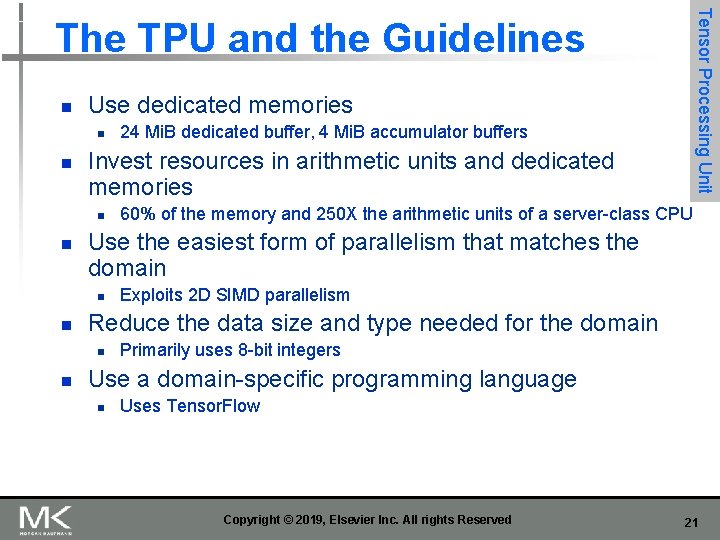
Tensor Processing Unit The TPU and the Guidelines n Use dedicated memories n n Invest resources in arithmetic units and dedicated memories n n Exploits 2 D SIMD parallelism Reduce the data size and type needed for the domain n n 60% of the memory and 250 X the arithmetic units of a server-class CPU Use the easiest form of parallelism that matches the domain n n 24 Mi. B dedicated buffer, 4 Mi. B accumulator buffers Primarily uses 8 -bit integers Use a domain-specific programming language n Uses Tensor. Flow Copyright © 2019, Elsevier Inc. All rights Reserved 21
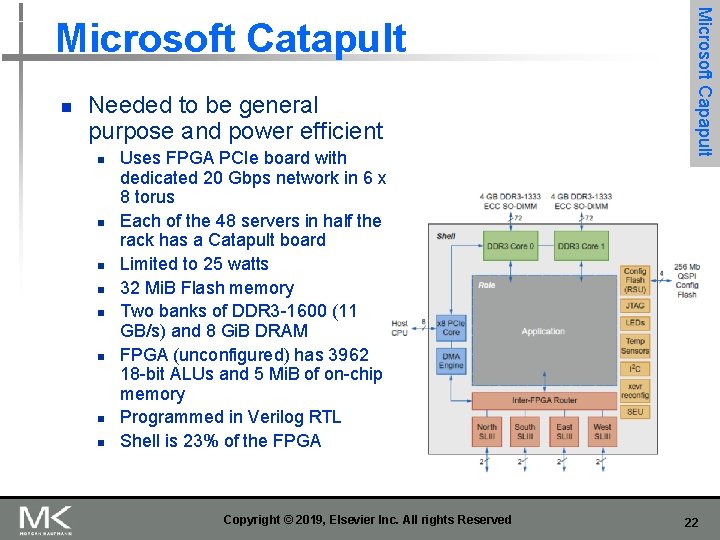
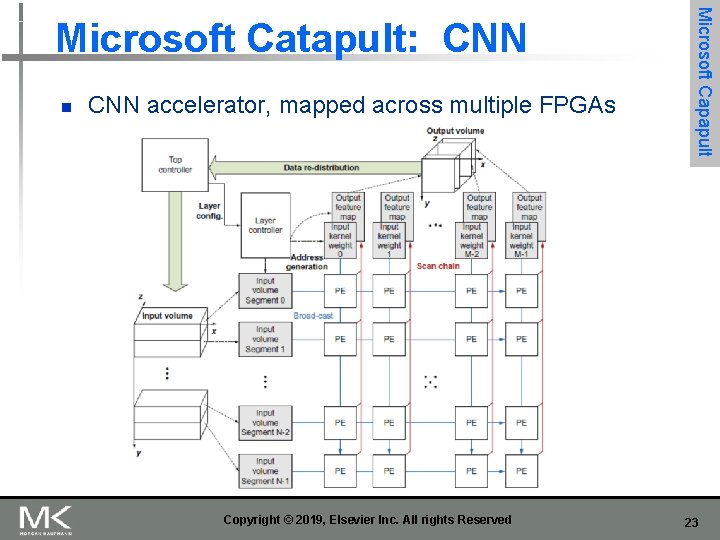
n Needed to be general purpose and power efficient n n n n Uses FPGA PCIe board with dedicated 20 Gbps network in 6 x 8 torus Each of the 48 servers in half the rack has a Catapult board Limited to 25 watts 32 Mi. B Flash memory Two banks of DDR 3 -1600 (11 GB/s) and 8 Gi. B DRAM FPGA (unconfigured) has 3962 18 -bit ALUs and 5 Mi. B of on-chip memory Programmed in Verilog RTL Shell is 23% of the FPGA Copyright © 2019, Elsevier Inc. All rights Reserved Microsoft Capapult Microsoft Catapult 22
n CNN accelerator, mapped across multiple FPGAs Copyright © 2019, Elsevier Inc. All rights Reserved Microsoft Capapult Microsoft Catapult: CNN 23
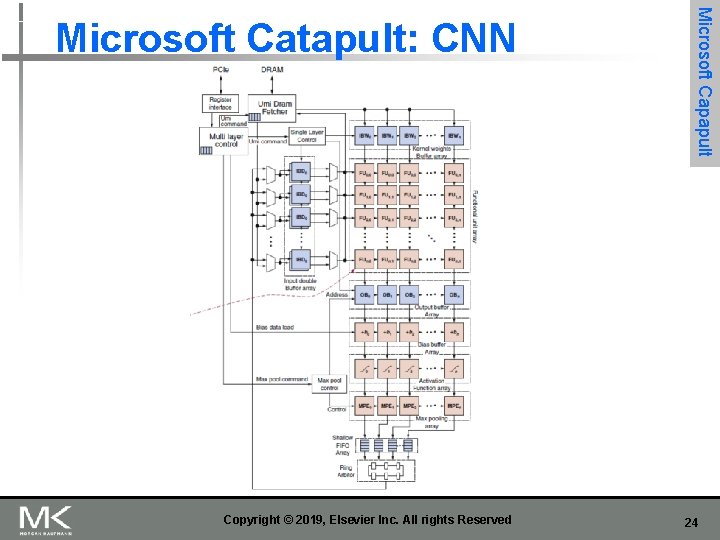
Copyright © 2019, Elsevier Inc. All rights Reserved Microsoft Capapult Microsoft Catapult: CNN 24
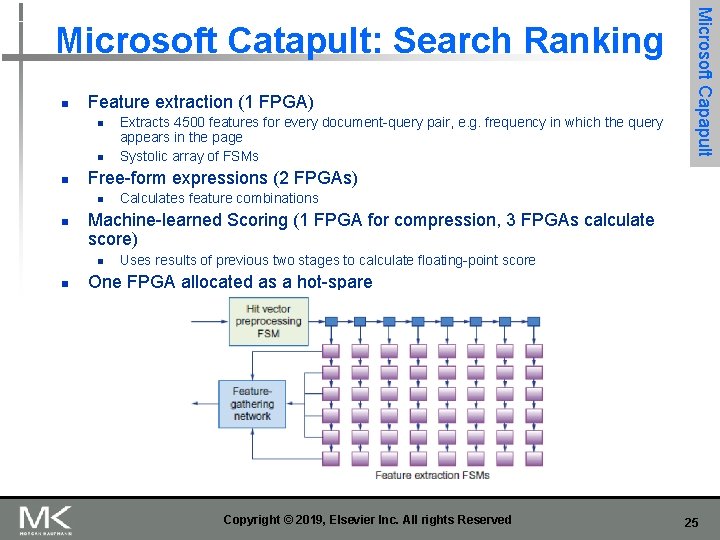
n Feature extraction (1 FPGA) n n n Free-form expressions (2 FPGAs) n n Calculates feature combinations Machine-learned Scoring (1 FPGA for compression, 3 FPGAs calculate score) n n Extracts 4500 features for every document-query pair, e. g. frequency in which the query appears in the page Systolic array of FSMs Microsoft Capapult Microsoft Catapult: Search Ranking Uses results of previous two stages to calculate floating-point score One FPGA allocated as a hot-spare Copyright © 2019, Elsevier Inc. All rights Reserved 25
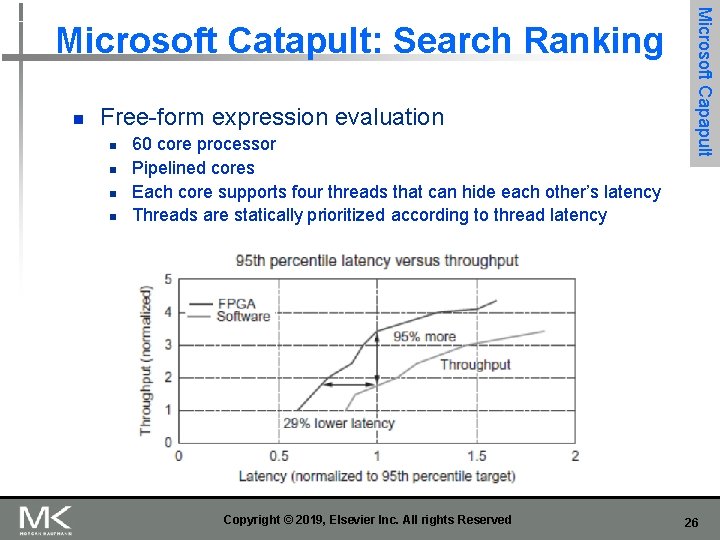
n Free-form expression evaluation n n 60 core processor Pipelined cores Each core supports four threads that can hide each other’s latency Threads are statically prioritized according to thread latency Copyright © 2019, Elsevier Inc. All rights Reserved Microsoft Capapult Microsoft Catapult: Search Ranking 26
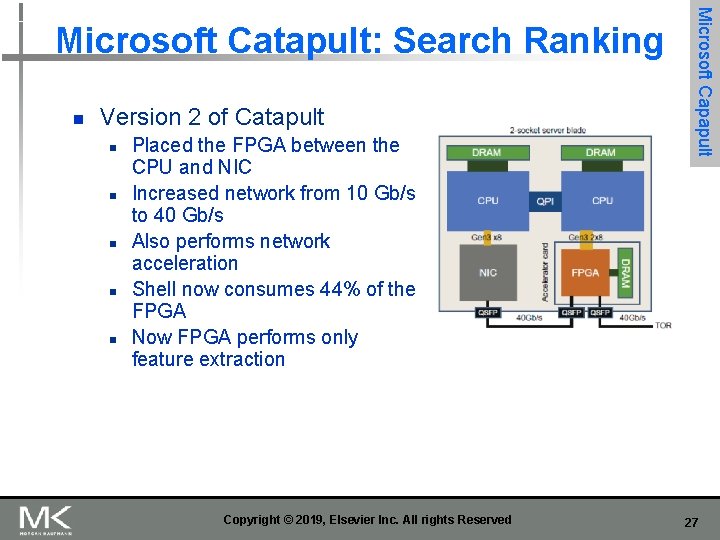
n Version 2 of Catapult n n n Placed the FPGA between the CPU and NIC Increased network from 10 Gb/s to 40 Gb/s Also performs network acceleration Shell now consumes 44% of the FPGA Now FPGA performs only feature extraction Copyright © 2019, Elsevier Inc. All rights Reserved Microsoft Capapult Microsoft Catapult: Search Ranking 27
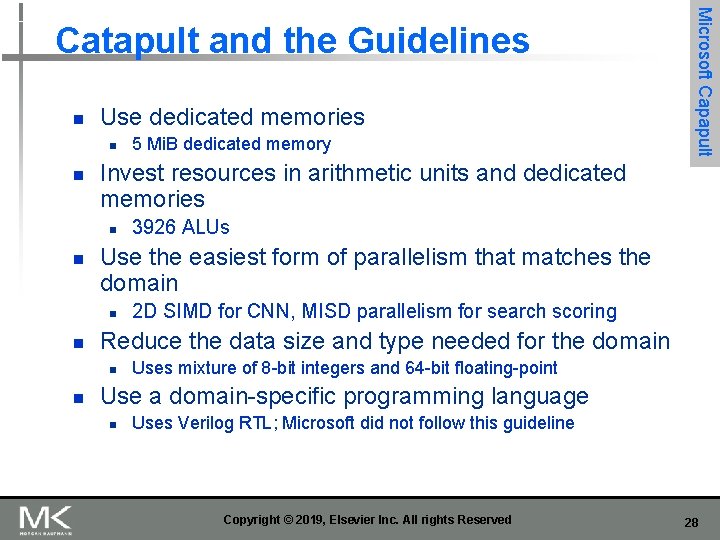
n Use dedicated memories n n Invest resources in arithmetic units and dedicated memories n n 2 D SIMD for CNN, MISD parallelism for search scoring Reduce the data size and type needed for the domain n n 3926 ALUs Use the easiest form of parallelism that matches the domain n n 5 Mi. B dedicated memory Microsoft Capapult Catapult and the Guidelines Uses mixture of 8 -bit integers and 64 -bit floating-point Use a domain-specific programming language n Uses Verilog RTL; Microsoft did not follow this guideline Copyright © 2019, Elsevier Inc. All rights Reserved 28
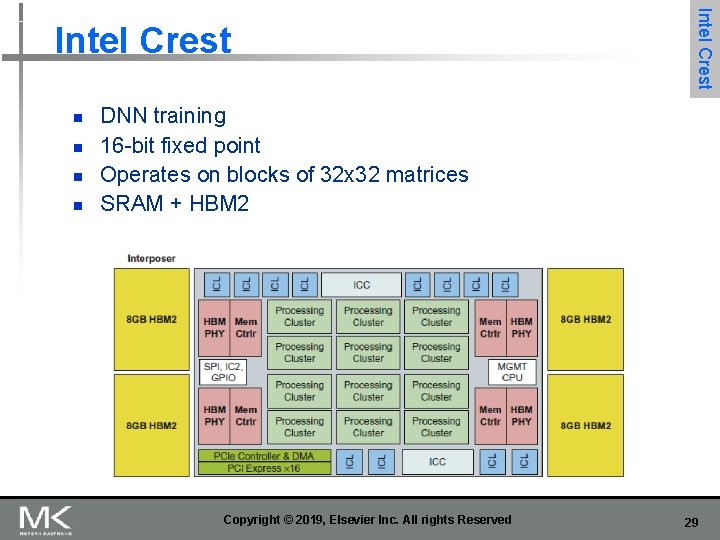
n n Intel Crest DNN training 16 -bit fixed point Operates on blocks of 32 x 32 matrices SRAM + HBM 2 Copyright © 2019, Elsevier Inc. All rights Reserved 29
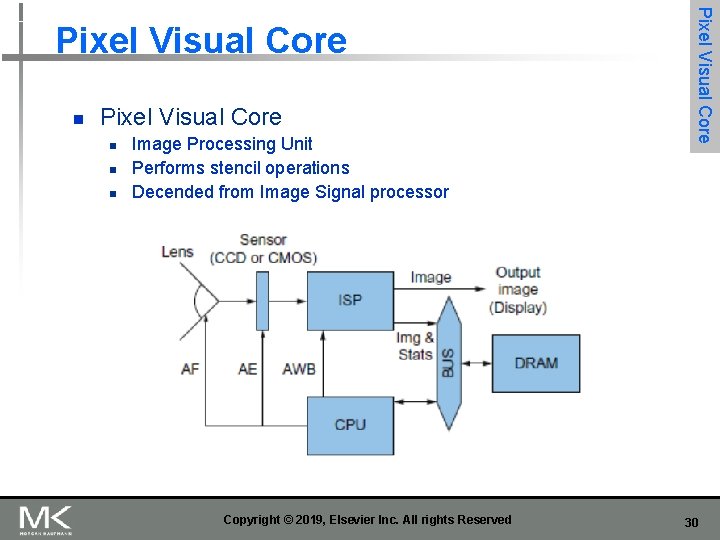
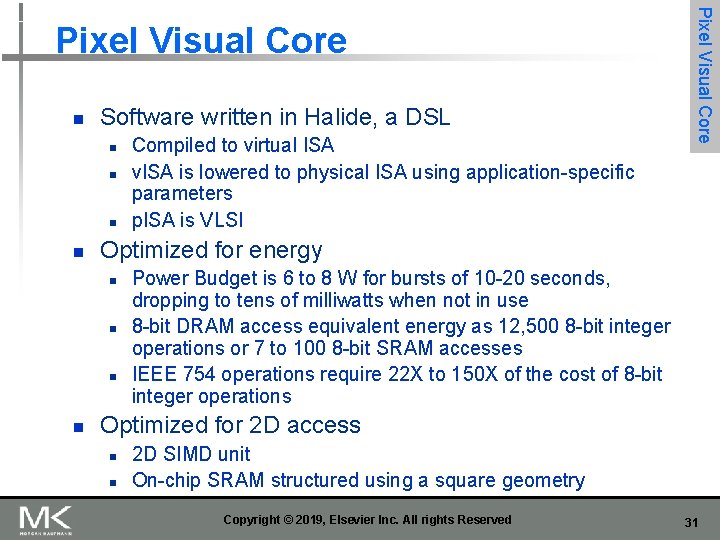
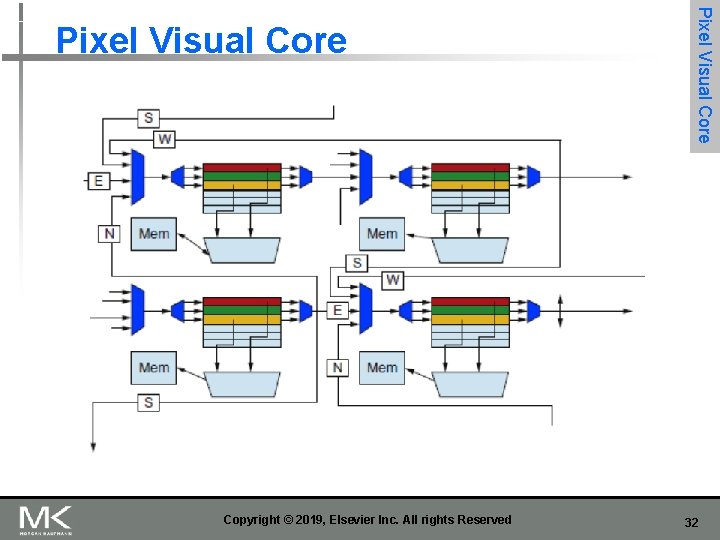
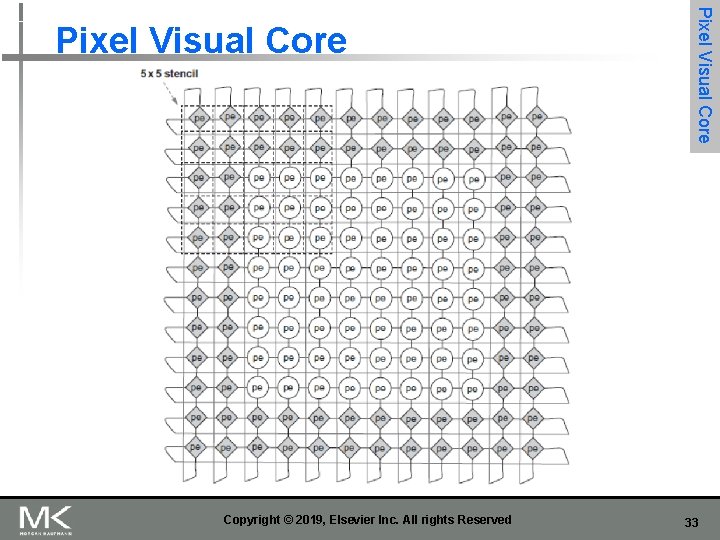
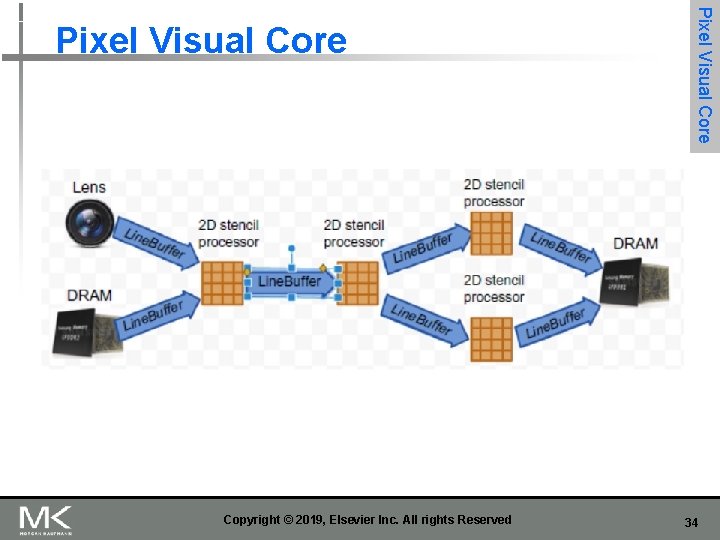
n Pixel Visual Core n n n Image Processing Unit Performs stencil operations Decended from Image Signal processor Copyright © 2019, Elsevier Inc. All rights Reserved Pixel Visual Core 30
n Software written in Halide, a DSL n n Optimized for energy n n Compiled to virtual ISA v. ISA is lowered to physical ISA using application-specific parameters p. ISA is VLSI Pixel Visual Core Power Budget is 6 to 8 W for bursts of 10 -20 seconds, dropping to tens of milliwatts when not in use 8 -bit DRAM access equivalent energy as 12, 500 8 -bit integer operations or 7 to 100 8 -bit SRAM accesses IEEE 754 operations require 22 X to 150 X of the cost of 8 -bit integer operations Optimized for 2 D access n n 2 D SIMD unit On-chip SRAM structured using a square geometry Copyright © 2019, Elsevier Inc. All rights Reserved 31
Copyright © 2019, Elsevier Inc. All rights Reserved Pixel Visual Core 32
Copyright © 2019, Elsevier Inc. All rights Reserved Pixel Visual Core 33
Copyright © 2019, Elsevier Inc. All rights Reserved Pixel Visual Core 34
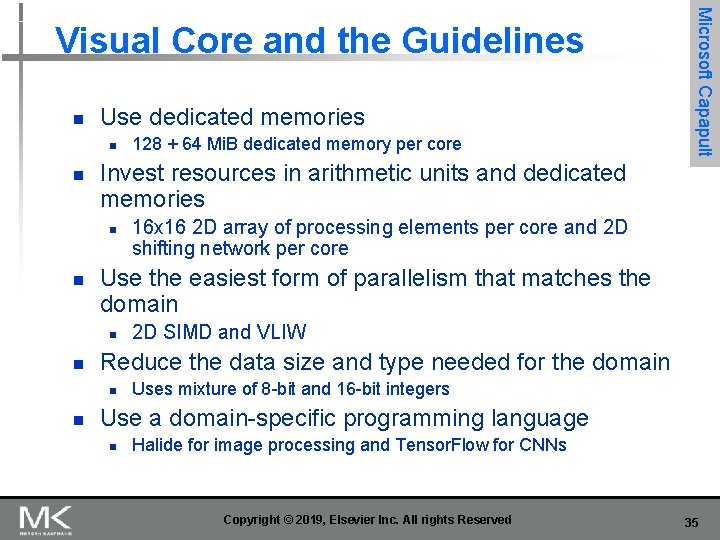
n Use dedicated memories n n Invest resources in arithmetic units and dedicated memories n n 2 D SIMD and VLIW Reduce the data size and type needed for the domain n n 16 x 16 2 D array of processing elements per core and 2 D shifting network per core Use the easiest form of parallelism that matches the domain n n 128 + 64 Mi. B dedicated memory per core Microsoft Capapult Visual Core and the Guidelines Uses mixture of 8 -bit and 16 -bit integers Use a domain-specific programming language n Halide for image processing and Tensor. Flow for CNNs Copyright © 2019, Elsevier Inc. All rights Reserved 35
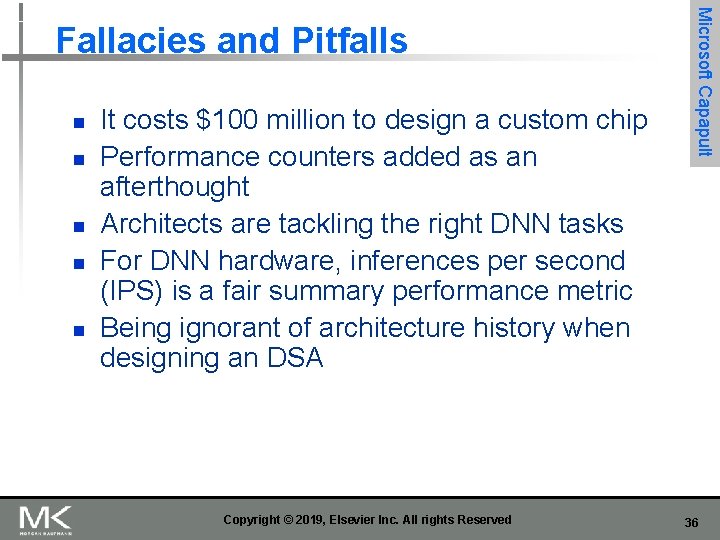
n n n It costs $100 million to design a custom chip Performance counters added as an afterthought Architects are tackling the right DNN tasks For DNN hardware, inferences per second (IPS) is a fair summary performance metric Being ignorant of architecture history when designing an DSA Copyright © 2019, Elsevier Inc. All rights Reserved Microsoft Capapult Fallacies and Pitfalls 36