
Computer Applications Introduction to Programming in Python 1
- Slides: 14
Computer Applications Introduction to Programming in Python 1 Hugh Davis hcd@soton. ac. uk Jian Shi Jian. Shi@soton. ac. uk Yvonne Howard rfp@ecs. soton. ac. uk
What is Programming? • Wikipedia (2011) ▫ “the process of writing, testing, debugging and maintaining the source code of computer programs. The purpose of programming is to create a program that exhibits a certain desired behavior. ” • Thefreedictionary. com (2011) ▫ “creating a sequence of instructions to enable the computer to do something” • OED (2011) ▫ “The operation or practice of programming a computer; the writing or preparation of computer programs. ”
Learning to Program Why bother? • All of your degrees will involve some programming • A lot of your jobs will involve programming, • or working with programmers ▫ Appreciation of what you can do • Simplify your lives ▫ Repetitive tasks
How are you going to learn to program? • We will explain the Principle of Programming at classes via Coding Dojos • We will also get you to follow Code Academy lessons (Sometimes having it explained twice helps) • There is an on-line book (a third explanation!) Think Python: How to Think Like a Computer Scientist. http: //www. greenteapress. com/thinkpython. pdf • There is lots of online Help e. g. https: //docs. python. org/2/tutorial/ • You will put what you learn into by Labs and Homework (~5 hours a week? ) PRACTICE! • We will provide extra help sessions on Wednesday Afternoons (starting next week) • Ask your friends – two brains are often better than one! Some already know… • We will provide you with tests every 3 or 4 weeks to make sure that you are making progress.
A Dirty Secret • No matter how we teach you will mainly learn through practice! • Programming is an important skill for a scientist or engineer ▫ Systematic thinking and problem solving ▫ Abstraction and data modeling • Did we mention that you need to practice?
PRACTICE! “I've often thought that sucking less every year is how humble programmers improve. You should be unhappy with code you wrote a year ago. ” - Jeff Atwood, http: //www. codinghorror. com/ “I have no talent. What I do have is a lot of practice. And I am not talking about occasionally dabbling in Ruby on the weekends. I am talking about the kind of practice where I beat code that isn’t working into submission (though often times the code wins). ” - John Nunemaker, http: //railstips. org/
Hints - Finding Help • ALWAYS TYPE THE CODE ▫ ▫ • INTERNET ▫ ▫ • search: "<language> programming tutorial" search: "how do I <something> in <language>” BOOKS ▫ • Will at least help you to get the muscle memory. Don't let people (even me or demonstrators) touch your keyboard or mouse! Read whole section and understand OTHER PEOPLE ▫ Don't just copy, get them to explain Practice, practice!
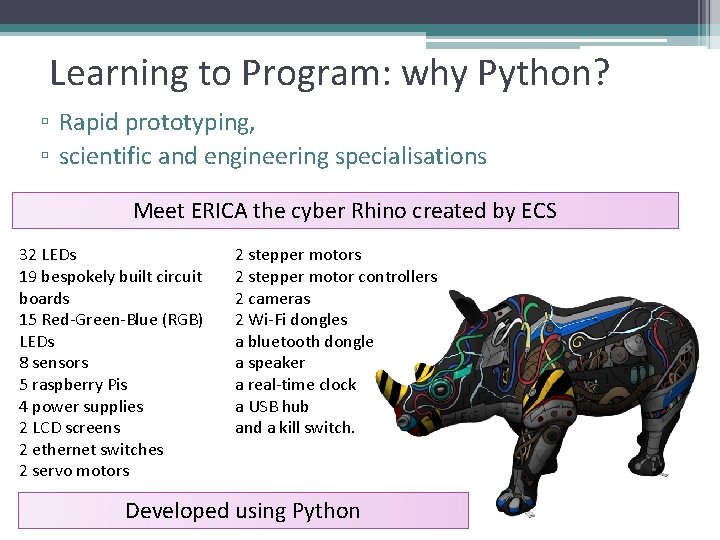
Learning to Program: why Python? ▫ Rapid prototyping, ▫ scientific and engineering specialisations Meet ERICA the cyber Rhino created by ECS 32 LEDs 19 bespokely built circuit boards 15 Red-Green-Blue (RGB) LEDs 8 sensors 5 raspberry Pis 4 power supplies 2 LCD screens 2 ethernet switches 2 servo motors 2 stepper motor controllers 2 cameras 2 Wi-Fi dongles a bluetooth dongle a speaker a real-time clock a USB hub and a kill switch. Developed using Python
Getting Python on your own machine • Go to https: //python. org ->Downloads (and select Windows or Mac. OSX etc) -> Chose Latest Python Release (at the top!) of ->2<- (currently 2. 7. 17, in Oct 2019) • Select The appropriate installer for your version of the OS (usually 64 bit) and follow instructions • When you run Python (or Idle) from the command line make sure it gives you the right version. (Others may already exist on your computer)
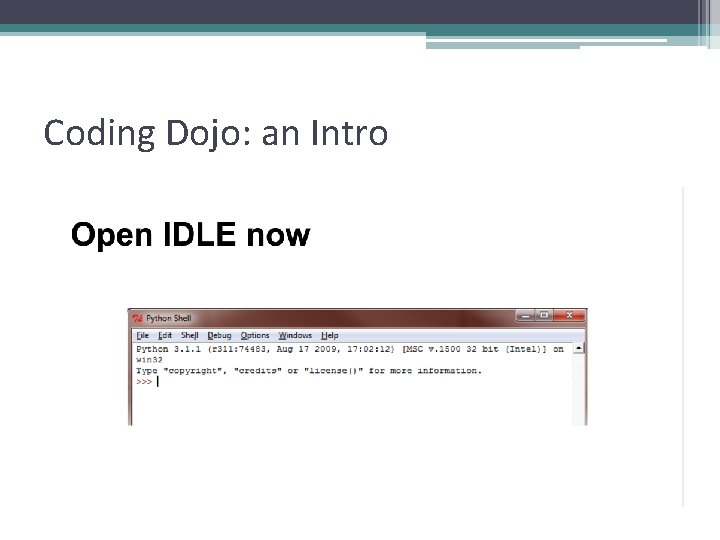
Coding Dojo: an Intro
Lets Go! • First two volunteers please
The End Introduction to Programming in Python Rikki Prince rfp@ecs. soton. ac. uk Yvonne Howard rfp@ecs. soton. ac. uk And Aristea, Huw, Jian, Jordi Nawar and Priyanka