
Computer and Robot Vision I ShihShinh Huang Email

Computer and Robot Vision I 黃世勳 (Shih-Shinh Huang) Email : poww@ccms. nkfust. edu. tw Office: B 322 -1 Office Hour: Ho (三) 9: 10 ~ 12: 00 1
Computer and Robot Vision I Syllabus 2
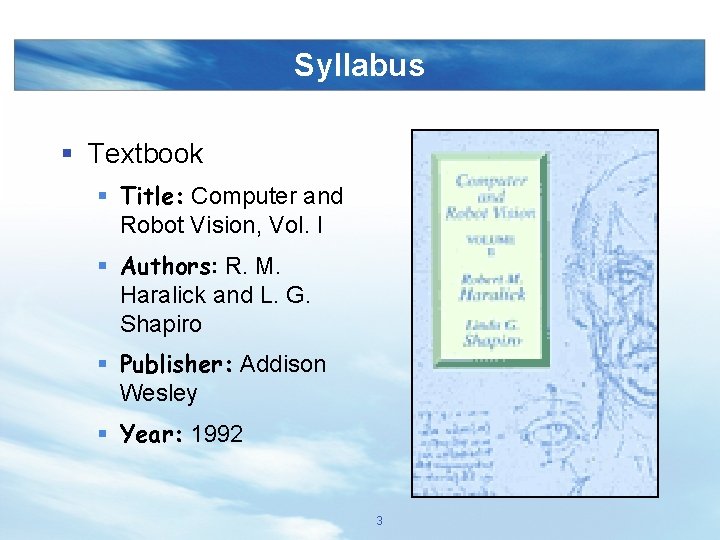
Syllabus § Textbook § Title: Computer and Robot Vision, Vol. I § Authors: R. M. Haralick and L. G. Shapiro § Publisher: Addison Wesley § Year: 1992 3
Syllabus § Course Outline § Basic Computer Vision • Computer Vision Overview • Binary Machine Vision: Thresholding and Segmentation • Binary Machine Vision: Region Analysis • Mathematical Morphology • Representation and Description • 3 D Computer Vision 4
Syllabus § Course Outline § Advanced Computer Vision • Statistical Pattern Recognition • Adaboost • SVM (Support Vector Machine) • HMM (Hidden Markov Model) • Kalman Filtering • Particle Filtering Tracking 5 Classification

Syllabus § Course Requirements § Homework Assignment (about 4) (40%) § Midterm Exam (Nov 21) (20 %) § Paper Reading (20 %) § Term Project (30%) 6
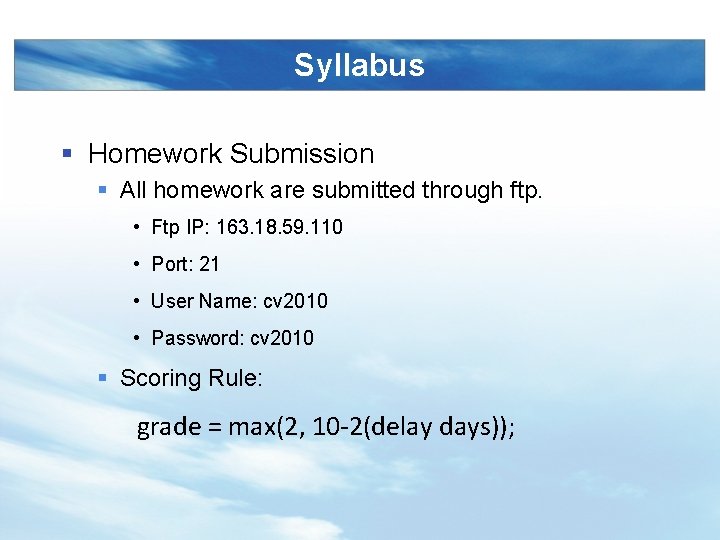
Syllabus § Homework Submission § All homework are submitted through ftp. • Ftp IP: 163. 18. 59. 110 • Port: 21 • User Name: cv 2010 • Password: cv 2010 § Scoring Rule: grade = max(2, 10 -2(delay days));
Computer and Robot Vision I Chapter 1 Computer Vision: Overview 8
Outline § 1. 1 Introduction § 1. 2 Recognition Methodology 9
Computer and Robot Vision I 1. 1 Introduction 10
1. 1 Introduction § Definition of Computer Vision § Develop theoretical and algorithmic basis to automatically extract and analyze useful information from an observed image, image set, or image sequence made by special-purpose or generalpurpose computers. emulate human vision with computers dual process of computer graphics 11

1. 1 Introduction § Journals 1. International Journal of Computer Vision (IJCV) 2. IEEE Trans. on Pattern Recognition and Machine Intelligence (PAMI). 3. IEEE Trans. on Image Processing (IP) 4. IEEE Trans. on Circuit Systems for Video Technology (CSVT) 5. Computer Vision and Image Understanding (CVIU) 6. CVGIP: Graphical Models and Image Processing 7. …… 12
1. 1 Introduction § Conference 1. International Conference on Computer Vision (ICCV) 2. IEEE Conference on Computer Vision and Pattern Recognition (CVPR) 3. European Conference on Computer Vision (ECCV) 4. Asian Conference on Computer Vision (ACCV) 5. IEEE Conference on Image Processing (ICIP) 6. IEEE Conference on Pattern Recognition (ICPR) 7. ……. 13
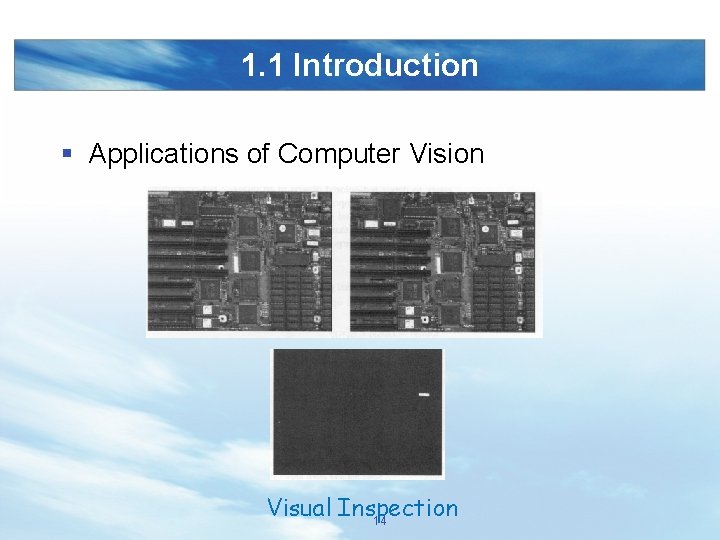
1. 1 Introduction § Applications of Computer Vision Visual Inspection 14
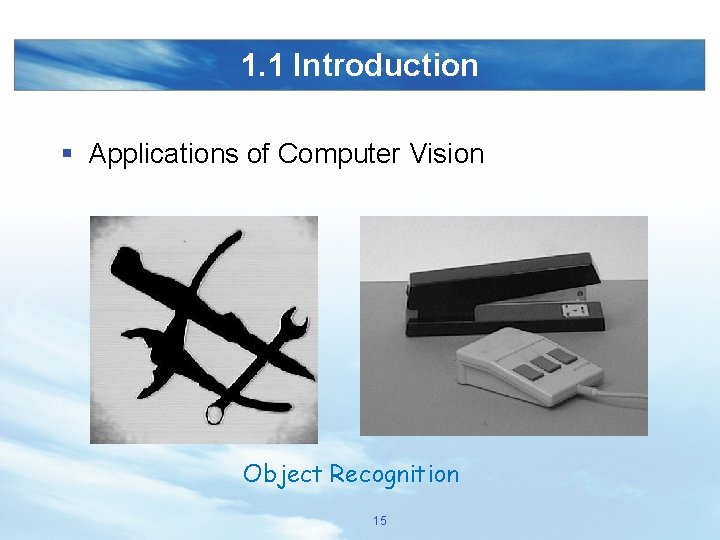
1. 1 Introduction § Applications of Computer Vision Object Recognition 15
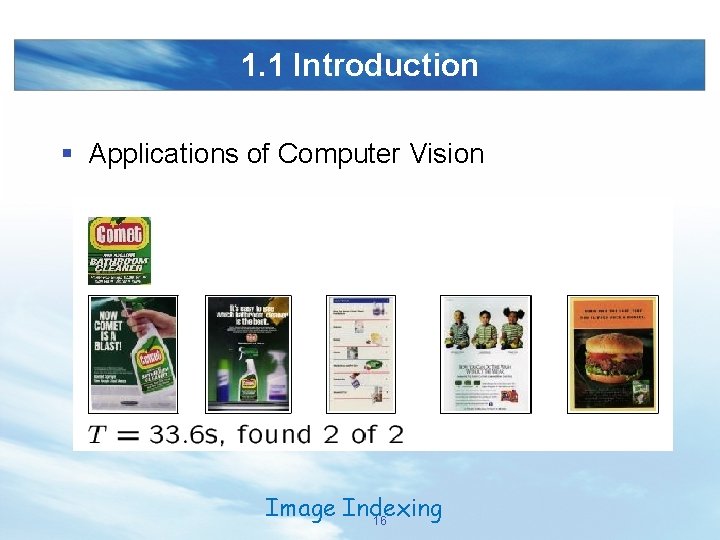
1. 1 Introduction § Applications of Computer Vision Image Indexing 16
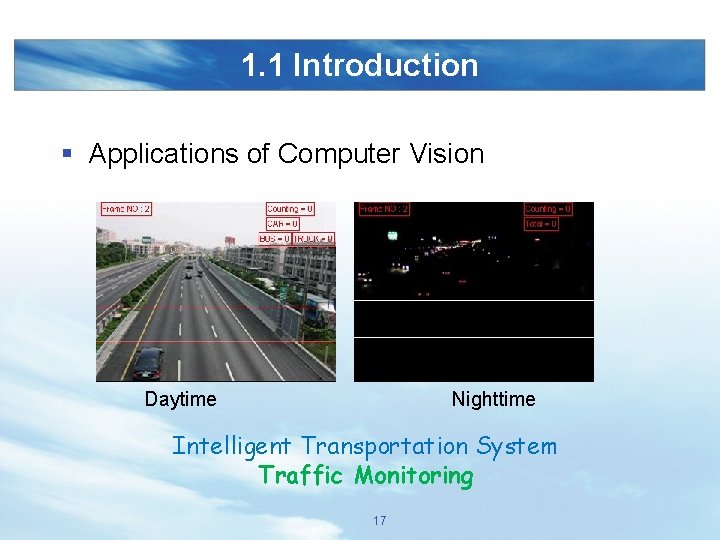
1. 1 Introduction § Applications of Computer Vision Daytime Nighttime Intelligent Transportation System Traffic Monitoring 17
1. 1 Introduction § Applications of Computer Vision Daytime Nighttime Intelligent Transportation System Lane/Vehicle Detection 18
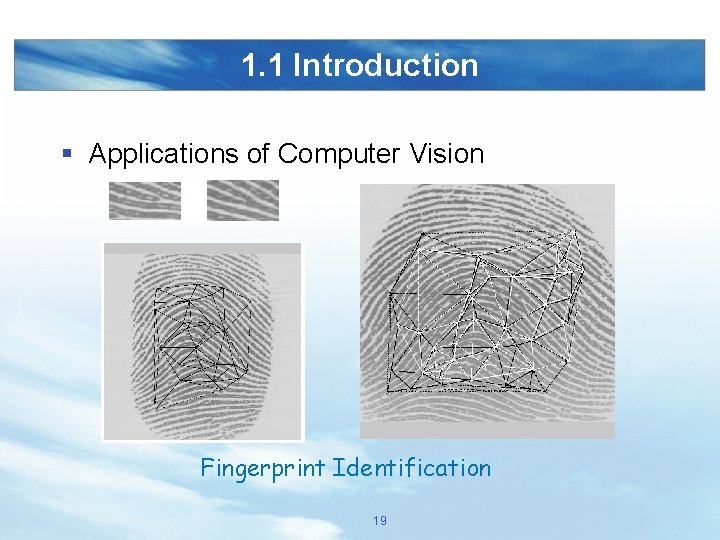
1. 1 Introduction § Applications of Computer Vision Fingerprint Identification 19
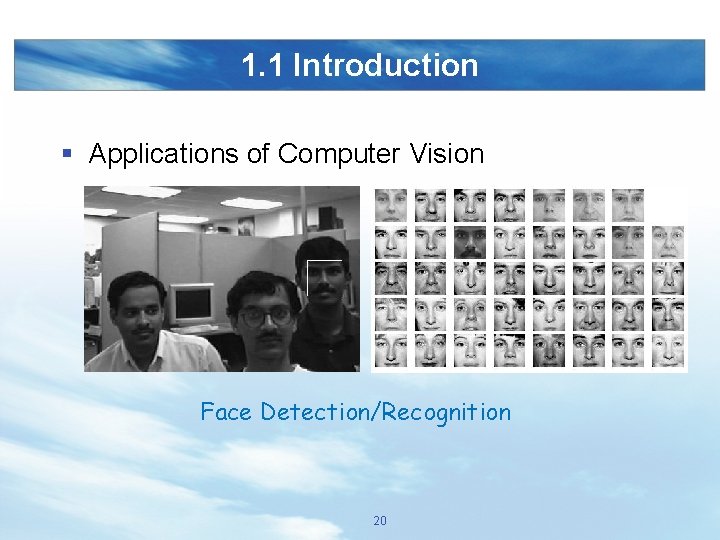
1. 1 Introduction § Applications of Computer Vision Face Detection/Recognition 20
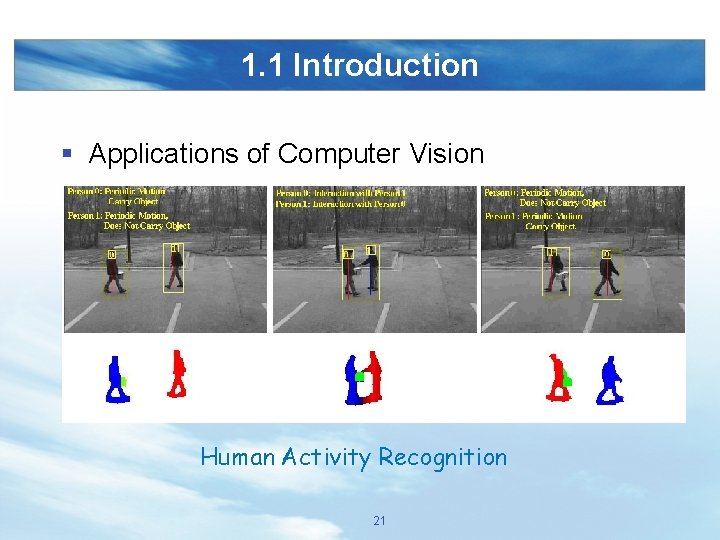
1. 1 Introduction § Applications of Computer Vision Human Activity Recognition 21
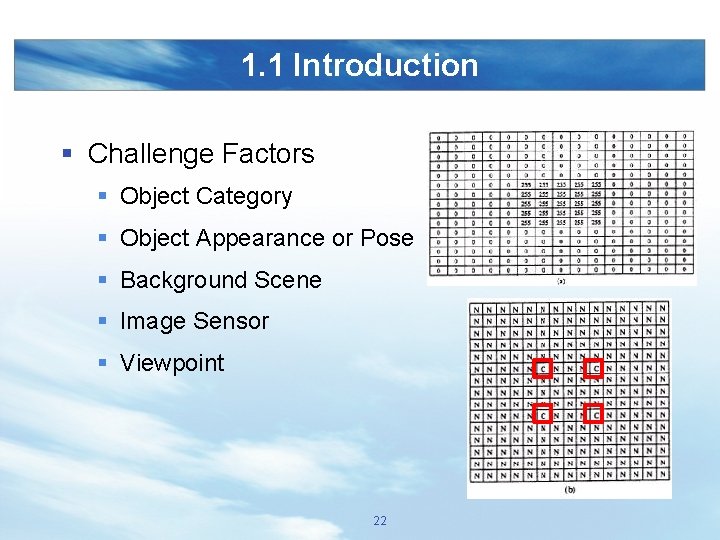
1. 1 Introduction § Challenge Factors § Object Category § Object Appearance or Pose § Background Scene § Image Sensor § Viewpoint 22
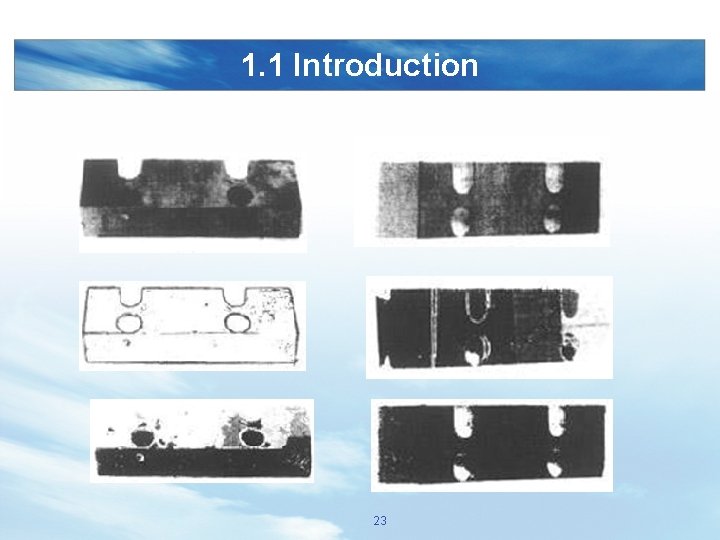
1. 1 Introduction 23
Computer and Robot Vision I 1. 2 Recognition Methodology 24
1. 2 Recognition Methodology § Six Steps § Image Formation § Conditioning § Labeling § Grouping § Feature Extraction § Matching (Detection / Classification) 25
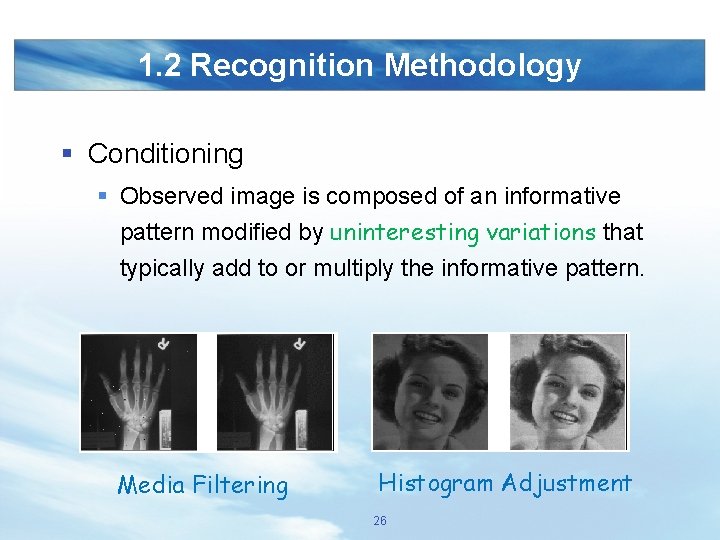
1. 2 Recognition Methodology § Conditioning § Observed image is composed of an informative pattern modified by uninteresting variations that typically add to or multiply the informative pattern. Media Filtering Histogram Adjustment 26
1. 2 Recognition Methodology § Labeling § Suggest that the informative pattern has structure as a spatial arrangement of events. § Each spatial event is a set of connected pixels. § Label pixels with the kinds of primitive spatial events. e. g. thresholding, edge detection, corner finding 27
1. 2 Recognition Methodology § Grouping § Identify the events by collecting together or identifying maximal connected sets of pixels participating in the same kind of event. e. g. segmentation, edge linking 28
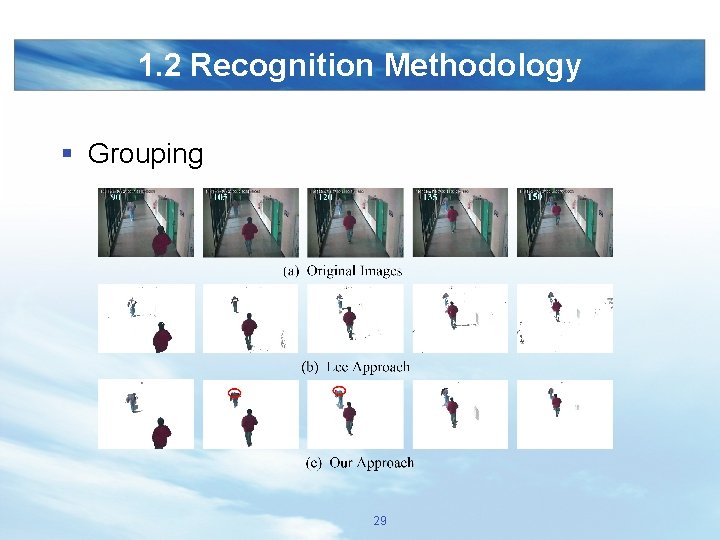
1. 2 Recognition Methodology § Grouping 29
1. 2 Recognition Methodology § Feature Extraction § Compute for each group of pixels a list of properties. • Area • Orientation • …. § Measure relationship between two or more groups • Topological Relationship • Spatial Relationship 30
1. 2 Recognition Methodology § Matching (Detection / Classification) § Determines the interpretation of some related set of image events § Associate these events with some given threedimensional object or two-dimensional shape. e. g. template matching 31

1. 2 Recognition Methodology § Matching (Detection / Classification) Matching Results Hierarchical Template Database Pedestrian Detection 32

1. 2 Recognition Methodology § Matching (Detection / Classification) Pedestrian Detection 33
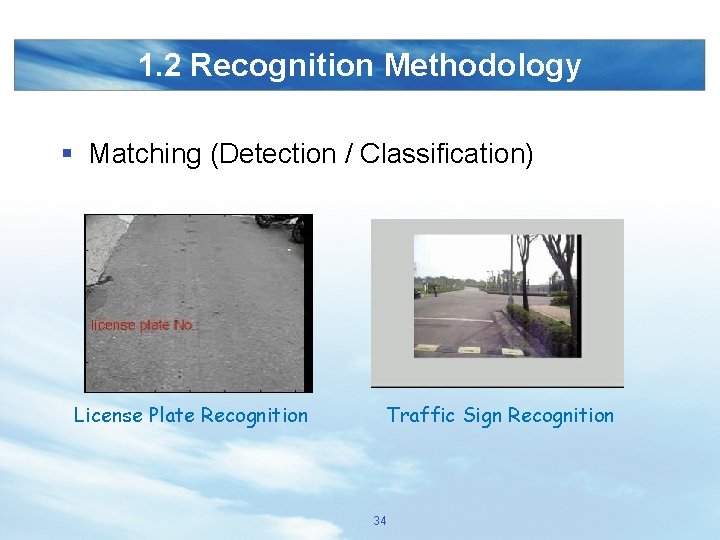
1. 2 Recognition Methodology § Matching (Detection / Classification) License Plate Recognition Traffic Sign Recognition 34

www. themegallery. com 35
- Slides: 35