
Computer and Information Security Chapter 6 Advanced Cryptanalysis

- Slides: 34
Computer and Information Security Chapter 6 Advanced Cryptanalysis 1
Chapter 6: Advanced Cryptanalysis For there is nothing covered, that shall not be revealed; neither hid, that shall not be known. Luke 12: 2 The magic words are squeamish ossifrage Solution to RSA challenge problem posed in 1977 by Ron Rivest, who estimated that breaking the message would require 40 quadrillion years. It was broken in 1994. Part 1 Cryptography 2
Introduction • More Advanced Attacks – – – WW II – the Enigma Attack on RC 4 as used in WEP Linear and Differential attacks Lattice Reduction attack on the knapsack A timeing attack on RSA 3
Advanced Cryptanalysis • Modern cryptanalysis – Differential cryptanalysis – Linear cryptanalysis • Side channel attack on RSA • Lattice reduction attack on knapsack • Hellman’s TMTO attack on DES Part 1 Cryptography 4
Linear and Differential Cryptanalysis Part 1 Cryptography 5
Introduction • Both linear and differential cryptanalysis developed to attack DES • Applicable to other block ciphers • Differential Biham and Shamir, 1990 – Apparently known to NSA in 1970’s – For analyzing ciphers, not a practical attack – A chosen plaintext attack • Linear cryptanalysis Matsui, 1993 – Perhaps not know to NSA in 1970’s – Slightly more feasible than differential cryptanalysis – A known plaintext attack Part 1 Cryptography 6
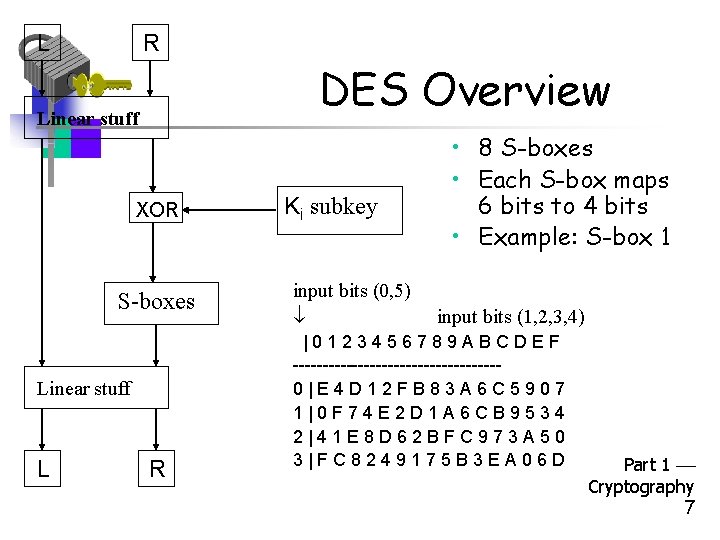
L R DES Overview Linear stuff XOR S-boxes Linear stuff L R Ki subkey input bits (0, 5) • 8 S-boxes • Each S-box maps 6 bits to 4 bits • Example: S-box 1 input bits (1, 2, 3, 4) |0123456789 ABCDEF -----------------0|E 4 D 12 FB 83 A 6 C 5907 1|0 F 74 E 2 D 1 A 6 CB 9534 2|41 E 8 D 62 BFC 973 A 50 3|FC 8249175 B 3 EA 06 D Part 1 Cryptography 7
Overview of Differential Cryptanalysis Part 1 Cryptography 8
Differential Cryptanalysis • • Consider DES All of DES is linear except S-boxes Differential attack focuses on nonlinearity Idea is to compare input and output differences • For simplicity, first consider one round and one S-box Part 1 Cryptography 9
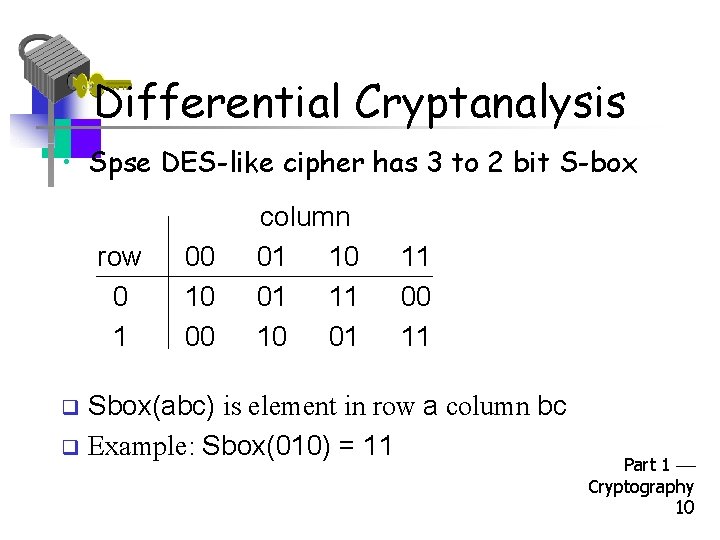
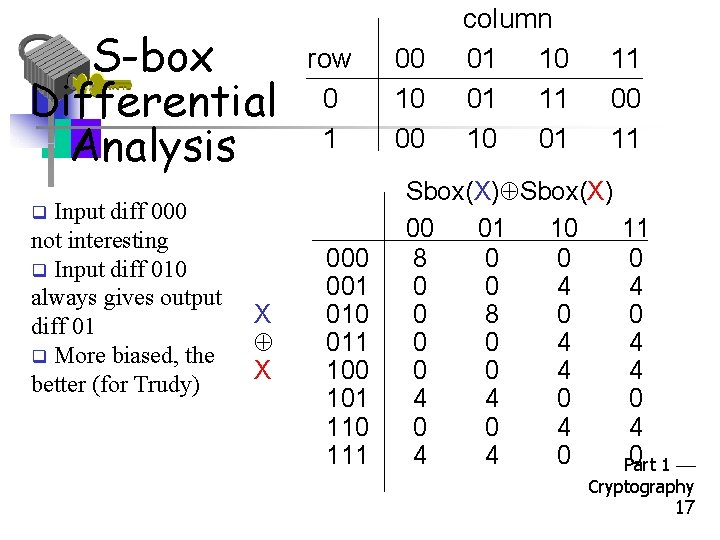
Differential Cryptanalysis • Spse DES-like cipher has 3 to 2 bit S-box row 0 1 00 10 00 column 01 10 01 11 00 11 Sbox(abc) is element in row a column bc q Example: Sbox(010) = 11 q Part 1 Cryptography 10
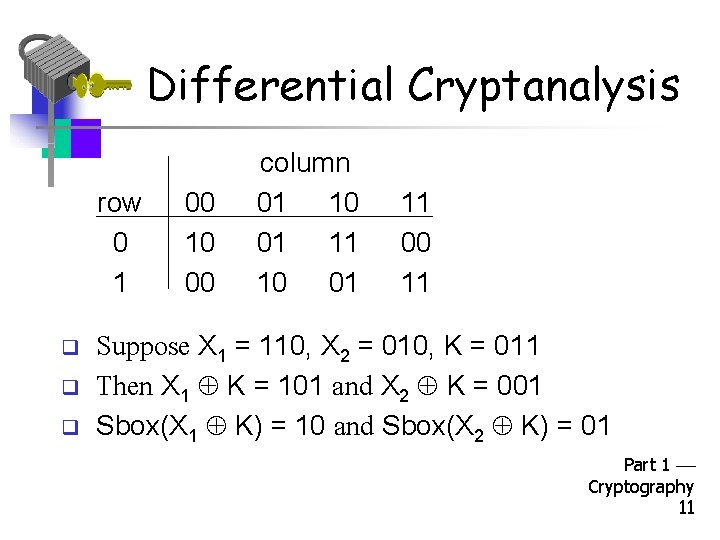
Differential Cryptanalysis row 0 1 q q q 00 10 00 column 01 10 01 11 00 11 Suppose X 1 = 110, X 2 = 010, K = 011 Then X 1 K = 101 and X 2 K = 001 Sbox(X 1 K) = 10 and Sbox(X 2 K) = 01 Part 1 Cryptography 11
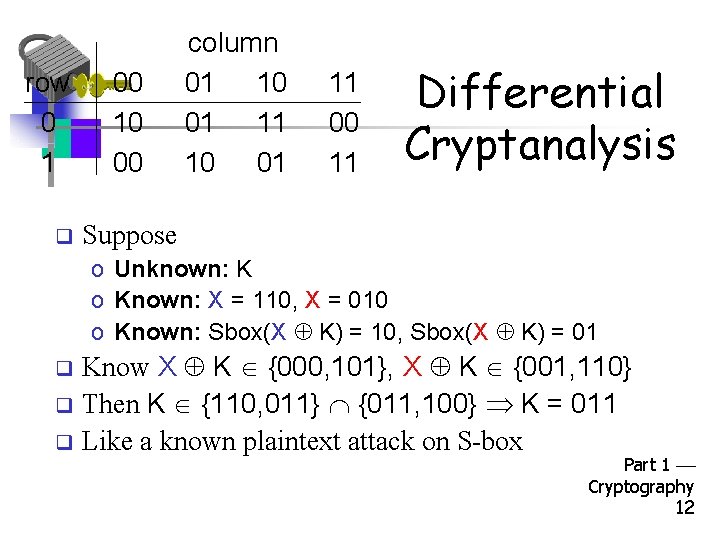
row 0 1 q 00 10 00 column 01 10 01 11 00 11 Differential Cryptanalysis Suppose o Unknown: K o Known: X = 110, X = 010 o Known: Sbox(X K) = 10, Sbox(X K) = 01 Know X K {000, 101}, X K {001, 110} q Then K {110, 011} {011, 100} K = 011 q Like a known plaintext attack on S-box q Part 1 Cryptography 12
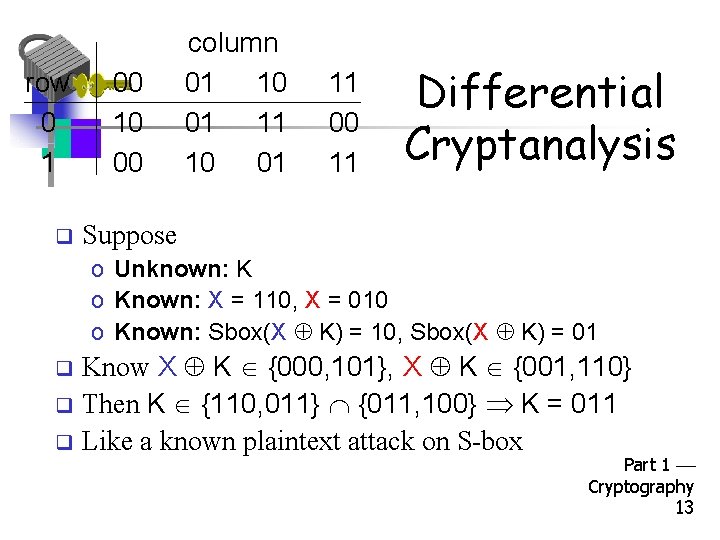
row 0 1 q 00 10 00 column 01 10 01 11 00 11 Differential Cryptanalysis Suppose o Unknown: K o Known: X = 110, X = 010 o Known: Sbox(X K) = 10, Sbox(X K) = 01 Know X K {000, 101}, X K {001, 110} q Then K {110, 011} {011, 100} K = 011 q Like a known plaintext attack on S-box q Part 1 Cryptography 13
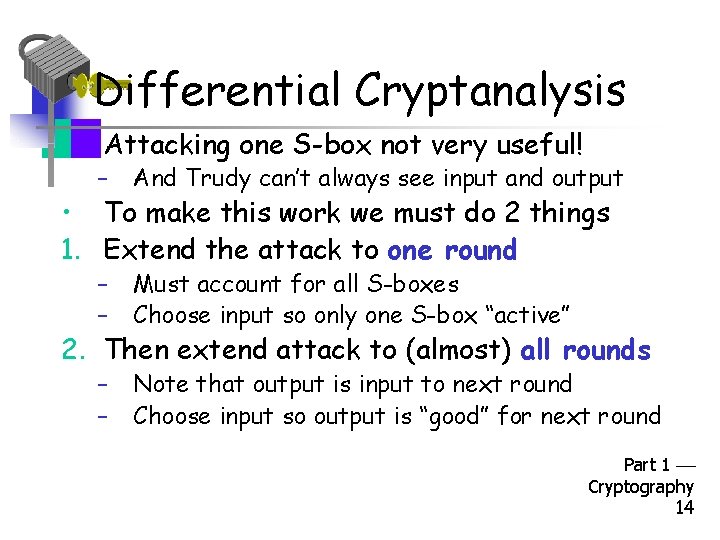
Differential Cryptanalysis • Attacking one S-box not very useful! – And Trudy can’t always see input and output – – Must account for all S-boxes Choose input so only one S-box “active” – – Note that output is input to next round Choose input so output is “good” for next round • To make this work we must do 2 things 1. Extend the attack to one round 2. Then extend attack to (almost) all rounds Part 1 Cryptography 14
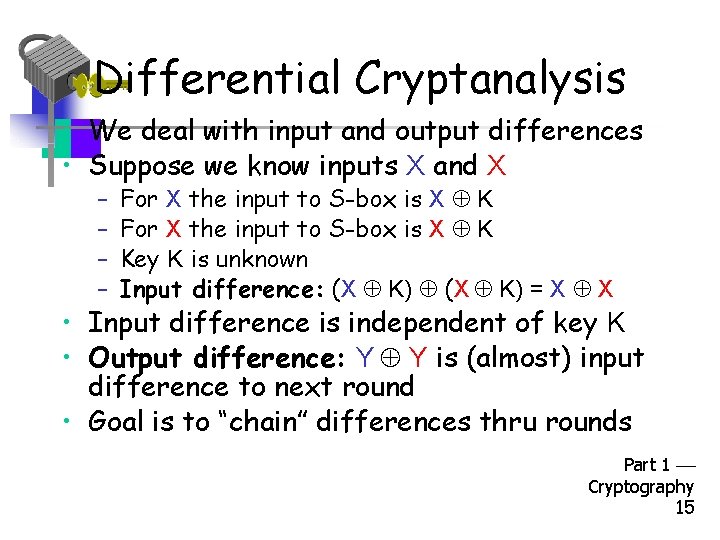
Differential Cryptanalysis • We deal with input and output differences • Suppose we know inputs X and X – – For X the input to S-box is X K Key K is unknown Input difference: (X K) = X X • Input difference is independent of key K • Output difference: Y Y is (almost) input difference to next round • Goal is to “chain” differences thru rounds Part 1 Cryptography 15
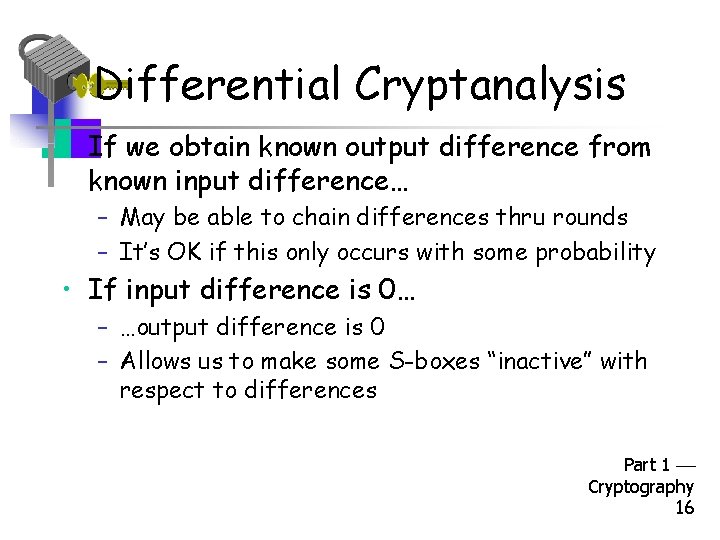
Differential Cryptanalysis • If we obtain known output difference from known input difference… – May be able to chain differences thru rounds – It’s OK if this only occurs with some probability • If input difference is 0… – …output difference is 0 – Allows us to make some S-boxes “inactive” with respect to differences Part 1 Cryptography 16
S-box Differential Analysis Input diff 000 not interesting q Input diff 010 always gives output diff 01 q More biased, the better (for Trudy) row 0 1 q X X 000 001 010 011 100 101 110 111 00 10 00 column 01 10 01 11 00 11 Sbox(X) 00 01 10 8 0 0 4 0 8 0 0 0 4 4 4 0 11 0 4 4 0 1 Part Cryptography 17
Overview of Linear Cryptanalysis Part 1 Cryptography 18
Linear Cryptanalysis • Like differential cryptanalysis, we target the nonlinear part of the cipher • But instead of differences, we approximate the nonlinearity with linear equations • For DES-like cipher we need to approximate S-boxes by linear functions • How well can we do this? Part 1 Cryptography 19
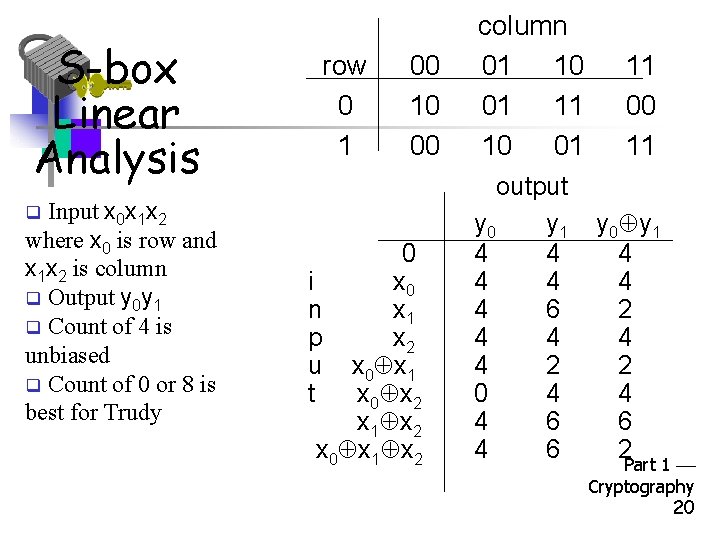
S-box Linear Analysis Input x 0 x 1 x 2 where x 0 is row and x 1 x 2 is column q Output y 0 y 1 q Count of 4 is unbiased q Count of 0 or 8 is best for Trudy row 0 1 00 10 00 q 0 i x 0 n x 1 p x 2 u x 0 x 1 t x 0 x 2 x 1 x 2 x 0 x 1 x 2 column 01 10 01 11 10 01 output y 0 y 1 4 4 4 6 4 4 4 2 0 4 4 6 11 00 11 y 0 y 1 4 4 2 4 6 2 Part 1 Cryptography 20
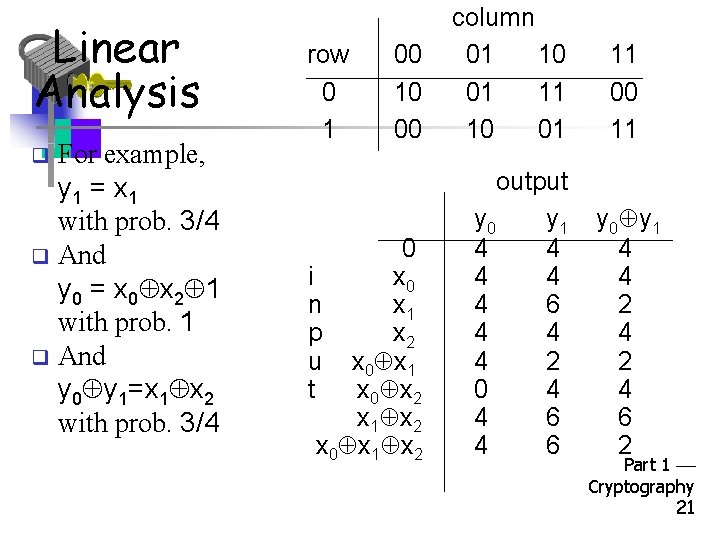
Linear Analysis For example, y 1 = x 1 with prob. 3/4 q And y 0 = x 0 x 2 1 with prob. 1 q And y 0 y 1=x 1 x 2 with prob. 3/4 00 10 00 column 01 10 01 11 10 01 0 i x 0 n x 1 p x 2 u x 0 x 1 t x 0 x 2 x 1 x 2 x 0 x 1 x 2 output y 0 y 1 4 4 4 6 4 4 4 2 0 4 4 6 row 0 1 q 11 00 11 y 0 y 1 4 4 2 4 6 2 Part 1 Cryptography 21
Linear Cryptanalysis • Consider a single DES S-box • Let Y = Sbox(X) • Suppose y 3 = x 2 x 5 with high probability – This is a linear approximation to output y 3 • Can we extend this so that we can solve linear equations for the key? • As in differential cryptanalysis, we need to “chain” thru multiple rounds Part 1 Cryptography 22
Linear Cryptanalysis of DES • DES is linear except for S-boxes • How well can we approximate S-boxes with linear functions? • DES S-boxes designed so there are no good linear approximations to any one output bit • But there are linear combinations of output bits that can be approximated by linear combinations of input bits Part 1 Cryptography 23
Tiny DES Part 1 Cryptography 24
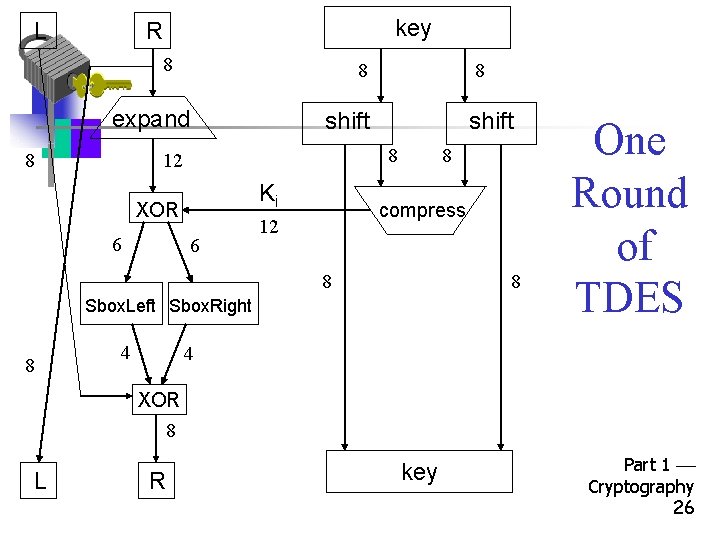
Tiny DES (TDES) • A much simplified version of DES – – – 16 bit block 16 bit key 4 rounds 2 S-boxes, each maps 6 bits to 4 bits 12 bit subkey each round • Plaintext = (L 0, R 0) • Ciphertext = (L 4, R 4) • No useless junk Part 1 Cryptography 25
L key R 8 8 expand 8 shift 8 12 Ki XOR 6 8 compress 12 8 8 Sbox. Left Sbox. Right 8 4 One Round of TDES 4 XOR 8 L R key Part 1 Cryptography 26
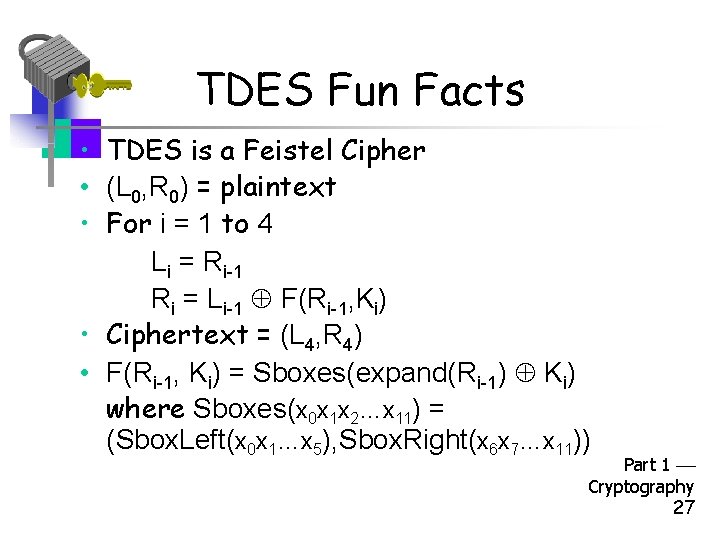
TDES Fun Facts • TDES is a Feistel Cipher • (L 0, R 0) = plaintext • For i = 1 to 4 Li = Ri-1 Ri = Li-1 F(Ri-1, Ki) • Ciphertext = (L 4, R 4) • F(Ri-1, Ki) = Sboxes(expand(Ri-1) Ki) where Sboxes(x 0 x 1 x 2…x 11) = (Sbox. Left(x 0 x 1…x 5), Sbox. Right(x 6 x 7…x 11)) Part 1 Cryptography 27
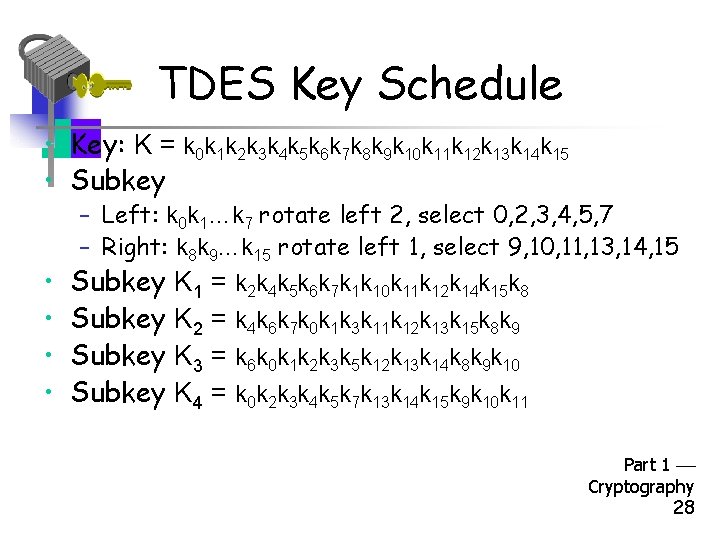
TDES Key Schedule • Key: K = k 0 k 1 k 2 k 3 k 4 k 5 k 6 k 7 k 8 k 9 k 10 k 11 k 12 k 13 k 14 k 15 • Subkey – Left: k 0 k 1…k 7 rotate left 2, select 0, 2, 3, 4, 5, 7 – Right: k 8 k 9…k 15 rotate left 1, select 9, 10, 11, 13, 14, 15 • Subkey K 1 = k 2 k 4 k 5 k 6 k 7 k 1 k 10 k 11 k 12 k 14 k 15 k 8 • Subkey K 2 = k 4 k 6 k 7 k 0 k 1 k 3 k 11 k 12 k 13 k 15 k 8 k 9 • Subkey K 3 = k 6 k 0 k 1 k 2 k 3 k 5 k 12 k 13 k 14 k 8 k 9 k 10 • Subkey K 4 = k 0 k 2 k 3 k 4 k 5 k 7 k 13 k 14 k 15 k 9 k 10 k 11 Part 1 Cryptography 28
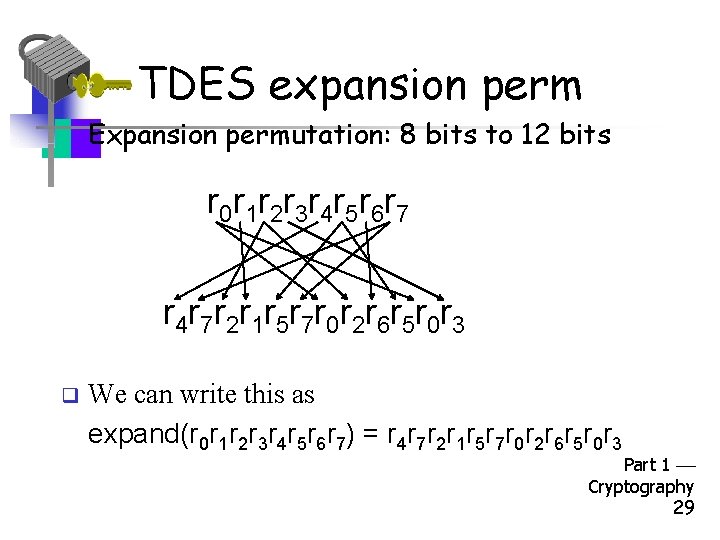
TDES expansion perm • Expansion permutation: 8 bits to 12 bits r 0 r 1 r 2 r 3 r 4 r 5 r 6 r 7 r 4 r 7 r 2 r 1 r 5 r 7 r 0 r 2 r 6 r 5 r 0 r 3 q We can write this as expand(r 0 r 1 r 2 r 3 r 4 r 5 r 6 r 7) = r 4 r 7 r 2 r 1 r 5 r 7 r 0 r 2 r 6 r 5 r 0 r 3 Part 1 Cryptography 29
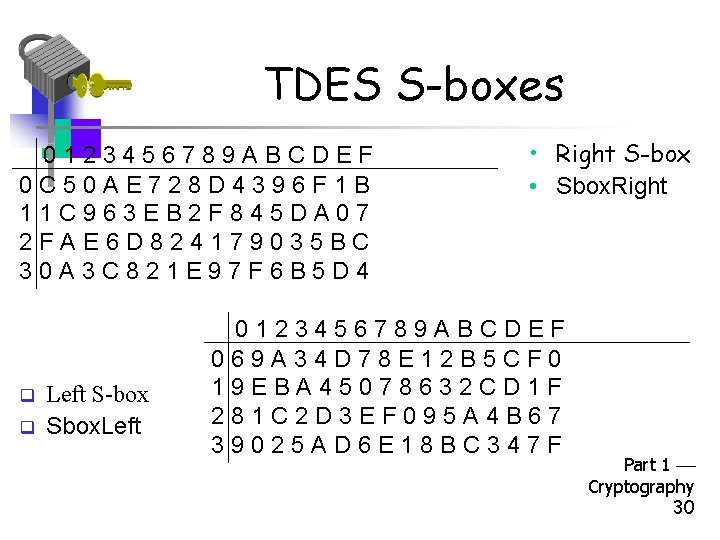
TDES S-boxes 0123456789 ABCDEF 0 C 50 AE 728 D 4396 F 1 B 11 C 963 EB 2 F 845 DA 07 2 FAE 6 D 824179035 BC 30 A 3 C 821 E 97 F 6 B 5 D 4 q q Left S-box Sbox. Left • Right S-box • Sbox. Right 0123456789 ABCDEF 069 A 34 D 78 E 12 B 5 CF 0 19 EBA 45078632 CD 1 F 281 C 2 D 3 EF 095 A 4 B 67 39025 AD 6 E 18 BC 347 F Part 1 Cryptography 30
Differential Cryptanalysis of TDES Part 1 Cryptography 31
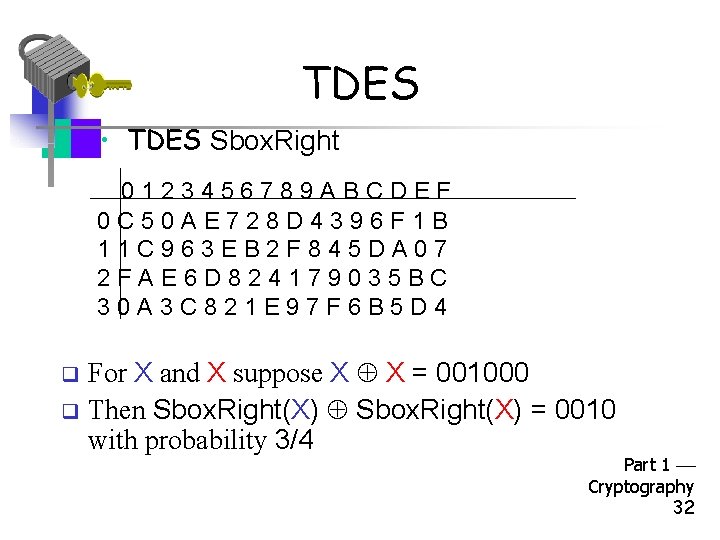
TDES • TDES Sbox. Right 0123456789 ABCDEF 0 C 50 AE 728 D 4396 F 1 B 11 C 963 EB 2 F 845 DA 07 2 FAE 6 D 824179035 BC 30 A 3 C 821 E 97 F 6 B 5 D 4 For X and X suppose X X = 001000 q Then Sbox. Right(X) = 0010 with probability 3/4 q Part 1 Cryptography 32
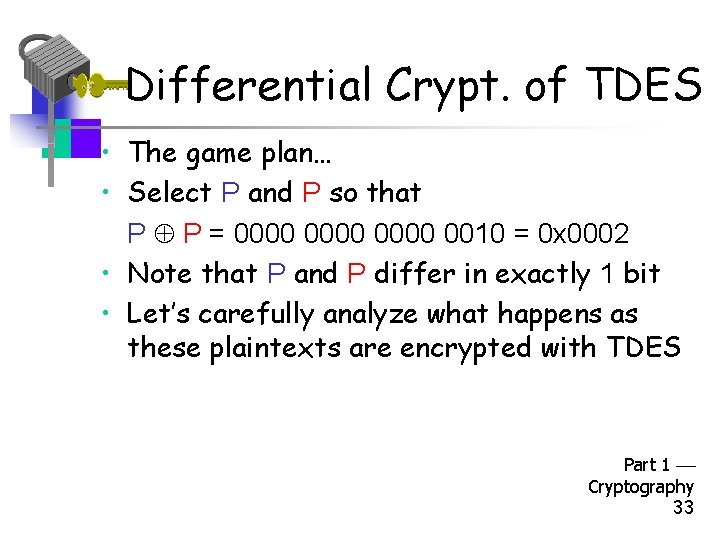
Differential Crypt. of TDES • The game plan… • Select P and P so that P P = 0000 0010 = 0 x 0002 • Note that P and P differ in exactly 1 bit • Let’s carefully analyze what happens as these plaintexts are encrypted with TDES Part 1 Cryptography 33
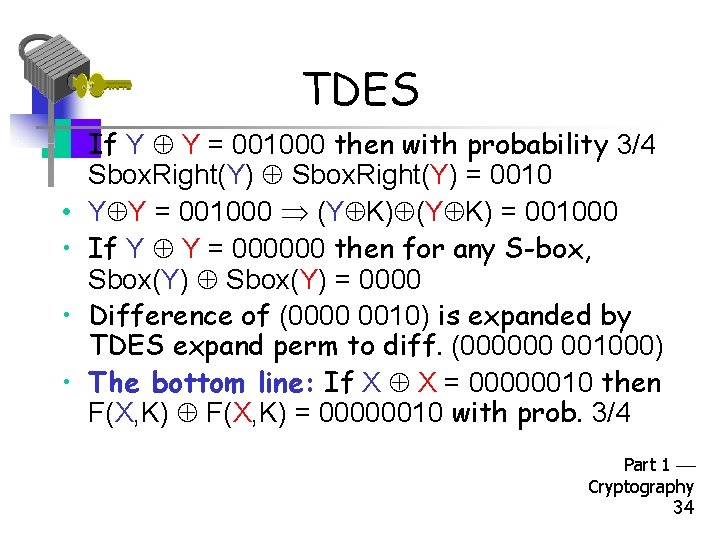
TDES • If Y Y = 001000 then with probability 3/4 Sbox. Right(Y) = 0010 • Y Y = 001000 (Y K) = 001000 • If Y Y = 000000 then for any S-box, Sbox(Y) = 0000 • Difference of (0000 0010) is expanded by TDES expand perm to diff. (000000 001000) • The bottom line: If X X = 00000010 then F(X, K) = 00000010 with prob. 3/4 Part 1 Cryptography 34