
Computer Algebra vs Reality Erik Postma and Elena
Computer Algebra vs. Reality Erik Postma and Elena Shmoylova Maplesoft June 25, 2009 © 2009 Maplesoft, a division of Waterloo Maple Inc.
Outline • Introduction • How to apply computer algebra techniques to real world problems? • Example • Open discussion © 2009 Maplesoft, a division of Waterloo Maple Inc. 2
Introduction • Computer algebra is based on symbolic computations • Benefit: Result is a nice closed form solution • Drawback: Problem itself should be nice too © 2009 Maplesoft, a division of Waterloo Maple Inc. 3
Computer Algebra Methods • Polynomial solvers for polynomial systems with coefficients in a rational extension field • Differential Groebner basis for polynomial DEs with coefficients in a rational extension field • Functional decomposition for multi- or univariate polynomials over a rational extension field • Index reduction for continuous and in some cases piecewise-continuous models © 2009 Maplesoft, a division of Waterloo Maple Inc. 4
Common Elements of Real-World Problems Floating point numbers and powers Trigonometric and other special functions Lookup tables Piecewise functions Numerical differentiators Compiled numerical procedures (“black-box” functions) • Delay elements • Random noise terms • etc. • • • © 2009 Maplesoft, a division of Waterloo Maple Inc. 5
How to apply computer algebra techniques to real-world problems? © 2009 Maplesoft, a division of Waterloo Maple Inc. 6
Convert One Type of Difficulty into Another • Look-up tables into piecewise • Almost anything into black-box function • Approximate functions by their Taylor or Padé series • Smooth piecewise functions, e. g. using radial basis functions • Floating point numbers into rationals © 2009 Maplesoft, a division of Waterloo Maple Inc. 7
Remove Difficulty from Model • If a difficulty can be combined into a subsystem, remove the subsystem from the model – View its arguments as outputs of the model – View its result as inputs into the model – Use symbolic technique on the model • Limited to techniques that can deal with arbitrary external inputs © 2009 Maplesoft, a division of Waterloo Maple Inc. 8
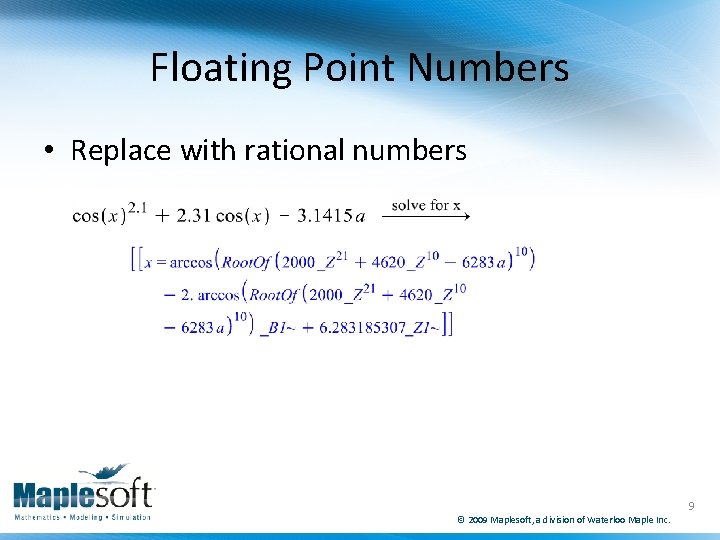
Floating Point Numbers • Replace with rational numbers © 2009 Maplesoft, a division of Waterloo Maple Inc. 9
Initial Conditions for Hybrid DAE Models • Problem: – User does not provide all initial conditions, need to find remaining initial conditions • Difficulty: – High-order DAEs have hidden constraints that may be needed to find initial conditions © 2009 Maplesoft, a division of Waterloo Maple Inc. 10
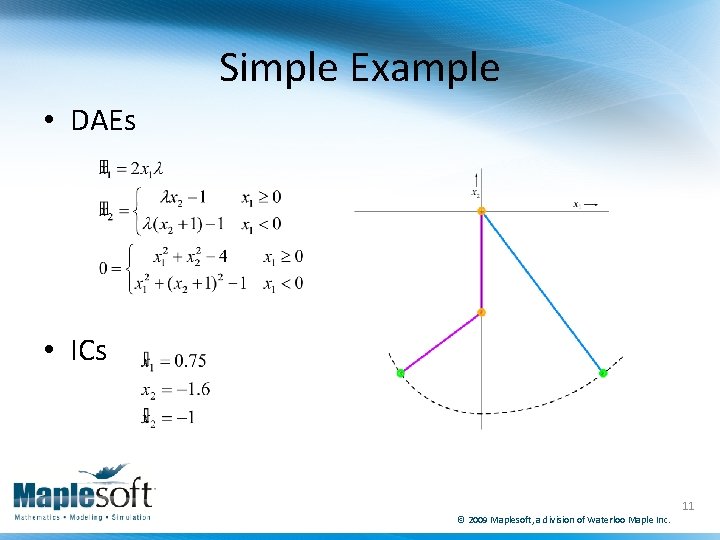
Simple Example • DAEs • ICs © 2009 Maplesoft, a division of Waterloo Maple Inc. 11
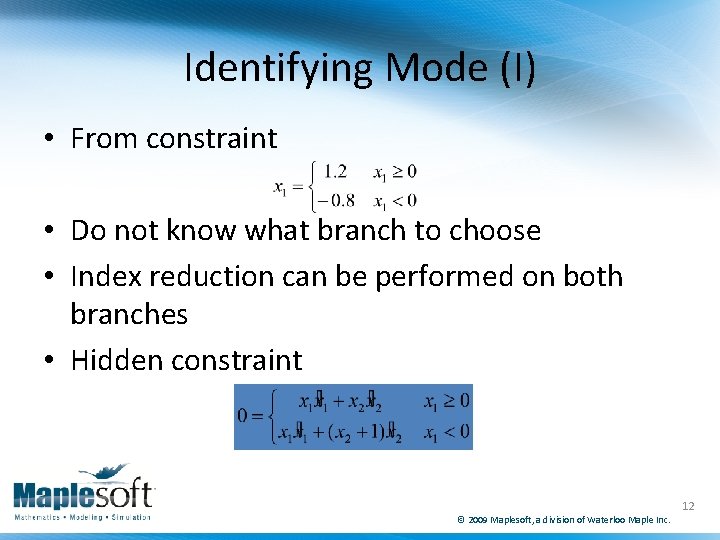
Identifying Mode (I) • From constraint • Do not know what branch to choose • Index reduction can be performed on both branches • Hidden constraint © 2009 Maplesoft, a division of Waterloo Maple Inc. 12
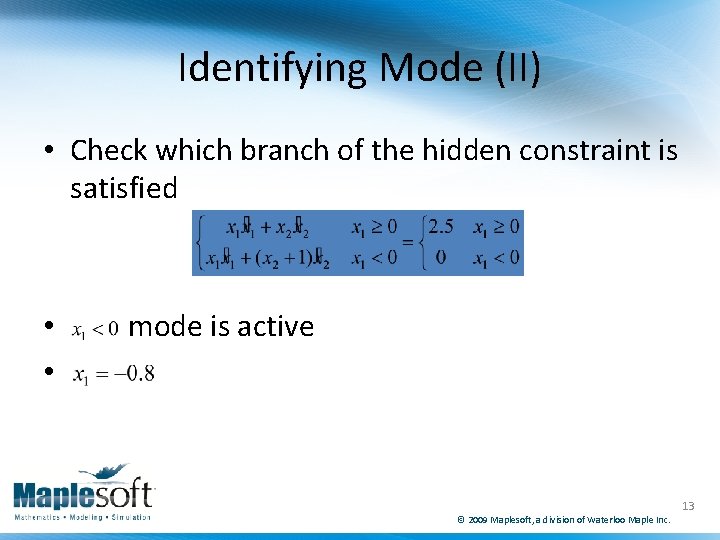
Identifying Mode (II) • Check which branch of the hidden constraint is satisfied • • mode is active © 2009 Maplesoft, a division of Waterloo Maple Inc. 13
Initial Conditions for Hybrid DAEs • To find ICs, hidden constraints are needed • To find hidden constraints, index reduction should be performed • It is infeasible to perform index reduction for all modes separately, need to know what mode system is in • To find mode of system, need to know the values of all variables, i. e. ICs © 2009 Maplesoft, a division of Waterloo Maple Inc. 14
Open Discussion: How to apply computer algebra techniques to real-world problems? © 2009 Maplesoft, a division of Waterloo Maple Inc. 15
- Slides: 15