
Computer aided drug design Lecture 12 Structural Bioinformatics
Computer aided drug design Lecture 12 Structural Bioinformatics Dr. Avraham Samson 81 -871 1
Perspective • Principles of drug discovery (brief) • Computer driven drug discovery • Data driven drug discovery • Modern target identification and selection • Modern lead identification Overall strong structural bioinformatics emphasis
What is a drug? • Defined composition with a pharmacological effect • Regulated by the Food and Drug Administration (FDA) • What is the process of Drug Discovery and Development?

Drugs and the Discovery Process • Small Molecules – Natural products • fermentation broths • plant extracts • animal fluids (e. g. , snake venoms) – Synthetic Medicinal Chemicals • Project medicinal chemistry derived • Combinatorial chemistry derived • Biologicals – Natural products (isolation) – Recombinant products – Chimeric or novel recombinant products
Discovery vs. Development • Discovery includes: Concept, mechanism, assay, screening, hit identification, lead demonstration, lead optimization • Discovery also includes In Vivo proof of concept in animals and concomitant demonstration of a therapeutic index • Development begins when the decision is made to put a molecule into phase I clinical trials
Discovery and Development • The time from conception to approval of a new drug is typically 10 -15 years • The vast majority of molecules fail along the way • The estimated cost to bring to market a successful drug is now $800 million!! (Dimasi, 2000)
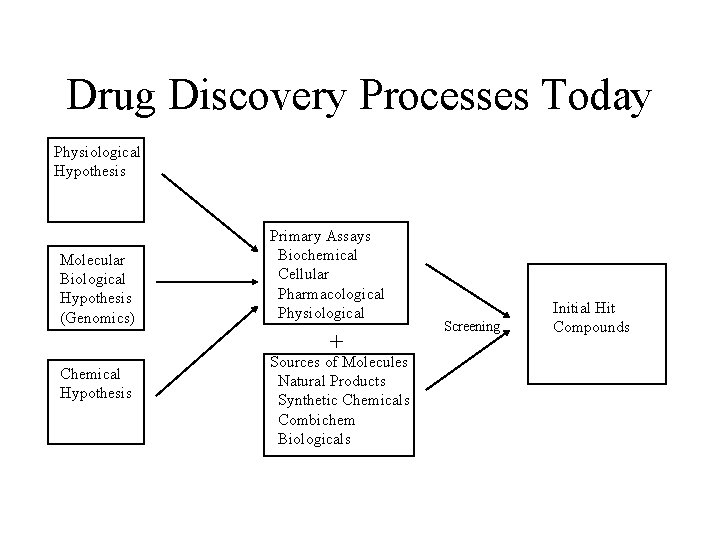
Drug Discovery Processes Today Physiological Hypothesis Molecular Biological Hypothesis (Genomics) Primary Assays Biochemical Cellular Pharmacological Physiological + Chemical Hypothesis Sources of Molecules Natural Products Synthetic Chemicals Combichem Biologicals Screening Initial Hit Compounds

Drug Discovery Processes - II Initial Hit Compounds Secondary Evaluation - Mechanism Of Action - Dose Response Hit to Lead Chemistry - physical properties -in vitro metabolism Initial Synthetic Evaluation - analytics - first analogs First In Vivo Tests - PK, efficacy, toxicity
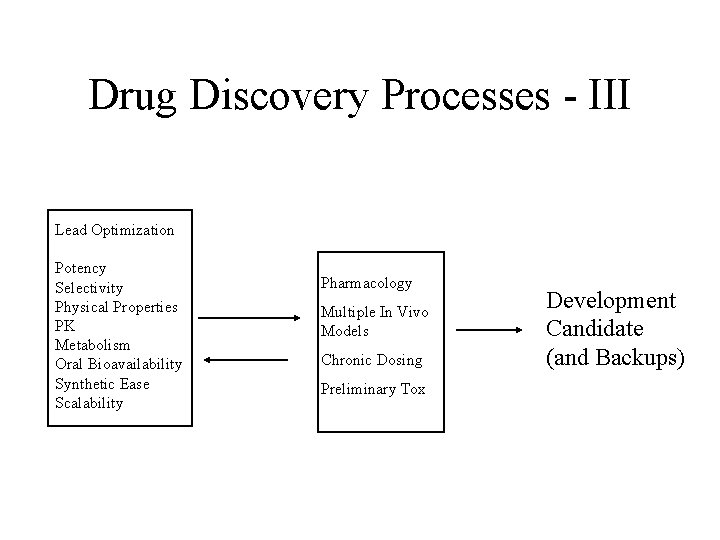
Drug Discovery Processes - III Lead Optimization Potency Selectivity Physical Properties PK Metabolism Oral Bioavailability Synthetic Ease Scalability Pharmacology Multiple In Vivo Models Chronic Dosing Preliminary Tox Development Candidate (and Backups)

Drug Discovery Disciplines • • • Medicine Physiology/pathology Pharmacology Molecular/cellular biology Automation/robotics Medicinal, analytical, and combinatorial chemistry • Structural and computational chemistries • Bioinformatics
Drug Discovery Program Rationales • Unmet Medical Need • Me Too! - Market - ($$$s) • Drugs in search of indications – Side-effects often lead to new indications • Indications in search of drugs – Mechanism based, hypothesis driven, reductionism
Serendipity and Drug Discovery • Often molecules are discovered/synthesized for one indication and then turn out to be useful for others – Tamoxifen (birth control and cancer) – Viagra (hypertension and erectile dysfunction) – Salvarsan (Sleeping sickness and syphilis) – Interferon-a (hairy cell leukemia and Hepatitis C)
Issues in Drug Discovery • • Hits and Leads - Is it a “Druggable” target? Resistance Pharmacodynamics Delivery - oral and otherwise Metabolism Solubility, toxicity Patentability
A Little History of Computer Aided Drug Design • 1960’s - Viz - review the target - drug interaction • 1980’s- Automation - high trhoughput target/drug selection • 1980’s- Databases (information technology) - combinatorial libraries • 1980’s- Fast computers - docking • 1990’s- Fast computers - genome assembly - genomic based target selection • 2000’s- Vast information handling - pharmacogenomics
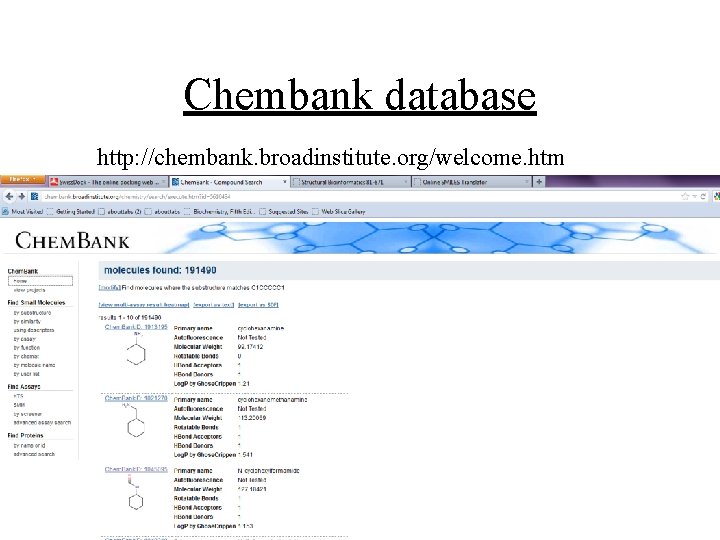
Chembank database http: //chembank. broadinstitute. org/welcome. htm

Patchdock http: //bioinfo 3 d. cs. tau. ac. il/Patch. Dock/index. html
From the Computer Perspective

Progress About the computer industry… “If the automobile industry had made as much progress in the past fifty years, a car today would cost a hundredth of a cent and go faster than the speed of light. ” – Ray Kurzweil, The Age of Spiritual Machines

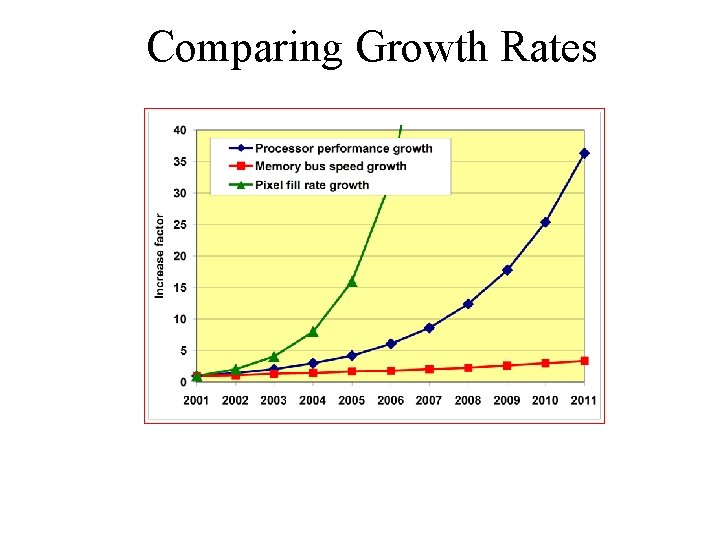
Growth of pixel fill rates SGI PC cards * Not counting custom hardware or special configurations • Fill rates recently growing by x 2 every year Data source: Product literature
Comparing Growth Rates
From the Target Perspective


Bioinformatics - A Revolution Biological Experiment Collect Data Information Characterize Knowledge Compare Model Discovery Infer Complexity Higher-life Technology 1 Organ 10 Brain Mapping Assembly Structure Sequence Model Metaboloic Pathway of E. coli 102 Neuronal Modeling 106 Virus Structure Ribosome Human Genome Project Yeast E. Coli C. Elegans Genome 1 # People/Web Site Genetic Circuits ESTs 90 100000 Computing Power Cardiac Modeling Cellular Sub-cellular Data 1000 100 Gene Chips 95 Year 00 1 Small Genome/Mo. Human Genome 05 Sequencing Technology

The Accumulation of Knowledge This “molecular scene” for c. AMP dependant protein kinase (PKA) depicts years of collective knowledge. Traditionally structure determination has been functional driven As we shall see it is becoming genomically driven
Example - http: //arabidopsis. sdsc. edu
Combinatorial Libraries • Thousands of variations to a fixed template • Good libraries span large areas of chemical and conformational space - molecular diversity • Diversity in - steric, electrostatic, hydrophobic interactions. . . • Desire to be as broad as “Merck” compounds from random screening • Computer aided library design is in its infancy Blaney and Martin - Curr. Op. In Chem. Biol. (1997) 1: 54 -59
- Slides: 27