
COMPUTER AIDED DIAGNOSIS CLASSIFICATION Prof Yasser Mostafa Kadah

- Slides: 13
COMPUTER AIDED DIAGNOSIS: CLASSIFICATION Prof. Yasser Mostafa Kadah – www. kspace. org
Recommended Reference Recent Advances in Breast Imaging, Mammography, and Computer-Aided Diagnosis of Breast Cancer, Editors: Jasjit S. Suri and Rangaraj M. Rangayyan, SPIE Press, 2006.
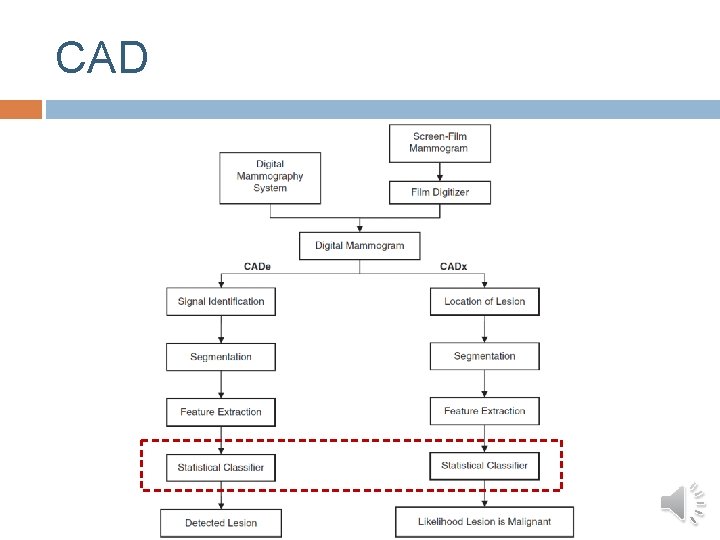
CAD
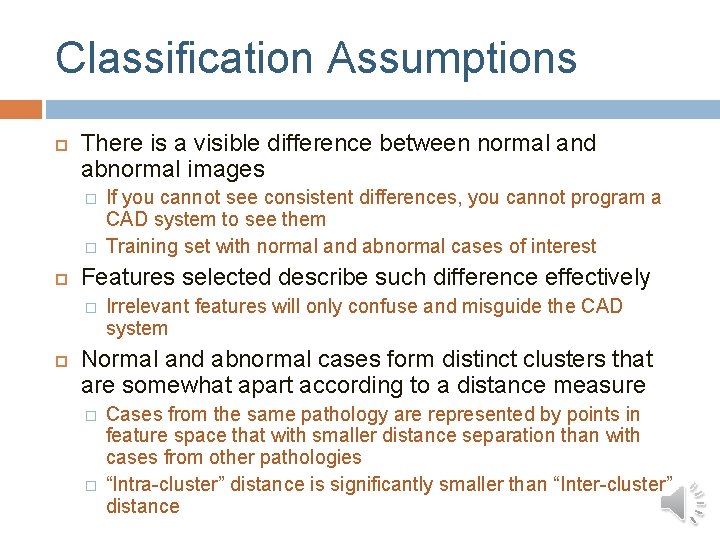
Classification Assumptions There is a visible difference between normal and abnormal images � � Features selected describe such difference effectively � If you cannot see consistent differences, you cannot program a CAD system to see them Training set with normal and abnormal cases of interest Irrelevant features will only confuse and misguide the CAD system Normal and abnormal cases form distinct clusters that are somewhat apart according to a distance measure � � Cases from the same pathology are represented by points in feature space that with smaller distance separation than with cases from other pathologies “Intra-cluster” distance is significantly smaller than “Inter-cluster” distance
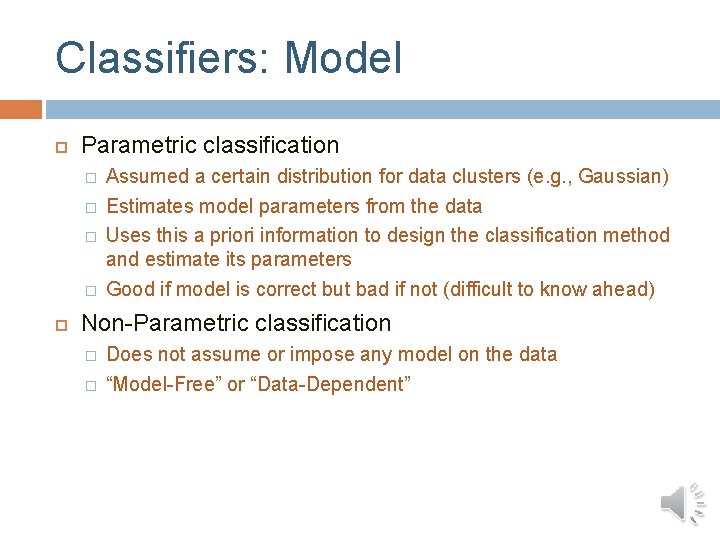
Classifiers: Model Parametric classification � � Assumed a certain distribution for data clusters (e. g. , Gaussian) Estimates model parameters from the data Uses this a priori information to design the classification method and estimate its parameters Good if model is correct but bad if not (difficult to know ahead) Non-Parametric classification � � Does not assume or impose any model on the data “Model-Free” or “Data-Dependent”
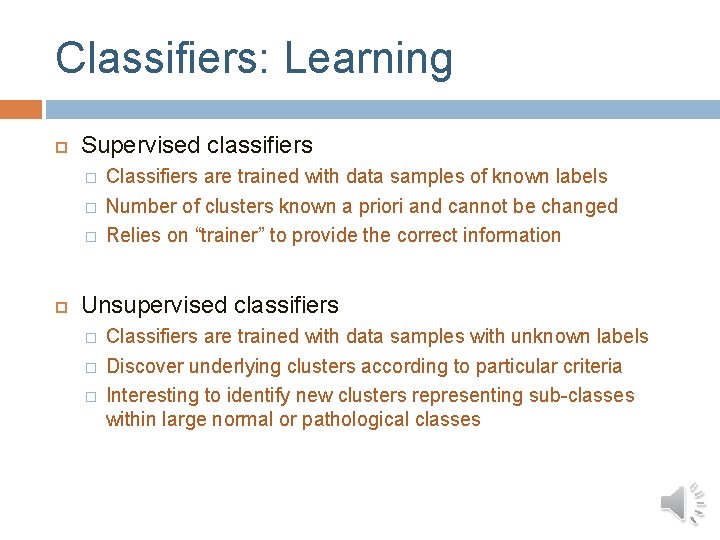
Classifiers: Learning Supervised classifiers � � � Classifiers are trained with data samples of known labels Number of clusters known a priori and cannot be changed Relies on “trainer” to provide the correct information Unsupervised classifiers � � � Classifiers are trained with data samples with unknown labels Discover underlying clusters according to particular criteria Interesting to identify new clusters representing sub-classes within large normal or pathological classes
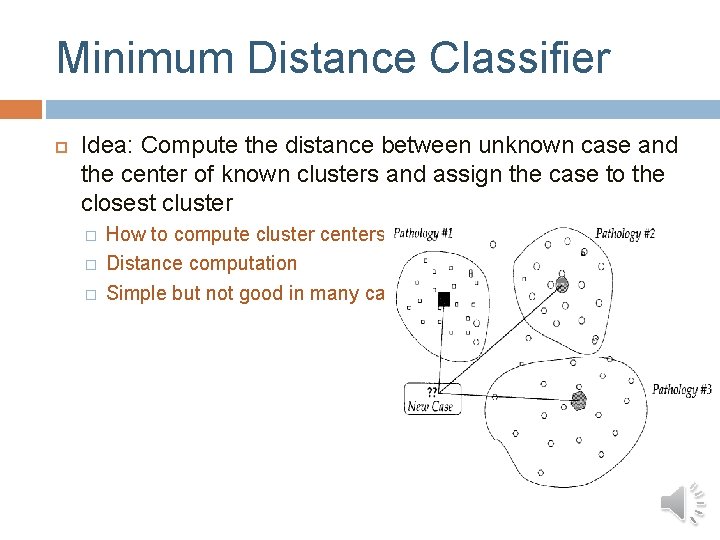
Minimum Distance Classifier Idea: Compute the distance between unknown case and the center of known clusters and assign the case to the closest cluster � � � How to compute cluster centers Distance computation Simple but not good in many cases
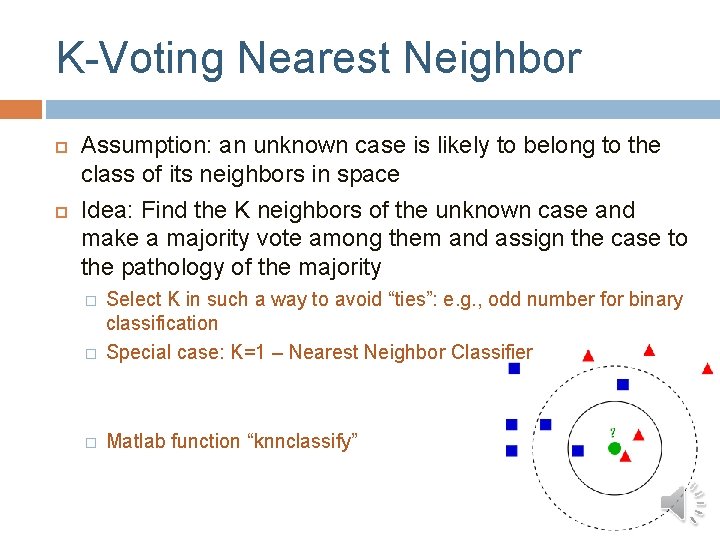
K-Voting Nearest Neighbor Assumption: an unknown case is likely to belong to the class of its neighbors in space Idea: Find the K neighbors of the unknown case and make a majority vote among them and assign the case to the pathology of the majority � Select K in such a way to avoid “ties”: e. g. , odd number for binary classification Special case: K=1 – Nearest Neighbor Classifier � Matlab function “knnclassify” �
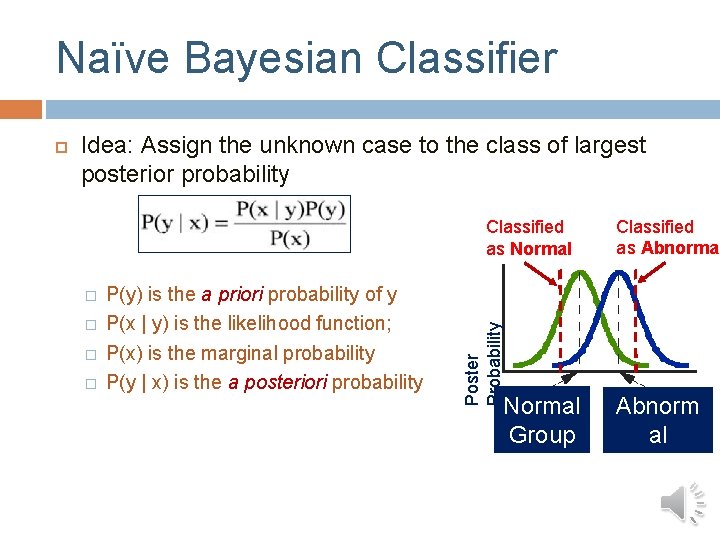
Naïve Bayesian Classifier Idea: Assign the unknown case to the class of largest posterior probability Classified as Normal � � P(y) is the a priori probability of y P(x | y) is the likelihood function; P(x) is the marginal probability P(y | x) is the a posteriori probability Poster Probability Normal Group Classified as Abnormal Abnorm al Group
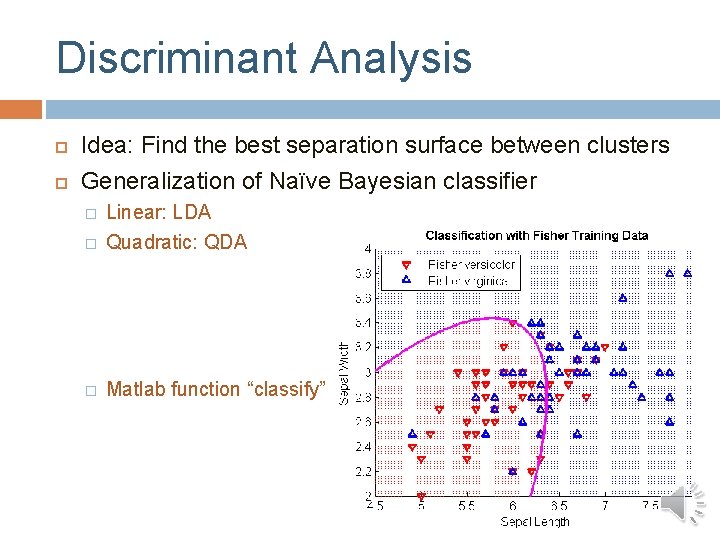
Discriminant Analysis Idea: Find the best separation surface between clusters Generalization of Naïve Bayesian classifier � Linear: LDA Quadratic: QDA � Matlab function “classify” �
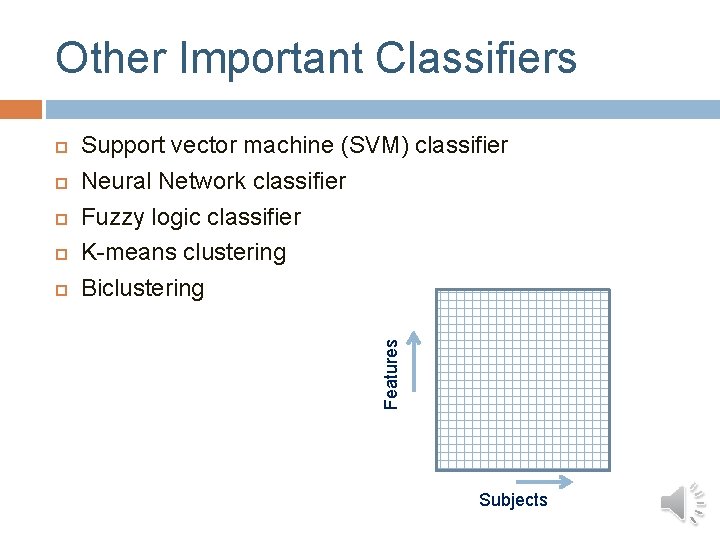
Other Important Classifiers Support vector machine (SVM) classifier Neural Network classifier Fuzzy logic classifier K-means clustering Biclustering Features Subjects
Things to Watch for Feature normalization is important and can improve training and classification results Independent training and testing data is a must � � Half and half for example Leave-one-out cross validation can be used for small data sets
Assignments Apply 2 classification methods to the selected features obtained from previous tasks and compare their results