
Computer Aided Analysis as an assistance to corrosion




- Slides: 32
Computer Aided Analysis as an assistance to corrosion control and reduction: from find-it/fix-it towards predict&manage Dr. Ing. Agnieszka Franczak, Elsyca NV, Belgium
Outline 1. Current practices in corrosion risk assessment 2. Role of a Computer Aided Analysis in corrosion risk assessment 3. The science behind the buttons 4. Corrosion design assistant 2
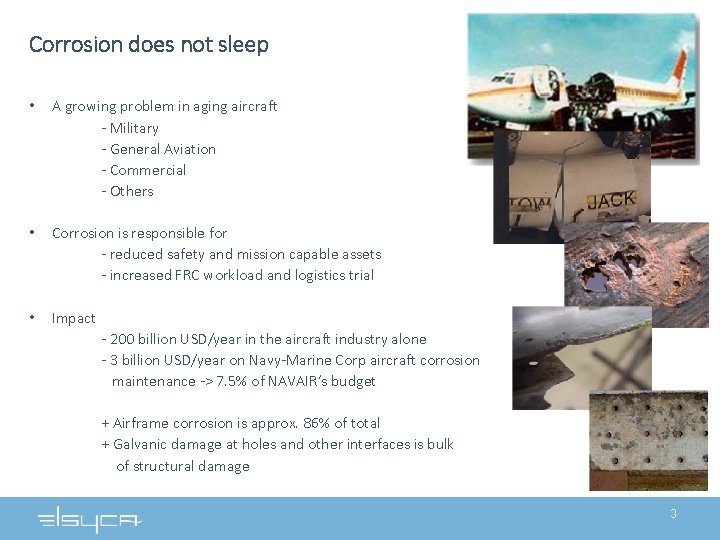
Corrosion does not sleep • A growing problem in aging aircraft - Military - General Aviation - Commercial - Others • Corrosion is responsible for - reduced safety and mission capable assets - increased FRC workload and logistics trial • Impact - 200 billion USD/year in the aircraft industry alone - 3 billion USD/year on Navy-Marine Corp aircraft corrosion maintenance -> 7. 5% of NAVAIR’s budget + Airframe corrosion is approx. 86% of total + Galvanic damage at holes and other interfaces is bulk of structural damage 3
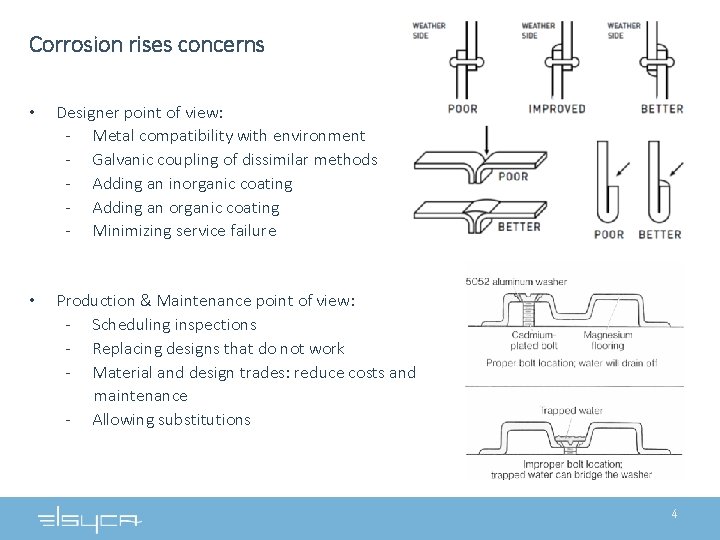
Corrosion rises concerns • Designer point of view: - Metal compatibility with environment - Galvanic coupling of dissimilar methods - Adding an inorganic coating - Adding an organic coating - Minimizing service failure • Production & Maintenance point of view: - Scheduling inspections - Replacing designs that do not work - Material and design trades: reduce costs and maintenance - Allowing substitutions 4
What do we do now?
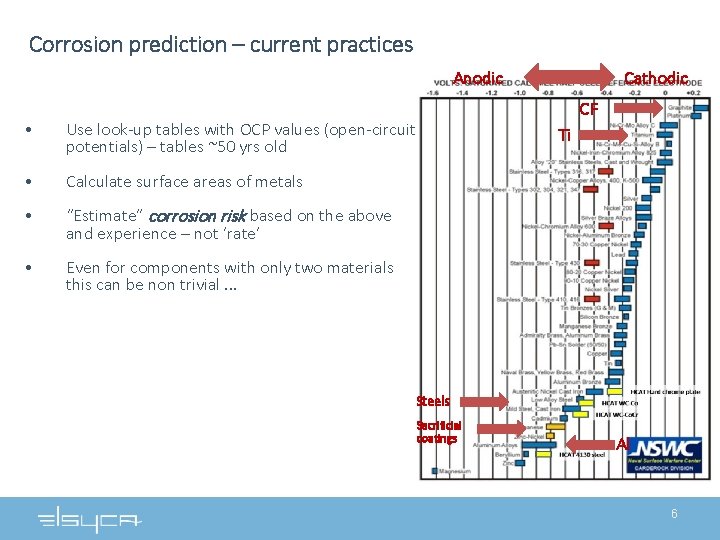
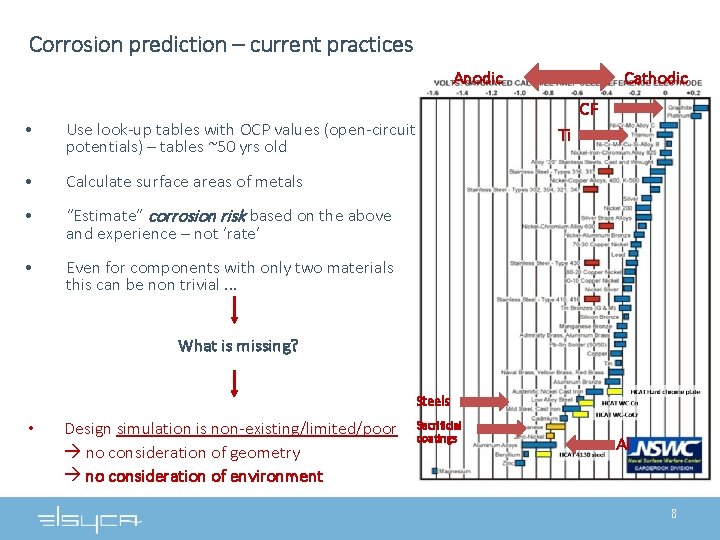
Corrosion prediction – current practices Cathodic Anodic • Use look-up tables with OCP values (open-circuit potentials) – tables ~50 yrs old • Calculate surface areas of metals • “Estimate” corrosion risk based on the above and experience – not ‘rate’ • Even for components with only two materials this can be non trivial. . . CF Ti Steels Sacrificial coatings Al 6
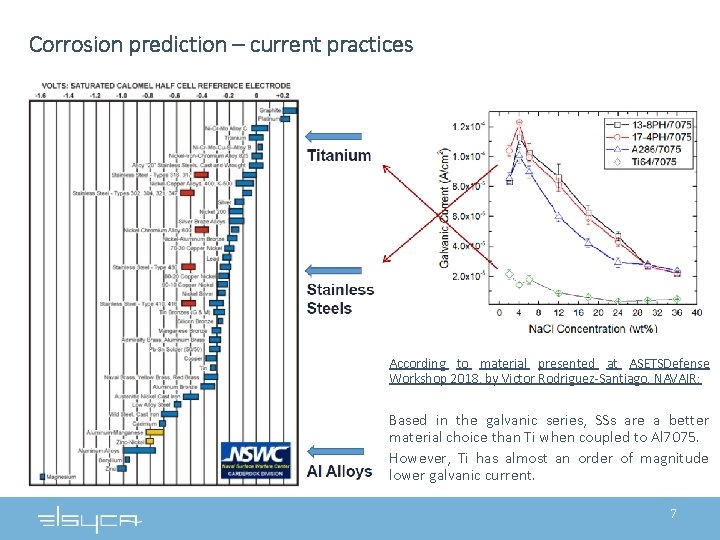
Corrosion prediction – current practices According to material presented at ASETSDefense Workshop 2018, by Victor Rodriguez-Santiago, NAVAIR: Based in the galvanic series, SSs are a better material choice than Ti when coupled to Al 7075. However, Ti has almost an order of magnitude lower galvanic current. 7
Corrosion prediction – current practices Cathodic Anodic • Use look-up tables with OCP values (open-circuit potentials) – tables ~50 yrs old • Calculate surface areas of metals • “Estimate” corrosion risk based on the above and experience – not ‘rate’ • Even for components with only two materials this can be non trivial. . . CF Ti What is missing? Steels • Design simulation is non-existing/limited/poor no consideration of geometry no consideration of environment Sacrificial coatings Al 8
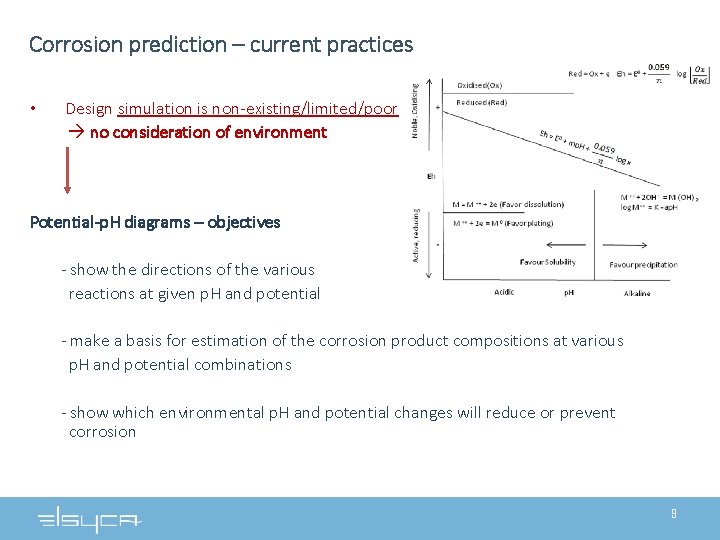
Corrosion prediction – current practices • Design simulation is non-existing/limited/poor no consideration of environment Potential-p. H diagrams – objectives - show the directions of the various reactions at given p. H and potential - make a basis for estimation of the corrosion product compositions at various p. H and potential combinations - show which environmental p. H and potential changes will reduce or prevent corrosion 9
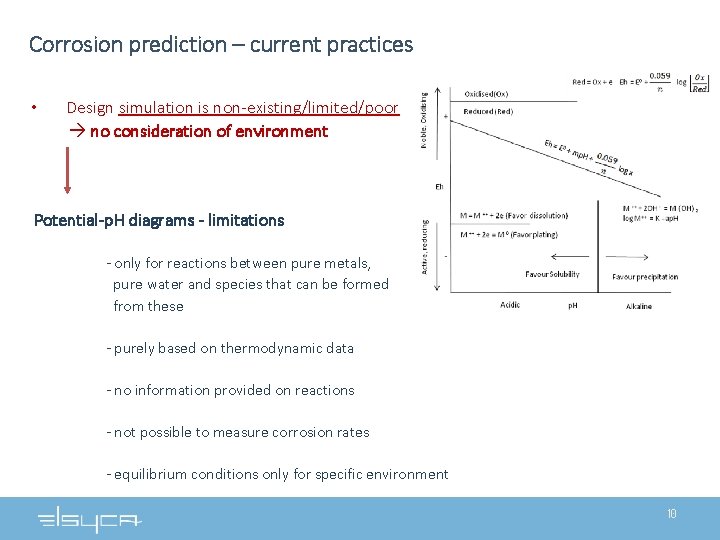
Corrosion prediction – current practices • Design simulation is non-existing/limited/poor no consideration of environment Potential-p. H diagrams - limitations - only for reactions between pure metals, pure water and species that can be formed from these - purely based on thermodynamic data - no information provided on reactions - not possible to measure corrosion rates - equilibrium conditions only for specific environment 10
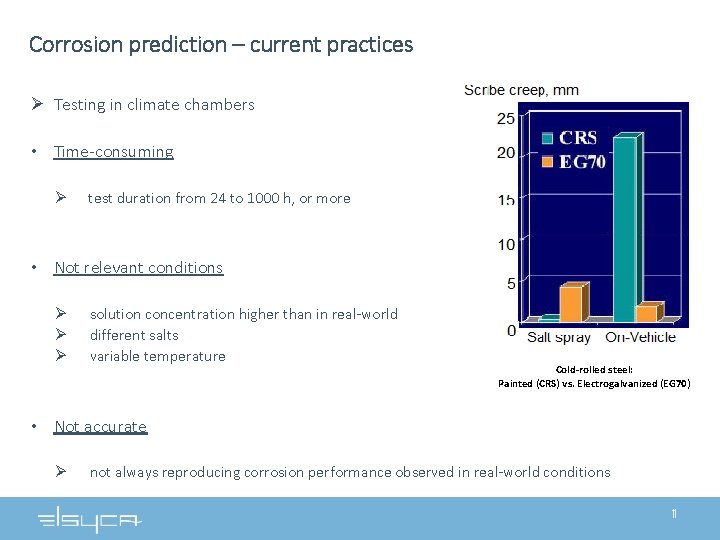
Corrosion prediction – current practices Ø Testing in climate chambers • Time-consuming Ø test duration from 24 to 1000 h, or more • Not relevant conditions Ø Ø Ø solution concentration higher than in real-world different salts variable temperature Cold-rolled steel: Painted (CRS) vs. Electrogalvanized (EG 70) • Not accurate Ø not always reproducing corrosion performance observed in real-world conditions 11
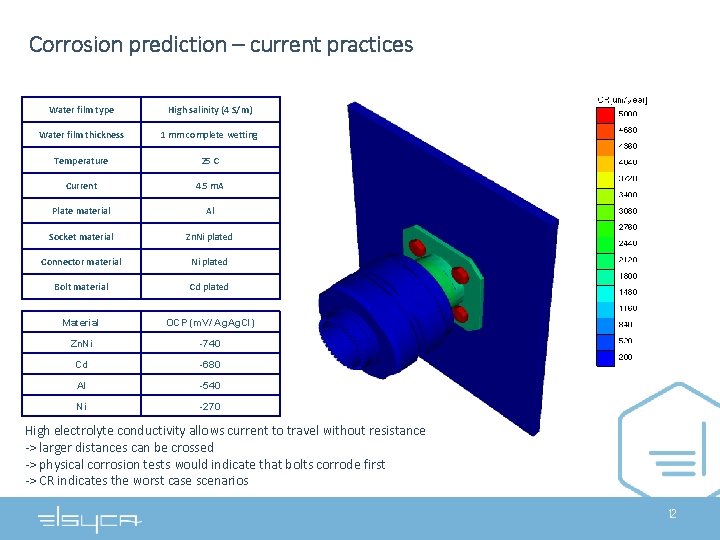
Corrosion prediction – current practices Water film type High salinity (4 S/m) Water film thickness 1 mm complete wetting Temperature 25 C Current 4. 5 m. A Plate material Al Socket material Zn. Ni plated Connector material Ni plated Bolt material Cd plated Material OCP (m. V/ Ag. Cl) Zn. Ni -740 Cd -680 Al -540 Ni -270 High electrolyte conductivity allows current to travel without resistance -> larger distances can be crossed -> physical corrosion tests would indicate that bolts corrode first -> CR indicates the worst case scenarios 12
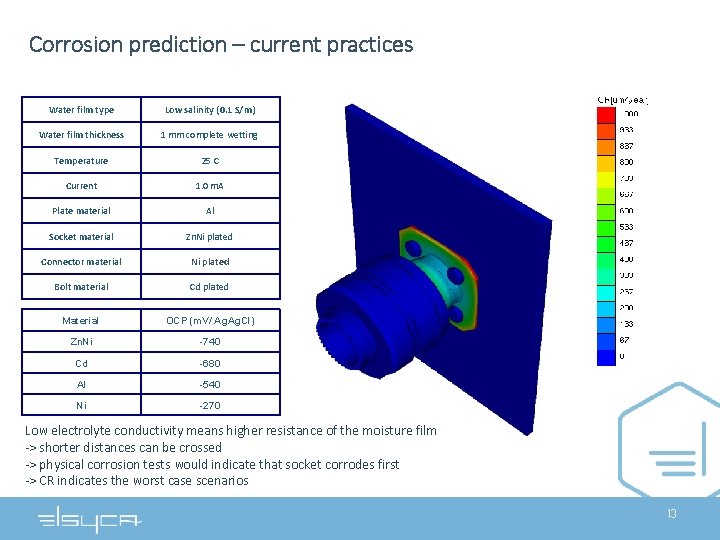
Corrosion prediction – current practices Water film type Low salinity (0. 1 S/m) Water film thickness 1 mm complete wetting Temperature 25 C Current 1. 0 m. A Plate material Al Socket material Zn. Ni plated Connector material Ni plated Bolt material Cd plated Material OCP (m. V/ Ag. Cl) Zn. Ni -740 Cd -680 Al -540 Ni -270 Low electrolyte conductivity means higher resistance of the moisture film -> shorter distances can be crossed -> physical corrosion tests would indicate that socket corrodes first -> CR indicates the worst case scenarios 13
What do we want to do?
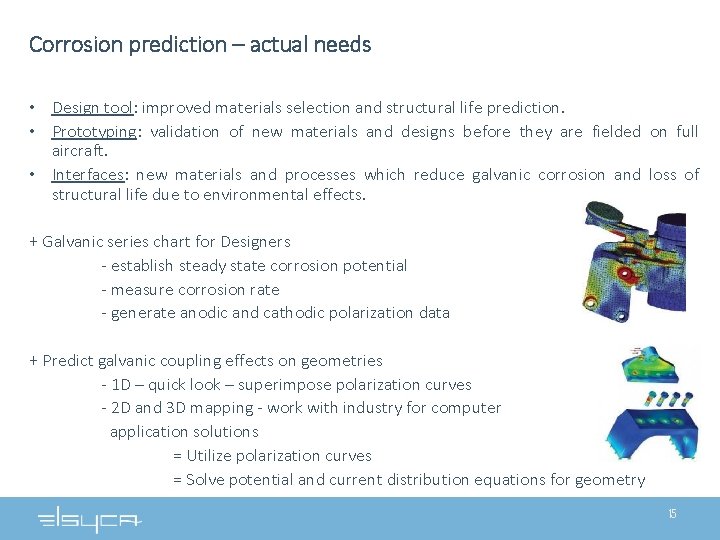
Corrosion prediction – actual needs • Design tool: improved materials selection and structural life prediction. • Prototyping: validation of new materials and designs before they are fielded on full aircraft. • Interfaces: new materials and processes which reduce galvanic corrosion and loss of structural life due to environmental effects. + Galvanic series chart for Designers - establish steady state corrosion potential - measure corrosion rate - generate anodic and cathodic polarization data + Predict galvanic coupling effects on geometries - 1 D – quick look – superimpose polarization curves - 2 D and 3 D mapping - work with industry for computer application solutions = Utilize polarization curves = Solve potential and current distribution equations for geometry 15
Role of a Computer Aided Analysis in corrosion risk assessment
Computer Aided Analysis in corrosion risk assessment • Corrosion design decisions are based solely on galvanic series open circuit potentials (OCPs) - ignores galvanic currents, surface treatments, fluid pathways, relative areas, shapes, fluid uptakes, etc. … • Design requires a way to do corrosion analysis that is like stress analysis - system approach, FEA - reliable, quantitative, relevant to structure and environment - done during design to avoid designing-in corrosion 17
Computer Aided Analysis in corrosion risk assessment • Corrosion design decisions are based solely on galvanic series open circuit potentials (OCPs) - ignores galvanic currents, surface treatments, fluid pathways, relative areas, shapes, fluid uptakes, etc. … • Design requires a way to do corrosion analysis that is like stress analysis - system approach, FEA - reliable, quantitative, relevant to structure and environment - done during design to avoid designing-in corrosion 18
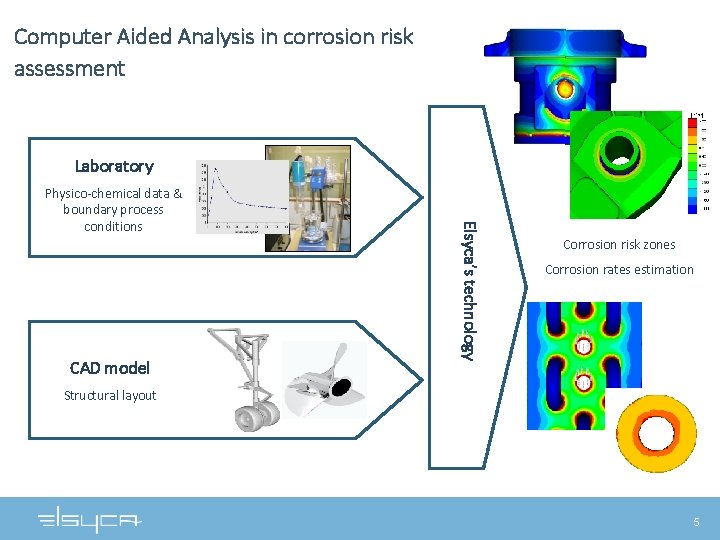
Computer Aided Analysis in corrosion risk assessment Laboratory CAD model Elsyca’s technology Physico-chemical data & boundary process conditions Corrosion risk zones Corrosion rates estimation Structural layout 5
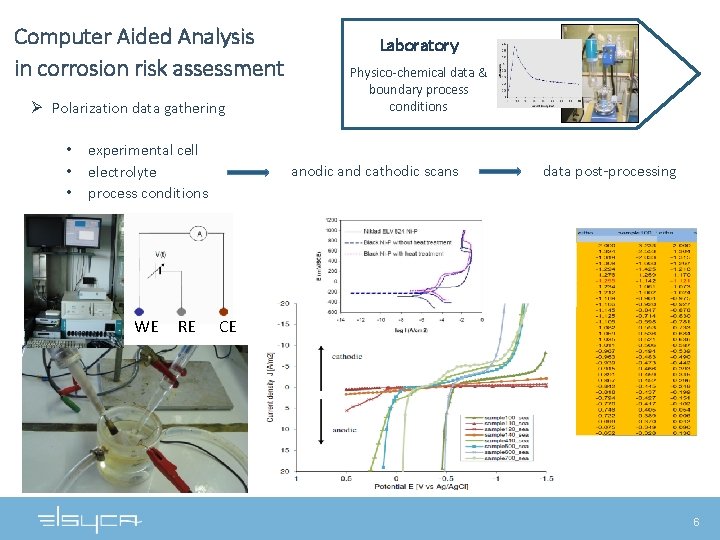
Computer Aided Analysis in corrosion risk assessment Ø Polarization data gathering • • • experimental cell electrolyte process conditions WE RE Laboratory Physico-chemical data & boundary process conditions anodic and cathodic scans data post-processing CE 6
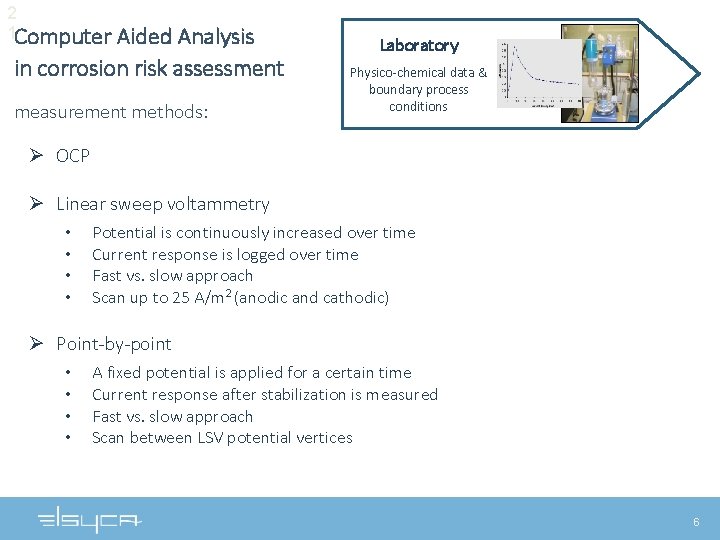
2 1 Computer Aided Analysis in corrosion risk assessment measurement methods: Laboratory Physico-chemical data & boundary process conditions Ø OCP Ø Linear sweep voltammetry • • Potential is continuously increased over time Current response is logged over time Fast vs. slow approach Scan up to 25 A/m 2 (anodic and cathodic) Ø Point-by-point • • A fixed potential is applied for a certain time Current response after stabilization is measured Fast vs. slow approach Scan between LSV potential vertices 6
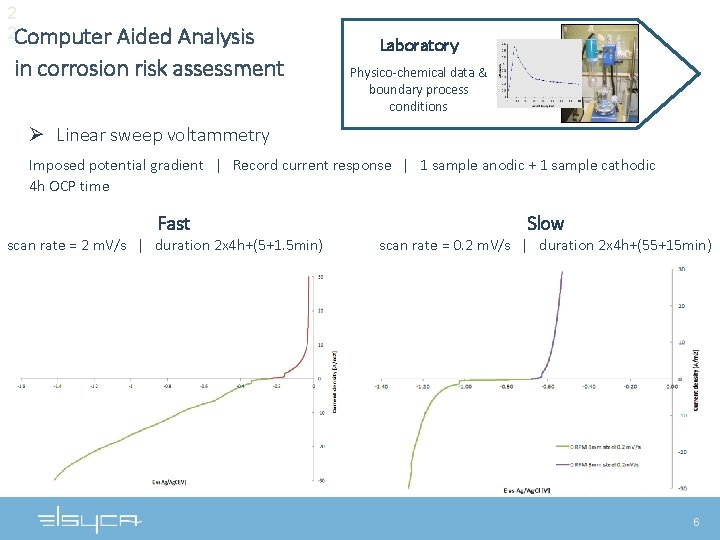
2 2 Computer Aided Analysis in corrosion risk assessment Laboratory Physico-chemical data & boundary process conditions Ø Linear sweep voltammetry Imposed potential gradient | Record current response | 1 sample anodic + 1 sample cathodic 4 h OCP time Fast scan rate = 2 m. V/s | duration 2 x 4 h+(5+1. 5 min) Slow scan rate = 0. 2 m. V/s | duration 2 x 4 h+(55+15 min) 6
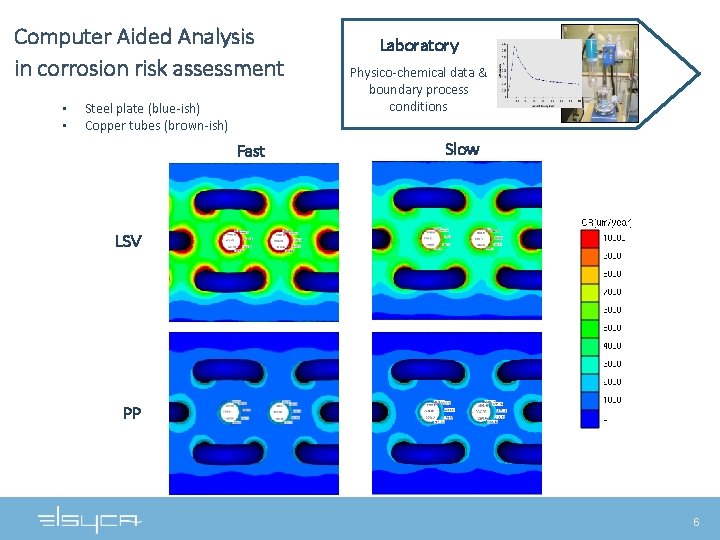
Computer Aided Analysis in corrosion risk assessment • • Steel plate (blue-ish) Copper tubes (brown-ish) Fast Laboratory Physico-chemical data & boundary process conditions Slow LSV PP 6
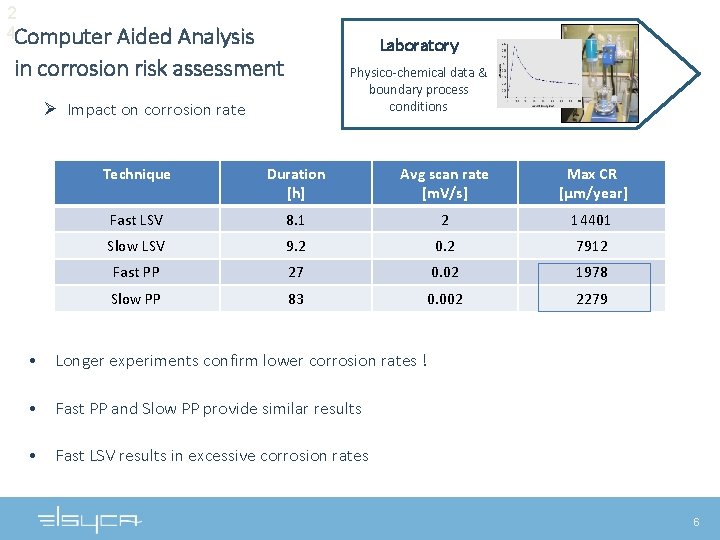
2 4 Computer Aided Analysis in corrosion risk assessment Laboratory Physico-chemical data & boundary process conditions Ø Impact on corrosion rate Technique Duration [h] Avg scan rate [m. V/s] Max CR [µm/year] Fast LSV 8. 1 2 14401 Slow LSV 9. 2 0. 2 7912 Fast PP 27 0. 02 1978 Slow PP 83 0. 002 2279 • Longer experiments confirm lower corrosion rates ! • Fast PP and Slow PP provide similar results • Fast LSV results in excessive corrosion rates 6
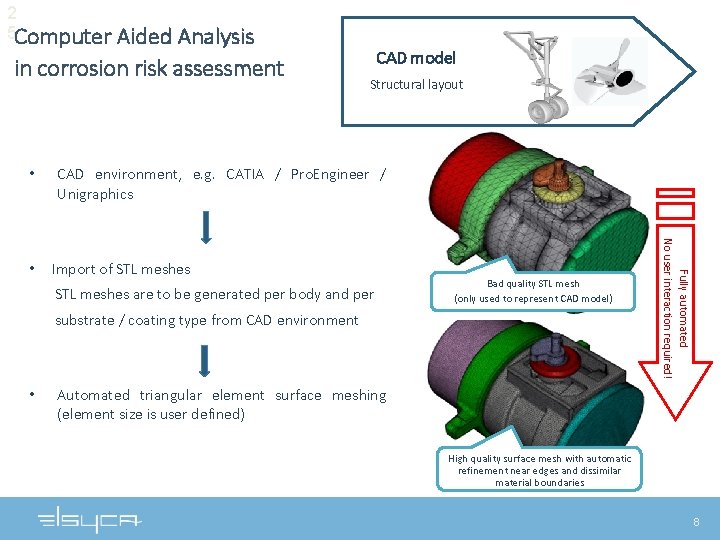
2 5 Computer Aided Analysis in corrosion risk assessment • Structural layout CAD environment, e. g. CATIA / Pro. Engineer / Unigraphics Import of STL meshes are to be generated per body and per Bad quality STL mesh (only used to represent CAD model) substrate / coating type from CAD environment • Fully automated No user interaction required! • CAD model Automated triangular element surface meshing (element size is user defined) High quality surface mesh with automatic refinement near edges and dissimilar material boundaries 8
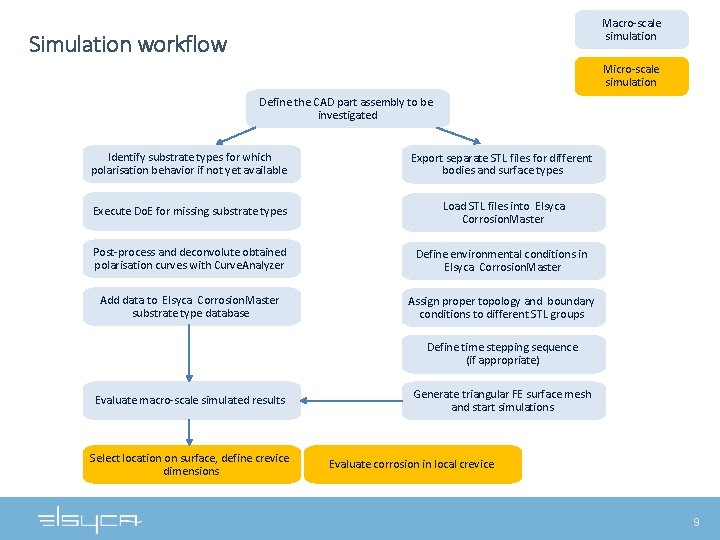
Macro-scale simulation Simulation workflow Micro-scale simulation Define the CAD part assembly to be investigated Identify substrate types for which polarisation behavior if not yet available Export separate STL files for different bodies and surface types Execute Do. E for missing substrate types Load STL files into Elsyca Corrosion. Master Post-process and deconvolute obtained polarisation curves with Curve. Analyzer Define environmental conditions in Elsyca Corrosion. Master Add data to Elsyca Corrosion. Master substrate type database Assign proper topology and boundary conditions to different STL groups Define time stepping sequence (if appropriate) Evaluate macro-scale simulated results Select location on surface, define crevice dimensions Generate triangular FE surface mesh and start simulations Evaluate corrosion in local crevice 9
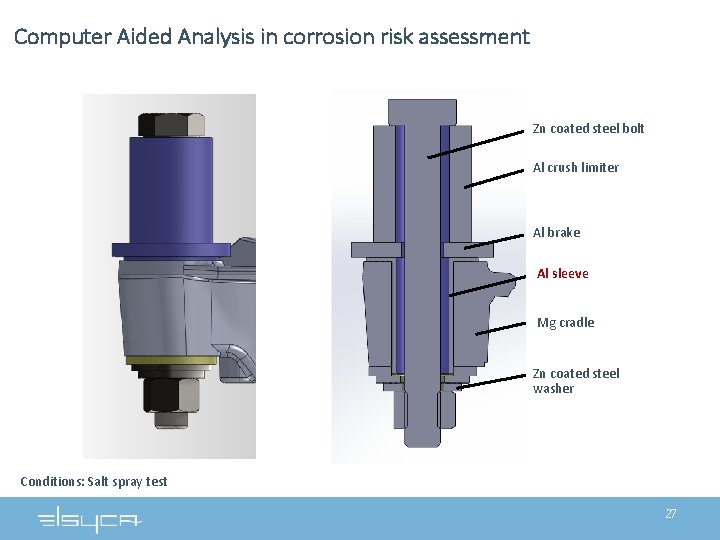
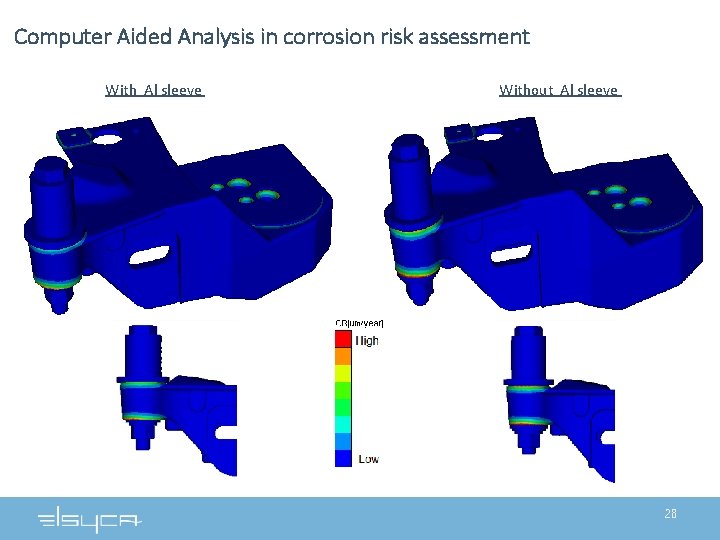
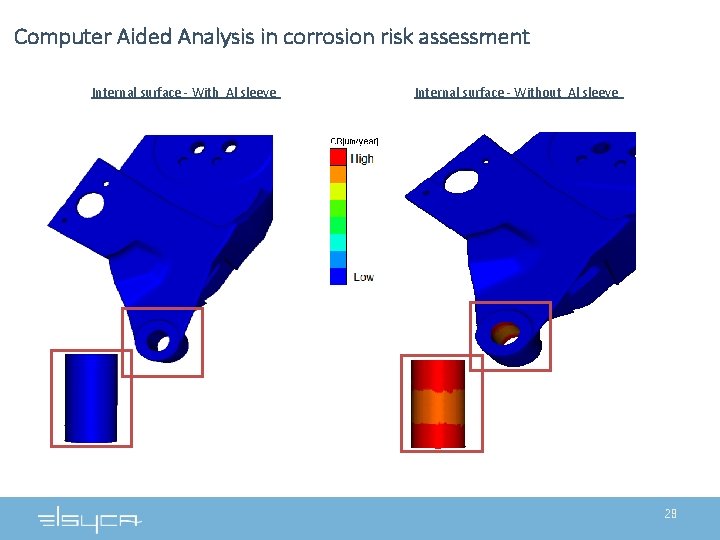
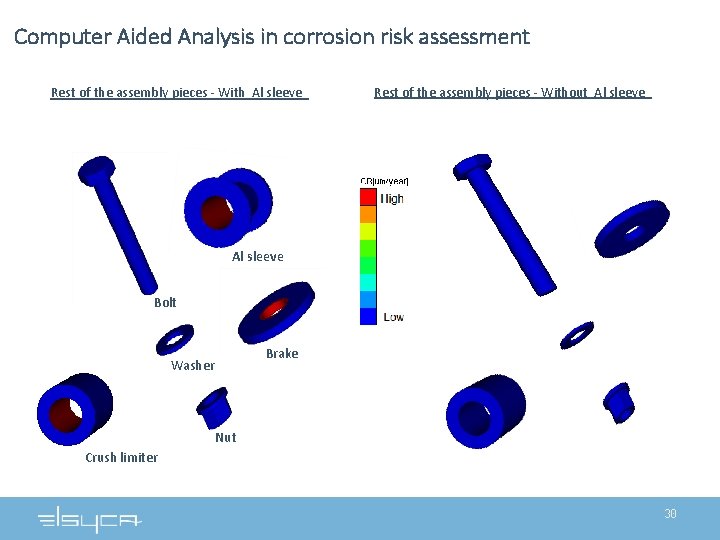
Computer Aided Analysis in corrosion risk assessment Zn coated steel bolt Al crush limiter Al brake Al sleeve Mg cradle Zn coated steel washer Conditions: Salt spray test 27
Computer Aided Analysis in corrosion risk assessment With Al sleeve Without Al sleeve 28
Computer Aided Analysis in corrosion risk assessment Internal surface - With Al sleeve Internal surface - Without Al sleeve 29
Computer Aided Analysis in corrosion risk assessment Rest of the assembly pieces - With Al sleeve Rest of the assembly pieces - Without Al sleeve Bolt Brake Washer Nut Crush limiter 30
Conclusions • Advanced development of lightweight materials and alternative coatings • Galvanic corrosion of joint dissimilar materials – a major concern • New demands for galvanic corrosion investigations • Galvanic corrosion prediction at the design stage – now it’s possible! • Computer Aided Analysis as the best practice in corrosion prevention 31
Thank you