
Computed Tomography CT Measurements of Attenuation Influence of
- Slides: 1
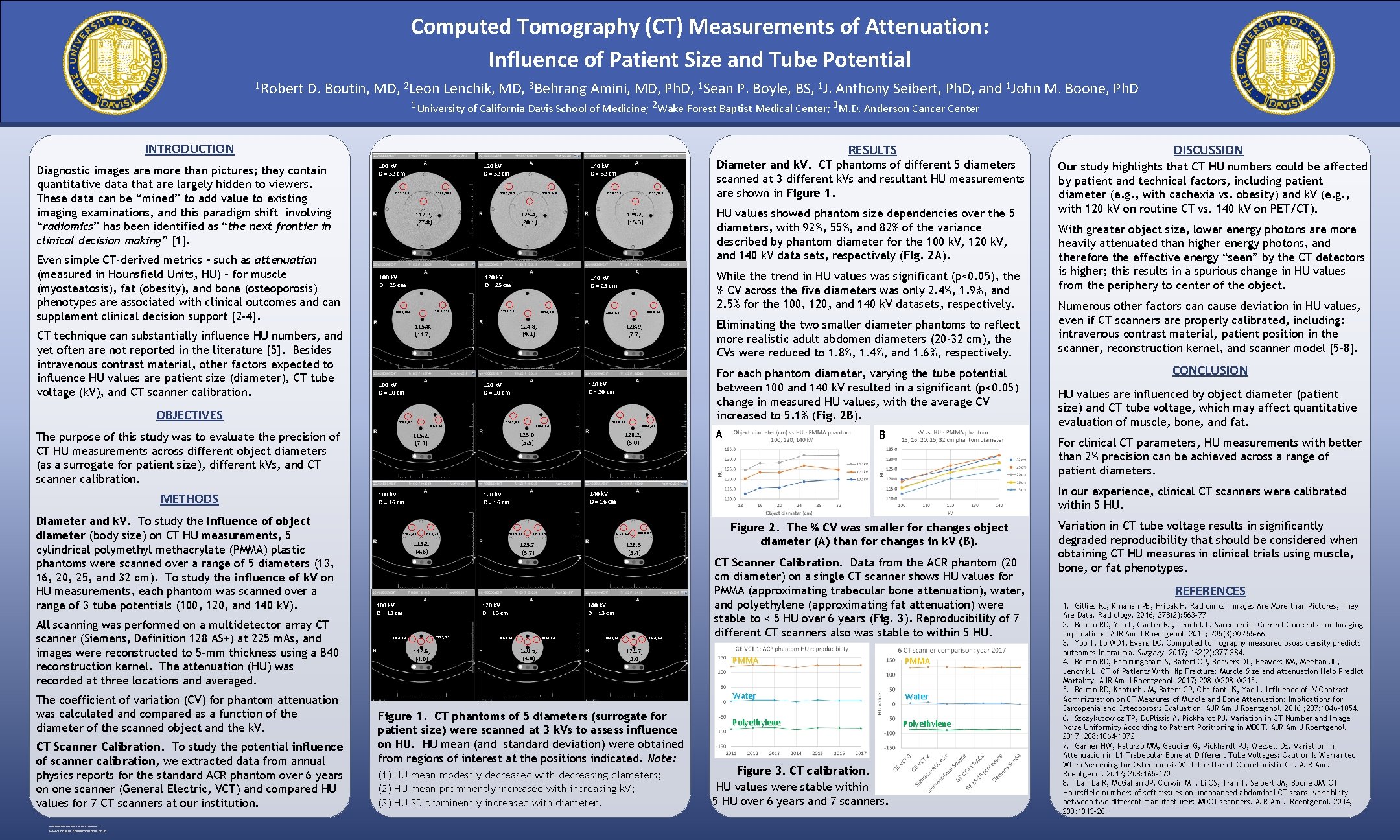
Computed Tomography (CT) Measurements of Attenuation: Influence of Patient Size and Tube Potential 1 Robert D. Boutin, MD, 2 Leon Lenchik, MD, 3 Behrang Amini, MD, Ph. D, 1 Sean P. Boyle, BS, 1 J. Anthony Seibert, Ph. D, and 1 John M. Boone, Ph. D 1 University of California Davis School of Medicine; 2 Wake Forest Baptist Medical Center; 3 M. D. Anderson Cancer Center INTRODUCTION Diagnostic images are more than pictures; they contain quantitative data that are largely hidden to viewers. These data can be “mined” to add value to existing imaging examinations, and this paradigm shift involving “radiomics” has been identified as “the next frontier in clinical decision making” [1]. Even simple CT-derived metrics – such as attenuation (measured in Hounsfield Units, HU) – for muscle (myosteatosis), fat (obesity), and bone (osteoporosis) phenotypes are associated with clinical outcomes and can supplement clinical decision support [2 -4]. CT technique can substantially influence HU numbers, and yet often are not reported in the literature [5]. Besides intravenous contrast material, other factors expected to influence HU values are patient size (diameter), CT tube voltage (k. V), and CT scanner calibration. OBJECTIVES RESULTS 121. 7, 20. 2 Diameter and k. V. To study the influence of object diameter (body size) on CT HU measurements, 5 cylindrical polymethyl methacrylate (PMMA) plastic phantoms were scanned over a range of 5 diameters (13, 16, 20, 25, and 32 cm). To study the influence of k. V on HU measurements, each phantom was scanned over a range of 3 tube potentials (100, 120, and 140 k. V). All scanning was performed on a multidetector array CT scanner (Siemens, Definition 128 AS+) at 225 m. As, and images were reconstructed to 5 -mm thickness using a B 40 reconstruction kernel. The attenuation (HU) was recorded at three locations and averaged. The coefficient of variation (CV) for phantom attenuation was calculated and compared as a function of the diameter of the scanned object and the k. V. CT Scanner Calibration. To study the potential influence of scanner calibration, we extracted data from annual physics reports for the standard ACR phantom over 6 years on one scanner (General Electric, VCT) and compared HU values for 7 CT scanners at our institution. RESEARCH POSTER PRESENTATION DESIGN © 2012 www. Poster. Presentations. com 120. 6, 20. 4 140 k. V D = 32 cm 126. 7, 15. 2 122. 3, 14. 9 117. 2, (27. 8) 119. 6, 11. 0 128. 3, 8. 2 127. 4, 7. 1 124. 8, (9. 4) 100 k. V D = 20 cm 115. 7, 6. 0 128. 9, 4. 0 123. 0, 5. 1 128. 2, (5. 0) 123. 1, 3. 5 115. 9, 4. 2 115. 2, (4. 6) 112. 6, (4. 0) 128. 0, 2. 7 128. 3, (3. 4) 120 k. V D = 13 cm 112. 8, 3. 2 B 140 k. V D = 13 cm 120. 1, 2. 6 120. 8, 2. 5 120. 6, (3. 0) Our study highlights that CT HU numbers could be affected by patient and technical factors, including patient diameter (e. g. , with cachexia vs. obesity) and k. V (e. g. , with 120 k. V on routine CT vs. 140 k. V on PET/CT). With greater object size, lower energy photons are more heavily attenuated than higher energy photons, and therefore the effective energy “seen” by the CT detectors is higher; this results in a spurious change in HU values from the periphery to center of the object. Numerous other factors can cause deviation in HU values, even if CT scanners are properly calibrated, including: intravenous contrast material, patient position in the scanner, reconstruction kernel, and scanner model [5 -8]. CONCLUSION HU values are influenced by object diameter (patient size) and CT tube voltage, which may affect quantitative evaluation of muscle, bone, and fat. For clinical CT parameters, HU measurements with better than 2% precision can be achieved across a range of patient diameters. In our experience, clinical CT scanners were calibrated within 5 HU. 127. 9, 2. 8 123. 7, 3. 2 123. 7, (3. 7) 100 k. V D = 13 cm A 140 k. V D = 16 cm 120 k. V D = 16 cm 100 k. V D = 16 cm 112. 6, 3. 4 128. 0, 4. 0 123. 0, (5. 5) 115. 2, (7. 3) For each phantom diameter, varying the tube potential between 100 and 140 k. V resulted in a significant (p<0. 05) change in measured HU values, with the average CV increased to 5. 1% (Fig. 2 B). 140 k. V D = 20 cm 124. 3, 5. 0 While the trend in HU values was significant (p<0. 05), the % CV across the five diameters was only 2. 4%, 1. 9%, and 2. 5% for the 100, 120, and 140 k. V datasets, respectively. Eliminating the two smaller diameter phantoms to reflect more realistic adult abdomen diameters (20 -32 cm), the CVs were reduced to 1. 8%, 1. 4%, and 1. 6%, respectively. 128. 9, (7. 7) 120 k. V D = 20 cm 115. 4, 4. 2 133. 6, 6. 1 134. 0, 6. 1 Diameter and k. V. CT phantoms of different 5 diameters scanned at 3 different k. Vs and resultant HU measurements are shown in Figure 1. HU values showed phantom size dependencies over the 5 diameters, with 92%, 55%, and 82% of the variance described by phantom diameter for the 100 k. V, 120 k. V, and 140 k. V data sets, respectively (Fig. 2 A). 140 k. V D = 25 cm 115. 8, (11. 7) 116. 5, 6. 1 133. 2, 10. 5 129. 2, (15. 3) 120 k. V D = 25 cm 120. 9, 10. 6 133. 6, 12. 4 125. 4, (20. 1) 100 k. V D = 25 cm The purpose of this study was to evaluate the precision of CT HU measurements across different object diameters (as a surrogate for patient size), different k. Vs, and CT scanner calibration. METHODS 120 k. V D = 32 cm 100 k. V D = 32 cm DISCUSSION 124. 6, 2. 4 124. 2, 2. 1 124. 7, (3. 0) Figure 1. CT phantoms of 5 diameters (surrogate for patient size) were scanned at 3 k. Vs to assess influence on HU. HU mean (and standard deviation) were obtained from regions of interest at the positions indicated. Note: (1) HU mean modestly decreased with decreasing diameters; (2) HU mean prominently increased with increasing k. V; (3) HU SD prominently increased with diameter. Figure 2. The % CV was smaller for changes object diameter (A) than for changes in k. V (B). CT Scanner Calibration. Data from the ACR phantom (20 cm diameter) on a single CT scanner shows HU values for PMMA (approximating trabecular bone attenuation), water, and polyethylene (approximating fat attenuation) were stable to < 5 HU over 6 years (Fig. 3). Reproducibility of 7 different CT scanners also was stable to within 5 HU. PMMA Water Polyethylene Figure 3. CT calibration. HU values were stable within 5 HU over 6 years and 7 scanners. Variation in CT tube voltage results in significantly degraded reproducibility that should be considered when obtaining CT HU measures in clinical trials using muscle, bone, or fat phenotypes. REFERENCES 1. Gillies RJ, Kinahan PE, Hricak H. Radiomics: Images Are More than Pictures, They Are Data. Radiology. 2016; 278(2): 563 -77. 2. Boutin RD, Yao L, Canter RJ, Lenchik L. Sarcopenia: Current Concepts and Imaging Implications. AJR Am J Roentgenol. 2015; 205(3): W 255 -66. 3. Yoo T, Lo WD 1, Evans DC. Computed tomography measured psoas density predicts outcomes in trauma. Surgery. 2017; 162(2): 377 -384. 4. Boutin RD, Bamrungchart S, Bateni CP, Beavers DP, Beavers KM, Meehan JP, Lenchik L. CT of Patients With Hip Fracture: Muscle Size and Attenuation Help Predict Mortality. AJR Am J Roentgenol. 2017; 208: W 208 -W 215. 5. Boutin RD, Kaptuch JM, Bateni CP, Chalfant JS, Yao L. Influence of IV Contrast Administration on CT Measures of Muscle and Bone Attenuation: Implications for Sarcopenia and Osteoporosis Evaluation. AJR Am J Roentgenol. 2016 ; 207: 1046 -1054. 6. Szczykutowicz TP, Du. Plissis A, Pickhardt PJ. Variation in CT Number and Image Noise Uniformity According to Patient Positioning in MDCT. AJR Am J Roentgenol. 2017; 208: 1064 -1072. 7. Garner HW, Paturzo MM, Gaudier G, Pickhardt PJ, Wessell DE. Variation in Attenuation in L 1 Trabecular Bone at Different Tube Voltages: Caution Is Warranted When Screening for Osteoporosis With the Use of Opportunistic CT. AJR Am J Roentgenol. 2017; 208: 165 -170. 8. Lamba R, Mc. Gahan JP, Corwin MT, Li CS, Tran T, Seibert JA, Boone JM. CT Hounsfield numbers of soft tissues on unenhanced abdominal CT scans: variability between two different manufacturers' MDCT scanners. AJR Am J Roentgenol. 2014; 203: 1013 -20.