
Computed Tomography CT CAT tomos slice graphein to
- Slides: 74
Computed Tomography CT, CAT tomos = slice, graphein = to write Magdalena Bazalova
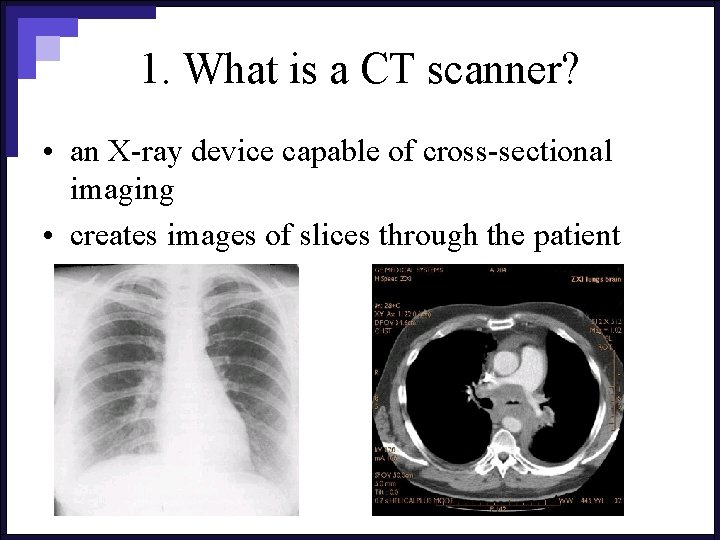
1. What is a CT scanner? • an X-ray device capable of cross-sectional imaging • creates images of slices through the patient
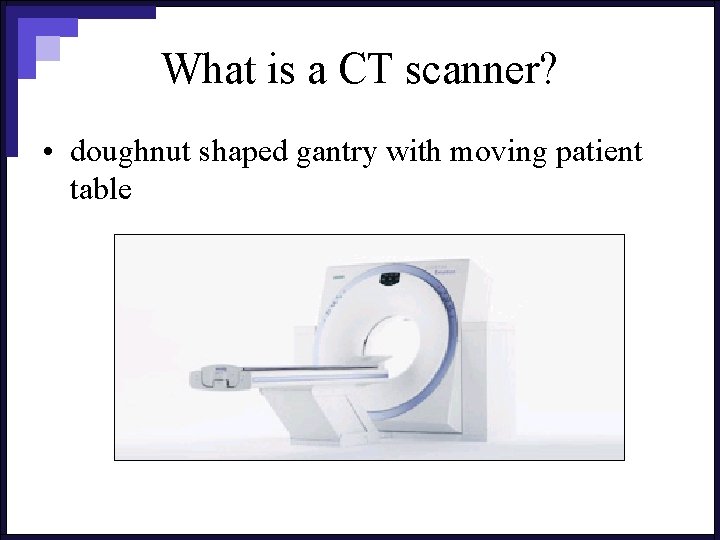
What is a CT scanner? • doughnut shaped gantry with moving patient table
Why CT? • conventional radiography suffers from collapsing of 3 D structures onto a 2 D image • although the resolution of CT is lower, it has extremely good low contrast resolution enabling the detection of very small changes in tissue type • CT gives accurate diagnostic information about the distribution of structures inside the body
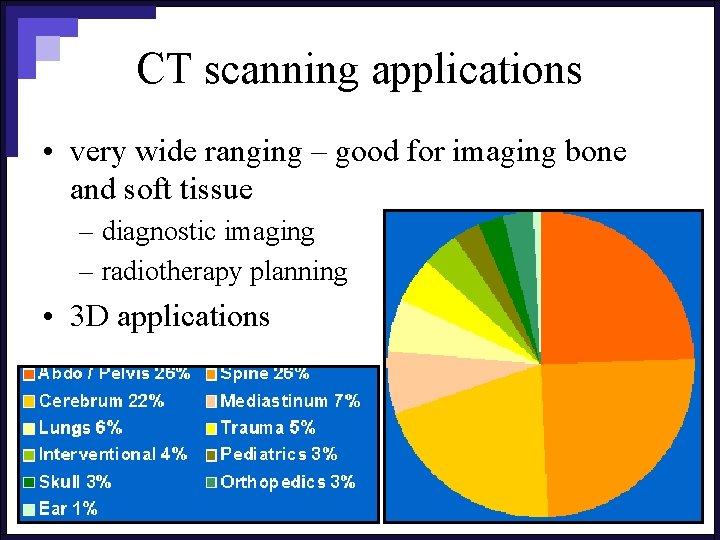
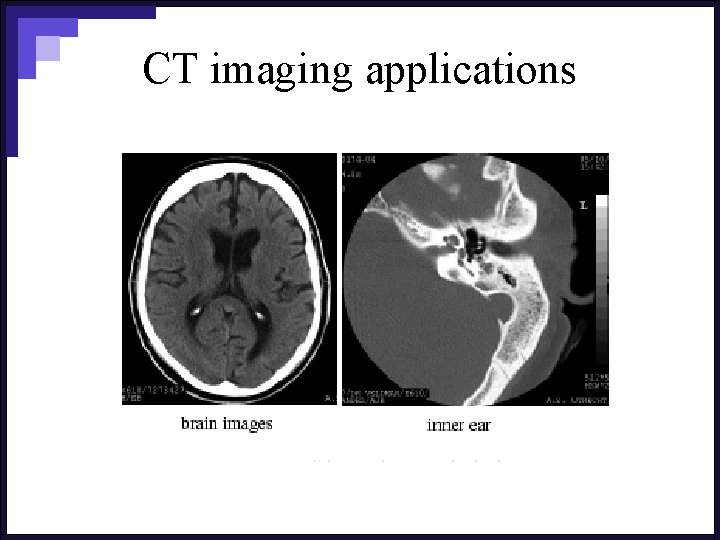
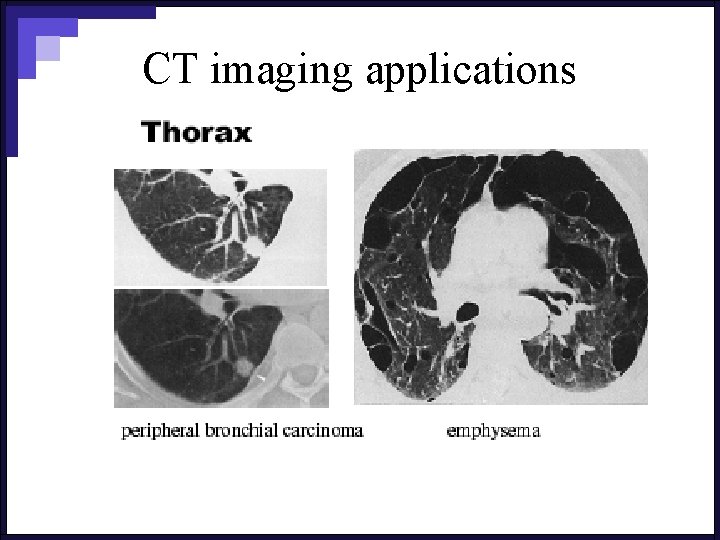
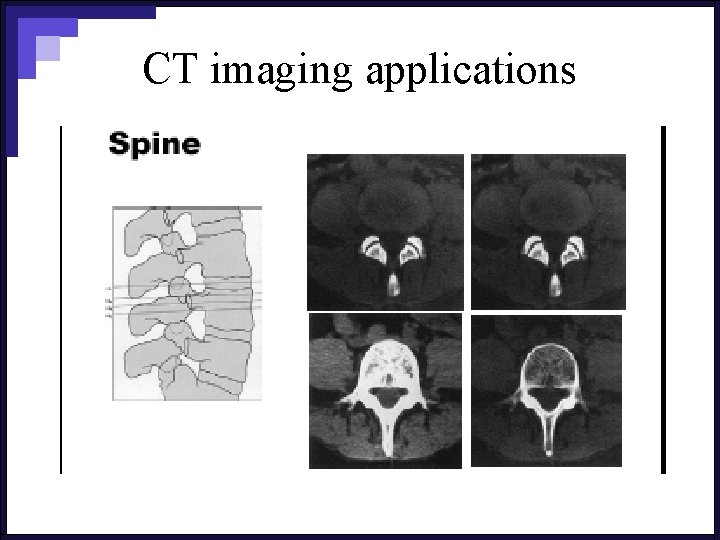
CT scanning applications • very wide ranging – good for imaging bone and soft tissue – diagnostic imaging – radiotherapy planning • 3 D applications
CT imaging applications
CT imaging applications
CT imaging applications
Why CT for radiotherapy? • Radiation therapy planning is done on the basis of patient CT images and is therefore patient specific – the target and organs at risk are delineated in CT images (possibly with help of other imaging modalities – PET) – dose calculation algorithms use CT images for determination of dose delivered to the patient during treatment
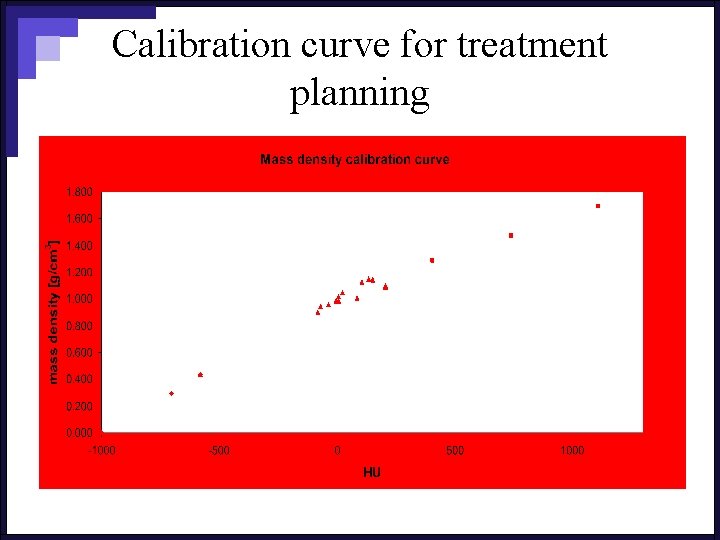
Why CT for radiotherapy? • Tissue inhomogeneities can be taken into account in most treatment planning systems • Dose to soft tissue is different than dose to cortical bone - mass density variations between tissue types are the most important factor • Therefore, mass densities of tissues have to be known for an accurate dose calculation • CT images do not represent mass densities of patient body directly but they can be converted into mass densities using a calibration curve
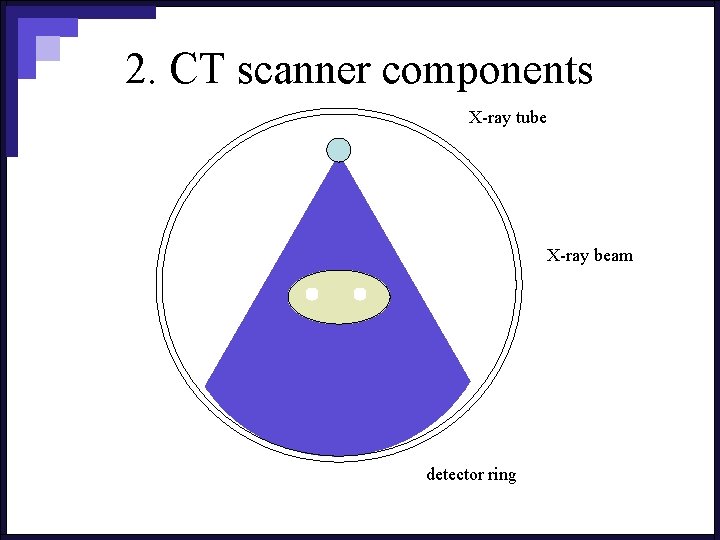
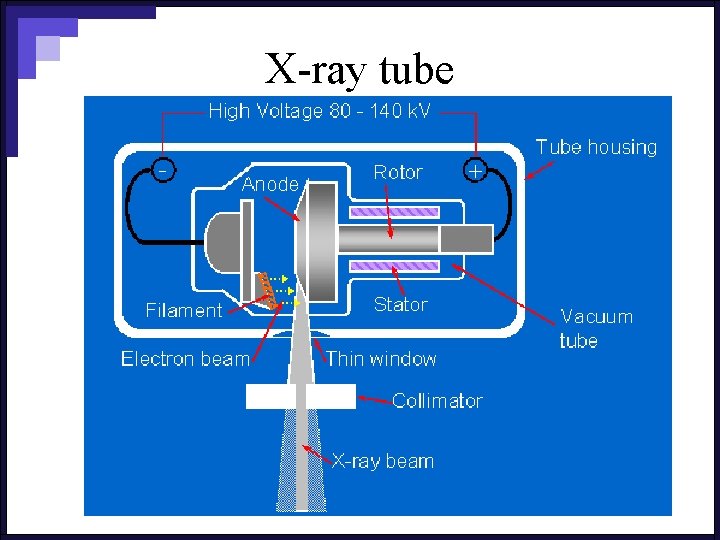
2. CT scanner components X-ray tube X-ray beam detector ring
X-ray journey
X-ray tube
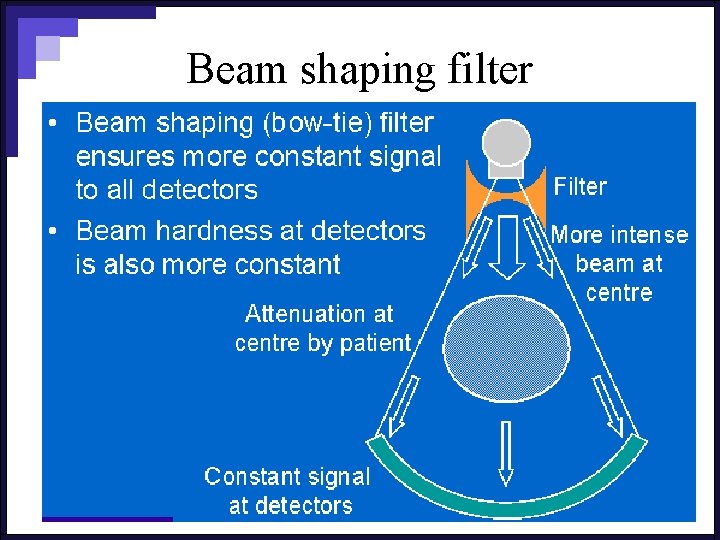
Beam shaping filter
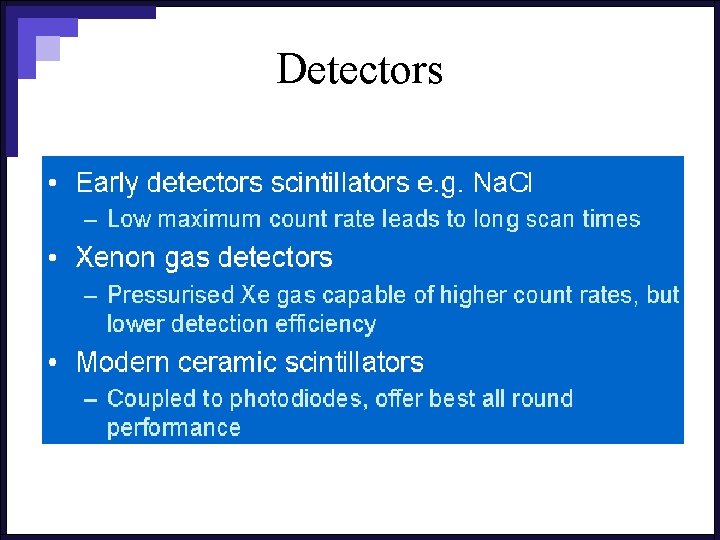
Detectors
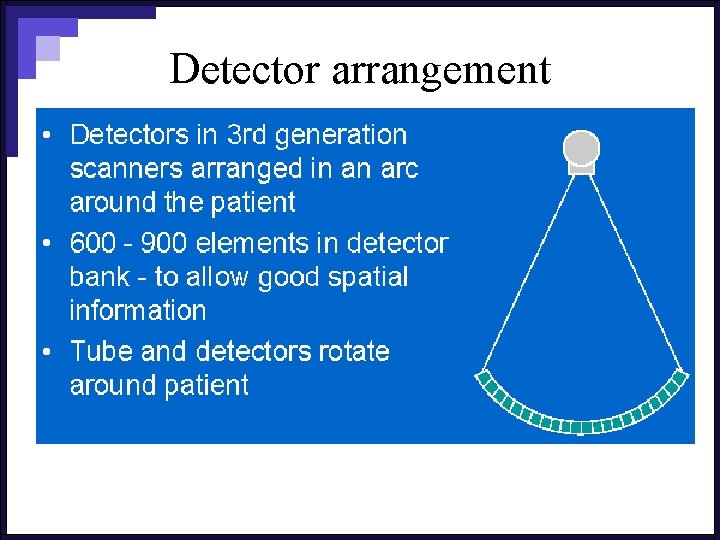
Detector arrangement
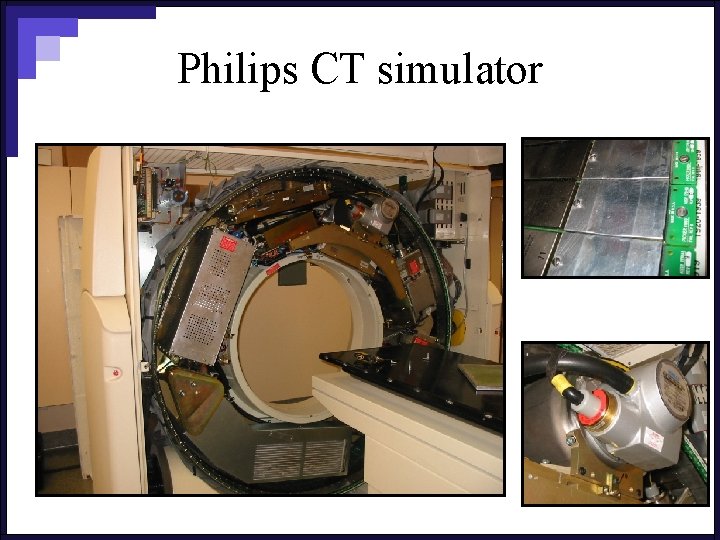
Philips CT simulator
Questions on CT apparatus • How do we call the device that produces X-ray beam? – (X-ray tube ) • What have the X-rays pass through on their way to the detector ring? – (beryllium window, Al filters, bow-tie filter, patient, anti-scatter grid)
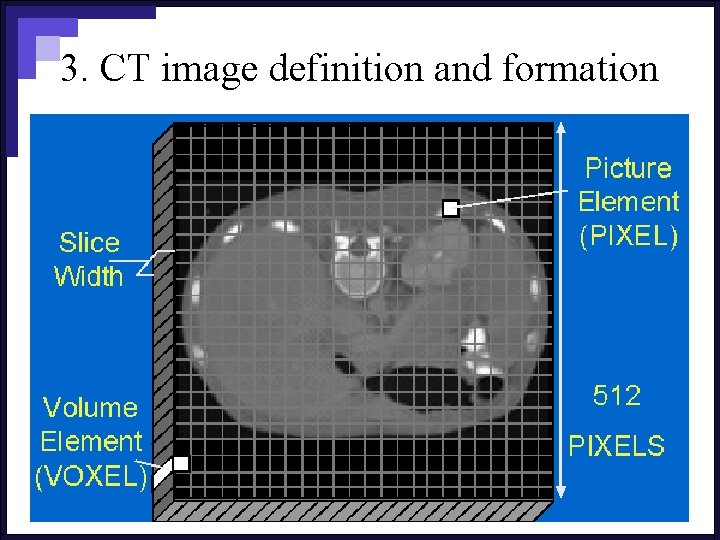
3. CT image definition and formation
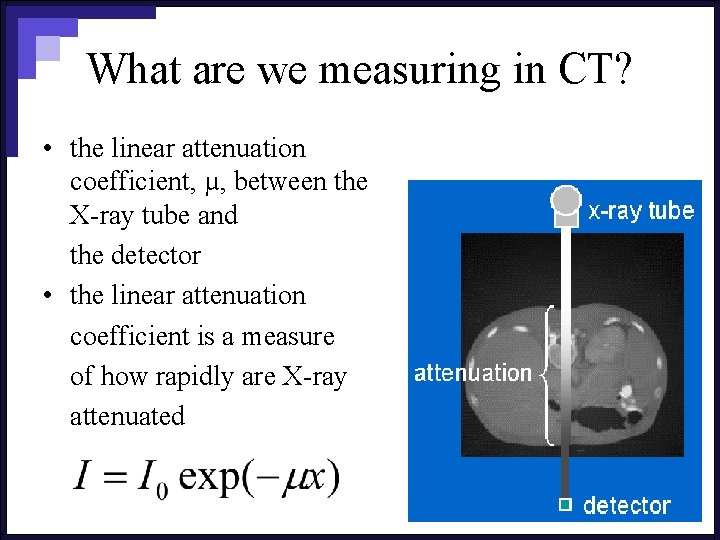
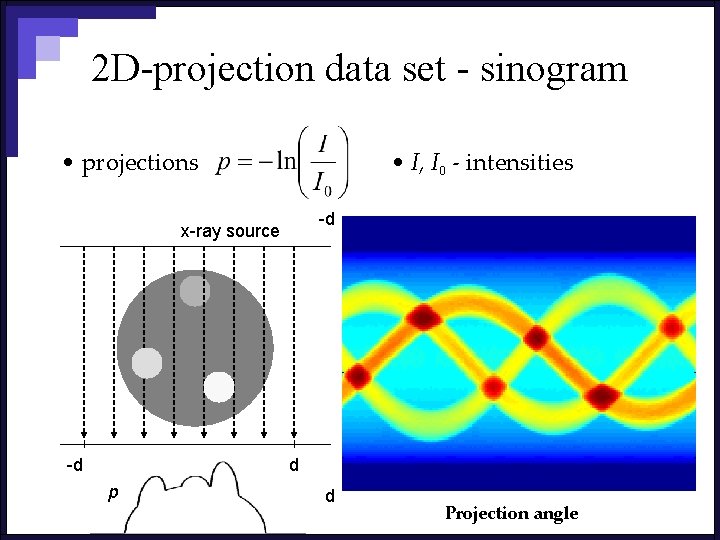
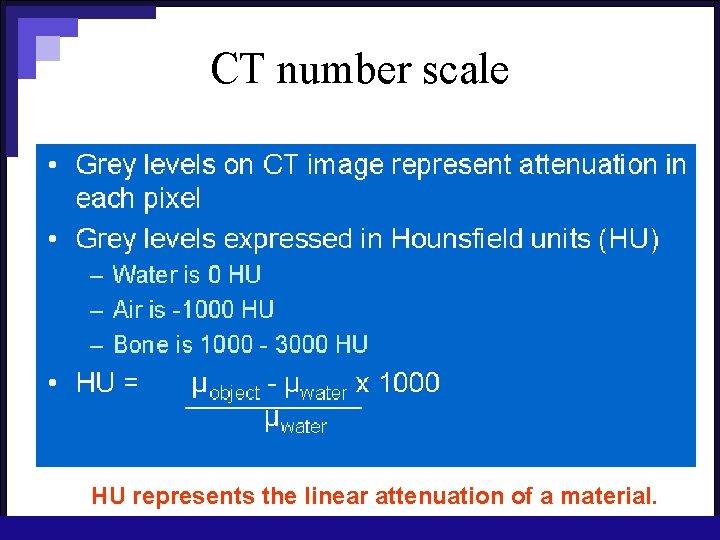
What are we measuring in CT? • the linear attenuation coefficient, µ, between the X-ray tube and the detector • the linear attenuation coefficient is a measure of how rapidly are X-ray attenuated
2 D-projection data set - sinogram • projections • I, I 0 - intensities -d x-ray source -d d p d Projection angle
Reconstruction algorithms • • Computer based simple back-projection filtered back-projection iterative techniques
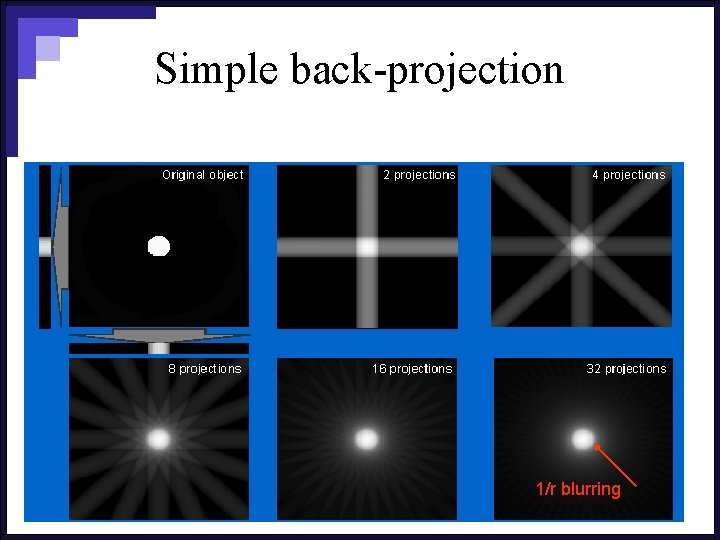
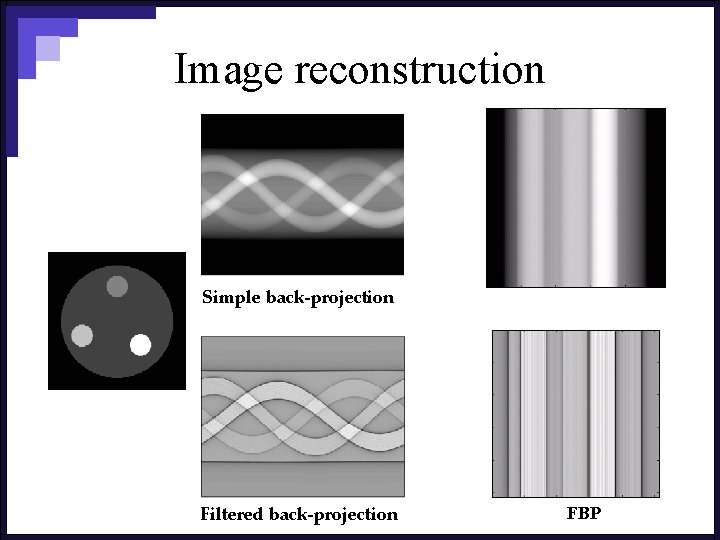
Simple back-projection • reverse the process of measurement of projection data to reconstruct an image • each projection is uniformly distributed across the reconstructed image
Simple back-projection 1/r blurring
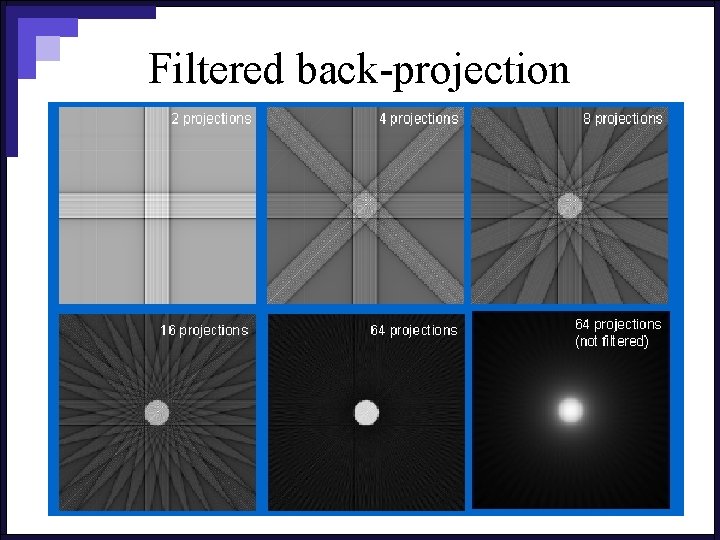
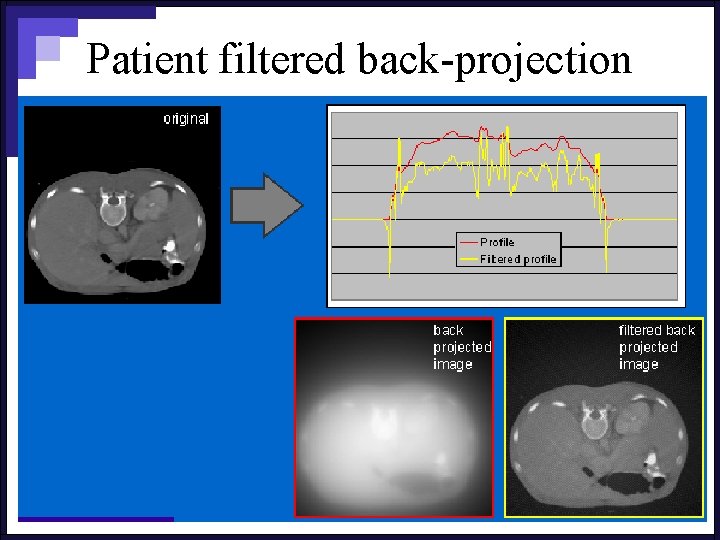
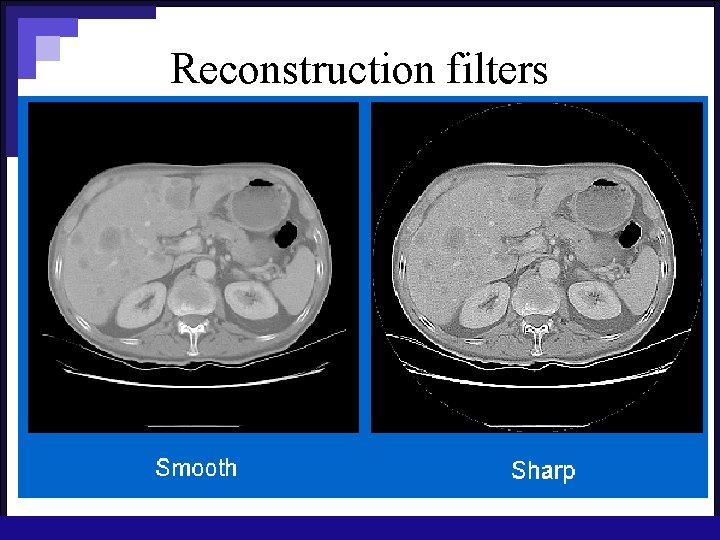
Filtered back-projection • simple back-projection produces blurred images • projection data need to be filtered before reconstruction • different filters can be applied for different diagnostic purposes – smoother filters for viewing soft tissue – sharp filters for high resolution images • back-projection is the same as before
Filtered back-projection
Image reconstruction Simple back-projection Filtered back-projection FBP
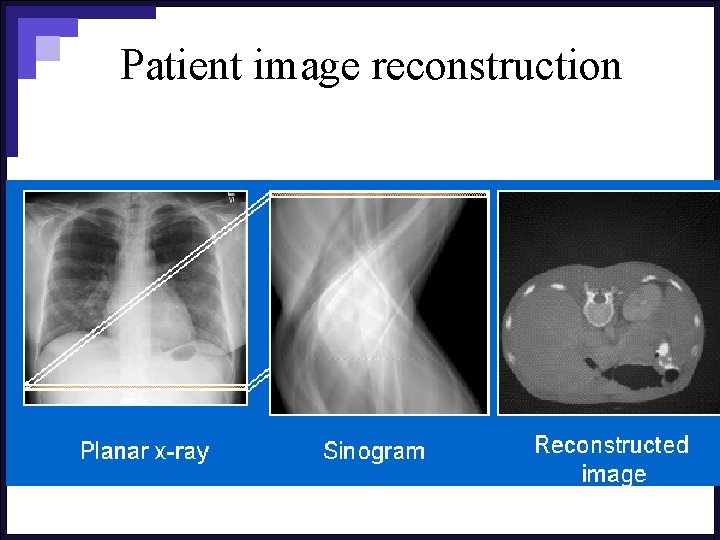
Patient image reconstruction
Patient filtered back-projection
CT number scale HU represents the linear attenuation of a material.
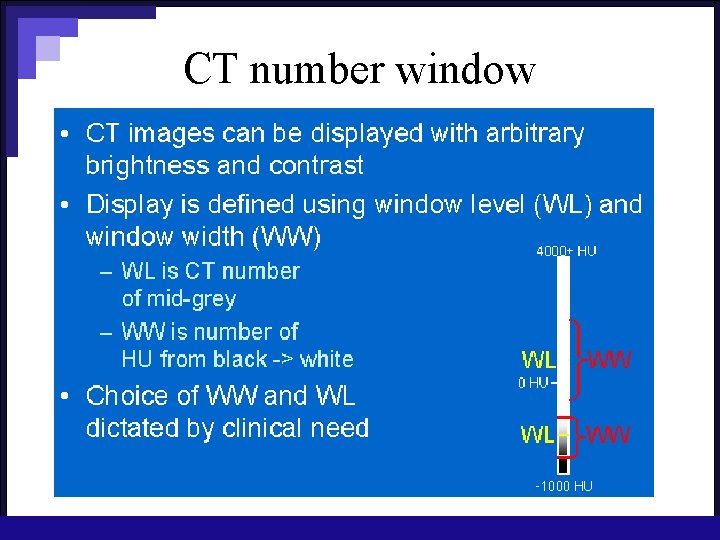
CT number window
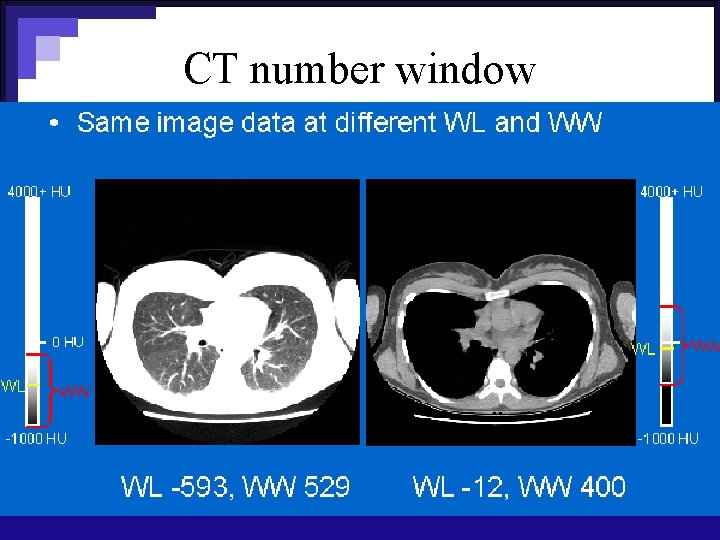
CT number window
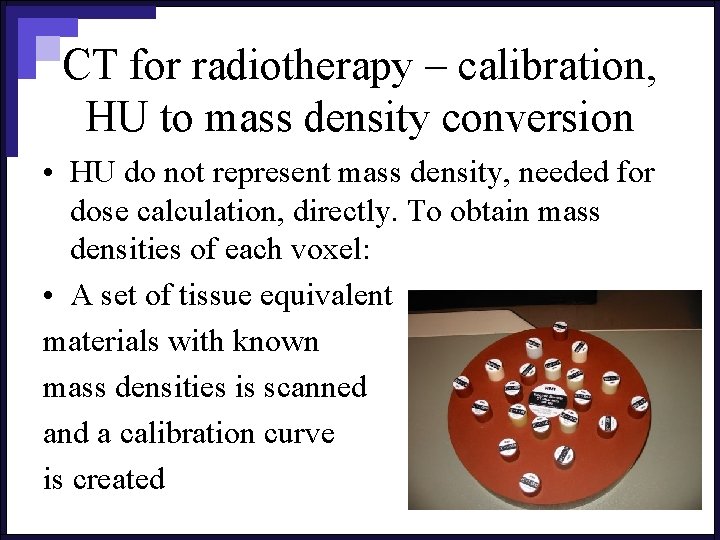
CT for radiotherapy – calibration, HU to mass density conversion • HU do not represent mass density, needed for dose calculation, directly. To obtain mass densities of each voxel: • A set of tissue equivalent materials with known mass densities is scanned and a calibration curve is created
Calibration curve for treatment planning
Questions on reconstruction • How do we call picture and volume elements? – (pixels and voxels) • What do CT images represent? – (linear attenuation coefficients of voxels) • How do we call raw detector data? – (a sinogram) • Name two reconstruction techniques? – (simple and filtered back-projection)
4. CT technology
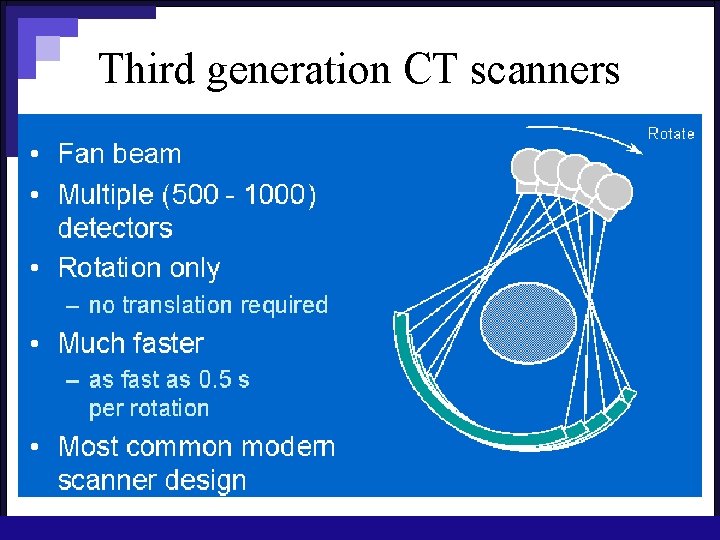
Third generation CT scanners
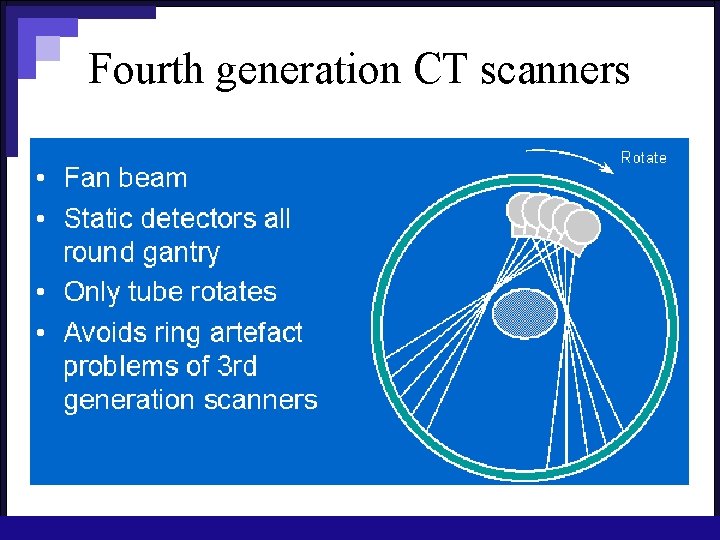
Fourth generation CT scanners
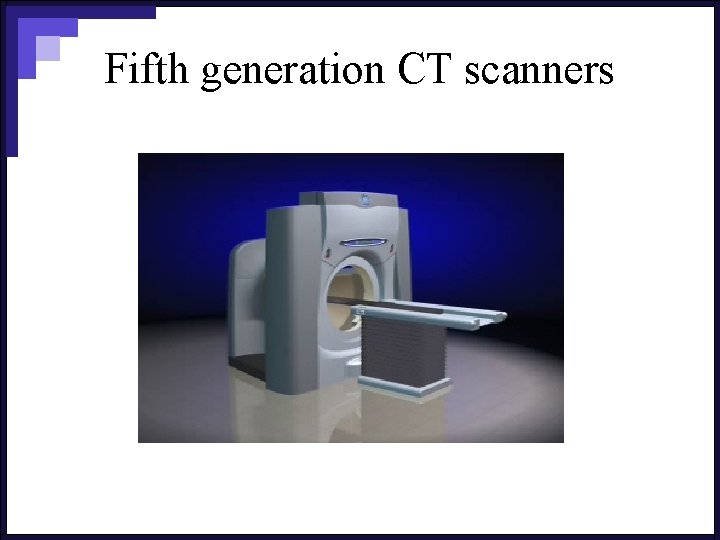
Fifth generation CT scanners
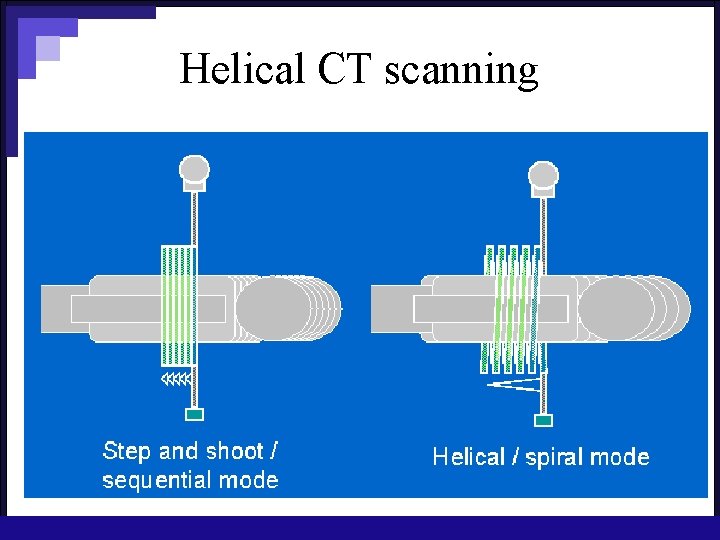
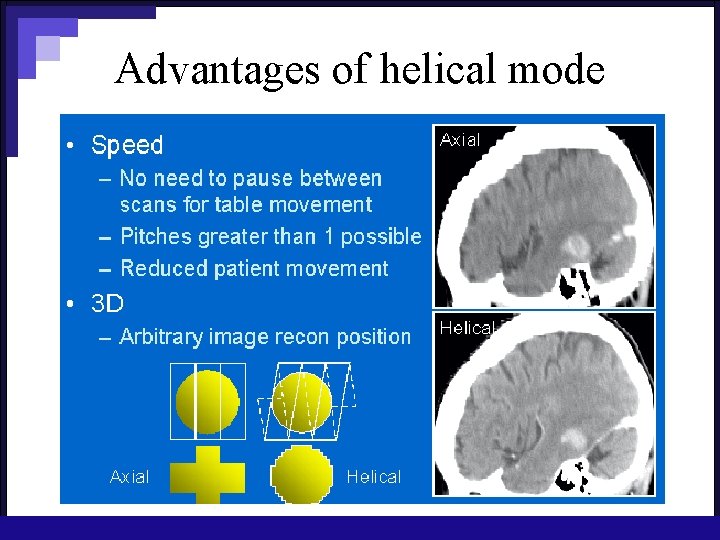
Helical CT scanning
Advantages of helical mode
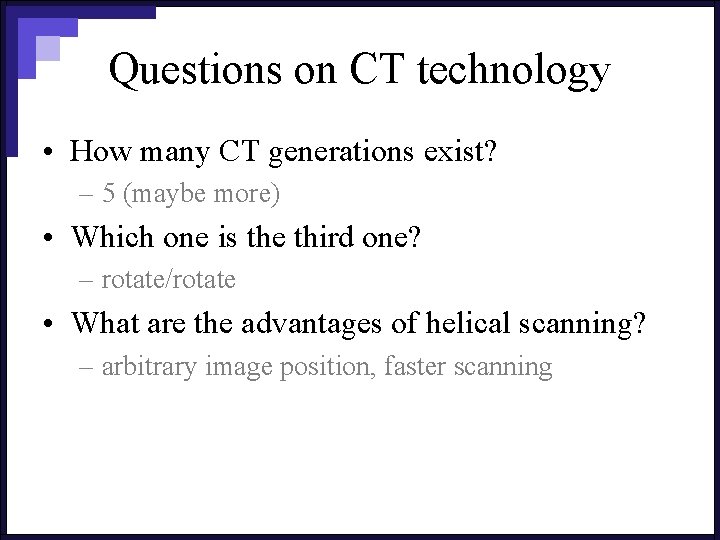
Questions on CT technology • How many CT generations exist? – 5 (maybe more) • Which one is the third one? – rotate/rotate • What are the advantages of helical scanning? – arbitrary image position, faster scanning
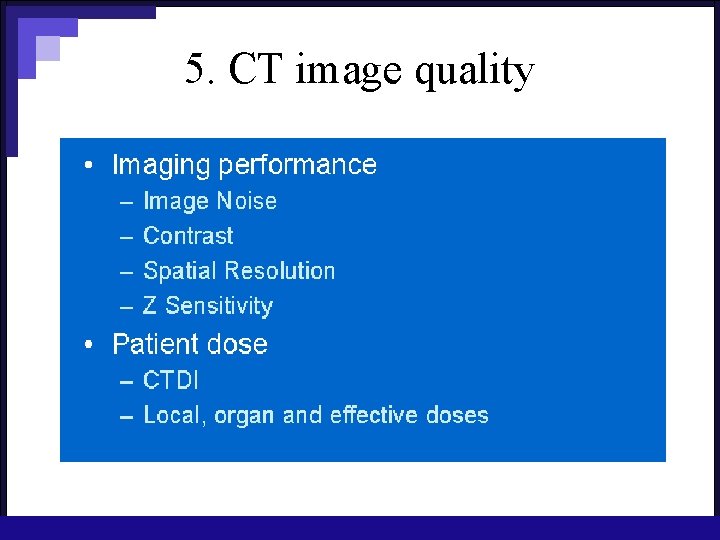
5. CT image quality
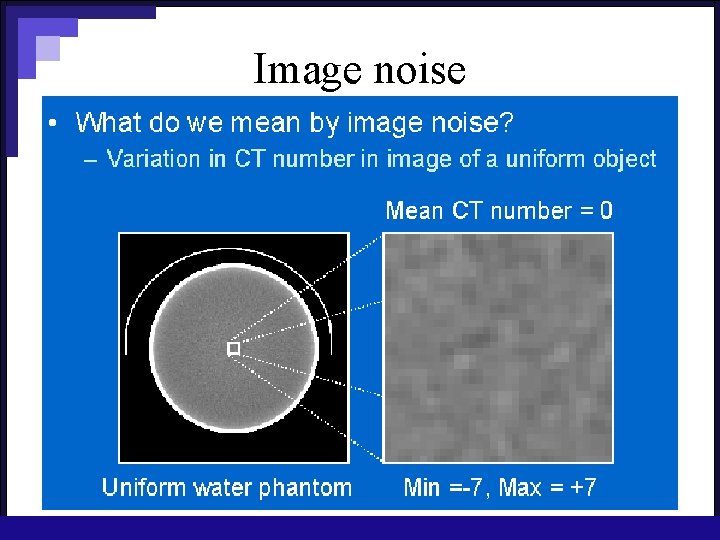
Image noise
Image noise
Image contrast
Image contrast
Factors affecting image noise
Reconstruction filters
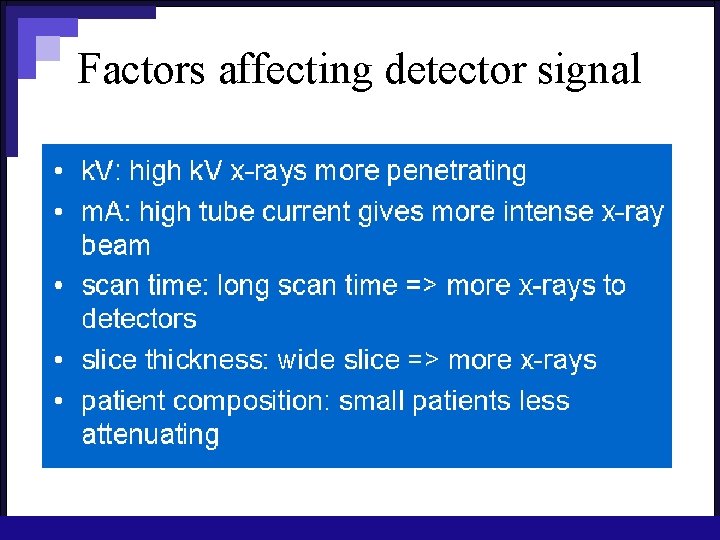
Factors affecting detector signal
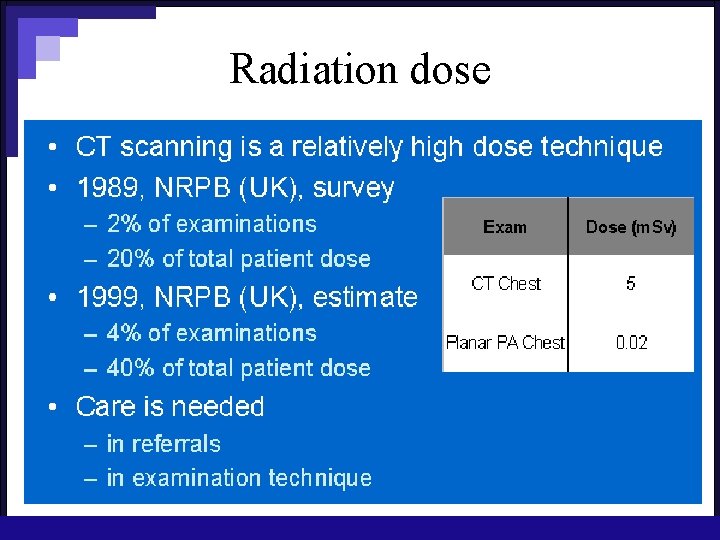
Radiation dose
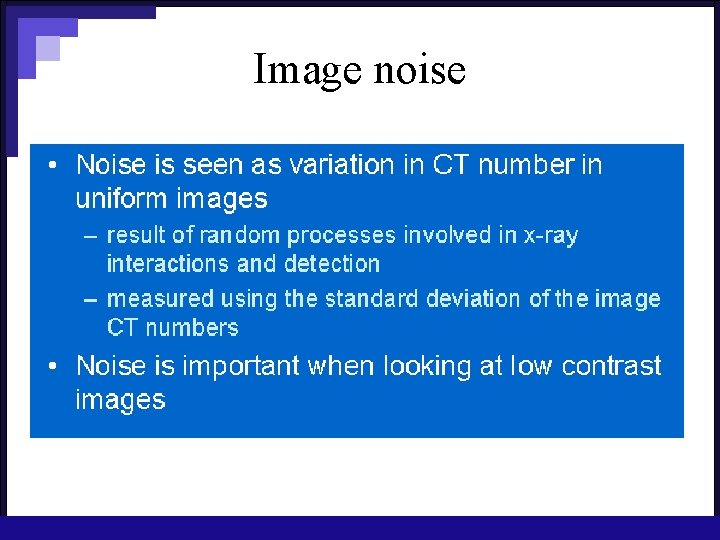
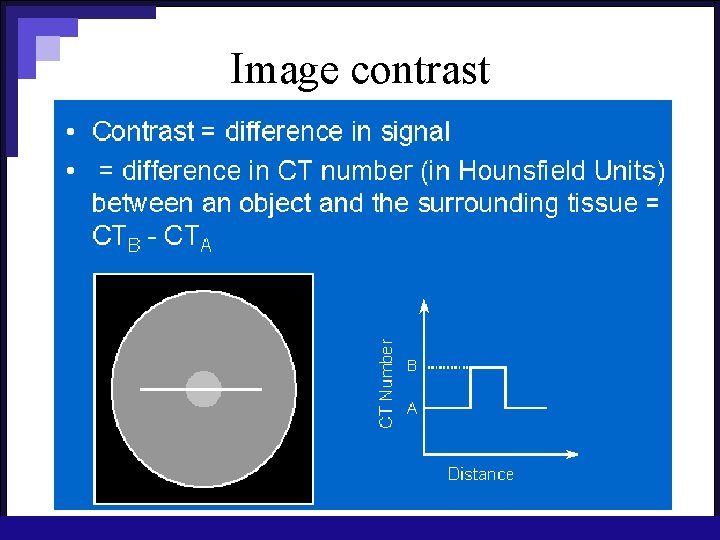
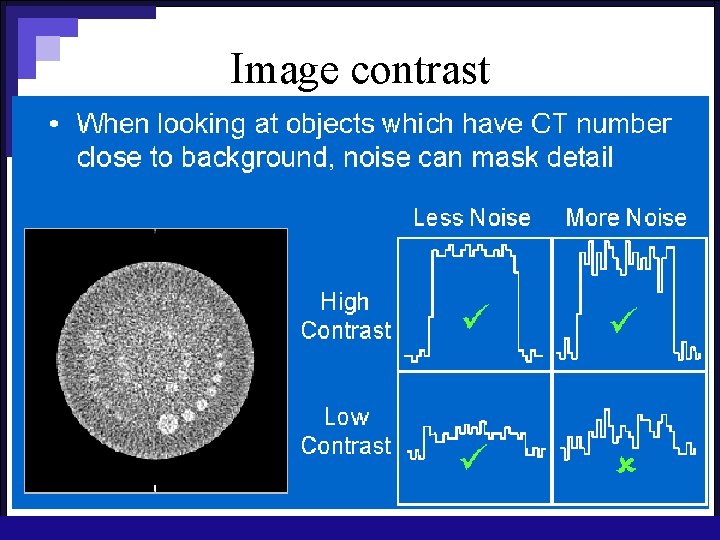
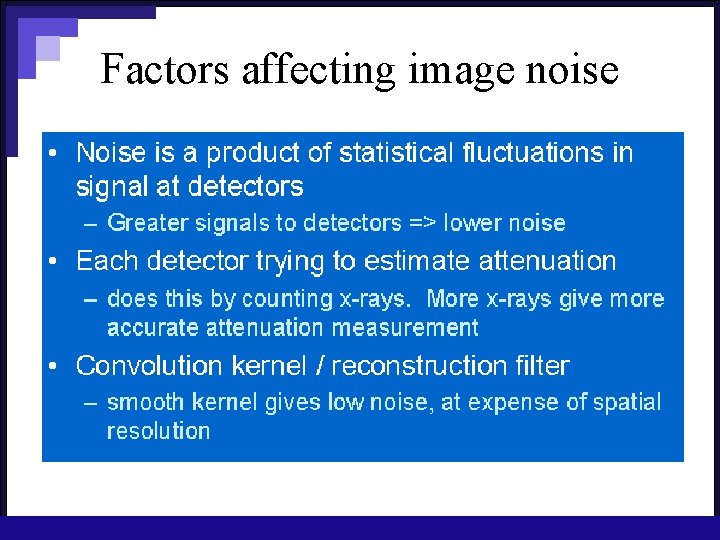
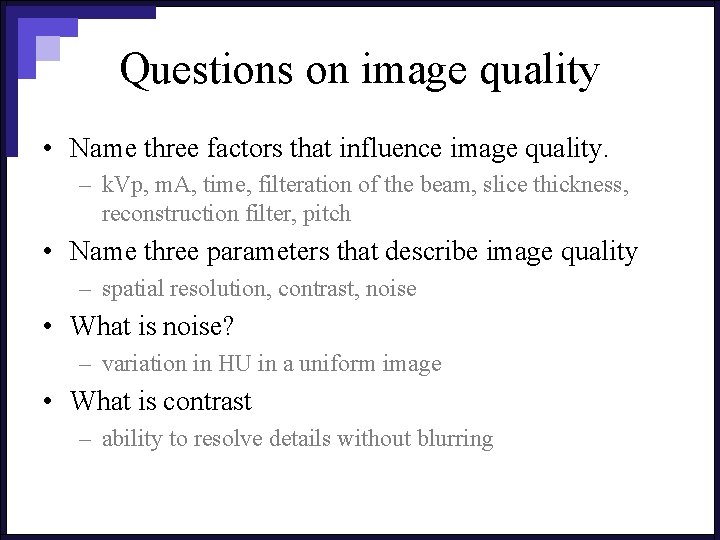
Questions on image quality • Name three factors that influence image quality. – k. Vp, m. A, time, filteration of the beam, slice thickness, reconstruction filter, pitch • Name three parameters that describe image quality – spatial resolution, contrast, noise • What is noise? – variation in HU in a uniform image • What is contrast – ability to resolve details without blurring
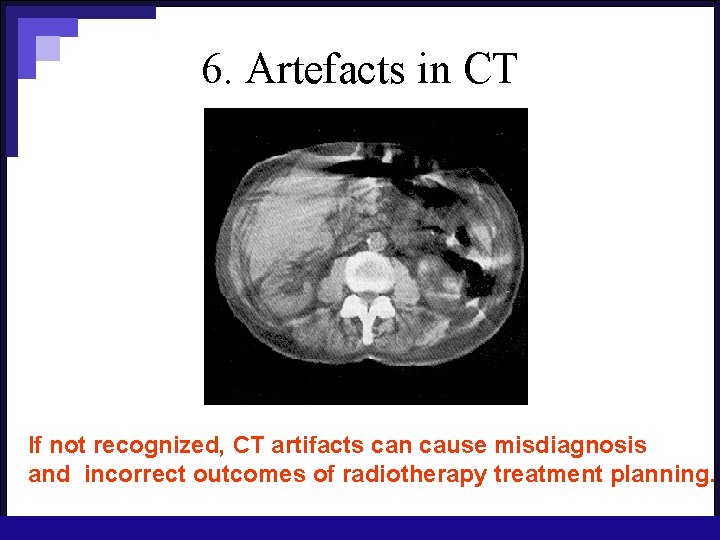
6. Artefacts in CT If not recognized, CT artifacts can cause misdiagnosis and incorrect outcomes of radiotherapy treatment planning.
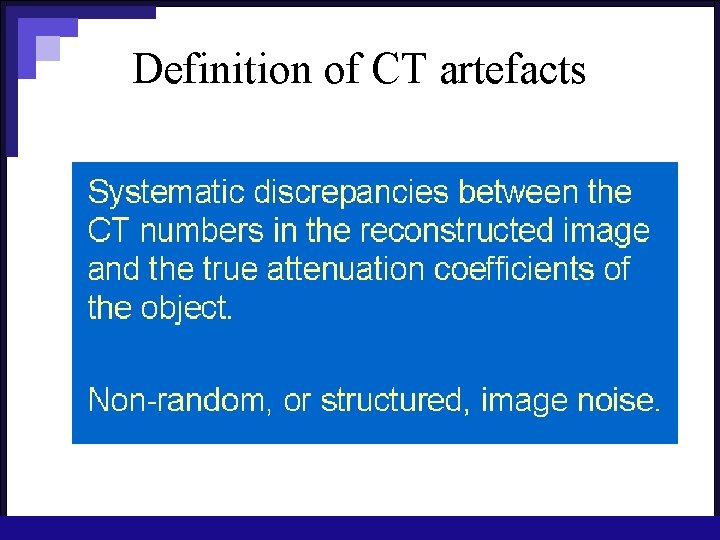
Definition of CT artefacts
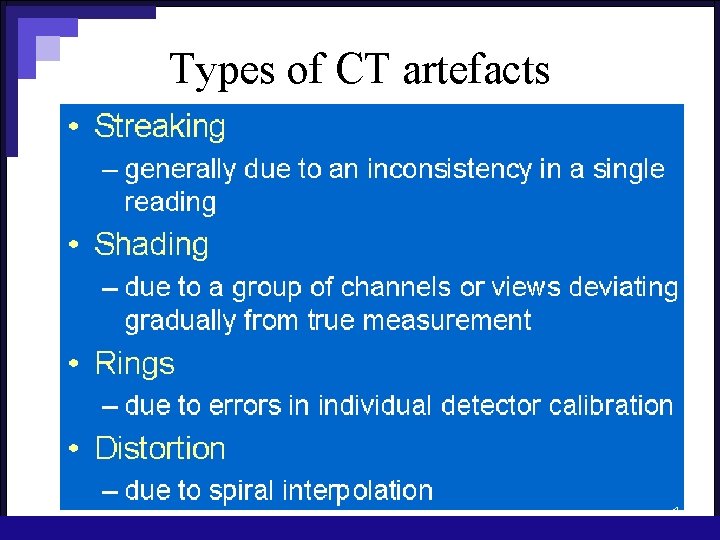
Types of CT artefacts
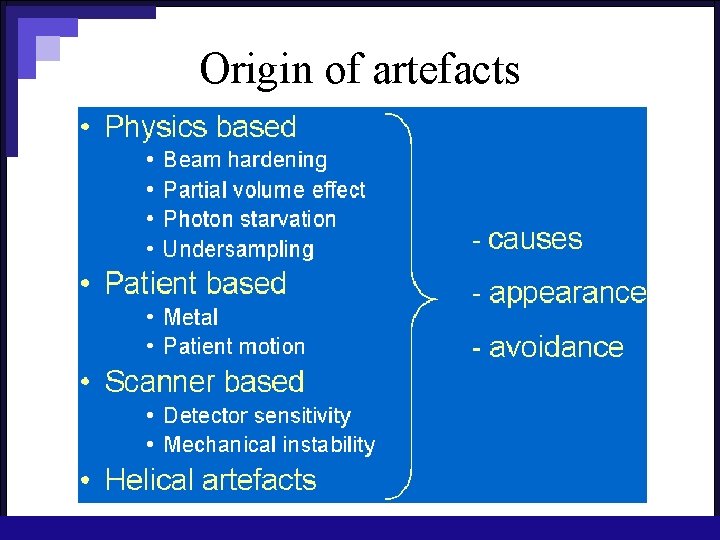
Origin of artefacts
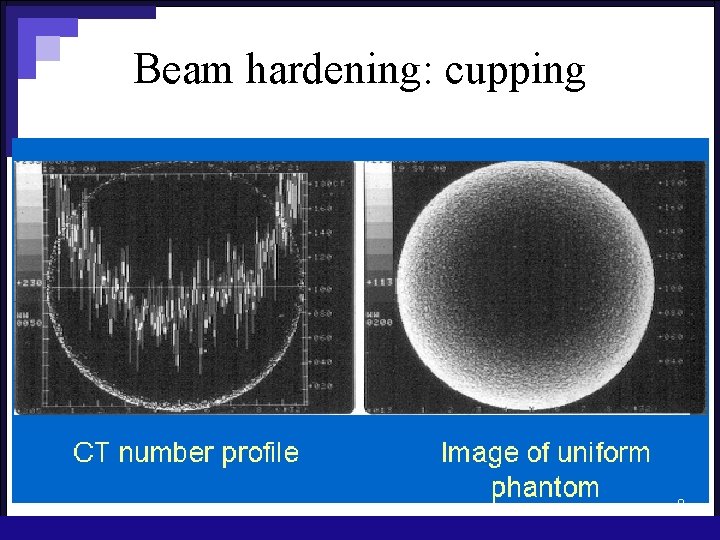
Beam hardening: cupping
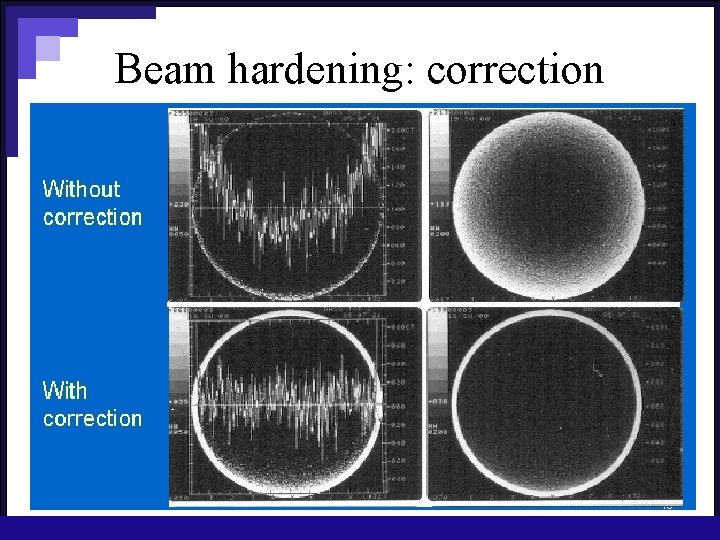
Beam hardening: correction
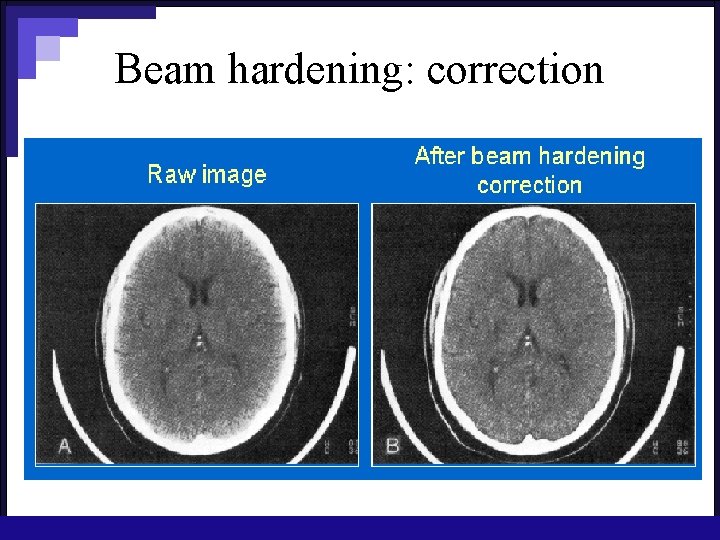
Beam hardening: correction
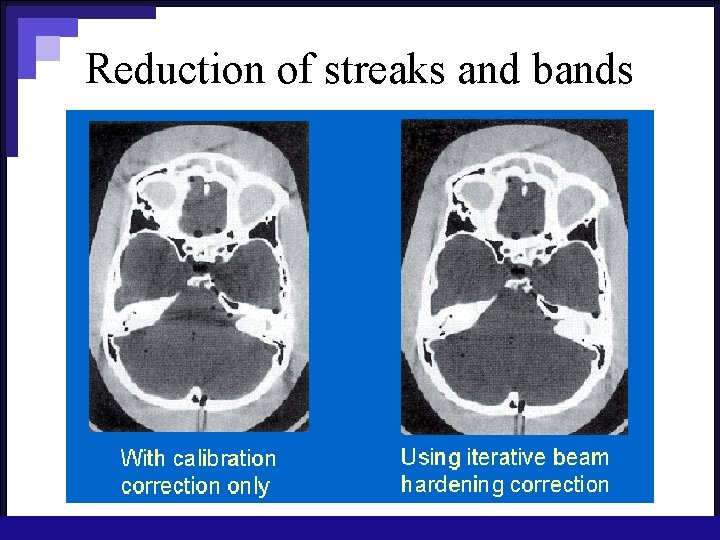
Reduction of streaks and bands
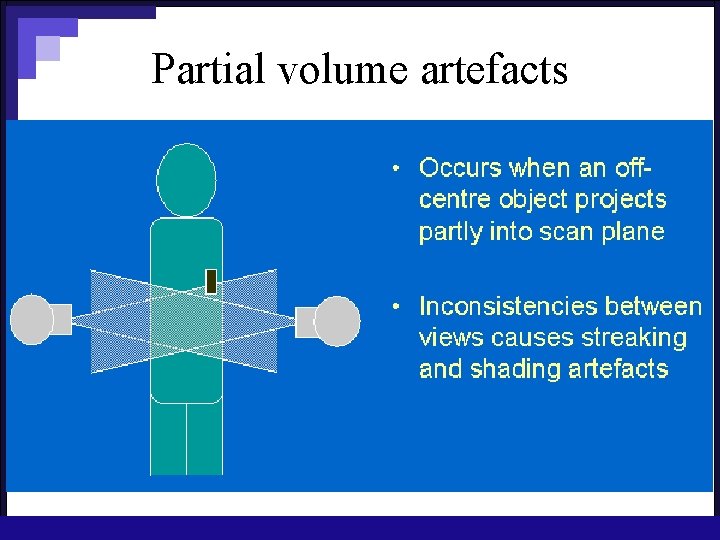
Partial volume artefacts
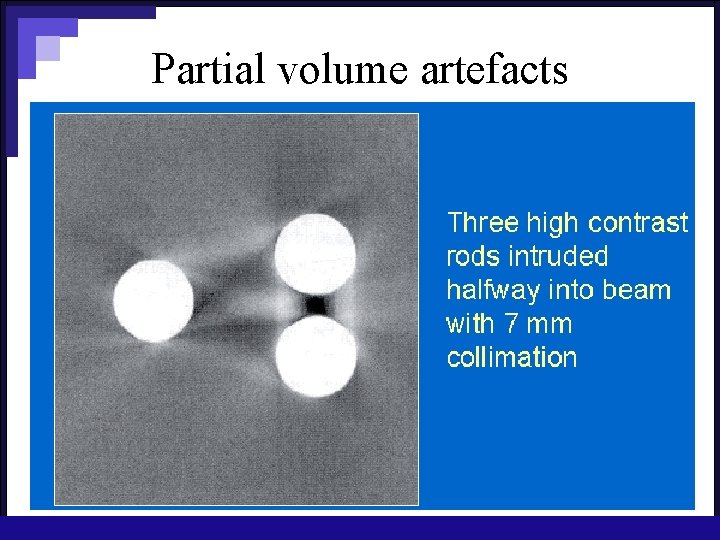
Partial volume artefacts
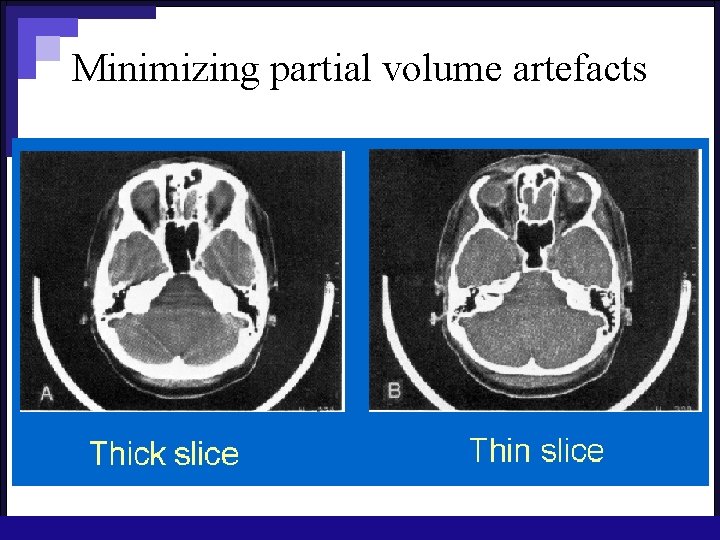
Minimizing partial volume artefacts
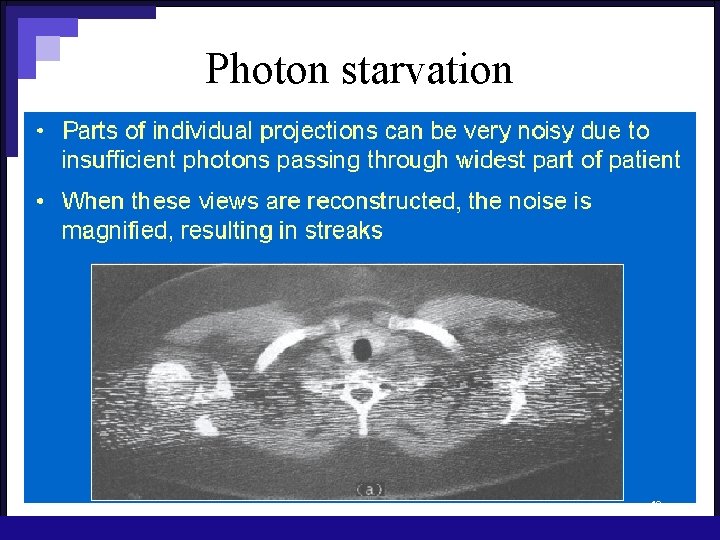
Photon starvation
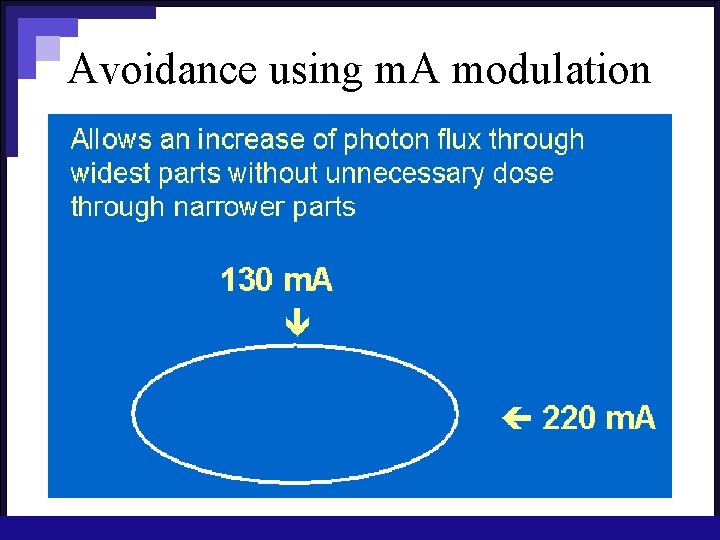
Avoidance using m. A modulation
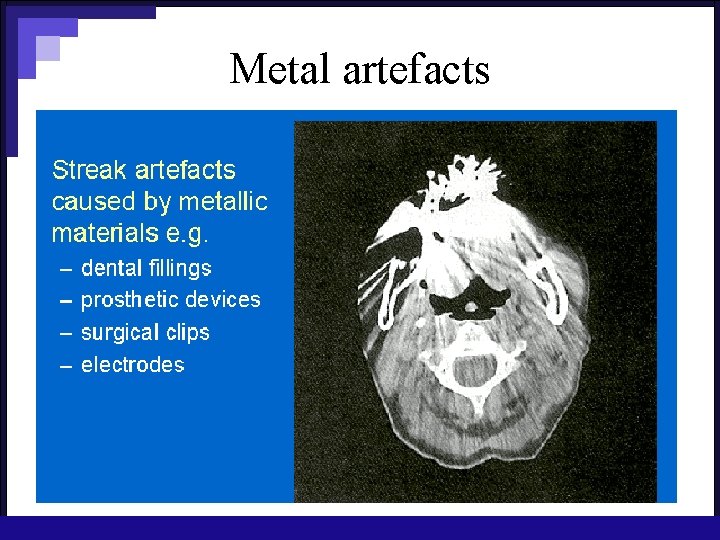
Metal artefacts
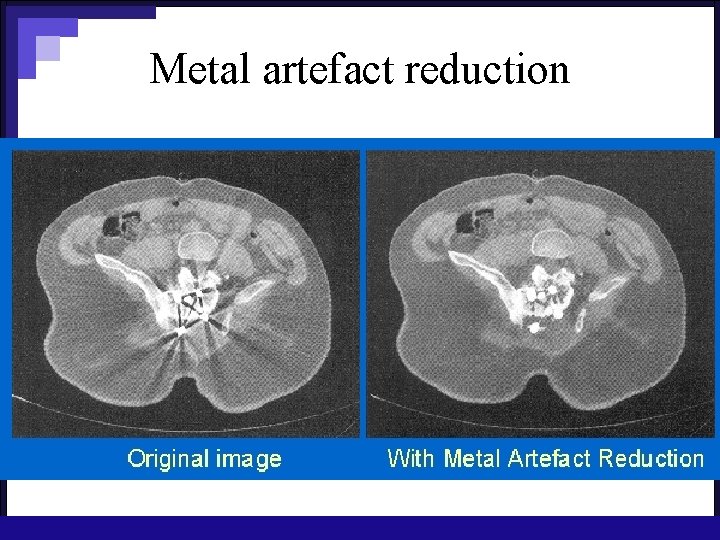
Metal artefact reduction
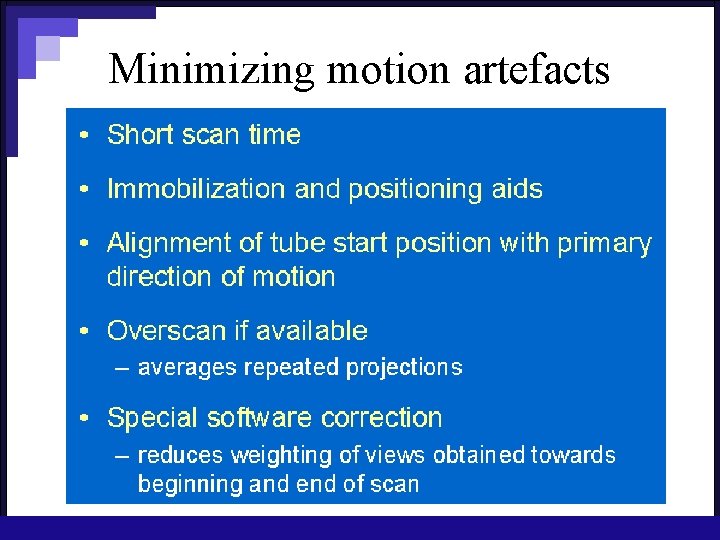
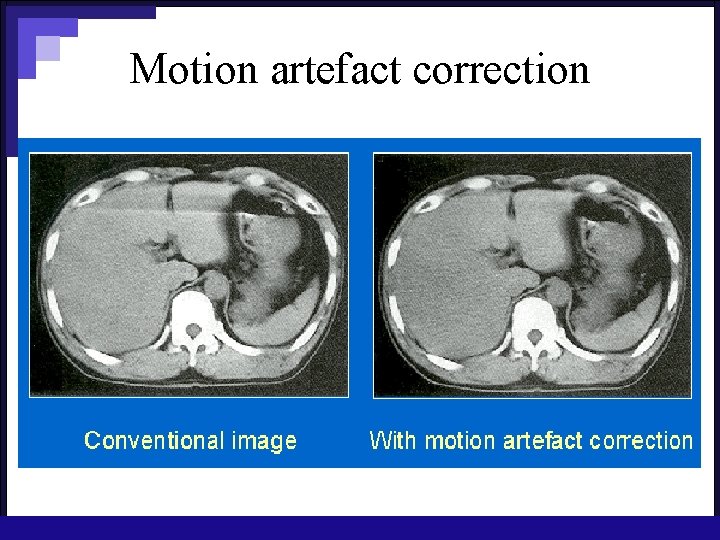
Patient motion artefacts • Voluntary and involuntary motion cause artefacts in the reconstructed image
Minimizing motion artefacts
Motion artefact correction
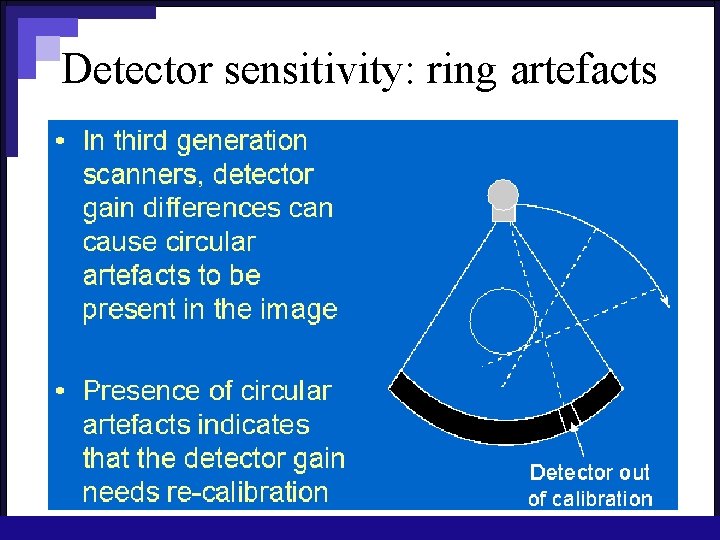
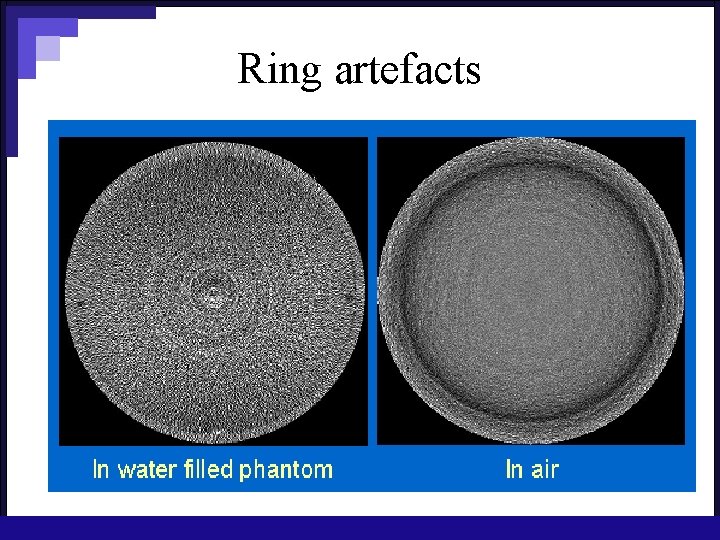
Detector sensitivity: ring artefacts
Ring artefacts
CT artefacts: summary
Questions on CT artifacts • Remedy for photon starvation? – m. A modulation, adaptive filtering • What can cause metal artifacts in patients? – dental implants, surgical clips, electrodes, prostheses • In which CT generation can occur ring artifacts? – in the 3 rd where detector ring rotates with X-ray tube