
COMPUTE SHADERS OPTIMIZE YOUR ENGINE USING COMPUTE LOU



![HIERARCHY OF WORK ITEMS [numthreads(8, 2, 4)] -> each thread group has 64 threads](https://slidetodoc.com/presentation_image_h2/2132d2ee4d81b7dbcf26ddbd9c9bf266/image-17.jpg "HIERARCHY OF WORK ITEMS [numthreads(8, 2, 4)] -> each thread group has 64 threads")
![HIERARCHY OF WORK ITEMS [numthreads(8, 2, 4)] -> each thread group has 64 threads](https://slidetodoc.com/presentation_image_h2/2132d2ee4d81b7dbcf26ddbd9c9bf266/image-18.jpg "HIERARCHY OF WORK ITEMS [numthreads(8, 2, 4)] -> each thread group has 64 threads")

![PROGRAMMING How are instructions executed? Let‘s look at an example groupshared float data[64]; …](https://slidetodoc.com/presentation_image_h2/2132d2ee4d81b7dbcf26ddbd9c9bf266/image-32.jpg "PROGRAMMING How are instructions executed? Let‘s look at an example groupshared float data[64]; …")
![EXECUTION MASK - BRANCHES … block_a: s_mov_b 64 s[0: 1], exec ; condition test,](https://slidetodoc.com/presentation_image_h2/2132d2ee4d81b7dbcf26ddbd9c9bf266/image-36.jpg "EXECUTION MASK - BRANCHES … block_a: s_mov_b 64 s[0: 1], exec ; condition test,")
![EXECUTION MASK - BRANCHES … block_a: s_mov_b 64 s[0: 1], exec ; condition test,](https://slidetodoc.com/presentation_image_h2/2132d2ee4d81b7dbcf26ddbd9c9bf266/image-37.jpg "EXECUTION MASK - BRANCHES … block_a: s_mov_b 64 s[0: 1], exec ; condition test,")
![block_a: s_mov_b 64 s[0: 1], exec ; condition test, writes results to s[2: 3]](https://slidetodoc.com/presentation_image_h2/2132d2ee4d81b7dbcf26ddbd9c9bf266/image-38.jpg "block_a: s_mov_b 64 s[0: 1], exec ; condition test, writes results to s[2: 3]")






- Slides: 65
COMPUTE SHADERS OPTIMIZE YOUR ENGINE USING COMPUTE LOU KRAMER DEVELOPER TECHNOLOGY ENGINEER, AMD Organized by
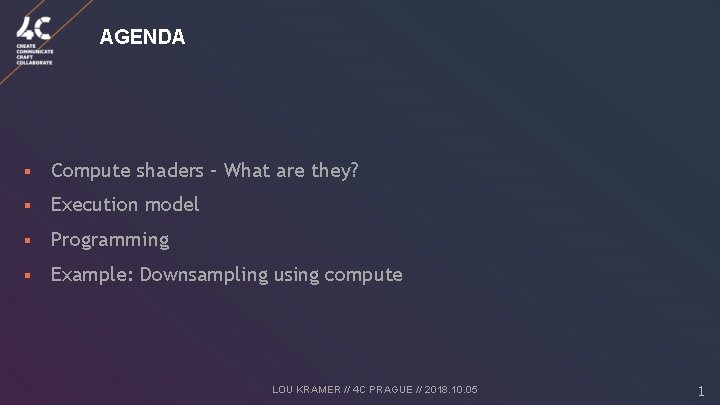
AGENDA § Compute shaders – What are they? § Execution model § Programming § Example: Downsampling using compute LOU KRAMER // 4 C PRAGUE // 2018. 10. 05 1
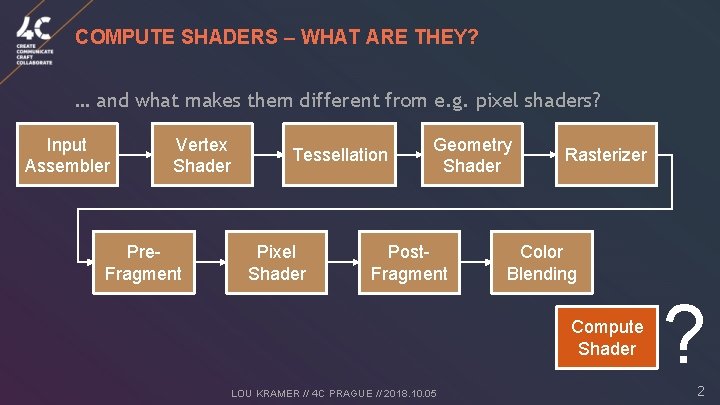
COMPUTE SHADERS – WHAT ARE THEY? … and what makes them different from e. g. pixel shaders? Input Assembler Vertex Shader Pre. Fragment Tessellation Pixel Shader Geometry Shader Post. Fragment Rasterizer Color Blending Compute Shader LOU KRAMER // 4 C PRAGUE // 2018. 10. 05 ? 2
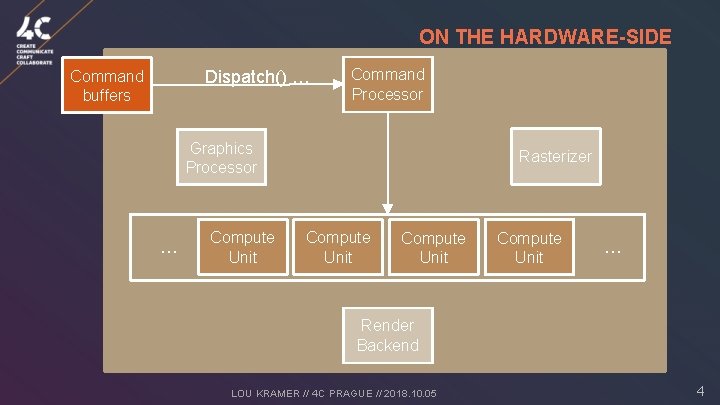
ON THE HARDWARE-SIDE Draw() … Command buffers Command Processor Graphics Processor … Compute Unit Rasterizer Compute Unit … Render Backend LOU KRAMER // 4 C PRAGUE // 2018. 10. 05 3
ON THE HARDWARE-SIDE Dispatch() … Command buffers Command Processor Graphics Processor … Compute Unit Rasterizer Compute Unit … Render Backend LOU KRAMER // 4 C PRAGUE // 2018. 10. 05 4
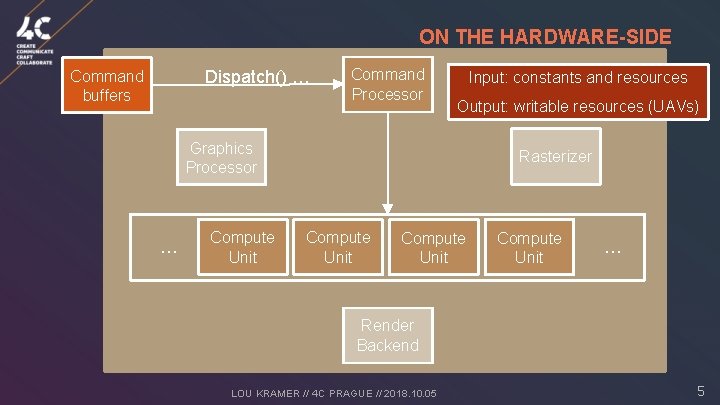
ON THE HARDWARE-SIDE Dispatch() … Command buffers Command Processor Input: constants and resources Output: writable resources (UAVs) Graphics Processor … Compute Unit Rasterizer Compute Unit … Render Backend LOU KRAMER // 4 C PRAGUE // 2018. 10. 05 5
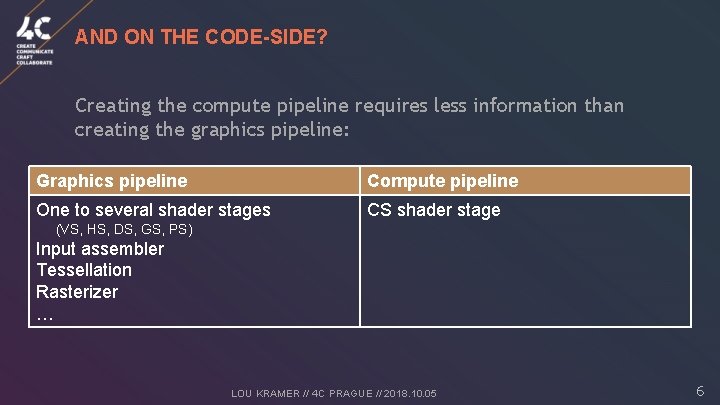
AND ON THE CODE-SIDE? Creating the compute pipeline requires less information than creating the graphics pipeline: Graphics pipeline Compute pipeline One to several shader stages CS shader stage (VS, HS, DS, GS, PS) Input assembler Tessellation Rasterizer … LOU KRAMER // 4 C PRAGUE // 2018. 10. 05 6
SHORT SUMMARY Compute shader introduce less hardware overhead compared to the other shader stages LOU KRAMER // 4 C PRAGUE // 2018. 10. 05 7
EXECUTION MODEL
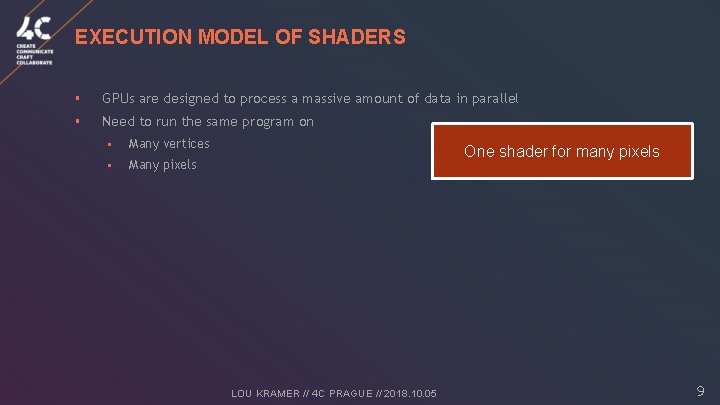
EXECUTION MODEL OF SHADERS § GPUs are designed to process a massive amount of data in parallel § Need to run the same program on § Many vertices § Many pixels One shader for many pixels LOU KRAMER // 4 C PRAGUE // 2018. 10. 05 9
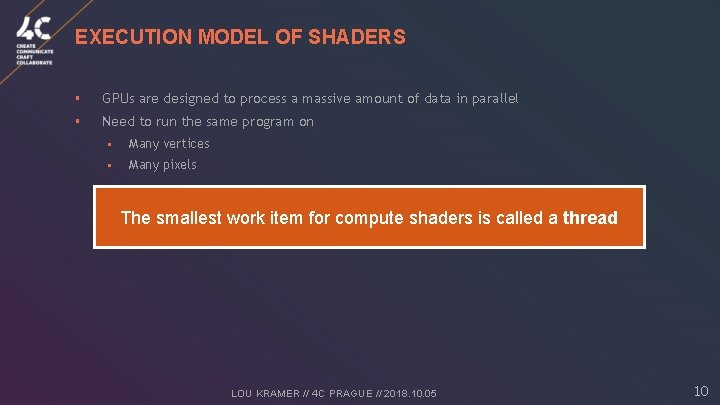
EXECUTION MODEL OF SHADERS § GPUs are designed to process a massive amount of data in parallel § Need to run the same program on § Many vertices § Many pixels The smallest work item for compute shaders is called a thread LOU KRAMER // 4 C PRAGUE // 2018. 10. 05 10
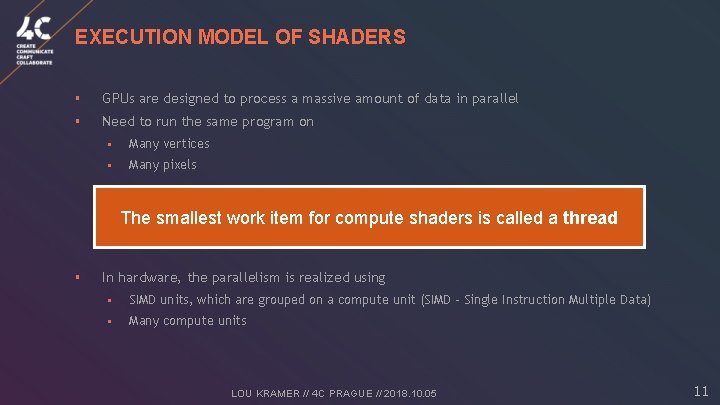
EXECUTION MODEL OF SHADERS § GPUs are designed to process a massive amount of data in parallel § Need to run the same program on § Many vertices § Many pixels The smallest work item for compute shaders is called a thread § In hardware, the parallelism is realized using § SIMD units, which are grouped on a compute unit (SIMD – Single Instruction Multiple Data) § Many compute units LOU KRAMER // 4 C PRAGUE // 2018. 10. 05 11
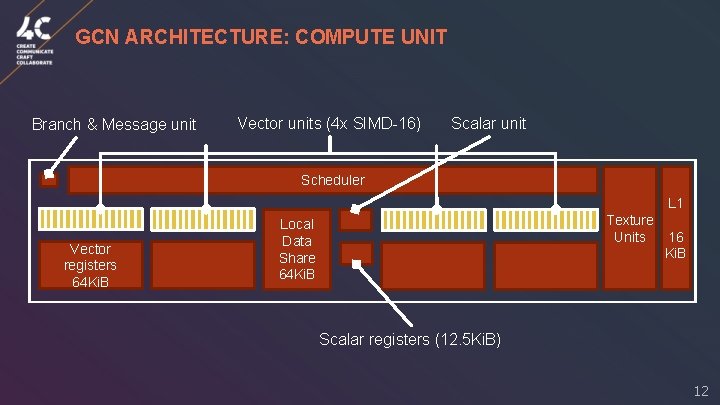
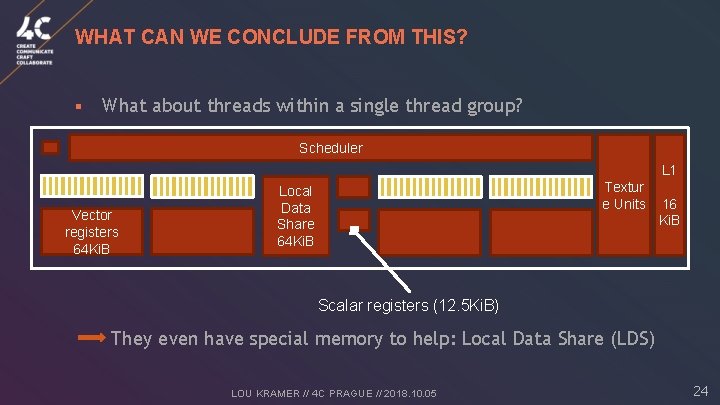
GCN ARCHITECTURE: COMPUTE UNIT Branch & Message unit Vector units (4 x SIMD-16) Scalar unit Scheduler L 1 Vector registers 64 Ki. B Texture Units Local Data Share 64 Ki. B 16 Ki. B Scalar registers (12. 5 Ki. B) 12
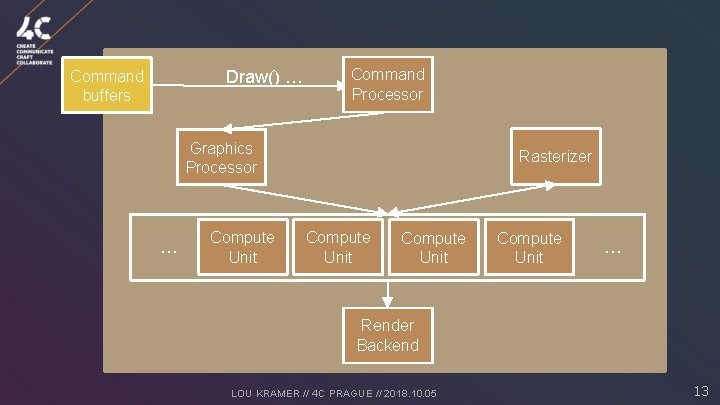
Draw() … Command buffers Command Processor Graphics Processor … Compute Unit Rasterizer Compute Unit … Render Backend LOU KRAMER // 4 C PRAGUE // 2018. 10. 05 13
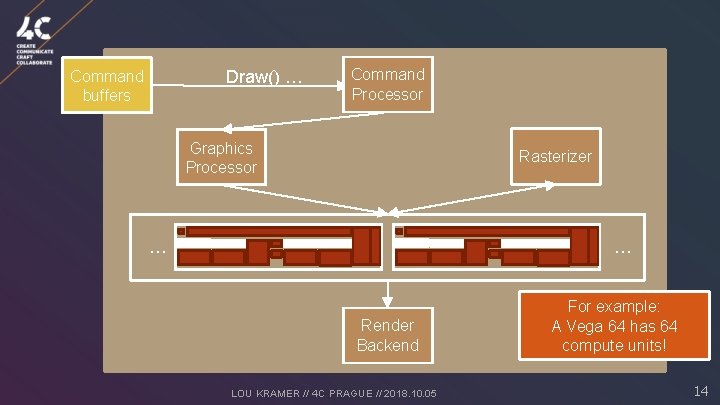
Draw() … Command buffers Command Processor Graphics Processor Rasterizer … … Render Backend LOU KRAMER // 4 C PRAGUE // 2018. 10. 05 For example: A Vega 64 has 64 compute units! 14
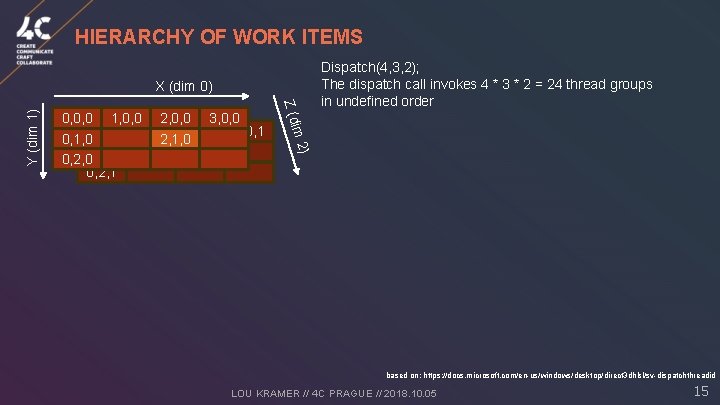
HIERARCHY OF WORK ITEMS ) im 2 0, 0, 0, 1, 0, 0, 2, 0, 0, 3, 0, 0, 1, 00, 0, 0 0 2, 1, 00, 0, 0 0, 2, 0 0 0, 2, 1 Z (d Y (dim 1) X (dim 0) Dispatch(4, 3, 2); The dispatch call invokes 4 * 3 * 2 = 24 thread groups in undefined order based on: https: //docs. microsoft. com/en-us/windows/desktop/direct 3 dhlsl/sv-dispatchthreadid LOU KRAMER // 4 C PRAGUE // 2018. 10. 05 15
HIERARCHY OF WORK ITEMS [numthreads(8, 2, 4)] -> each thread group has 64 threads ) In the compute shader, the thread group size is declared using im 2 0, 0, 0, 1, 0, 0, 2, 0, 0, 3, 0, 0, 1, 00, 0, 0 0 2, 1, 00, 0, 0 0, 2, 0 0 0, 2, 1 Z (d Y (dim 1) X (dim 0) Dispatch(4, 3, 2); The dispatch call invokes 4 * 3 * 2 = 24 thread groups in undefined order Thread group (2, 1, 0) 0, 0, 0, 1, 0, 0, 2, 0, 0, 3, 0, 0, 4, 0, 0, 5, 0, 0, 6, 0, 0, 7, 0, 0, 0, 0, 0, 1, 0 0 0, 0, 0 5, 1, 00, 0, 0, 20, 0, 3 0, 1, 1 0 0 0 0, 1, 2 0 0 0 0, 1, 3 based on: https: //docs. microsoft. com/en-us/windows/desktop/direct 3 dhlsl/sv-dispatchthreadid LOU KRAMER // 4 C PRAGUE // 2018. 10. 05 16
HIERARCHY OF WORK ITEMS [numthreads(8, 2, 4)] -> each thread group has 64 threads ) In the compute shader, the thread group size is declared using Thread (5, 1, 0) im 2 0, 0, 0, 1, 0, 0, 2, 0, 0, 3, 0, 0, 1, 00, 0, 0 0 2, 1, 00, 0, 0 0, 2, 0 0 0, 2, 1 Z (d Y (dim 1) X (dim 0) Dispatch(4, 3, 2); The dispatch call invokes 4 * 3 * 2 = 24 thread groups in undefined order SV_Group. Thread. ID: (5, 1, 0) SV_Group. ID: (2, 1, 0) SV_Dispatch. Thread. ID: (2, 1, 0) * (8, 2, 4) + (5, 1, 0) = (21, 3, 0) SV_Group. Index: 0*8*2+1*8+5= 13 Thread group (2, 1, 0) 0, 0, 0, 1, 0, 0, 2, 0, 0, 3, 0, 0, 4, 0, 0, 5, 0, 0, 6, 0, 0, 7, 0, 0, 0, 0, 0, 1, 0 0 0, 0, 0 5, 1, 00, 0, 0, 20, 0, 3 0, 1, 1 0 0 0 0, 1, 2 0 0 0 0, 1, 3 based on: https: //docs. microsoft. com/en-us/windows/desktop/direct 3 dhlsl/sv-dispatchthreadid LOU KRAMER // 4 C PRAGUE // 2018. 10. 05 17
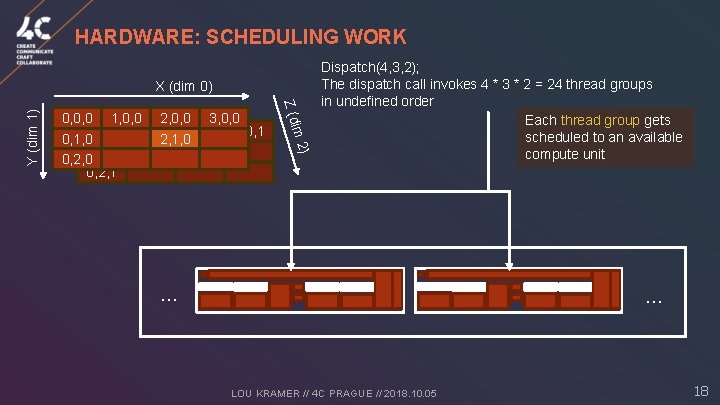
HARDWARE: SCHEDULING WORK ) im 2 0, 0, 0, 1, 0, 0, 2, 0, 0, 3, 0, 0, 1, 00, 0, 0 0 2, 1, 00, 0, 0 0, 2, 0 0 0, 2, 1 Z (d Y (dim 1) X (dim 0) Dispatch(4, 3, 2); The dispatch call invokes 4 * 3 * 2 = 24 thread groups in undefined order Each thread group gets scheduled to an available compute unit … … LOU KRAMER // 4 C PRAGUE // 2018. 10. 05 18
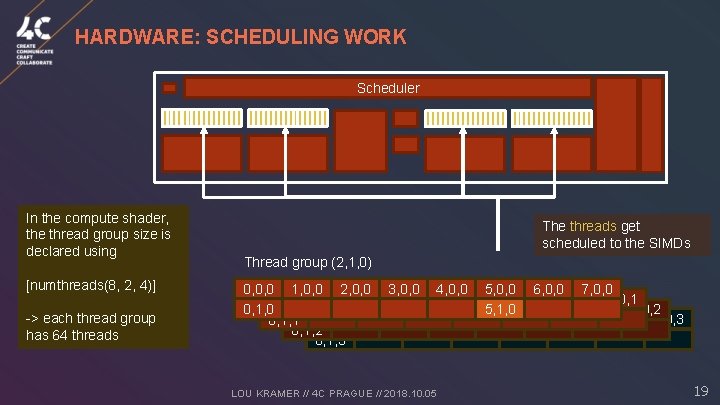
HARDWARE: SCHEDULING WORK Scheduler In the compute shader, the thread group size is declared using [numthreads(8, 2, 4)] -> each thread group has 64 threads The threads get scheduled to the SIMDs Thread group (2, 1, 0) 0, 0, 0, 1, 0, 0, 2, 0, 0, 3, 0, 0, 4, 0, 0, 5, 0, 0, 6, 0, 0, 7, 0, 0, 0, 0, 0, 1, 0 0 0, 0, 0 5, 1, 00, 0, 0, 20, 0, 3 0, 1, 1 0 0 0 0, 1, 2 0 0 0 0, 1, 3 LOU KRAMER // 4 C PRAGUE // 2018. 10. 05 19
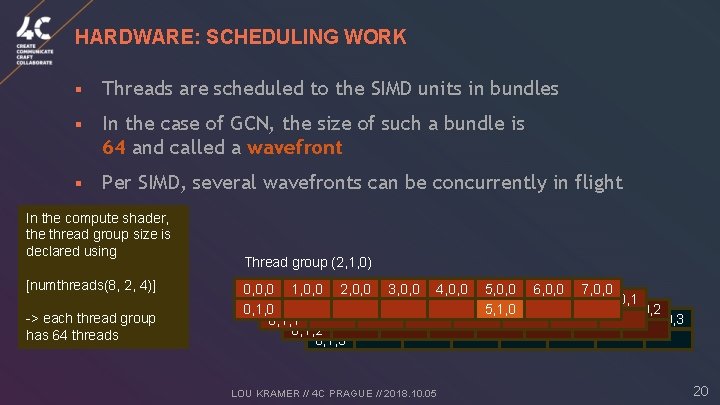
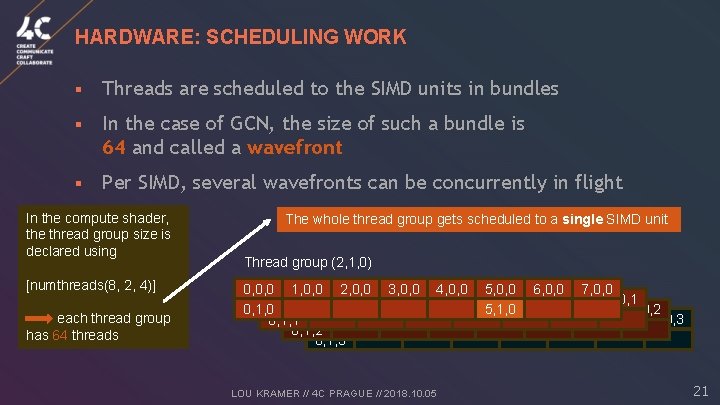
HARDWARE: SCHEDULING WORK § Threads are scheduled to the SIMD units in bundles § In the case of GCN, the size of such a bundle is 64 and called a wavefront § Per SIMD, several wavefronts can be concurrently in flight In the compute shader, the thread group size is declared using [numthreads(8, 2, 4)] -> each thread group has 64 threads Thread group (2, 1, 0) 0, 0, 0, 1, 0, 0, 2, 0, 0, 3, 0, 0, 4, 0, 0, 5, 0, 0, 6, 0, 0, 7, 0, 0, 0, 0, 0, 1, 0 0 0, 0, 0 5, 1, 00, 0, 0, 20, 0, 3 0, 1, 1 0 0 0 0, 1, 2 0 0 0 0, 1, 3 LOU KRAMER // 4 C PRAGUE // 2018. 10. 05 20
HARDWARE: SCHEDULING WORK § Threads are scheduled to the SIMD units in bundles § In the case of GCN, the size of such a bundle is 64 and called a wavefront § Per SIMD, several wavefronts can be concurrently in flight In the compute shader, the thread group size is declared using [numthreads(8, 2, 4)] each thread group has 64 threads The whole thread group gets scheduled to a single SIMD unit Thread group (2, 1, 0) 0, 0, 0, 1, 0, 0, 2, 0, 0, 3, 0, 0, 4, 0, 0, 5, 0, 0, 6, 0, 0, 7, 0, 0, 0, 0, 0, 1, 0 0 0, 0, 0 5, 1, 00, 0, 0, 20, 0, 3 0, 1, 1 0 0 0 0, 1, 2 0 0 0 0, 1, 3 LOU KRAMER // 4 C PRAGUE // 2018. 10. 05 21
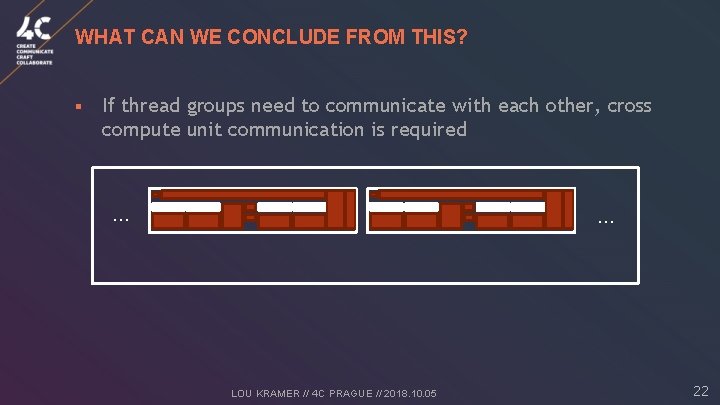
WHAT CAN WE CONCLUDE FROM THIS? § If thread groups need to communicate with each other, cross compute unit communication is required … … LOU KRAMER // 4 C PRAGUE // 2018. 10. 05 22
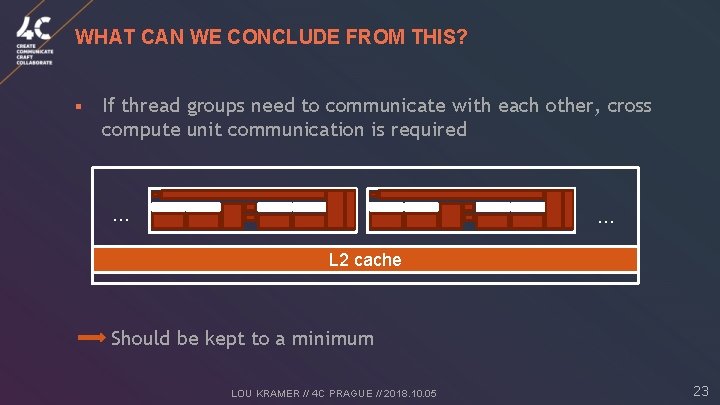
WHAT CAN WE CONCLUDE FROM THIS? § If thread groups need to communicate with each other, cross compute unit communication is required … … L 2 cache Should be kept to a minimum LOU KRAMER // 4 C PRAGUE // 2018. 10. 05 23
WHAT CAN WE CONCLUDE FROM THIS? § What about threads within a single thread group? Scheduler L 1 Vector registers 64 Ki. B Textur e Units Local Data Share 64 Ki. B 16 Ki. B Scalar registers (12. 5 Ki. B) They even have special memory to help: Local Data Share (LDS) LOU KRAMER // 4 C PRAGUE // 2018. 10. 05 24
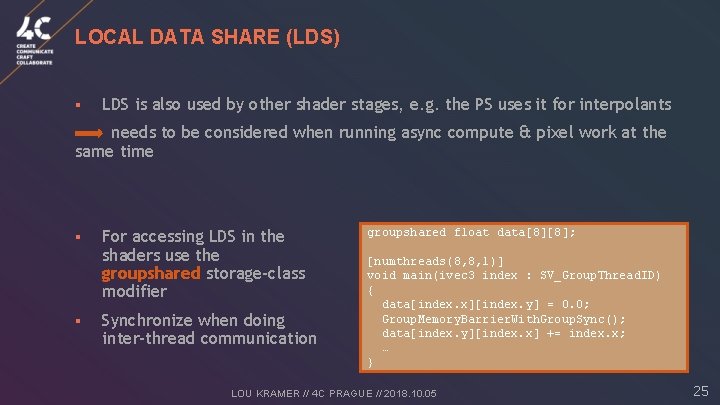
LOCAL DATA SHARE (LDS) § LDS is also used by other shader stages, e. g. the PS uses it for interpolants needs to be considered when running async compute & pixel work at the same time § § For accessing LDS in the shaders use the groupshared storage-class modifier Synchronize when doing inter-thread communication groupshared float data[8][8]; [numthreads(8, 8, 1)] void main(ivec 3 index : SV_Group. Thread. ID) { data[index. x][index. y] = 0. 0; Group. Memory. Barrier. With. Group. Sync(); data[index. y][index. x] += index. x; … } LOU KRAMER // 4 C PRAGUE // 2018. 10. 05 25
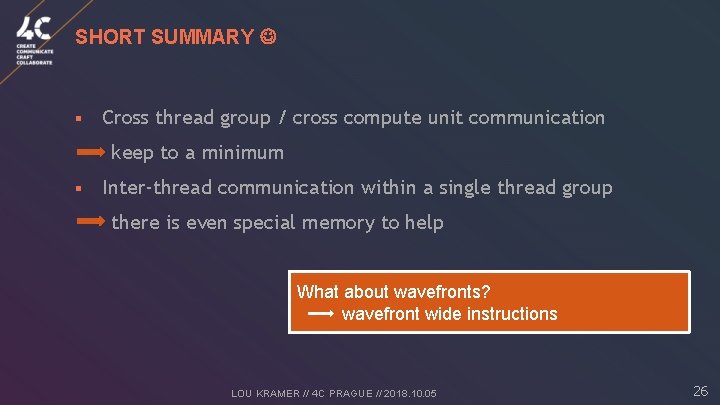
SHORT SUMMARY § Cross thread group / cross compute unit communication keep to a minimum § Inter-thread communication within a single thread group there is even special memory to help What about wavefronts? wavefront wide instructions LOU KRAMER // 4 C PRAGUE // 2018. 10. 05 26
PROGRAMMING
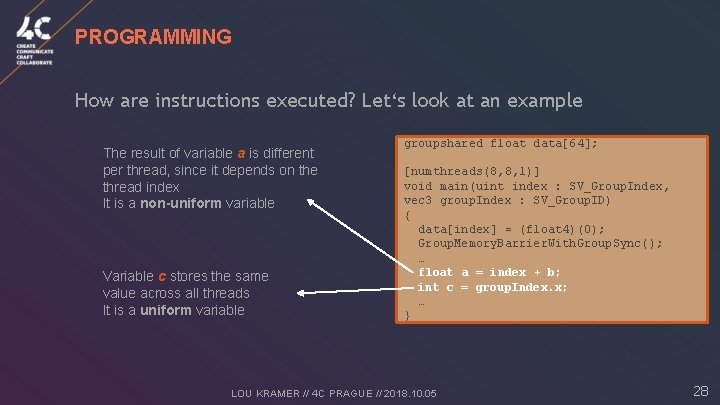
PROGRAMMING How are instructions executed? Let‘s look at an example The result of variable a is different per thread, since it depends on the thread index It is a non-uniform variable Variable c stores the same value across all threads It is a uniform variable groupshared float data[64]; [numthreads(8, 8, 1)] void main(uint index : SV_Group. Index, vec 3 group. Index : SV_Group. ID) { data[index] = (float 4)(0); Group. Memory. Barrier. With. Group. Sync(); … float a = index + b; int c = group. Index. x; … } LOU KRAMER // 4 C PRAGUE // 2018. 10. 05 28
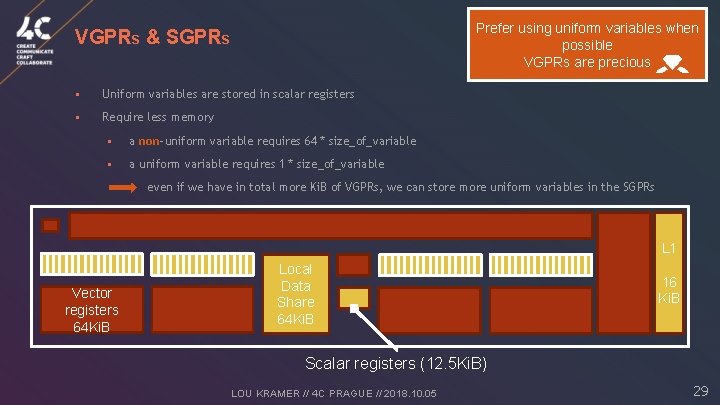
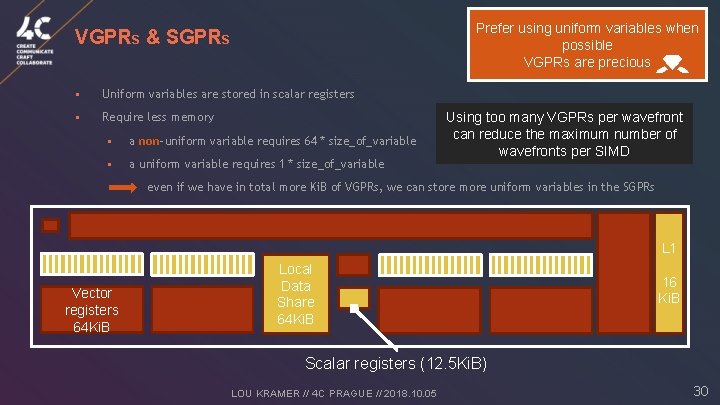
Prefer using uniform variables when possible VGPRs are precious VGPRS & SGPRS § Uniform variables are stored in scalar registers § Require less memory § a non-uniform variable requires 64 * size_of_variable § a uniform variable requires 1 * size_of_variable even if we have in total more Ki. B of VGPRs, we can store more uniform variables in the SGPRs L 1 Vector registers 64 Ki. B Local Data Share 64 Ki. B 16 Ki. B Scalar registers (12. 5 Ki. B) LOU KRAMER // 4 C PRAGUE // 2018. 10. 05 29
Prefer using uniform variables when possible VGPRs are precious VGPRS & SGPRS § Uniform variables are stored in scalar registers § Require less memory § a non-uniform variable requires 64 * size_of_variable § a uniform variable requires 1 * size_of_variable Using too many VGPRs per wavefront can reduce the maximum number of wavefronts per SIMD even if we have in total more Ki. B of VGPRs, we can store more uniform variables in the SGPRs L 1 Vector registers 64 Ki. B Local Data Share 64 Ki. B 16 Ki. B Scalar registers (12. 5 Ki. B) LOU KRAMER // 4 C PRAGUE // 2018. 10. 05 30
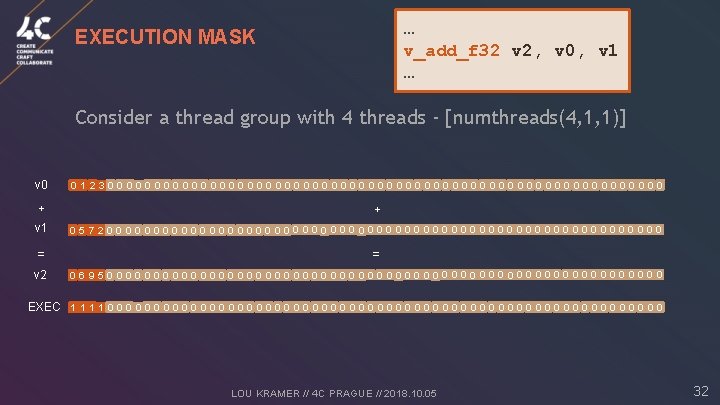
PROGRAMMING How are instructions executed? Let‘s look at an example groupshared float data[64]; … v_add_f 32 v 2, v 0, v 1 … [numthreads(8, 8, 1)] void main(uint index : SV_Group. Index) { data[index] = (float 4)(0); Group. Memory. Barrier. With. Group. Sync(); … float a = index + b; … } LOU KRAMER // 4 C PRAGUE // 2018. 10. 05 31
… v_add_f 32 v 2, v 0, v 1 … EXECUTION MASK Consider a thread group with 4 threads - [numthreads(4, 1, 1)] v 0 + v 1 = v 2 0123000000000000000000000000000000 + 0572000000000000000000000000000000 = 0695000000000000000000000000000000 EXEC 1 1 0 0 0 0 0 0 0 0 0 0 0 0 0 0 0 LOU KRAMER // 4 C PRAGUE // 2018. 10. 05 32
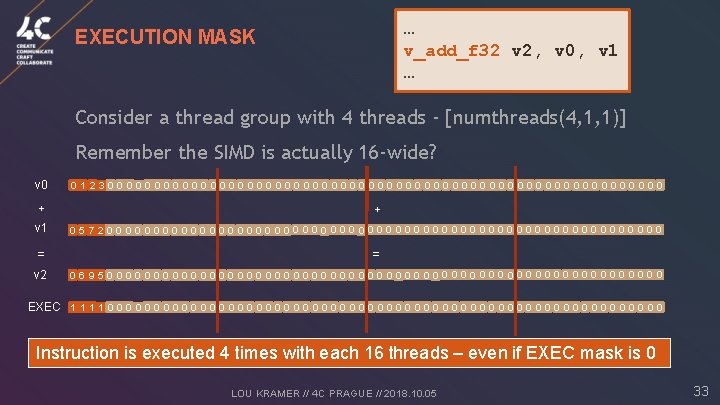
… v_add_f 32 v 2, v 0, v 1 … EXECUTION MASK Consider a thread group with 4 threads - [numthreads(4, 1, 1)] Remember the SIMD is actually 16 -wide? v 0 + v 1 = v 2 0123000000000000000000000000000000 + 0572000000000000000000000000000000 = 0695000000000000000000000000000000 EXEC 1 1 0 0 0 0 0 0 0 0 0 0 0 0 0 0 0 Instruction is executed 4 times with each 16 threads – even if EXEC mask is 0 LOU KRAMER // 4 C PRAGUE // 2018. 10. 05 33
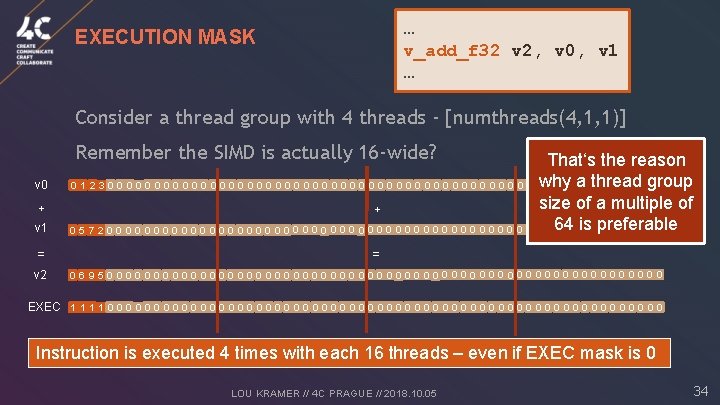
… v_add_f 32 v 2, v 0, v 1 … EXECUTION MASK Consider a thread group with 4 threads - [numthreads(4, 1, 1)] Remember the SIMD is actually 16 -wide? v 0 + v 1 = v 2 That‘s the reason 0 0 0 group 00 0 0 a 0 thread 0 1 2 3 0 0 0 0 0 0 0 0 0 0 0 0 why size of a multiple of + 64 0000000 0 0 is 0 0 preferable 05720000000000000000000000000 = 0695000000000000000000000000000000 EXEC 1 1 0 0 0 0 0 0 0 0 0 0 0 0 0 0 0 Instruction is executed 4 times with each 16 threads – even if EXEC mask is 0 LOU KRAMER // 4 C PRAGUE // 2018. 10. 05 34
EXECUTION MASK - BRANCHES … block_a: s_mov_b 64 s[0: 1], exec ; condition test, writes results to s[2: 3] s_mov_b 64 s[2: 3], condition s_mov_b 64 exec, s[2: 3] s_branch_execz block_c block_b: ; ‘if‘ part: compute. Detail(); s_not_b 64 exec, exec s_branch_execz block_d block_c: ; ‘else‘ part: compute. Basic(); block_d: s_mov_b 64 exec, s[0: 1] ; code afterwards … groupshared float data[64]; [numthreads(8, 8, 1)] void main(uint index : SV_Group. Index) { … if (condition) compute. Detail(); else compute. Basic(); … } LOU KRAMER // 4 C PRAGUE // 2018. 10. 05 35
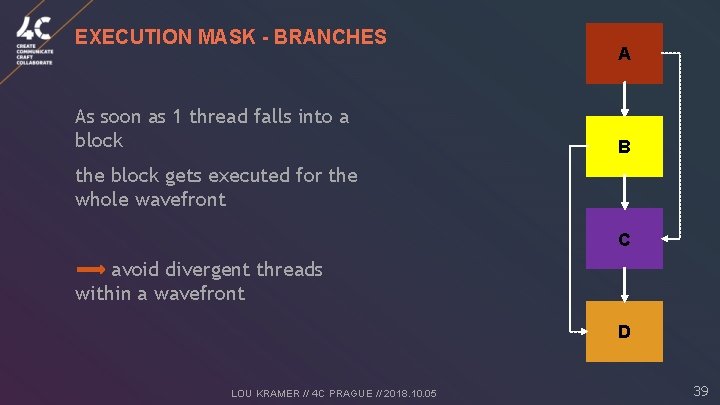
EXECUTION MASK - BRANCHES … block_a: s_mov_b 64 s[0: 1], exec ; condition test, writes results to s[2: 3] s_mov_b 64 s[2: 3], condition s_mov_b 64 exec, s[2: 3] s_branch_execz block_c block_b: ; ‘if‘ part: compute. Detail(); s_not_b 64 exec, exec s_branch_execz block_d block_c: ; ‘else‘ part: compute. Basic(); block_d: s_mov_b 64 exec, s[0: 1] ; code afterwards … A Save exec B exec = result of test per thread Invert exec Restore exec LOU KRAMER // 4 C PRAGUE // 2018. 10. 05 C D 36
block_a: s_mov_b 64 s[0: 1], exec ; condition test, writes results to s[2: 3] s_mov_b 64 s[2: 3], condition s_mov_b 64 s_branch_execz exec, s[2: 3] block_c block_b: ; ‘if‘ part: compute. Detail(); s_not_b 64 s_branch_execz block_c: exec, exec block_d ; ‘else‘ part: compute. Basic(); block_d: s_mov_b 64 exec, s[0: 1] ; code afterwards LOU KRAMER // 4 C PRAGUE // 2018. 10. 05 37
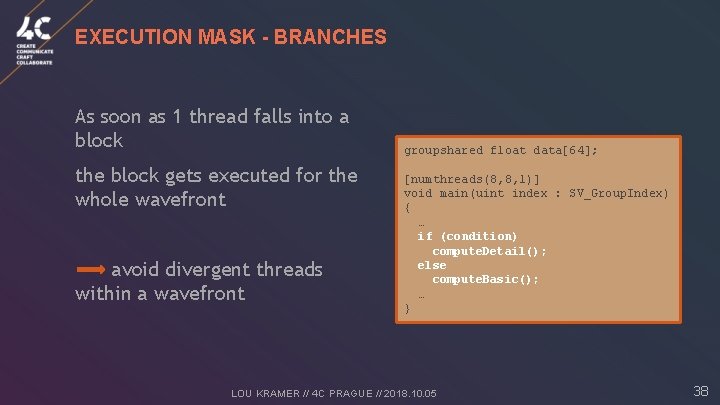
EXECUTION MASK - BRANCHES As soon as 1 thread falls into a block the block gets executed for the whole wavefront avoid divergent threads within a wavefront groupshared float data[64]; [numthreads(8, 8, 1)] void main(uint index : SV_Group. Index) { … if (condition) compute. Detail(); else compute. Basic(); … } LOU KRAMER // 4 C PRAGUE // 2018. 10. 05 38
EXECUTION MASK - BRANCHES As soon as 1 thread falls into a block A B the block gets executed for the whole wavefront C avoid divergent threads within a wavefront D LOU KRAMER // 4 C PRAGUE // 2018. 10. 05 39
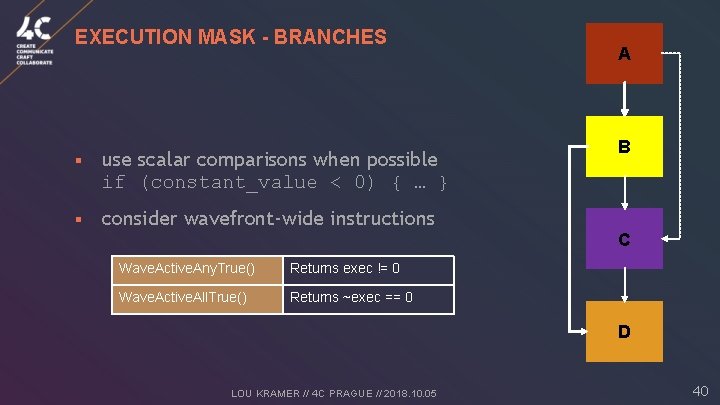
EXECUTION MASK - BRANCHES § use scalar comparisons when possible if (constant_value < 0) { … } § consider wavefront-wide instructions A B C Wave. Active. Any. True() Returns exec != 0 Wave. Active. All. True() Returns ~exec == 0 D LOU KRAMER // 4 C PRAGUE // 2018. 10. 05 40
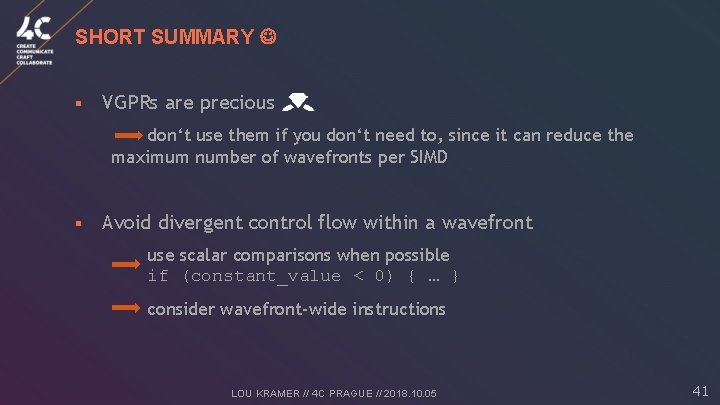
SHORT SUMMARY § VGPRs are precious don‘t use them if you don‘t need to, since it can reduce the maximum number of wavefronts per SIMD § Avoid divergent control flow within a wavefront use scalar comparisons when possible if (constant_value < 0) { … } consider wavefront-wide instructions LOU KRAMER // 4 C PRAGUE // 2018. 10. 05 41
DOWNSAMPLING
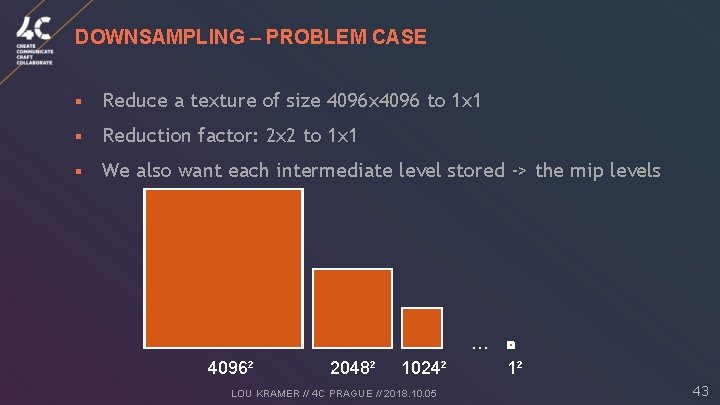
DOWNSAMPLING – PROBLEM CASE § Reduce a texture of size 4096 x 4096 to 1 x 1 § Reduction factor: 2 x 2 to 1 x 1 § We also want each intermediate level stored -> the mip levels … 4096² 2048² 1024² LOU KRAMER // 4 C PRAGUE // 2018. 10. 05 1² 43
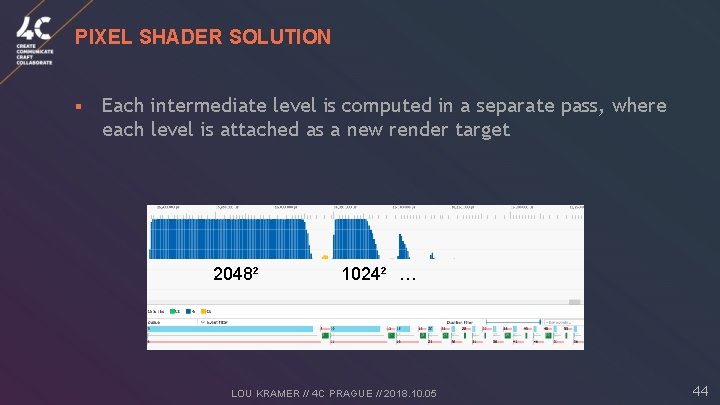
PIXEL SHADER SOLUTION § Each intermediate level is computed in a separate pass, where each level is attached as a new render target 2048² 1024² … LOU KRAMER // 4 C PRAGUE // 2018. 10. 05 44
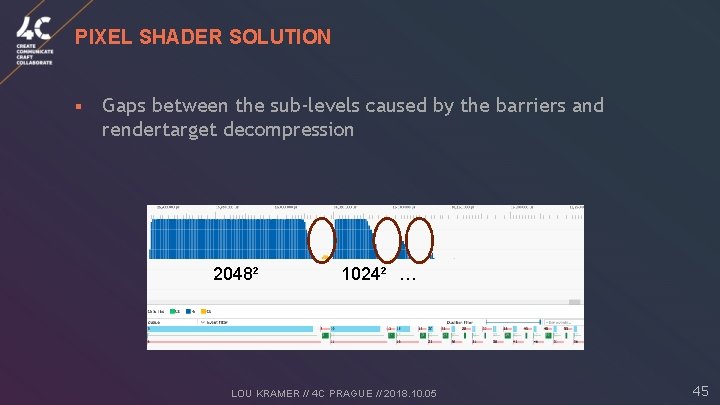
PIXEL SHADER SOLUTION § Gaps between the sub-levels caused by the barriers and rendertarget decompression 2048² 1024² … LOU KRAMER // 4 C PRAGUE // 2018. 10. 05 45
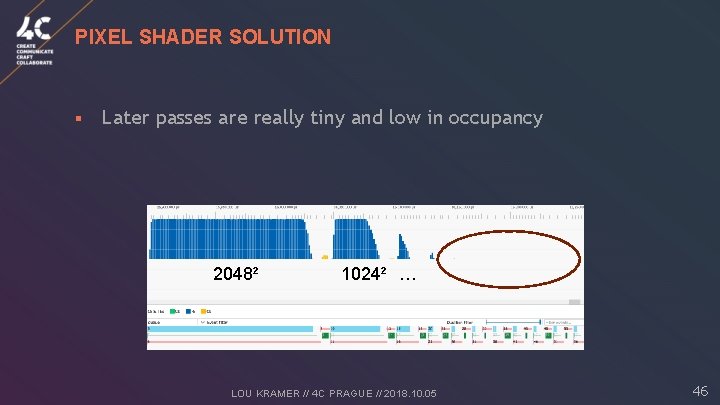
PIXEL SHADER SOLUTION § Later passes are really tiny and low in occupancy 2048² 1024² … LOU KRAMER // 4 C PRAGUE // 2018. 10. 05 46
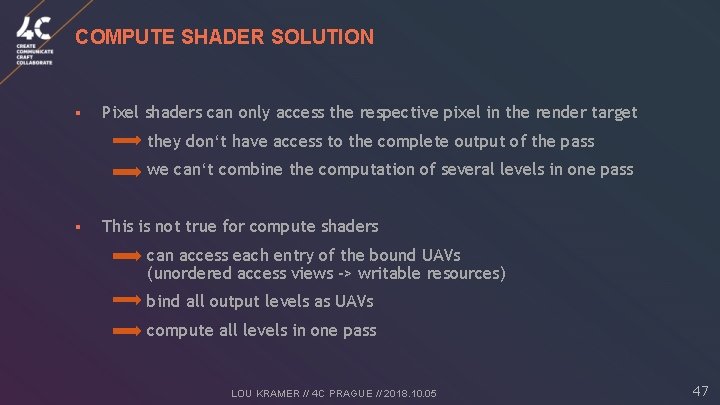
COMPUTE SHADER SOLUTION § Pixel shaders can only access the respective pixel in the render target they don‘t have access to the complete output of the pass we can‘t combine the computation of several levels in one pass § This is not true for compute shaders can access each entry of the bound UAVs (unordered access views -> writable resources) bind all output levels as UAVs compute all levels in one pass LOU KRAMER // 4 C PRAGUE // 2018. 10. 05 47
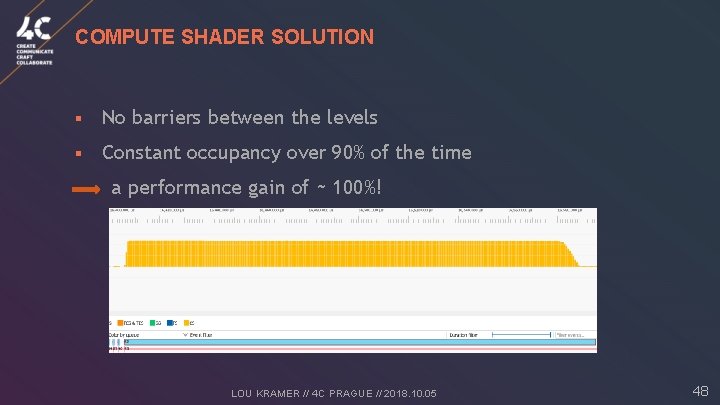
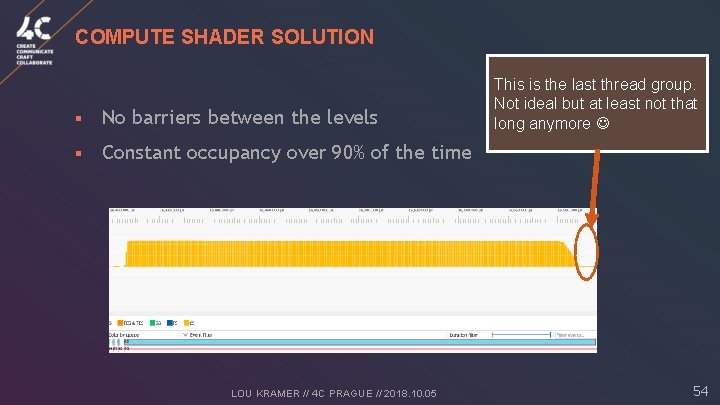
COMPUTE SHADER SOLUTION § No barriers between the levels § Constant occupancy over 90% of the time a performance gain of ~ 100%! LOU KRAMER // 4 C PRAGUE // 2018. 10. 05 48
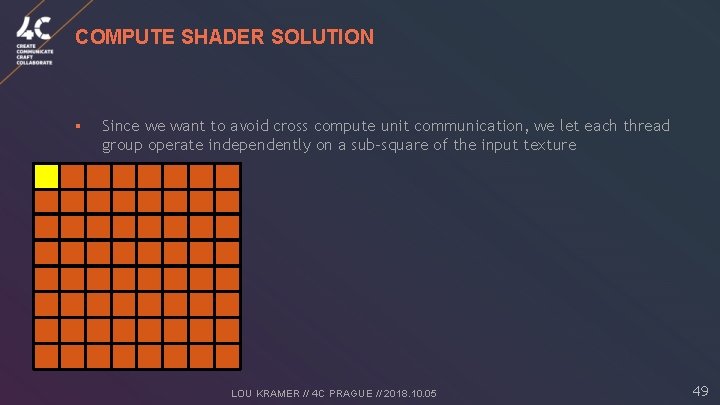
COMPUTE SHADER SOLUTION § Since we want to avoid cross compute unit communication, we let each thread group operate independently on a sub-square of the input texture LOU KRAMER // 4 C PRAGUE // 2018. 10. 05 49
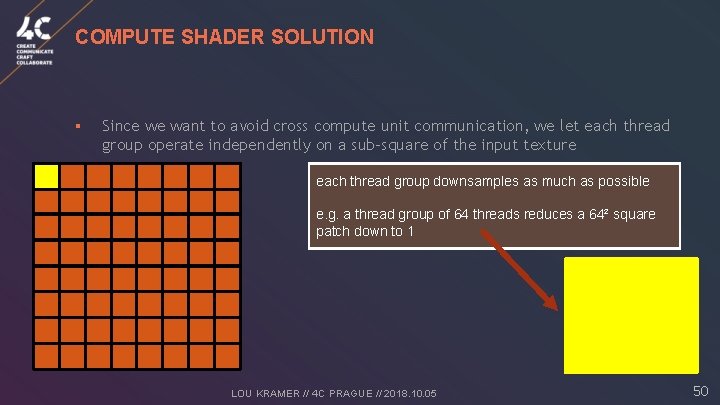
COMPUTE SHADER SOLUTION § Since we want to avoid cross compute unit communication, we let each thread group operate independently on a sub-square of the input texture each thread group downsamples as much as possible e. g. a thread group of 64 threads reduces a 64² square patch down to 1 LOU KRAMER // 4 C PRAGUE // 2018. 10. 05 50
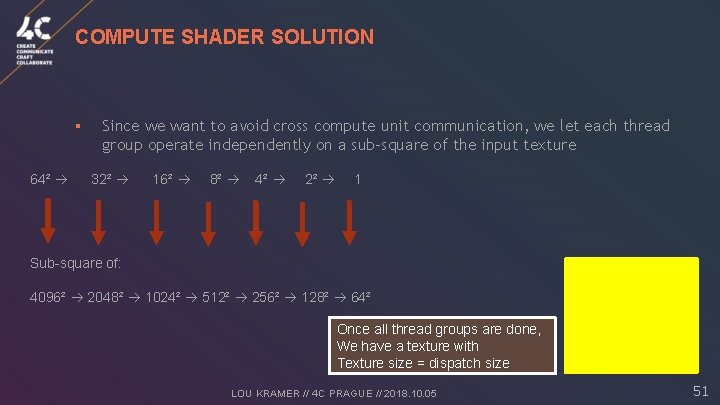
COMPUTE SHADER SOLUTION § 64² Since we want to avoid cross compute unit communication, we let each thread group operate independently on a sub-square of the input texture 32² 16² 8² 4² 2² 1 Sub-square of: 4096² 2048² 1024² 512² 256² 128² 64² Once all thread groups are done, We have a texture with Texture size = dispatch size LOU KRAMER // 4 C PRAGUE // 2018. 10. 05 51
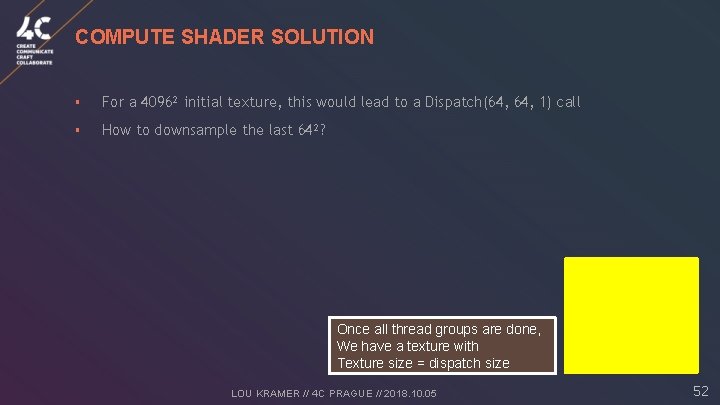
COMPUTE SHADER SOLUTION § For a 4096² initial texture, this would lead to a Dispatch(64, 1) call § How to downsample the last 64²? Once all thread groups are done, We have a texture with Texture size = dispatch size LOU KRAMER // 4 C PRAGUE // 2018. 10. 05 52
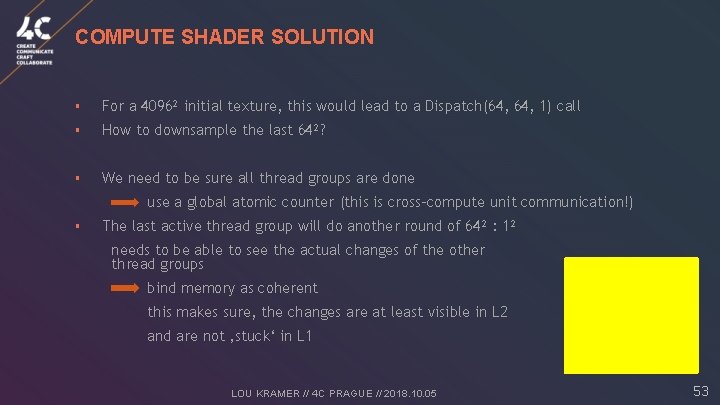
COMPUTE SHADER SOLUTION § For a 4096² initial texture, this would lead to a Dispatch(64, 1) call § How to downsample the last 64²? § We need to be sure all thread groups are done use a global atomic counter (this is cross-compute unit communication!) § The last active thread group will do another round of 64² : 1² needs to be able to see the actual changes of the other thread groups bind memory as coherent this makes sure, the changes are at least visible in L 2 and are not ‚stuck‘ in L 1 LOU KRAMER // 4 C PRAGUE // 2018. 10. 05 53
COMPUTE SHADER SOLUTION § No barriers between the levels § Constant occupancy over 90% of the time LOU KRAMER // 4 C PRAGUE // 2018. 10. 05 This is the last thread group. Not ideal but at least not that long anymore 54
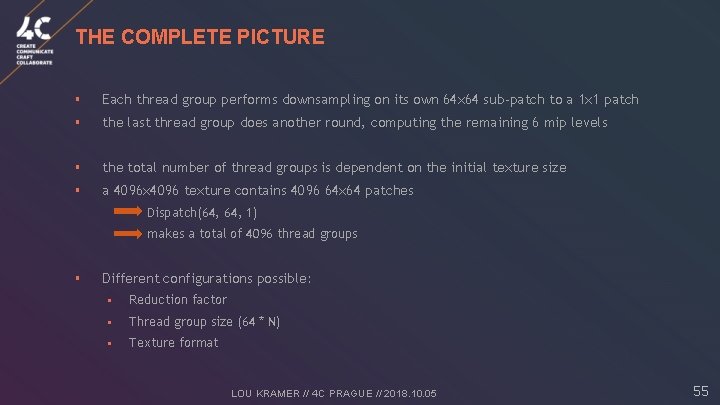
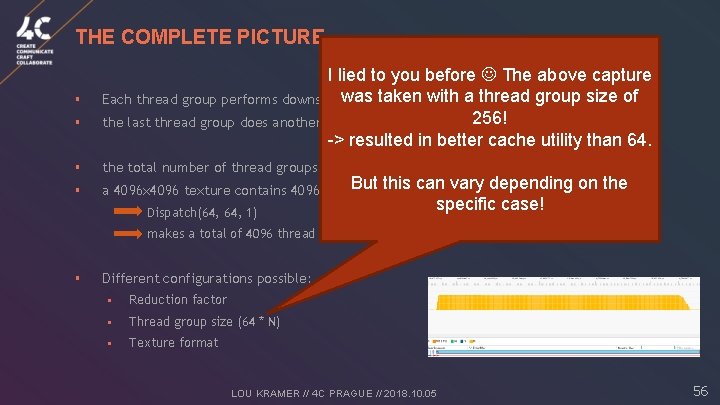
THE COMPLETE PICTURE § Each thread group performs downsampling on its own 64 x 64 sub-patch to a 1 x 1 patch § the last thread group does another round, computing the remaining 6 mip levels § the total number of thread groups is dependent on the initial texture size § a 4096 x 4096 texture contains 4096 64 x 64 patches Dispatch(64, 1) makes a total of 4096 thread groups § Different configurations possible: § Reduction factor § Thread group size (64 * N) § Texture format LOU KRAMER // 4 C PRAGUE // 2018. 10. 05 55
THE COMPLETE PICTURE § § I lied to you before The above capture was on taken with a thread group size of Each thread group performs downsampling its own 64 x 64 sub-patch to a 1 x 1 patch 256! 6 mip levels the last thread group does another round, computing the remaining -> resulted in better cache utility than 64. the total number of thread groups is dependent on the initial texture size But this can a 4096 x 4096 texture contains 4096 64 x 64 patches Dispatch(64, 1) vary depending on the specific case! makes a total of 4096 thread groups § Different configurations possible: § Reduction factor § Thread group size (64 * N) § Texture format LOU KRAMER // 4 C PRAGUE // 2018. 10. 05 56
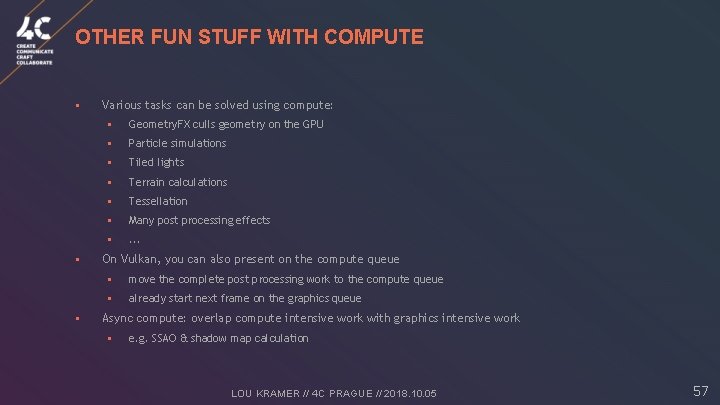
OTHER FUN STUFF WITH COMPUTE § § § Various tasks can be solved using compute: § Geometry. FX culls geometry on the GPU § Particle simulations § Tiled lights § Terrain calculations § Tessellation § Many post processing effects § . . . On Vulkan, you can also present on the compute queue § move the complete post processing work to the compute queue § already start next frame on the graphics queue Async compute: overlap compute intensive work with graphics intensive work § e. g. SSAO & shadow map calculation LOU KRAMER // 4 C PRAGUE // 2018. 10. 05 57
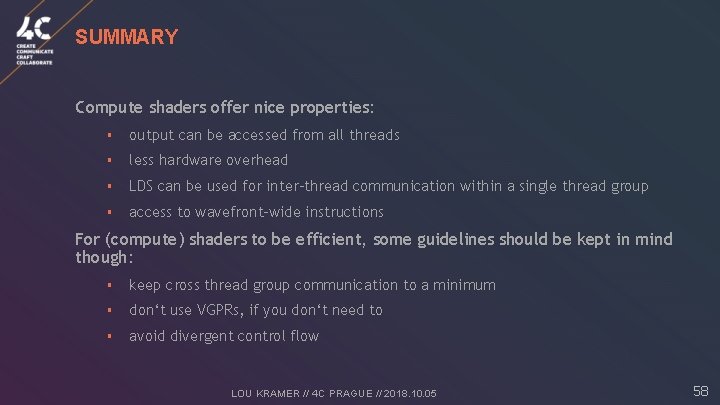
SUMMARY Compute shaders offer nice properties: § output can be accessed from all threads § less hardware overhead § LDS can be used for inter-thread communication within a single thread group § access to wavefront-wide instructions For (compute) shaders to be efficient, some guidelines should be kept in mind though: § keep cross thread group communication to a minimum § don‘t use VGPRs, if you don‘t need to § avoid divergent control flow LOU KRAMER // 4 C PRAGUE // 2018. 10. 05 58
ANY QUESTIONS? LOU KRAMER Developer Technology Engineer, AMD Lou. Kramer@amd. com lou_auroyup CONF 4 C. COM Organized by
SPECIAL THANKS TO § Dominik Baumeister § Matthäus Chajdas § Rys Sommefeldt § Steven Tovey LOU KRAMER // 4 C PRAGUE // 2018. 10. 05 60
REFERENCES § https: //anteru. net/ § https: //gpuopen. com/optimizing-gpu-occupancy-resourceusage-large-thread-groups/ § https: //www. khronos. org/blog/vulkan-subgroup-tutorial § https: //docs. microsoft. com/enus/windows/desktop/direct 3 dhlsl/sv-dispatchthreadid LOU KRAMER // 4 C PRAGUE // 2018. 10. 05 61
DISCLAIMER & ATTRIBUTION The information presented in this document is for informational purposes only and may contain technical inaccuracies, omissions and typographical errors. The information contained herein is subject to change and may be rendered inaccurate for many reasons, including but not limited to product and roadmap changes, component and motherboard version changes, new model and/or product releases, product differences between differing manufacturers, software changes, BIOS flashes, firmware upgrades, or the like. AMD assumes no obligation to update or otherwise correct or revise this information. However, AMD reserves the right to revise this information and to make changes from time to the content hereof without obligation of AMD to notify any person of such revisions or changes. AMD MAKES NO REPRESENTATIONS OR WARRANTIES WITH RESPECT TO THE CONTENTS HEREOF AND ASSUMES NO RESPONSIBILITY FOR ANY INACCURACIES, ERRORS OR OMISSIONS THAT MAY APPEAR IN THIS INFORMATION. AMD SPECIFICALLY DISCLAIMS ANY IMPLIED WARRANTIES OF MERCHANTABILITY OR FITNESS FOR ANY PARTICULAR PURPOSE. IN NO EVENT WILL AMD BE LIABLE TO ANY PERSON FOR ANY DIRECT, INDIRECT, SPECIAL OR OTHER CONSEQUENTIAL DAMAGES ARISING FROM THE USE OF ANY INFORMATION CONTAINED HEREIN, EVEN IF AMD IS EXPRESSLY ADVISED OF THE POSSIBILITY OF SUCH DAMAGES. ATTRIBUTION © 2018 Advanced Micro Devices, Inc. All rights reserved. AMD, the AMD Arrow logo and combinations thereof are trademarks of Advanced Micro Devices, Inc. in the United States and/or other jurisdictions. Other names are for informational purposes only and may be trademarks of their respective owners. LOU KRAMER // 4 C PRAGUE // 2018. 10. 05 62
LOU KRAMER // 4 C PRAGUE // 2018. 10. 05 63
ANY QUESTIONS? LOU KRAMER Developer Technology Engineer, AMD Lou. Kramer@amd. com lou_auroyup CONF 4 C. COM Organized by