
Computational tools for process modeling Computational heat and
- Slides: 5
Computational tools for process modeling
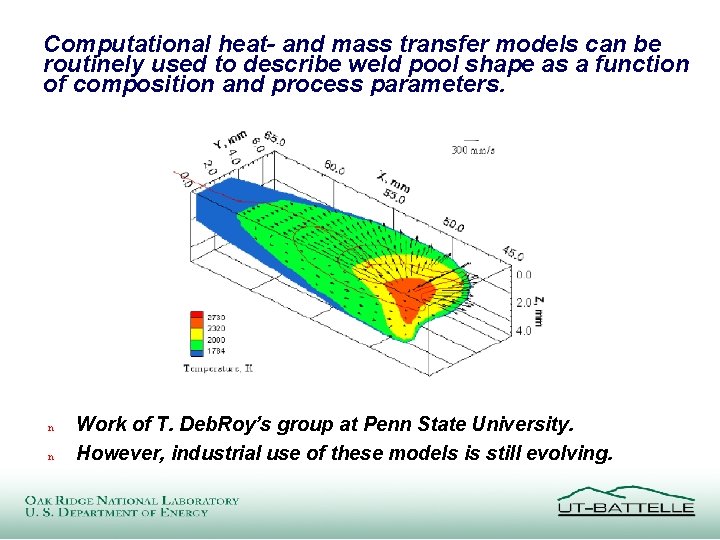
Computational heat- and mass transfer models can be routinely used to describe weld pool shape as a function of composition and process parameters. n n Work of T. Deb. Roy’s group at Penn State University. However, industrial use of these models is still evolving.
There are many models to describe weld microstructure. n n Carbon equivalence relates the volume fraction of martensite and bainite with time to cool from 800 to 500°C u Ion, Ashby and Easterling u Very successful but not good for slow cooling rate and low carbon steels Using equations based on TTT/CCT information u Work of Kirkaldy et al. 1982, & Watt et al. 1988 u Not good for low carbon steels Phenomenological models of austenite decomposition to various ferrite phases u Bhadeshia et al. 1985 Simultaneous transformation kinetics equations u Jones and Bhadeshia, 1997
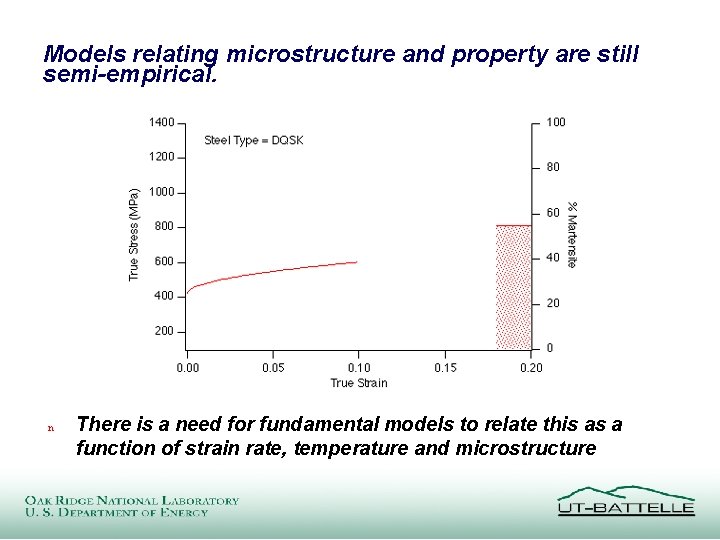
Models relating microstructure and property are still semi-empirical. n There is a need for fundamental models to relate this as a function of strain rate, temperature and microstructure
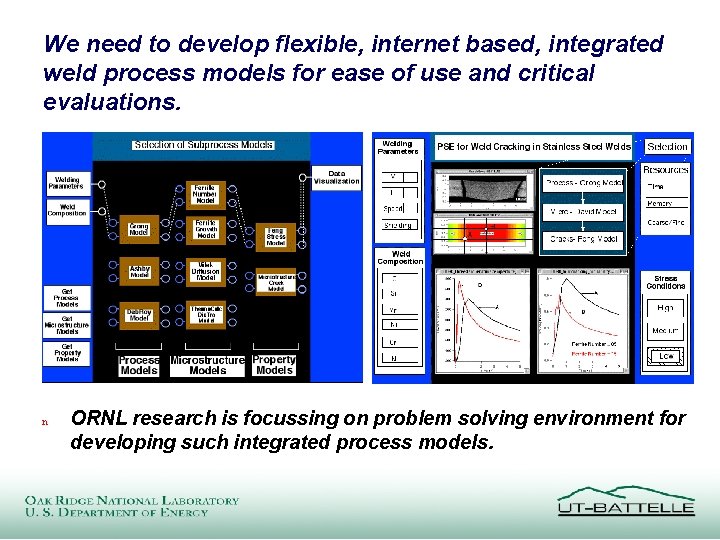
We need to develop flexible, internet based, integrated weld process models for ease of use and critical evaluations. n ORNL research is focussing on problem solving environment for developing such integrated process models.