
COMPUTATIONAL THINKING Dr Isaac Gang Computer Science Texas














- Slides: 42
COMPUTATIONAL THINKING Dr. Isaac Gang, Computer Science Texas A&M University Commerce Isaac. gang@tamuc. edu Dr. Joyce E. Kyle Miller, Curriculum & Instruction Texas A&M University Commerce Joyce. miller@tamuc. edu
Breaking a complex problem down into smaller problems and solving each one individually. A. B. C. D. Decomposition Abstraction Programming Algorithmic Thinking
Picking out the important bits of information from the problem, ignoring the specific details that don’t matter. • • A. Decomposition B. Abstraction C. Programming D. Algorithmic Thinking
Mike is posting an online advertisement on a forum to promote his band’s upcoming tour. Which of the following is most important to include in the advertisement? • • A. The name of the band’s manager B. A Bio of each band member C. A list of the performance pieces D. Date of Tour
A logical way of getting from the problem to the solution. If the steps you take to solve a problem follow an algorithm then they can be reused and adapted to solve similar problems in the future. • • A. Decomposition B. Abstraction C. Programming D. Algorithmic Thinking
Which of these is an example of decomposition? • • • A. Breaking the problem of organizing a cake sale into smaller parts, such as who will bake the cakes and when to hold the cake sale. B. Taking the problem of baking a cake and thinking about how we can make the best cake possible. C. Looking at the different kinds of cake that can be made.
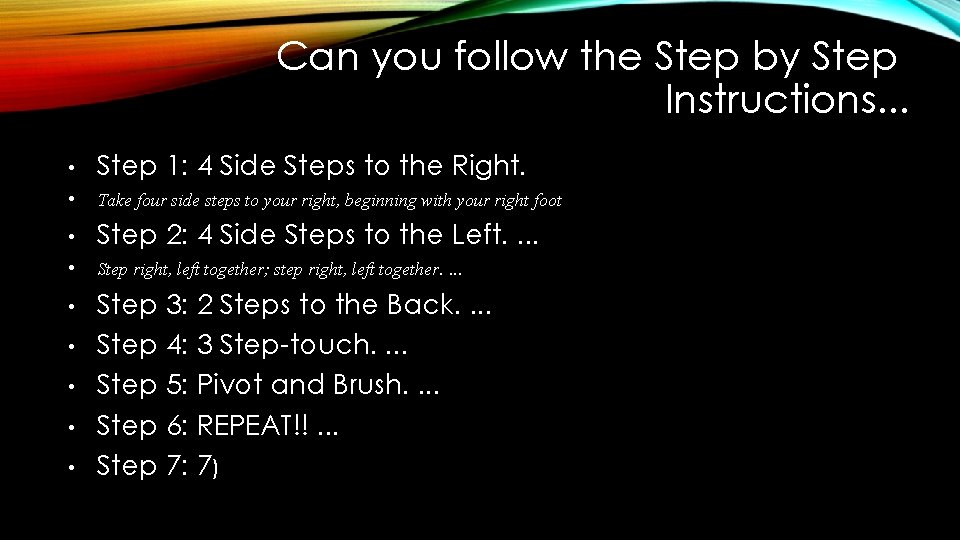
Can you follow the Step by Step Instructions. . . • Step 1: 4 Side Steps to the Right. • Take four side steps to your right, beginning with your right foot • Step 2: 4 Side Steps to the Left. • Step right, left together; step right, left together. . • • • Step 3: 2 Steps to the Back. . Step 4: 3 Step-touch. . Step 5: Pivot and Brush. . Step 6: REPEAT!!. . . Step 7: 7) . . .
WHAT IS COMPUTER SCIENCE? https: //youtu. be/0 p. F 9 PN 8 Upq. I
WHAT IS COMPUTATIONAL THINKING? https: //youtu. be/Vo. CZs. FGVsy 4
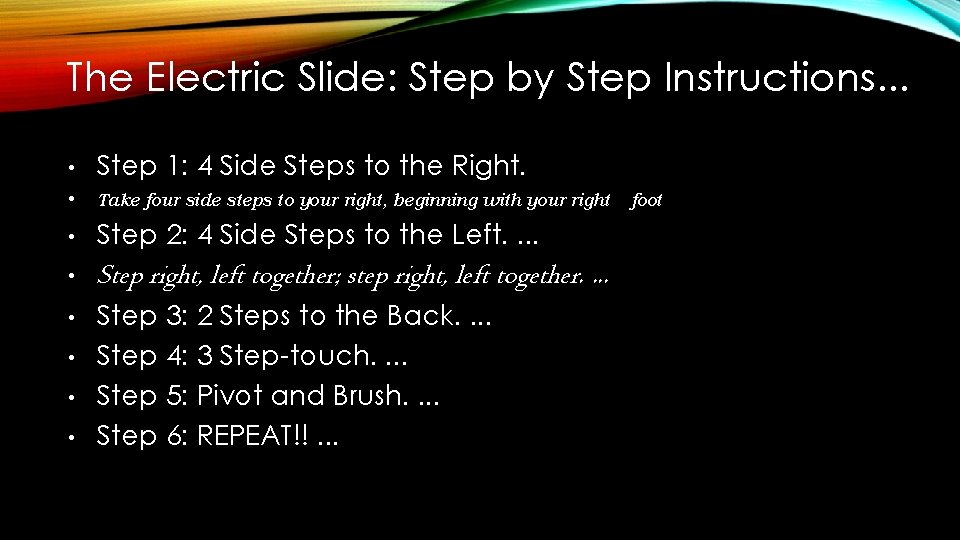
The Electric Slide: Step by Step Instructions. . . • Step 1: 4 Side Steps to the Right. • Take four side steps to your right, beginning with your right foot • Step 2: 4 Side Steps to the Left. . • Step right, left together; step right, left together. . • Step 3: 2 Steps to the Back. . Step 4: 3 Step-touch. . Step 5: Pivot and Brush. . Step 6: REPEAT!!. . . • • •
Hand Clapping Games https: //icebreakerideas. com/hand-clapping-games/ Hold your hands up, your fingers pointing to the ceiling. As you are saying the rhyme, turn your hands back and forth. Whenever you say “double, ” both hands face towards you. Whenever you say “this, ” and “that, ” your palms face away from you. https: //youtu. be/g. WXNb. Ieft. Rk
STEP TEAMS • https: //youtu. be/f. Nd. ZKouf 5 CQ
Body Percussion • https: //youtu. be/4 ocax. LQ 4 ig 8
WARM UP • Give me instructions for. . . • WALKING TO a certain point in the room. . . • Step by Step
Follow My Instructions, and Duplicate the Image
EXTENDED LEARNING Enrichment or Outside of class activities • Stuffie Maps • Create a life-size grid on the rug with tape Have student bring stuffed animals to school. Students can program friends to move their actual stuffies as directed in the programs. • Create Your Own • Have students create their own maps. • Have other students solve them using programs. •
Algorithm Can you give instructions verbally?
COMPUTATIONAL THINKING ACTIVITY • Can you write out the steps, procedures for replicating this figure?
Can someone else follow your steps? •
What does the replicated figure look like? •
• What are the BUGS in your steps?
• What needs to be changed?
• Begin Again
Use, Illustrate, Display the Vocabulary • Decomposition • Algorithm • Patterns • Abstraction
COMPUTATIONAL THINKING “. . . breaking down • difficult problem into more familiar ones • •
• DECOMPOSITION
. . . that we can solve using • a set of rules to find solutions
• ALGORITHIM
. . . and using abstractions to generalize those solutions to similar problems
• • ABSTRACTIONS One object stands for many
• PATTERNS
Use, Illustrate, Display the Vocabulary • Decomposition • Algorithm • Patterns • Abstraction
Creative Problem Solving (CPS) • • IDENTIFYING A PROBLEM • FACT FINDING • PROBLEM FINDING • IDEA FINDING • SOLUTION FINDING ACCEPTANCE FINDING
CHARACTERISTICS OF COMPUTATIONAL THINKING • Ordered and Precise sequence of steps to solve problems • Using a computer to automate that process, when appropriate • Problem Solving • Producing a Solution • Planning • Critical Thinking • Creativity • Collaboration • Puzzeling, Figuring Things Out • Searching for Solutions • Draws on Analytical Thinking
ACTIVITIES • • Ms. Martinez’s 6 th grade social studies class is studying the Roman Empire and creating timelines and drawing maps. Mr. Lee’s 7 th Grade class is looking a a series of diagrams her students have created to portray floor plans of their school and homes. Mr. Butler’s 5 th Grade Music class has been studying the diatonic scale and the concept of pitch. Now the students are using Scratch to create a virtual xylophone that will correctly reproduce the scale. Mr. Davis’ 9 th grade language arts class is studying various literary elements, such as plot, point of view, irony, and voice and they have read various short stories.
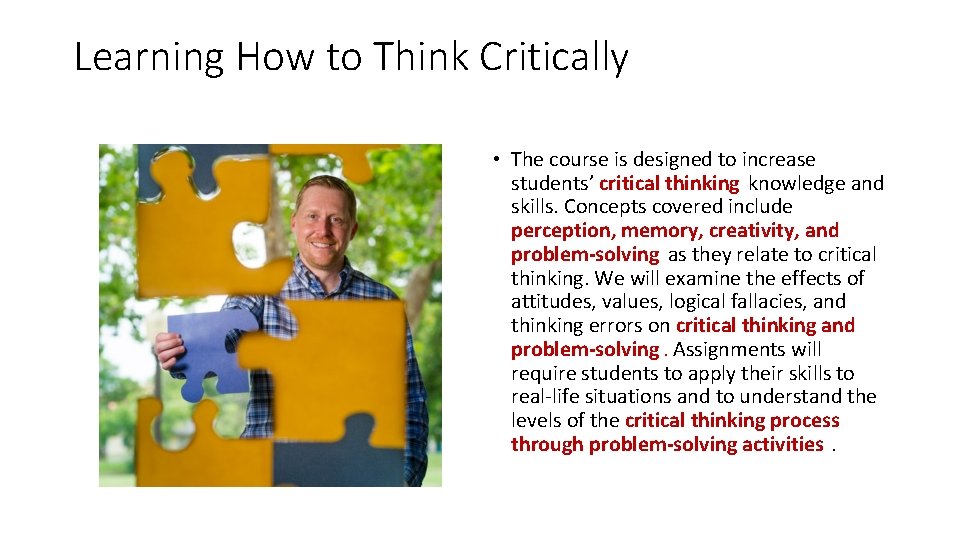
Learning How to Think Critically • The course is designed to increase students’ critical thinking knowledge and skills. Concepts covered include perception, memory, creativity, and problem-solving as they relate to critical thinking. We will examine the effects of attitudes, values, logical fallacies, and thinking errors on critical thinking and problem-solving. Assignments will require students to apply their skills to real-life situations and to understand the levels of the critical thinking process through problem-solving activities.
Separate and Unequal? The State of Public Education Sixty Years Post Brown • Is equal access to a quality education possible for all students in the US if vestiges of separate but unequal public schooling still exists? Extreme educational disparities also exist in academic achievemnt and performance of students based on race, gender, region, community locale and socioeconomic status. Many scholars and politicians have argued that education is the great socioeconomic equalizer. Students taking this Signature Course, through hands-on interactive activities will critically explore the state of public education in the US post the Brown v. Board of Education decision.
Business, Society, and Unfettered Thought • This signature course will focus on the critical thinking skills required to manage the increasingly integrated, interdependent, and complex relationship between business and society. Students will gain an understanding of the role of business in society, the capacity to use knowledge to effectively analyze, debate, and solve societal/organizational problems in a socially responsible and ethical manner, and the ability to successfully communicate potential solutions across audiences.
Use, Illustrate, Display the Vocabulary • Decomposition • Algorithm • Patterns • Abstraction
Programming a Bee Bot • https: //youtu. be/z. FU 3 -nr. Svs. Q Programming a Bee Bot • https: //youtu. be/bx. QZA 4 YHpbk Bee Bot for Numeracy • https: //studio. code. org/s/coursea-2018/stage/6/puzzle/3 Coding on the Computer
Computational Thinking • What does it look like in the schools? • https: //youtu. be/r. NIM 1 fz. J 8 u 0 • Hour of Code • https: //youtu. be/X 4 oy_V 6 na. B 4 • https: //youtu. be/_bkn. BDEc. NYU • Family Code Night
Computer Science Standards, K - 12 https: //c. ymcdn. com/sites/www. csteachers. org/resource/resmgr/Docs/Standar ds/CSTA_K-12_CSS. pdf Computer Science for Fun http: //www. cs 4 fn. org/ Computational Thinking Unplugged https: //youtu. be/b 4 a 7 Ty 1 Tp. KU ISTE Computational Thinking Toolkit https: //www. iste. org/explore/articledetail? articleid=152