
COMPUTATIONAL PROTEOMICS AND METABOLOMICS Oliver Kohlbacher Sven Nahnsen
COMPUTATIONAL PROTEOMICS AND METABOLOMICS Oliver Kohlbacher, Sven Nahnsen, Knut Reinert 7. Peptide Identification I – Database Search This work is licensed under a Creative Commons Attribution 4. 0 International License.
LEARNING UNIT 7 A PEPTIDE DATABASE SEARCH This work is licensed under a Creative Commons Attribution 4. 0 International License.
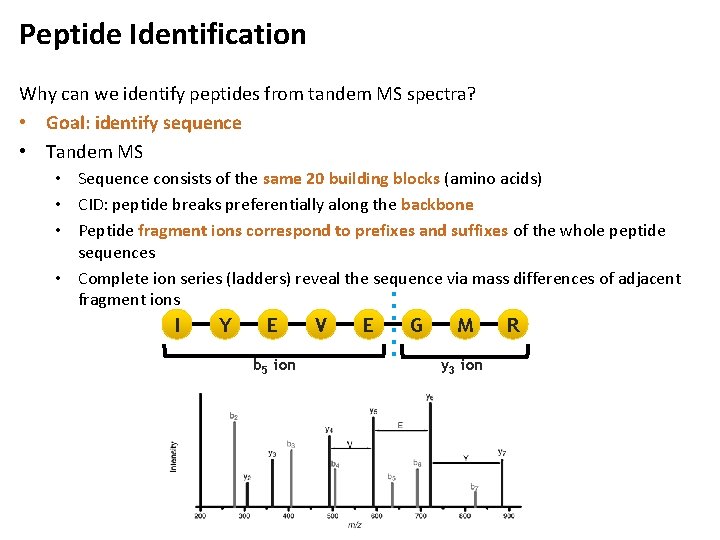
Peptide Identification Why can we identify peptides from tandem MS spectra? • Goal: identify sequence • Tandem MS • Sequence consists of the same 20 building blocks (amino acids) • CID: peptide breaks preferentially along the backbone • Peptide fragment ions correspond to prefixes and suffixes of the whole peptide sequences • Complete ion series (ladders) reveal the sequence via mass differences of adjacent fragment ions I Y E b 5 ion V E G M y 3 ion R
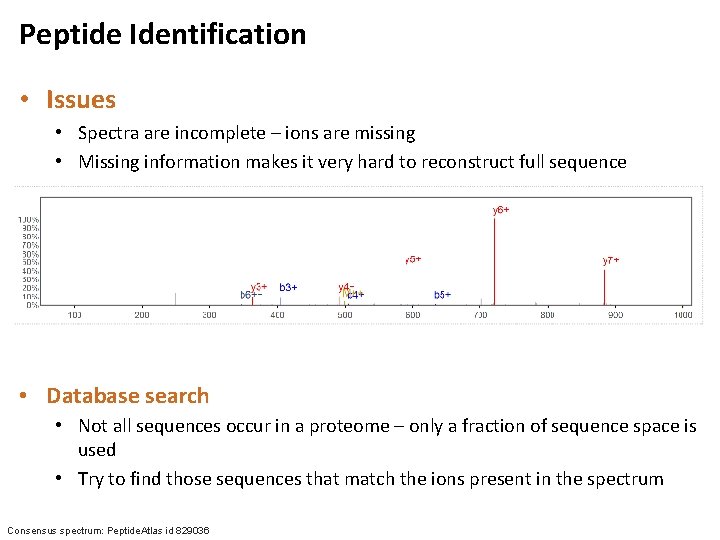
Peptide Identification • Issues • Spectra are incomplete – ions are missing • Missing information makes it very hard to reconstruct full sequence • Database search • Not all sequences occur in a proteome – only a fraction of sequence space is used • Try to find those sequences that match the ions present in the spectrum Consensus spectrum: Peptide. Atlas id 829036
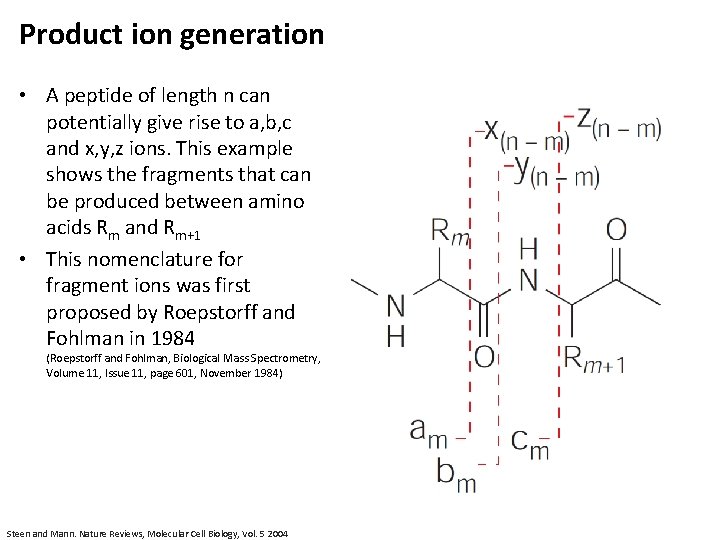
Product ion generation • A peptide of length n can potentially give rise to a, b, c and x, y, z ions. This example shows the fragments that can be produced between amino acids Rm and Rm+1 • This nomenclature for fragment ions was first proposed by Roepstorff and Fohlman in 1984 (Roepstorff and Fohlman, Biological Mass Spectrometry, Volume 11, Issue 11, page 601, November 1984) Steen and Mann. Nature Reviews, Molecular Cell Biology, Vol. 5 2004
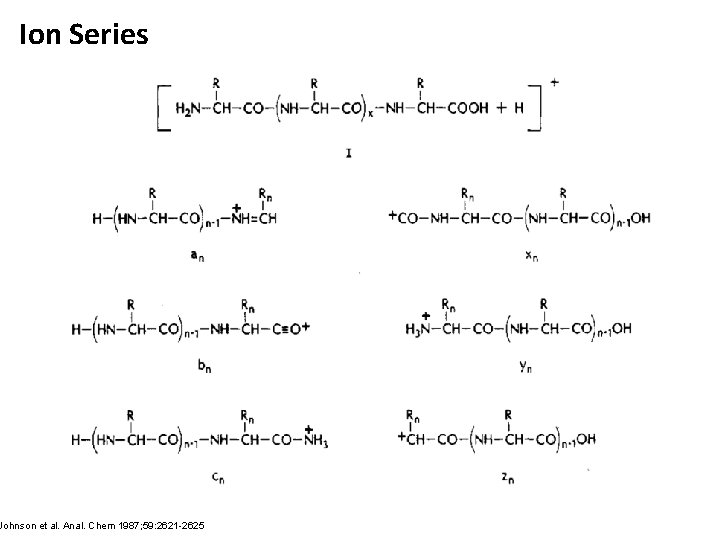
Ion Series Johnson et al. Anal. Chem 1987; 59: 2621 -2625
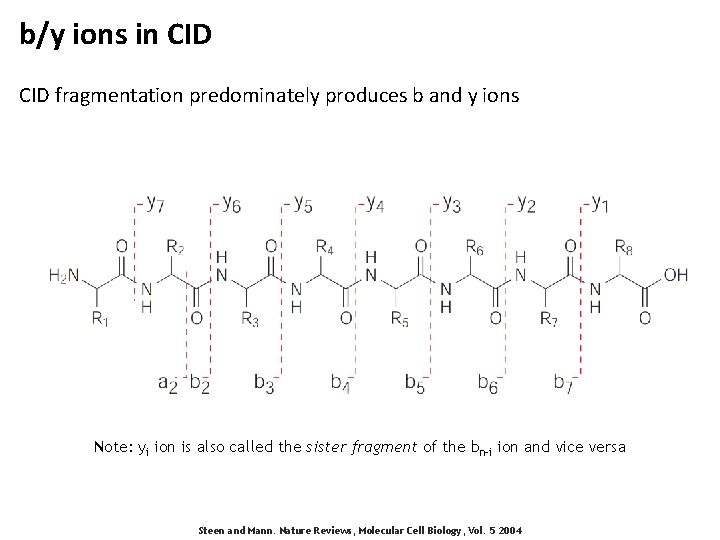
b/y ions in CID fragmentation predominately produces b and y ions Note: yi ion is also called the sister fragment of the bn-i ion and vice versa Steen and Mann. Nature Reviews, Molecular Cell Biology, Vol. 5 2004
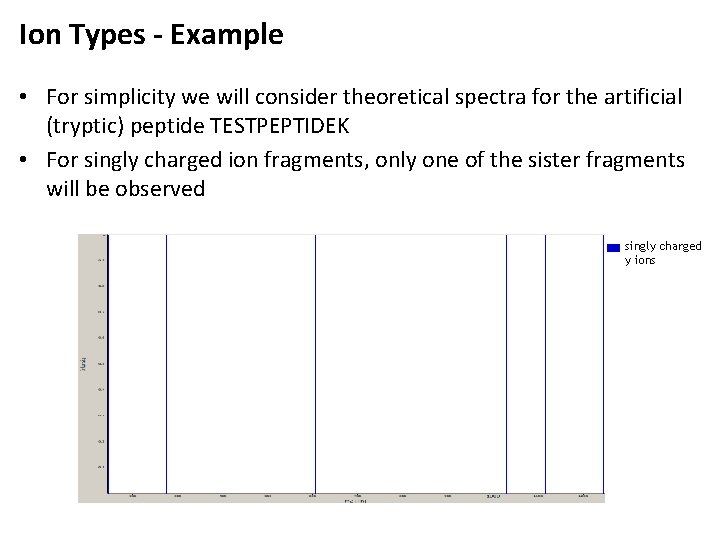
Ion Types - Example • For simplicity we will consider theoretical spectra for the artificial (tryptic) peptide TESTPEPTIDEK • For singly charged ion fragments, only one of the sister fragments will be observed singly charged y ions
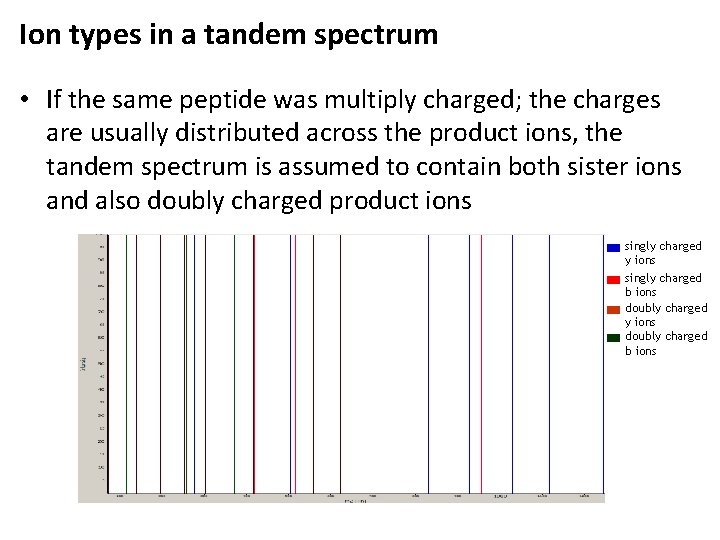
Ion types in a tandem spectrum • If the same peptide was multiply charged; the charges are usually distributed across the product ions, the tandem spectrum is assumed to contain both sister ions and also doubly charged product ions singly charged y ions singly charged b ions doubly charged y ions doubly charged b ions
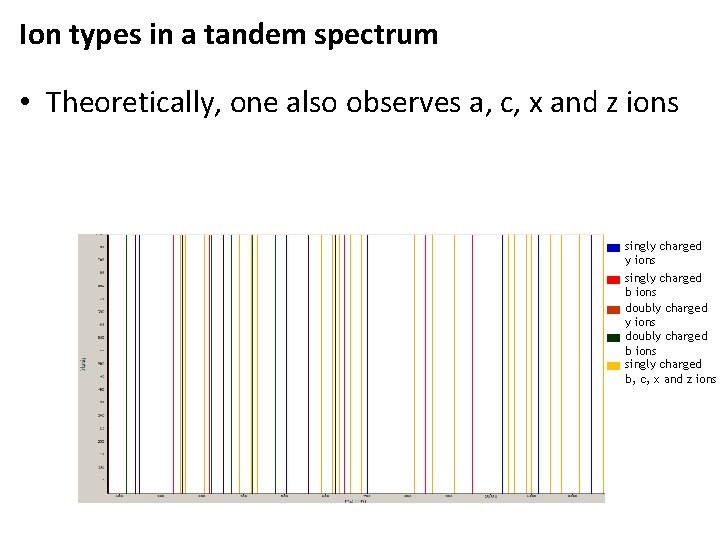
Ion types in a tandem spectrum • Theoretically, one also observes a, c, x and z ions singly charged y ions singly charged b ions doubly charged y ions doubly charged b ions singly charged b, c, x and z ions
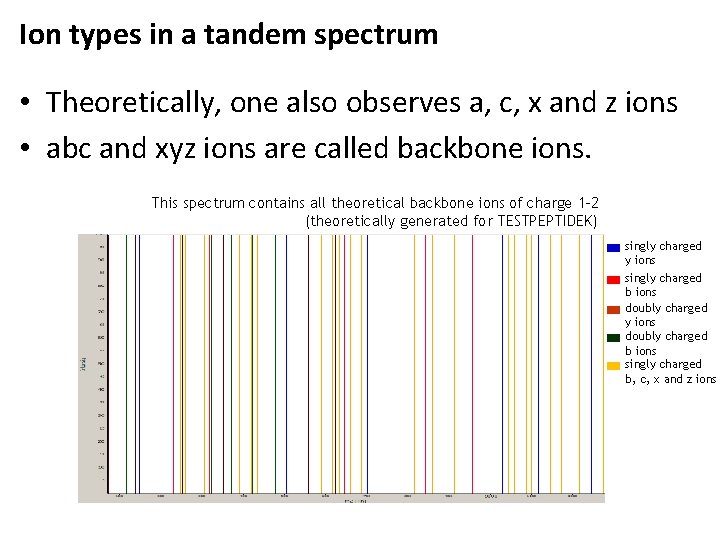
Ion types in a tandem spectrum • Theoretically, one also observes a, c, x and z ions • abc and xyz ions are called backbone ions. This spectrum contains all theoretical backbone ions of charge 1 -2 (theoretically generated for TESTPEPTIDEK) singly charged y ions singly charged b ions doubly charged y ions doubly charged b ions singly charged b, c, x and z ions
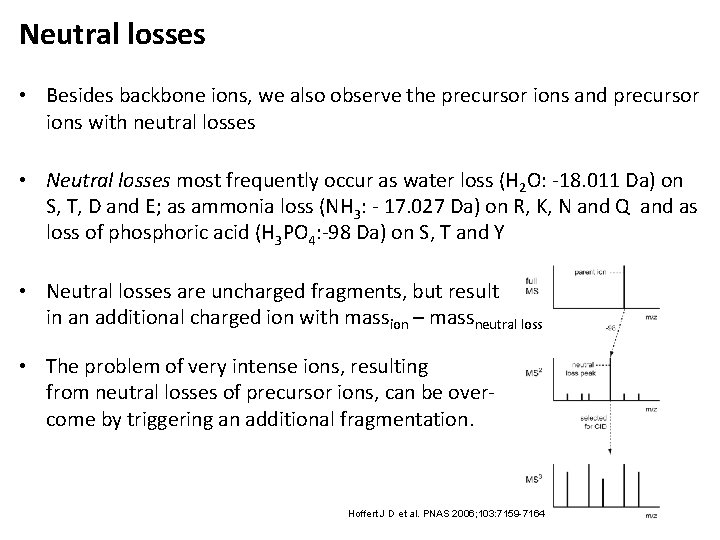
Neutral losses • Besides backbone ions, we also observe the precursor ions and precursor ions with neutral losses • Neutral losses most frequently occur as water loss (H 2 O: -18. 011 Da) on S, T, D and E; as ammonia loss (NH 3: - 17. 027 Da) on R, K, N and Q and as loss of phosphoric acid (H 3 PO 4: -98 Da) on S, T and Y • Neutral losses are uncharged fragments, but result in an additional charged ion with massion – massneutral loss • The problem of very intense ions, resulting from neutral losses of precursor ions, can be overcome by triggering an additional fragmentation. Hoffert J D et al. PNAS 2006; 103: 7159 -7164
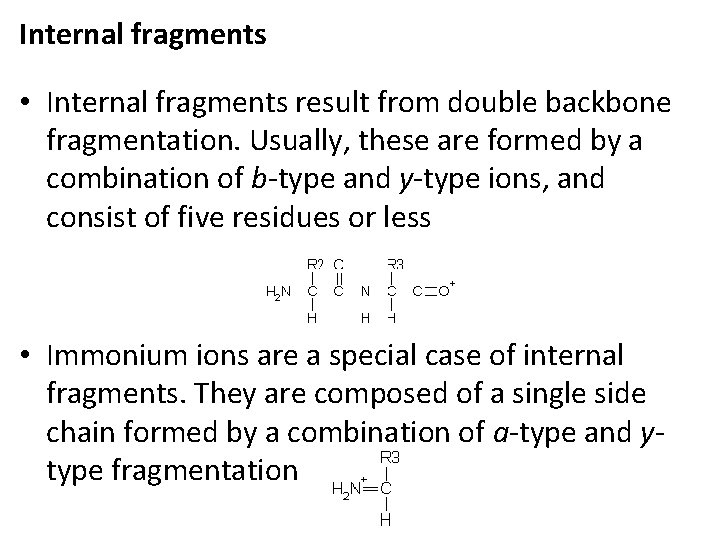
Internal fragments • Internal fragments result from double backbone fragmentation. Usually, these are formed by a combination of b-type and y-type ions, and consist of five residues or less • Immonium ions are a special case of internal fragments. They are composed of a single side chain formed by a combination of a-type and ytype fragmentation
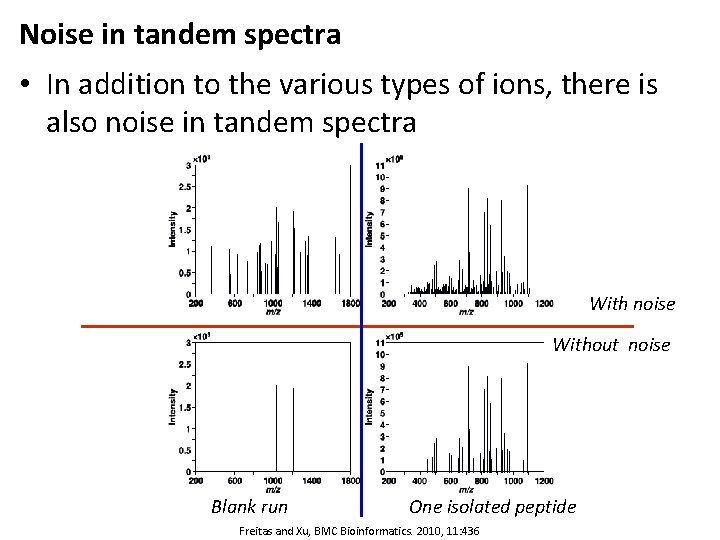
Noise in tandem spectra • In addition to the various types of ions, there is also noise in tandem spectra With noise Without noise Blank run One isolated peptide Freitas and Xu, BMC Bioinformatics. 2010, 11: 436
Summary ion types • Due to different fragmentation efficacies and different response factors, fragment ions will have different intensities • These intensities can be predicted using machine learning techniques and appropriate fragmentation models, however, most search engines do not include intensity information, but only the masses • In general, a simple peptide search engine should consider b and y type ions, doubly charged b and y type (b 2+, y 2+) ions and optionally b-NH 3 , y-NH 3 and b-H 2 O y ,
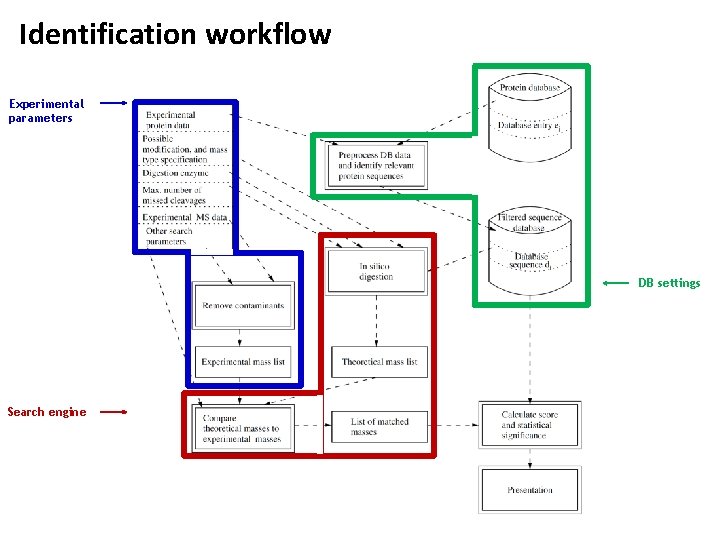
Identification workflow Experimental parameters DB settings Search engine
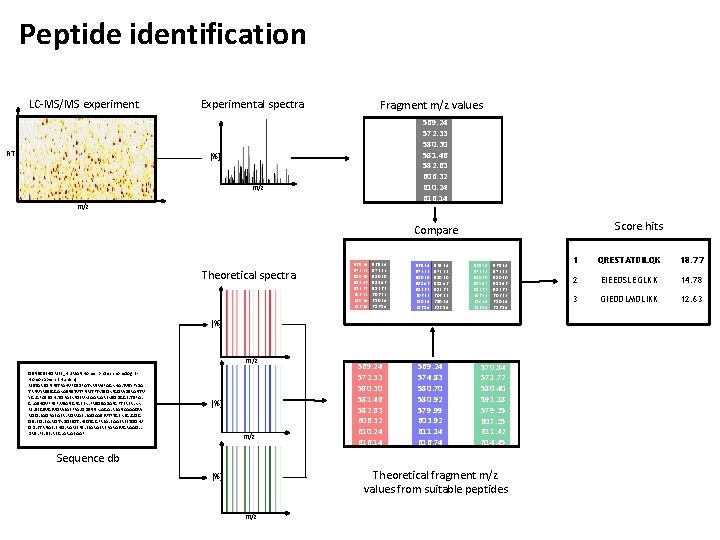
Peptide identification LC-MS/MS experiment RT Experimental spectra Fragment m/z values 569. 24 572. 33 580. 30 581. 46 582. 63 606. 32 610. 24 616. 14 [%] m/z Score hits Compare Theoretical spectra 569. 24 572. 33 580. 30 581. 46 582. 63 606. 32 610. 24 616. 14 [%] m/z Q 9 NSC 5|HOME 3_HUMAN Homer protein homolog 3 Homo sapiens (Human) MSTAREQPIFSTRAHVFQIDPATKRNWIPAGKHALTVSYFYDA TRNVYRIISIGGAKAIINSTVTPNMTFTKTSQKFGQWDSRANTV YGLGFASEQHLTQFAEKFQEVKEAARLAREKSQDGGELTSPAL GLASHQVPPSPLVSANGPGEEKLFRSQSADAPGPTERERLKK MLSEGSVGEVQWEAEFFALQDSNNKLAGALREANAAAAQW RQQLEAQRAEAERLRQRVAELEAQAASEVTPTGEKEGLGQG QSLEQLEALVQTKDQEIQTLKSQTGGPREALEAAEREETQQKV QDLETRNAELEHQLRAMERSLEEARAERERARAEVGRAAQLL DVSLFELSELREGLARLAEAAP [%] m/z 569. 24 572. 33 580. 30 581. 46 582. 63 606. 32 610. 24 616. 14 569. 24 574. 83 580. 70 580. 92 579. 99 603. 92 611. 14 616. 74 570. 84 571. 72 580. 40 591. 18 579. 35 607. 25 611. 42 614. 45 Sequence db Theoretical fragment m/z values from suitable peptides [%] m/z 1 QRESTATDILQK 18. 77 2 EIEEDSLEGLKK 14. 78 3 GIEDDLMDLIKK 12. 63
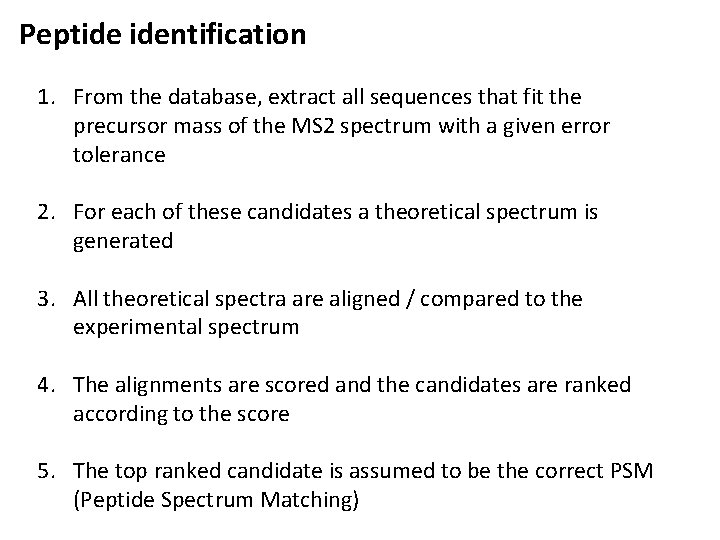
Peptide identification 1. From the database, extract all sequences that fit the precursor mass of the MS 2 spectrum with a given error tolerance 2. For each of these candidates a theoretical spectrum is generated 3. All theoretical spectra are aligned / compared to the experimental spectrum 4. The alignments are scored and the candidates are ranked according to the score 5. The top ranked candidate is assumed to be the correct PSM (Peptide Spectrum Matching)
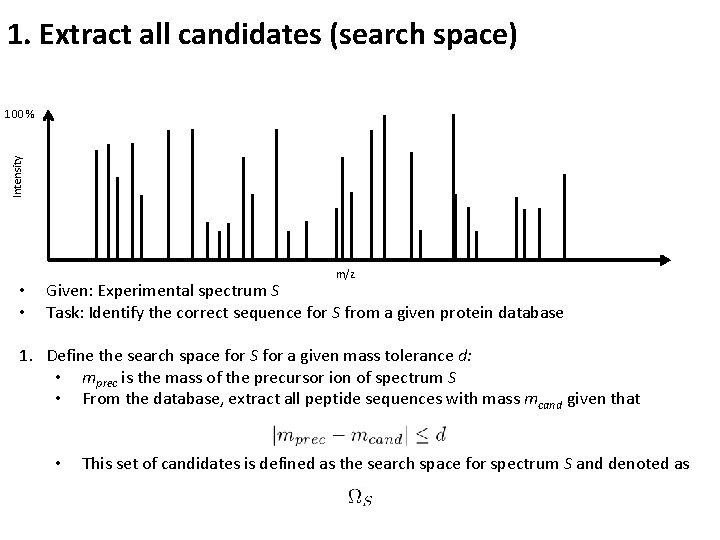
1. Extract all candidates (search space) Intensity 100 % • • m/z Given: Experimental spectrum S Task: Identify the correct sequence for S from a given protein database 1. Define the search space for S for a given mass tolerance d: • mprec is the mass of the precursor ion of spectrum S • From the database, extract all peptide sequences with mass mcand given that • This set of candidates is defined as the search space for spectrum S and denoted as
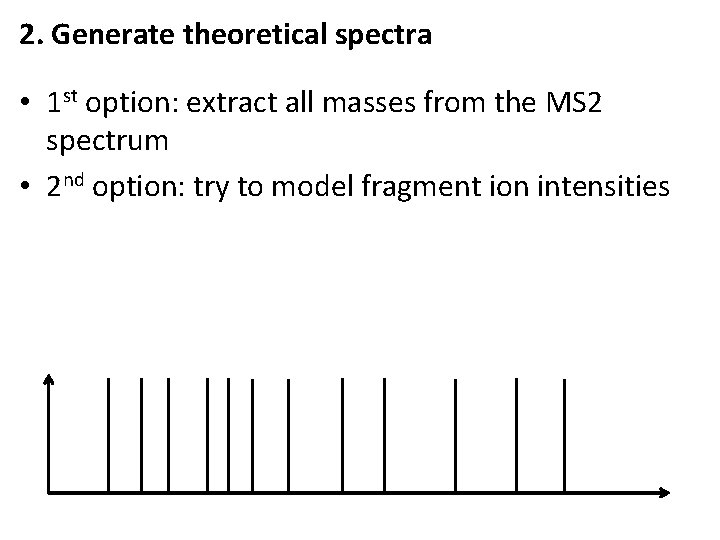
2. Generate theoretical spectra • 1 st option: extract all masses from the MS 2 spectrum • 2 nd option: try to model fragment ion intensities
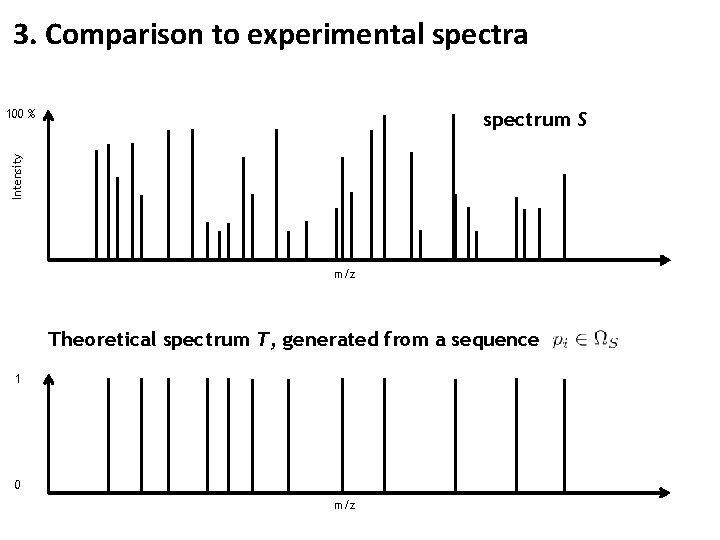
3. Comparison to experimental spectra 100 % Intensity spectrum S m/z Theoretical spectrum T, generated from a sequence 1 0 m/z
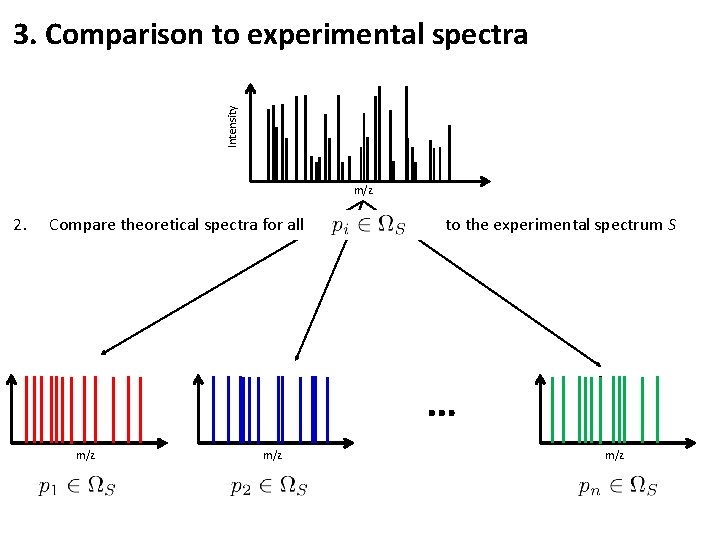
Intensity 3. Comparison to experimental spectra m/z 2. Compare theoretical spectra for all to the experimental spectrum S … m/z m/z
4. Scoring of peptide candidates • There are numerous tools for the comparison of theoretical and experimental candidate peptides • The main difference of search engines is the implementation of the scoring schemes (resulting in differences in runtime and performance) • However, conceptually all search engine algorithms are based on fragment ion comparison • In the following, we will discuss Discussed in detail Drafted • X!Tandem, Craig, R. and Beavis, R. C. (2003) Rapid Commun. Mass Spectrom. , 17, 2310– 2316 • Sequest Eng et al. , J. Am. Soc. Mass Spectrom. 1994, 5, 976 -989.

LEARNING UNIT 7 B SEARCH ENGINES This work is licensed under a Creative Commons Attribution 4. 0 International License.
X!Tandem • Craig, R. and Beavis, R. C. (2003) Rapid Commun. Mass Spectrom. , 17, 2310– 2316. • http: //www. thegpm. org/tandem/instructions. html
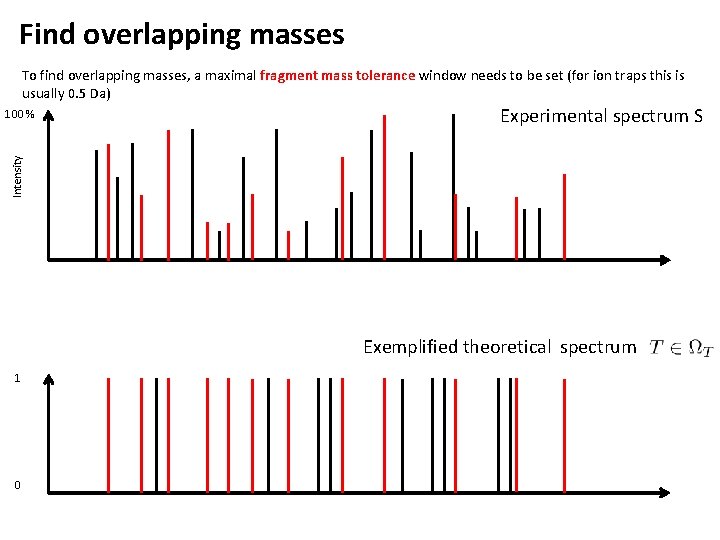
Find overlapping masses To find overlapping masses, a maximal fragment mass tolerance window needs to be set (for ion traps this is usually 0. 5 Da) Experimental spectrum S Intensity 100 % Exemplified theoretical spectrum 1 0
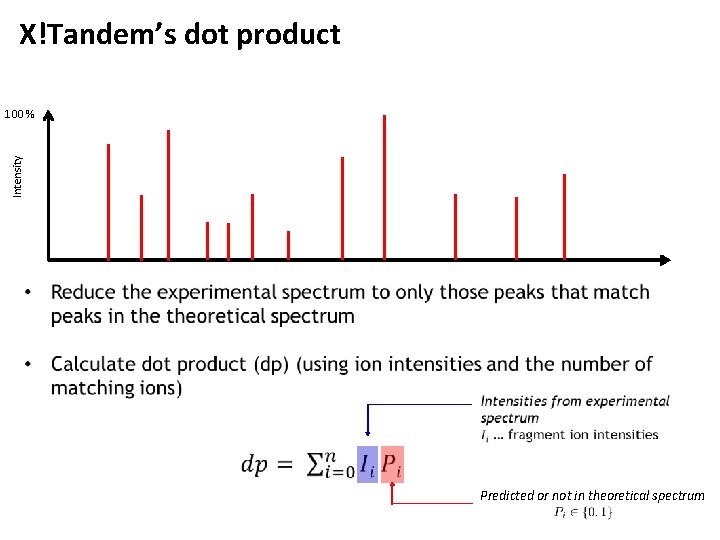
X!Tandem’s dot product Intensity 100 % Predicted or not in theoretical spectrum
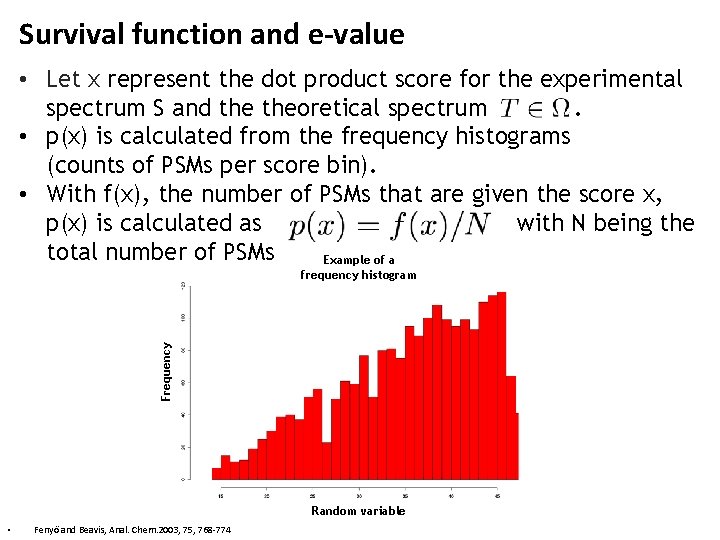
Survival function and e-value • Let x represent the dot product score for the experimental spectrum S and theoretical spectrum. • p(x) is calculated from the frequency histograms (counts of PSMs per score bin). • With f(x), the number of PSMs that are given the score x, p(x) is calculated as with N being the total number of PSMs Example of a Frequency frequency histogram Random variable • Fenyö and Beavis, Anal. Chem. 2003, 75, 768 -774
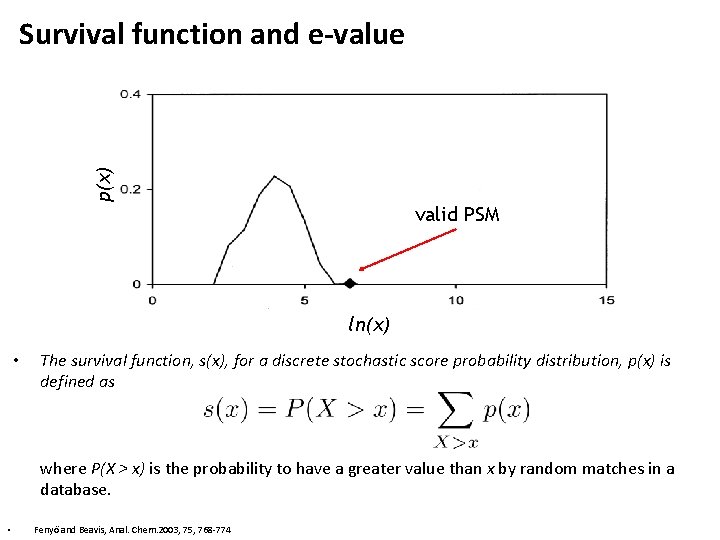
p(x) Survival function and e-value valid PSM ln(x) • The survival function, s(x), for a discrete stochastic score probability distribution, p(x) is defined as where P(X > x) is the probability to have a greater value than x by random matches in a database. • Fenyö and Beavis, Anal. Chem. 2003, 75, 768 -774
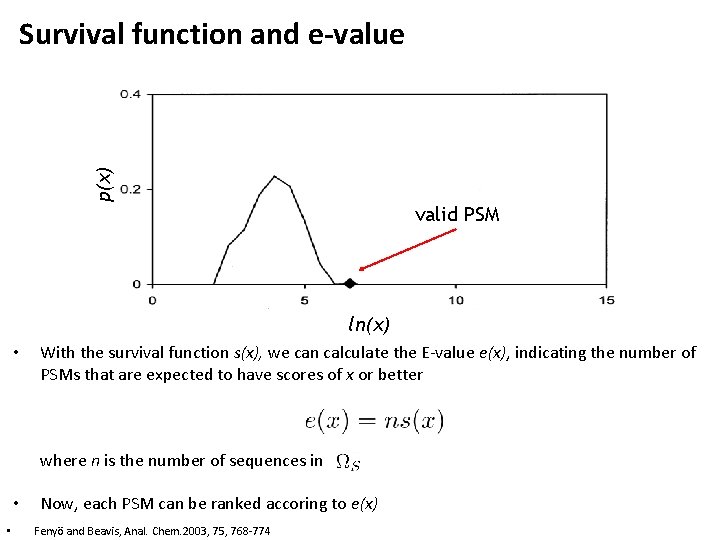
p(x) Survival function and e-value valid PSM ln(x) • With the survival function s(x), we can calculate the E-value e(x), indicating the number of PSMs that are expected to have scores of x or better where n is the number of sequences in • • Now, each PSM can be ranked accoring to e(x) Fenyö and Beavis, Anal. Chem. 2003, 75, 768 -774
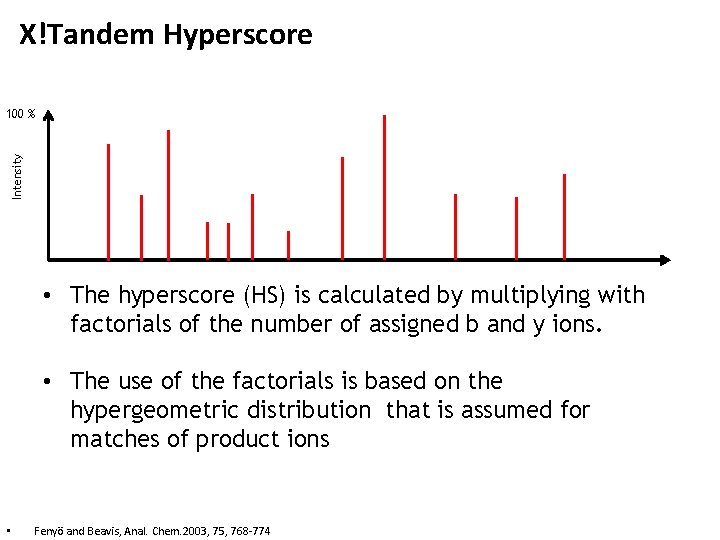
X!Tandem Hyperscore Intensity 100 % • The hyperscore (HS) is calculated by multiplying with factorials of the number of assigned b and y ions. • The use of the factorials is based on the hypergeometric distribution that is assumed for matches of product ions • Fenyö and Beavis, Anal. Chem. 2003, 75, 768 -774
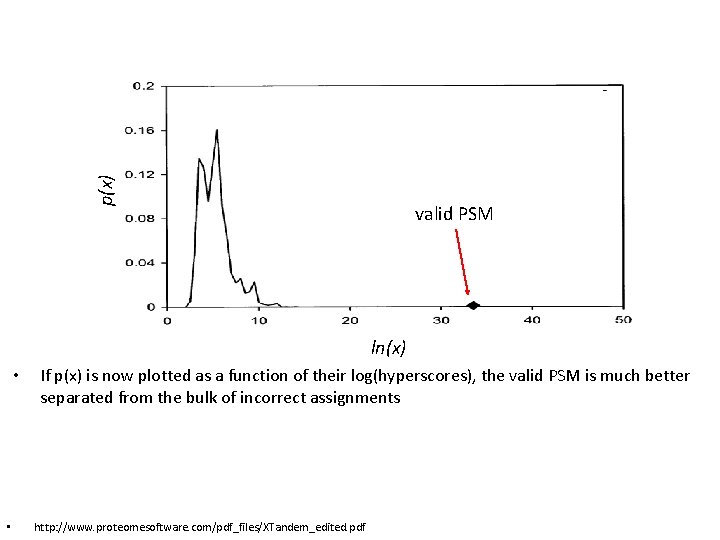
p(x) valid PSM ln(x) • • If p(x) is now plotted as a function of their log(hyperscores), the valid PSM is much better separated from the bulk of incorrect assignments http: //www. proteomesoftware. com/pdf_files/XTandem_edited. pdf
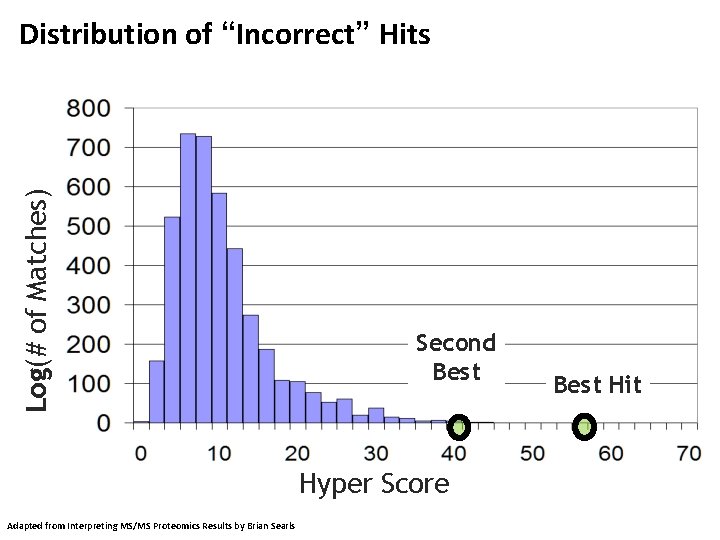
Log(# of Matches) Distribution of “Incorrect” Hits Second Best Hyper Score Adapted from Interpreting MS/MS Proteomics Results by Brian Searls Best Hit
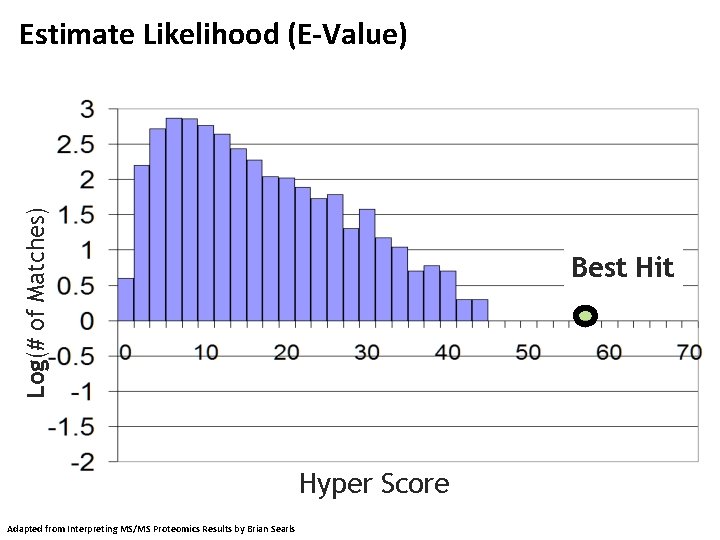
Log(# of Matches) Estimate Likelihood (E-Value) Best Hit Hyper Score Adapted from Interpreting MS/MS Proteomics Results by Brian Searls
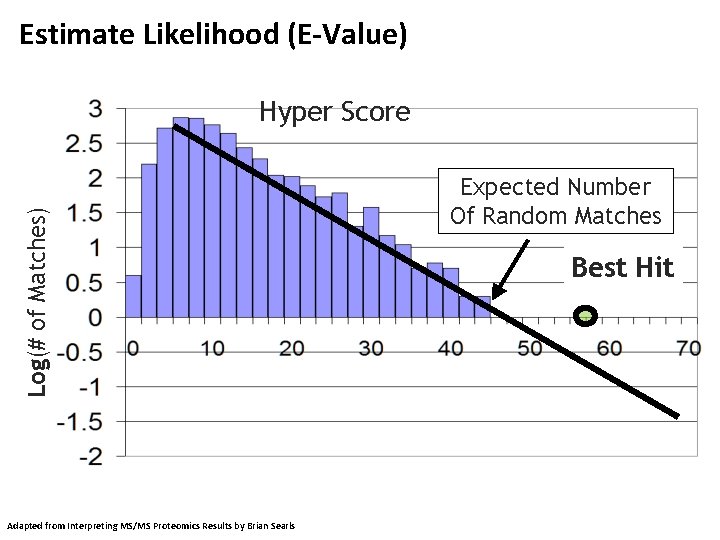
Estimate Likelihood (E-Value) Log(# of Matches) Hyper Score Adapted from Interpreting MS/MS Proteomics Results by Brian Searls Expected Number Of Random Matches Best Hit
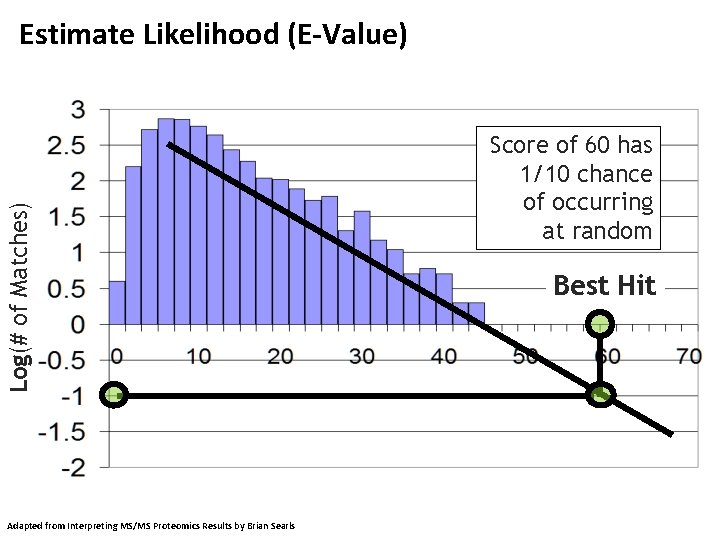
Log(# of Matches) Estimate Likelihood (E-Value) Adapted from Interpreting MS/MS Proteomics Results by Brian Searls Score of 60 has 1/10 chance of occurring at random Best Hit
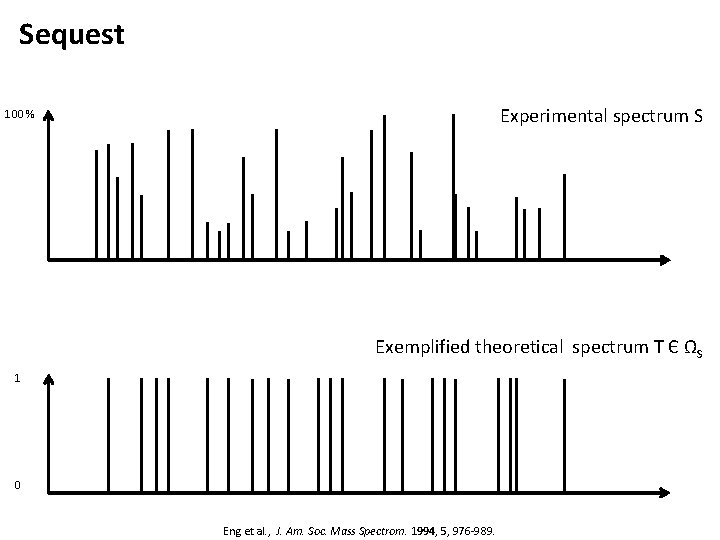
Sequest Experimental spectrum S 100 % Exemplified theoretical spectrum T Є ΩS 1 0 Eng et al. , J. Am. Soc. Mass Spectrom. 1994, 5, 976 -989.
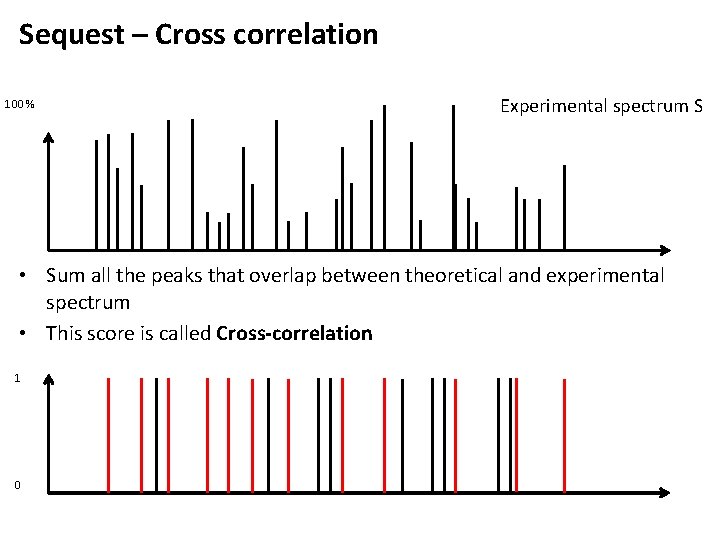
Sequest – Cross correlation 100 % Experimental spectrum S • Sum all the peaks that overlap between theoretical and experimental spectrum • This score is called Cross-correlation 1 0
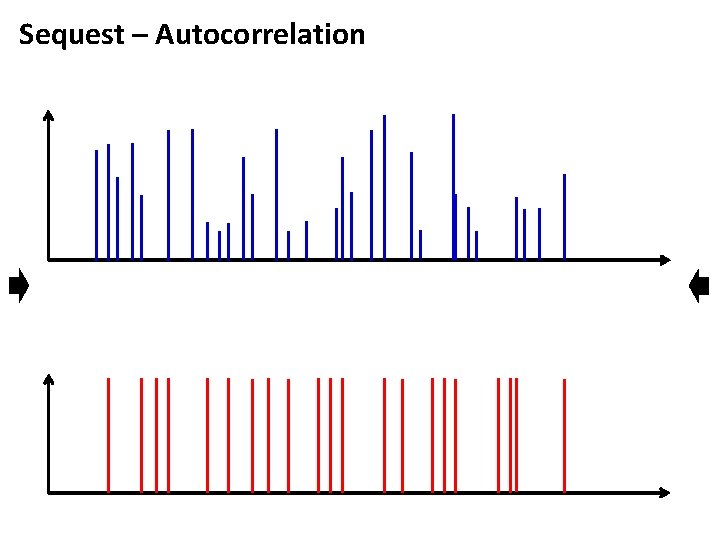
Sequest – Autocorrelation
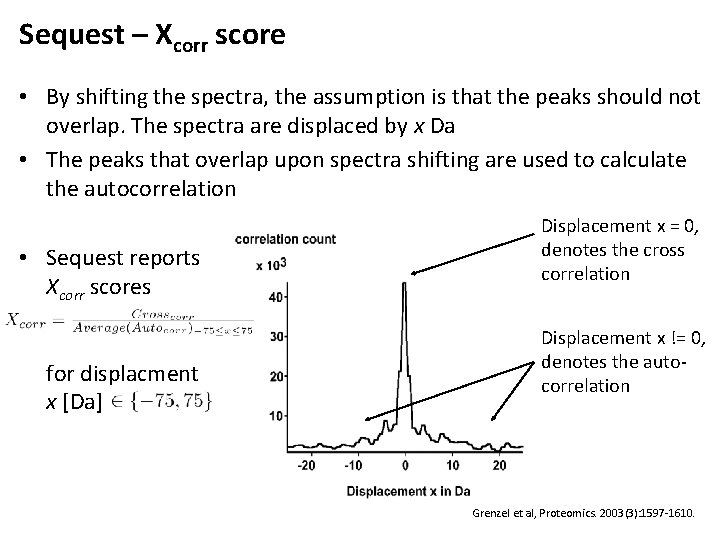
Sequest – Xcorr score • By shifting the spectra, the assumption is that the peaks should not overlap. The spectra are displaced by x Da • The peaks that overlap upon spectra shifting are used to calculate the autocorrelation • Sequest reports Xcorr scores for displacment x [Da] Displacement x = 0, denotes the cross correlation Displacement x != 0, denotes the autocorrelation Grenzel et al, Proteomics. 2003(3): 1597 -1610.
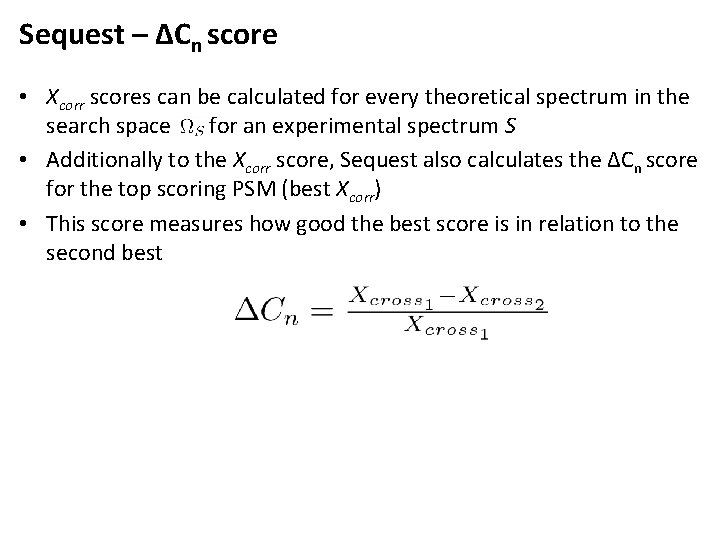
Sequest – ΔCn score • Xcorr scores can be calculated for every theoretical spectrum in the search space for an experimental spectrum S • Additionally to the Xcorr score, Sequest also calculates the ΔCn score for the top scoring PSM (best Xcorr) • This score measures how good the best score is in relation to the second best
Other Search Engines • Mascot from Matrix Science (http: //www. matrixscience. com/) • • Mascot is one of the most popular search engines Commercial software Algorithmic details have never been published Mascot calculats p-values for all candidates in the search space and ranks the output according to these p-values • Phenyx • Commercial software • Colinge et al. , Proteomics. Vol. 3, No. 8, August 2003, pp. 1454 -1463. • Ins. Pec. T • Very fast open-source search engine • Designed for the identification of posttranslational modification • Tanner et al. , J Proteome Res. 2005 Jul-Aug; 4(4): 1287 -95. • Myrimatch • Open source • Tabb et al. , J Proteome Res. 6(2) 654 -61. 2007 Feb
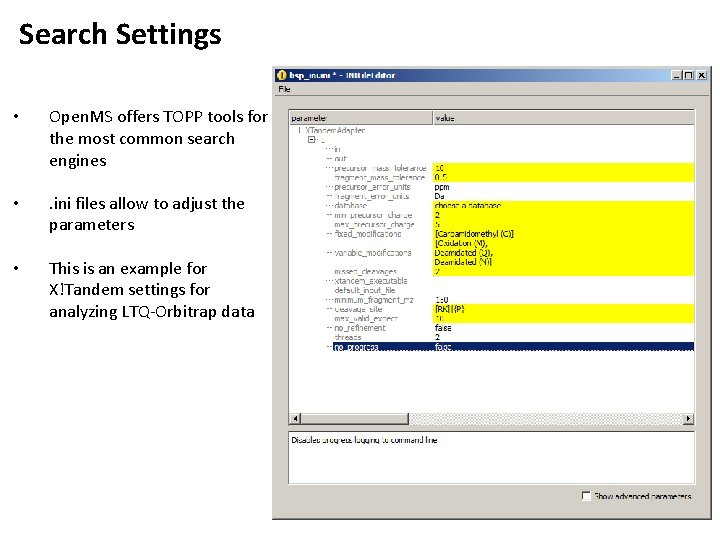
Search Settings • Open. MS offers TOPP tools for the most common search engines • . ini files allow to adjust the parameters • This is an example for X!Tandem settings for analyzing LTQ-Orbitrap data
Mass Tolerance Settings • Mass tolerance settings: • Easy to estimate when knowing the instrument, calibration runs • Precursor tolerance determines search space • should be stringent, but broad enough to have several entries per search space (e. g. , for E-value calculation) • 5 -10 ppm is commonly used for data acquired on well-calibrated Orbitrap instruments • Product (or fragment) tolerance determines the number of theoretical fragment ions that can be matched to the experimental spectrum • again, should be stringent, but also provide enough flexibility for statistical assessment (e. g. , drawing the Poisson distribution in the OMSSA algorithm) • 0. 5 Da is commonly used for data recorded by ion traps (e. g. LTQ)
Charge States and Missed Cleavages Charge state settings • Frequently, the mass spectrometer is set to only fragment features with charge > 1 • If you know your data is restricted to several charge states (e. g. , for your mass spectrometric settings), you can save time by not looking at these Missed cleavages • Sometimes, proteases don’t cleave perfectly • 1 or 2 missed cleavages should be allowed, but be careful since the number of missed cleavages increases your search space sizes!
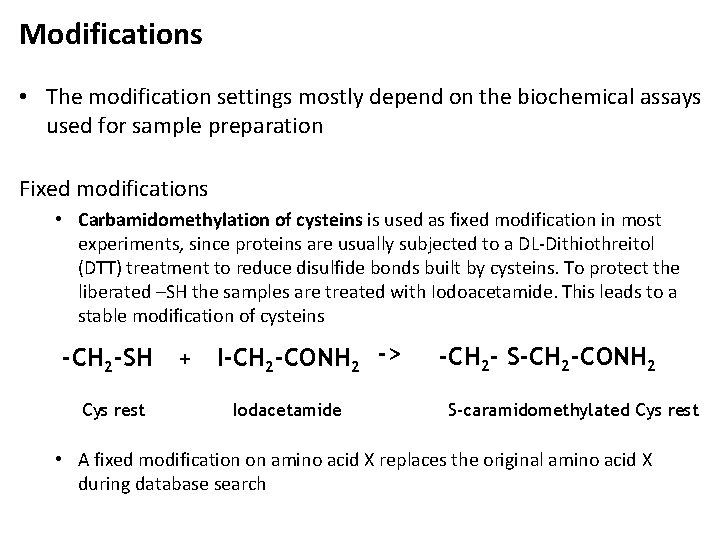
Modifications • The modification settings mostly depend on the biochemical assays used for sample preparation Fixed modifications • Carbamidomethylation of cysteins is used as fixed modification in most experiments, since proteins are usually subjected to a DL-Dithiothreitol (DTT) treatment to reduce disulfide bonds built by cysteins. To protect the liberated –SH the samples are treated with Iodoacetamide. This leads to a stable modification of cysteins -CH 2 -SH Cys rest + I-CH 2 -CONH 2 -> Iodacetamide -CH 2 - S-CH 2 -CONH 2 S-caramidomethylated Cys rest • A fixed modification on amino acid X replaces the original amino acid X during database search
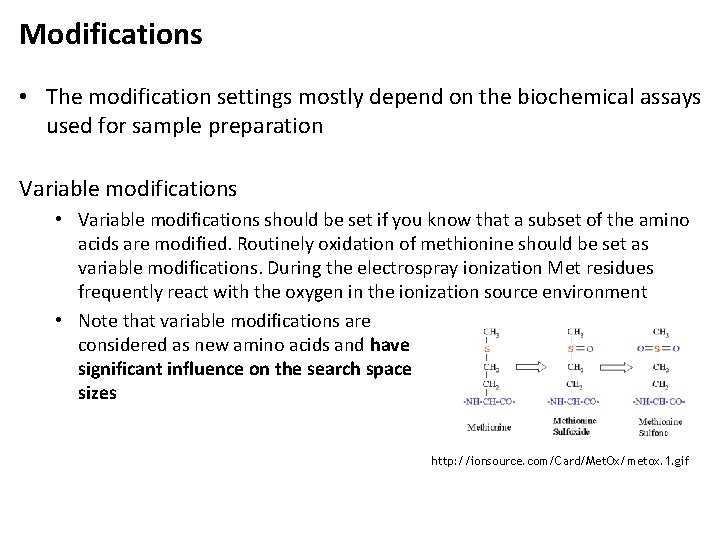
Modifications • The modification settings mostly depend on the biochemical assays used for sample preparation Variable modifications • Variable modifications should be set if you know that a subset of the amino acids are modified. Routinely oxidation of methionine should be set as variable modifications. During the electrospray ionization Met residues frequently react with the oxygen in the ionization source environment • Note that variable modifications are considered as new amino acids and have significant influence on the search space sizes http: //ionsource. com/Card/Met. Ox/metox. 1. gif
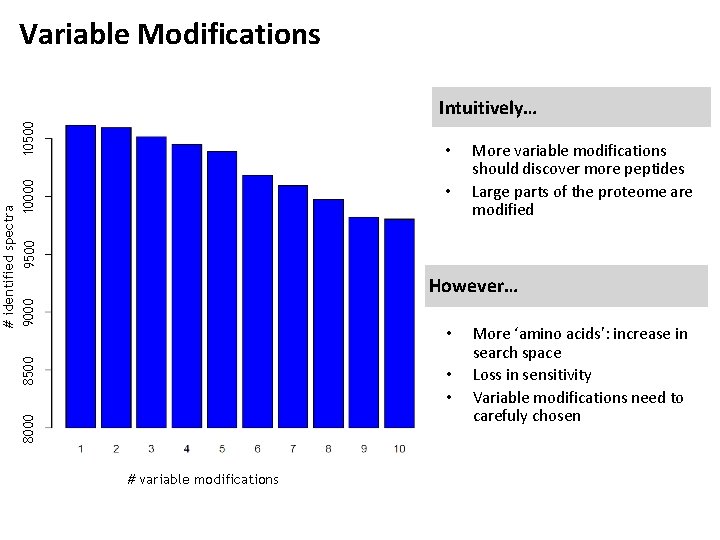
Variable Modifications 10500 Intuitively… # identified spectra 9000 10000 9500 • • More variable modifications should discover more peptides Large parts of the proteome are modified However… 8500 • 8000 • • # variable modifications More ‘amino acids’: increase in search space Loss in sensitivity Variable modifications need to carefuly chosen

LEARNING UNIT 7 C FDR ESTIMATION This work is licensed under a Creative Commons Attribution 4. 0 International License.
Database Settings • The database should contain all protein sequences that are expected to be in the sample (e. g. , all human proteins when looking at proteomics data from human cell lines) • From the database and the enzyme of ‘cutting rule’ settings, the peptide candidates are calculated • Besides the expected proteins, the database should also contain common contaminants, such as trypsin (or other enzymes), keratins or BSA (bovine serum albumin) that is usually used for instrument calibration • Databases can also be designed in a way to give an intuitive idea on False discovery rates -> target/decoy databases
Target-Decoy Databases • Take the original protein sequences (target sequences) and reverse, pseudo-reverse, randomize or shuffle these sequences to create decoy sequences • Either the data is searched twice (first versus the target and then versus the decoy database) or the data is searched once versus a database containing both target and decoy sequences • The assumption here is that if a decoy peptide is annotated to spectra, the PSM scores can be used to estimate the number of false identifications Important: • The decoy database design should provide equal numbers of decoy peptides as there are target peptides per search space (with randomized sequences this is hard to control) • Ideally one should avoid large overlap between target and decoy peptides
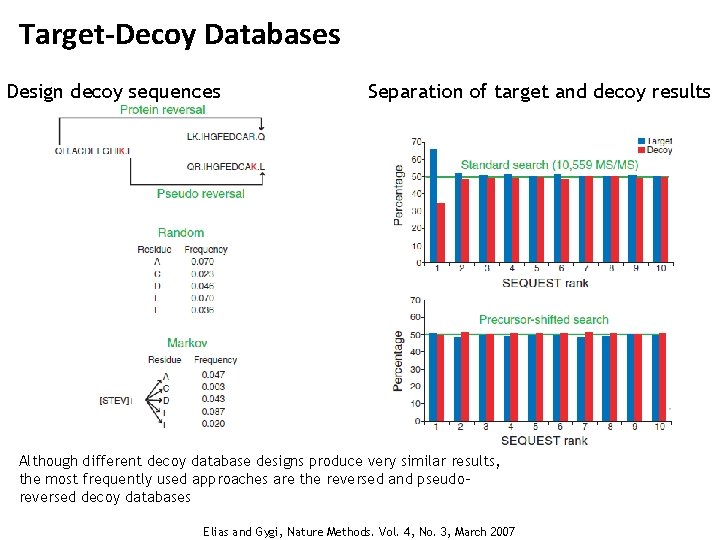
Target-Decoy Databases Design decoy sequences Separation of target and decoy results Although different decoy database designs produce very similar results, the most frequently used approaches are the reversed and pseudoreversed decoy databases Elias and Gygi, Nature Methods. Vol. 4, No. 3, March 2007
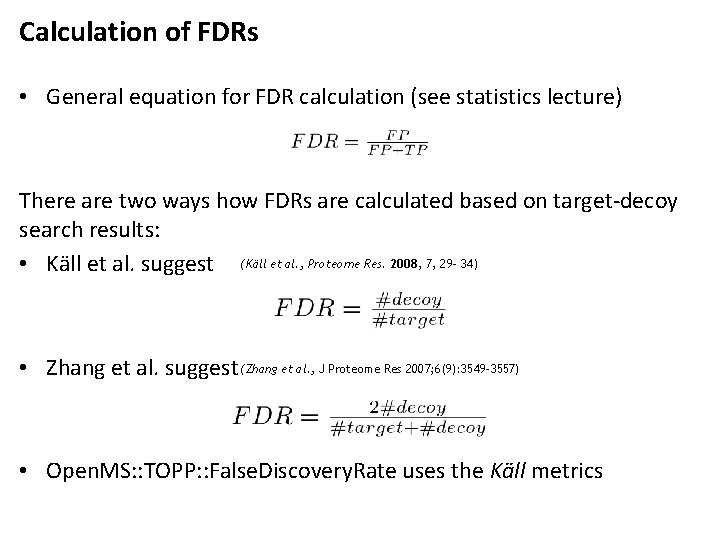
Calculation of FDRs • General equation for FDR calculation (see statistics lecture) There are two ways how FDRs are calculated based on target-decoy search results: • Käll et al. suggest (Käll et al. , Proteome Res. 2008, 7, 29– 34) • Zhang et al. suggest (Zhang et al. , J Proteome Res 2007; 6(9): 3549– 3557) • Open. MS: : TOPP: : False. Discovery. Rate uses the Käll metrics

LEARNING UNIT 7 D CONSENSUS IDENTIFICATION This work is licensed under a Creative Commons Attribution 4. 0 International License.
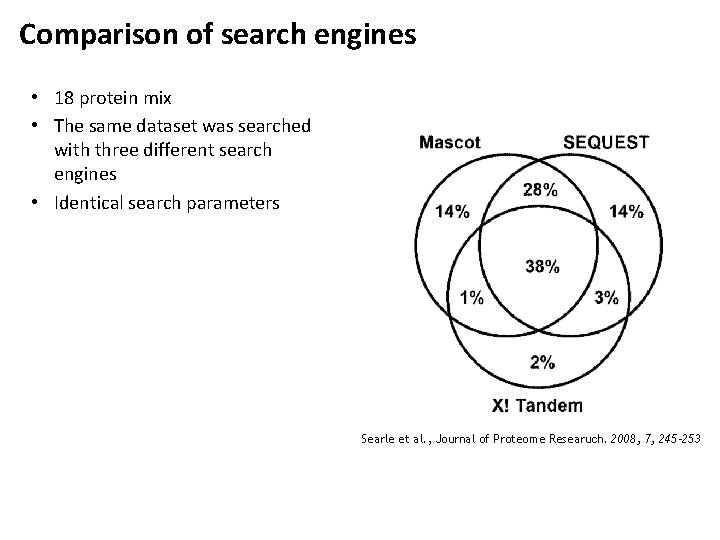
Comparison of search engines • 18 protein mix • The same dataset was searched with three different search engines • Identical search parameters Searle et al. , Journal of Proteome Researuch. 2008, 7, 245– 253
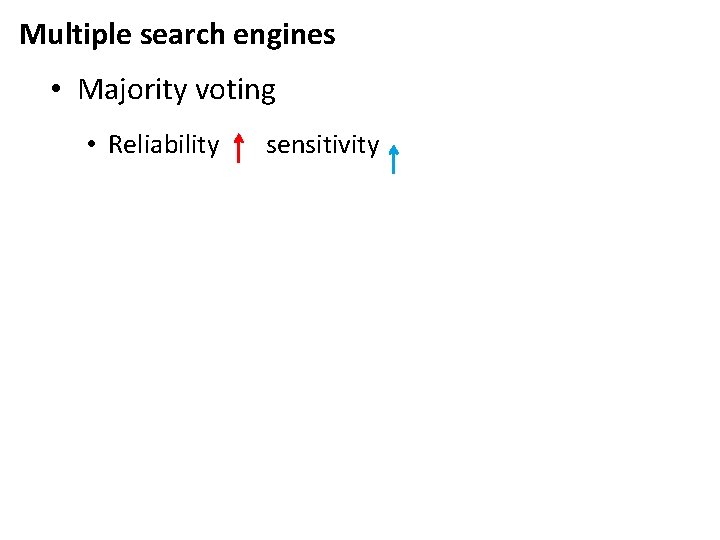
Multiple search engines • Majority voting • Reliability sensitivity
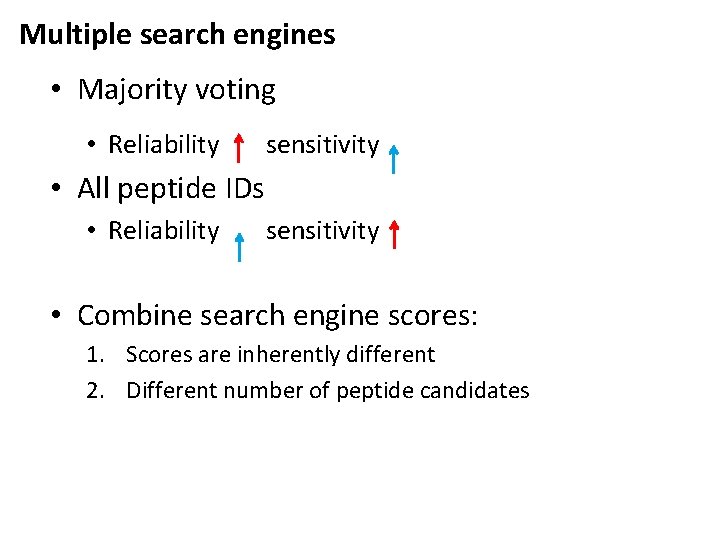
Multiple search engines • Majority voting • Reliability sensitivity • All peptide IDs • Reliability sensitivity • Combine search engine scores: 1. Scores are inherently different 2. Different number of peptide candidates
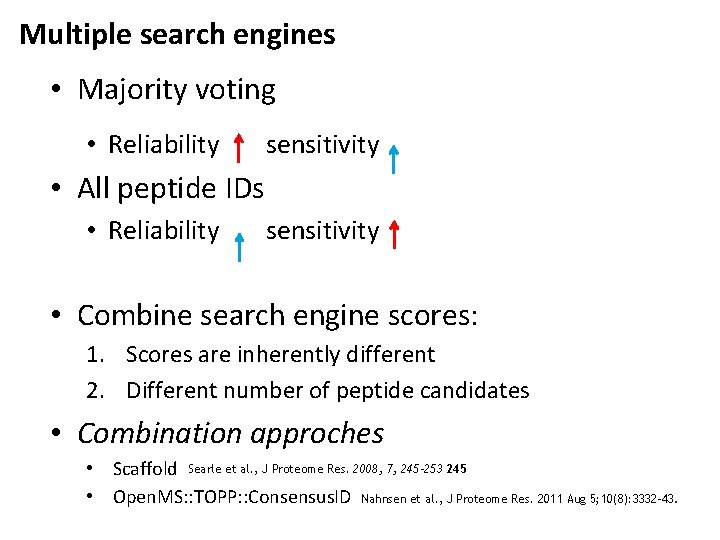
Multiple search engines • Majority voting • Reliability sensitivity • All peptide IDs • Reliability sensitivity • Combine search engine scores: 1. Scores are inherently different 2. Different number of peptide candidates • Combination approches • Scaffold Searle et al. , J Proteome Res. 2008, 7, 245– 253 245 • Open. MS: : TOPP: : Consensus. ID Nahnsen et al. , J Proteome Res. 2011 Aug 5; 10(8): 3332 -43.
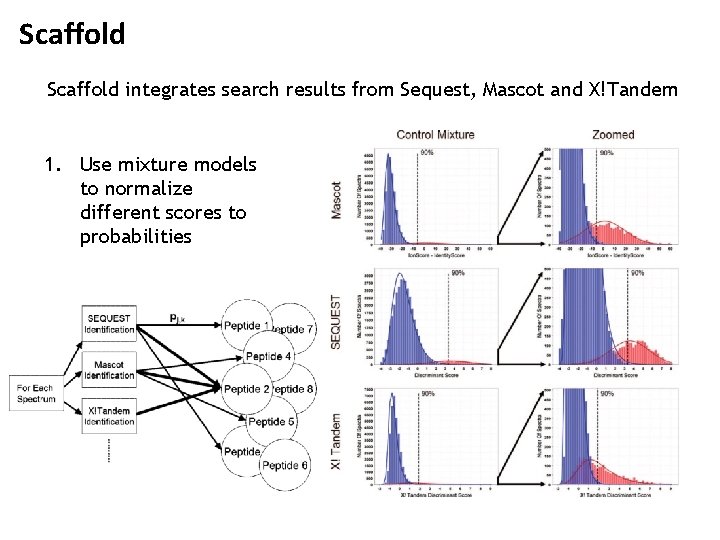
Scaffold integrates search results from Sequest, Mascot and X!Tandem 1. Use mixture models to normalize different scores to probabilities
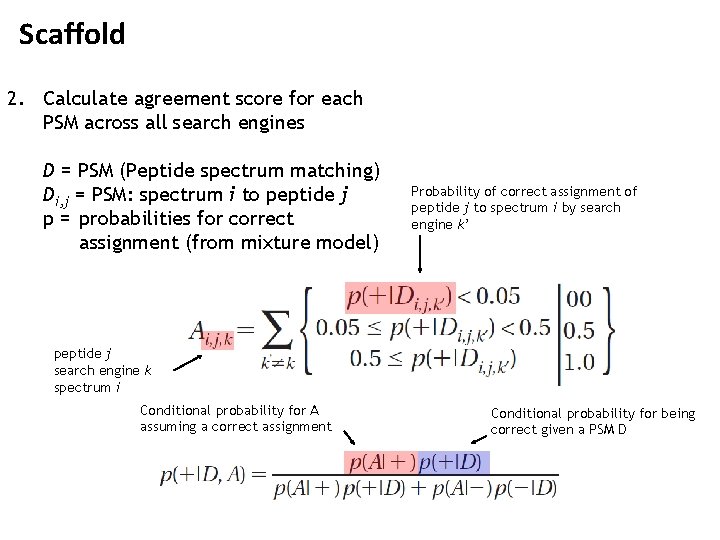
Scaffold 2. Calculate agreement score for each PSM across all search engines D = PSM (Peptide spectrum matching) Di, j = PSM: spectrum i to peptide j p = probabilities for correct assignment (from mixture model) Probability of correct assignment of peptide j to spectrum i by search engine k’ peptide j search engine k spectrum i Conditional probability for A assuming a correct assignment Conditional probability for being correct given a PSM D
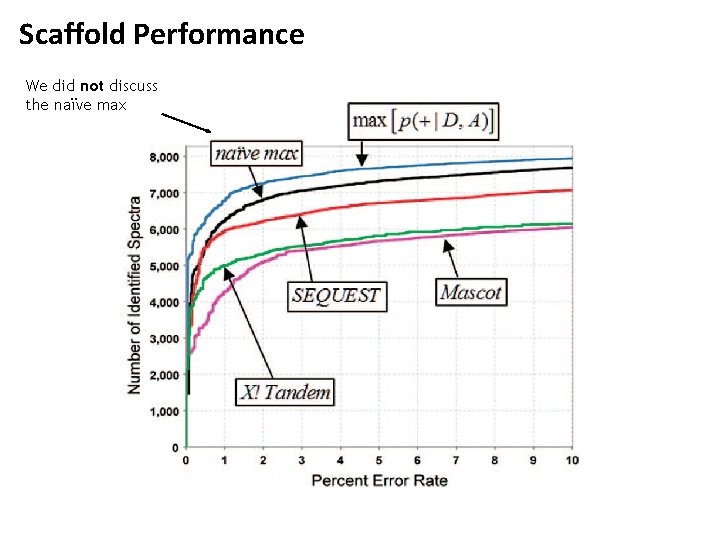
Scaffold Performance We did not discuss the naïve max
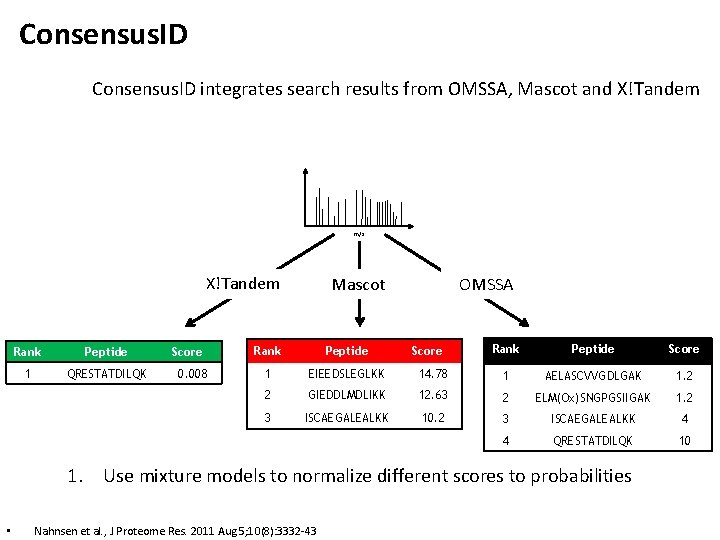
Consensus. ID integrates search results from OMSSA, Mascot and X!Tandem m/z X!Tandem Rank Peptide 1 QRESTATDILQK Score 0. 008 Mascot OMSSA Rank Peptide Score 14. 78 1 AELASCVVGDLGAK 1. 2 GIEDDLMDLIKK 12. 63 2 ELM(Ox)SNGPGSIIGAK 1. 2 ISCAEGALEALKK 10. 2 3 ISCAEGALEALKK 4 4 QRESTATDILQK 10 Rank Peptide 1 EIEEDSLEGLKK 2 3 Score 1. Use mixture models to normalize different scores to probabilities • Nahnsen et al. , J Proteome Res. 2011 Aug 5; 10(8): 3332 -43
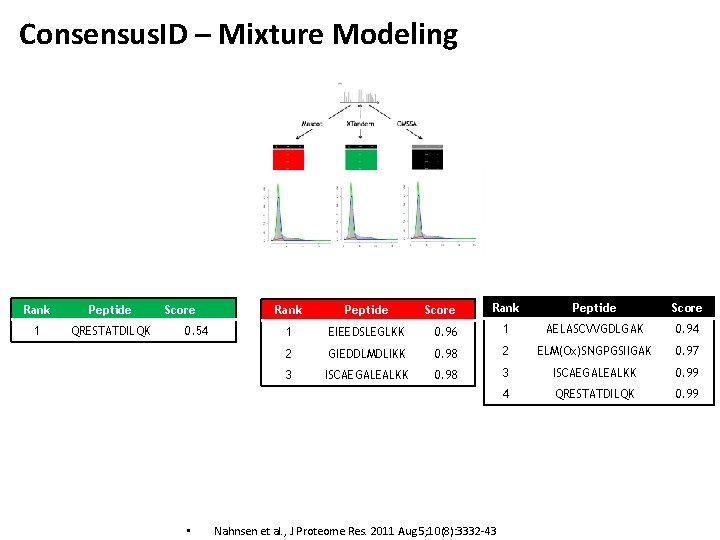
Consensus. ID – Mixture Modeling Rank Peptide 1 QRESTATDILQK Score 0. 54 • Rank Peptide Score 0. 96 1 AELASCVVGDLGAK 0. 94 GIEDDLMDLIKK 0. 98 2 ELM(Ox)SNGPGSIIGAK 0. 97 ISCAEGALEALKK 0. 98 3 ISCAEGALEALKK 0. 99 4 QRESTATDILQK 0. 99 Rank Peptide 1 EIEEDSLEGLKK 2 3 Score Nahnsen et al. , J Proteome Res. 2011 Aug 5; 10(8): 3332 -43
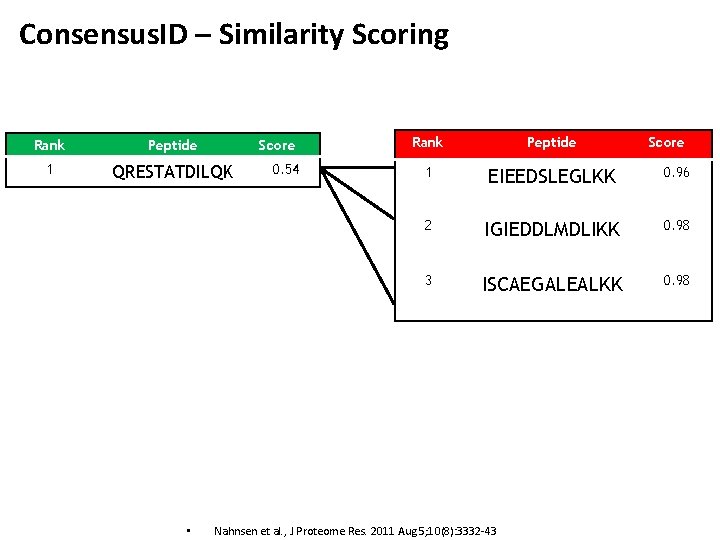
Consensus. ID – Similarity Scoring Rank Peptide 1 QRESTATDILQK • Score 0. 54 Rank Peptide 1 EIEEDSLEGLKK 0. 96 2 IGIEDDLMDLIKK 0. 98 3 ISCAEGALEALKK 0. 98 Nahnsen et al. , J Proteome Res. 2011 Aug 5; 10(8): 3332 -43 Score
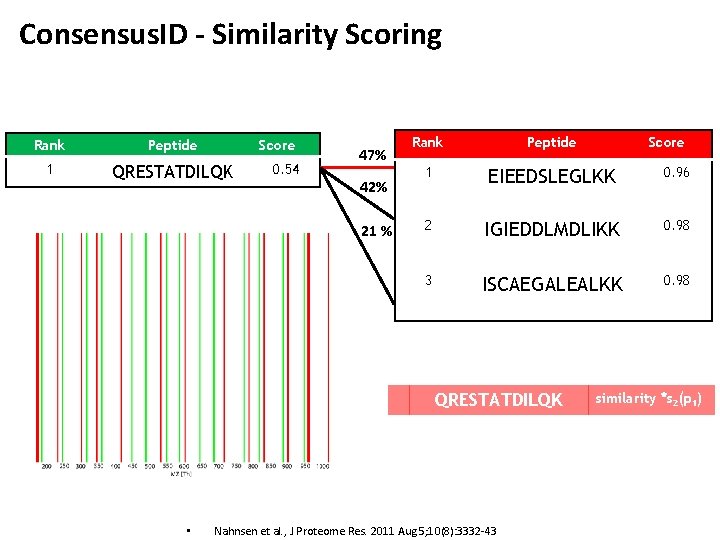
Consensus. ID - Similarity Scoring Rank Peptide Score 1 QRESTATDILQK 0. 54 47% 42% 21 % Rank Peptide 1 EIEEDSLEGLKK 0. 96 2 IGIEDDLMDLIKK 0. 98 3 ISCAEGALEALKK 0. 98 QRESTATDILQK • Nahnsen et al. , J Proteome Res. 2011 Aug 5; 10(8): 3332 -43 Score similarity *s 2(p 1)
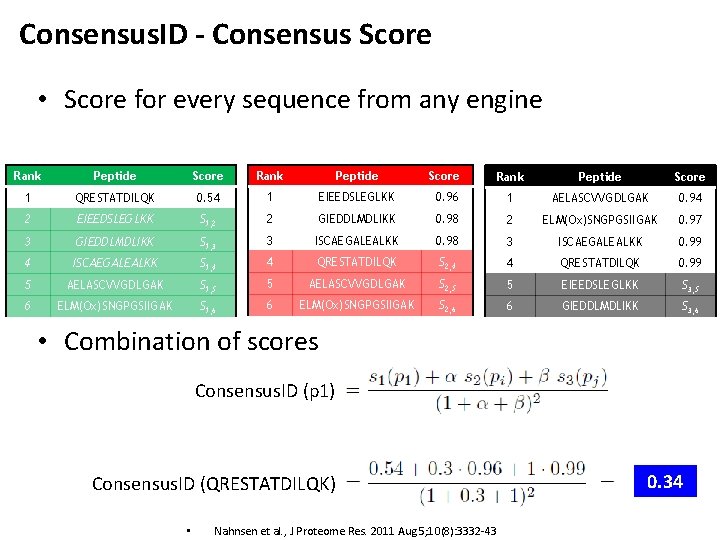
Consensus. ID - Consensus Score • Score for every sequence from any engine Rank Peptide Score 1 QRESTATDILQK 0. 54 1 EIEEDSLEGLKK 0. 96 1 AELASCVVGDLGAK 0. 94 2 EIEEDSLEGLKK S 1, 2 2 GIEDDLMDLIKK 0. 98 2 ELM(Ox)SNGPGSIIGAK 0. 97 3 GIEDDLMDLIKK S 1, 3 3 ISCAEGALEALKK 0. 98 3 ISCAEGALEALKK 0. 99 4 ISCAEGALEALKK S 1, 4 4 QRESTATDILQK S 2, 4 4 QRESTATDILQK 0. 99 5 AELASCVVGDLGAK S 1, 5 5 AELASCVVGDLGAK S 2, 5 5 EIEEDSLEGLKK S 3, 5 6 ELM(Ox)SNGPGSIIGAK S 1, 6 6 ELM(Ox)SNGPGSIIGAK S 2, 6 6 GIEDDLMDLIKK S 3, 6 • Combination of scores Consensus. ID (p 1) Consensus. ID (QRESTATDILQK) • Nahnsen et al. , J Proteome Res. 2011 Aug 5; 10(8): 3332 -43 0. 34
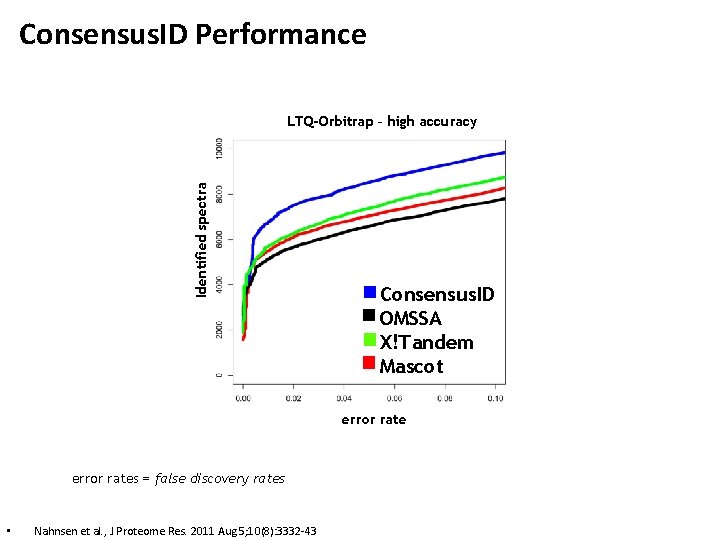
Consensus. ID Performance Identified spectra LTQ-Orbitrap – high accuracy Consensus. ID OMSSA X!Tandem Mascot error rates = false discovery rates • Nahnsen et al. , J Proteome Res. 2011 Aug 5; 10(8): 3332 -43
References • • • • Eidhammer et al. , Computational Methods for Mass Spectrometry Proteomics. Wiley. 2007. Freitas and Xu, BMC Bioinformatics. 2010, 11: 436 Roepstorff and Fohlman, Biological Mass Spectrometry, Volume 11, Issue 11, page 601, November 1984 Steen and Mann. Nature Reviews, Molecular Cell Biology, Vol. 5 2004 Johnson et al. Anal. Chem 1987; 59: 2621 -2625 Hoffert J D et al. PNAS 2006; 103: 7159 -7164 Craig, R. and Beavis, R. C. (2003) Rapid Commun. Mass Spectrom. , 17, 2310– 2316 Geer et al. (2004) J Proteome Res. 2004 Sep-Oct; 3(5): 958 -64. Eng et al. , J. Am. Soc. Mass Spectrom. 1994, 5, 976 -989. Fenyö and Beavis, Anal. Chem. 2003, 75, 768 -774 http: //www. proteomesoftware. com/pdf_files/XTandem_edited. pdf Grenzel et al, Proteomics. 2003(3): 1597 -1610. Elias and Gygi, Nature Methods. Vol. 4, No. 3, March 2007 Searle et al. , Journal of Proteome Researuch. 2008, 7, 245– 253 245 Nahnsen et al. , J Proteome Res. 2011 Aug 5; 10(8): 3332 -43

Materials • Online Materials • Learning Unit 7 A, B, C, D 76
- Slides: 69