
Computational Physics Thinking Rubin H Landau Founding Dir

Computational (Physics) Thinking Rubin H Landau, Founding Dir Computational Physics for Undergraduates BS Degree Program @ Oregon State University Prior Support: NSF (CCLI, CI-Team/EPIC), OSU, MSR e. Science Workshop © Rubin Landau, CPUG
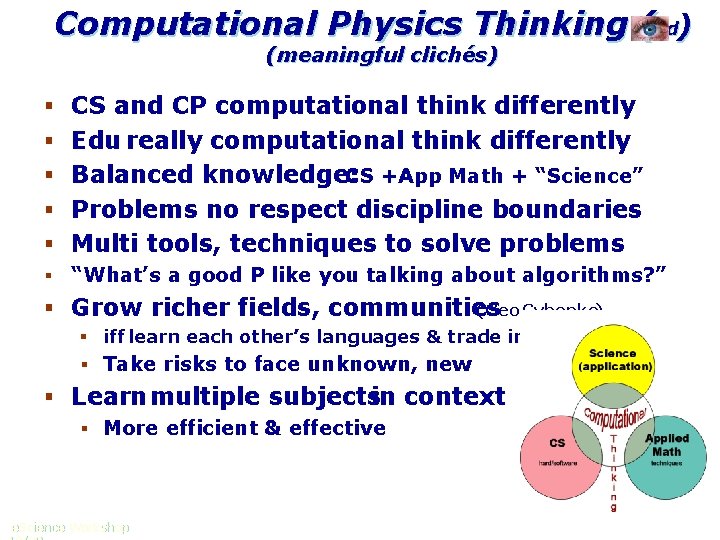
Computational Physics Thinking (Ed) (meaningful clichés) § CS and CP computational think differently § Edu really computational think differently § Balanced knowledge: CS +App Math + “Science” § Problems no respect discipline boundaries § Multi tools, techniques to solve problems § “What’s a good P like you talking about algorithms? ” § Grow richer fields, communities (Geo Cybenko) § iff learn each other’s languages & trade in good faith § Take risks to face unknown, new § Learn multiple subjectsin context § More efficient & effective e. Science Workshop
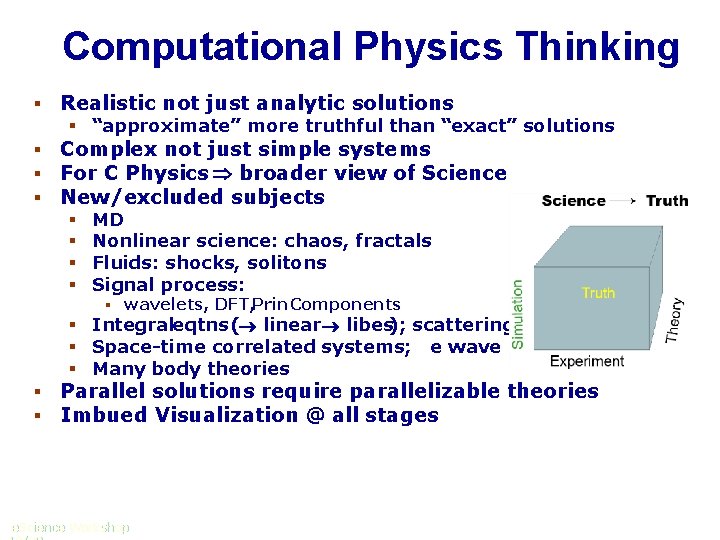
Computational Physics Thinking § Realistic not just analytic solutions § § § Complex not just simple systems For C Physics broader view of Science New/excluded subjects § “approximate” more truthful than “exact” solutions § § MD Nonlinear science: chaos, fractals Fluids: shocks, solitons Signal process: § wavelets, DFT, Prin Components § Integraleqtns ( linear libes); scattering § Space-time correlated systems; e wave packets § Many body theories § § Parallel solutions require parallelizable theories Imbued Visualization @ all stages e. Science Workshop
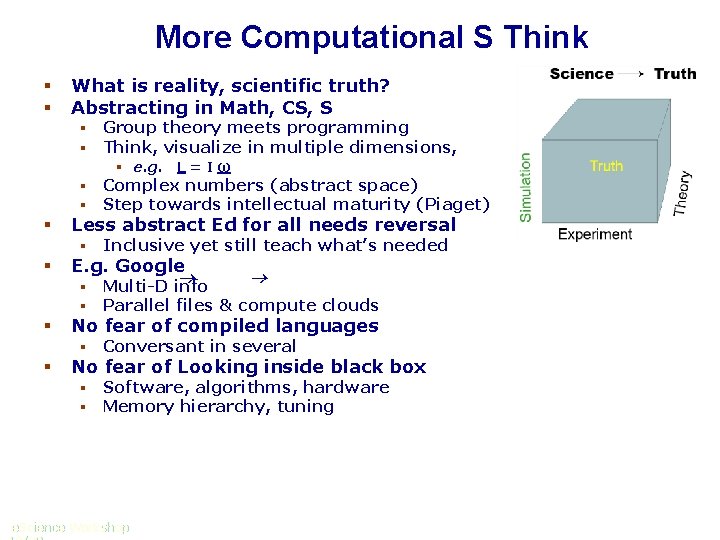
More Computational S Think § § What is reality, scientific truth? Abstracting in Math, CS, S Group theory meets programming Think, visualize in multiple dimensions, § e. g. L = I ω § Complex numbers (abstract space) § Step towards intellectual maturity (Piaget) § § § Less abstract Ed for all needs reversal § § E. g. Google § § § Multi-D info Parallel files & compute clouds No fear of compiled languages § § Inclusive yet still teach what’s needed Conversant in several No fear of Looking inside black box § § Software, algorithms, hardware Memory hierarchy, tuning e. Science Workshop

Evidence for (Science Ed) O t h e r C S M T H P H Y S § RHL Survey (Y&L) § CSE, CP ~ balance § Small sample § Stereotypes� § PH Ed: �imbalance? e. Science Workshop © Rubin Landau, CPUG
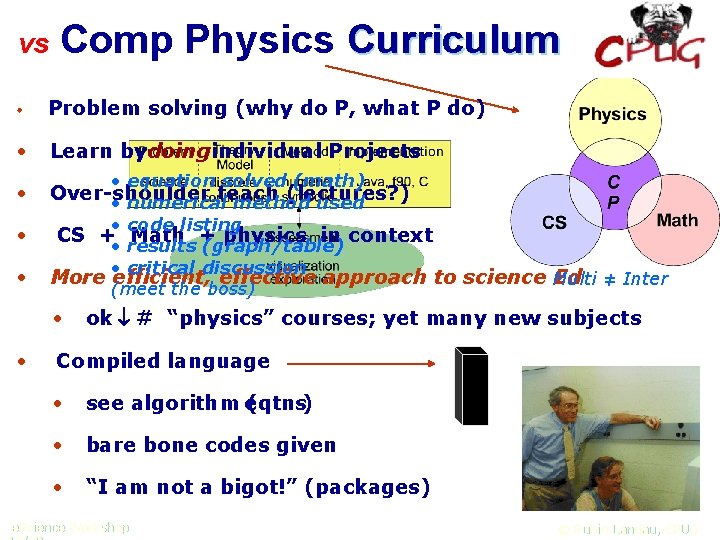
vs Comp Physics Curriculum • Problem solving (why do P, what P do) • Learn bydoing individual Projects • Over-shoulder teach (lectures? ) • numerical method used • • • equation solved (math) • code listing • results (graph/table) critical discussion More • efficient, effective approach to science Multi Ed ≠ Inter (meet the boss) CS + Math + physics in context • • O. Y. ok # “physics” courses; yet many new subjects Compiled language • see algorithm eqtns ( ) • bare bone codes given • “I am not a bigot!” (packages) e. Science Workshop © Rubin Landau, CPUG
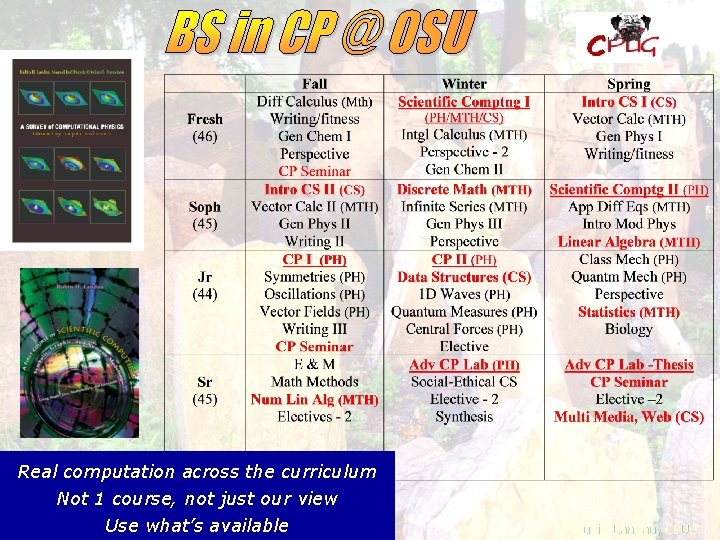
Real computation across the curriculum Not 1 course, not just our view Use what’s available © Rubin Landau, CPUG
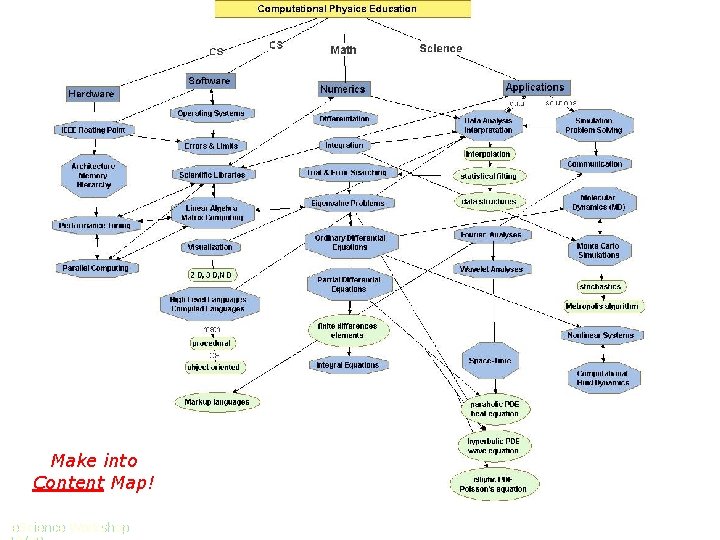
Make into Content Map! e. Science Workshop
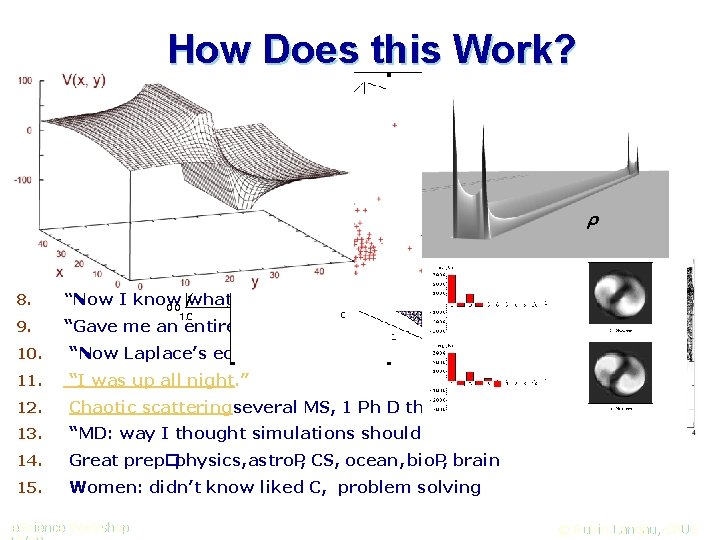
How Does this Work? 1. Challenging for some students (intro*, multidisciplinary) 2. Unhappy with grade if just ran code, no thought, no time 3. Students often thankful when/that over (career) 4. Tears, emotion; human-C interaction = complex 5. Excitement; human-C interaction = complex, emotional 6. “This combo is what I interested in, but had to pick 1” 7. “Why have we studied fluids only in our freshman year? ” 8. “Now I know what is dynamic in thermodynamics” 9. “Gave me an entirely new view of integration, series, ” 10. “Now Laplace’s equation makes sense” 11. “I was up all night. ” 12. Chaotic scattering: several MS, 1 Ph D thesis 13. “MD: way I thought simulations should be” 14. Great prep�physics, astro. P, CS, ocean, bio. P, brain 15. Women: didn’t know liked C, problem solving e. Science Workshop © Rubin Landau, CPUG
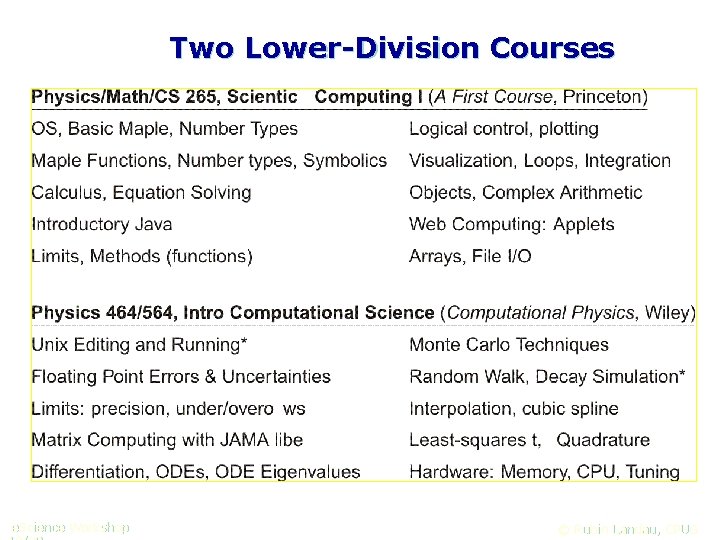
Two Lower-Division Courses e. Science Workshop © Rubin Landau, CPUG
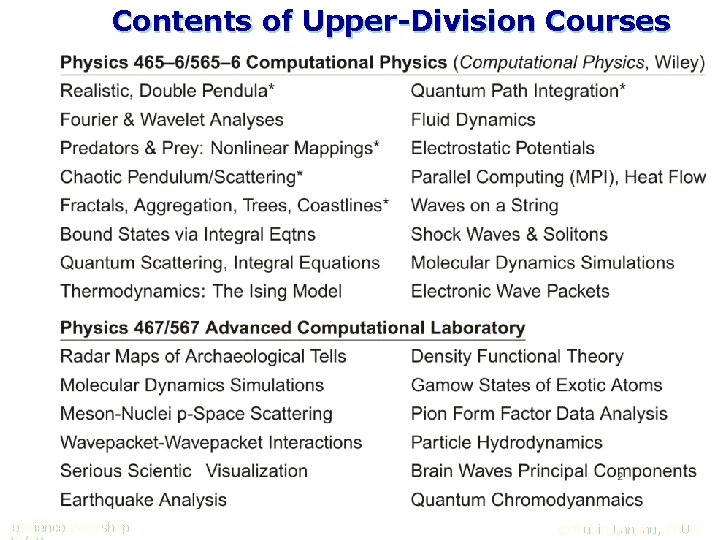
Contents of Upper-Division Courses e. Science Workshop © Rubin Landau, CPUG
- Slides: 11