
Computational Modeling of Wind Turbine Aerodynamics and Helicopter
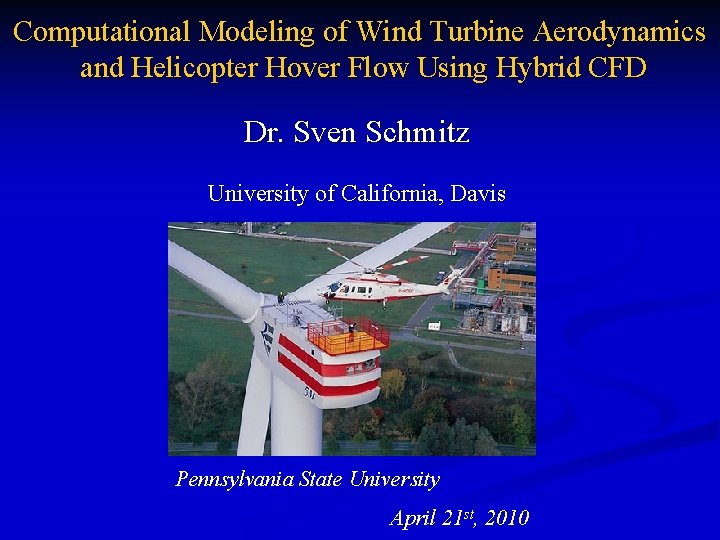
Computational Modeling of Wind Turbine Aerodynamics and Helicopter Hover Flow Using Hybrid CFD Dr. Sven Schmitz University of California, Davis Pennsylvania State University April 21 st, 2010
Outline n Wind Energy n The NREL Phase VI Experiment n Hybrid CFD for Wind Turbines n Hybrid CFD for Helicopter Hover Flow n Future Research Directions 2
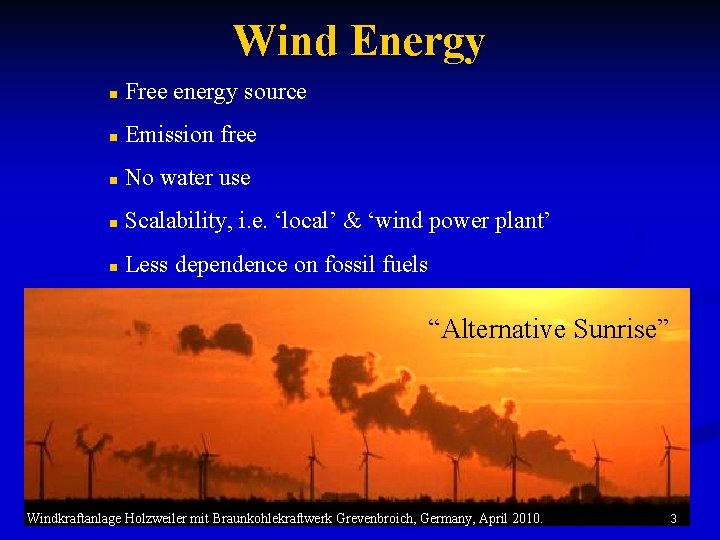
Wind Energy n Free energy source n Emission free n No water use n Scalability, i. e. ‘local’ & ‘wind power plant’ n Less dependence on fossil fuels “Alternative Sunrise” Windkraftanlage Holzweiler mit Braunkohlekraftwerk Grevenbroich, Germany, April 2010. 3
Wind Energy - U. S. Market n Over 10, 000 MW installed in 2009 - U. S. world leader n Top U. S. Wind Turbine Supplier : GE Energy n Wind industry supports 85, 000 jobs in 50 states n Now 9 wind turbine manufacturers in U. S. www. awea. org/reports (April 2010) 4
Wind Energy - Incentives n US DOE – Energy Efficiency and Renewable Energy à n 20% Wind Energy by 2030 Pennsylvania - Alternative Energy Investment Act (2009) à Wind Energy Supply Chain Initiative (WESCI) 5
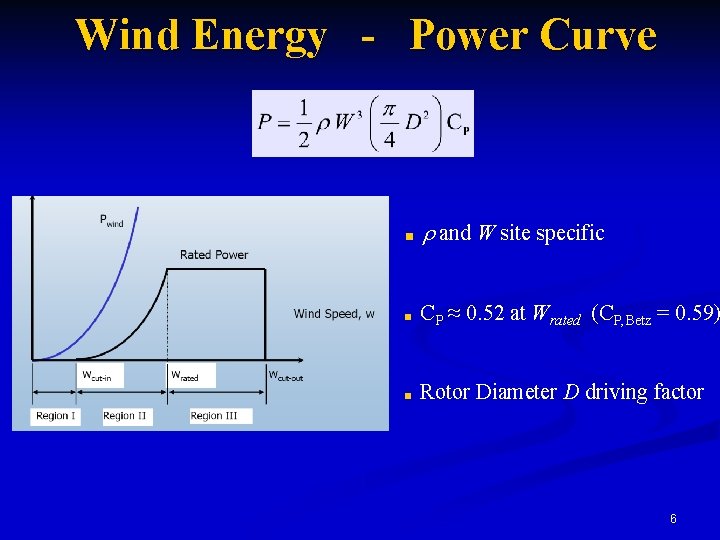
Wind Energy - Power Curve < r and W site specific < CP ≈ 0. 52 at Wrated (CP, Betz = 0. 59) < Rotor Diameter D driving factor 6
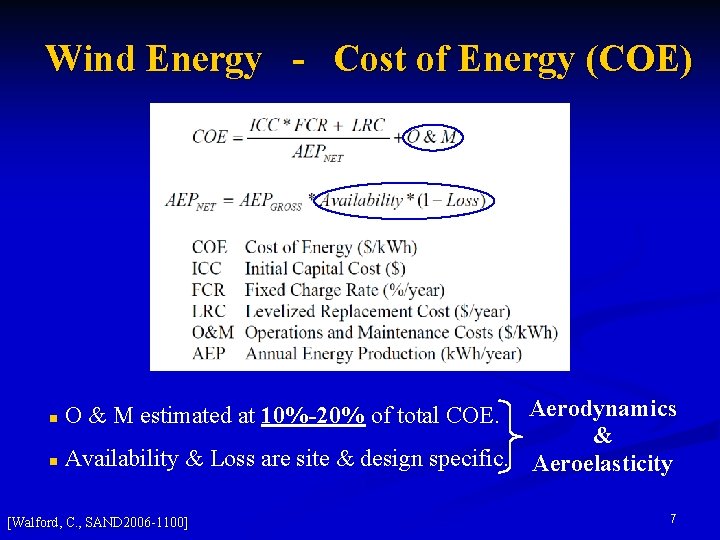
Wind Energy - Cost of Energy (COE) Aerodynamics & n Availability & Loss are site & design specific. Aeroelasticity n O & M estimated at 10%-20% of total COE. [Walford, C. , SAND 2006 -1100] 7

Wind Energy - Cost Reduction n Maximize Availability, Minimize Loss à à n Improved designs for Region II Reduce fatigue loads Minimize Operation and Maintenance (O & M) à à Reduce # turbines to maintain by increasing turbine power Reduce fatigue loads 8
Wind Energy Challenges in Computational Modeling n Unsteady Aerodynamics à n Aeroelasticity à à n Blade load response to wind gust Blade tip deflections of several meters Twist changes > 10 deg Airfoil Soiling à Performance loss caused by dirt, insects, etc. 9
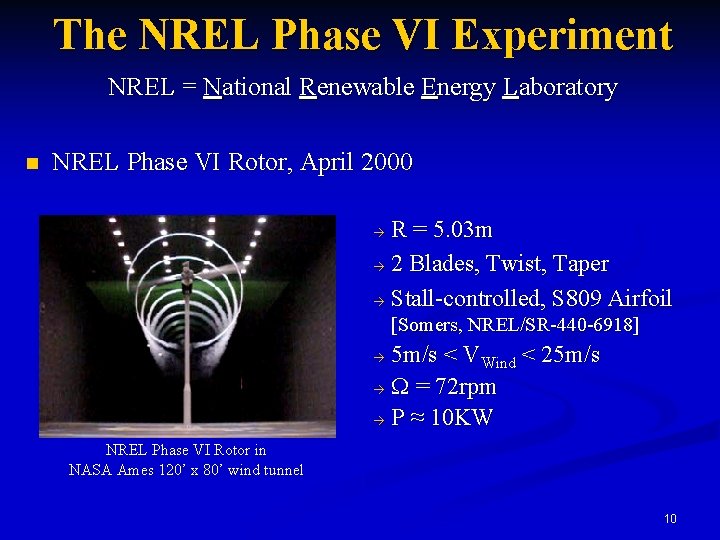
The NREL Phase VI Experiment NREL = National Renewable Energy Laboratory n NREL Phase VI Rotor, April 2000 R = 5. 03 m à 2 Blades, Twist, Taper à Stall-controlled, S 809 Airfoil à [Somers, NREL/SR-440 -6918] 5 m/s < VWind < 25 m/s à W = 72 rpm à P ≈ 10 KW à NREL Phase VI Rotor in NASA Ames 120’ x 80’ wind tunnel 10
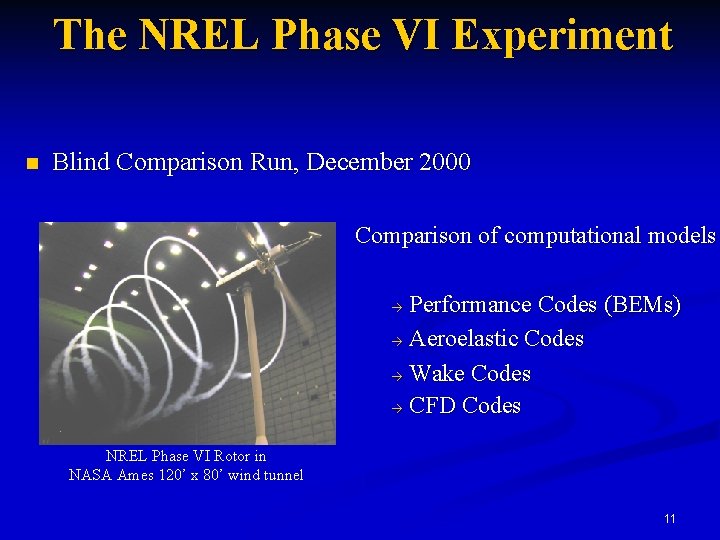
The NREL Phase VI Experiment n Blind Comparison Run, December 2000 Comparison of computational models Performance Codes (BEMs) à Aeroelastic Codes à Wake Codes à CFD Codes à NREL Phase VI Rotor in NASA Ames 120’ x 80’ wind tunnel 11
![The NREL Phase VI Experiment Main Results from Blind Comparison Run [NREL/TP-500 -29494] n](http://slidetodoc.com/presentation_image_h2/b88fd438c781ce94bf83d1e8a84b7e99/image-12.jpg "The NREL Phase VI Experiment Main Results from Blind Comparison Run [NREL/TP-500 -29494] n")
The NREL Phase VI Experiment Main Results from Blind Comparison Run [NREL/TP-500 -29494] n No-Yaw, Steady-State, No-Stall conditions … Turbine Power Prediction : 25% - 175% of measured Blade Bending Prediction : 85% - 150% of measured Conclusions from Blind Comparison Run [NREL/TP-500 -29494] CFD Codes -> Overall best predictions of turbine power and blade loads. Wake Codes -> Good performance for attached flow. 12
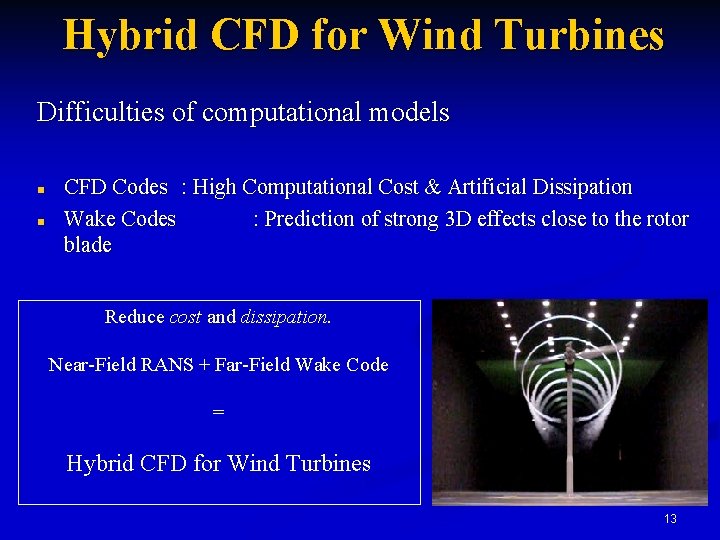
Hybrid CFD for Wind Turbines Difficulties of computational models n n CFD Codes : High Computational Cost & Artificial Dissipation Wake Codes : Prediction of strong 3 D effects close to the rotor blade Reduce cost and dissipation. Near-Field RANS + Far-Field Wake Code = Hybrid CFD for Wind Turbines 13

Hybrid CFD for Wind Turbines Parallelized Coupled Solver (PCS) Navier-Stokes Biot-Savart Law (discrete) Boundary of Navier-Stokes Zone Vortex Method Bound Vortex Converged for … Vortex Filament 14
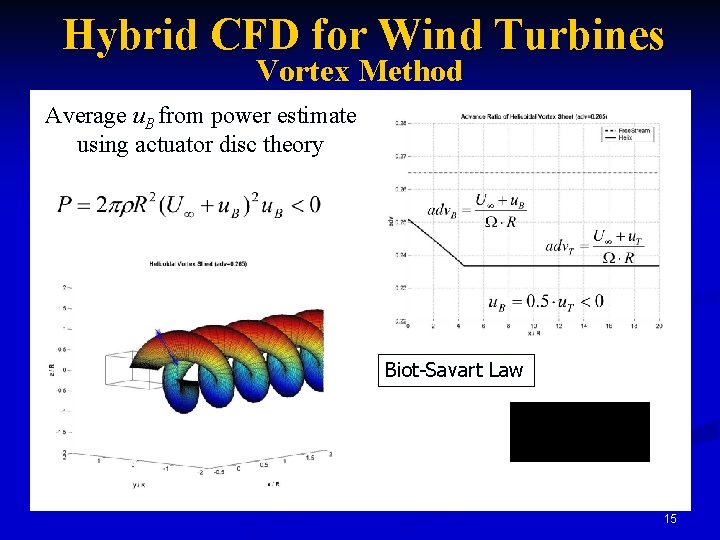
Hybrid CFD for Wind Turbines Vortex Method Average u. B from power estimate using actuator disc theory Biot-Savart Law 15

Hybrid CFD for Wind Turbines Vortex Method Accuracy of straight-line Vortex Segmentation : => [Gupta & Leishman, AIAA-2004 -0828] ΔΘ = 10˚ => Error < 10% ΔΘ < 2. 5˚ => Error < 1% C Parameters for accurate calculation of induced velocities : Ø Minimum Number of Vortex Filaments : 39 Ø Trefftz Plane Location : 20 blade radii behind the rotor disc Ø Vortex Segmentation ΔΘ : 0. 02˚ at the blade, 12˚ after 1 revolution Accuracy achieved in Induced Velocities at representative points : < 1% 16
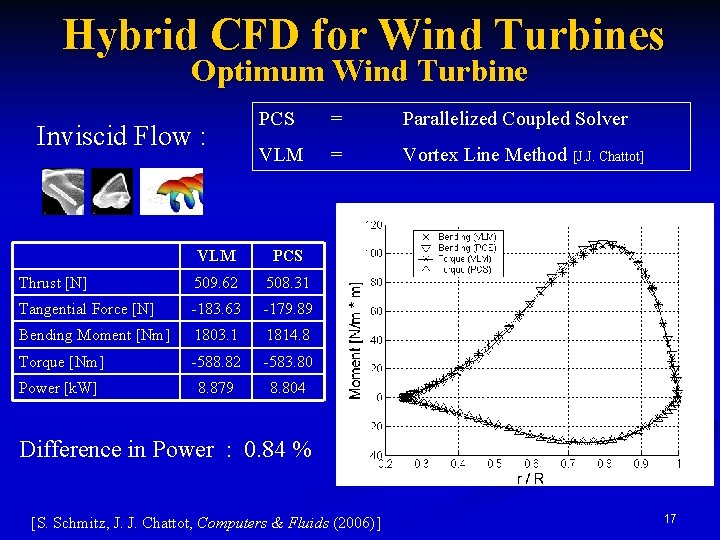
Hybrid CFD for Wind Turbines Optimum Wind Turbine Inviscid Flow : PCS = Parallelized Coupled Solver VLM = Vortex Line Method [J. J. Chattot] VLM PCS Thrust [N] 509. 62 508. 31 Tangential Force [N] -183. 63 -179. 89 Bending Moment [Nm] 1803. 1 1814. 8 Torque [Nm] -588. 82 -583. 80 Power [k. W] 8. 879 8. 804 Difference in Power : 0. 84 % [S. Schmitz, J. J. Chattot, Computers & Fluids (2006)] 17
![Hybrid CFD for Wind Turbines Optimum Wind Turbine Viscous Flow : Thrust [N] Tangential](http://slidetodoc.com/presentation_image_h2/b88fd438c781ce94bf83d1e8a84b7e99/image-18.jpg "Hybrid CFD for Wind Turbines Optimum Wind Turbine Viscous Flow : Thrust [N] Tangential")
Hybrid CFD for Wind Turbines Optimum Wind Turbine Viscous Flow : Thrust [N] Tangential Force [N] Bending Moment [Nm] Torque [Nm] Power [k. W] VLM 472. 41 -163. 26 1670. 2 -519. 58 7. 835 PCS = Parallelized Coupled Solver VLM = Vortex Line Method [J. J. Chattot] PCS 458. 60 -150. 80 1636. 4 -485. 50 7. 321 Difference in Power : 6. 6 % [S. Schmitz, J. J. Chattot, Computers & Fluids (2006)] 18

Hybrid CFD for Wind Turbines NREL Phase VI Rotor Rotating, S-Sequence Fully Attached Flow : U =7 m/s 19
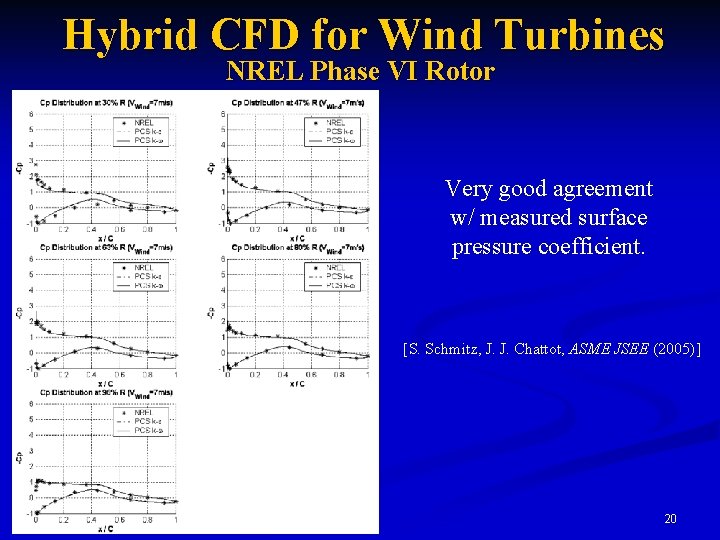
Hybrid CFD for Wind Turbines NREL Phase VI Rotor Very good agreement w/ measured surface pressure coefficient. [S. Schmitz, J. J. Chattot, ASME JSEE (2005)] 20
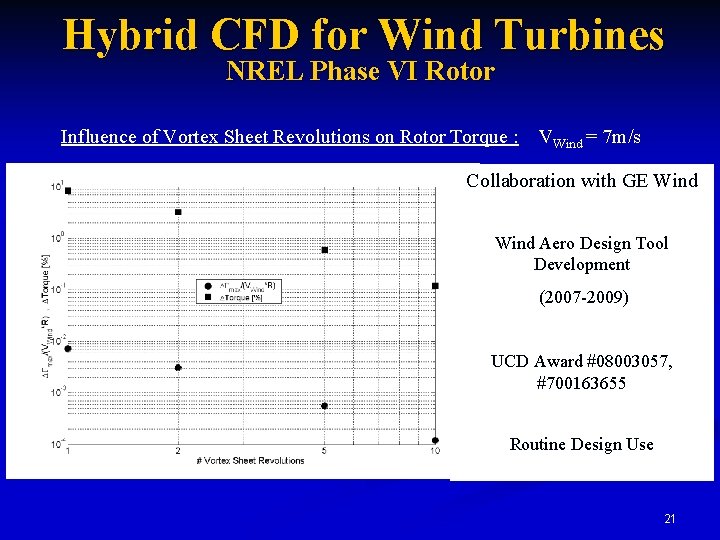
Hybrid CFD for Wind Turbines NREL Phase VI Rotor Influence of Vortex Sheet Revolutions on Rotor Torque : VWind = 7 m/s Collaboration with GE Wind Aero Design Tool Development (2007 -2009) UCD Award #08003057, #700163655 Routine Design Use 21
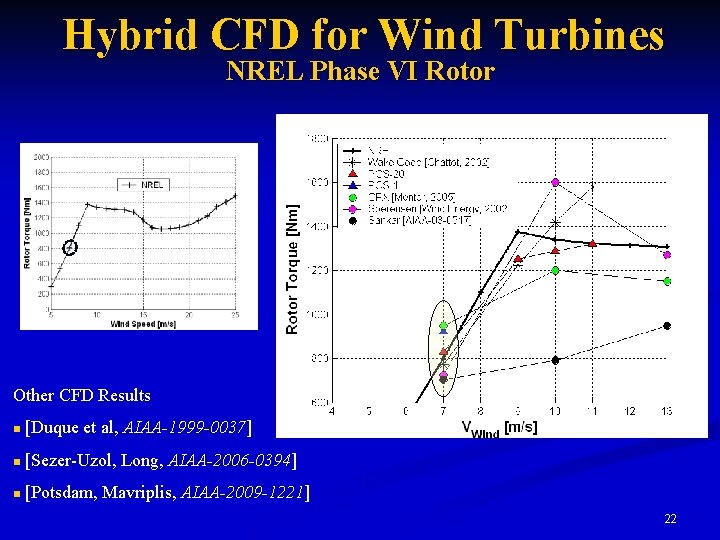
Hybrid CFD for Wind Turbines NREL Phase VI Rotor Other CFD Results n [Duque et al, AIAA-1999 -0037] n [Sezer-Uzol, Long, AIAA-2006 -0394] n [Potsdam, Mavriplis, AIAA-2009 -1221] 22
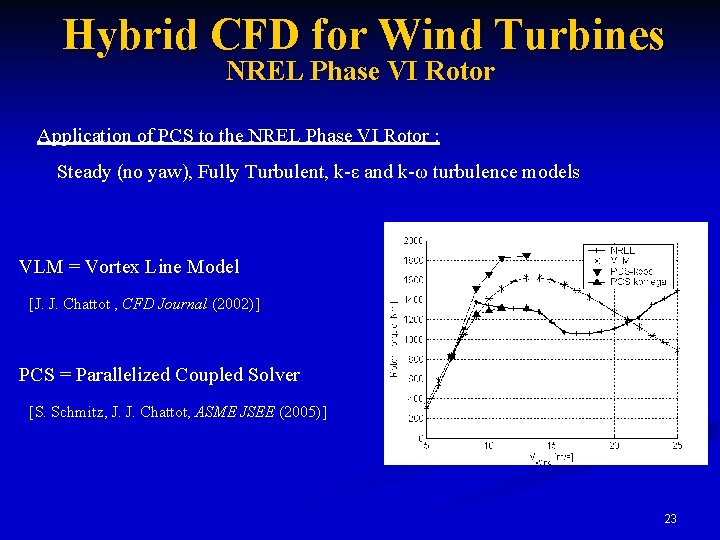
Hybrid CFD for Wind Turbines NREL Phase VI Rotor Application of PCS to the NREL Phase VI Rotor : Steady (no yaw), Fully Turbulent, k-ε and k-ω turbulence models VLM = Vortex Line Model [J. J. Chattot , CFD Journal (2002)] PCS = Parallelized Coupled Solver [S. Schmitz, J. J. Chattot, ASME JSEE (2005)] 23
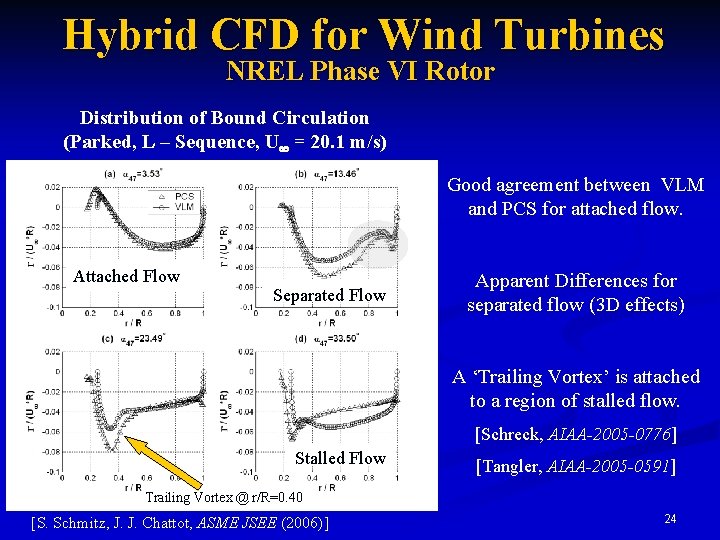
Hybrid CFD for Wind Turbines NREL Phase VI Rotor Distribution of Bound Circulation (Parked, L – Sequence, U = 20. 1 m/s) Good agreement between VLM and PCS for attached flow. Attached Flow Separated Flow Apparent Differences for separated flow (3 D effects) A ‘Trailing Vortex’ is attached to a region of stalled flow. [Schreck, AIAA-2005 -0776] Stalled Flow [Tangler, AIAA-2005 -0591] Trailing Vortex @ r/R=0. 40 [S. Schmitz, J. J. Chattot, ASME JSEE (2006)] 24
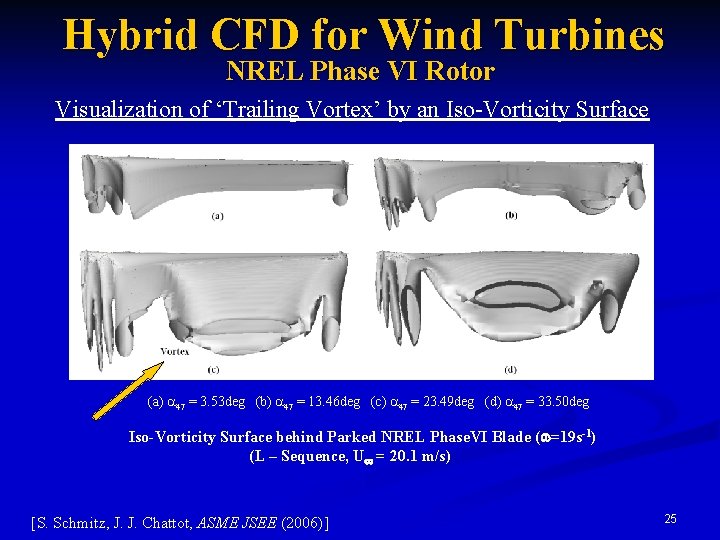
Hybrid CFD for Wind Turbines NREL Phase VI Rotor Visualization of ‘Trailing Vortex’ by an Iso-Vorticity Surface (a) a 47 = 3. 53 deg (b) a 47 = 13. 46 deg (c) a 47 = 23. 49 deg (d) a 47 = 33. 50 deg Iso-Vorticity Surface behind Parked NREL Phase. VI Blade (w=19 s-1) (L – Sequence, U = 20. 1 m/s) [S. Schmitz, J. J. Chattot, ASME JSEE (2006)] 25
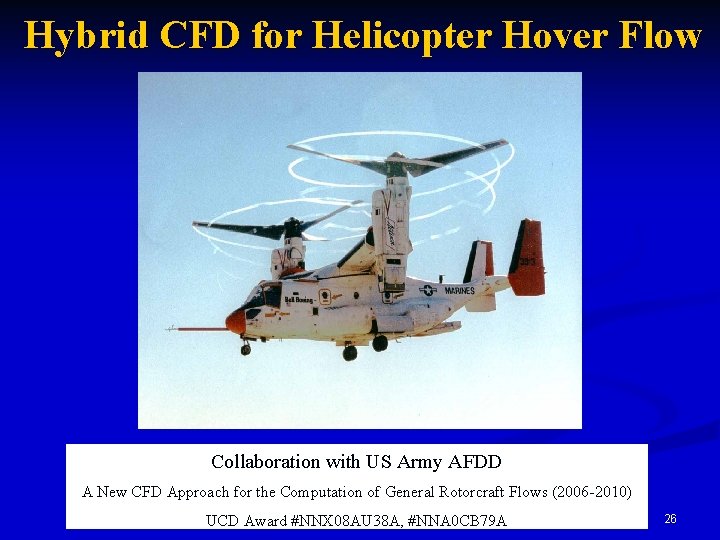
Hybrid CFD for Helicopter Hover Flow complex physics need for high accuracy a recurring engineering need Collaboration with US Army many methods developed, few AFDD validated data that supports physical models A little New CFD Approach for the Computation complete of General Rotorcraft Flows (2006 -2010) UCD Award #NNX 08 AU 38 A, #NNA 0 CB 79 A 26

Hybrid CFD for Helicopter Hover Flow Coupling UMTURNS w/ HELIX-IA i. 91 x 125 x 107 193 x 65 x 96 Typical HELIX-IA-hybrid grid topology ii. HELIX-IA provides wake structure and induced inflow. Interpolate HELIX-IA velocity to UMTURNS boundary. iii. Impose Blade Circulation from UMTURNS to HELIX-IA Wake. 27

Hybrid CFD for Helicopter Hover Flow HELIX-IA : An Iterative Eulerian- / Lagrangian Solution Process Vorticity Embedding 28

Hybrid CFD for Helicopter Hover Flow Vorticity Embedding t=p Roll Up – Vortex Sheet w/ Elliptical Loading (Qv Field) [S. Schmitz et al, AIAA-2009 -3856] 29

Hybrid CFD for Helicopter Hover Flow Vorticity Embedding t = 0. 0 Roll Up – Pair of Vortex Ring Sheets t = p/4 t = 2 p [S. Schmitz et al, AIAA-2009 -3856] 30

Hybrid CFD for Helicopter Hover Flow Validation : Model UH-60 A Blade 31

Hybrid CFD for Helicopter Hover Flow Axial/Radial Tip Vortex Trajectory Comparisons Model UH-60 A Rotor – CT/s = 0. 085, Mtip=0. 63 Radial Axial [S. Schmitz et al, AHS Journal (2009)] 32

Hybrid CFD for Helicopter Hover Flow Pressure Coefficient vs. x/c Model UH-60 A Rotor – CT/s = 0. 085, Mtip=0. 63 r/R = 0. 865 r/R = 0. 92 r/R = 0. 945 r/R = 0. 965 [S. Schmitz et al, AHS Journal (2009)] 33
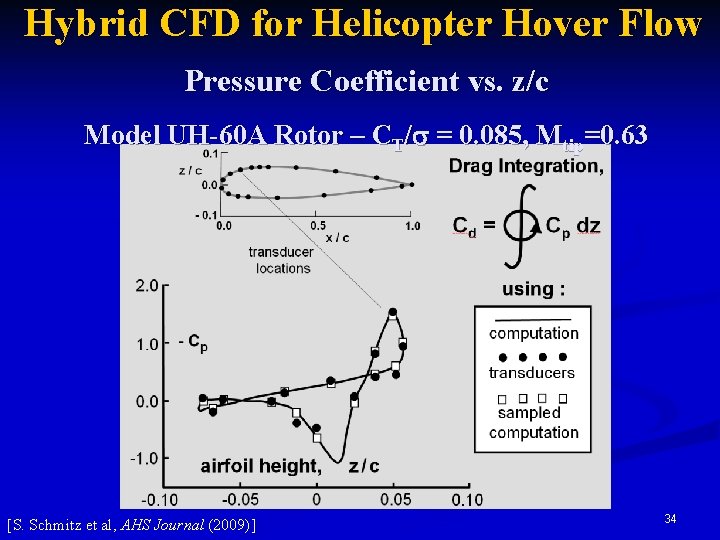
Hybrid CFD for Helicopter Hover Flow Pressure Coefficient vs. z/c Model UH-60 A Rotor – CT/s = 0. 085, Mtip=0. 63 [S. Schmitz et al, AHS Journal (2009)] 34
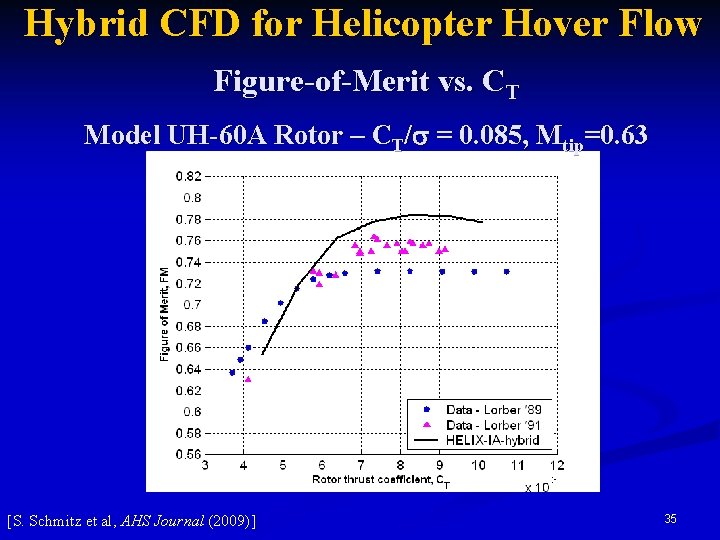
Hybrid CFD for Helicopter Hover Flow Figure-of-Merit vs. CT Model UH-60 A Rotor – CT/s = 0. 085, Mtip=0. 63 [S. Schmitz et al, AHS Journal (2009)] 35
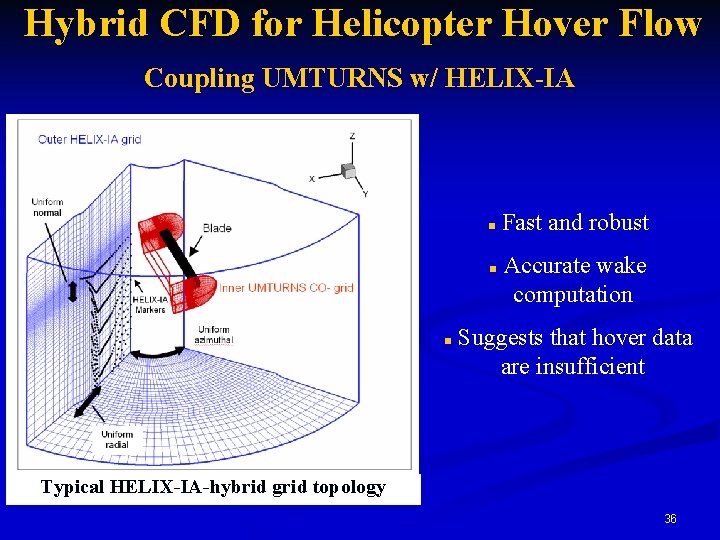
Hybrid CFD for Helicopter Hover Flow Coupling UMTURNS w/ HELIX-IA n n n Fast and robust Accurate wake computation Suggests that hover data are insufficient Typical HELIX-IA-hybrid grid topology 36
Future Research Directions Combining experiences & resources in Wind Energy and Rotorcraft HYBRID U-RANS/POTENTIAL SOLVER Outer Wake Solver n Vorticity-Embedding Potential Solver, HELIX-IA à For steady flow comparable to Biot-Savart à Possibility for efficient free wake computation Inner U-RANS Solver n Over. Flow, CFX, UMTURNS, etc. 37
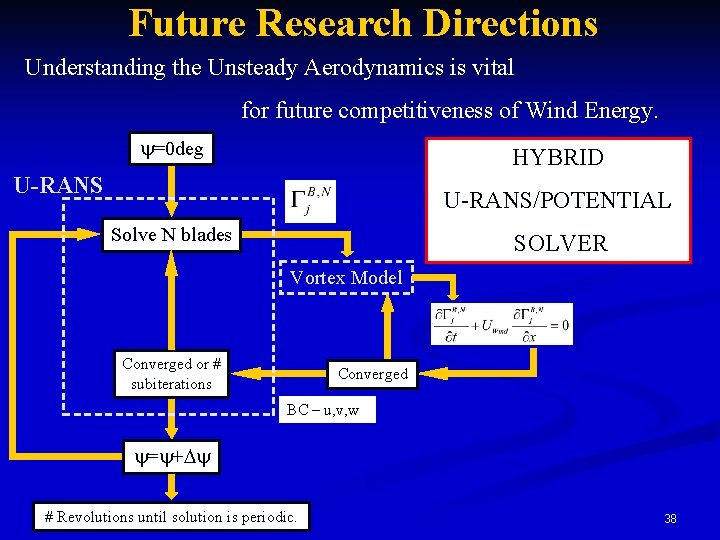
Future Research Directions Understanding the Unsteady Aerodynamics is vital for future competitiveness of Wind Energy. y=0 deg HYBRID U-RANS/POTENTIAL Solve N blades SOLVER Vortex Model Converged or # subiterations Converged BC – u, v, w y=y+Dy # Revolutions until solution is periodic. 38
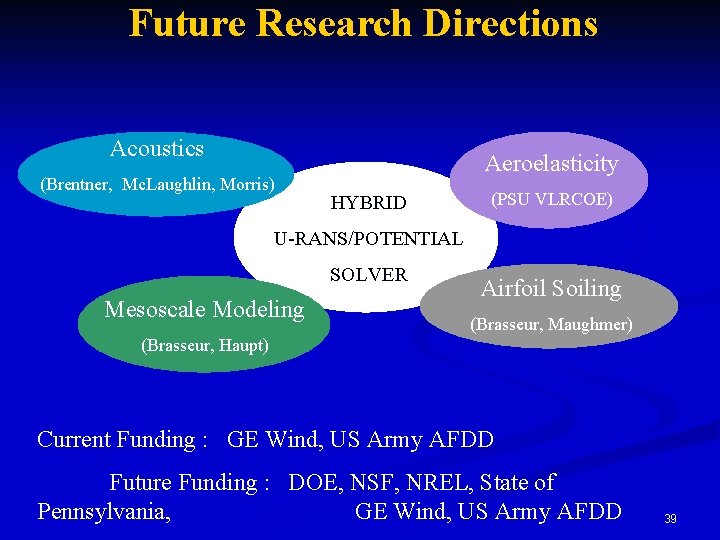
Future Research Directions Acoustics (Brentner, Mc. Laughlin, Morris) Aeroelasticity HYBRID (PSU VLRCOE) U-RANS/POTENTIAL SOLVER Mesoscale Modeling Airfoil Soiling (Brasseur, Maughmer) (Brasseur, Haupt) Current Funding : GE Wind, US Army AFDD Future Funding : DOE, NSF, NREL, State of Pennsylvania, GE Wind, US Army AFDD 39

Hybrid CFD for Wind Turbines Future fast & accurate wind turbine/plant designs Wake Interactions at ‘Horns Rev’, Denmark 40
- Slides: 40