
Computational Methods in Physics PHYS 3437 Dr Rob
Computational Methods in Physics PHYS 3437 Dr Rob Thacker Dept of Astronomy & Physics (MM-301 C) thacker@ap. smu. ca
Today’s Lecture n Numerical integration Simple rules n Romberg Integration n Gaussian quadrature n n References: Numerical Recipes has a pretty good discussion
Quadrature & interpolation n Quadrature has become a synonym for numerical integration n n All quadrature methods rely upon the interpolation of the integral function f using a class of functions n n n Primarily in 1 d, higher dimensional evaluation is sometimes dubbed cubature e. g. polynomials Utilizing the known closed form integral of the interpolated function allows simple calculation of the weights Different functions will require different quadrature algorithms n n Singular functions may require specialized Gaussian quadrature, or changes of variables Oscillating functions require simpler methods, e. g. trapezoidal rule
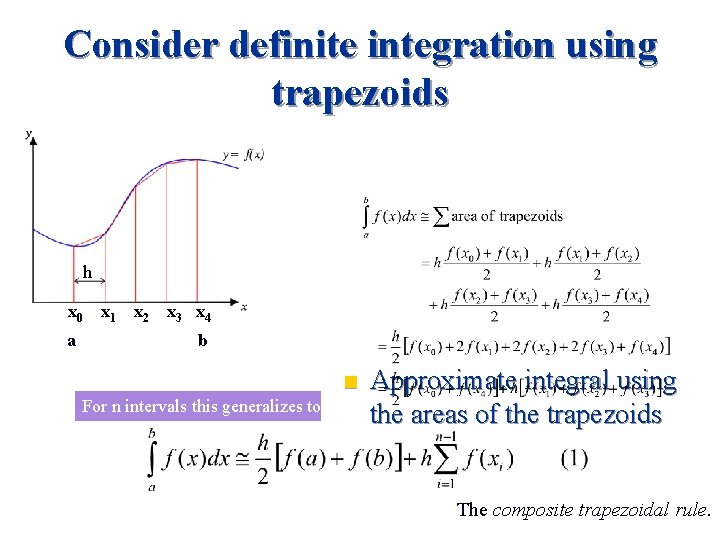
Consider definite integration using trapezoids h x 0 a x 1 Dx x 2 Dx x 3 x 4 Dx b For n intervals general formula is to n intervals this generalizes n Approximate integral using the areas of the trapezoids The composite trapezoidal rule.
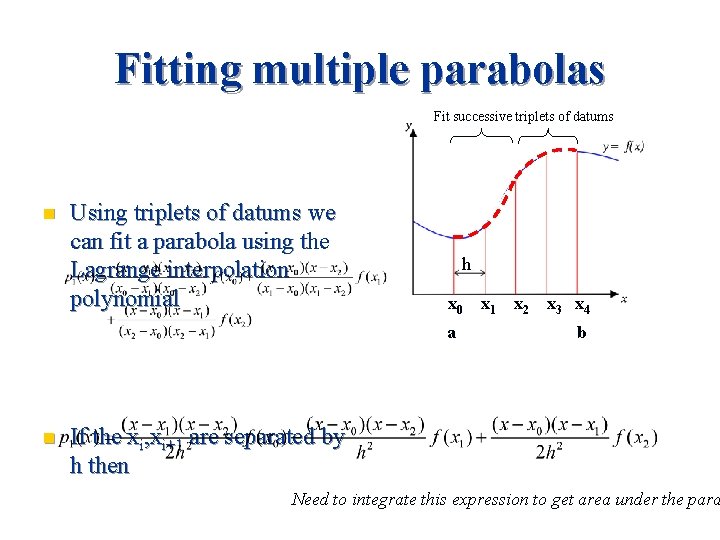
Fitting multiple parabolas Fit successive triplets of datums n Using triplets of datums we can fit a parabola using the Lagrange interpolation polynomial h x 0 a n x 1 Dx x 2 Dx x 3 x 4 Dx b If the xi, xi+1 are separated by h then Need to integrate this expression to get area under the para
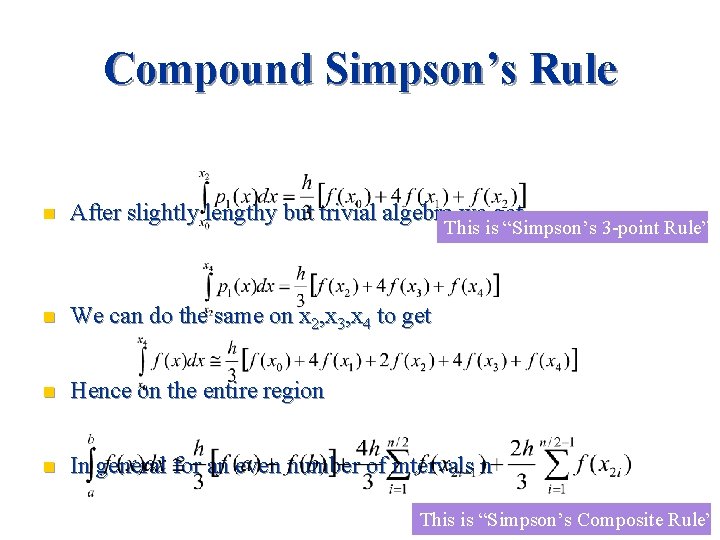
Compound Simpson’s Rule n After slightly lengthy but trivial algebra we get n We can do the same on x 2, x 3, x 4 to get n Hence on the entire region n In general for an even number of intervals n This is “Simpson’s 3 -point Rule” This is “Simpson’s Composite Rule”
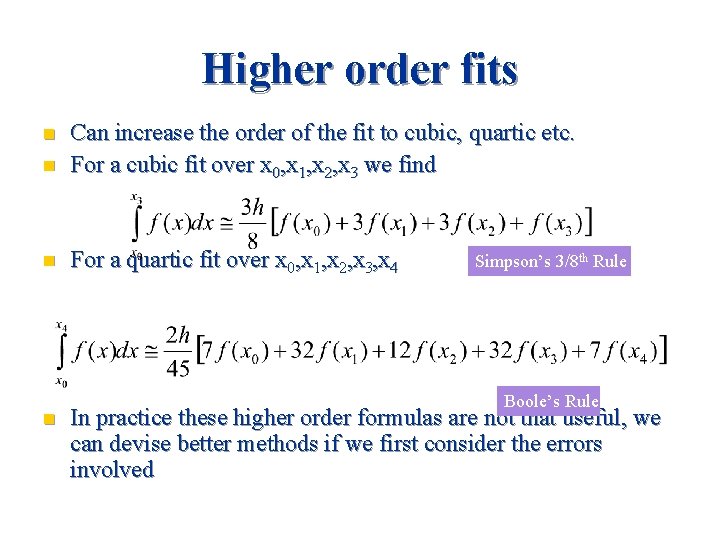
Higher order fits n Can increase the order of the fit to cubic, quartic etc. For a cubic fit over x 0, x 1, x 2, x 3 we find n For a quartic fit over x 0, x 1, x 2, x 3, x 4 n n Simpson’s 3/8 th Rule Boole’s Rule In practice these higher order formulas are not that useful, we can devise better methods if we first consider the errors involved
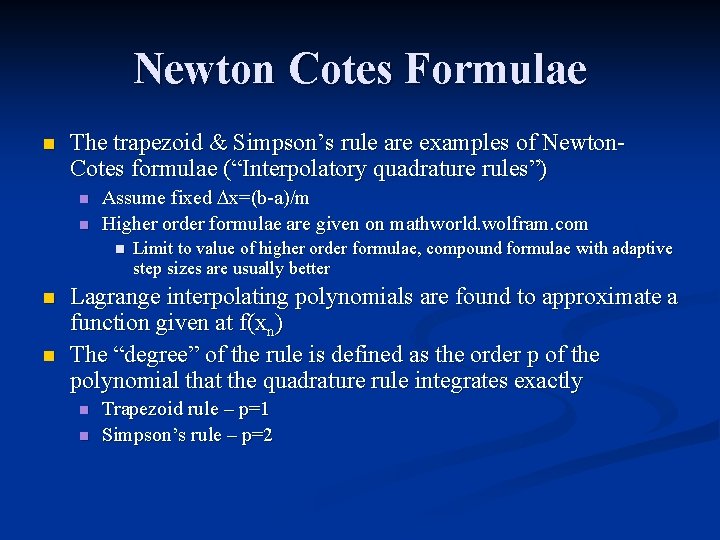
Newton Cotes Formulae n The trapezoid & Simpson’s rule are examples of Newton. Cotes formulae (“Interpolatory quadrature rules”) n n Assume fixed Dx=(b-a)/m Higher order formulae are given on mathworld. wolfram. com n n n Limit to value of higher order formulae, compound formulae with adaptive step sizes are usually better Lagrange interpolating polynomials are found to approximate a function given at f(xn) The “degree” of the rule is defined as the order p of the polynomial that the quadrature rule integrates exactly n n Trapezoid rule – p=1 Simpson’s rule – p=2
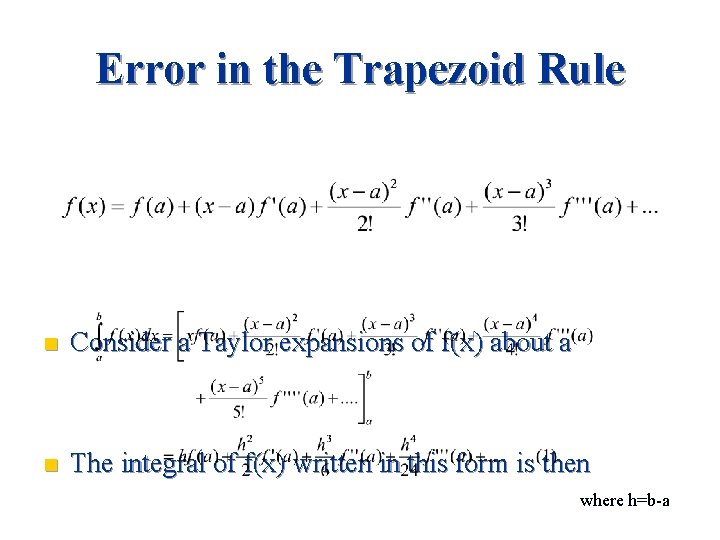
Error in the Trapezoid Rule n Consider a Taylor expansions of f(x) about a n The integral of f(x) written in this form is then where h=b-a
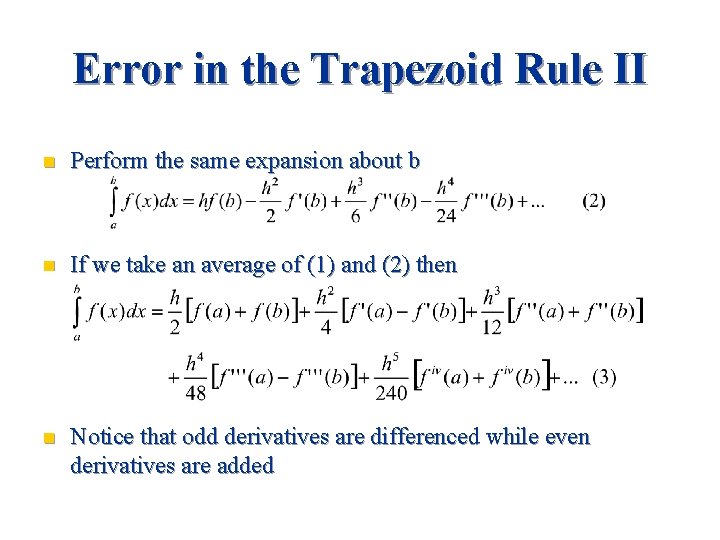
Error in the Trapezoid Rule II n Perform the same expansion about b n If we take an average of (1) and (2) then n Notice that odd derivatives are differenced while even derivatives are added
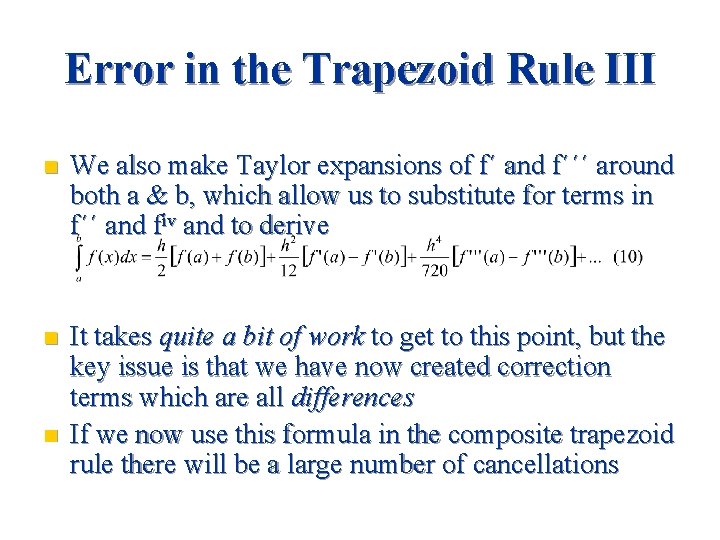
Error in the Trapezoid Rule III n We also make Taylor expansions of f´ and f´´´ around both a & b, which allow us to substitute for terms in f´´ and fiv and to derive n It takes quite a bit of work to get to this point, but the key issue is that we have now created correction terms which are all differences If we now use this formula in the composite trapezoid rule there will be a large number of cancellations n
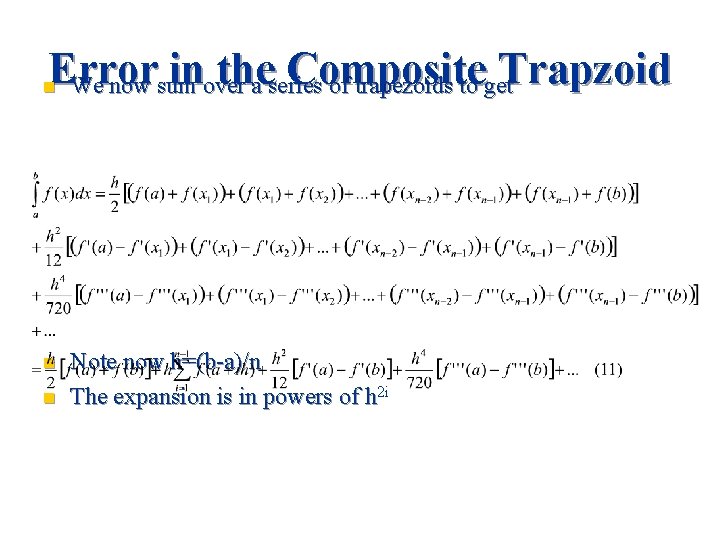
Error inover the Composite Trapzoid We now sum a series of trapezoids to get n n n Note now h=(b-a)/n The expansion is in powers of h 2 i
Euler-Maclaurin Integration rule n The formula we just derived is called the Euler. Maclaurin integration rule. It has a number of uses: n n n If the integrand is easily differentiable the correction terms can be calculated precisely We can use Richardson Extrapolation to remove the first error term and progressively produce a more accurate result If the derivatives at the end points are zero then the formula immediately tells you that the simple Trapezoid Rule gives extremely accurate results!
Richardson Extrapolation: Review n n Idea is to improve results from numerical method from order O(hk) to O(hk+1) Suppose we have a quantity A that is represented by the expansion n n Write this expansion as n n K, K’’ are unknown and represent error terms, k is a known constant (1) Note: If we drop the O(hk+1) terms we have a linear equation in A and K By reducing the step size we get another equation for A n (2) Note the O(hk+1) terms are different in each expansion
Eliminate the leading error n So we have two equations in A again: n We can eliminate K, the leading order error:
n Define B(h) as follows: n and B(h) is accurate to higher order than our previous A(h) Define the higher order accurate estimate n Then we have a new equation for A:
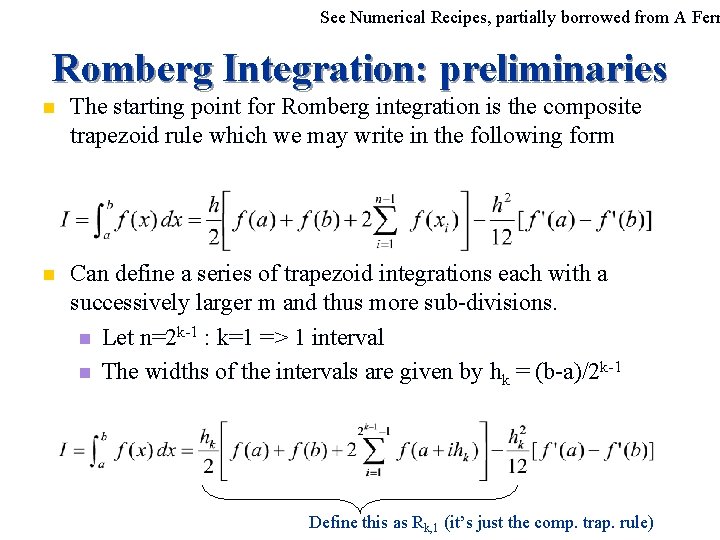
See Numerical Recipes, partially borrowed from A Ferr Romberg Integration: preliminaries n The starting point for Romberg integration is the composite trapezoid rule which we may write in the following form n Can define a series of trapezoid integrations each with a successively larger m and thus more sub-divisions. n Let n=2 k-1 : k=1 => 1 interval n The widths of the intervals are given by hk = (b-a)/2 k-1 Define this as Rk, 1 (it’s just the comp. trap. rule)
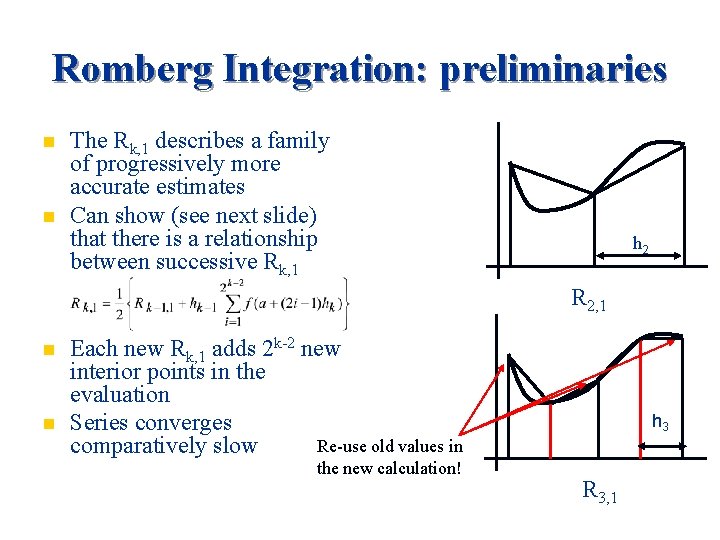
Romberg Integration: preliminaries n n The Rk, 1 describes a family of progressively more accurate estimates Can show (see next slide) that there is a relationship between successive Rk, 1 h 2 R 2, 1 n n Each new Rk, 1 adds 2 k-2 new interior points in the evaluation Series converges Re-use old values in comparatively slow the new calculation! h 3 R 3, 1
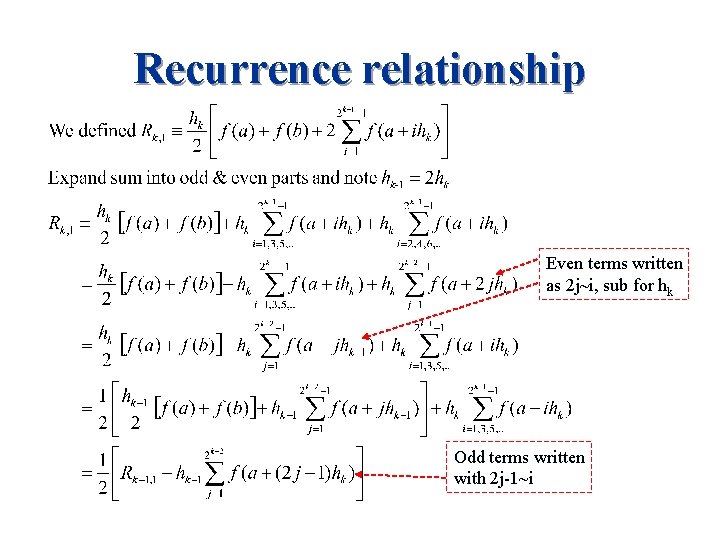
Recurrence relationship Even terms written as 2 j~i, sub for hk Odd terms written with 2 j-1~i
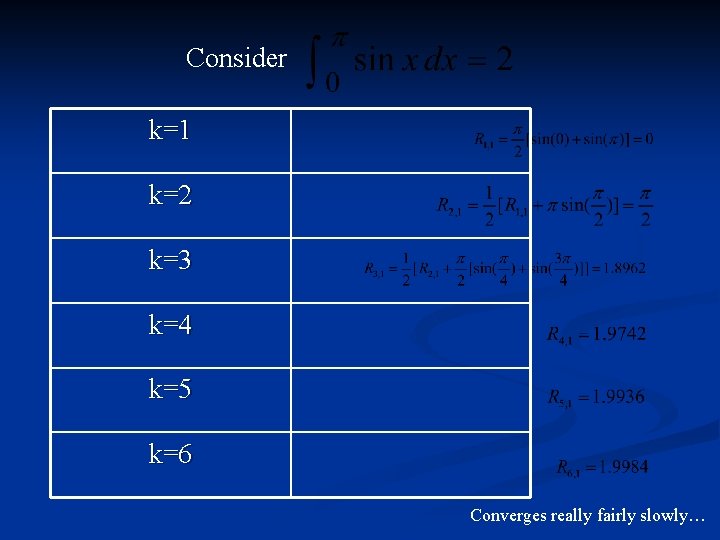
Consider k=1 k=2 k=3 k=4 k=5 k=6 Converges really fairly slowly…
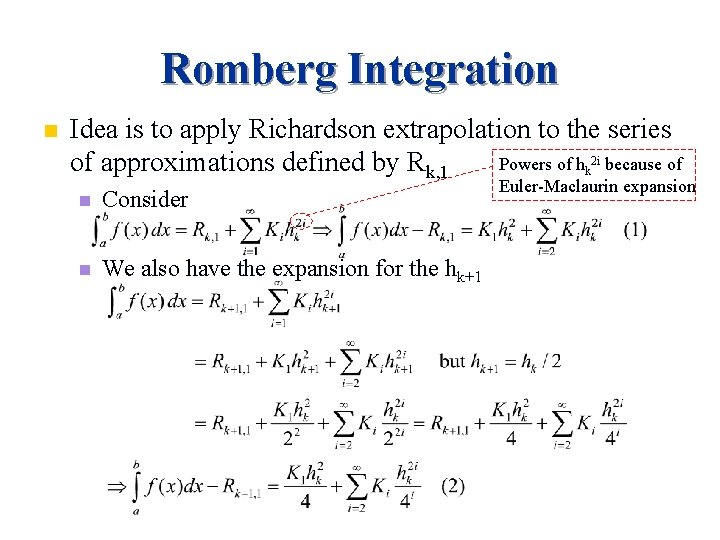
Romberg Integration n Idea is to apply Richardson extrapolation to the series Powers of hk 2 i because of of approximations defined by Rk, 1 n Consider n We also have the expansion for the hk+1 Euler-Maclaurin expansion
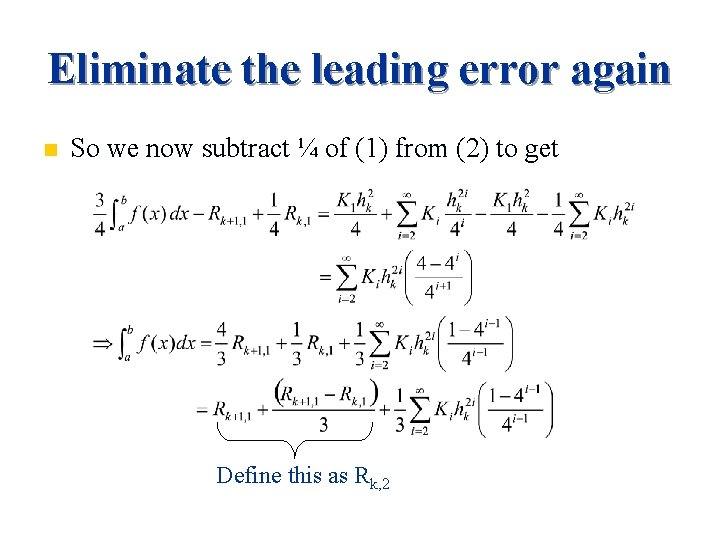
Eliminate the leading error again n So we now subtract ¼ of (1) from (2) to get Define this as Rk, 2
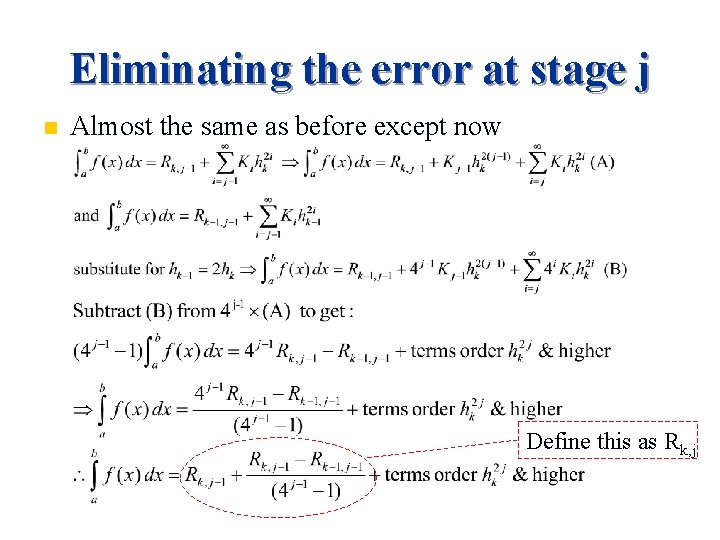
Eliminating the error at stage j n Almost the same as before except now Define this as Rk, j
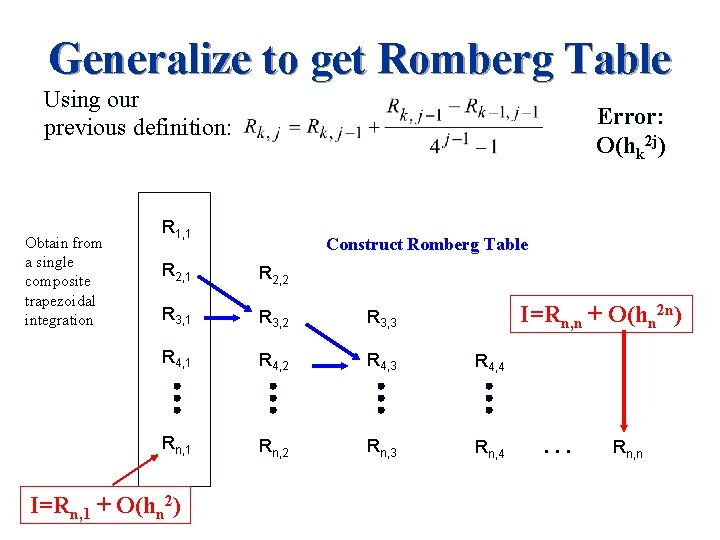
Generalize to get Romberg Table Using our previous definition: Obtain from a single composite trapezoidal integration Error: O(hk 2 j) R 1, 1 Construct Romberg Table R 2, 1 R 2, 2 R 3, 1 R 3, 2 R 3, 3 R 4, 1 R 4, 2 R 4, 3 R 4, 4 Rn, 1 Rn, 2 Rn, 3 Rn, 4 I=Rn, 1 + O(hn 2) I=Rn, n + O(hn 2 n) … Rn, n
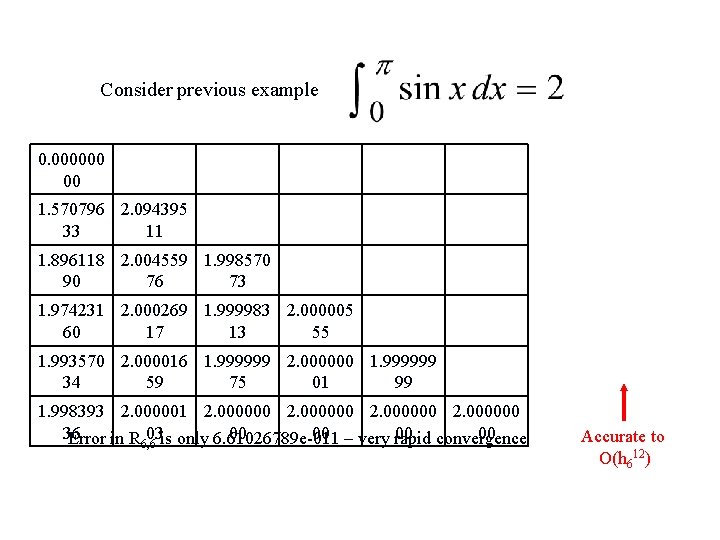
Consider previous example 0. 000000 00 1. 570796 2. 094395 33 11 1. 896118 2. 004559 1. 998570 90 76 73 1. 974231 2. 000269 1. 999983 2. 000005 60 17 13 55 1. 993570 2. 000016 1. 999999 2. 000000 1. 999999 34 59 75 01 99 1. 998393 2. 000001 2. 000000 36 03 is only 6. 61026789 e-011 00 00 – very rapid 00 convergence 00 Error in R 6, 6 Accurate to O(h 612)
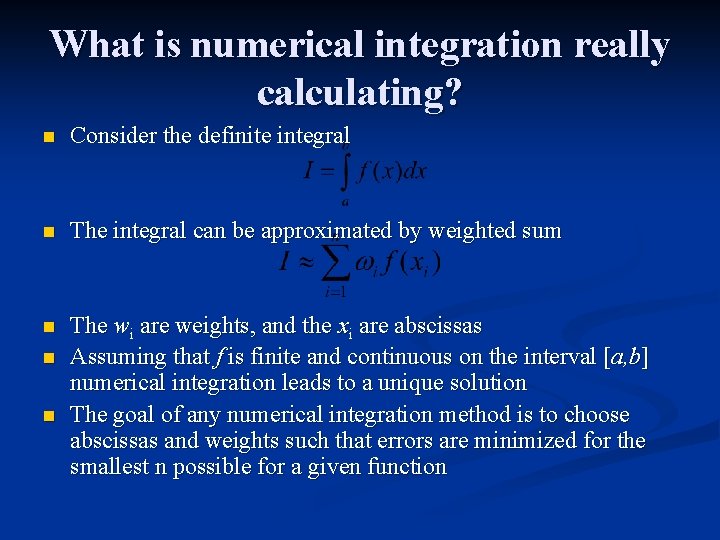
What is numerical integration really calculating? n Consider the definite integral n The integral can be approximated by weighted sum n The wi are weights, and the xi are abscissas Assuming that f is finite and continuous on the interval [a, b] numerical integration leads to a unique solution The goal of any numerical integration method is to choose abscissas and weights such that errors are minimized for the smallest n possible for a given function n n
NON EXAMINABLE See Numerical Recipes for a lengthy discussion Gaussian Quadrature n n n Thus far we have considered regular spaced abscissas, although we have considered the possibility of adapting spacing We’ve also looked solely at closed interval formulas Gaussian quadrature achieves high accuracy and efficiency by optimally selecting the abscissas It is usual to apply a change of variables to make the integral map to [-1, 1] There also a number of different families of Gaussian quadrature, we’ll look at Gauss-Legendre Let’s look at a related example first
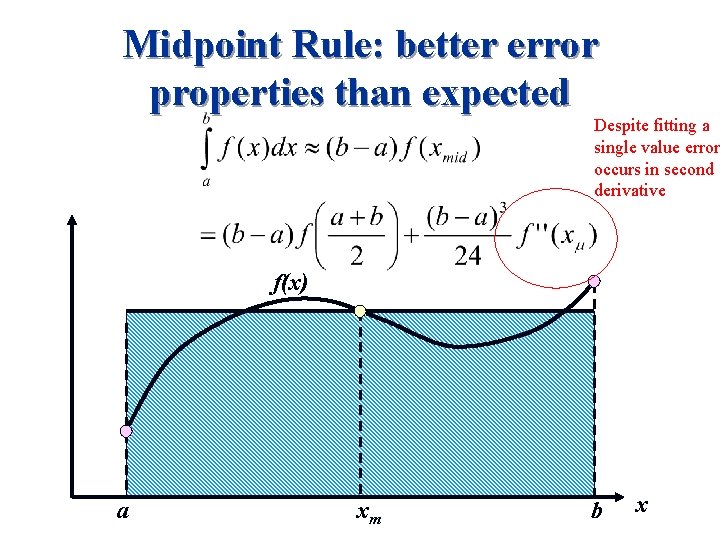
Midpoint Rule: better error properties than expected Despite fitting a single value error occurs in second derivative f(x) a xm b x
![Coordinate transformation on to [1, 1] n The transformation is a simple linear mapping](http://slidetodoc.com/presentation_image_h2/ceb892ad17d5a59746503b534ed6fe91/image-29.jpg "Coordinate transformation on to [1, 1] n The transformation is a simple linear mapping")
Coordinate transformation on to [1, 1] n The transformation is a simple linear mapping a t 1 t 2 b
![Gaussian Quadrature on [-1, 1] Recall the original series approximation Consider, n=2, then we](http://slidetodoc.com/presentation_image_h2/ceb892ad17d5a59746503b534ed6fe91/image-30.jpg "Gaussian Quadrature on [-1, 1] Recall the original series approximation Consider, n=2, then we")
Gaussian Quadrature on [-1, 1] Recall the original series approximation Consider, n=2, then we have -1 n x 1 x 2 1 We have 4 unknowns, c 1, c 2, x 1, x 2, so we can choose these values to yield exact integrals for f(x)=x 0, x, x 2, x 3
![Gaussian Quadrature on [-1, 1] Evaluate the integrals for f = x 0, x](http://slidetodoc.com/presentation_image_h2/ceb892ad17d5a59746503b534ed6fe91/image-31.jpg "Gaussian Quadrature on [-1, 1] Evaluate the integrals for f = x 0, x")
Gaussian Quadrature on [-1, 1] Evaluate the integrals for f = x 0, x 1, x 2, x 3 n Yields four equations for the four unknowns
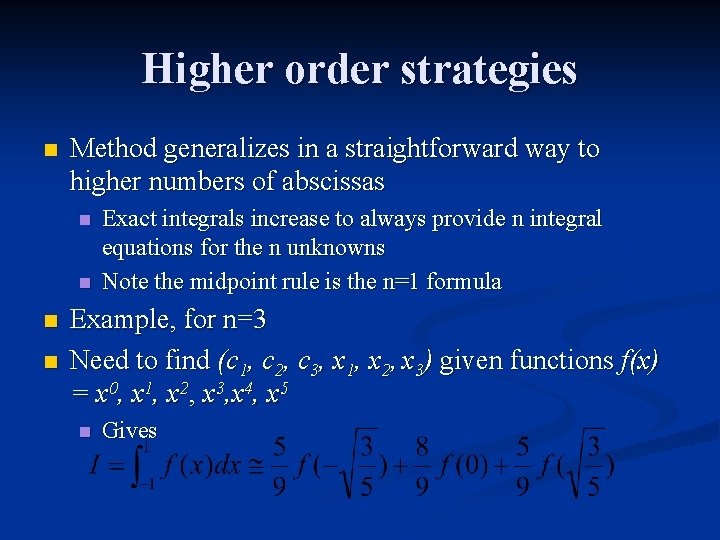
Higher order strategies n Method generalizes in a straightforward way to higher numbers of abscissas n n Exact integrals increase to always provide n integral equations for the n unknowns Note the midpoint rule is the n=1 formula Example, for n=3 Need to find (c 1, c 2, c 3, x 1, x 2, x 3) given functions f(x) = x 0, x 1, x 2, x 3, x 4, x 5 n Gives
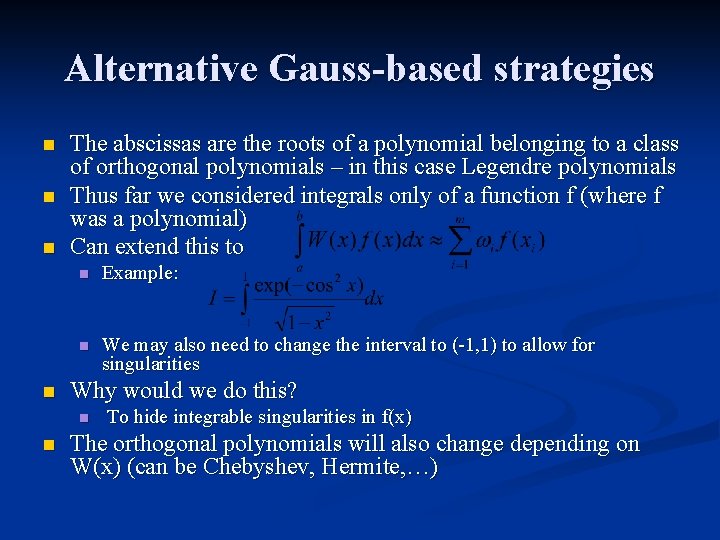
Alternative Gauss-based strategies n n The abscissas are the roots of a polynomial belonging to a class of orthogonal polynomials – in this case Legendre polynomials Thus far we considered integrals only of a function f (where f was a polynomial) Can extend this to n Example: n We may also need to change the interval to (-1, 1) to allow for singularities Why would we do this? n n To hide integrable singularities in f(x) The orthogonal polynomials will also change depending on W(x) (can be Chebyshev, Hermite, …)
Summary n Low order Newton-Cotes formulae have comparatively slow convergence properties n n n Applying Richardson Extrapolation to the compound trapezoid rule gives Romberg Integration n n Higher order methods have better convergence properties but can suffer from numerical instabilities High order ≠ high accuracy Very good convergence properties for a simple method Gaussian quadrature, and related methods, show good stability and are computationally efficient n Implemented in many numerical libraries
Next lecture n Numerical integration problems Using changes of variable n Dealing with singularities n n Multidimensional integration
- Slides: 35