
Computational Methods for Kinetic Processes in Plasma Physics






















- Slides: 60
Computational Methods for Kinetic Processes in Plasma Physics Ken Nishikawa National Space Science & Technology Center/UAH Over views: Simulation methods Macroscopic and Microscopic Processes August 23, 2011 1/39
Context 1. 2. 3. 4. 5. Brief history of PIC simulations Introduction Basic structures of 3 D RPIC code Basic structures of 3 D GRMHD code Summary and Future Improvements
Brief history of PIC simulations In late 1950 s John Dawson began 1 D electrostatic “charge-sheet” experiments at Princeton, later at UCLA. 1965 Hockney, Buneman -- introduced grids and direct Poisson solver 1970 -s theory of electrostatic PIC developed (Langdon) First electromagnetic codes 1980 s-90 s 3 D EM PIC takes off (Dawson, Rev. Modern Physics, 1983) “PIC text books” come out in 1988 and 1990 Integrated circuit doubles ~ every two years (Moore’s law)
Experiments Simulations Nonlinear phenomena PIC MHD Hybrid Vlasov Plasma Physics Applications Particle acceleration Instabilities Radiation Anomalous resistivity Reconnection Relativistic jets Theory Linear Quasi-linear
Magnetic field in the Universe Magnetic and gravitational fields play a important role in determining the evolution of the matter in many astrophysical objects Magnetic field can be amplified by the gas contraction or shear motion. Even when the magnetic field is weak initially, the magnetic field glows in the short time scale and influences gas dynamics of the system
Plasmas in the Universe The major constituents of the universe are made of plasmas. When the temperature of gas is more than 104 K, the gas becomes fully ionized plasmas (4 th phase of matter). Plasmas are applied to many astrophysical phenomena. Plasmas are treated in several ways particle-in-cell (PIC) (microscopic) magnetohydrodynamics, MHD (macroscopic) (not covered) hybrid (fluid electron and kinetic ions) (not covered) MHD with test particles (fluid mixed with particles) (not covered) particles with photons (not covered)
3 D Relativistic particle-in-cell code Kinetic processes are included in this code Particle acceleration can be investigated Calculation of radiation can be calculated Simulation system size is limited due to necessity of resolving Debye length (Skin depth) Global dynamics of plasma such as large jets cannot be simulated This simulation method is complimentary to MHD method which will be described briefly later
Collisionless plasma can be described by Vlasov-Maxwell equations with distribution function f(x, v, t) (6 dimensions): Direct calculation of this set of equations – 6 D Improvements have been made, but difficult to calculate using this method
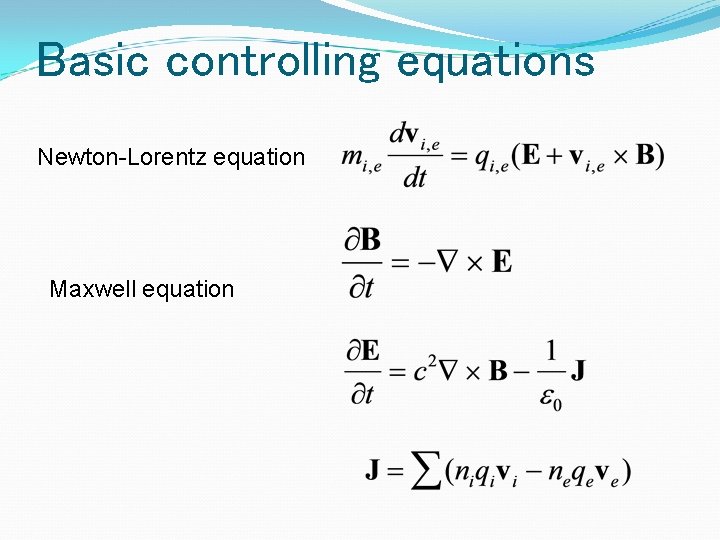
Basic controlling equations Newton-Lorentz equation Maxwell equation
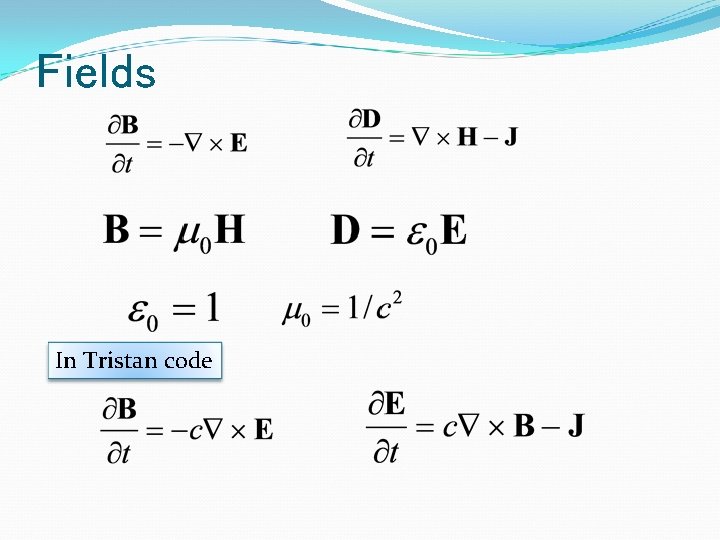
Fields In Tristan code
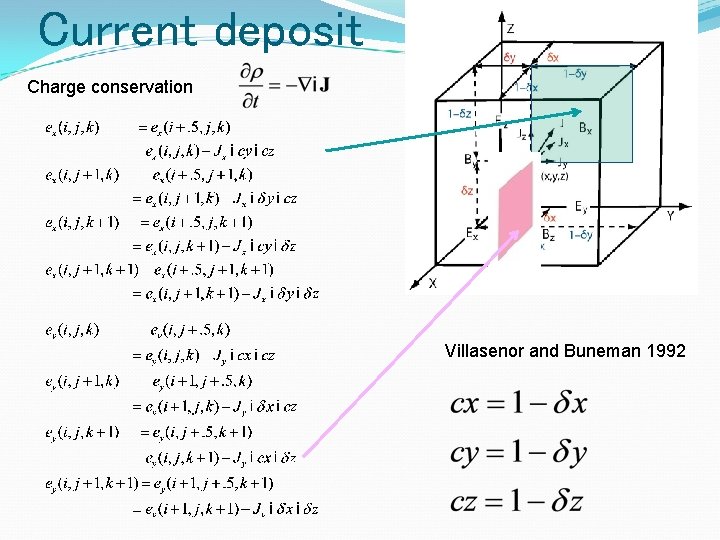
Two major methods of calculating current 1. Spectral method (UPIC code) (note by Decyk) We will review this method in details later after we do handout exercises 2. Charge-conserving current deposit (Villasenor & Buneman 1992) We will review this method with Umeda’s method later
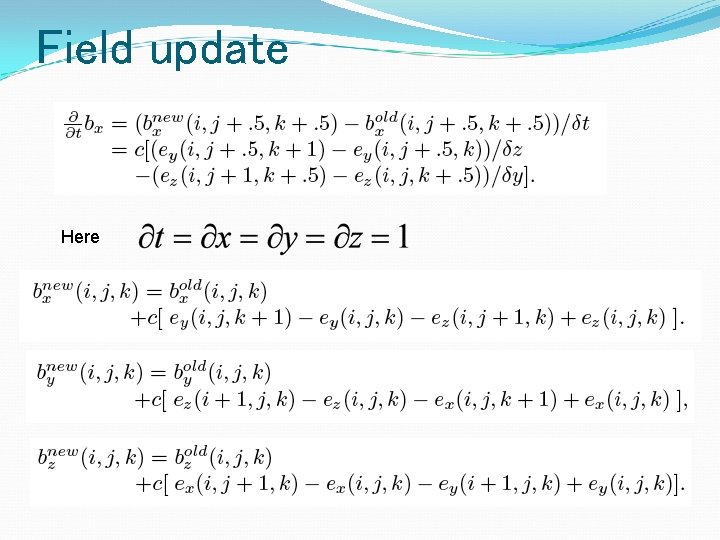
Ampere equation In Yee Lattice ex, ey, ez, bx, by, bz are, respectively staggered and shifted on 0. 5 from (I, j, k) and located at the position Yee lattice
Field update Here
Electric field update
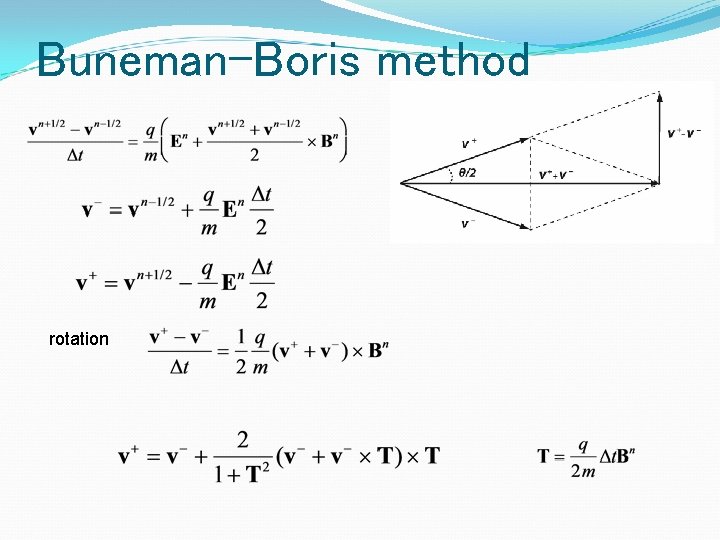
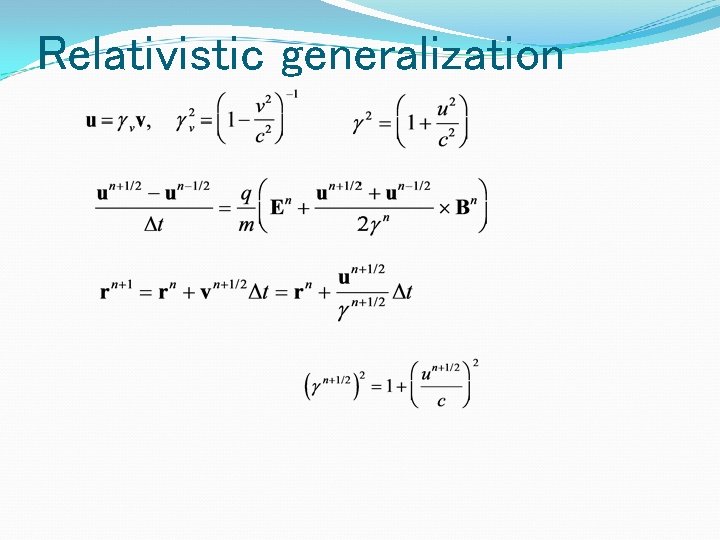
Particle update Newton-Lorentz equation Buneman-Boris method Half an electric acceleration Pure magnetic rotation Another half electric acceleration
Buneman-Boris method rotation
Buneman-Boris method (cont) 4 steps
Relativistic generalization
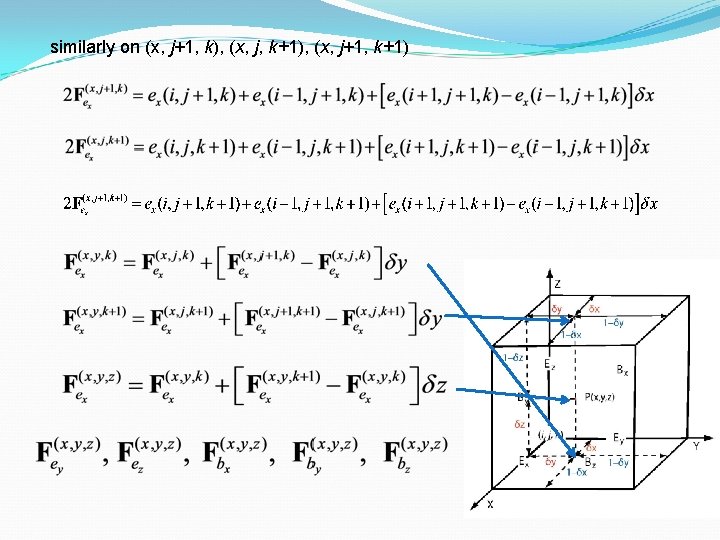
Force interpretations “volume” weight on (x, j, k)
similarly on (x, j+1, k), (x, j, k+1), (x, j+1, k+1)
Current deposit scheme (2 -D) y x
Current deposit Charge conservation Villasenor and Buneman 1992
Schematic computational cycle (Cai et al. 2006)
Time evolution of RPIC code
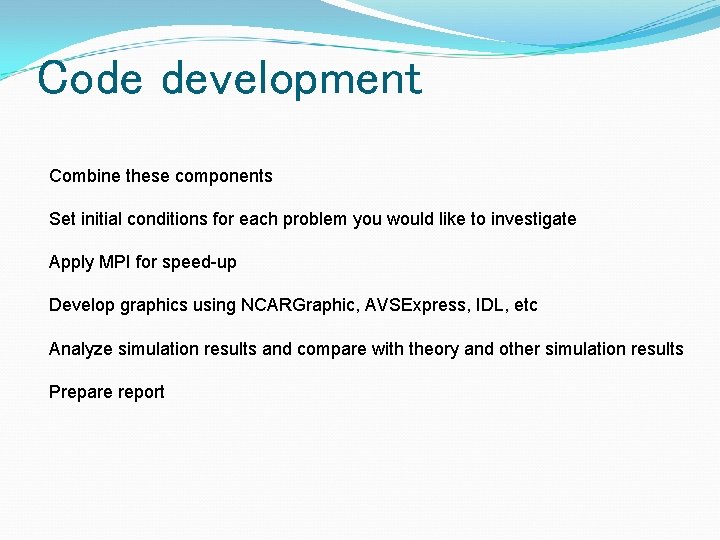
Code development Combine these components Set initial conditions for each problem you would like to investigate Apply MPI for speed-up Develop graphics using NCARGraphic, AVSExpress, IDL, etc Analyze simulation results and compare with theory and other simulation results Prepare report
Relativistic MHD Simulations of Relativistic Jets Yosuke Mizuno National Space Science and Technology Center (NSSTC) Center for Space Plasma and Aeronomic Research/ The University of Alabama in Huntsville Co-authors and active collaborators: M. Takahashi (Aichi Univ. of Edu. ), K. Shibata (Kwasan Obs/Kyoto Univ. ), S. Yamada (Waseda Univ. ), S. Koide (Kumamoto Univ. ), S. Nagataki (Kyoto Univ. /YITP), K. -I. Nishikawa (NSSTC/UAH), P. Hardee (Univ. of Alabama), G. J. Fishiman (NSSTC/NASA-MSFC), D. H. Hartmann (Clemson Univ. ), B. Zhang (UNLV), D. Proga (UNLV), S. V. Fuerst (Stanford Univ. ), K. Wu (UCL), Y. Lyubarsky (Ben-Gurion Univ. ), K. Ghosh (NSSTC), C. Fendt (MPIA), P. Coppi (Yele Univ. ), P. Biermann (MPIf. R)
1. Development of 3 D GRMHD Code “RAISHIN” This section is only showing the differences between RPIC and RMHD (not covered in this course) Mizuno et al. 2006 a, Astro-ph/0609004
Numerical Approach to Relativistic MHD RHD: reviews Marti & Muller (2003) and Fonts (2003) SRMHD: many authors Application: relativistic Riemann problems, relativistic jet propagation, jet stability, pulsar wind nebule, etc. GRMHD Fixed spacetime (Koide, Shibata & Kudoh 1998; De Villiers & Hawley 2003; Gammie, Mc. Kinney & Toth 2003; Komissarov 2004; Anton et al. 2005; Annios, Fragile & Salmonson 2005; Del Zanna et al. 2007) Application: The structure of accretion flows onto black hole and/or formation of jets, BZ process near rotating black hole, the formation of GRB jets in collapsars etc. Dynamical spacetime (Duez et al. 2005; Shibata & Sekiguchi 2005; Anderson et al. 2006; Giacomazzo & Rezzolla 2007 )
Propose to Make a New GRMHD Code The Koide’s GRMHD Code (Koide, Shibata & Kudoh 1999; Koide 2003) has been applied to many high-energy astrophysical phenomena and showed pioneering results. However, the code can not perform calculation in highly relativistic ( >5) or highly magnetized regimes. The critical problem of the Koide’s GRMHD code is the schemes can not guarantee to maintain divergence free magnetic field. In order to improve these numerical difficulties, we have developed a new 3 D GRMHD code RAISHIN (Rel. At. Ivi. Stic magneto. Hydrodynamc s. Imulatio. N, RAISHIN is the Japanese ancient god of lightning).
4 D General Relativistic MHD Equation General relativistic equation of conservation laws and Maxwell equations: ∇n ( r U n ) = 0 ∇n T mn = 0 (conservation law of particle-number) (conservation law of energy-momentum) ∂m. Fnl + ∂ n. Flm + ∂ l. F mn = 0 ∇m. F mn =-J Ideal MHD condition: n (Maxwell equations) Fnm. Un = 0 metric: ds 2=gmndxmdxn Equation of state : p=(G-1) u r : rest-mass density. p : proper gas pressure. u: internal energy. c: speed of light. h : specific enthalpy, h =1 + u + p / r. G: specific heat ratio. Umu : velocity four vector. Jmu : current density four vector. ∇mn : covariant derivative. gmn : 4 -metric, Tmn : energy momentum tensor, Tmn = r h Um Un+pgmn+Fms. Fns -gmn. Flk/4. Fmn : field-strength tensor,
Conservative Form of GRMHD Equations (3+1 Form) a: lapse function, bi: shift vector, gij: 3 -metric Metric: (Particle number conservation) (Momentum conservation) (Energy conservation) (Induction equation) U (conserved variables) Fi (numerical flux) S (source term) √-g : determinant of 4 -metric √g : determinant of 3 -metric Detail of derivation of GRMHD equations Anton et al. (2005) etc.
New 3 D GRMHD Code “RAISHIN” Mizuno et al. (2006) RAISHIN utilizes conservative, high-resolution shock capturing schemes (Godunov-type scheme) to solve the 3 D general relativistic MHD equations (metric is static) Ability of RAISHIN code Multi-dimension (1 D, 2 D, 3 D) Special (Minkowski spcetime) and General relativity (static metric; Schwarzschild or Kerr spacetime) Different coordinates (RMHD: Cartesian, Cylindrical, Spherical and GRMHD: Boyer-Lindquist of non-rotating or rotating BH) Use several numerical methods to solving each problem Maintain divergence-free magnetic field by numerically Use constant Gamma-law or variable equation of states Parallelized by Open MP
Detailed Features of the Numerical Schemes Mizuno et al. 2006 a, astro-ph/0609004 RAISHIN utilizes conservative, high-resolution shock capturing schemes (Godunov-type scheme) to solve the 3 D GRMHD equations (metric is static) * Reconstruction: PLM (Minmod & MC slope-limiter function), convex ENO, PPM * Riemann solver: HLL, HLLC approximate Riemann solver * Constrained Transport: Flux interpolated constrained transport scheme * Time evolution: Multi-step Runge-Kutta method (2 nd & 3 rd-order) * Recovery step: Koide 2 variable method, Noble 2 variable method, Mignore-Mc. Kinney 1 variable method
Relativistic MHD Shock-Tube Tests Exact solution: Giacomazzo & Rezzolla (2006)
Relativistic MHD Shock-Tube Tests Balsara Test 1 (Balsara 2001) FR SR SS FR CD Black: exact solution, Blue: MC-limiter, Light blue: minmod-limiter, Orange: CENO, red: PPM 400 computational zones • The results show good agreement of the exact solution calculated by Giacommazo & Rezzolla (2006). • Minmod slope-limiter and CENO reconstructions are more diffusive than the MC slopelimiter and PPM reconstructions. • Although MC slope limiter and PPM reconstructions can resolve the discontinuities sharply, some small oscillations are seen at the discontinuities.
Relativistic MHD Shock-Tube Tests KO MC Min CENO PPM • Komissarov: Shock Tube Test 1 △ ○ ○ (large P) • Komissarov: Collision Test × ○ ○ (large g) • Balsara Test 1(Brio & Wu) ○ ○ ○ • Balsara Test 2 × ○ ○ (large P & B) • Balsara Test 3 × ○ ○ (large g) • Balsara Test 4 × ○ ○ (large P & B) • Balsara Test 5 ○ ○ ○ • Generic Alfven Test ○ ○ ○
Applicability of Hydrodynamic Approximation To apply hydrodynamic approximation, we need the condition: Spatial scale >> mean free path Time scale >> collision time These are not necessarily satisfied in many astrophysical plasmas E. g. , solar corona, galactic halo, cluster of galaxies etc. But in plasmas with magnetic field, the effective mean free path is given by the ion Larmor radius. Hence if the size of phenomenon is much larger than the ion Larmor radius, hydrodynamic approximation can be used.
Applicability of MHD Approximation MHD describe macroscopic behavior of plasmas if Spatial scale >> ion Larmor radius Time scale >> ion Larmor period But MHD can not treat Particle acceleration Origin of resistivity Electromagnetic waves
Basics of Numerical RMHD Code Non-conservative form (De Villier & Hawley (2003), Anninos et al. (2005)) U=U(P) - conserved variables, P – primitive variables F- numerical flux of U where Merit: • they solve the internal energy equation rather than energy equation. → advantage in regions where the internal energy small compared to total energy (such as supersonic flow) • Recover of primitive variables are fairly straightforward Demerit: • It can not applied high resolution shock-capturing method and artificial viscosity must be used for handling discontinuities
Basics of Numerical RMHD Code Conservative form (Koide et al. (1999), Kommisarov (2001), Gammie et al (2003), Anton et al. (2004), Duez et al. (2005), Shibata & Sekiguchi (2005) etc) System of Conservation Equations U=U(P) - conserved variables, P – primitive variables F- numerical flux of U, S - source of U Merit: • High resolution shock-capturing method can be applied to GRMHD equations Demerit: • These schemes must recover primitive variables P by numerically solving the system of equations after each step (because the schemes evolve conservative variables U)
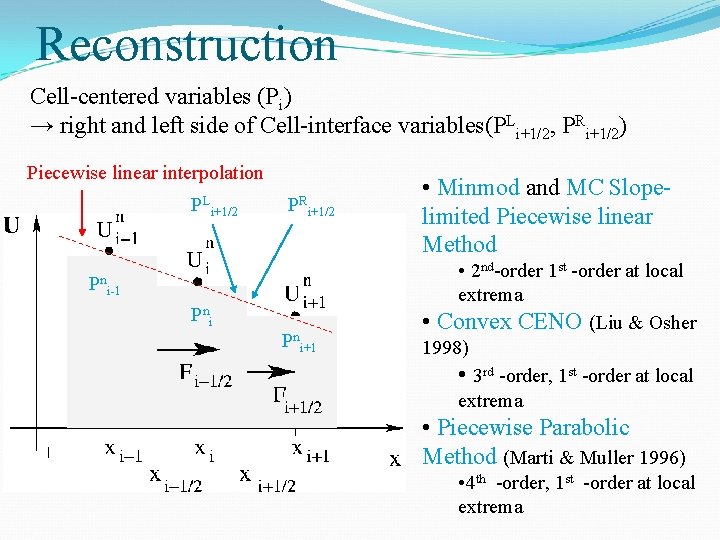
Reconstruction Cell-centered variables (Pi) → right and left side of Cell-interface variables(PLi+1/2, PRi+1/2) Piecewise linear interpolation PL i+1/2 PRi+1/2 • Minmod and MC Slopelimited Piecewise linear Method Pni+1 • 2 nd-order 1 st -order at local extrema • Convex CENO (Liu & Osher 1998) • 3 rd -order, 1 st -order at local extrema Pni-1 Pn i • Piecewise Parabolic Method (Marti & Muller 1996) • 4 th -order, 1 st -order at local extrema
Piecewise Linear Method Reconstructed cell-interface variables Slope-limiter flunction Minmod function Monotonized Centeral (MC) function
Piecewise Parabolic Method • 1 st Step: interpolation • quartic polynomial interpolation determined by the five zone-averaged values. • 2 nd Step: contact steepening • slightly modified to produce narrower profiles in the vicinity of a contact discontinuity • 3 rd Step: Flattening • near strong shocks the order of the method is reduced locally to avoid spurious postshock oscillations • 4 th Step: Monotonization • monotonize by the interpolation parabola between smooth and shock region
HLL Approximate Riemann Solver • Calculate numerical flux at cell-inteface from reconstructed cell -interface variables based on Riemann problem • We use HLL approximate Riemann solver • Need only the maximum left- and right- going wave speeds (in MHD case, fast mode) HLL flux FR=F(PR), FL=F(PL); UR=U(PR), UL=U(PL) SR=max(0, c+R, c+L); SL=max(0, c-R, c-L) If SL >0 FHLL=FL SL < 0 < SR , FHLL=FM SR < 0 FHLL=FR
HLLC Approximate Riemann Solver Mignore & Bodo (2006) • HLL Approximate Riemann solver: single state in Riemann fan • HLLC Approximate Riemann solver: two-state in Riemann fan HLLC
Constrained Transport Differential Equations - The evolution equation can keep divergence free magnetic field • If treat the induction equation as all other conservation laws, it can not maintain divergence free magnetic field → We need spatial treatment for magnetic field evolution Constrained transport method • Evans & Hawley’s Constrained Transport (Komissarov (1999, 2002, 2004), de Villiers & Hawley (2003), Del Zanna et al. (2003), Anton et al. (2005)) • Toth’s constrained transport (Gammie et al. (2003), Duez et al. (2005)) • Diffusive cleaning (Annios et al. (2005))
Constrained Transport (Toth 2000) 2 D case Use the “modified flux” f that is such a linear combination of normal fluxes at neighbouring interfaces that the “corner-centred” numerical k+1/2 representation of div. B is kept invariant during integration. j-1/2 j+1/2 k-1/2
Constrained Transport (Toth 2000)
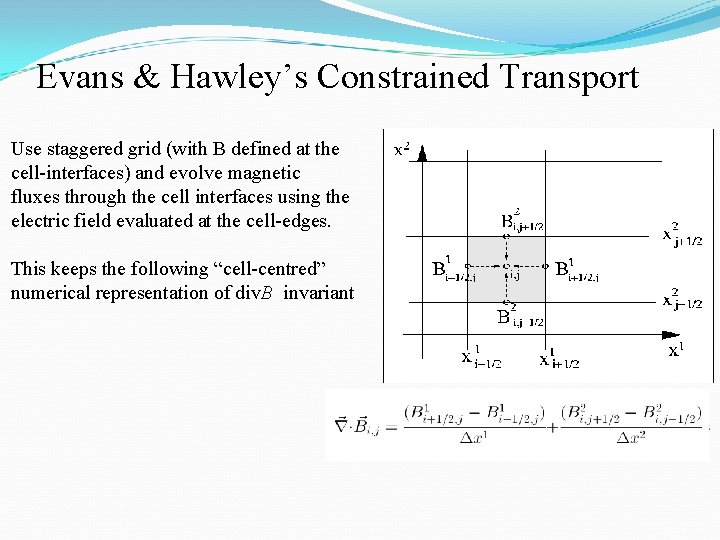
Evans & Hawley’s Constrained Transport Use staggered grid (with B defined at the cell-interfaces) and evolve magnetic fluxes through the cell interfaces using the electric field evaluated at the cell-edges. This keeps the following “cell-centred” numerical representation of div. B invariant
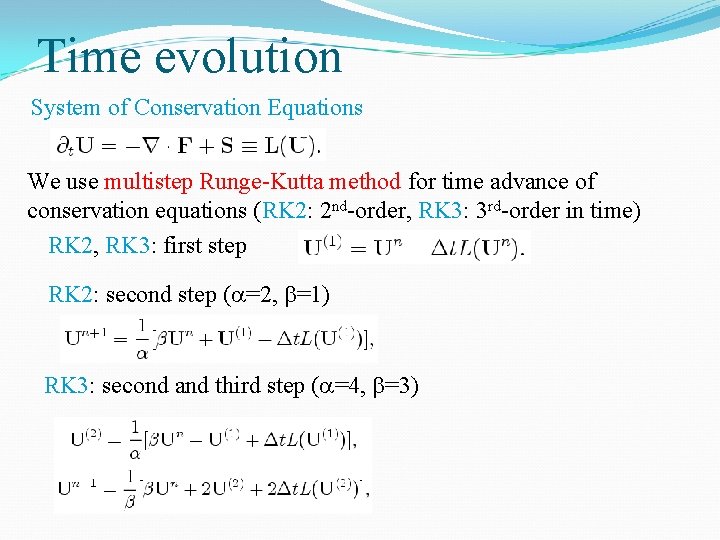
Time evolution System of Conservation Equations We use multistep Runge-Kutta method for time advance of conservation equations (RK 2: 2 nd-order, RK 3: 3 rd-order in time) RK 2, RK 3: first step RK 2: second step (a=2, b=1) RK 3: second and third step (a=4, b=3)
Recovery step The GRMHD code require a calculation of primitive variables from conservative variables. The forward transformation (primitive → conserved) has a close-form solution, but the inverse transformation (conserved → primitive) requires the solution of a set of five nonlinear equations Method Koide’s 2 D method (Koide, Shibata & Kudoh 1999) Noble’s 2 D method (Noble et al. 2005)
Recovery step (Koide’s 2 D method) Conserved quantities(D, P, e, B) → primitive variables (r, p, v, B) 2 -variable Newton-Raphson iteration method
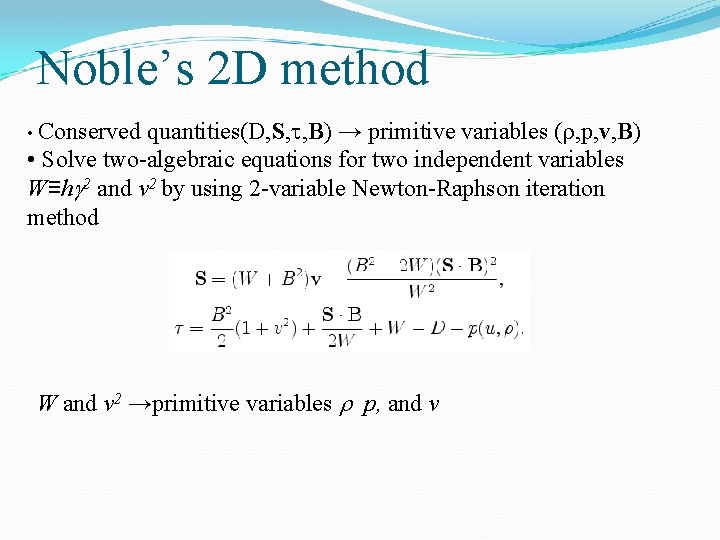
Noble’s 2 D method • Conserved quantities(D, S, t, B) → primitive variables (r, p, v, B) • Solve two-algebraic equations for two independent variables W≡hg 2 and v 2 by using 2 -variable Newton-Raphson iteration method W and v 2 →primitive variables r p, and v
Summary (cont. ) We have investigated stability properties of magnetized spine-sheath relativistic jets by theoretical work and 3 D RMHD simulations. The most important result is that destructive KH modes can be stabilized even when the jet Lorentz factor exceeds the Alfven Lorentz factor. Even in the absence of stabilization, spatial growth of destructive KH modes can be reduced by the presence of magnetically sheath flow (~0. 5 c) around a relativistic jet spine (>0. 9 c)
Summary (cont. ) We performed relativistic magnetohydrodynamic simulations of the hydrodynamic boosting mechanism for relativistic jets explored by Aloy & Rezzolla (2006) using the RAISHIN code. We find that magnetic fields can lead to more efficient acceleration of the jet, in comparison to the pure-hydrodynamic case. The presence and relative orientation of a magnetic field in relativistic jets can significant modify the hydrodynamic boost mechanism studied by Aloy & Rezzolla (2006).
Future Work Code Development Kerr-Schild Coordinates: long-term simulation in GRMHD Resistivity: extension to non-ideal MHD; (e. g. , Watanabe & Yokoyama 2007; Komissarov 2007) Couple with radiation transfer: link to observation Research of Jet Formation and Propagation Dependence on Magnetic field structure, BH spin parameter, disk structure and perturbation etc. Research of Jet Stability Dependence on Eo. S Current-Driven instability Apply to astrophysical phenomena in which relativistic outflows and/or GR essential (AGNs, microquasars, neutron stars, and GRBs etc. )
Current Driven instability From MHD model of jet formation, jets launch with twisted magnetic field from the black hole magnetosphere In such configuration, the most dangerous instability is current driven (CD) kink mode This instability excites large-scale helical motions and it disrupts the system Relativistic CD kink instability was studied only in linear approximation (e. g. , Lyubarskii 1999) The investigation of nonlinear behavior of CD kink instability is important for the stability and structure of relativistic jets Need 3 D relativistic MHD simulation
Plan of Operation Study numerically non-linear evolution of different kinkunstable configurations When the instability saturates, disrupts, and final state Coupling KH and CD instabilities What is fastest growth modes in magnetized relativistic jets? Take into account rotation, velocity shear, and expansion Take into account several jet configuration Top-hat jets (Mizuno et al. 2007) Spine-sheath jet configuration (Mizuno et al. 2007) Boosted boundary layer jets (Mizuno et al. 2008) etc
Future Long-Term Plans I apply to astrophysical phenomena in which relativistic outflows and/or GR essential (AGNs, microquasars, neutron stars, and GRBs etc. ) I apply my future works on jet study to results obtained at very high-energy particle observations by HESS, MAGIC and VERITAS will require to link large scale processes to the microphysics of the plasma, efficient particle acceleration processes and radiation mechanisms