
Computational meshes matrices conjugate gradients and mesh partitioning



![Web graph: Page. Rank (Google) [Brin, Page] An important page is one that many](https://slidetodoc.com/presentation_image/4751c7407b3af4e216aa5b0b66e39efb/image-20.jpg "Web graph: Page. Rank (Google) [Brin, Page] An important page is one that many")

- Slides: 24
Computational meshes, matrices, conjugate gradients, and mesh partitioning Some slides are from David Culler, Jim Demmel, Bob Lucas, Horst Simon, Kathy Yelick, et al. , UCB CS 267
Parallelism in Regular meshes • Computing a Stencil on a regular mesh • need to communicate mesh points near boundary to neighboring processors. • Often done with ghost regions • Surface-to-volume ratio keeps communication down, but • Still may be problematic in practice Implemented using “ghost” regions. Adds memory overhead 2
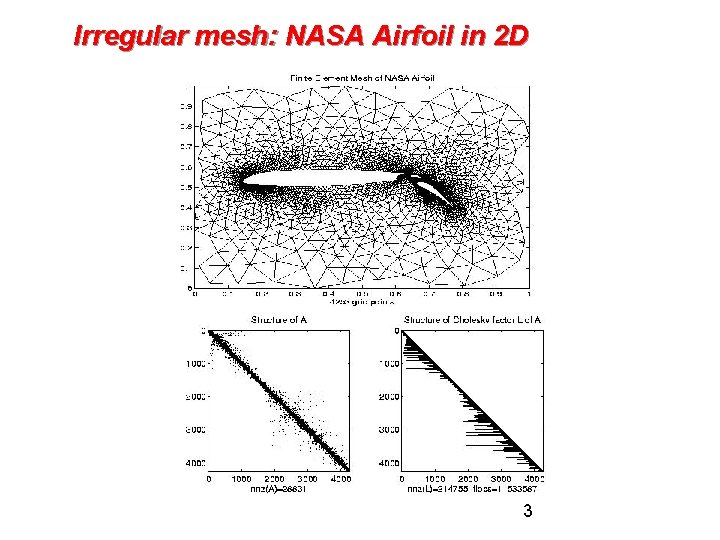
Irregular mesh: NASA Airfoil in 2 D 3
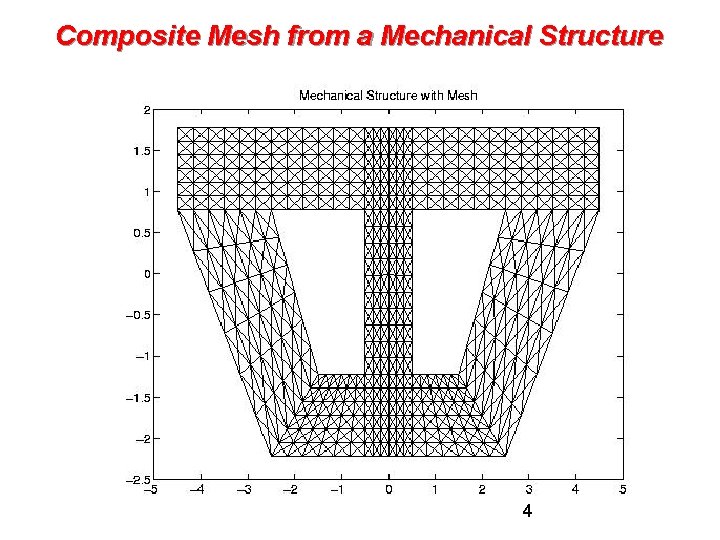
Composite Mesh from a Mechanical Structure 4
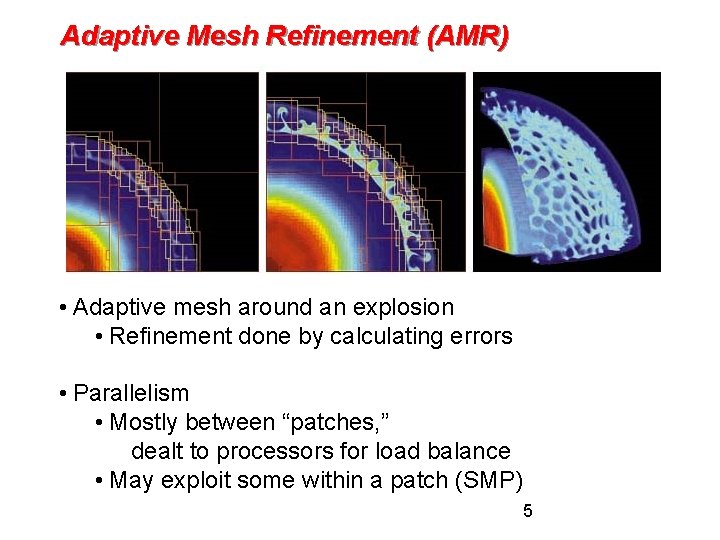
Adaptive Mesh Refinement (AMR) • Adaptive mesh around an explosion • Refinement done by calculating errors • Parallelism • Mostly between “patches, ” dealt to processors for load balance • May exploit some within a patch (SMP) 5
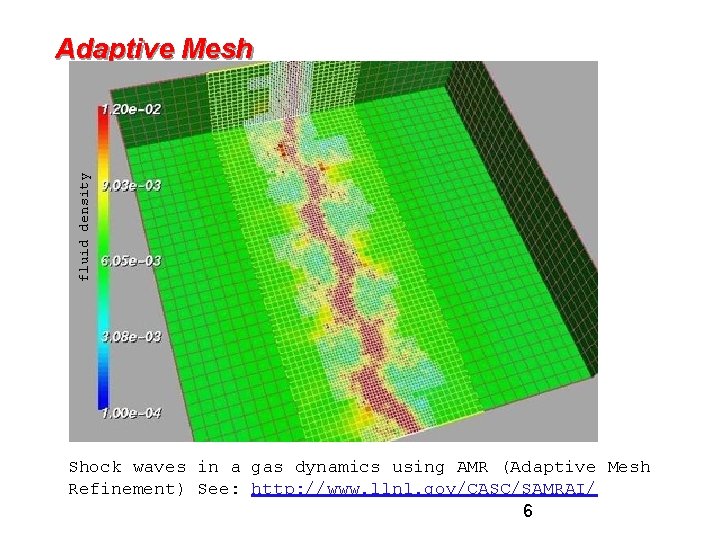
fluid density Adaptive Mesh Shock waves in a gas dynamics using AMR (Adaptive Mesh Refinement) See: http: //www. llnl. gov/CASC/SAMRAI/ 6
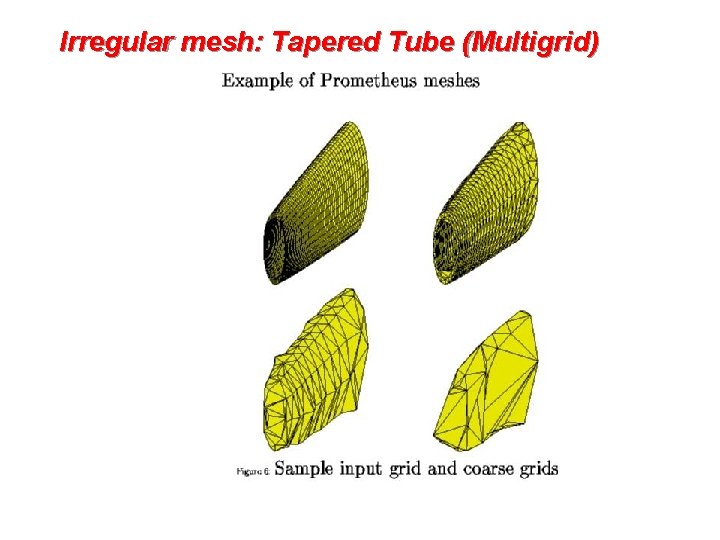
Irregular mesh: Tapered Tube (Multigrid) 7
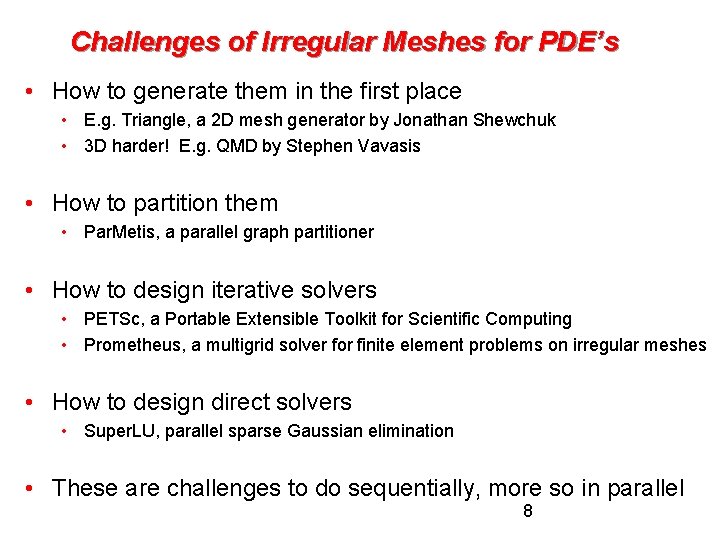
Challenges of Irregular Meshes for PDE’s • How to generate them in the first place • E. g. Triangle, a 2 D mesh generator by Jonathan Shewchuk • 3 D harder! E. g. QMD by Stephen Vavasis • How to partition them • Par. Metis, a parallel graph partitioner • How to design iterative solvers • PETSc, a Portable Extensible Toolkit for Scientific Computing • Prometheus, a multigrid solver for finite element problems on irregular meshes • How to design direct solvers • Super. LU, parallel sparse Gaussian elimination • These are challenges to do sequentially, more so in parallel 8
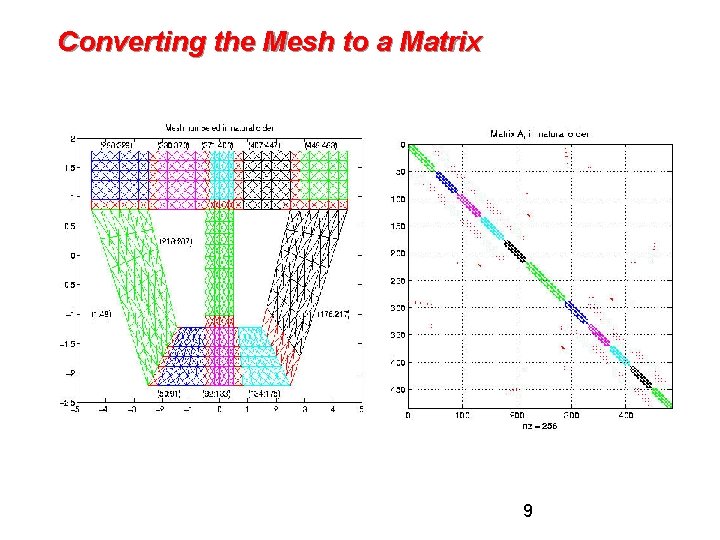
Converting the Mesh to a Matrix 9
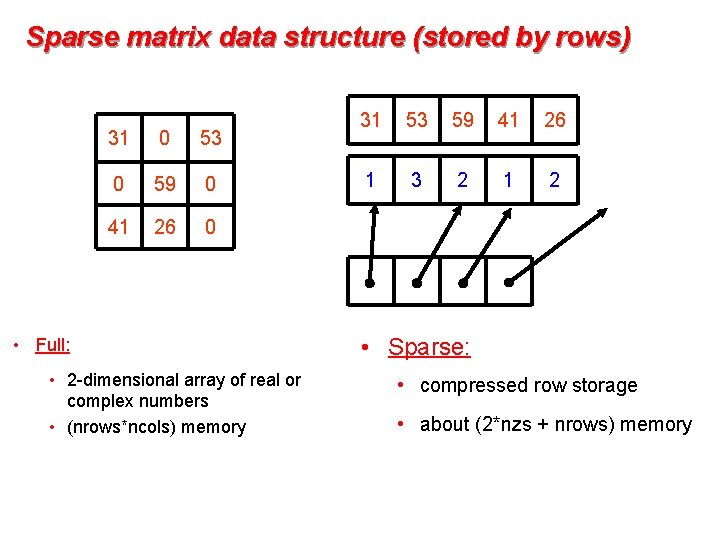
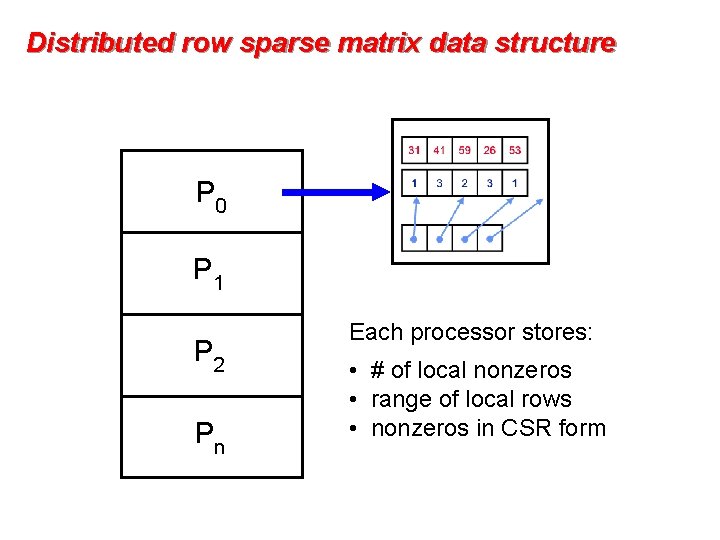
Sparse matrix data structure (stored by rows) 31 0 53 0 59 0 41 26 0 • Full: • 2 -dimensional array of real or complex numbers • (nrows*ncols) memory 31 53 59 41 26 1 3 2 1 2 • Sparse: • compressed row storage • about (2*nzs + nrows) memory
Distributed row sparse matrix data structure P 0 P 1 P 2 Pn Each processor stores: • # of local nonzeros • range of local rows • nonzeros in CSR form
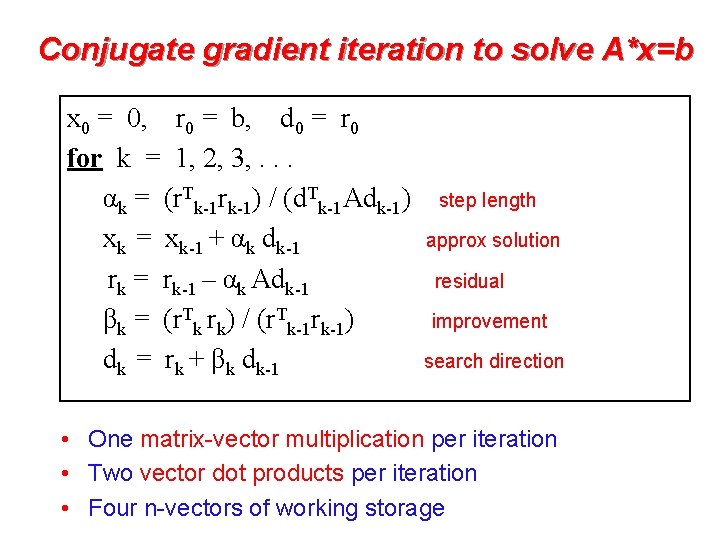
Conjugate gradient iteration to solve A*x=b x 0 = 0, r 0 = b, d 0 = r 0 for k = 1, 2, 3, . . . αk = (r. Tk-1 rk-1) / (d. Tk-1 Adk-1) xk = xk-1 + αk dk-1 rk = rk-1 – αk Adk-1 βk = (r. Tk rk) / (r. Tk-1 rk-1) dk = rk + βk dk-1 step length approx solution residual improvement search direction • One matrix-vector multiplication per iteration • Two vector dot products per iteration • Four n-vectors of working storage
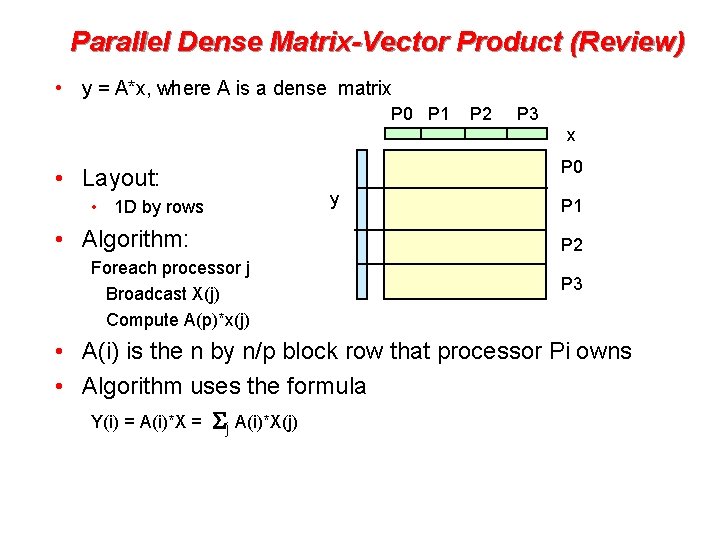
Parallel Dense Matrix-Vector Product (Review) • y = A*x, where A is a dense matrix P 0 P 1 P 2 P 3 x • Layout: • 1 D by rows • Algorithm: Foreach processor j Broadcast X(j) Compute A(p)*x(j) P 0 y P 1 P 2 P 3 • A(i) is the n by n/p block row that processor Pi owns • Algorithm uses the formula Y(i) = A(i)*X = Sj A(i)*X(j)
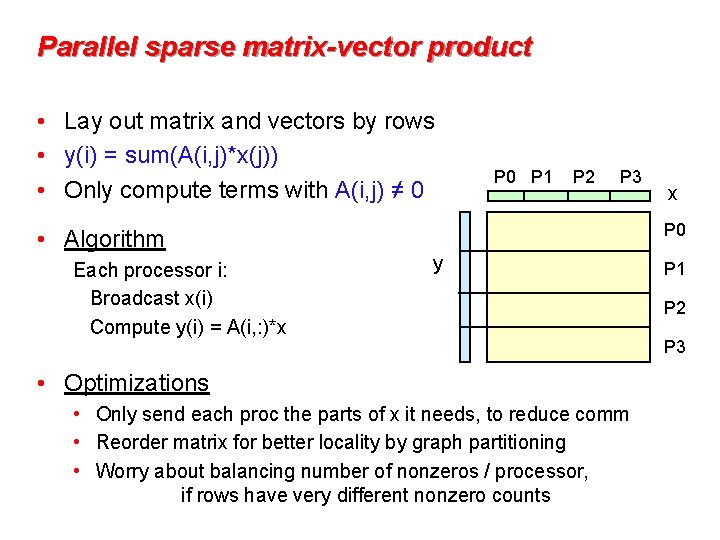
Parallel sparse matrix-vector product • Lay out matrix and vectors by rows • y(i) = sum(A(i, j)*x(j)) • Only compute terms with A(i, j) ≠ 0 • Algorithm Each processor i: Broadcast x(i) Compute y(i) = A(i, : )*x P 0 P 1 P 2 P 3 x P 0 y • Optimizations • Only send each proc the parts of x it needs, to reduce comm • Reorder matrix for better locality by graph partitioning • Worry about balancing number of nonzeros / processor, if rows have very different nonzero counts P 1 P 2 P 3
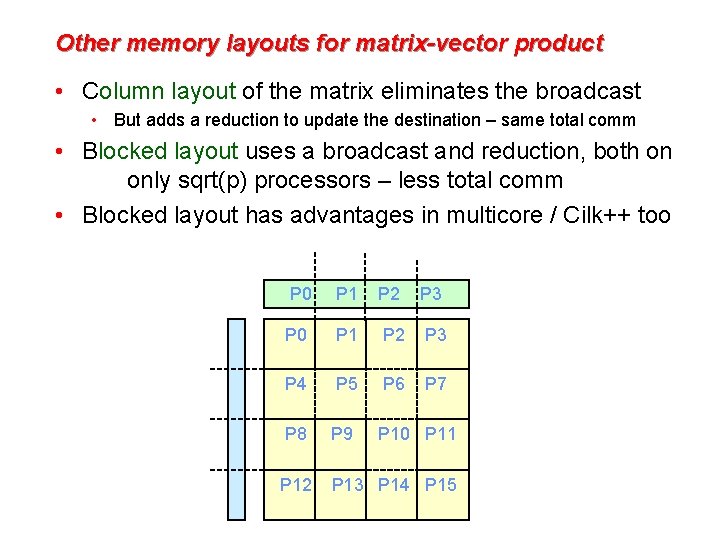
Other memory layouts for matrix-vector product • Column layout of the matrix eliminates the broadcast • But adds a reduction to update the destination – same total comm • Blocked layout uses a broadcast and reduction, both on only sqrt(p) processors – less total comm • Blocked layout has advantages in multicore / Cilk++ too P 0 P 1 P 2 P 3 P 4 P 5 P 6 P 7 P 8 P 9 P 10 P 11 P 12 P 13 P 14 P 15
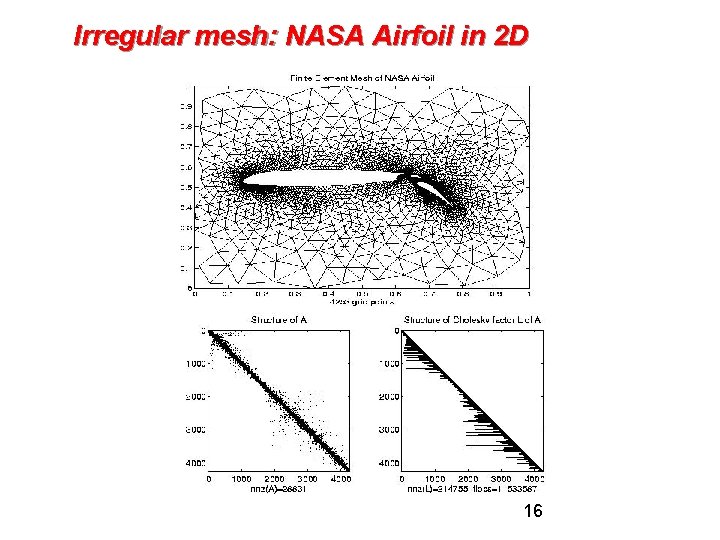
Irregular mesh: NASA Airfoil in 2 D 16
Graphs and Sparse Matrices • Sparse matrix is a representation of a (sparse) graph 1 1 2 6 5 6 1 1 3 5 4 1 2 1 4 3 1 1 4 1 1 1 2 3 1 1 6 5 • Matrix entries are edge weights • Number of nonzeros per row is the vertex degree • Edges represent data dependencies in matrix-vector multiplication
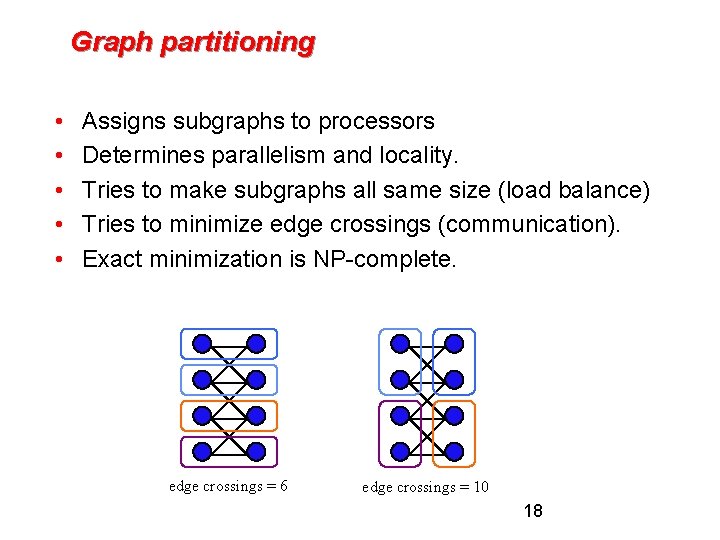
Graph partitioning • • • Assigns subgraphs to processors Determines parallelism and locality. Tries to make subgraphs all same size (load balance) Tries to minimize edge crossings (communication). Exact minimization is NP-complete. edge crossings = 6 edge crossings = 10 18
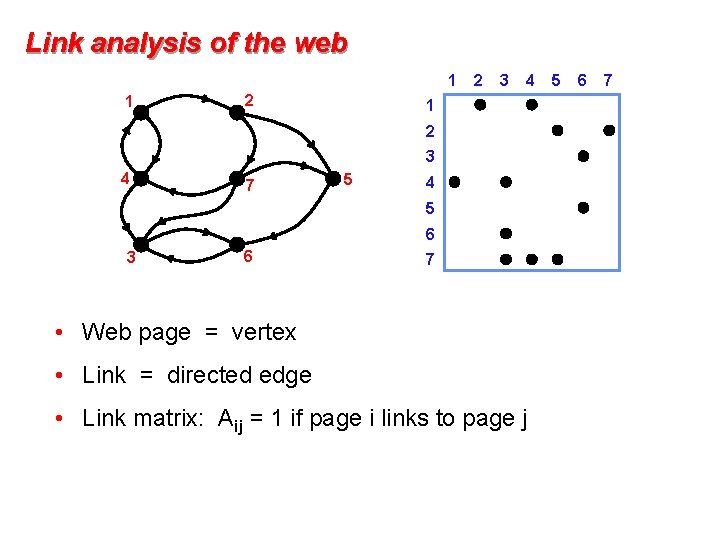
Link analysis of the web 1 1 2 2 3 4 1 2 3 4 7 5 4 5 6 3 6 7 • Web page = vertex • Link = directed edge • Link matrix: Aij = 1 if page i links to page j 5 6 7
Web graph: Page. Rank (Google) [Brin, Page] An important page is one that many important pages point to. • Markov process: follow a random link most of the time; otherwise, go to any page at random. • Importance = stationary distribution of Markov process. • Transition matrix is p*A + (1 -p)*ones(size(A)), scaled so each column sums to 1. • Importance of page i is the i-th entry in the principal eigenvector of the transition matrix. • But the matrix is 1, 000, 000 by 1, 000, 000.
A Page Rank Matrix • Importance ranking of web pages • Stationary distribution of a Markov chain • Power method: matvec and vector arithmetic • Matlab*P page ranking demo (from SC’ 03) on a web crawl of mit. edu (170, 000 pages)
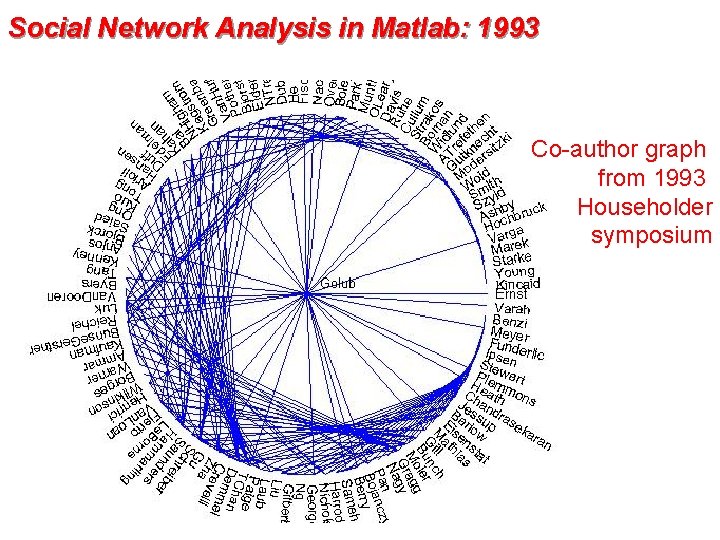
Social Network Analysis in Matlab: 1993 Co-author graph from 1993 Householder symposium
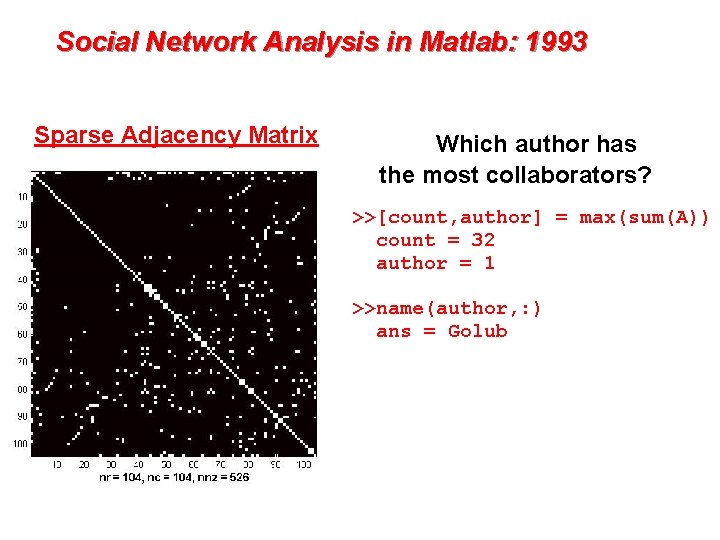
Social Network Analysis in Matlab: 1993 Sparse Adjacency Matrix Which author has the most collaborators? >>[count, author] = max(sum(A)) count = 32 author = 1 >>name(author, : ) ans = Golub
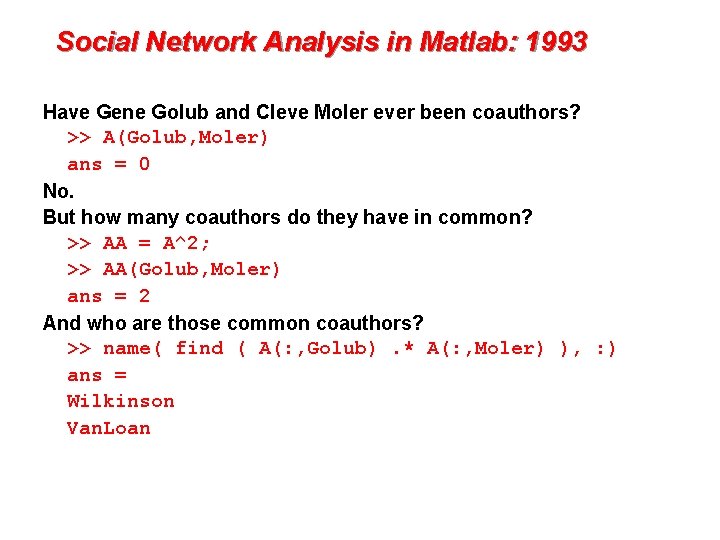
Social Network Analysis in Matlab: 1993 Have Gene Golub and Cleve Moler ever been coauthors? >> A(Golub, Moler) ans = 0 No. But how many coauthors do they have in common? >> AA = A^2; >> AA(Golub, Moler) ans = 2 And who are those common coauthors? >> name( find ( A(: , Golub). * A(: , Moler) ), : ) ans = Wilkinson Van. Loan