
Computational Game Theory Lecture 1 Introduction 1 Agenda







- Slides: 71
Computational Game Theory Lecture 1 - Introduction 1
Agenda � Introduction to Game Theory � Basic Game Theory Examples � Strategic Games � More Game Theory Examples � Equilibrium � Mixed Strategy 2
Computational Game Theory � The study of Game Theory in the context of Computer Science, in order to reason about problems from computability and algorithm design. 3
CGT in Computer Science � Artificial Intelligence ◦ Single/multi agent environment ◦ Learning � Communications Networks ◦ Many players (end-users, ISVs, Infrastructure Providers) ◦ Players wish to maximize their own benefit and act accordingly ◦ The trick is to design a system where it’s beneficial for the player to follow the rules 4
CGT in Computer Science � Theory ◦ Algorithms design ◦ Complexity ◦ Quality of game states (Equilibrium states in particular) � Industry ◦ Sponsored search – design biddings to maximize bidder’s benefit while ensuring good outcome for the owners 5
Game Theory � Rational Player ◦ Prioritizes possible actions according to utility or cost ◦ Strives to maximize utility or to minimize cost � Competitive Environment ◦ More than one player at the same time Game Theory analyzes how rational players behave in competitive environments 6
Agenda � Introduction to Game Theory � Basic Game Theory examples 7
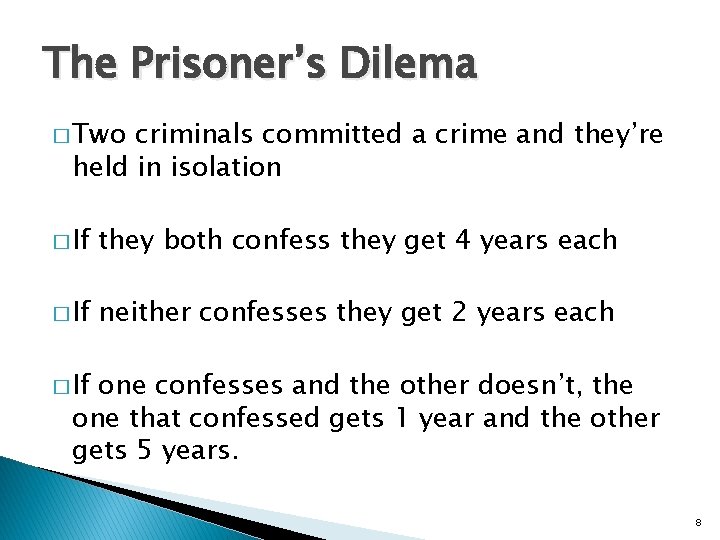
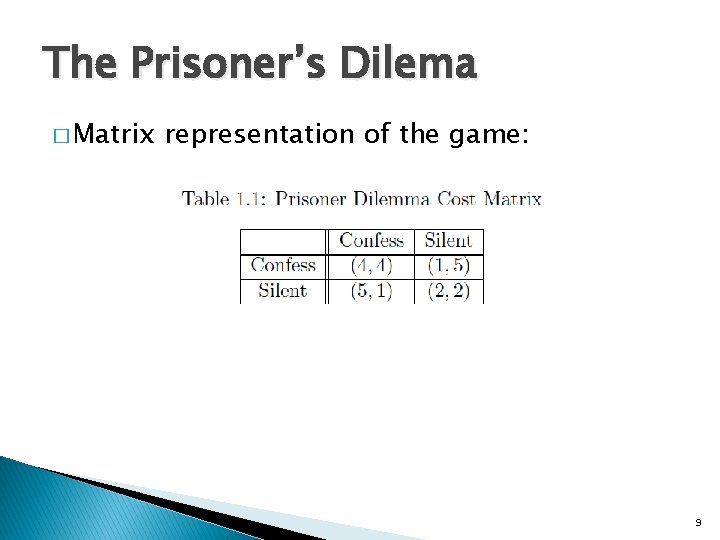
The Prisoner’s Dilema � Two criminals committed a crime and they’re held in isolation � If they both confess they get 4 years each � If neither confesses they get 2 years each � If one confesses and the other doesn’t, the one that confessed gets 1 year and the other gets 5 years. 8
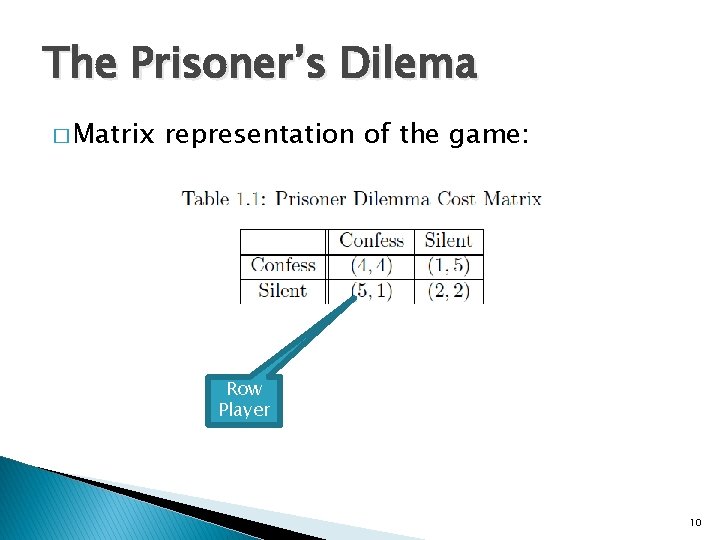
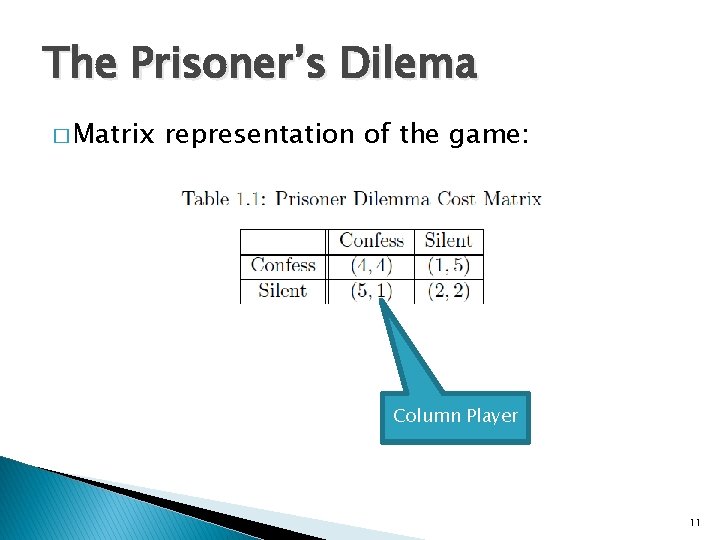
The Prisoner’s Dilema � Matrix representation of the game: 9
The Prisoner’s Dilema � Matrix representation of the game: Row Player 10
The Prisoner’s Dilema � Matrix representation of the game: Column Player 11
The Prisoner’s Dilema � Matrix representation of the game: For example: Column player confesses, row player doesn’t. Column player gets 1 year, row player gets 5 years 12
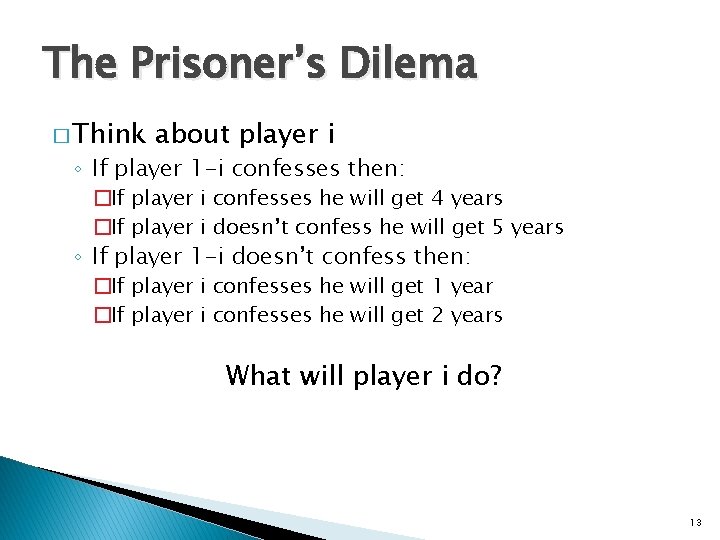
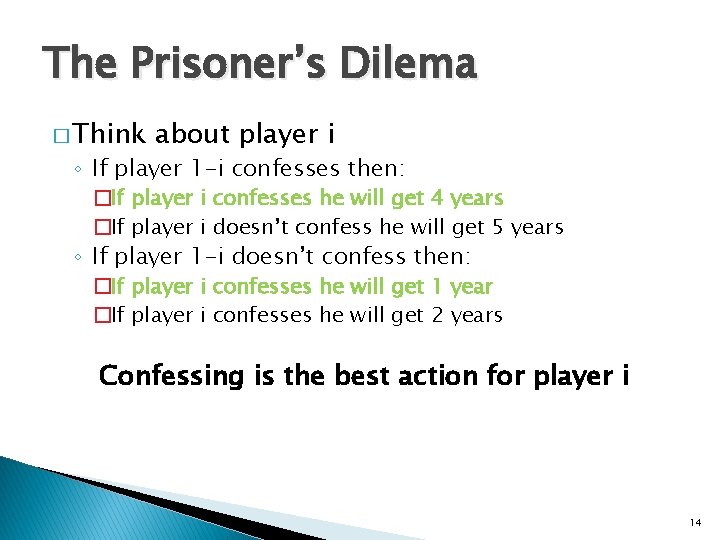
The Prisoner’s Dilema � Think about player i ◦ If player 1 -i confesses then: �If player i confesses he will get 4 years �If player i doesn’t confess he will get 5 years ◦ If player 1 -i doesn’t confess then: �If player i confesses he will get 1 year �If player i confesses he will get 2 years What will player i do? 13
The Prisoner’s Dilema � Think about player i ◦ If player 1 -i confesses then: �If player i confesses he will get 4 years �If player i doesn’t confess he will get 5 years ◦ If player 1 -i doesn’t confess then: �If player i confesses he will get 1 year �If player i confesses he will get 2 years Confessing is the best action for player i 14
The Prisoner’s Dilema � Game Theory predicts that both players will choose to confess � This is called an Equilibrium (to be defined later) 15
ISP Routing � Internet Service Providers (ISP) often share their physical networks for free � In some cases an ISP can either choose to route traffic in its own network or via a partner network 16
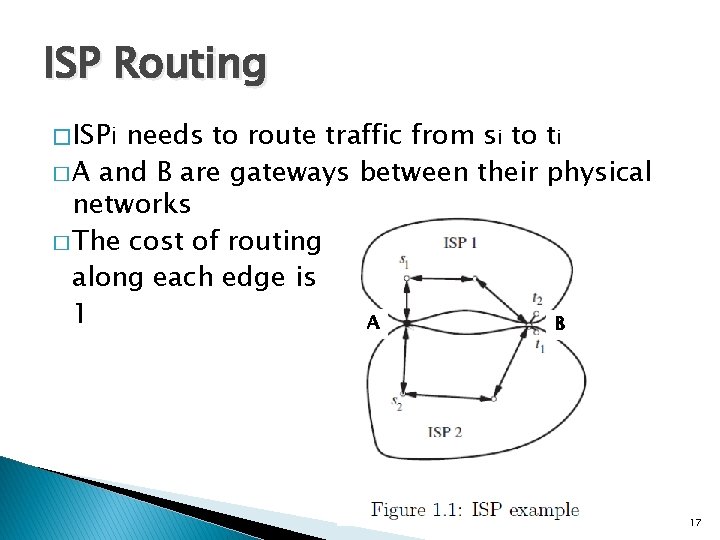
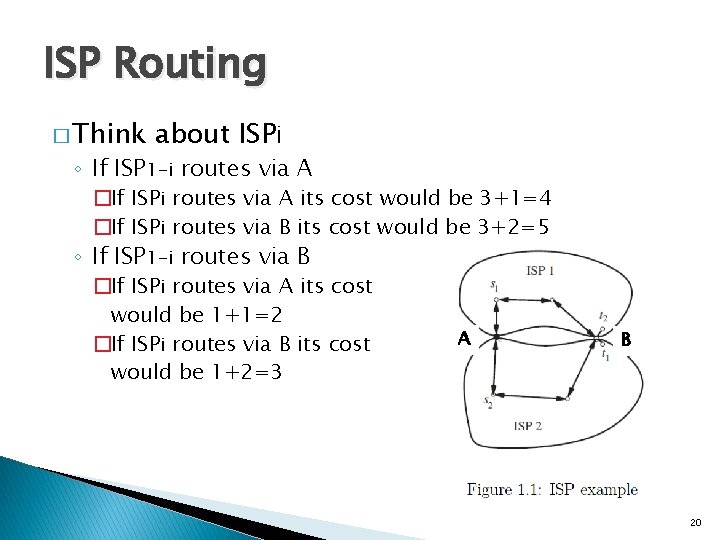
ISP Routing � ISPi needs to route traffic from si to ti � A and B are gateways between their physical networks � The cost of routing along each edge is 1 A B 17
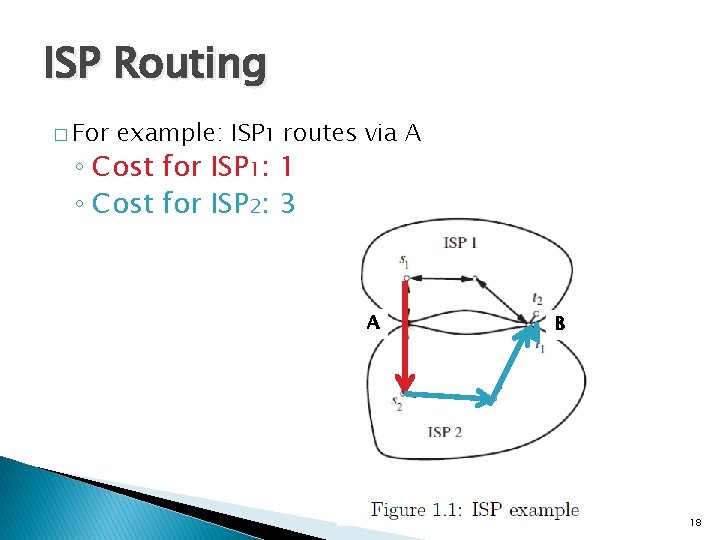
ISP Routing � For example: ISP 1 routes via A ◦ Cost for ISP 1: 1 ◦ Cost for ISP 2: 3 A B 18
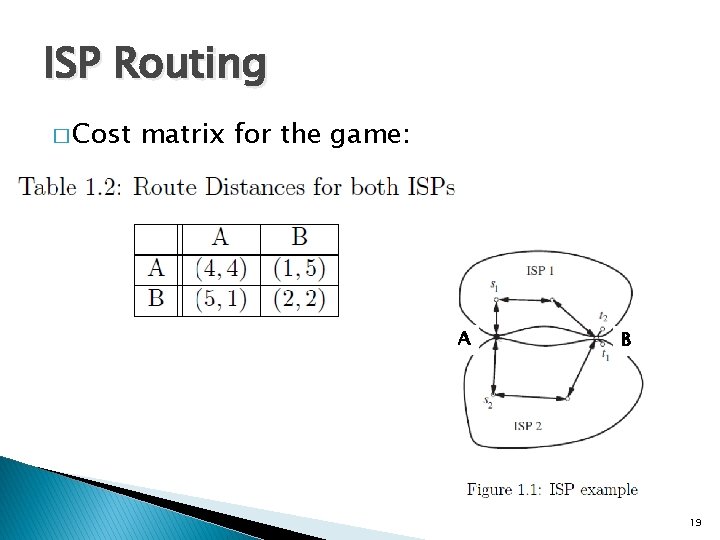
ISP Routing � Cost matrix for the game: A B 19
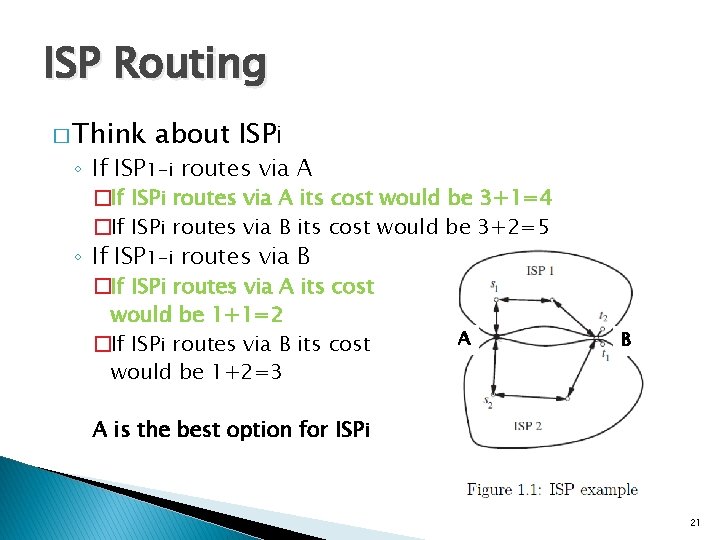
ISP Routing � Think about ISPi ◦ If ISP 1 -i routes via A �If ISPi routes via A its cost would be 3+1=4 �If ISPi routes via B its cost would be 3+2=5 ◦ If ISP 1 -i routes via B �If ISPi routes via A its cost would be 1+1=2 �If ISPi routes via B its cost would be 1+2=3 A B 20
ISP Routing � Think about ISPi ◦ If ISP 1 -i routes via A �If ISPi routes via A its cost would be 3+1=4 �If ISPi routes via B its cost would be 3+2=5 ◦ If ISP 1 -i routes via B �If ISPi routes via A its cost would be 1+1=2 �If ISPi routes via B its cost would be 1+2=3 A B A is the best option for ISPi 21
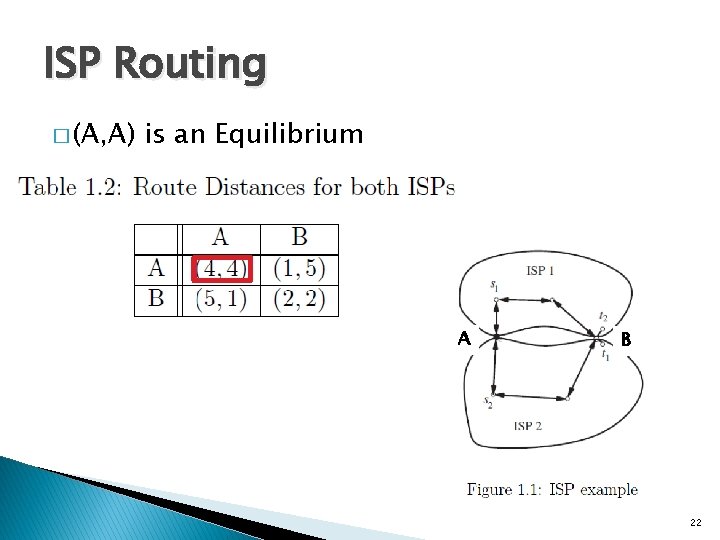
ISP Routing � (A, A) is an Equilibrium A B 22
Agenda � Introduction to Game Theory � Basic Game Theory examples 23
Strategic Games � The game consists of only one ‘turn’ � All the players play simultaneously and are unaware of what the other players do � Players are selfish, wanting to maximize their own benefit 24
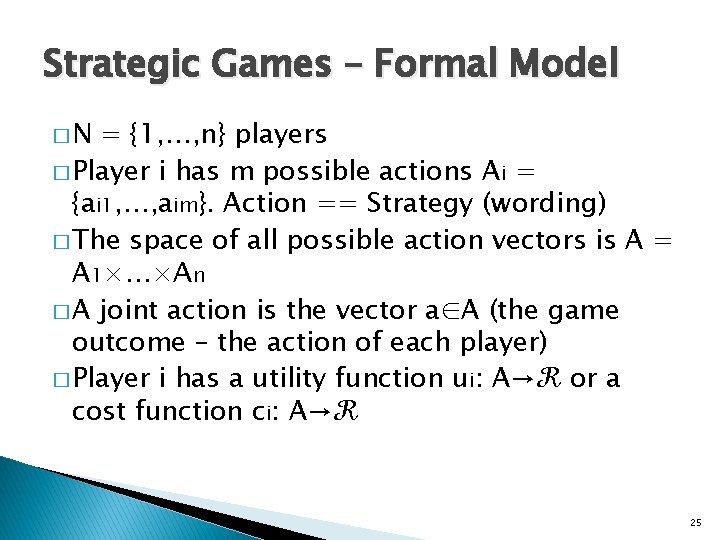
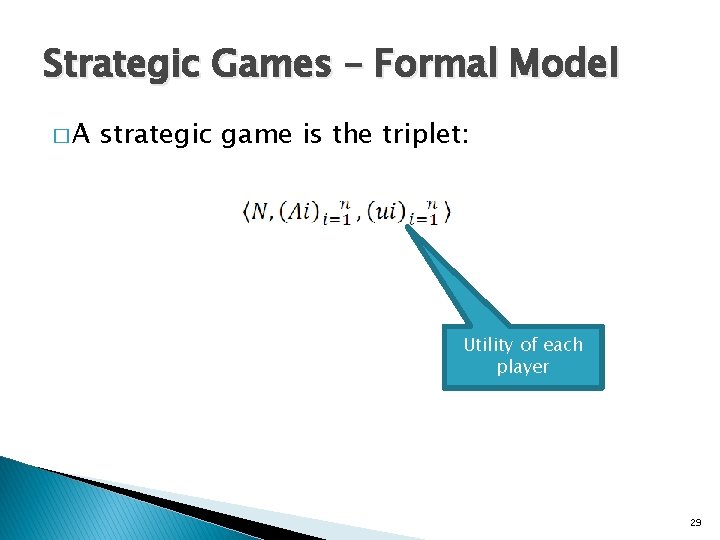
Strategic Games – Formal Model �N = {1, …, n} players � Player i has m possible actions Ai = {ai 1, …, aim}. Action == Strategy (wording) � The space of all possible action vectors is A = A 1×…×An � A joint action is the vector a∈A (the game outcome – the action of each player) � Player i has a utility function ui: A→ℛ or a cost function ci: A→ℛ 25
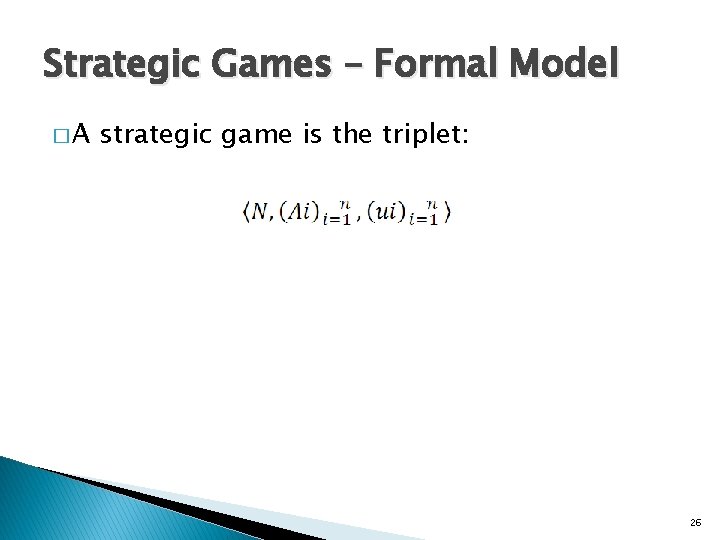
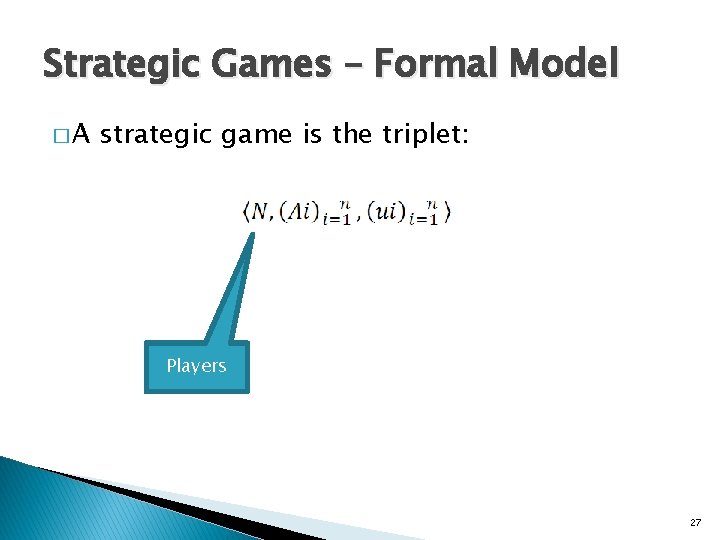
Strategic Games – Formal Model �A strategic game is the triplet: 26
Strategic Games – Formal Model �A strategic game is the triplet: Players 27
Strategic Games – Formal Model �A strategic game is the triplet: Actions of each player 28
Strategic Games – Formal Model �A strategic game is the triplet: Utility of each player 29
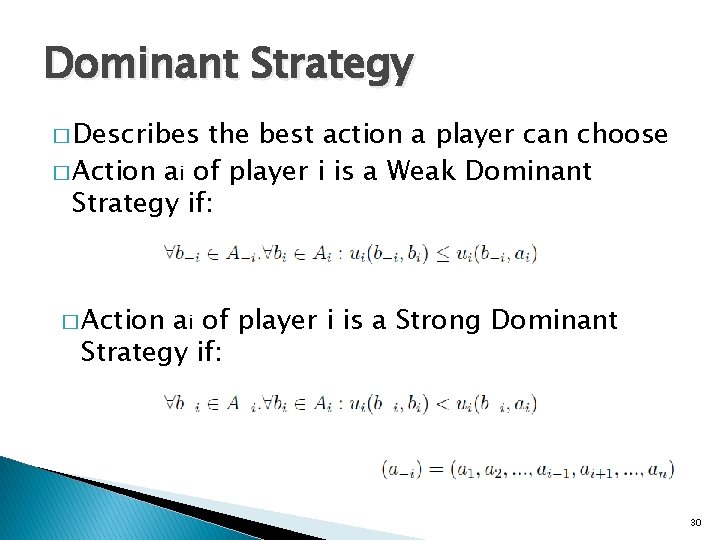
Dominant Strategy � Describes the best action a player can choose � Action ai of player i is a Weak Dominant Strategy if: � Action ai of player i is a Strong Dominant Strategy if: 30
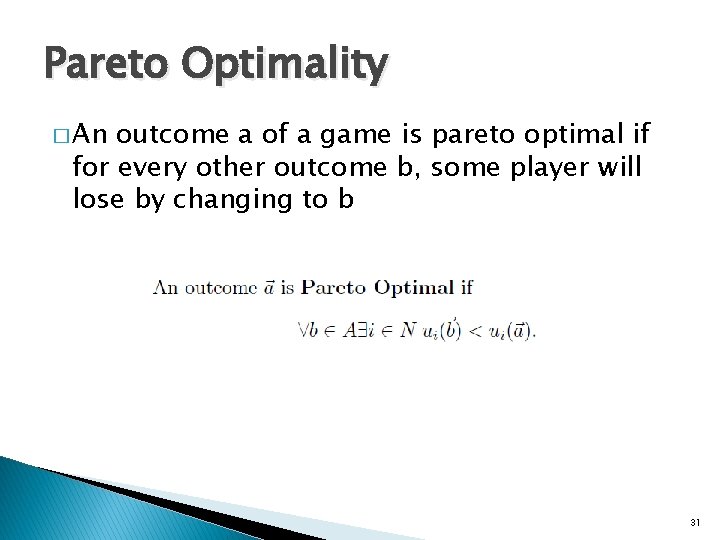
Pareto Optimality � An outcome a of a game is pareto optimal if for every other outcome b, some player will lose by changing to b 31
Agenda � Introduction to Game Theory � Basic Game Theory examples 32
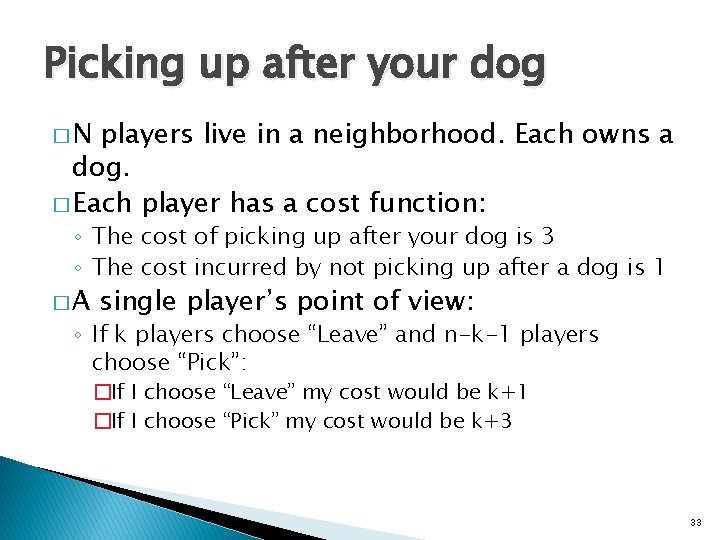
Picking up after your dog �N players live in a neighborhood. Each owns a dog. � Each player has a cost function: ◦ The cost of picking up after your dog is 3 ◦ The cost incurred by not picking up after a dog is 1 �A single player’s point of view: ◦ If k players choose “Leave” and n-k-1 players choose “Pick”: �If I choose “Leave” my cost would be k+1 �If I choose “Pick” my cost would be k+3 33
Picking up after your dog � “Leave” � Note: is a dominant action for a player ◦ If all players choose “Pick” the cost would be 3 for each ◦ The dominant action can be changed by changing the rules: assume the authorities would fine me every time I choose “Leave” 34
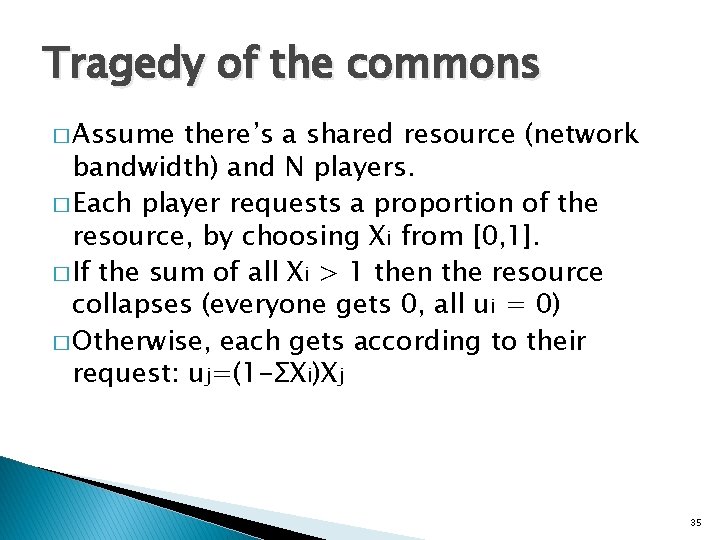
Tragedy of the commons � Assume there’s a shared resource (network bandwidth) and N players. � Each player requests a proportion of the resource, by choosing Xi from [0, 1]. � If the sum of all Xi > 1 then the resource collapses (everyone gets 0, all ui = 0) � Otherwise, each gets according to their request: uj=(1 -ΣXi)Xj 35
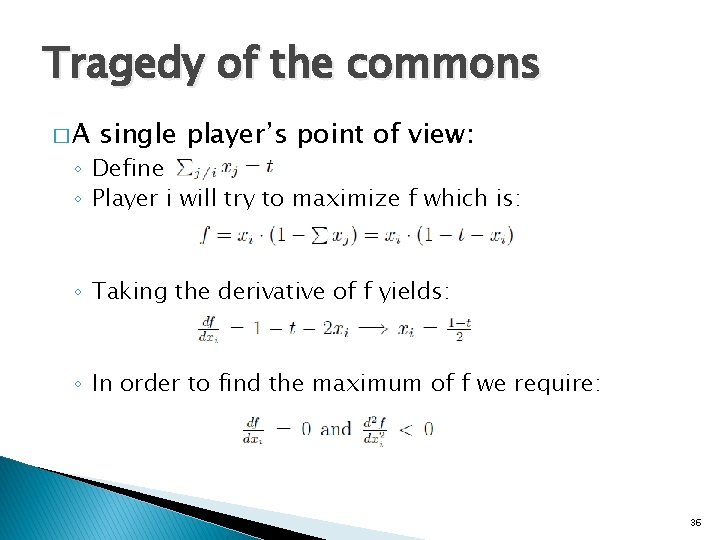
Tragedy of the commons �A single player’s point of view: ◦ Define ◦ Player i will try to maximize f which is: ◦ Taking the derivative of f yields: ◦ In order to find the maximum of f we require: 36
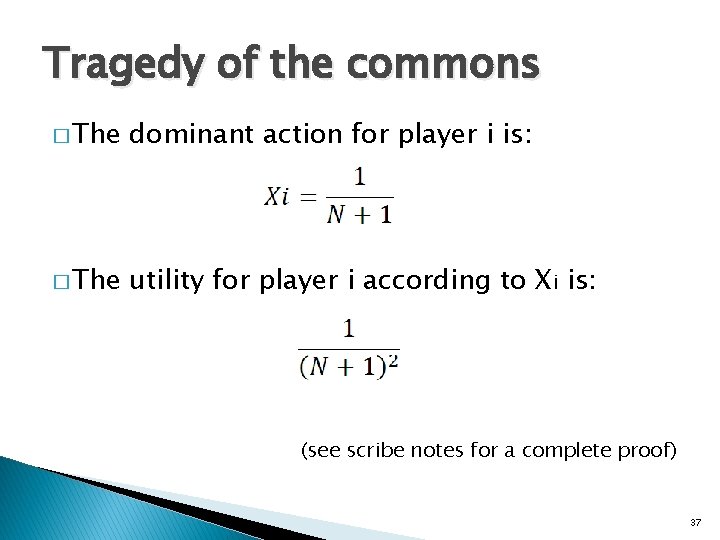
Tragedy of the commons � The dominant action for player i is: � The utility for player i according to Xi is: (see scribe notes for a complete proof) 37
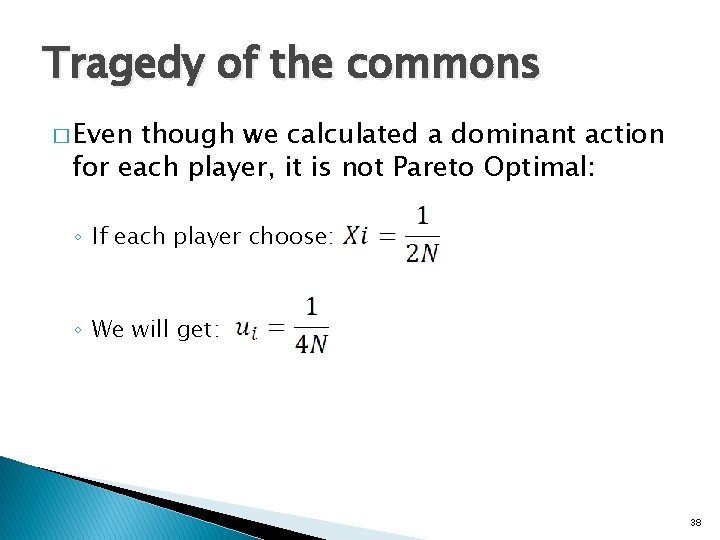
Tragedy of the commons � Even though we calculated a dominant action for each player, it is not Pareto Optimal: ◦ If each player choose: ◦ We will get: 38
Agenda � Introduction to Game Theory � Basic Game Theory examples 39
Nash Equilibrium �A Nash Equilibrium is an outcome of the game in which no player can improve its utility alone: � Alternative definition: every player’s action is a best response: 40
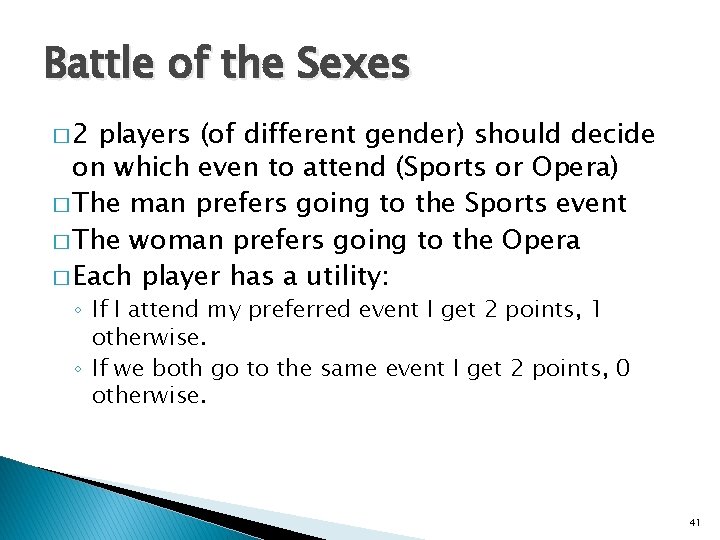
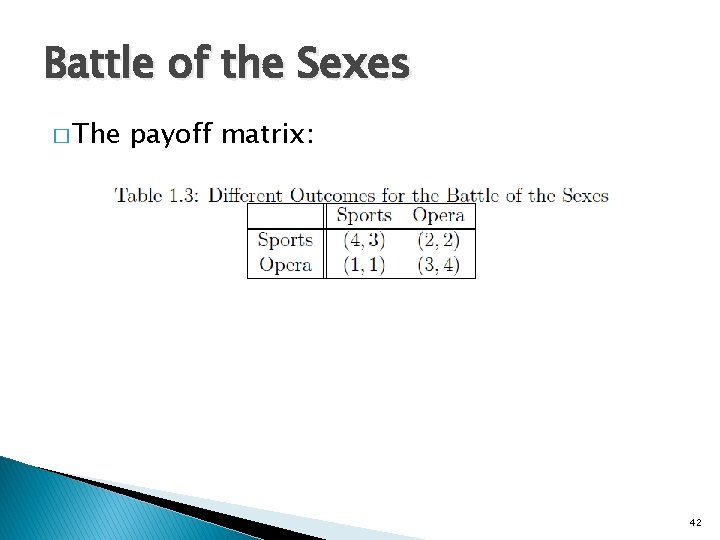
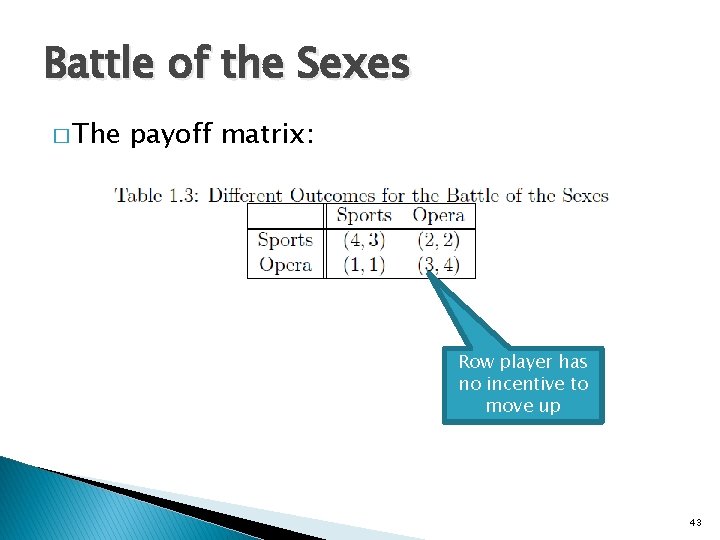
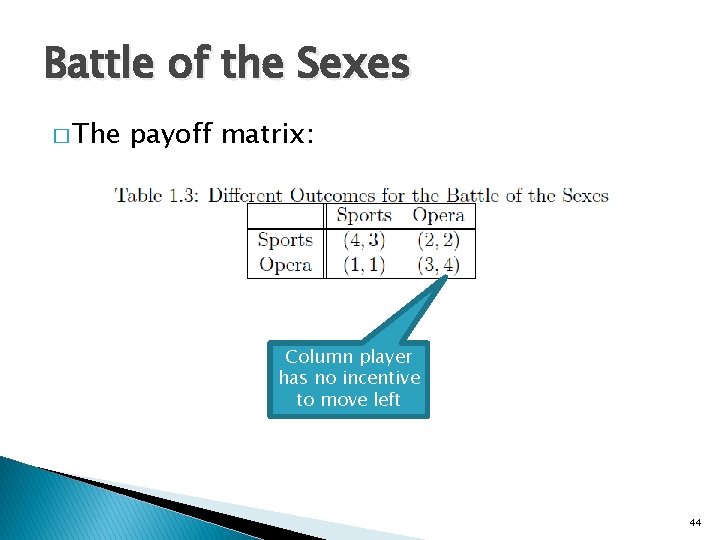
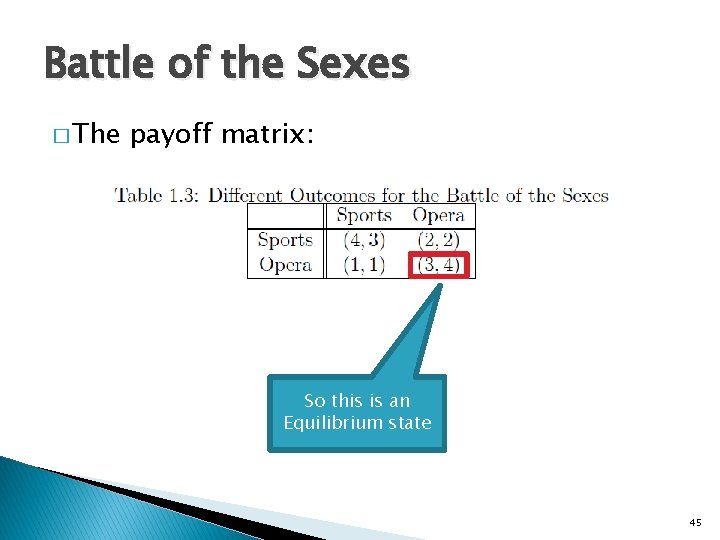
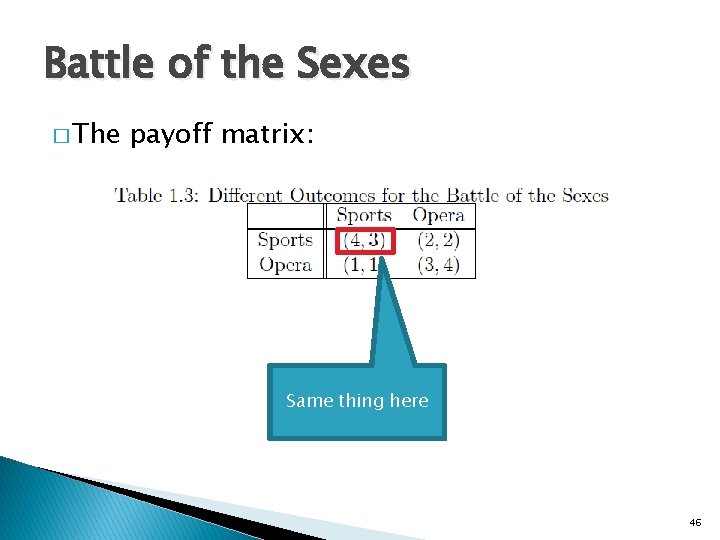
Battle of the Sexes � 2 players (of different gender) should decide on which even to attend (Sports or Opera) � The man prefers going to the Sports event � The woman prefers going to the Opera � Each player has a utility: ◦ If I attend my preferred event I get 2 points, 1 otherwise. ◦ If we both go to the same event I get 2 points, 0 otherwise. 41
Battle of the Sexes � The payoff matrix: 42
Battle of the Sexes � The payoff matrix: Row player has no incentive to move up 43
Battle of the Sexes � The payoff matrix: Column player has no incentive to move left 44
Battle of the Sexes � The payoff matrix: So this is an Equilibrium state 45
Battle of the Sexes � The payoff matrix: Same thing here 46
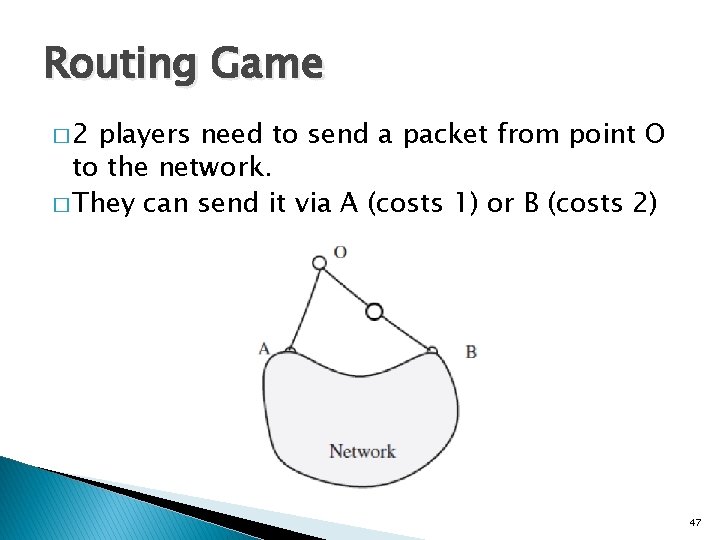
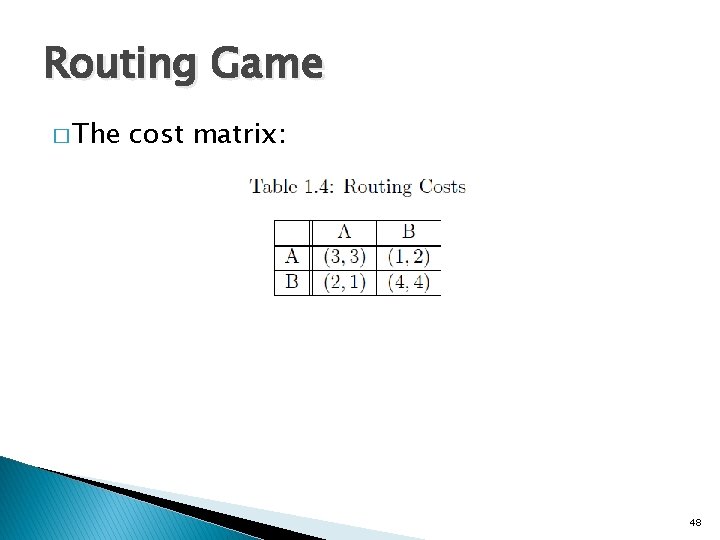
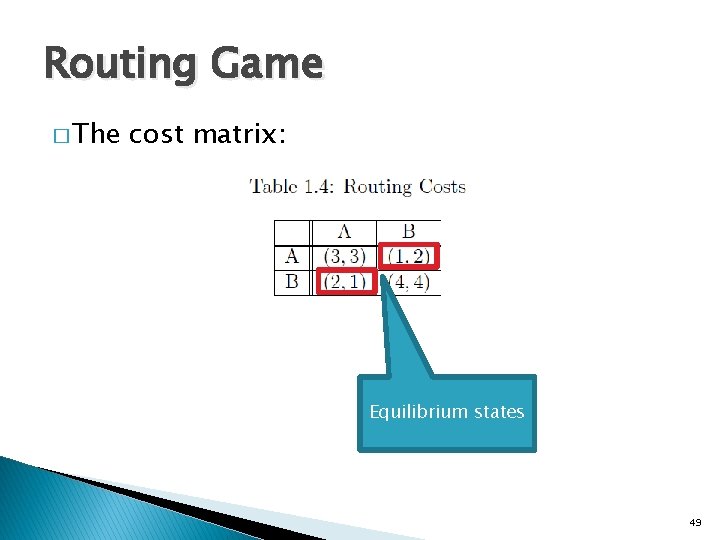
Routing Game � 2 players need to send a packet from point O to the network. � They can send it via A (costs 1) or B (costs 2) 47
Routing Game � The cost matrix: 48
Routing Game � The cost matrix: Equilibrium states 49
Agenda � Introduction to Game Theory � Basic Game Theory examples 50
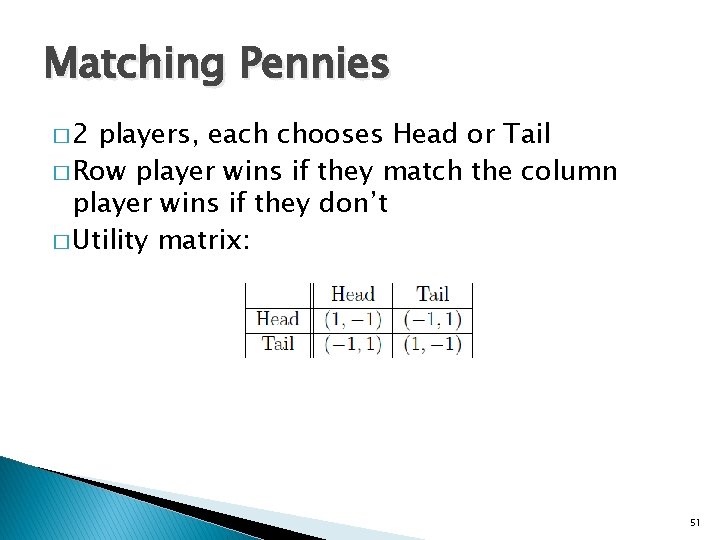
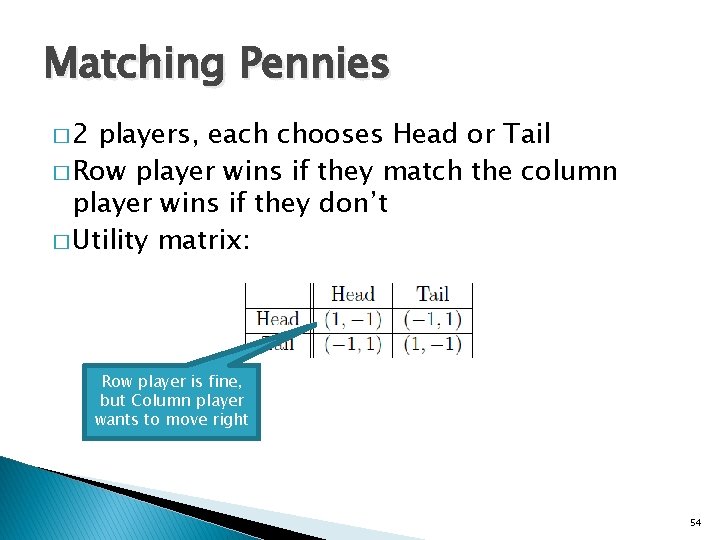
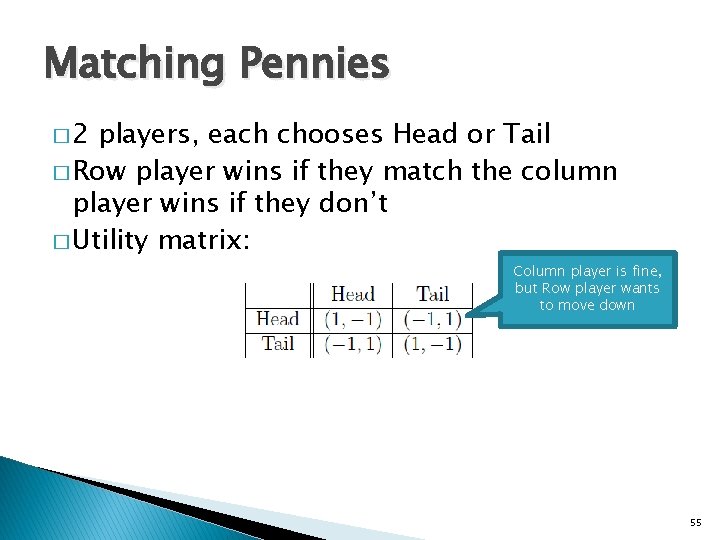
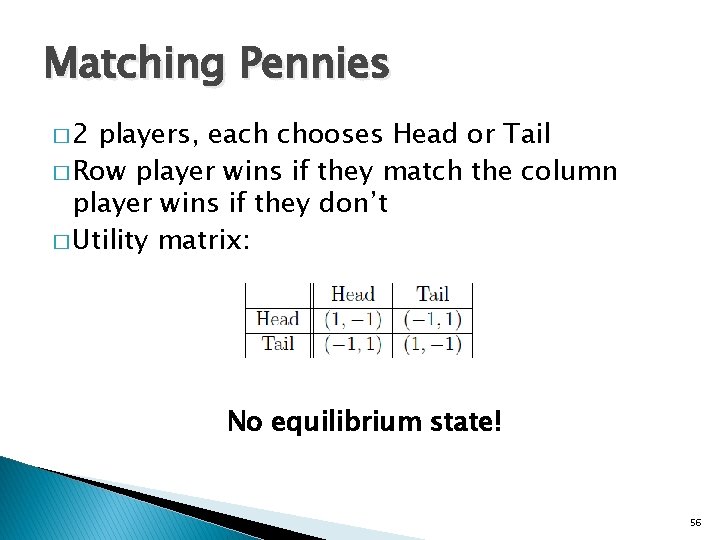
Matching Pennies � 2 players, each chooses Head or Tail � Row player wins if they match the column player wins if they don’t � Utility matrix: 51
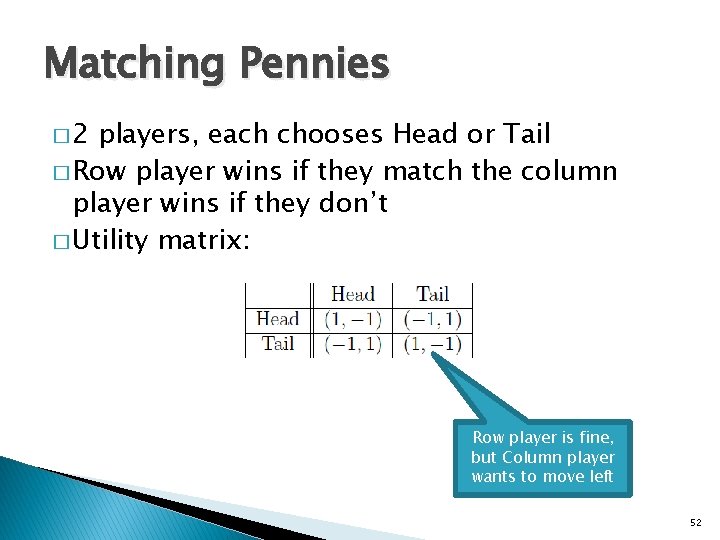
Matching Pennies � 2 players, each chooses Head or Tail � Row player wins if they match the column player wins if they don’t � Utility matrix: Row player is fine, but Column player wants to move left 52
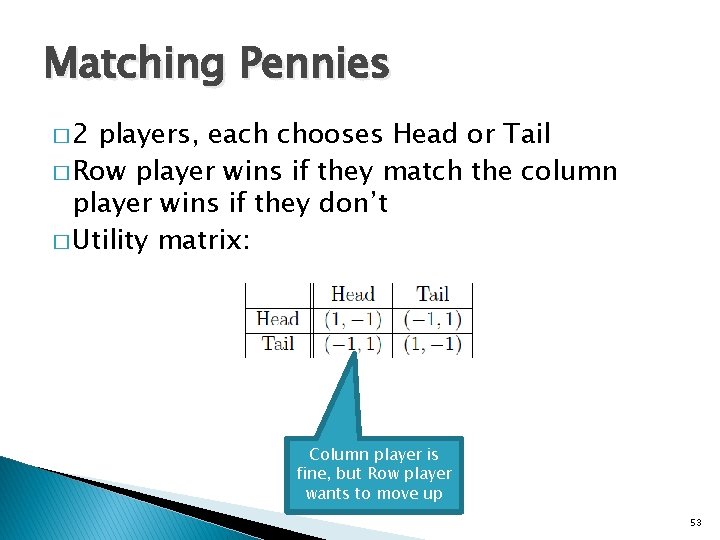
Matching Pennies � 2 players, each chooses Head or Tail � Row player wins if they match the column player wins if they don’t � Utility matrix: Column player is fine, but Row player wants to move up 53
Matching Pennies � 2 players, each chooses Head or Tail � Row player wins if they match the column player wins if they don’t � Utility matrix: Row player is fine, but Column player wants to move right 54
Matching Pennies � 2 players, each chooses Head or Tail � Row player wins if they match the column player wins if they don’t � Utility matrix: Column player is fine, but Row player wants to move down 55
Matching Pennies � 2 players, each chooses Head or Tail � Row player wins if they match the column player wins if they don’t � Utility matrix: No equilibrium state! 56
Mixed Strategy � Players do not choose a pure strategy (one specific strategy) � Players choose a distribution over their possible pure strategies � For example: with probability p I choose Head, and with probability 1 -p I choose Tail 57
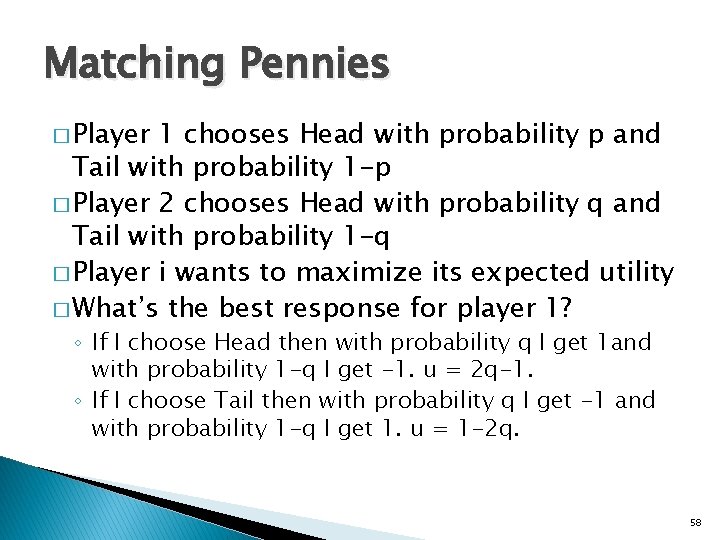
Matching Pennies � Player 1 chooses Head with probability p and Tail with probability 1 -p � Player 2 chooses Head with probability q and Tail with probability 1 -q � Player i wants to maximize its expected utility � What’s the best response for player 1? ◦ If I choose Head then with probability q I get 1 and with probability 1 -q I get -1. u = 2 q-1. ◦ If I choose Tail then with probability q I get -1 and with probability 1 -q I get 1. u = 1 -2 q. 58
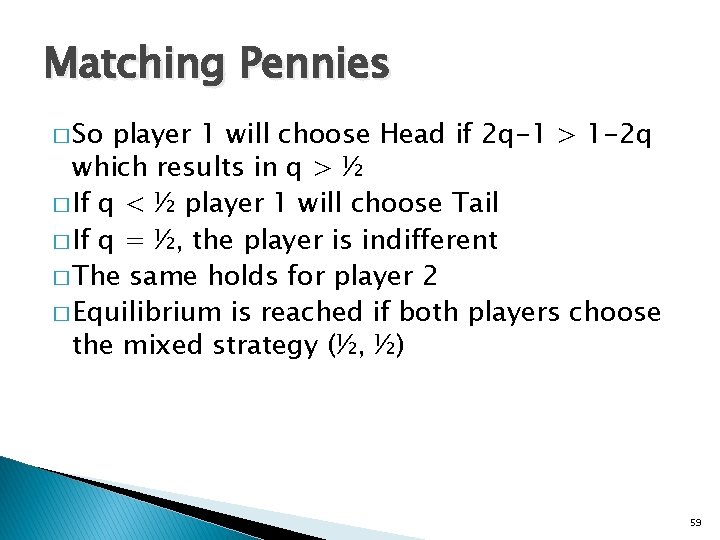
Matching Pennies � So player 1 will choose Head if 2 q-1 > 1 -2 q which results in q > ½ � If q < ½ player 1 will choose Tail � If q = ½, the player is indifferent � The same holds for player 2 � Equilibrium is reached if both players choose the mixed strategy (½, ½) 59
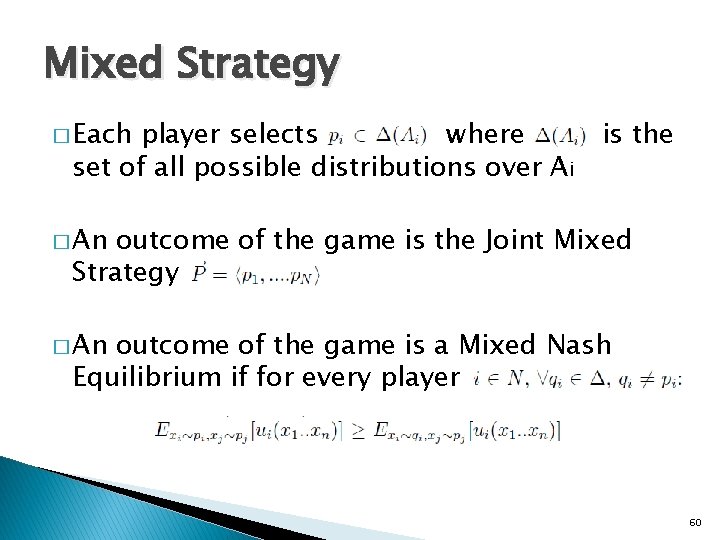
Mixed Strategy � Each player selects where is the set of all possible distributions over Ai � An outcome of the game is the Joint Mixed Strategy � An outcome of the game is a Mixed Nash Equilibrium if for every player 60
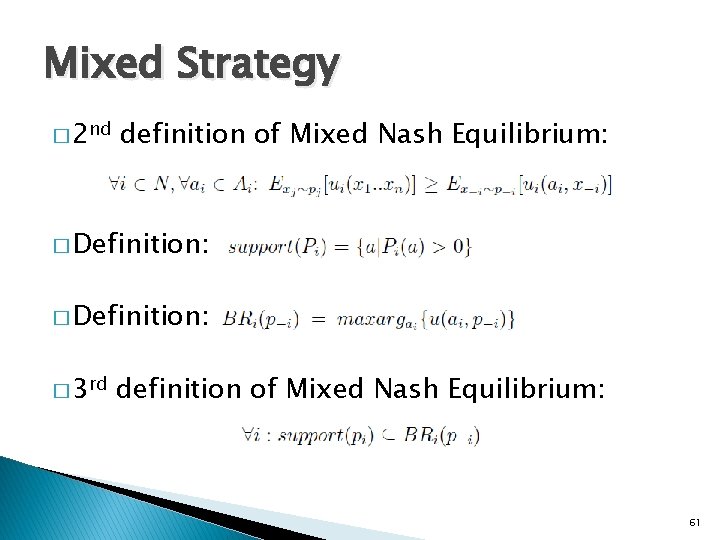
Mixed Strategy � 2 nd definition of Mixed Nash Equilibrium: � Definition: � 3 rd definition of Mixed Nash Equilibrium: 61
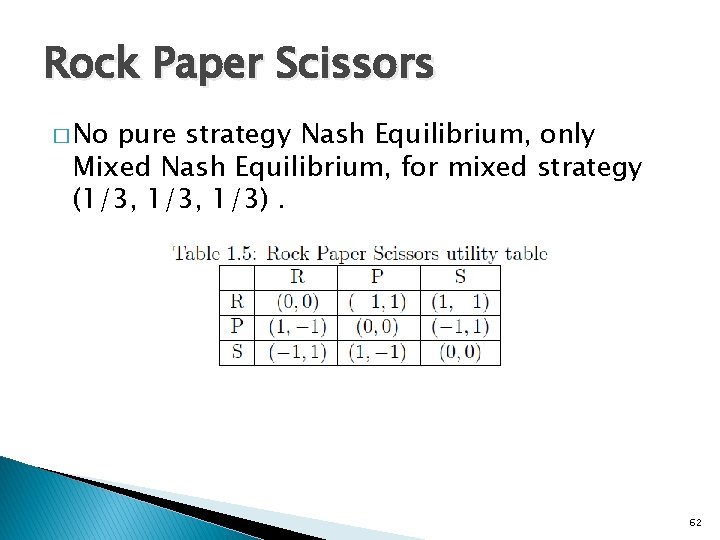
Rock Paper Scissors � No pure strategy Nash Equilibrium, only Mixed Nash Equilibrium, for mixed strategy (1/3, 1/3). 62
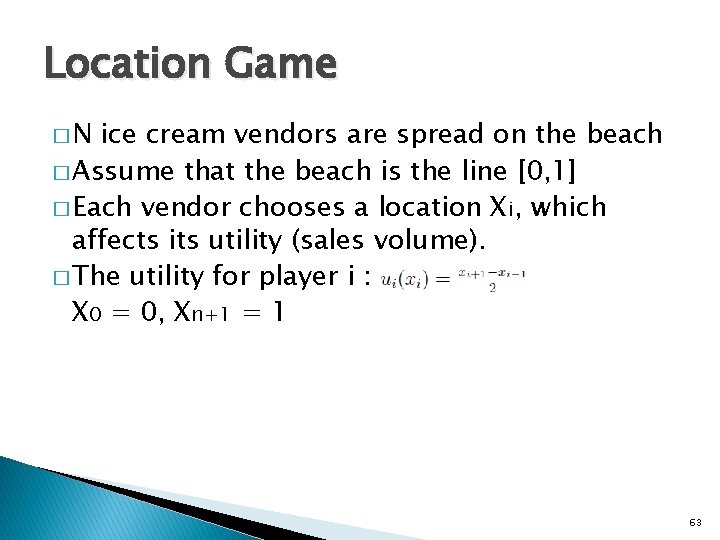
Location Game �N ice cream vendors are spread on the beach � Assume that the beach is the line [0, 1] � Each vendor chooses a location Xi, which affects its utility (sales volume). � The utility for player i : X 0 = 0, Xn+1 = 1 63
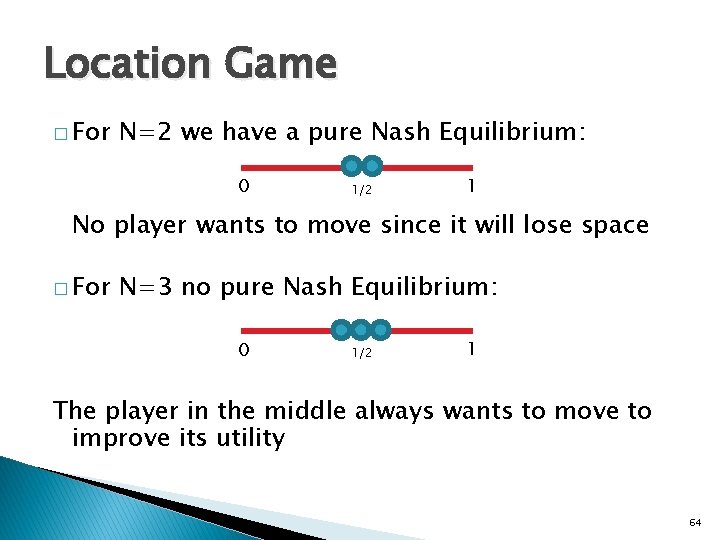
Location Game � For N=2 we have a pure Nash Equilibrium: 0 1/2 1 No player wants to move since it will lose space � For N=3 no pure Nash Equilibrium: 0 1/2 1 The player in the middle always wants to move to improve its utility 64
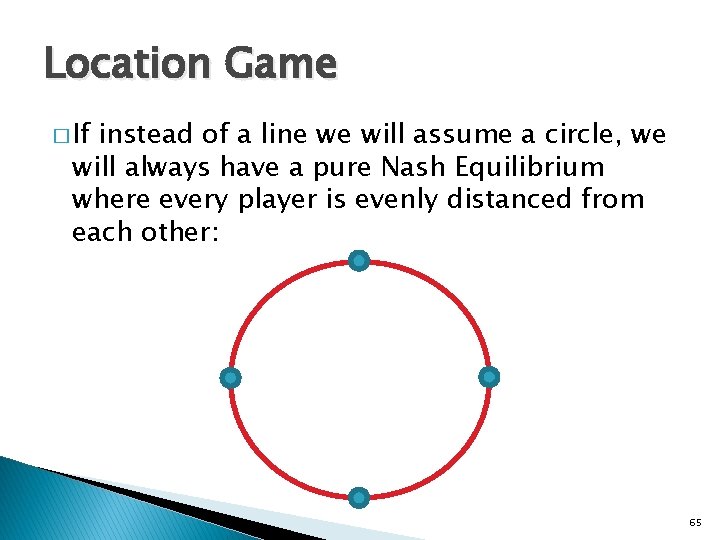
Location Game � If instead of a line we will assume a circle, we will always have a pure Nash Equilibrium where every player is evenly distanced from each other: 65
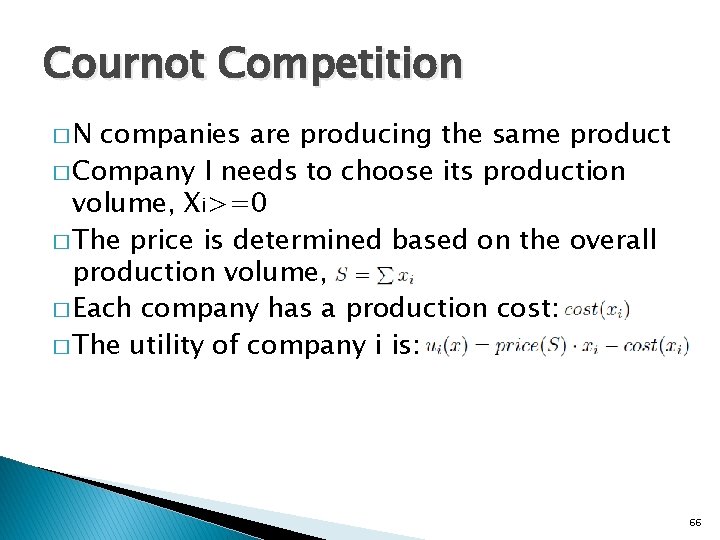
Cournot Competition �N companies are producing the same product � Company I needs to choose its production volume, Xi>=0 � The price is determined based on the overall production volume, � Each company has a production cost: � The utility of company i is: 66
Cournot Competition � Case 1: Linear price, no production cost ◦ Company i’s utility: ◦ Pure Nash Equilibrium is reached at: 67
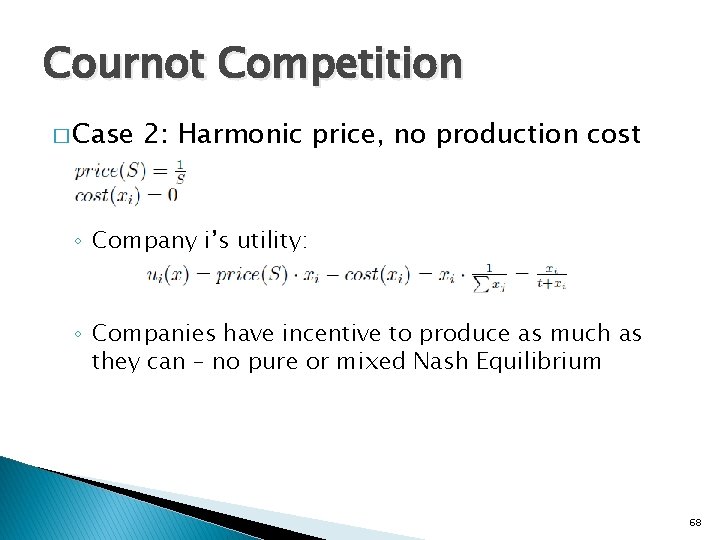
Cournot Competition � Case 2: Harmonic price, no production cost ◦ Company i’s utility: ◦ Companies have incentive to produce as much as they can – no pure or mixed Nash Equilibrium 68
Auction �N players wants to buy a single item which is on sale � Each player has a valuation for the product, vi � Assume WLOG that v 1>=v 2>=… � Each player submits bid, bi, all players submit simultaneously. 69
Auction � Case 1: First price auction ◦ The player with the highest bid wins ◦ The price equals to the bid ◦ 1 st Equilibrium is: �The first player needs to know the valuation of the second player – not practical ◦ 2 nd Equilibrium is: 70
Auction � Case 2: Second price auction ◦ The player with the highest bid wins ◦ The price equals to the second highest bid �No incentive to bid higher than one’s valuation - a player’s utility when it bids its valuation is at least as high than when it bids any other value �This mechanism encourages players to bid truthfully 71