
Computational Fluid Dynamics Simulation of a Baffle Valve
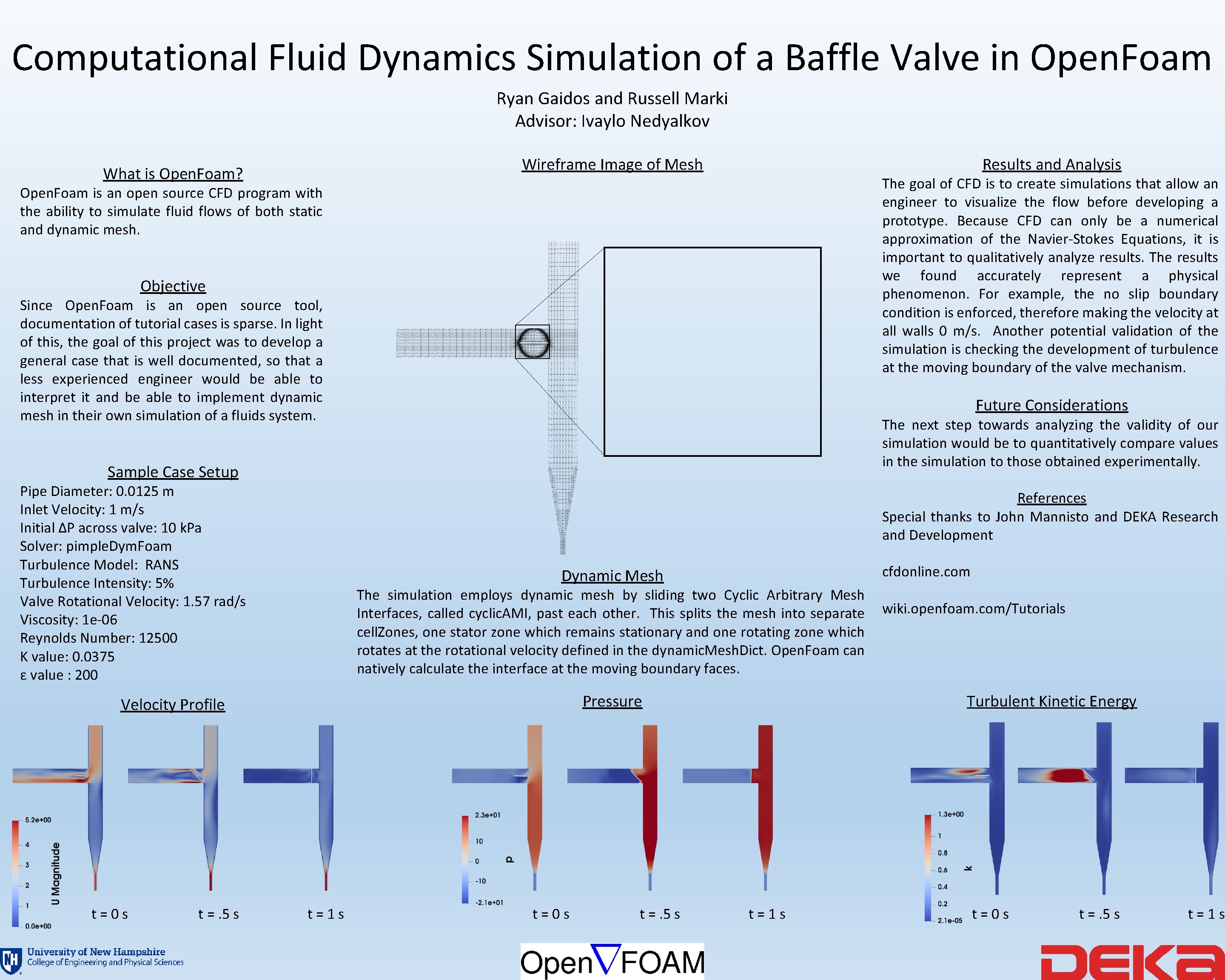
Computational Fluid Dynamics Simulation of a Baffle Valve in Open. Foam Ryan Gaidos and Russell Marki Advisor: Ivaylo Nedyalkov Results and Analysis Wireframe Image of Mesh What is Open. Foam? The goal of CFD is to create simulations that allow an engineer to visualize the flow before developing a prototype. Because CFD can only be a numerical approximation of the Navier-Stokes Equations, it is important to qualitatively analyze results. The results we found accurately represent a physical phenomenon. For example, the no slip boundary condition is enforced, therefore making the velocity at all walls 0 m/s. Another potential validation of the simulation is checking the development of turbulence at the moving boundary of the valve mechanism. Open. Foam is an open source CFD program with the ability to simulate fluid flows of both static and dynamic mesh. Objective Since Open. Foam is an open source tool, documentation of tutorial cases is sparse. In light of this, the goal of this project was to develop a general case that is well documented, so that a less experienced engineer would be able to interpret it and be able to implement dynamic mesh in their own simulation of a fluids system. Future Considerations The next step towards analyzing the validity of our simulation would be to quantitatively compare values in the simulation to those obtained experimentally. Sample Case Setup Pipe Diameter: 0. 0125 m Inlet Velocity: 1 m/s Initial ΔP across valve: 10 k. Pa Solver: pimple. Dym. Foam Turbulence Model: RANS Turbulence Intensity: 5% Valve Rotational Velocity: 1. 57 rad/s Viscosity: 1 e-06 Reynolds Number: 12500 K value: 0. 0375 ε value : 200 References Special thanks to John Mannisto and DEKA Research and Development The simulation employs dynamic mesh by sliding two Cyclic Arbitrary Mesh Interfaces, called cyclic. AMI, past each other. This splits the mesh into separate cell. Zones, one stator zone which remains stationary and one rotating zone which rotates at the rotational velocity defined in the dynamic. Mesh. Dict. Open. Foam can natively calculate the interface at the moving boundary faces. t =. 5 s t=1 s t=0 s t =. 5 s wiki. openfoam. com/Tutorials Turbulent Kinetic Energy Pressure Velocity Profile t=0 s cfdonline. com Dynamic Mesh t=1 s t=0 s t =. 5 s t=1 s
- Slides: 1