
Computational Fluid Dynamics CFD Study on the Influence


- Slides: 17
Computational Fluid Dynamics (CFD) Study on the Influence of Airflow Patterns on Carbon Dioxide Distribution and Emission Rate in a Scaled Livestock Building Li Rong 1), Peter V. Nielsen 1), Guo. Hong Tong 2) Guoqiang Zhang 3), Peter Ravn 3) 1)Department 2) 3) Department of Civil Engineering, Aalborg University Shenyang Agricultural University , China of Agricultural Engineering, Research Centre Bygholm, University of Aarhus 24/06/2008
Outline • • Introduction Validation of CFD model Results Conclusion
Introduction • Concentration distribution inside the livestock building relating to: ventilation system heat condition manure condition etc. • Objective of this paper is to investigate the influence of the ventilation system on concentration distribution
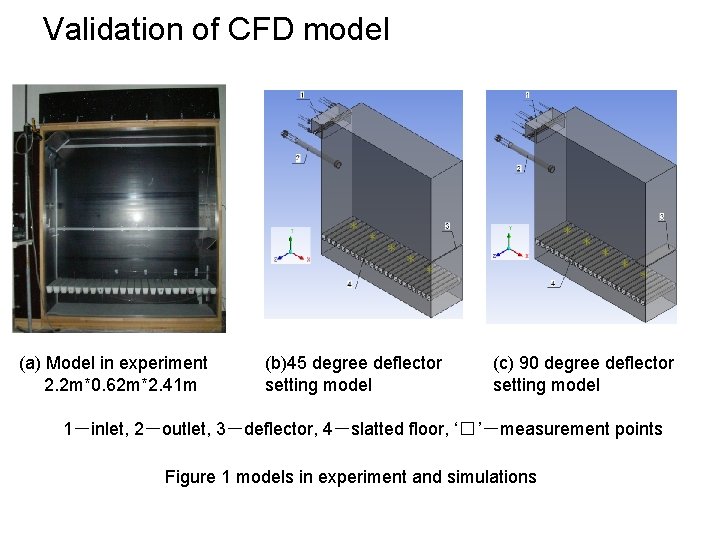
Validation of CFD model (a) Model in experiment 2. 2 m*0. 62 m*2. 41 m (b)45 degree deflector setting model (c) 90 degree deflector setting model 1-inlet, 2-outlet, 3-deflector, 4-slatted floor, ‘� ’-measurement points Figure 1 models in experiment and simulations
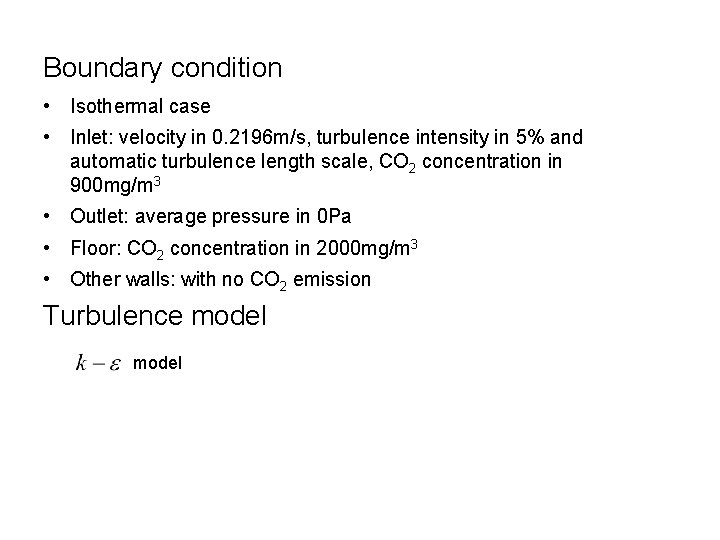
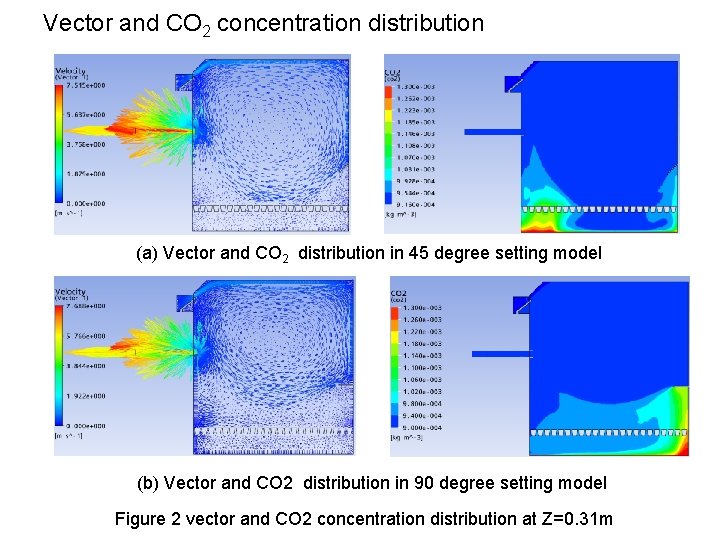
Boundary condition • Isothermal case • Inlet: velocity in 0. 2196 m/s, turbulence intensity in 5% and automatic turbulence length scale, CO 2 concentration in 900 mg/m 3 • Outlet: average pressure in 0 Pa • Floor: CO 2 concentration in 2000 mg/m 3 • Other walls: with no CO 2 emission Turbulence model
Vector and CO 2 concentration distribution (a) Vector and CO 2 distribution in 45 degree setting model (b) Vector and CO 2 distribution in 90 degree setting model Figure 2 vector and CO 2 concentration distribution at Z=0. 31 m
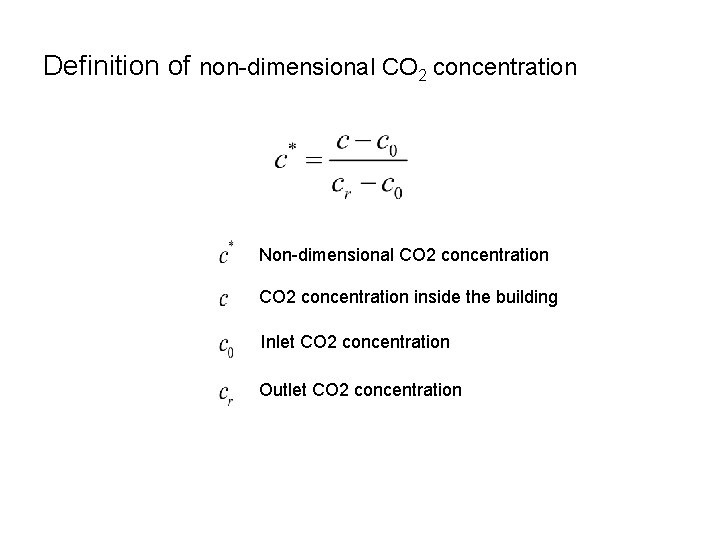
Definition of non-dimensional CO 2 concentration Non-dimensional CO 2 concentration inside the building Inlet CO 2 concentration Outlet CO 2 concentration
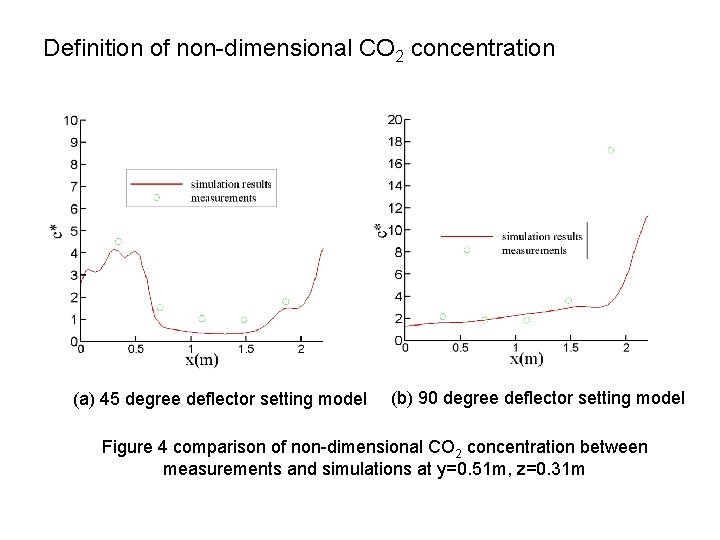
Definition of non-dimensional CO 2 concentration (a) 45 degree deflector setting model (b) 90 degree deflector setting model Figure 4 comparison of non-dimensional CO 2 concentration between measurements and simulations at y=0. 51 m, z=0. 31 m
Results • Influence of airflow rate on non-dimensional CO 2 concentration • Influence of airflow rate on emission rate • Influence of an extra outlet setting below the slatted floor on emission rate
Influence of airflow rate on non-dimensional CO 2 concentration distribution and emission rate Boundary conditions • Airflow rate including 100, 150, 200 m 3/h • Isothermal cases • Floor: with CO 2 concentration in 2000 mg/m 3 • Other walls: with no CO 2 emission • Deflector: 45 degree, 90 degree
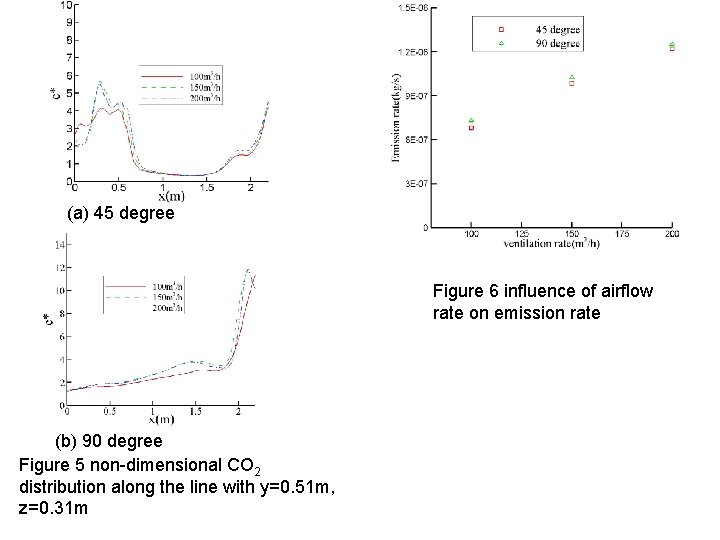
(a) 45 degree Figure 6 influence of airflow rate on emission rate (b) 90 degree Figure 5 non-dimensional CO 2 distribution along the line with y=0. 51 m, z=0. 31 m
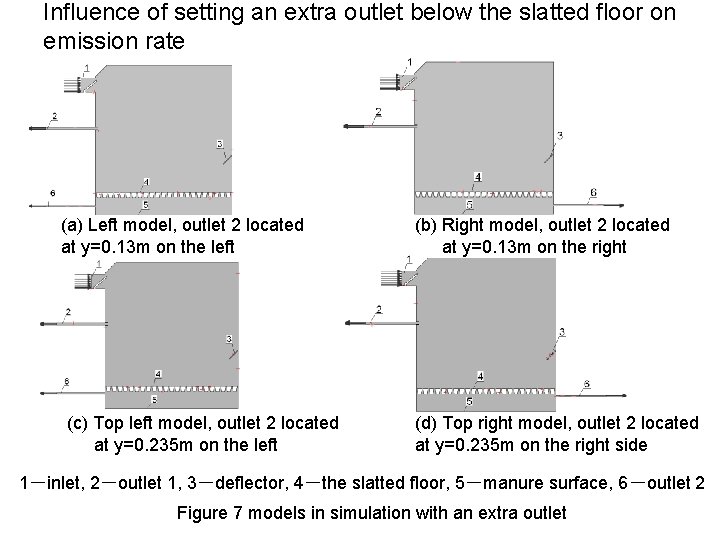
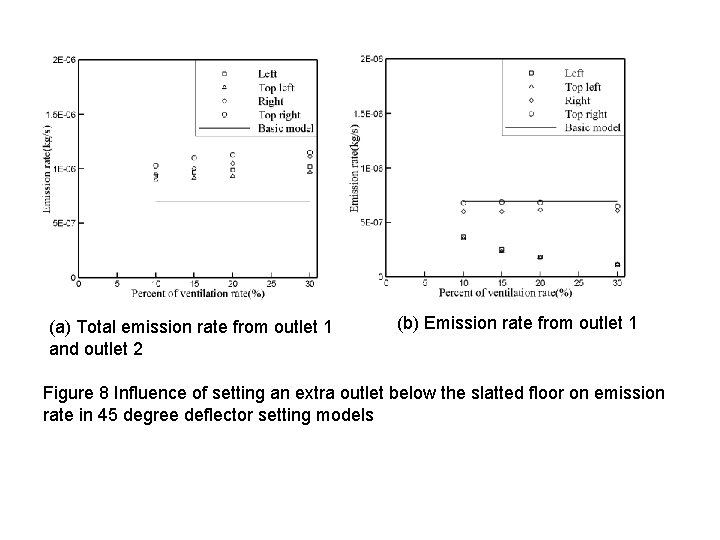
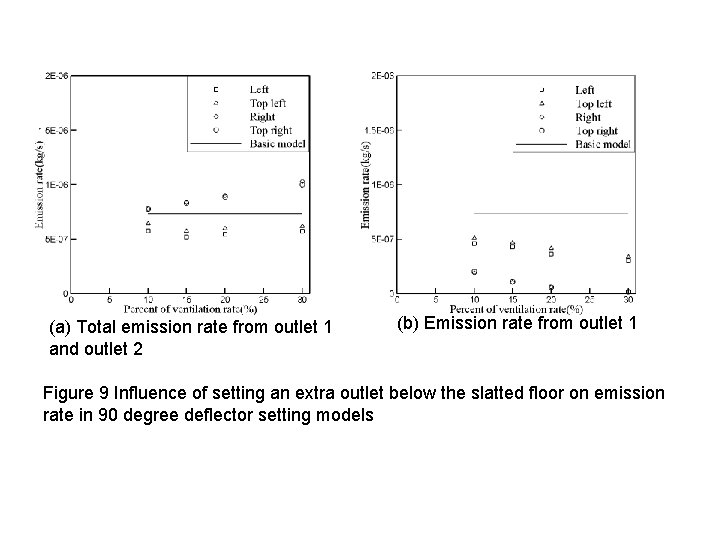
Influence of setting an extra outlet below the slatted floor on emission rate (a) Left model, outlet 2 located at y=0. 13 m on the left (c) Top left model, outlet 2 located at y=0. 235 m on the left (b) Right model, outlet 2 located at y=0. 13 m on the right (d) Top right model, outlet 2 located at y=0. 235 m on the right side 1-inlet, 2-outlet 1, 3-deflector, 4-the slatted floor, 5-manure surface, 6-outlet 2 Figure 7 models in simulation with an extra outlet
Boundary conditions • Isothermal case • Inlet: velocity in 0. 2196 m/s, turbulence intensity in 5% and automatic turbulence length scale, CO 2 concentration in 900 mg/m 3 • Outlet 1: average pressure in 0 Pa • Outlet 2: 10%, 15%, 20%, 30% of ventilation rate • Floor: CO 2 concentration in 2000 mg/m 3 • Other walls: with no CO 2 emission Turbulence model
(a) Total emission rate from outlet 1 and outlet 2 (b) Emission rate from outlet 1 Figure 8 Influence of setting an extra outlet below the slatted floor on emission rate in 45 degree deflector setting models
(a) Total emission rate from outlet 1 and outlet 2 (b) Emission rate from outlet 1 Figure 9 Influence of setting an extra outlet below the slatted floor on emission rate in 90 degree deflector setting models
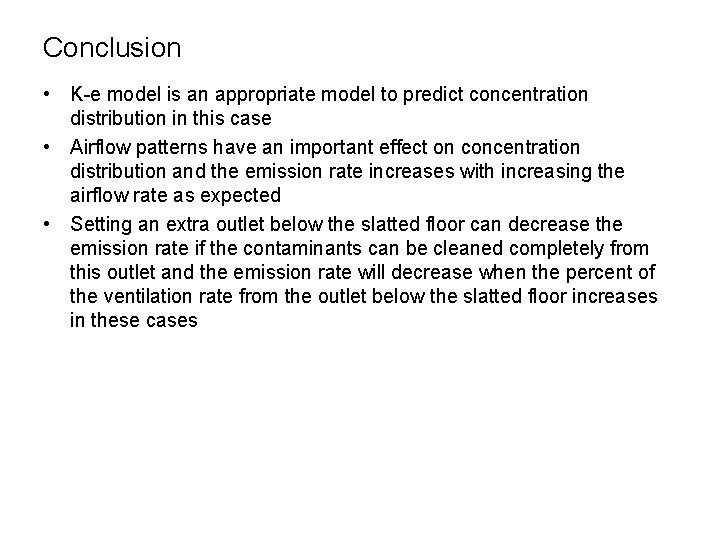
Conclusion • K-e model is an appropriate model to predict concentration distribution in this case • Airflow patterns have an important effect on concentration distribution and the emission rate increases with increasing the airflow rate as expected • Setting an extra outlet below the slatted floor can decrease the emission rate if the contaminants can be cleaned completely from this outlet and the emission rate will decrease when the percent of the ventilation rate from the outlet below the slatted floor increases in these cases
Thank you very much!