
Computational Complexity Theory Lecture 9 Read once certificates

- Slides: 68
Computational Complexity Theory Lecture 9: Read once certificates; NL = co-NL Indian Institute of Science
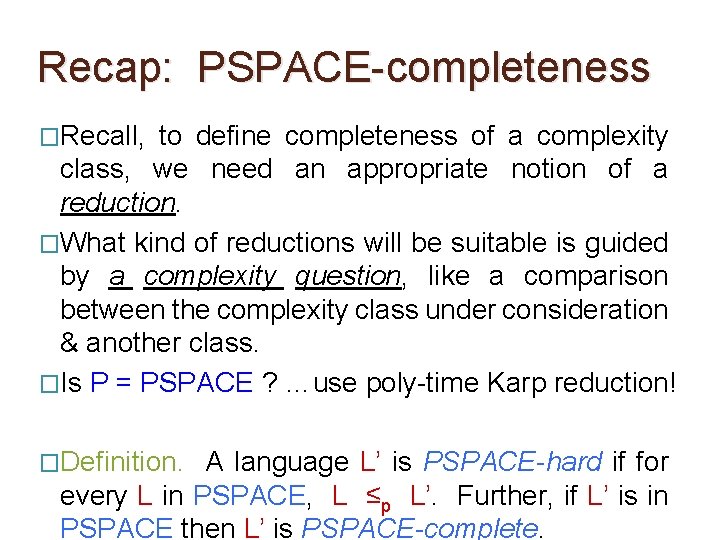
Recap: PSPACE-completeness �Recall, to define completeness of a complexity class, we need an appropriate notion of a reduction. �What kind of reductions will be suitable is guided by a complexity question, like a comparison between the complexity class under consideration & another class. �Is P = PSPACE ? …use poly-time Karp reduction! �Definition. A language L’ is PSPACE-hard if for every L in PSPACE, L ≤p L’. Further, if L’ is in PSPACE then L’ is PSPACE-complete.
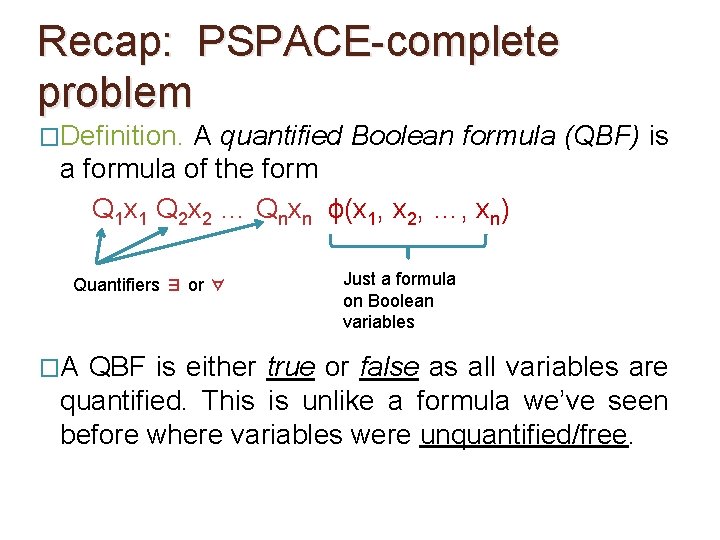
Recap: PSPACE-complete problem �Definition. A quantified Boolean formula (QBF) is a formula of the form Q 1 x 1 Q 2 x 2 … Qnxn ϕ(x 1, x 2, …, xn) Quantifiers ∃ or ∀ �A Just a formula on Boolean variables QBF is either true or false as all variables are quantified. This is unlike a formula we’ve seen before where variables were unquantified/free.
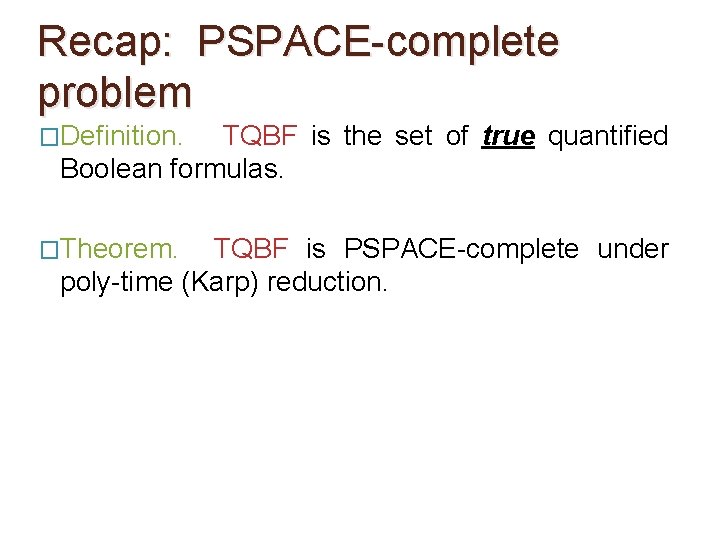
Recap: PSPACE-complete problem �Definition. TQBF is the set of true quantified Boolean formulas. �Theorem. TQBF is PSPACE-complete under poly-time (Karp) reduction.
Recap: NL-completeness �Recall again, to define completeness of a complexity class, we need an appropriate notion of a reduction. �What kind of reductions will be suitable is guided by a complexity question, like a comparison between the complexity class under consideration & another class. �Is L = NL ? …poly-time (Karp) reductions are much too powerful for L. �We need to define a suitable ‘log-space’ reduction.
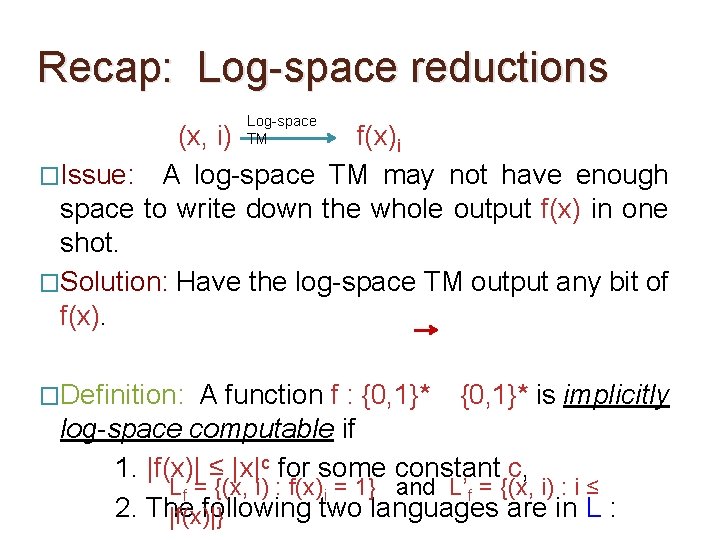
Recap: Log-space reductions Log-space TM (x, i) f(x)i �Issue: A log-space TM may not have enough space to write down the whole output f(x) in one shot. �Solution: Have the log-space TM output any bit of f(x). �Definition: A function f : {0, 1}* is implicitly log-space computable if 1. |f(x)| ≤ |x|c for some constant c, Lf = {(x, i) : f(x)i = 1} and L’f = {(x, i) : i ≤ 2. The following two languages are in L : |f(x)|}
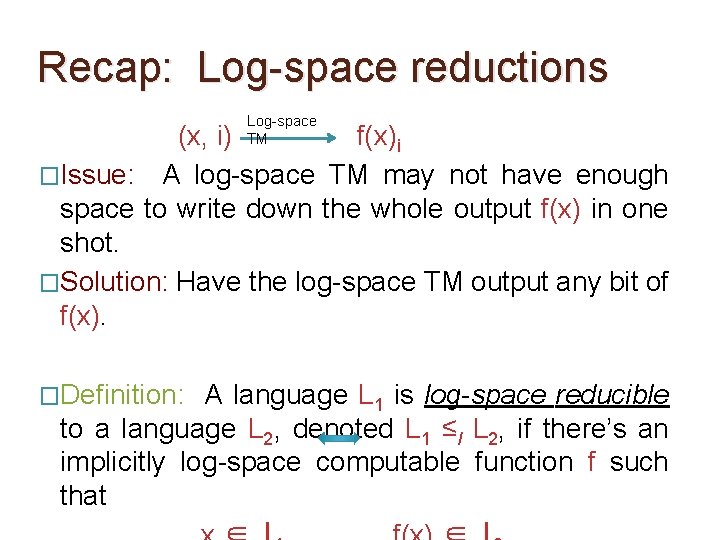
Recap: Log-space reductions Log-space TM (x, i) f(x)i �Issue: A log-space TM may not have enough space to write down the whole output f(x) in one shot. �Solution: Have the log-space TM output any bit of f(x). �Definition: A language L 1 is log-space reducible to a language L 2, denoted L 1 ≤l L 2, if there’s an implicitly log-space computable function f such that
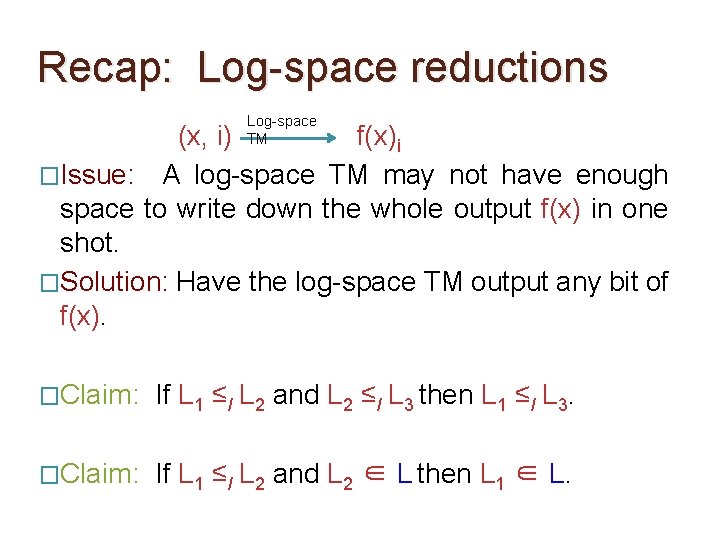
Recap: Log-space reductions Log-space TM (x, i) f(x)i �Issue: A log-space TM may not have enough space to write down the whole output f(x) in one shot. �Solution: Have the log-space TM output any bit of f(x). �Claim: If L 1 ≤l L 2 and L 2 ≤l L 3 then L 1 ≤l L 3. �Claim: If L 1 ≤l L 2 and L 2 ∈ L then L 1 ∈ L.
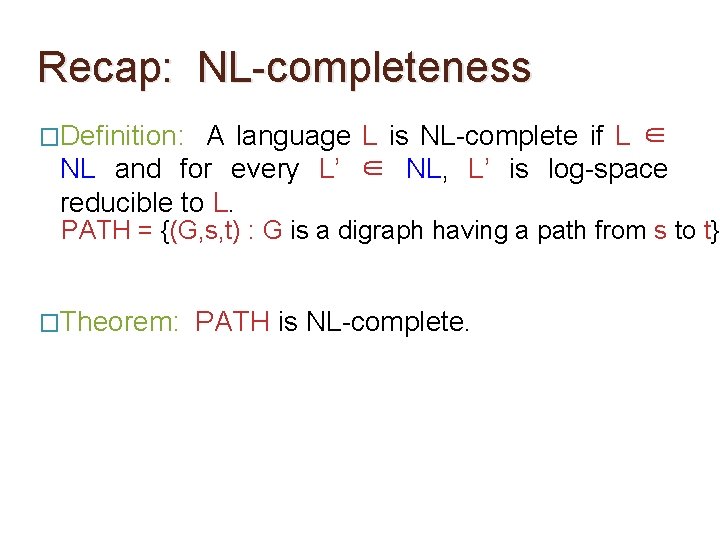
Recap: NL-completeness �Definition: A language L is NL-complete if L ∈ NL and for every L’ ∈ NL, L’ is log-space reducible to L. PATH = {(G, s, t) : G is a digraph having a path from s to t}. �Theorem: PATH is NL-complete.
An alternate characterization of NL
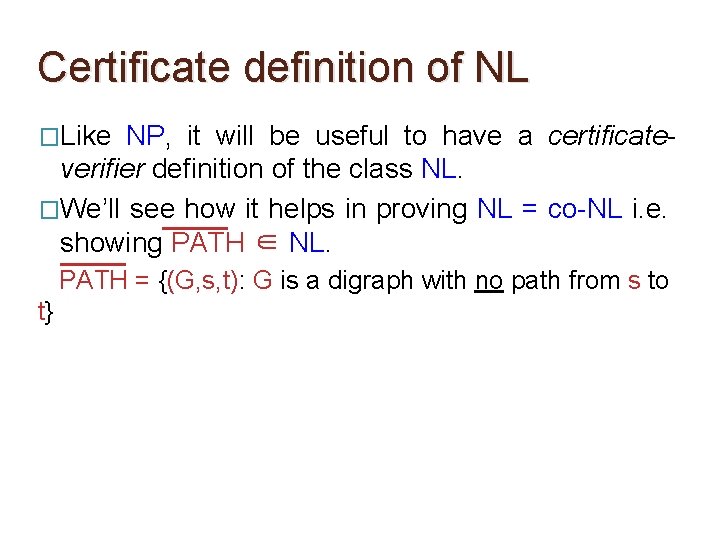
Certificate definition of NL �Like NP, it will be useful to have a certificateverifier definition of the class NL. �We’ll see how it helps in proving NL = co-NL i. e. showing PATH ∈ NL. PATH = {(G, s, t): G is a digraph with no path from s to t}
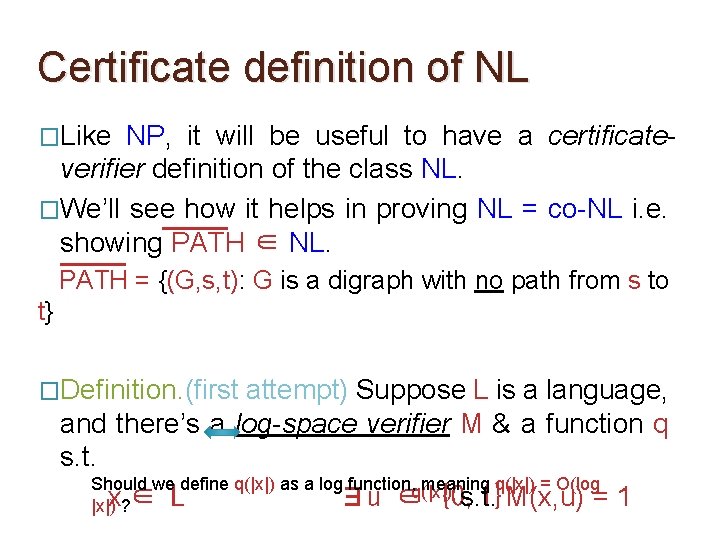
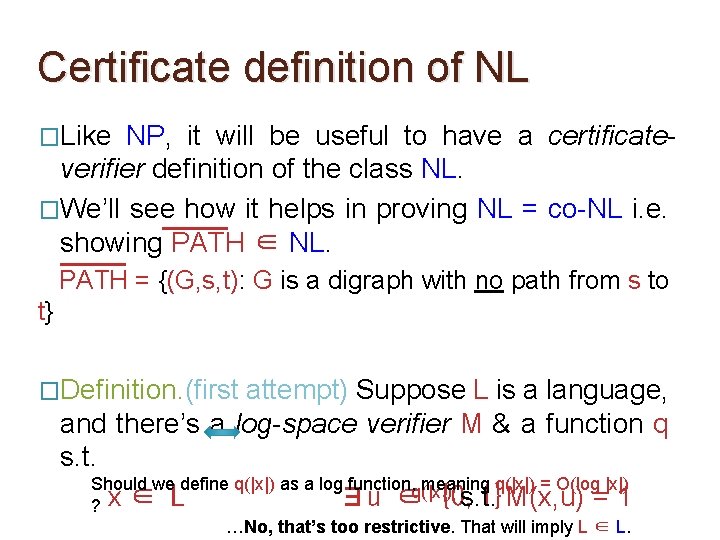
Certificate definition of NL �Like NP, it will be useful to have a certificateverifier definition of the class NL. �We’ll see how it helps in proving NL = co-NL i. e. showing PATH ∈ NL. PATH = {(G, s, t): G is a digraph with no path from s to t} �Definition. (first attempt) Suppose L is a language, and there’s a log-space verifier M & a function q s. t. Should we define q(|x|) as a log function, q(|x|) meaning q(|x|) = O(log ∃u ∈ {0, 1} s. t. M(x, u) = 1 |x|)x? ∈ L
Certificate definition of NL �Like NP, it will be useful to have a certificateverifier definition of the class NL. �We’ll see how it helps in proving NL = co-NL i. e. showing PATH ∈ NL. PATH = {(G, s, t): G is a digraph with no path from s to t} �Definition. (first attempt) Suppose L is a language, and there’s a log-space verifier M & a function q s. t. Should we define q(|x|) as a log function, q(|x|) meaning q(|x|) = O(log |x|) ∃u ∈ {0, 1} s. t. M(x, u) = 1 ? x ∈ L …No, that’s too restrictive. That will imply L ∈ L.
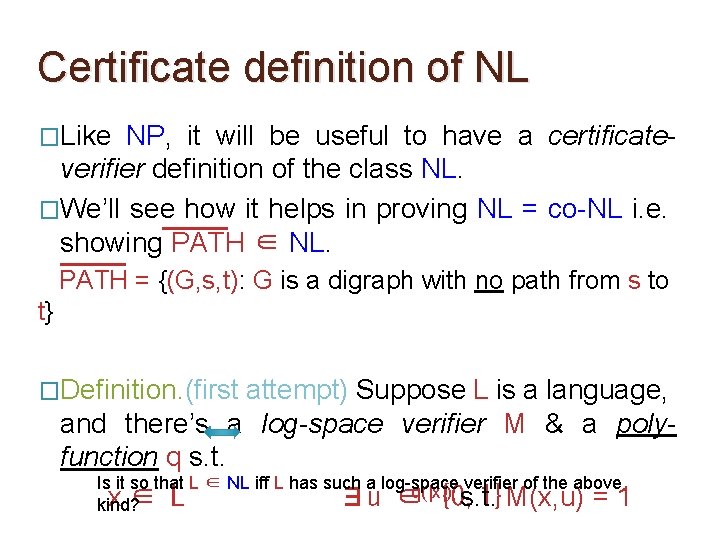
Certificate definition of NL �Like NP, it will be useful to have a certificateverifier definition of the class NL. �We’ll see how it helps in proving NL = co-NL i. e. showing PATH ∈ NL. PATH = {(G, s, t): G is a digraph with no path from s to t} �Definition. (first attempt) Suppose L is a language, and there’s a log-space verifier M & a polyfunction q s. t. Is it so that L ∈ NL iff L has such a log-space verifier of the above q(|x|) x∈ L ∃u ∈ {0, 1} s. t. M(x, u) = 1 kind?
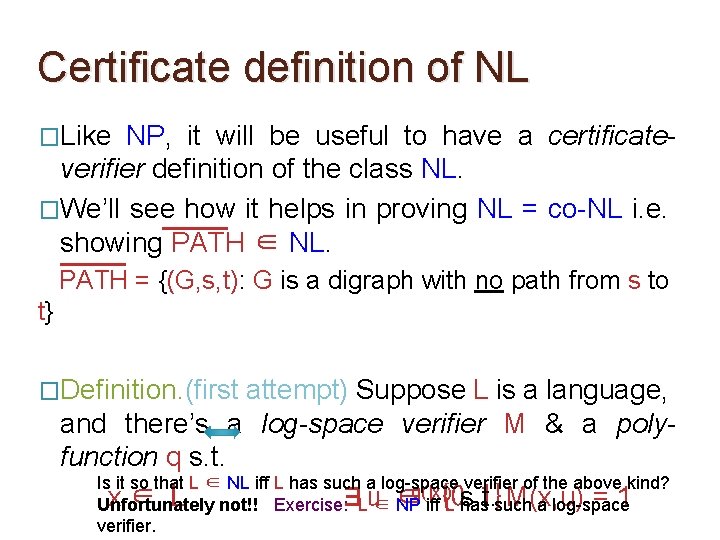
Certificate definition of NL �Like NP, it will be useful to have a certificateverifier definition of the class NL. �We’ll see how it helps in proving NL = co-NL i. e. showing PATH ∈ NL. PATH = {(G, s, t): G is a digraph with no path from s to t} �Definition. (first attempt) Suppose L is a language, and there’s a log-space verifier M & a polyfunction q s. t. Is it so that L ∈ NL iff L has such a log-space verifier of the above kind? q(|x|) x ∈ L not!! Exercise: ∃u s. t. such M(x, u) =1 Unfortunately L∈∈ NP iff{0, 1} L has a log-space verifier.
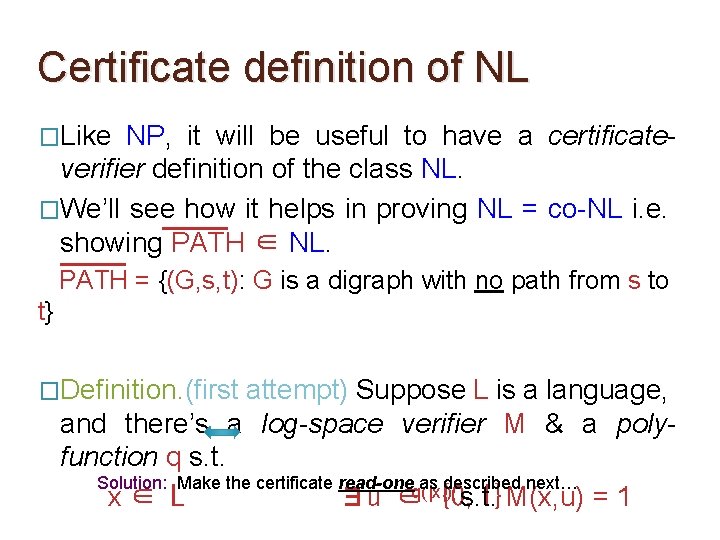
Certificate definition of NL �Like NP, it will be useful to have a certificateverifier definition of the class NL. �We’ll see how it helps in proving NL = co-NL i. e. showing PATH ∈ NL. PATH = {(G, s, t): G is a digraph with no path from s to t} �Definition. (first attempt) Suppose L is a language, and there’s a log-space verifier M & a polyfunction q s. t. Solution: Make the certificate read-oneq(|x|) as described next… x∈ L ∃u ∈ {0, 1} s. t. M(x, u) = 1
Certificate definition of NL �Like NP, it will be useful to have a certificateverifier definition of the class NL. �We’ll see how it helps in proving NL = co-NL i. e. showing PATH ∈ NL. PATH = {(G, s, t): G is a digraph with no path from s to t} �Definition. A tape is called a read-one tape if the head moves from left to right and never turns back.
Certificate definition of NL �Like NP, it will be useful to have a certificateverifier definition of the class NL. �We’ll see how it helps in proving NL = co-NL i. e. showing PATH ∈ NL. PATH = {(G, s, t): G is a digraph with no path from s to t} �Definition. A language L has read-once certificates if there’s a log-space verifier M & a poly-function q s. t. x∈ L ∃u ∈q(|x|) {0, 1} s. t. M(x, u) = 1,
Certificate definition of NL �Like NP, it will be useful to have a certificateverifier definition of the class NL. �We’ll see how it helps in proving NL = co-NL i. e. showing PATH ∈ NL. PATH = {(G, s, t): G is a digraph with no path from s to t} �Theorem. L ∈ NL iff L has read-once certificates.
Certificate definition of NL �Like NP, it will be useful to have a certificateverifier definition of the class NL. �We’ll see how it helps in proving NL = co-NL i. e. showing PATH ∈ NL. PATH = {(G, s, t): G is a digraph with no path from s to t} �Theorem. L ∈ NL iff L has read-once certificates. �Proof. Suppose L ∈ NL. Let N be an NTM that decides L. Think of a verifier M that on input (x, u) simulates N on input x by using u as the nondeterministic choices of N. Clearly |u| =
Certificate definition of NL �Like NP, it will be useful to have a certificateverifier definition of the class NL. �We’ll see how it helps in proving NL = co-NL i. e. showing PATH ∈ NL. PATH = {(G, s, t): G is a digraph with no path from s to t} �Theorem. L ∈ NL iff L has read-once certificates. �Proof. …as GN, x has poly(|x|) configurations. M scans u from left to right without moving its head backward. So, u is a read-once certificate satisfying,
Certificate definition of NL �Like NP, it will be useful to have a certificateverifier definition of the class NL. �We’ll see how it helps in proving NL = co-NL i. e. showing PATH ∈ NL. PATH = {(G, s, t): G is a digraph with no path from s to t} �Theorem. L ∈ NL iff L has read-once certificates. �Proof. Suppose L has read-once certificates, and M be a log-space verifier s. t. x∈ L ∃u ∈q(|x|) {0, 1} s. t. M(x, u) = 1.
Certificate definition of NL �Like NP, it will be useful to have a certificateverifier definition of the class NL. �We’ll see how it helps in proving NL = co-NL i. e. showing PATH ∈ NL. PATH = {(G, s, t): G is a digraph with no path from s to t} �Theorem. L ∈ NL iff L has read-once certificates. �Proof. Now, think of an NTM N that on input x starts simulating M. It guesses the bits of u as and when required during the simulation. As u is read-once for M, there’s no need for N to store u.
Certificate definition of NL �Like NP, it will be useful to have a certificateverifier definition of the class NL. �We’ll see how it helps in proving NL = co-NL i. e. showing PATH ∈ NL. PATH = {(G, s, t): G is a digraph with no path from s to t} �Theorem. L ∈ NL iff L has read-once certificates. �Proof. So, N is a log-space NTM deciding L.
NL = co-NL
Class co-NL �Definition. A language L is in co-NL if L ∈ NL. L is co-NL complete if L ∈ co-NL and for every L’ ∈ co-NL, L’ is log-space reducible to L. PATH = {(G, s, t): G is a digraph with no path from s to t} �Obs. PATH is co-NL complete under log-space reduction.
Class co-NL �Definition. A language L is in co-NL if L ∈ NL. L is co-NL complete if L ∈ co-NL and for every L’ ∈ co-NL, L’ is log-space reducible to L. PATH = {(G, s, t): G is a digraph with no path from s to t} �Obs. PATH is co-NL complete under log-space reduction. �Obs. If L’ log-space reduces to a language in NL then L’ ∈ NL. So, if PATH ∈ NL then NL = co-
NL = co-NL �Theorem. (Immerman, Szelepcsenyi) PATH ∈ NL. �Proof. It is sufficient to show that there’s a logspace verifier M & a poly-function q s. t. x ∈ PATH ∃u ∈ q(|x|) {0, 1} s. t. M(x, u) = 1, where u is given on a read-once input tape of M. �Let us focus on forming a read-once certificate u that convinces a verifier that there’s no path from s to t…
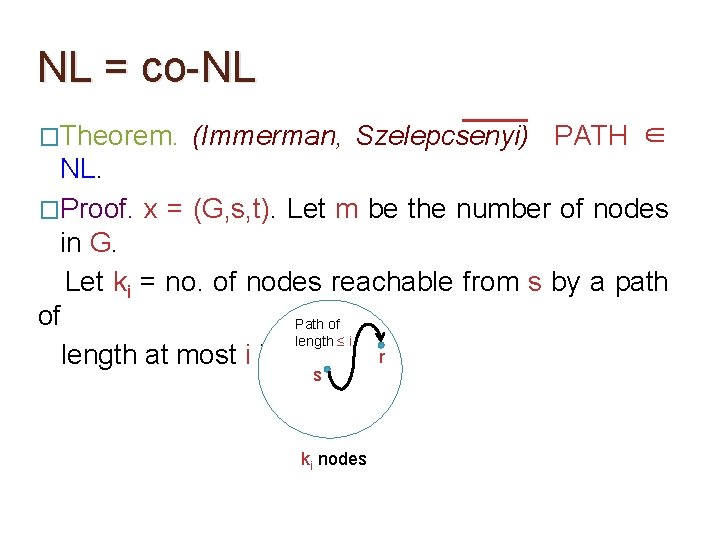
NL = co-NL �Theorem. (Immerman, Szelepcsenyi) PATH ∈ NL. �Proof. x = (G, s, t). Let m be the number of nodes in G. Let ki = no. of nodes reachable from s by a path of Path of length ≤ i r length at most i in G. s ki nodes
NL = co-NL �Theorem. (Immerman, Szelepcsenyi) PATH ∈ NL. �Proof. x = (G, s, t). Let m be the number of nodes in G. Let ki = no. of nodes reachable from s by a path of length at most i in G. Read-once certificate u is of the form (u 1, u 2, …, um, v), where ui’s and v are strings s. t. (1) reading until (u 1, u 2, …ui) in a read-once fashion, M
NL = co-NL �Theorem. (Immerman, Szelepcsenyi) PATH ∈ NL. �Proof. x = (G, s, t). Let m be the number of nodes in G. Let ki = no. of nodes reachable from s by a path of length at most i in G. Read-once certificate u is of the form (u 1, u 2, …, um, v), where ui’s and v are strings s. t. (1) reading until (u 1, u 2, …ui) in a read-once fashion, M
NL = co-NL �Theorem. (Immerman, Szelepcsenyi) PATH ∈ NL. �Proof. x = (G, s, t). Let m be the number of nodes in G. Let ki = no. of nodes reachable from s by a path of length at most i in G. Read-once certificate u is of the form (u 1, u 2, …, um, v), where ui’s and v are strings s. t. (1) reading until (u 1, u 2, …ui) in a read-once fashion, M
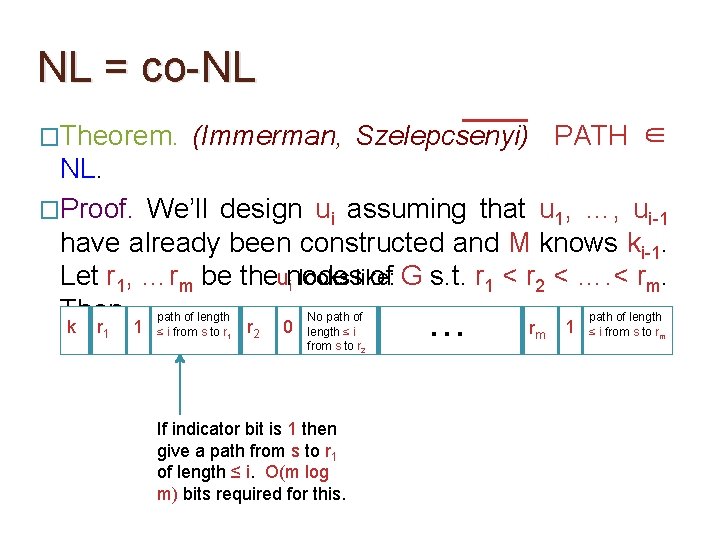
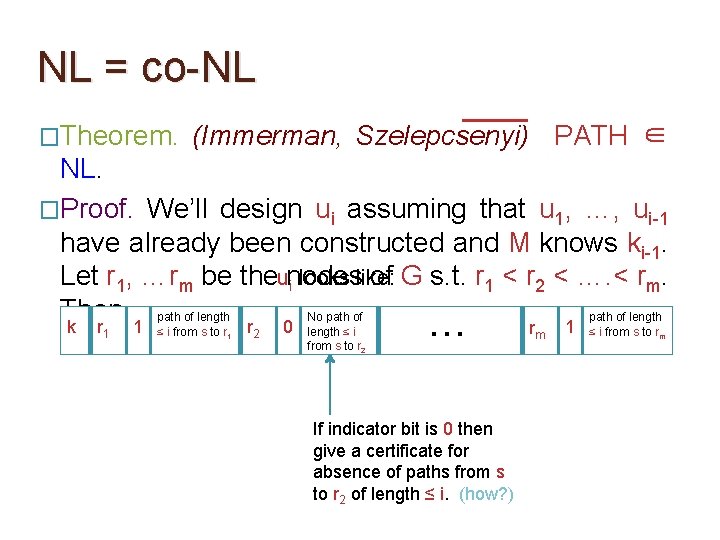
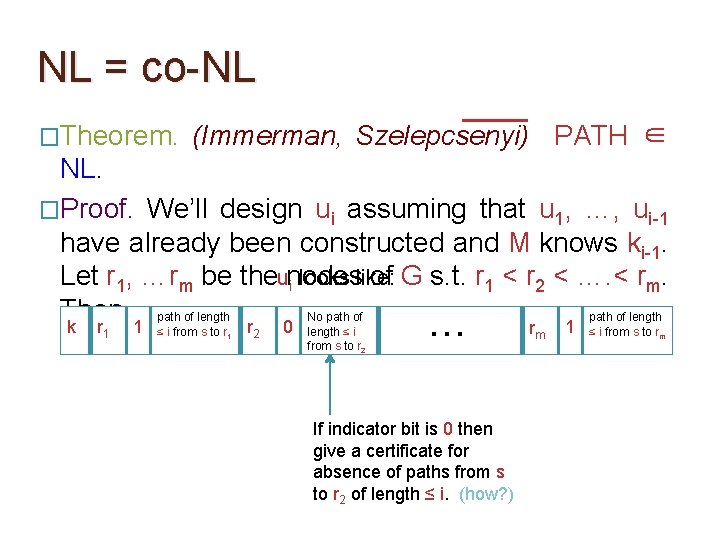
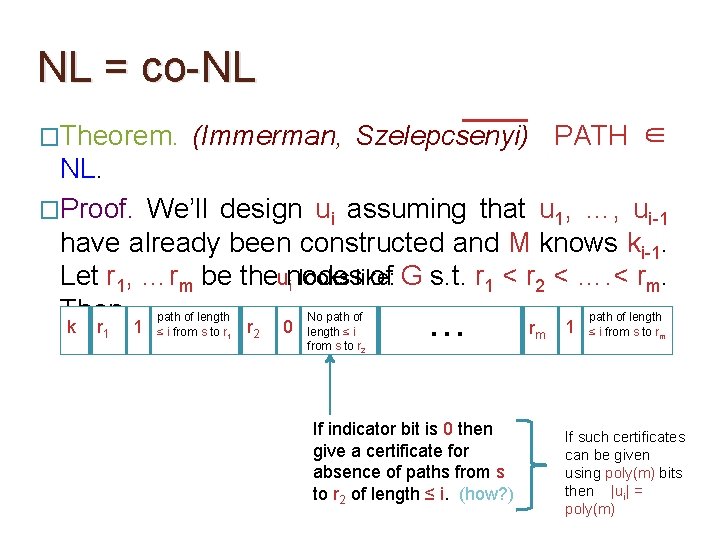
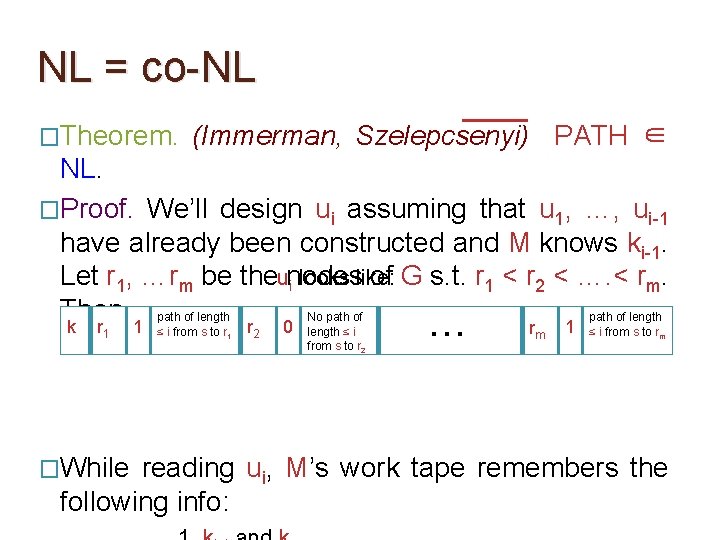
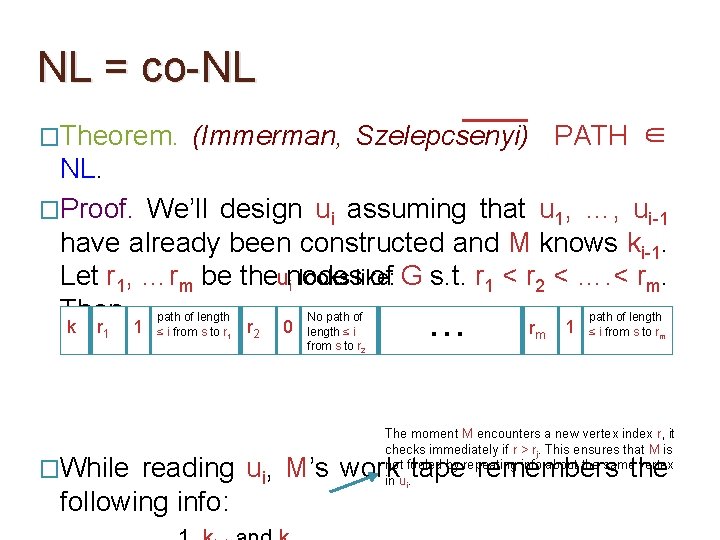
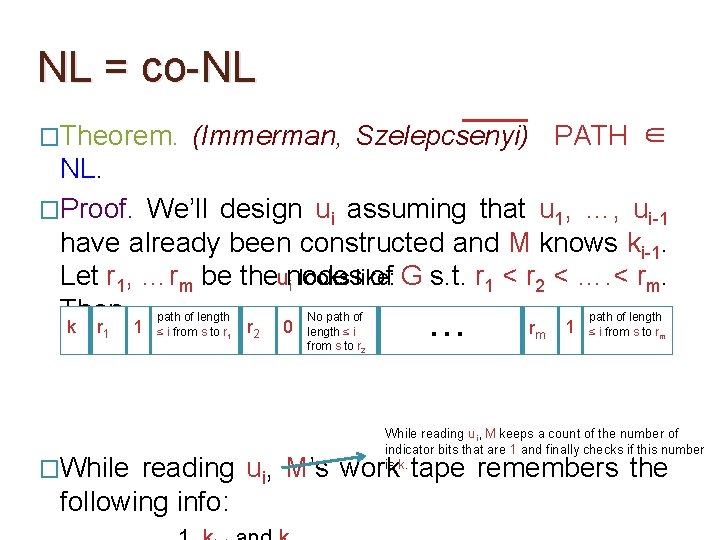
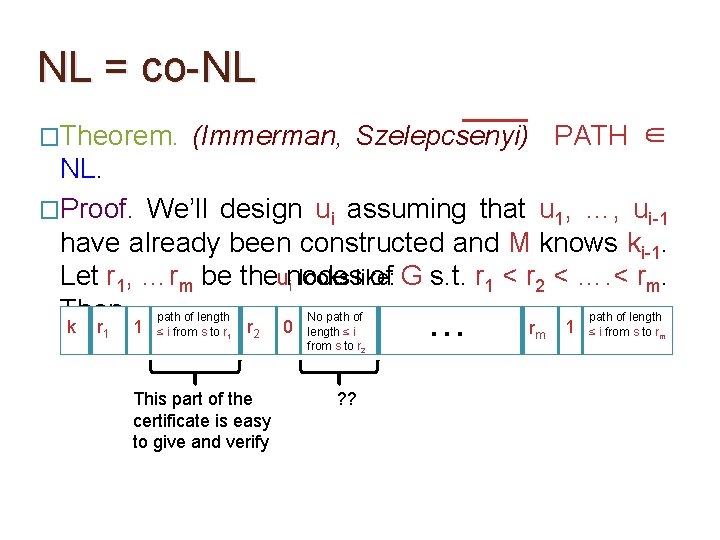
NL = co-NL �Theorem. (Immerman, Szelepcsenyi) PATH ∈ NL. �Proof. We’ll design ui assuming that u 1, …, ui-1 have already been constructed and M knows ki-1. Let r 1, …rm be the nodes of G s. t. r 1 < r 2 < …. < rm. Then,
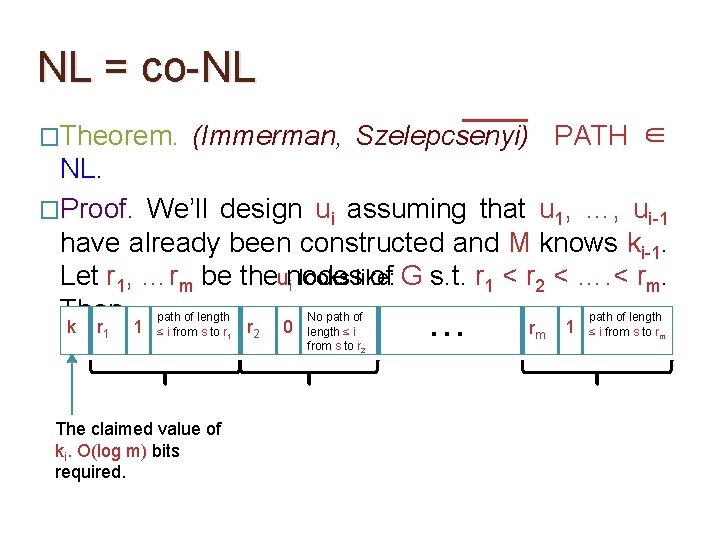
NL = co-NL �Theorem. (Immerman, Szelepcsenyi) PATH ∈ NL. �Proof. We’ll design ui assuming that u 1, …, ui-1 have already been constructed and M knows ki-1. Let r 1, …rm be theunodes of G s. t. r 1 < r 2 < …. < rm. i looks like: Then, path of length No path of length k r 1 1 ≤ i from s to r 1 The claimed value of ki. O(log m) bits required. r 2 0 length ≤ i from s to r 2 … rm 1 ≤ i from s to rm
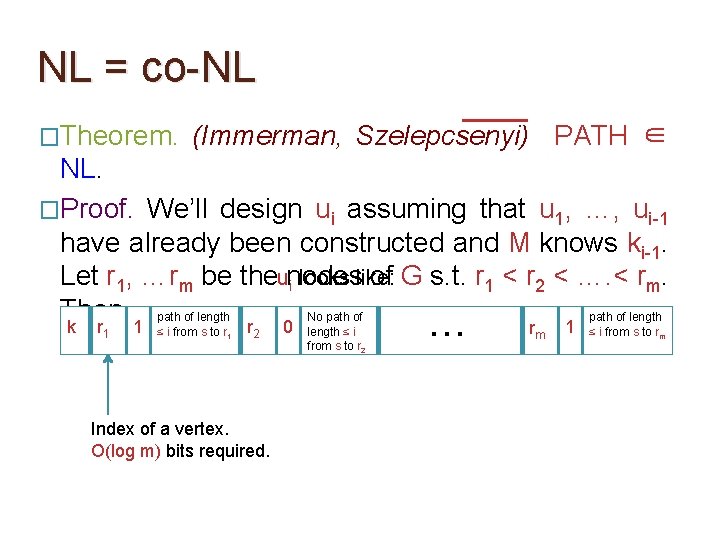
NL = co-NL �Theorem. (Immerman, Szelepcsenyi) PATH ∈ NL. �Proof. We’ll design ui assuming that u 1, …, ui-1 have already been constructed and M knows ki-1. Let r 1, …rm be theunodes of G s. t. r 1 < r 2 < …. < rm. i looks like: Then, path of length No path of length k r 1 1 ≤ i from s to r 1 r 2 Index of a vertex. O(log m) bits required. 0 length ≤ i from s to r 2 … rm 1 ≤ i from s to rm
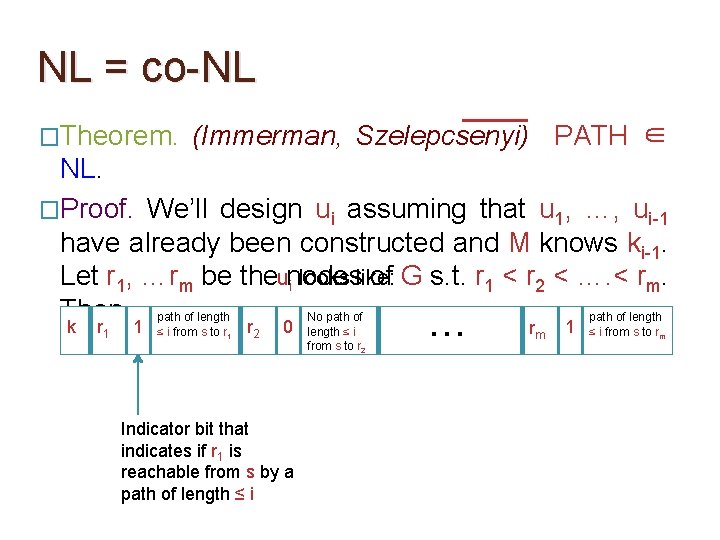
NL = co-NL �Theorem. (Immerman, Szelepcsenyi) PATH ∈ NL. �Proof. We’ll design ui assuming that u 1, …, ui-1 have already been constructed and M knows ki-1. Let r 1, …rm be theunodes of G s. t. r 1 < r 2 < …. < rm. i looks like: Then, path of length No path of length k r 1 1 ≤ i from s to r 1 r 2 0 Indicator bit that indicates if r 1 is reachable from s by a path of length ≤ i from s to r 2 … rm 1 ≤ i from s to rm
NL = co-NL �Theorem. (Immerman, Szelepcsenyi) PATH ∈ NL. �Proof. We’ll design ui assuming that u 1, …, ui-1 have already been constructed and M knows ki-1. Let r 1, …rm be theunodes of G s. t. r 1 < r 2 < …. < rm. i looks like: Then, path of length No path of length k r 1 1 ≤ i from s to r 1 r 2 0 length ≤ i from s to r 2 If indicator bit is 1 then give a path from s to r 1 of length ≤ i. O(m log m) bits required for this. … rm 1 ≤ i from s to rm
NL = co-NL �Theorem. (Immerman, Szelepcsenyi) PATH ∈ NL. �Proof. We’ll design ui assuming that u 1, …, ui-1 have already been constructed and M knows ki-1. Let r 1, …rm be theunodes of G s. t. r 1 < r 2 < …. < rm. i looks like: Then, path of length No path of length k r 1 1 ≤ i from s to r 1 r 2 0 length ≤ i from s to r 2 … If indicator bit is 0 then give a certificate for absence of paths from s to r 2 of length ≤ i. (how? ) rm 1 ≤ i from s to rm
NL = co-NL �Theorem. (Immerman, Szelepcsenyi) PATH ∈ NL. �Proof. We’ll design ui assuming that u 1, …, ui-1 have already been constructed and M knows ki-1. Let r 1, …rm be theunodes of G s. t. r 1 < r 2 < …. < rm. i looks like: Then, path of length No path of length k r 1 1 ≤ i from s to r 1 r 2 0 length ≤ i from s to r 2 … If indicator bit is 0 then give a certificate for absence of paths from s to r 2 of length ≤ i. (how? ) rm 1 ≤ i from s to rm
NL = co-NL �Theorem. (Immerman, Szelepcsenyi) PATH ∈ NL. �Proof. We’ll design ui assuming that u 1, …, ui-1 have already been constructed and M knows ki-1. Let r 1, …rm be theunodes of G s. t. r 1 < r 2 < …. < rm. i looks like: Then, path of length No path of length k r 1 1 ≤ i from s to r 1 r 2 0 length ≤ i from s to r 2 … If indicator bit is 0 then give a certificate for absence of paths from s to r 2 of length ≤ i. (how? ) rm 1 ≤ i from s to rm If such certificates can be given using poly(m) bits then |ui| = poly(m)
NL = co-NL �Theorem. (Immerman, Szelepcsenyi) PATH ∈ NL. �Proof. We’ll design ui assuming that u 1, …, ui-1 have already been constructed and M knows ki-1. Let r 1, …rm be theunodes of G s. t. r 1 < r 2 < …. < rm. i looks like: Then, path of length No path of length k r 1 �While 1 ≤ i from s to r 1 r 2 0 length ≤ i from s to r 2 … rm 1 ≤ i from s to rm reading ui, M’s work tape remembers the following info:
NL = co-NL �Theorem. (Immerman, Szelepcsenyi) PATH ∈ NL. �Proof. We’ll design ui assuming that u 1, …, ui-1 have already been constructed and M knows ki-1. Let r 1, …rm be theunodes of G s. t. r 1 < r 2 < …. < rm. i looks like: Then, path of length No path of length k r 1 �While 1 ≤ i from s to r 1 r 2 0 length ≤ i from s to r 2 … rm 1 ≤ i from s to rm The moment M encounters a new vertex index r, it checks immediately if r > rj. This ensures that M is not fooled by repeating info about the same vertex in ui. reading ui, M’s work tape remembers the following info:
NL = co-NL �Theorem. (Immerman, Szelepcsenyi) PATH ∈ NL. �Proof. We’ll design ui assuming that u 1, …, ui-1 have already been constructed and M knows ki-1. Let r 1, …rm be theunodes of G s. t. r 1 < r 2 < …. < rm. i looks like: Then, path of length No path of length k r 1 �While 1 ≤ i from s to r 1 r 2 0 length ≤ i from s to r 2 … rm 1 ≤ i from s to rm While reading ui, M keeps a count of the number of indicator bits that are 1 and finally checks if this number is k. reading ui, M’s work tape remembers the following info:
NL = co-NL �Theorem. (Immerman, Szelepcsenyi) PATH ∈ NL. �Proof. We’ll design ui assuming that u 1, …, ui-1 have already been constructed and M knows ki-1. Let r 1, …rm be theunodes of G s. t. r 1 < r 2 < …. < rm. i looks like: Then, path of length No path of length k r 1 1 ≤ i from s to r 1 r 2 This part of the certificate is easy to give and verify 0 length ≤ i from s to r 2 ? ? … rm 1 ≤ i from s to rm
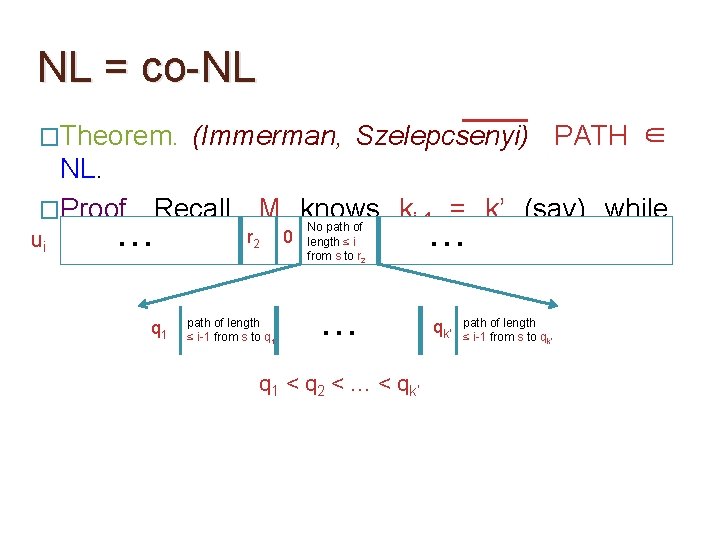
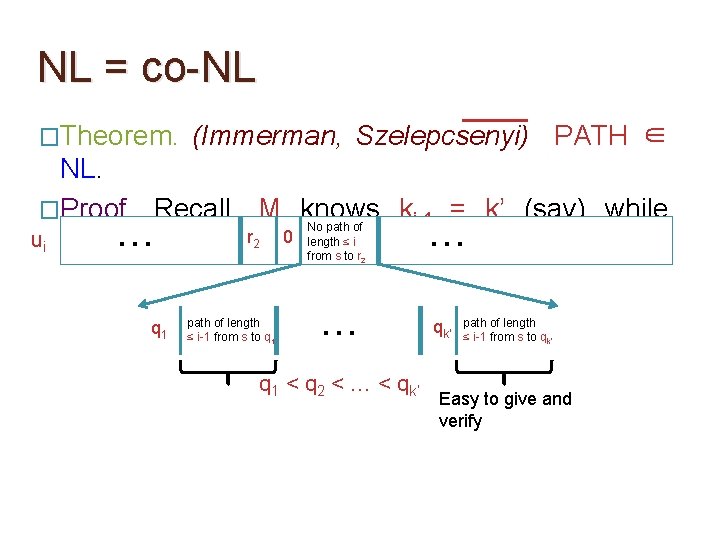
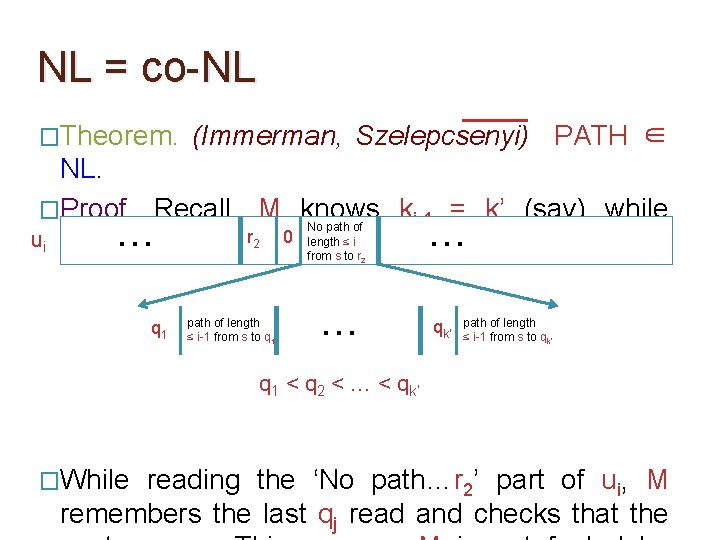
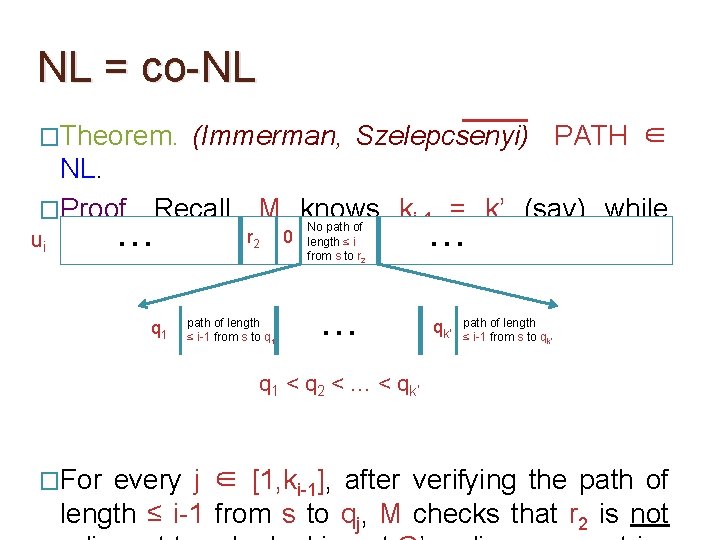
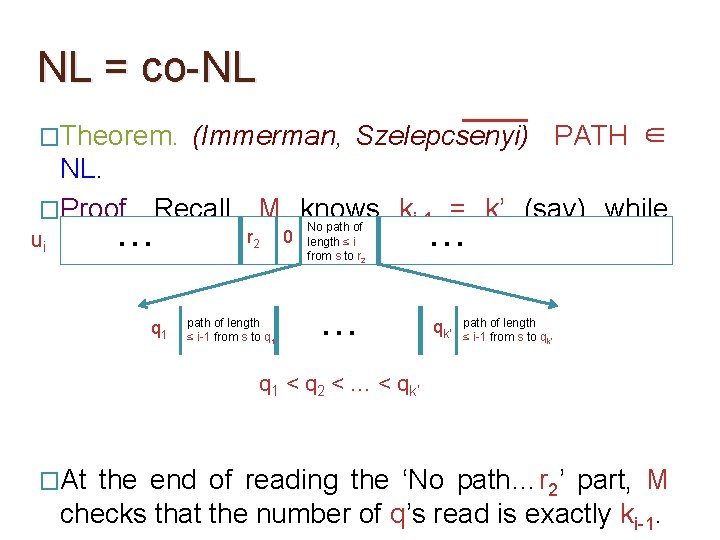
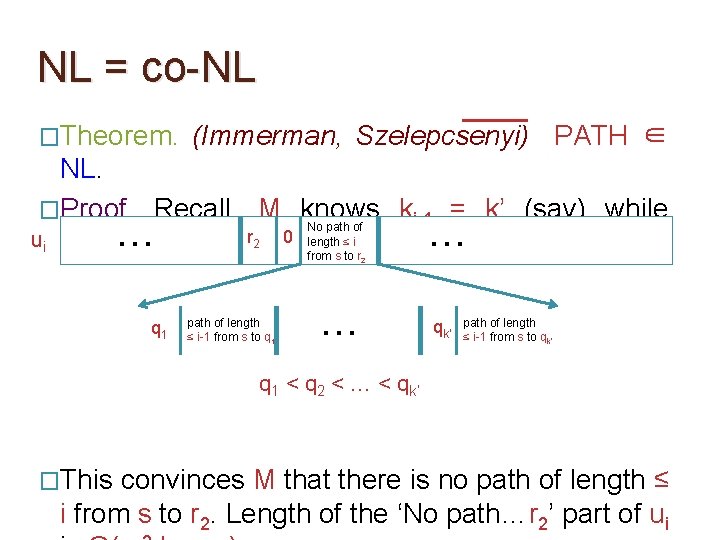
NL = co-NL �Theorem. (Immerman, Szelepcsenyi) PATH ∈ NL. �Proof. Recall, M knows ki-1 = k’ (say) while No path of r 0 length ≤ i … u i. … ui reading 2 from s to r 2 q 1 path of length ≤ i-1 from s to q 1 … q 1 < q 2 < … < qk’ path of length ≤ i-1 from s to qk’
NL = co-NL �Theorem. (Immerman, Szelepcsenyi) PATH ∈ NL. �Proof. Recall, M knows ki-1 = k’ (say) while No path of r 0 length ≤ i … u i. … ui reading 2 from s to r 2 q 1 path of length ≤ i-1 from s to q 1 … q 1 < q 2 < … < qk’ path of length ≤ i-1 from s to qk’ Easy to give and verify
NL = co-NL �Theorem. (Immerman, Szelepcsenyi) PATH ∈ NL. �Proof. Recall, M knows ki-1 = k’ (say) while No path of r 0 length ≤ i … u i. … ui reading 2 from s to r 2 q 1 path of length ≤ i-1 from s to q 1 … qk’ path of length ≤ i-1 from s to qk’ q 1 < q 2 < … < qk’ �While reading the ‘No path…r 2’ part of ui, M remembers the last qj read and checks that the
NL = co-NL �Theorem. (Immerman, Szelepcsenyi) PATH ∈ NL. �Proof. Recall, M knows ki-1 = k’ (say) while No path of r 0 length ≤ i … u i. … ui reading 2 from s to r 2 q 1 path of length ≤ i-1 from s to q 1 … qk’ path of length ≤ i-1 from s to qk’ q 1 < q 2 < … < qk’ �For every j ∈ [1, ki-1], after verifying the path of length ≤ i-1 from s to qj, M checks that r 2 is not
NL = co-NL �Theorem. (Immerman, Szelepcsenyi) PATH ∈ NL. �Proof. Recall, M knows ki-1 = k’ (say) while No path of r 0 length ≤ i … u i. … ui reading 2 from s to r 2 q 1 path of length ≤ i-1 from s to q 1 … qk’ path of length ≤ i-1 from s to qk’ q 1 < q 2 < … < qk’ �At the end of reading the ‘No path…r 2’ part, M checks that the number of q’s read is exactly ki-1.
NL = co-NL �Theorem. (Immerman, Szelepcsenyi) PATH ∈ NL. �Proof. Recall, M knows ki-1 = k’ (say) while No path of r 0 length ≤ i … u i. … ui reading 2 from s to r 2 q 1 path of length ≤ i-1 from s to q 1 … qk’ path of length ≤ i-1 from s to qk’ q 1 < q 2 < … < qk’ �This convinces M that there is no path of length ≤ i from s to r 2. Length of the ‘No path…r 2’ part of ui
NL = co-NL �Theorem. (Immerman, Szelepcsenyi) PATH ∈ NL. �Proof. So, after reading (u 1, …, um), the verifier M knows km, the number of vertices reachable from s. �The v part of the certificate u is similar to the ‘No path…r 2’ part of ui described before. The details here are easy to fill in (homework). �We stress again that M is able to verify
Polynomial Hierarchy
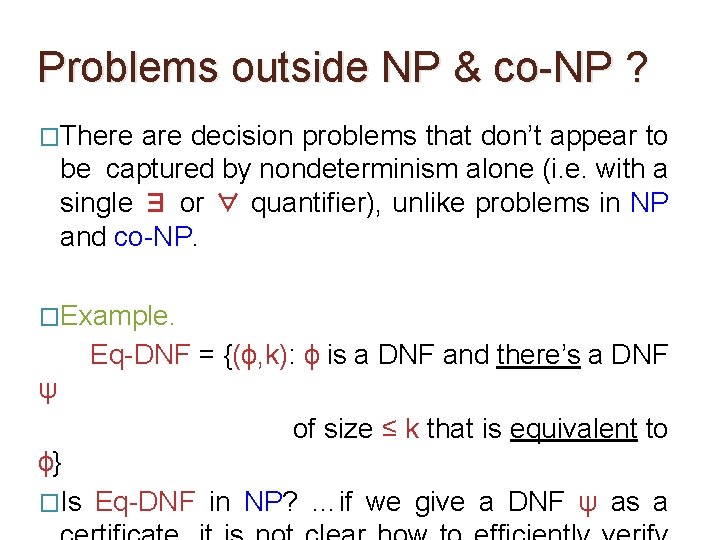
Problems outside NP & co-NP ? �There are decision problems that don’t appear to be captured by nondeterminism alone (i. e. with a single ∃ or ∀ quantifier), unlike problems in NP and co-NP. �Example. Eq-DNF = {(ϕ, k): ϕ is a DNF and there’s a DNF ψ of size ≤ k that is equivalent to ϕ} �Two Boolean formulas on the same input
Problems outside NP & co-NP ? �There are decision problems that don’t appear to be captured by nondeterminism alone (i. e. with a single ∃ or ∀ quantifier), unlike problems in NP and co-NP. �Example. Eq-DNF = {(ϕ, k): ϕ is a DNF and there’s a DNF ψ of size ≤ k that is equivalent to ϕ} �Is Eq-DNF in NP? …if we give a DNF ψ as a
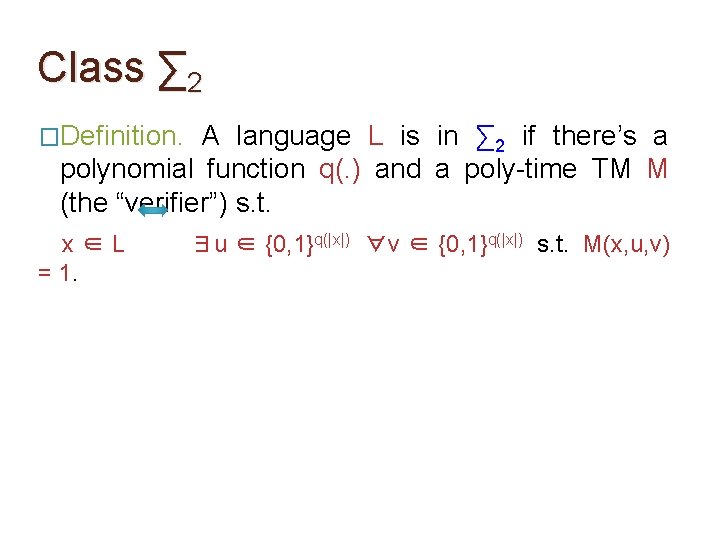
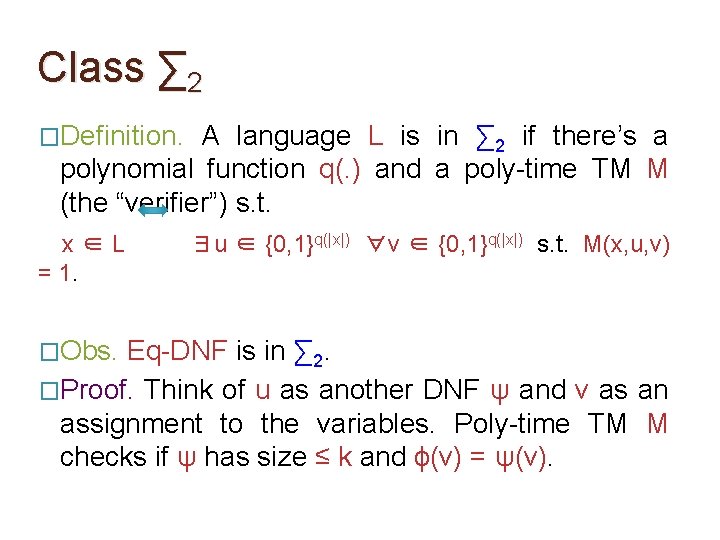
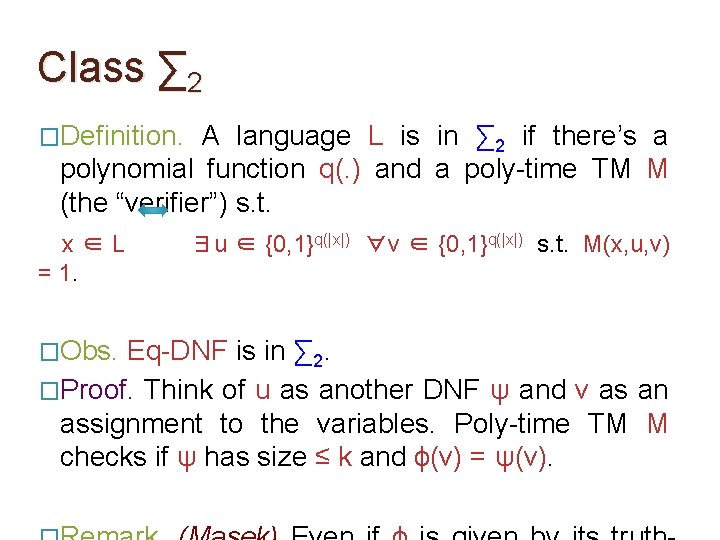
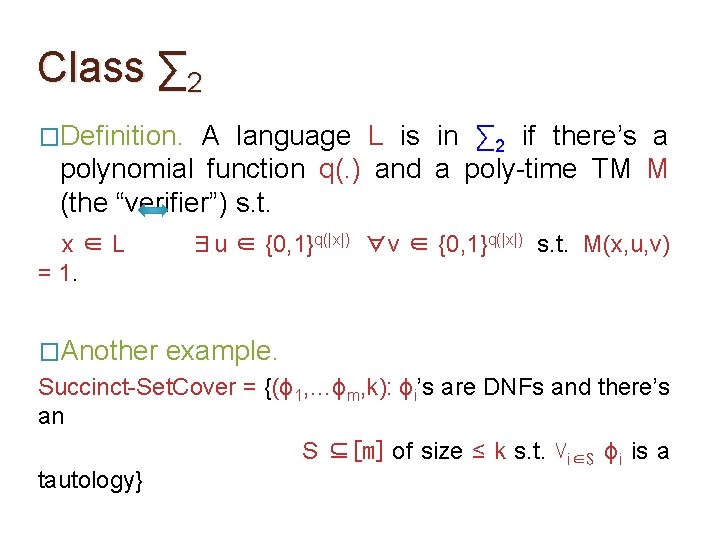
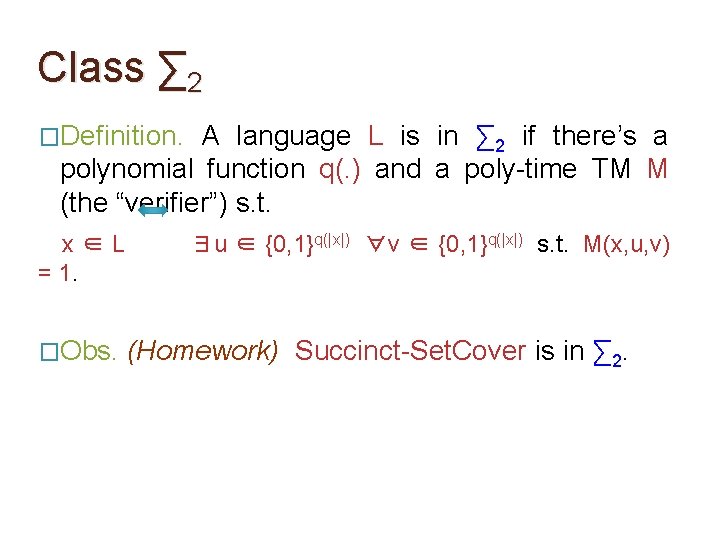
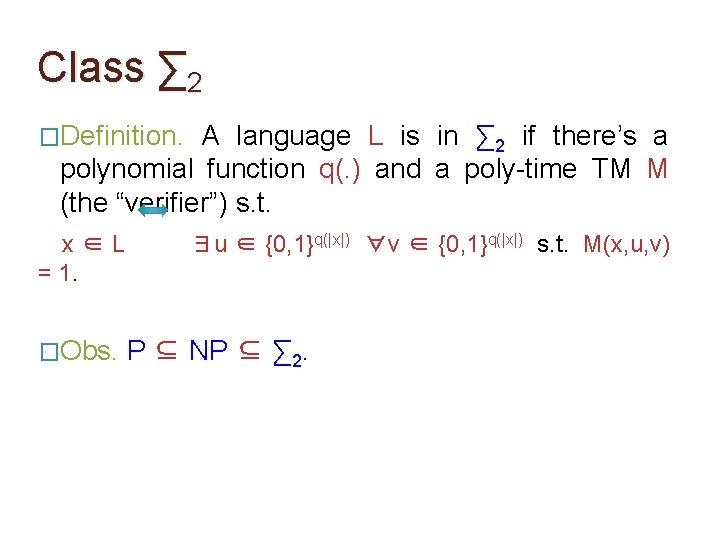
Class ∑ 2 �Definition. A language L is in ∑ 2 if there’s a polynomial function q(. ) and a poly-time TM M (the “verifier”) s. t. x∈L = 1. ∃u ∈ {0, 1}q(|x|) ∀v ∈ {0, 1}q(|x|) s. t. M(x, u, v)
Class ∑ 2 �Definition. A language L is in ∑ 2 if there’s a polynomial function q(. ) and a poly-time TM M (the “verifier”) s. t. x∈L = 1. �Obs. ∃u ∈ {0, 1}q(|x|) ∀v ∈ {0, 1}q(|x|) s. t. M(x, u, v) Eq-DNF is in ∑ 2. �Proof. Think of u as another DNF ψ and v as an assignment to the variables. Poly-time TM M checks if ψ has size ≤ k and ϕ(v) = ψ(v).
Class ∑ 2 �Definition. A language L is in ∑ 2 if there’s a polynomial function q(. ) and a poly-time TM M (the “verifier”) s. t. x∈L = 1. �Obs. ∃u ∈ {0, 1}q(|x|) ∀v ∈ {0, 1}q(|x|) s. t. M(x, u, v) Eq-DNF is in ∑ 2. �Proof. Think of u as another DNF ψ and v as an assignment to the variables. Poly-time TM M checks if ψ has size ≤ k and ϕ(v) = ψ(v).
Class ∑ 2 �Definition. A language L is in ∑ 2 if there’s a polynomial function q(. ) and a poly-time TM M (the “verifier”) s. t. x∈L = 1. �Another ∃u ∈ {0, 1}q(|x|) ∀v ∈ {0, 1}q(|x|) s. t. M(x, u, v) example. Succinct-Set. Cover = {(ϕ 1, …ϕm, k): ϕi’s are DNFs and there’s an S ⊆[m] of size ≤ k s. t. ⋁i∈S ϕi is a tautology}
Class ∑ 2 �Definition. A language L is in ∑ 2 if there’s a polynomial function q(. ) and a poly-time TM M (the “verifier”) s. t. x∈L = 1. �Obs. ∃u ∈ {0, 1}q(|x|) ∀v ∈ {0, 1}q(|x|) s. t. M(x, u, v) (Homework) Succinct-Set. Cover is in ∑ 2.
Class ∑ 2 �Definition. A language L is in ∑ 2 if there’s a polynomial function q(. ) and a poly-time TM M (the “verifier”) s. t. x∈L = 1. �Obs. ∃u ∈ {0, 1}q(|x|) ∀v ∈ {0, 1}q(|x|) s. t. M(x, u, v) P ⊆ NP ⊆ ∑ 2.
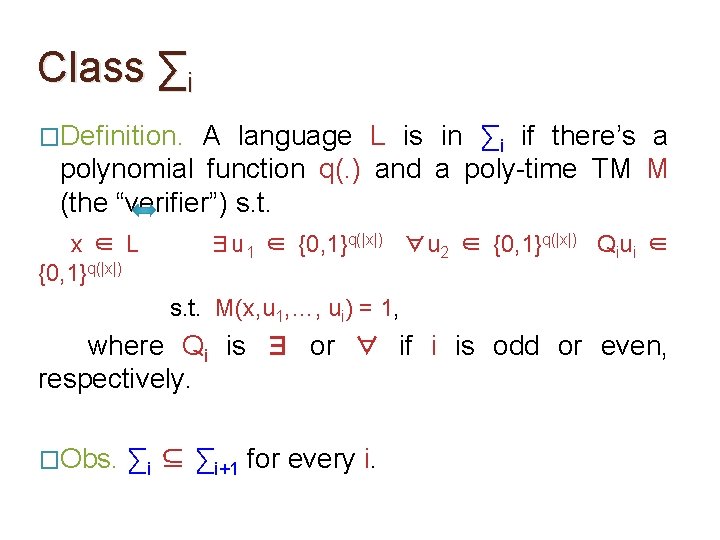
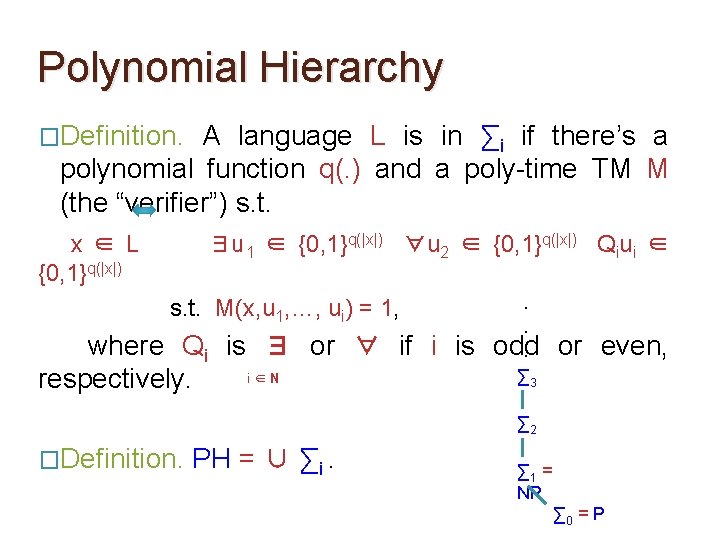
Class ∑i �Definition. A language L is in ∑i if there’s a polynomial function q(. ) and a poly-time TM M (the “verifier”) s. t. x ∈ L {0, 1}q(|x|) ∃u 1 ∈ {0, 1}q(|x|) ∀u 2 ∈ {0, 1}q(|x|) Qiui ∈ s. t. M(x, u 1, …, ui) = 1, where Qi is ∃ or ∀ if i is odd or even, respectively. �Obs. ∑i ⊆ ∑i+1 for every i.
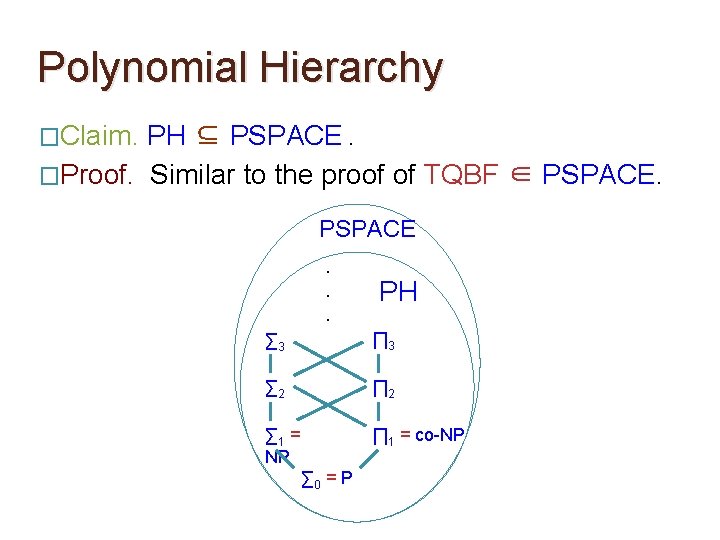
Polynomial Hierarchy �Definition. A language L is in ∑i if there’s a polynomial function q(. ) and a poly-time TM M (the “verifier”) s. t. x ∈ L {0, 1}q(|x|) ∃u 1 ∈ {0, 1}q(|x|) ∀u 2 ∈ {0, 1}q(|x|) Qiui ∈ s. t. M(x, u 1, …, ui) = 1, where Qi is ∃ or ∀ if i is i∈N respectively. . . odd. or even, ∑ 3 ∑ 2 �Definition. PH = ∪ ∑i. ∑ 1 = NP ∑ 0 = P
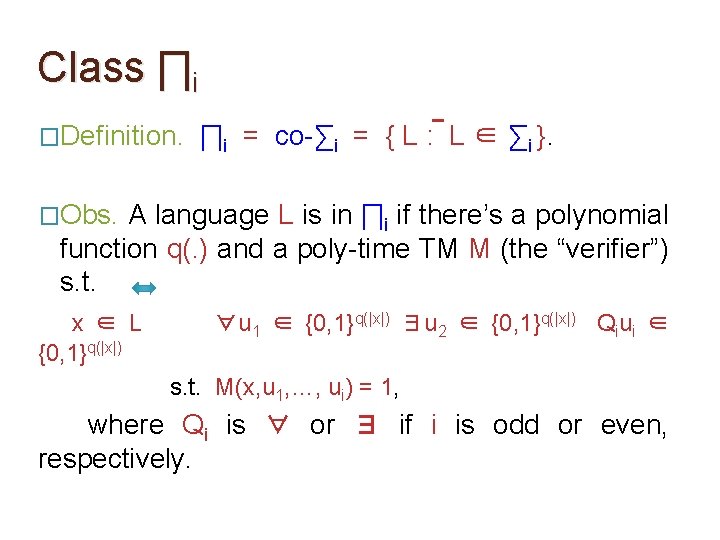
Class ∏i �Definition. ∏i = co-∑i = { L : L ∈ ∑i }. �Obs. A language L is in ∏i if there’s a polynomial function q(. ) and a poly-time TM M (the “verifier”) s. t. x ∈ L {0, 1}q(|x|) ∀u 1 ∈ {0, 1}q(|x|) ∃u 2 ∈ {0, 1}q(|x|) Qiui ∈ s. t. M(x, u 1, …, ui) = 1, where Qi is ∀ or ∃ if i is odd or even, respectively.
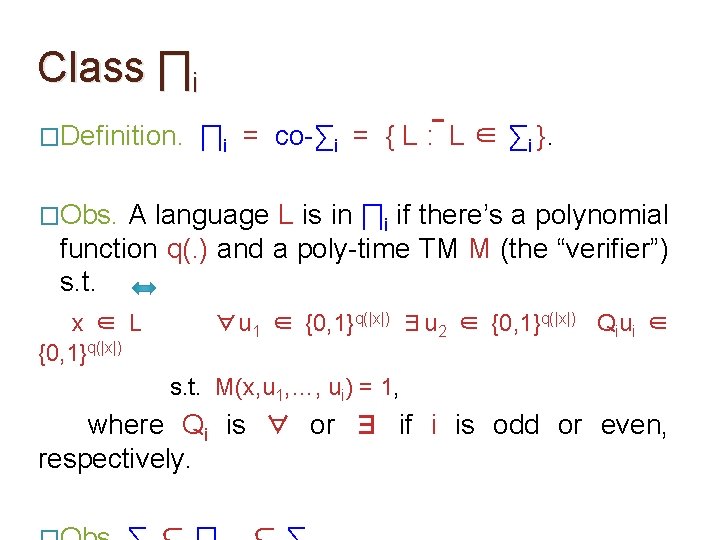
Class ∏i �Definition. ∏i = co-∑i = { L : L ∈ ∑i }. �Obs. A language L is in ∏i if there’s a polynomial function q(. ) and a poly-time TM M (the “verifier”) s. t. x ∈ L {0, 1}q(|x|) ∀u 1 ∈ {0, 1}q(|x|) ∃u 2 ∈ {0, 1}q(|x|) Qiui ∈ s. t. M(x, u 1, …, ui) = 1, where Qi is ∀ or ∃ if i is odd or even, respectively.
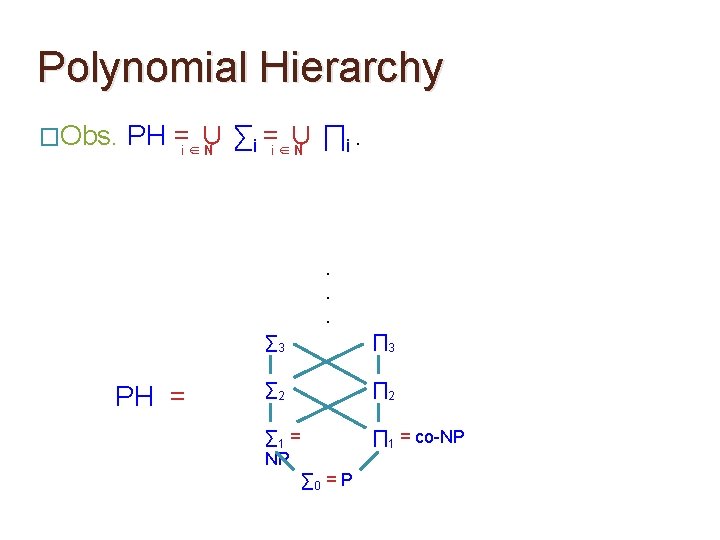
Polynomial Hierarchy �Obs. PH =i ∈∪ ∑i =i ∈∪ ∏i. N N . . . PH = ∑ 3 ∏ 3 ∑ 2 ∏ 2 ∑ 1 = NP ∏ 1 = co-NP ∑ 0 = P
Polynomial Hierarchy �Claim. PH ⊆ PSPACE. �Proof. Similar to the proof of TQBF ∈ PSPACE. . . PH ∑ 3 ∏ 3 ∑ 2 ∏ 2 ∑ 1 = NP ∏ 1 = co-NP ∑ 0 = P
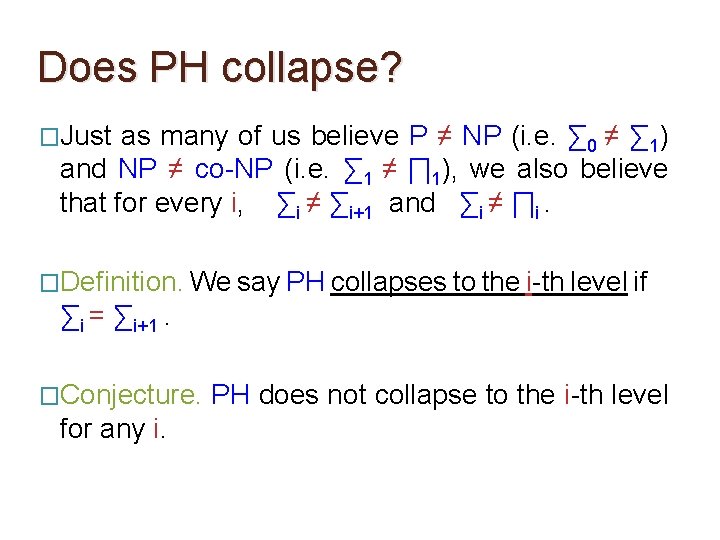
Does PH collapse? �Just as many of us believe P ≠ NP (i. e. ∑ 0 ≠ ∑ 1) and NP ≠ co-NP (i. e. ∑ 1 ≠ ∏ 1), we also believe that for every i, ∑i ≠ ∑i+1 and ∑i ≠ ∏i. �Definition. We say PH collapses to the i-th level if ∑i = ∑i+1. �Conjecture. for any i. PH does not collapse to the i-th level
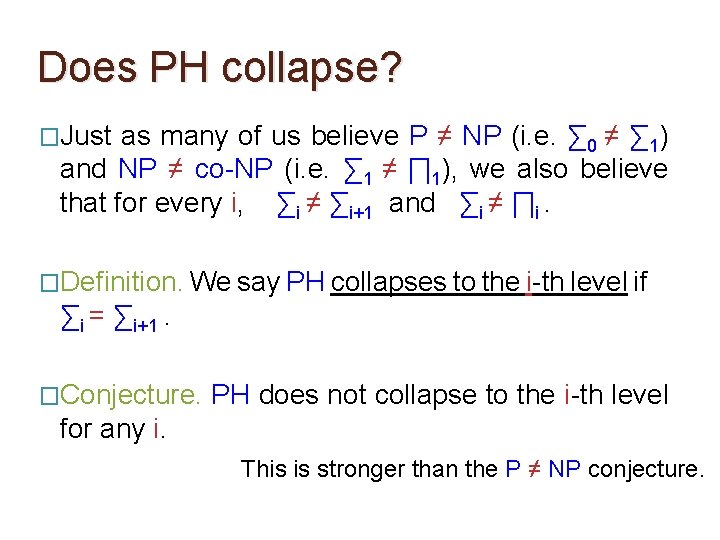
Does PH collapse? �Just as many of us believe P ≠ NP (i. e. ∑ 0 ≠ ∑ 1) and NP ≠ co-NP (i. e. ∑ 1 ≠ ∏ 1), we also believe that for every i, ∑i ≠ ∑i+1 and ∑i ≠ ∏i. �Definition. We say PH collapses to the i-th level if ∑i = ∑i+1. �Conjecture. PH does not collapse to the i-th level for any i. This is stronger than the P ≠ NP conjecture.