
Computational Complexity Theory Lecture 8 Savitchs theorem PSPACE


- Slides: 67
Computational Complexity Theory Lecture 8: Savitch’s theorem; PSPACE and NLcompleteness Indian Institute of Science
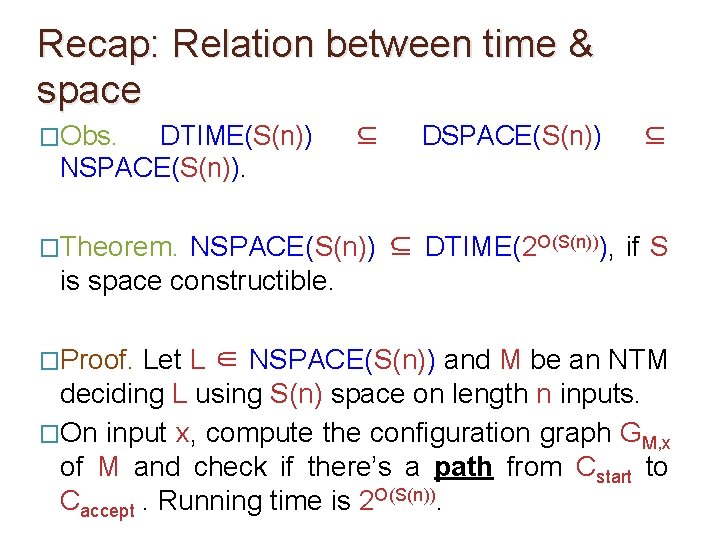
Recap: Relation between time & space �Obs. DTIME(S(n)) NSPACE(S(n)). ⊆ DSPACE(S(n)) �Theorem. ⊆ O(S(n))), if S NSPACE(S(n)) ⊆ DTIME(2 EXP is space constructible. PSPAC E NP co-NP P NL L
Recap: Configuration graph �Definition. A configuration of a TM M on input x, at any particular step of its execution, consists of (a) the nonblank symbols of its work tapes, (b) the current state, (c) the current head positions. It captures a ‘snapshot’ of M at any particular moment of execution. State info Input head index Work tape head index b 1 … Note: A configuration C can be represented using O(S(n)) bits if M uses S(n) ≥ log n space on n-bit inputs. b. S(n)
Recap: Configuration graph �Definition. A configuration graph of a TM M on input x, denoted GM, x, is a directed graph whose nodes are all the possible configurations of M on input x. There’s an edge from one configuration C 1 to another C 2, if C 2 can be reached from C 1 by an application of M’s transition function(s). �Number of nodes in GM, x = 2 O(S(n)), if M uses S(n) space on n-bit inputs
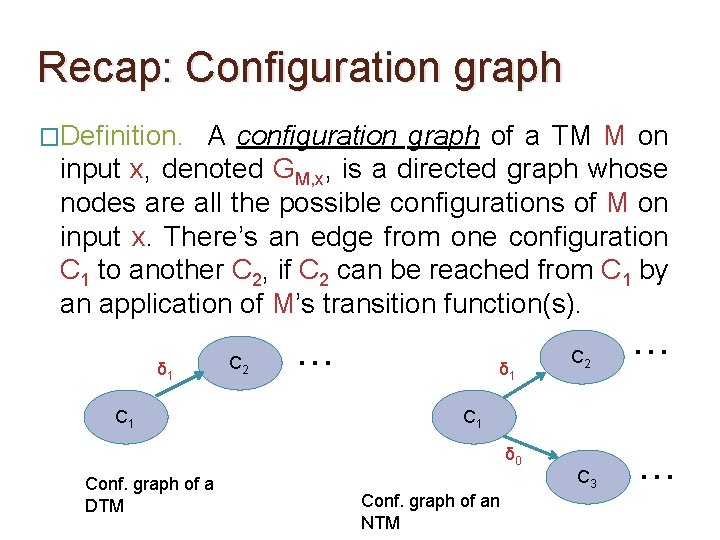
Recap: Configuration graph �Definition. A configuration graph of a TM M on input x, denoted GM, x, is a directed graph whose nodes are all the possible configurations of M on input x. There’s an edge from one configuration C 1 to another C 2, if C 2 can be reached from C 1 by an application of M’s transition function(s). δ 1 C 2 … δ 1 … C 1 δ 0 Conf. graph of a DTM C 2 Conf. graph of an NTM C 3 …
Recap: Configuration graph �Definition. A configuration graph of a TM M on input x, denoted GM, x, is a directed graph whose nodes are all the possible configurations of M on input x. There’s an edge from one configuration C 1 to another C 2, if C 2 can be reached from C 1 by an application of M’s transition function(s). �M accepts x if and only if there’s a path from Cstart to Caccept in GM, x.
Recap: Relation between time & space �Obs. DTIME(S(n)) NSPACE(S(n)). ⊆ DSPACE(S(n)) ⊆ �Theorem. NSPACE(S(n)) ⊆ DTIME(2 O(S(n))), if S is space constructible. �Proof. Let L ∈ NSPACE(S(n)) and M be an NTM deciding L using S(n) space on length n inputs. �On input x, compute the configuration graph GM, x of M and check if there’s a path from Cstart to Caccept. Running time is 2 O(S(n)).
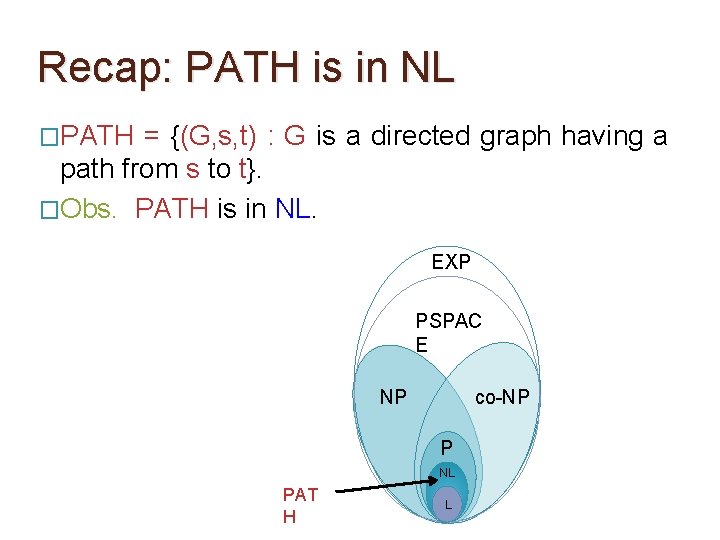
Recap: PATH is in NL �PATH = {(G, s, t) : G is a directed graph having a path from s to t}. �Obs. PATH is in NL. EXP PSPAC E NP co-NP P NL PAT H L
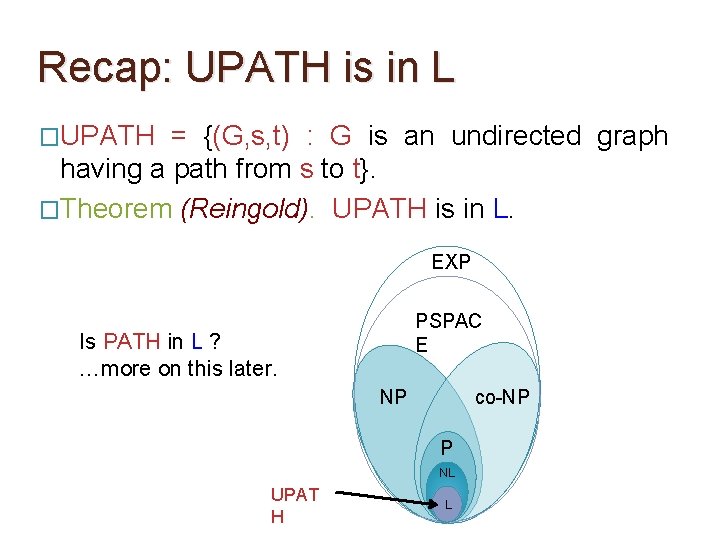
Recap: UPATH is in L �UPATH = {(G, s, t) : G is an undirected graph having a path from s to t}. �Theorem (Reingold). UPATH is in L. EXP PSPAC E Is PATH in L ? …more on this later. NP co-NP P NL UPAT H L
PSPACE = NPSPACE
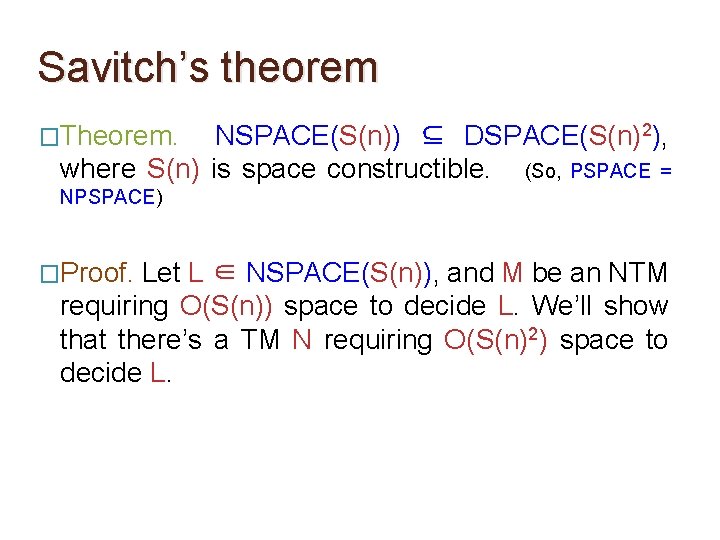
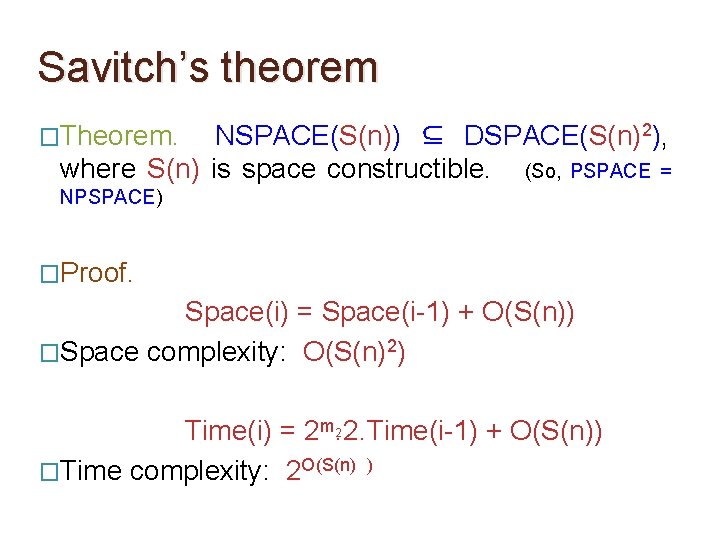
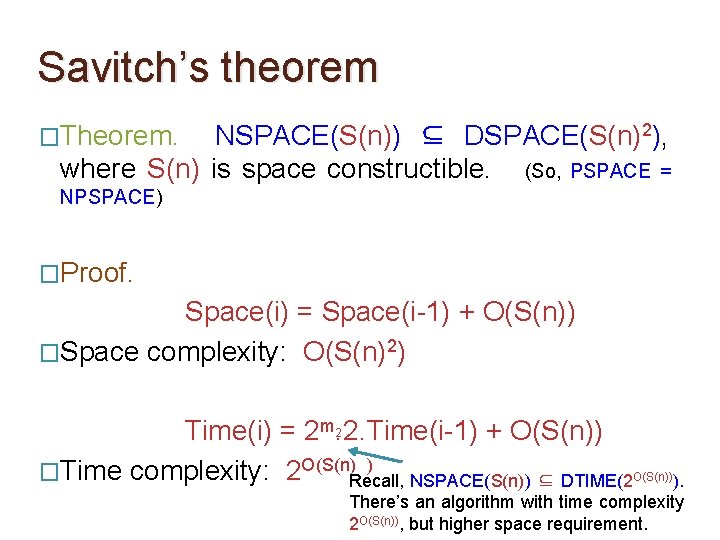
Savitch’s theorem �Theorem. NSPACE(S(n)) ⊆ DSPACE(S(n)2), where S(n) is space constructible. (So, PSPACE = NPSPACE) �Proof. Let L ∈ NSPACE(S(n)), and M be an NTM requiring O(S(n)) space to decide L. We’ll show that there’s a TM N requiring O(S(n)2) space to decide L.
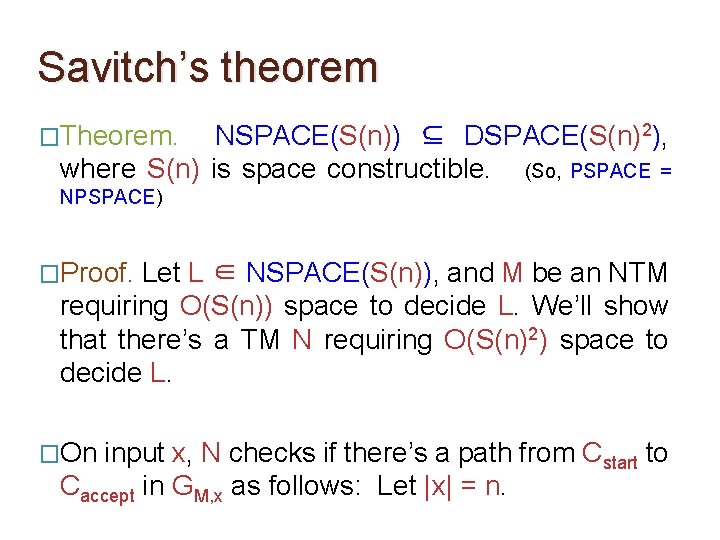
Savitch’s theorem �Theorem. NSPACE(S(n)) ⊆ DSPACE(S(n)2), where S(n) is space constructible. (So, PSPACE = NPSPACE) �Proof. Let L ∈ NSPACE(S(n)), and M be an NTM requiring O(S(n)) space to decide L. We’ll show that there’s a TM N requiring O(S(n)2) space to decide L. �On input x, N checks if there’s a path from Cstart to Caccept in GM, x as follows: Let |x| = n.
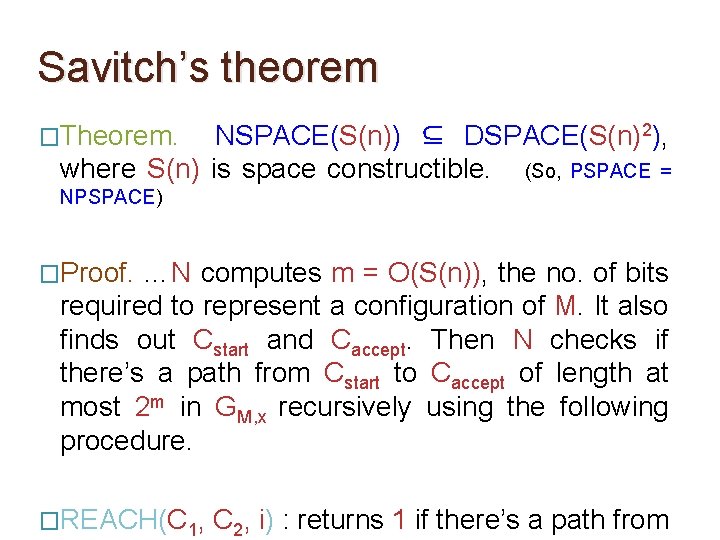
Savitch’s theorem �Theorem. NSPACE(S(n)) ⊆ DSPACE(S(n)2), where S(n) is space constructible. (So, PSPACE = NPSPACE) �Proof. …N computes m = O(S(n)), the no. of bits required to represent a configuration of M. It also finds out Cstart and Caccept. Then N checks if there’s a path from Cstart to Caccept of length at most 2 m in GM, x recursively using the following procedure. �REACH(C 1, C 2, i) : returns 1 if there’s a path from
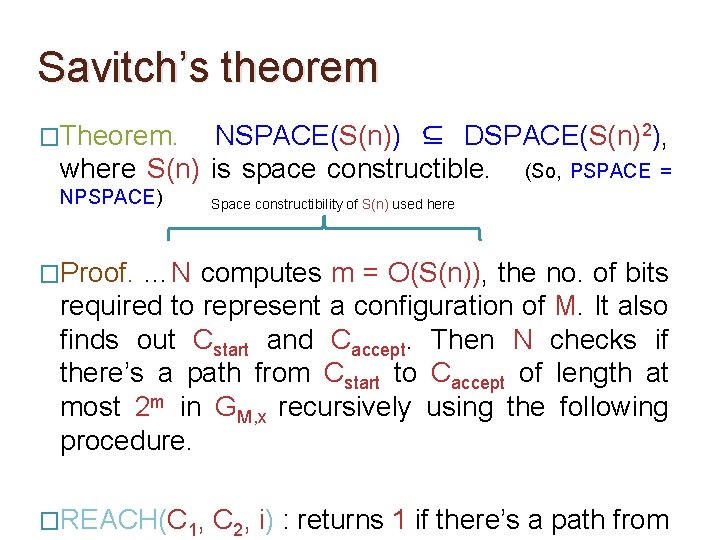
Savitch’s theorem �Theorem. NSPACE(S(n)) ⊆ DSPACE(S(n)2), where S(n) is space constructible. (So, PSPACE = NPSPACE) Space constructibility of S(n) used here �Proof. …N computes m = O(S(n)), the no. of bits required to represent a configuration of M. It also finds out Cstart and Caccept. Then N checks if there’s a path from Cstart to Caccept of length at most 2 m in GM, x recursively using the following procedure. �REACH(C 1, C 2, i) : returns 1 if there’s a path from
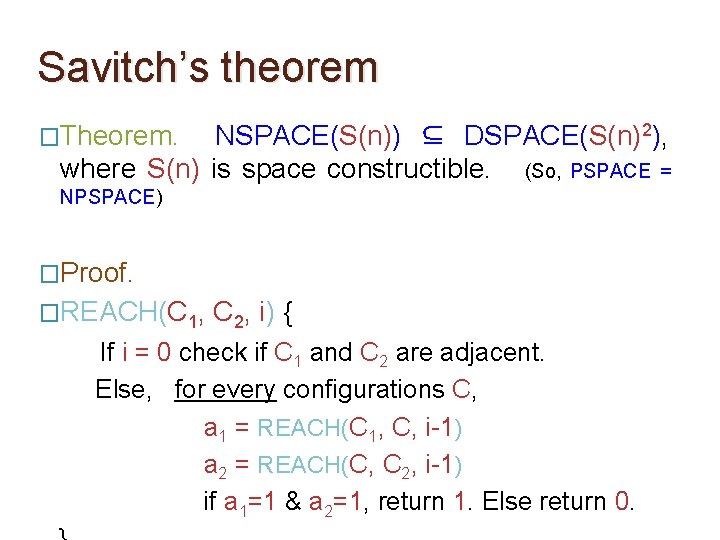
Savitch’s theorem �Theorem. NSPACE(S(n)) ⊆ DSPACE(S(n)2), where S(n) is space constructible. (So, PSPACE = NPSPACE) �Proof. �REACH(C 1, C 2, i) { If i = 0 check if C 1 and C 2 are adjacent. Else, for every configurations C, a 1 = REACH(C 1, C, i-1) a 2 = REACH(C, C 2, i-1) if a 1=1 & a 2=1, return 1. Else return 0.
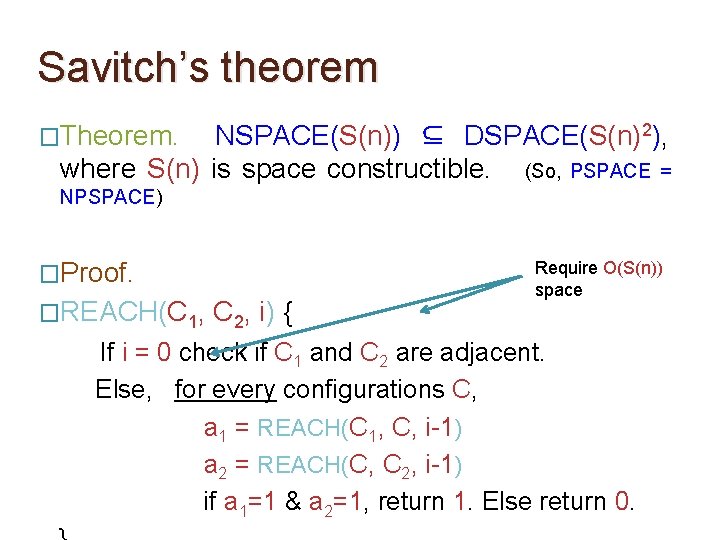
Savitch’s theorem �Theorem. NSPACE(S(n)) ⊆ DSPACE(S(n)2), where S(n) is space constructible. (So, PSPACE = NPSPACE) �Proof. �REACH(C 1, C 2, i) { Require O(S(n)) space If i = 0 check if C 1 and C 2 are adjacent. Else, for every configurations C, a 1 = REACH(C 1, C, i-1) a 2 = REACH(C, C 2, i-1) if a 1=1 & a 2=1, return 1. Else return 0.
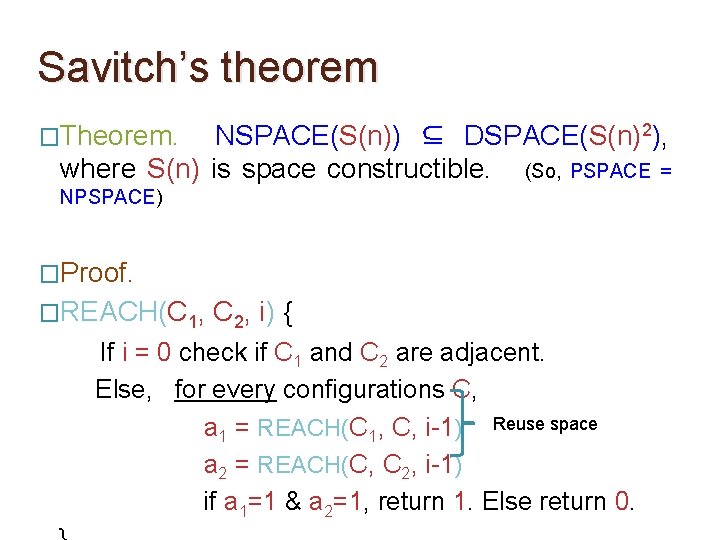
Savitch’s theorem �Theorem. NSPACE(S(n)) ⊆ DSPACE(S(n)2), where S(n) is space constructible. (So, PSPACE = NPSPACE) �Proof. �REACH(C 1, C 2, i) { If i = 0 check if C 1 and C 2 are adjacent. Else, for every configurations C, a 1 = REACH(C 1, C, i-1) Reuse space a 2 = REACH(C, C 2, i-1) if a 1=1 & a 2=1, return 1. Else return 0.
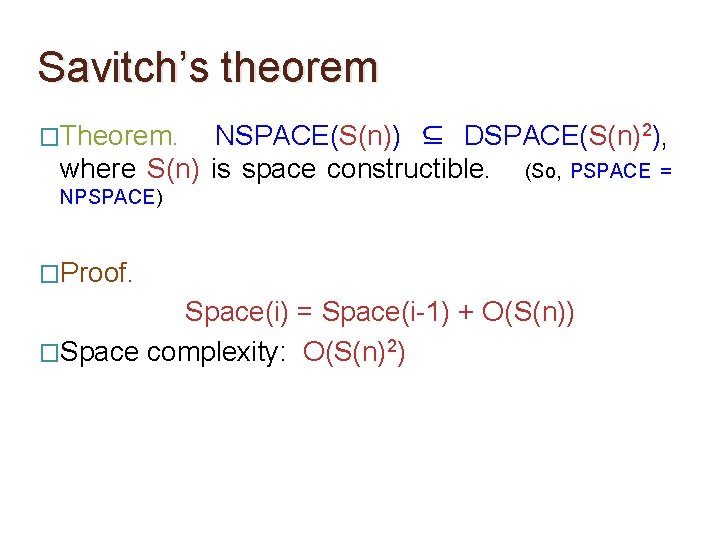
Savitch’s theorem �Theorem. NSPACE(S(n)) ⊆ DSPACE(S(n)2), where S(n) is space constructible. (So, PSPACE = NPSPACE) �Proof. Space(i) = Space(i-1) + O(S(n)) �Space complexity: O(S(n)2)
Savitch’s theorem �Theorem. NSPACE(S(n)) ⊆ DSPACE(S(n)2), where S(n) is space constructible. (So, PSPACE = NPSPACE) �Proof. Space(i) = Space(i-1) + O(S(n)) �Space complexity: O(S(n)2) Time(i) = 2 m 2. 2. Time(i-1) + O(S(n)) �Time complexity: 2 O(S(n) )
Savitch’s theorem �Theorem. NSPACE(S(n)) ⊆ DSPACE(S(n)2), where S(n) is space constructible. (So, PSPACE = NPSPACE) �Proof. Space(i) = Space(i-1) + O(S(n)) �Space complexity: O(S(n)2) Time(i) = 2 m 2. 2. Time(i-1) + O(S(n)) ) �Time complexity: 2 O(S(n)Recall, NSPACE(S(n)) ⊆ DTIME(2 O(S(n))). There’s an algorithm with time complexity 2 O(S(n)), but higher space requirement.
PSPACE-completeness
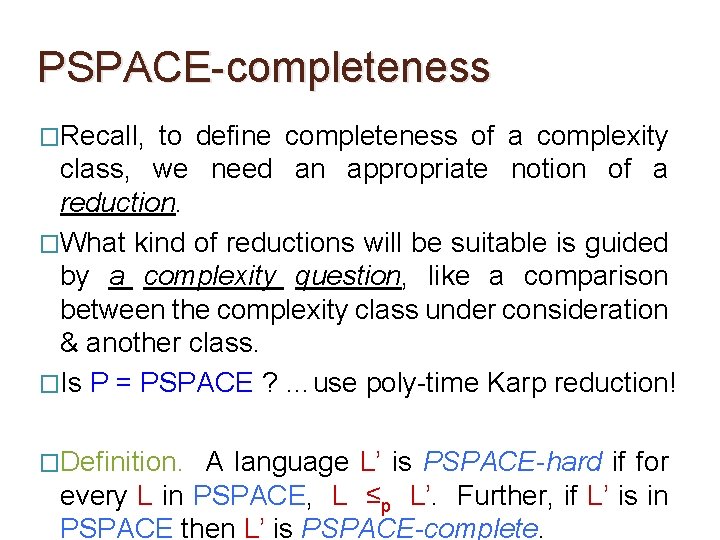
PSPACE-completeness �Recall, to define completeness of a complexity class, we need an appropriate notion of a reduction. �What kind of reductions will be suitable is guided by a complexity question, like a comparison between the complexity class under consideration & another class. �Is P = PSPACE ?
PSPACE-completeness �Recall, to define completeness of a complexity class, we need an appropriate notion of a reduction. �What kind of reductions will be suitable is guided by a complexity question, like a comparison between the complexity class under consideration & another class. �Is P = PSPACE ? …use poly-time Karp reduction! �Definition. A language L’ is PSPACE-hard if for every L in PSPACE, L ≤p L’. Further, if L’ is in PSPACE then L’ is PSPACE-complete.
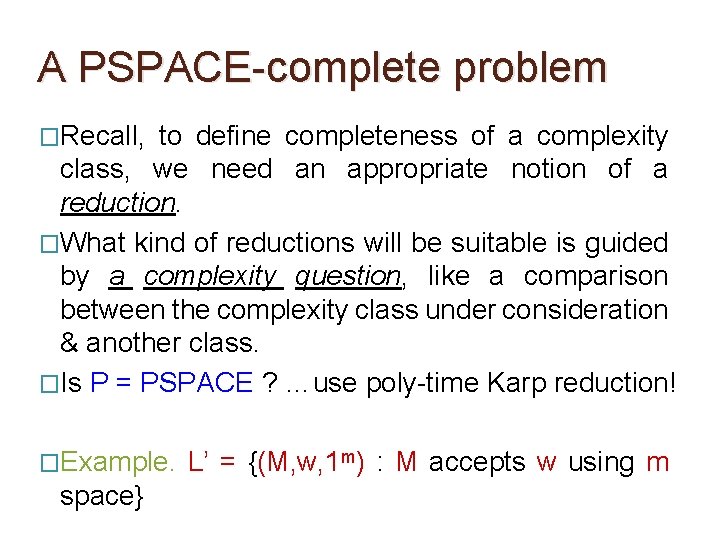
A PSPACE-complete problem �Recall, to define completeness of a complexity class, we need an appropriate notion of a reduction. �What kind of reductions will be suitable is guided by a complexity question, like a comparison between the complexity class under consideration & another class. �Is P = PSPACE ? …use poly-time Karp reduction! �Example. space} L’ = {(M, w, 1 m) : M accepts w using m
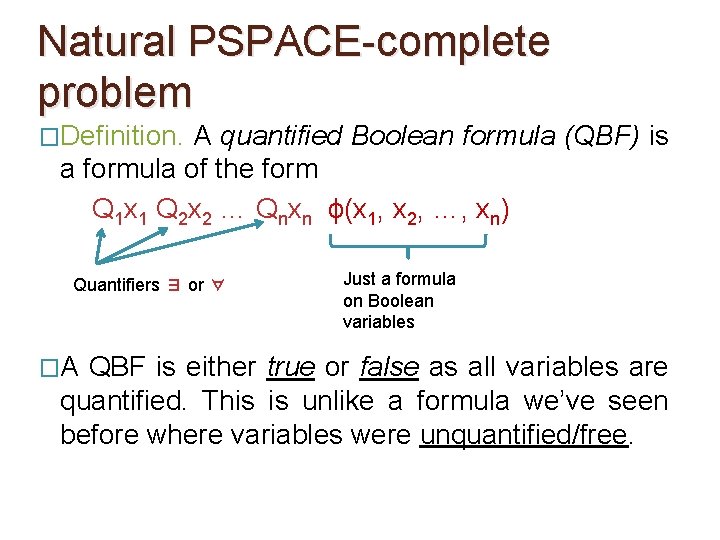
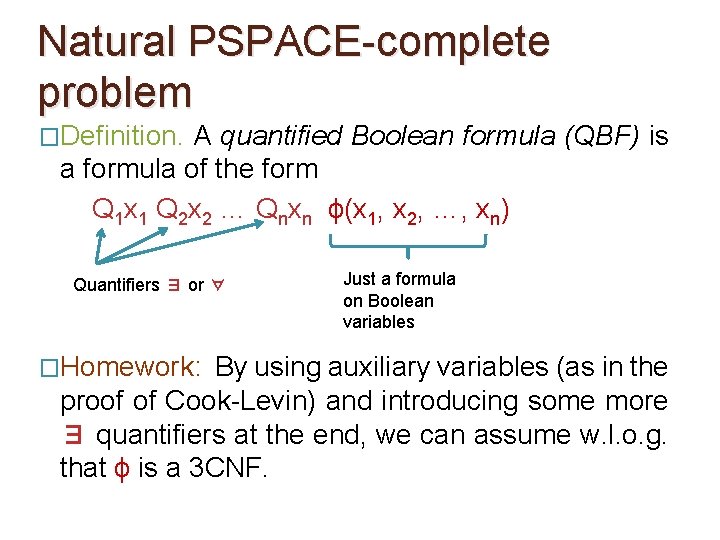
Natural PSPACE-complete problem �Definition. A quantified Boolean formula (QBF) is a formula of the form Q 1 x 1 Q 2 x 2 … Qnxn ϕ(x 1, x 2, …, xn) Quantifiers ∃ or ∀ �A Just a formula on Boolean variables QBF is either true or false as all variables are quantified. This is unlike a formula we’ve seen before where variables were unquantified/free.
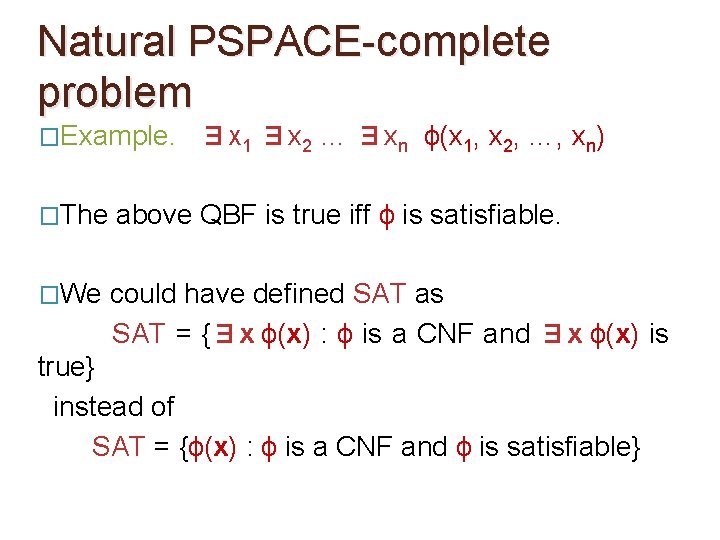
Natural PSPACE-complete problem �Example. ∃x 1 ∃x 2 … ∃xn ϕ(x 1, x 2, …, xn) �The above QBF is true iff ϕ is satisfiable. �We could have defined SAT as SAT = {∃x ϕ(x) : ϕ is a CNF and ∃x ϕ(x) is true} instead of SAT = {ϕ(x) : ϕ is a CNF and ϕ is satisfiable}
Natural PSPACE-complete problem �Definition. A quantified Boolean formula (QBF) is a formula of the form Q 1 x 1 Q 2 x 2 … Qnxn ϕ(x 1, x 2, …, xn) Quantifiers ∃ or ∀ �Homework: Just a formula on Boolean variables By using auxiliary variables (as in the proof of Cook-Levin) and introducing some more ∃ quantifiers at the end, we can assume w. l. o. g. that ϕ is a 3 CNF.
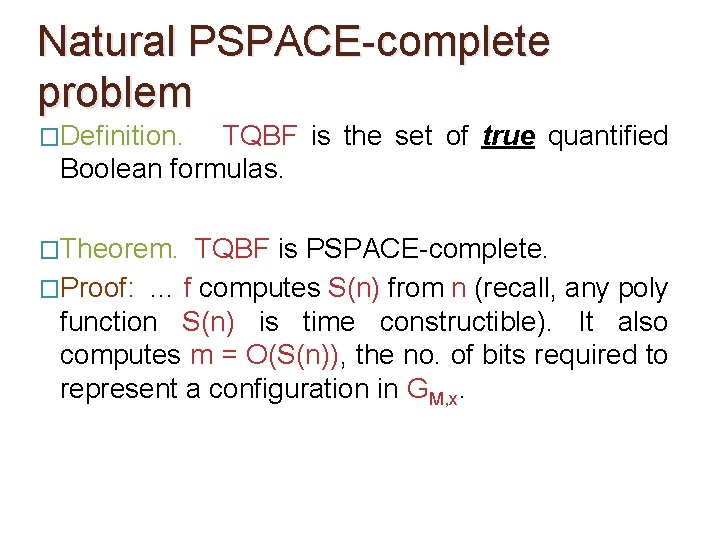
Natural PSPACE-complete problem �Definition. TQBF is the set of true quantified Boolean formulas. �Theorem. TQBF is PSPACE-complete. �Proof: Easy to see that TQBF is in PSPACE – just think of a suitable recursive procedure. We’ll now show that every L ∈ PSPACE reduces to TQBF via poly-time Karp reduction…
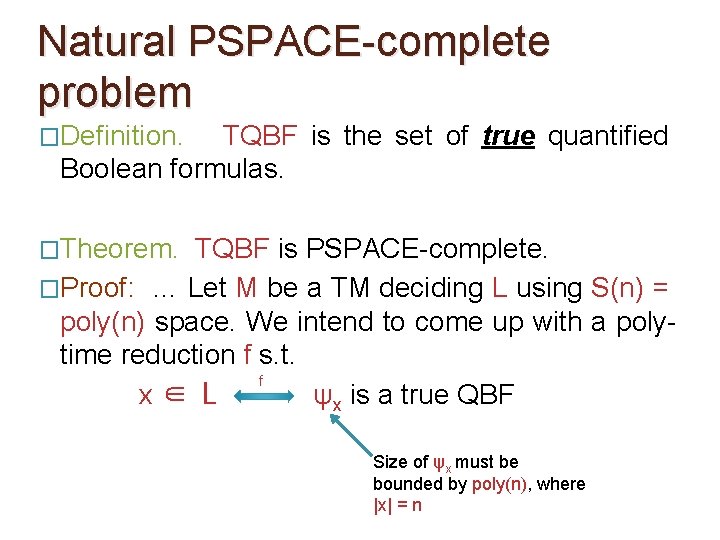
Natural PSPACE-complete problem �Definition. TQBF is the set of true quantified Boolean formulas. �Theorem. TQBF is PSPACE-complete. �Proof: … Let M be a TM deciding L using S(n) = poly(n) space. We intend to come up with a polytime reduction f s. t. f x∈ L ψx is a true QBF Size of ψx must be bounded by poly(n), where |x| = n
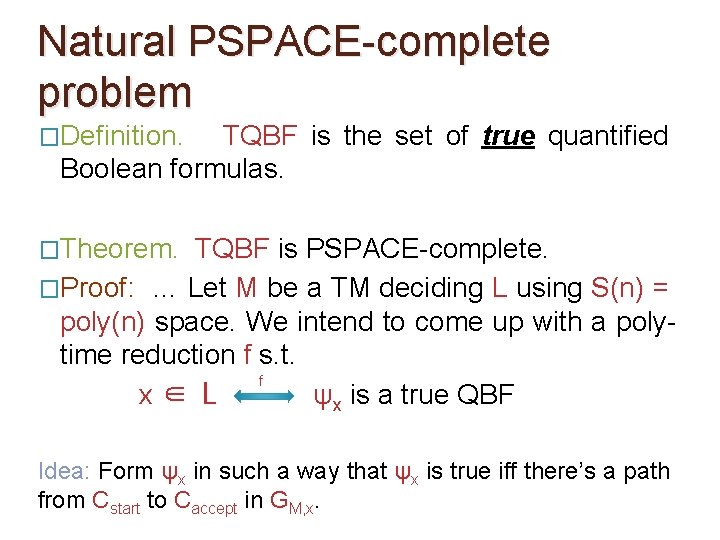
Natural PSPACE-complete problem �Definition. TQBF is the set of true quantified Boolean formulas. �Theorem. TQBF is PSPACE-complete. �Proof: … Let M be a TM deciding L using S(n) = poly(n) space. We intend to come up with a polytime reduction f s. t. f x∈ L ψx is a true QBF Idea: Form ψx in such a way that ψx is true iff there’s a path from Cstart to Caccept in GM, x.
Natural PSPACE-complete problem �Definition. TQBF is the set of true quantified Boolean formulas. �Theorem. TQBF is PSPACE-complete. �Proof: … f computes S(n) from n (recall, any poly function S(n) is time constructible). It also computes m = O(S(n)), the no. of bits required to represent a configuration in GM, x.
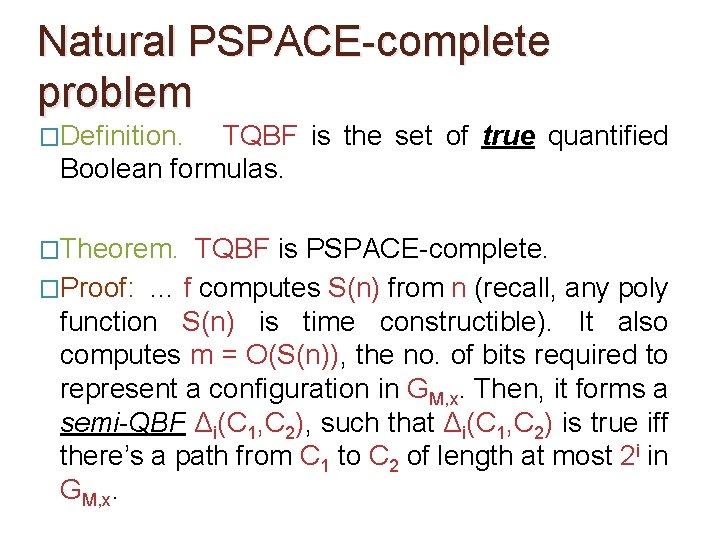
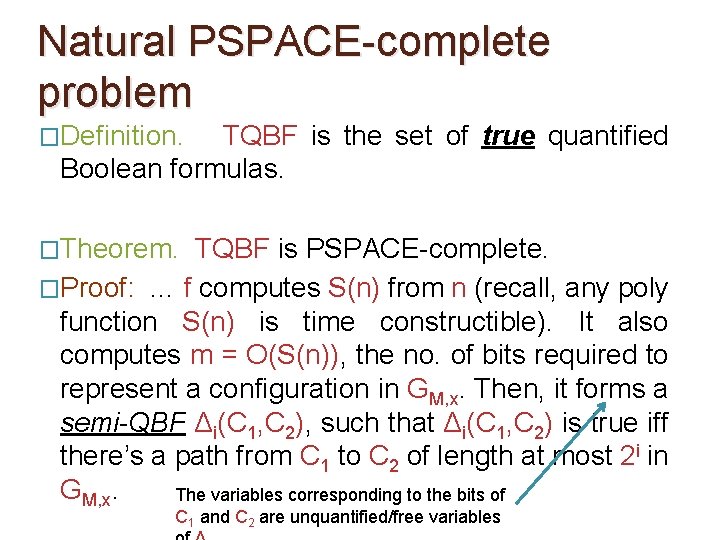
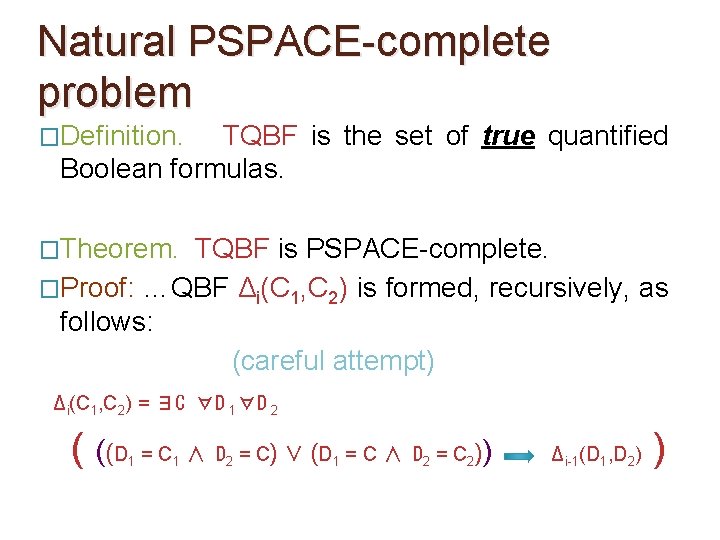
Natural PSPACE-complete problem �Definition. TQBF is the set of true quantified Boolean formulas. �Theorem. TQBF is PSPACE-complete. �Proof: … f computes S(n) from n (recall, any poly function S(n) is time constructible). It also computes m = O(S(n)), the no. of bits required to represent a configuration in GM, x. Then, it forms a semi-QBF Δi(C 1, C 2), such that Δi(C 1, C 2) is true iff there’s a path from C 1 to C 2 of length at most 2 i in GM, x.
Natural PSPACE-complete problem �Definition. TQBF is the set of true quantified Boolean formulas. �Theorem. TQBF is PSPACE-complete. �Proof: … f computes S(n) from n (recall, any poly function S(n) is time constructible). It also computes m = O(S(n)), the no. of bits required to represent a configuration in GM, x. Then, it forms a semi-QBF Δi(C 1, C 2), such that Δi(C 1, C 2) is true iff there’s a path from C 1 to C 2 of length at most 2 i in GM, x. The variables corresponding to the bits of C 1 and C 2 are unquantified/free variables
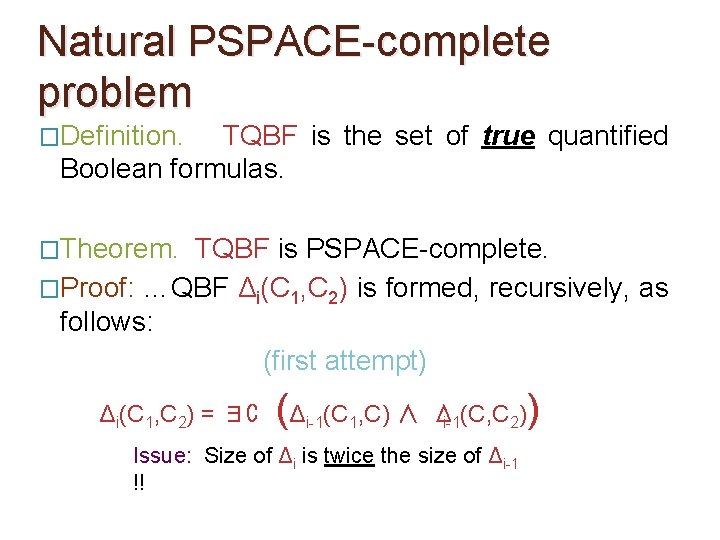
Natural PSPACE-complete problem �Definition. TQBF is the set of true quantified Boolean formulas. �Theorem. TQBF is PSPACE-complete. �Proof: …QBF Δi(C 1, C 2) is formed, recursively, as follows: (first attempt) Δi(C 1, C 2) = ∃C (Δ i-1(C 1, C) ∧ Δ i-1(C, C 2) Issue: Size of Δi is twice the size of Δi-1 !! )
Natural PSPACE-complete problem �Definition. TQBF is the set of true quantified Boolean formulas. �Theorem. TQBF is PSPACE-complete. �Proof: …QBF Δi(C 1, C 2) is formed, recursively, as follows: (careful attempt) Δi(C 1, C 2) = ∃C ∀D 1∀D 2 ( ((D 1 = C 1 ∧ D 2 = C) ∨ (D 1 = C ∧ D 2 = C 2)) Δi-1(D 1, D 2) )
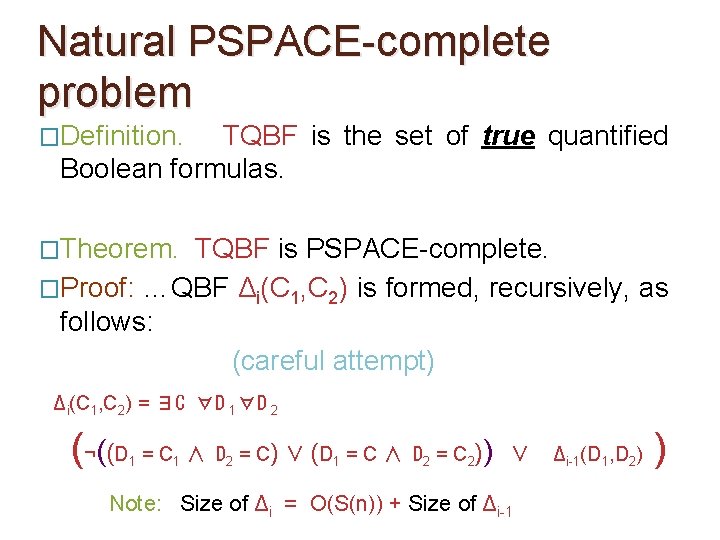
Natural PSPACE-complete problem �Definition. TQBF is the set of true quantified Boolean formulas. �Theorem. TQBF is PSPACE-complete. �Proof: …QBF Δi(C 1, C 2) is formed, recursively, as follows: (careful attempt) Δi(C 1, C 2) = ∃C ∀D 1∀D 2 ( ¬ ((D 1 = C 1 ∧ D 2 = C) ∨ (D 1 = C ∧ D 2 = C 2)) ∨ Note: Size of Δi = O(S(n)) + Size of Δi-1(D 1, D 2) )
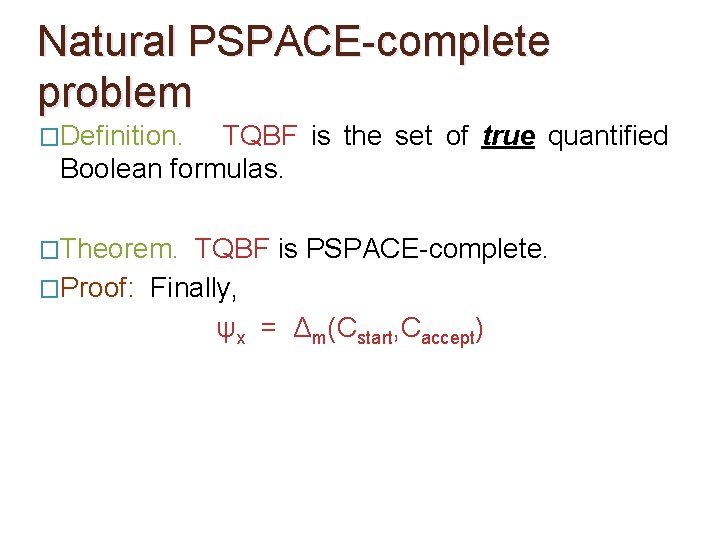
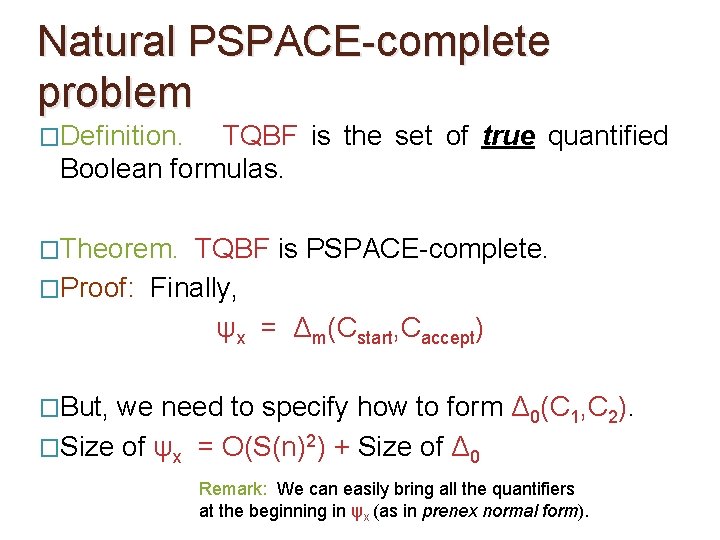
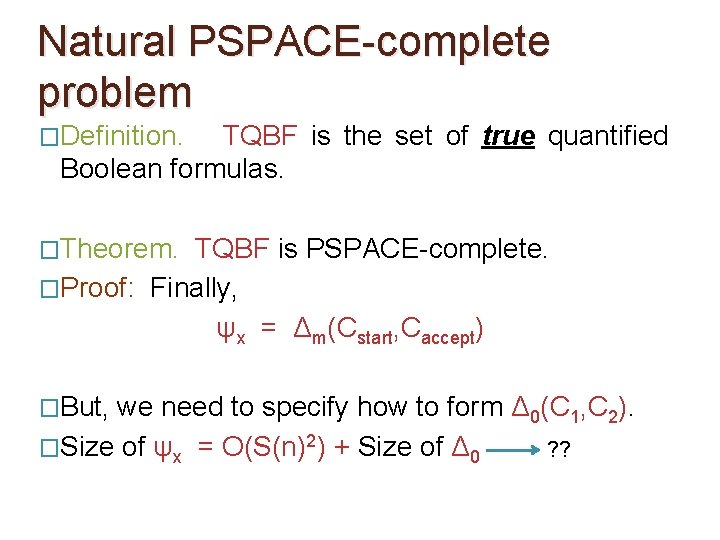
Natural PSPACE-complete problem �Definition. TQBF is the set of true quantified Boolean formulas. �Theorem. TQBF is PSPACE-complete. �Proof: Finally, ψx = Δm(Cstart, Caccept)
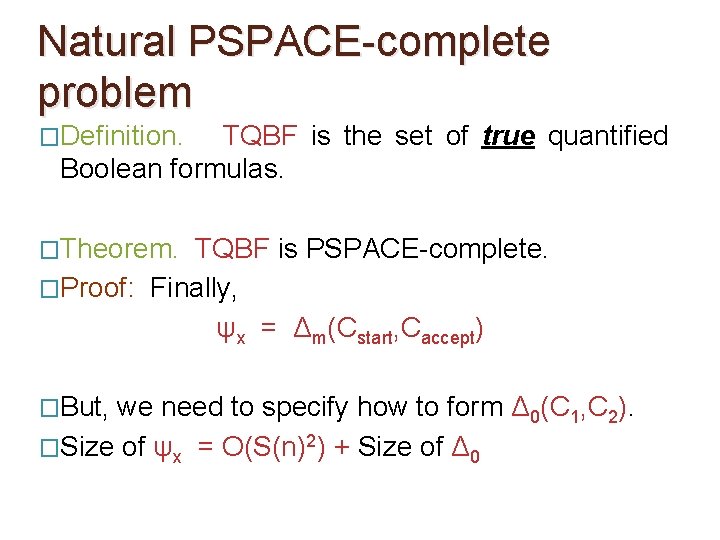
Natural PSPACE-complete problem �Definition. TQBF is the set of true quantified Boolean formulas. �Theorem. TQBF is PSPACE-complete. �Proof: Finally, ψx = Δm(Cstart, Caccept) �But, we need to specify how to form Δ 0(C 1, C 2). �Size of ψx = O(S(n)2) + Size of Δ 0
Natural PSPACE-complete problem �Definition. TQBF is the set of true quantified Boolean formulas. �Theorem. TQBF is PSPACE-complete. �Proof: Finally, ψx = Δm(Cstart, Caccept) �But, we need to specify how to form Δ 0(C 1, C 2). �Size of ψx = O(S(n)2) + Size of Δ 0 Remark: We can easily bring all the quantifiers at the beginning in ψx (as in prenex normal form).
Natural PSPACE-complete problem �Definition. TQBF is the set of true quantified Boolean formulas. �Theorem. TQBF is PSPACE-complete. �Proof: Finally, ψx = Δm(Cstart, Caccept) �But, we need to specify how to form Δ 0(C 1, C 2). �Size of ψx = O(S(n)2) + Size of Δ 0 ? ?
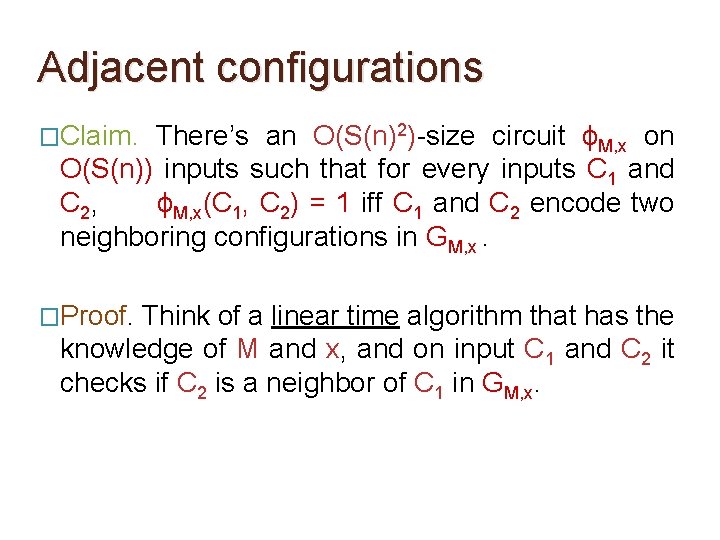
Adjacent configurations �Claim. There’s an O(S(n)2)-size circuit ϕM, x on O(S(n)) inputs such that for every inputs C 1 and C 2, ϕM, x(C 1, C 2) = 1 iff C 1 and C 2 encode two neighboring configurations in GM, x. �Proof. Think of a linear time algorithm that has the knowledge of M and x, and on input C 1 and C 2 it checks if C 2 is a neighbor of C 1 in GM, x.
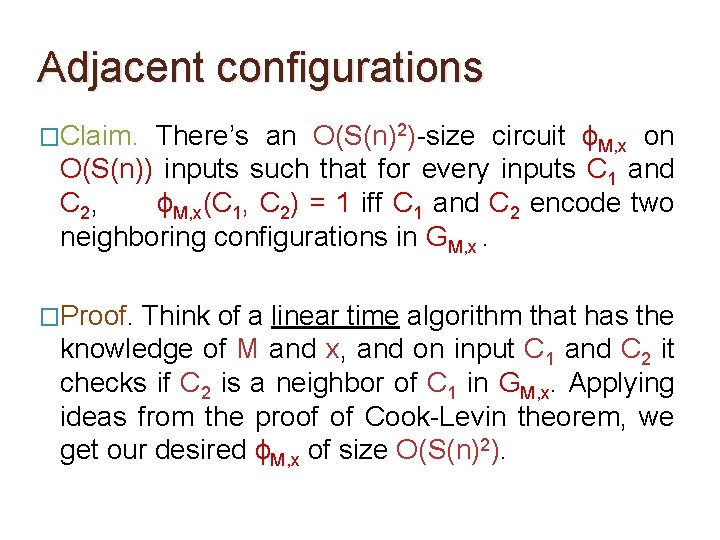
Adjacent configurations �Claim. There’s an O(S(n)2)-size circuit ϕM, x on O(S(n)) inputs such that for every inputs C 1 and C 2, ϕM, x(C 1, C 2) = 1 iff C 1 and C 2 encode two neighboring configurations in GM, x. �Proof. Think of a linear time algorithm that has the knowledge of M and x, and on input C 1 and C 2 it checks if C 2 is a neighbor of C 1 in GM, x. Applying ideas from the proof of Cook-Levin theorem, we get our desired ϕM, x of size O(S(n)2).
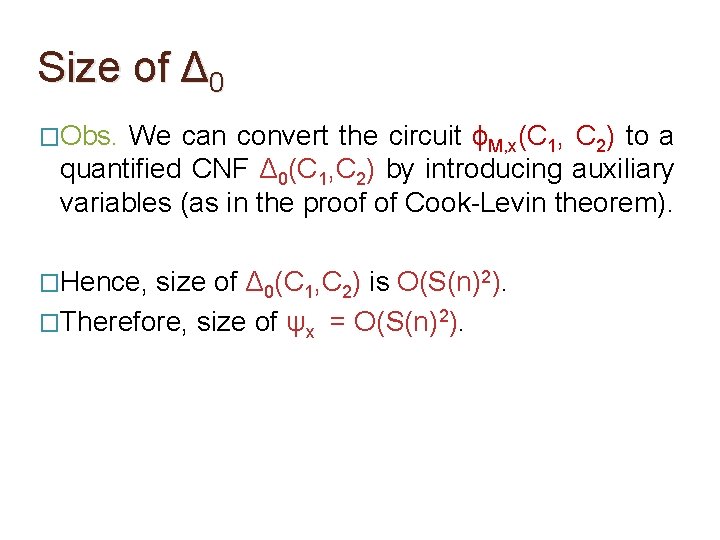
Size of Δ 0 �Obs. We can convert the circuit ϕM, x(C 1, C 2) to a quantified CNF Δ 0(C 1, C 2) by introducing auxiliary variables (as in the proof of Cook-Levin theorem). �Hence, size of Δ 0(C 1, C 2) is O(S(n)2). �Therefore, size of ψx = O(S(n)2).
Other PSPACE complete problems �Checking if a player has a winning strategy in certain two-player games, like (generalized) Hex, Reversi, Geography etc.
NL-completeness
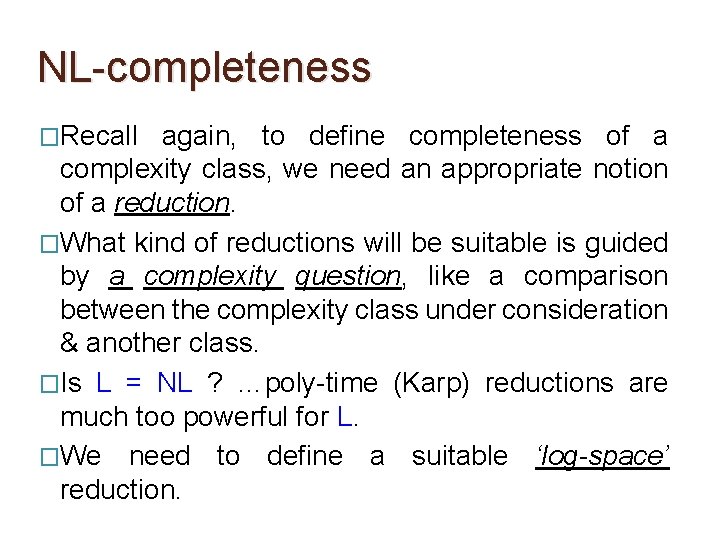
NL-completeness �Recall again, to define completeness of a complexity class, we need an appropriate notion of a reduction. �What kind of reductions will be suitable is guided by a complexity question, like a comparison between the complexity class under consideration & another class. �Is L = NL ?
NL-completeness �Recall again, to define completeness of a complexity class, we need an appropriate notion of a reduction. �What kind of reductions will be suitable is guided by a complexity question, like a comparison between the complexity class under consideration & another class. �Is L = NL ? …poly-time (Karp) reductions are much too powerful for L. �We need to define a suitable ‘log-space’ reduction.
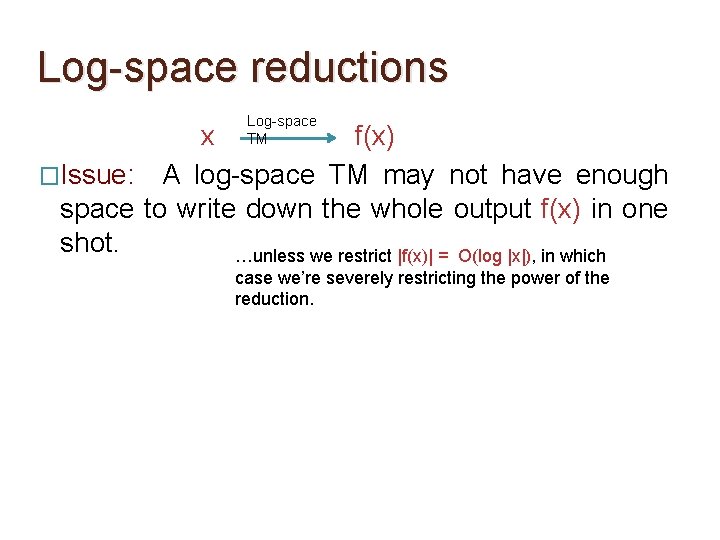
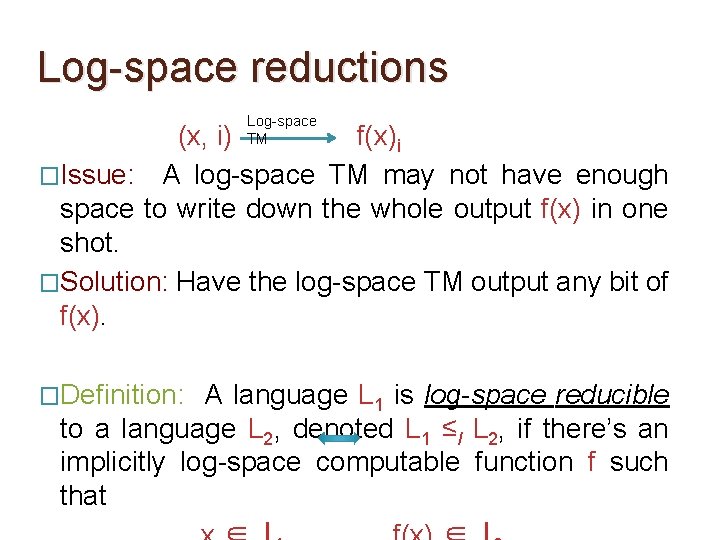
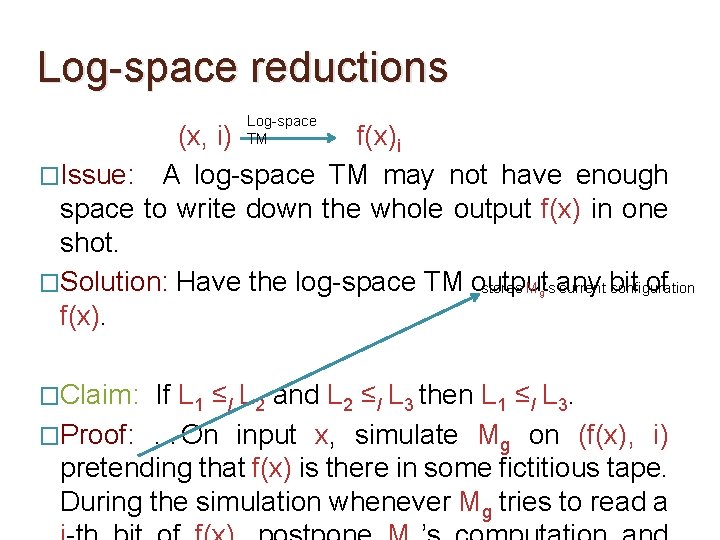
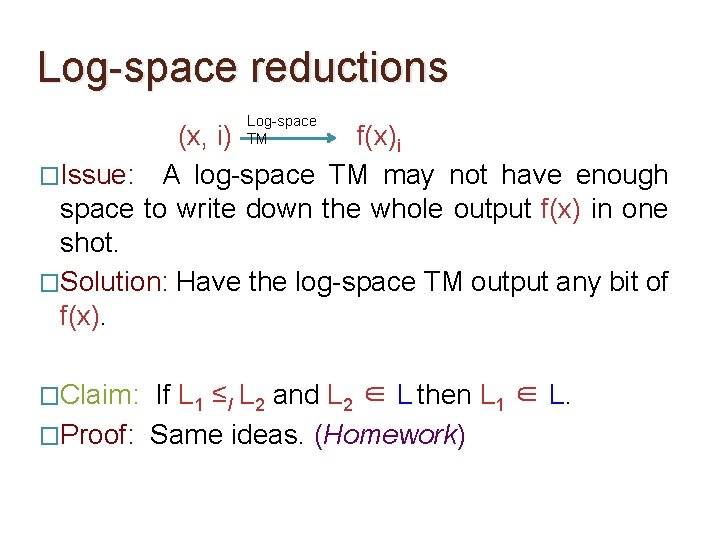
Log-space reductions Log-space TM x f(x) �Issue: A log-space TM may not have enough space to write down the whole output f(x) in one shot. …unless we restrict |f(x)| = O(log |x|), in which case we’re severely restricting the power of the reduction.
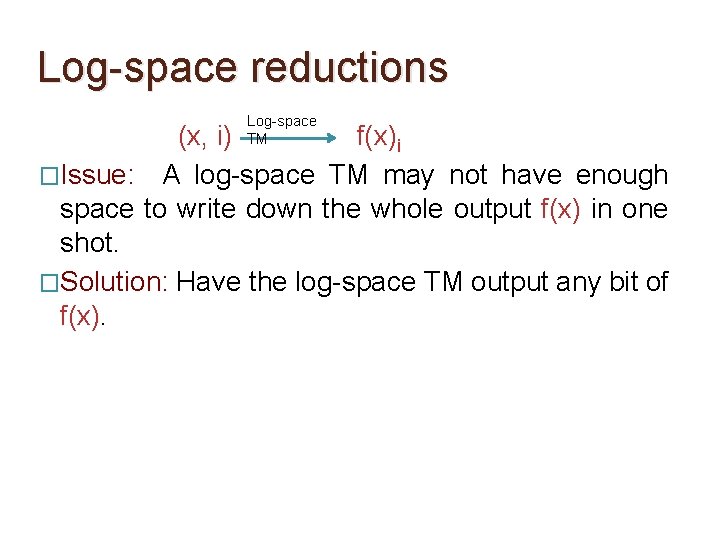
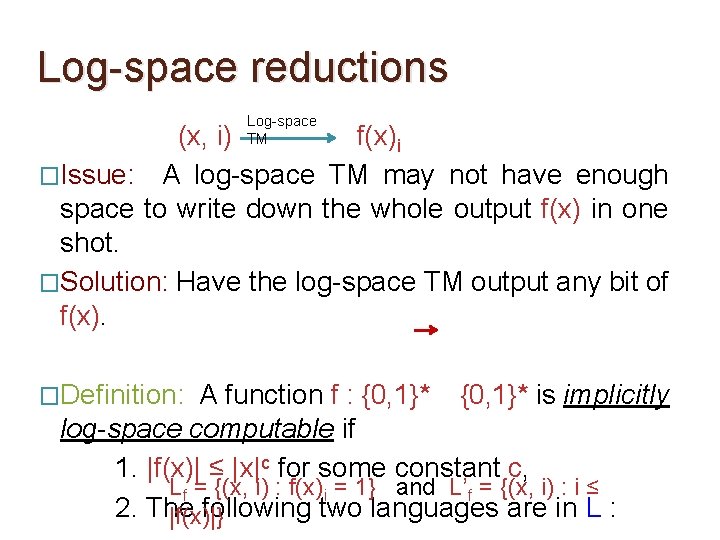
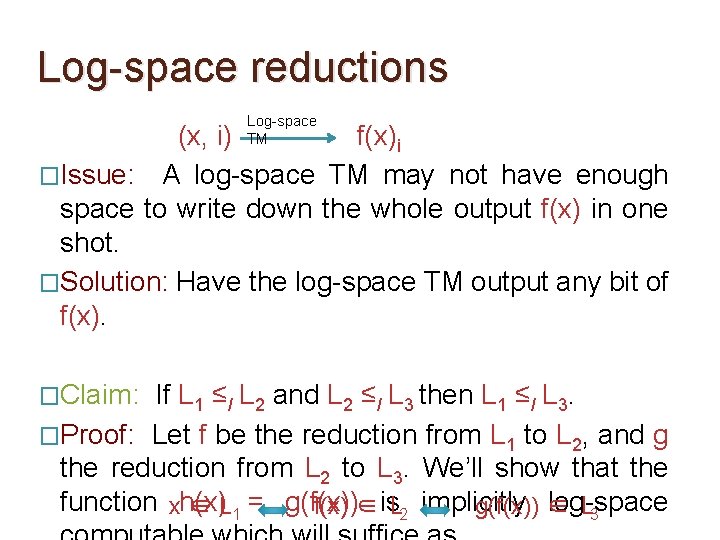
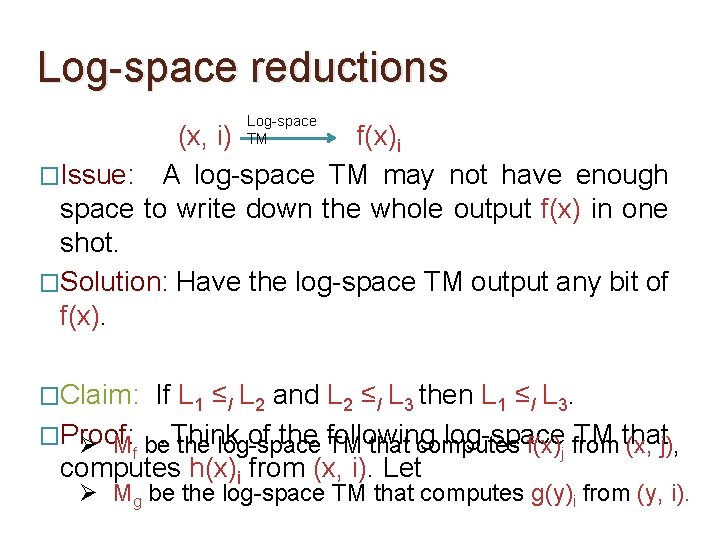
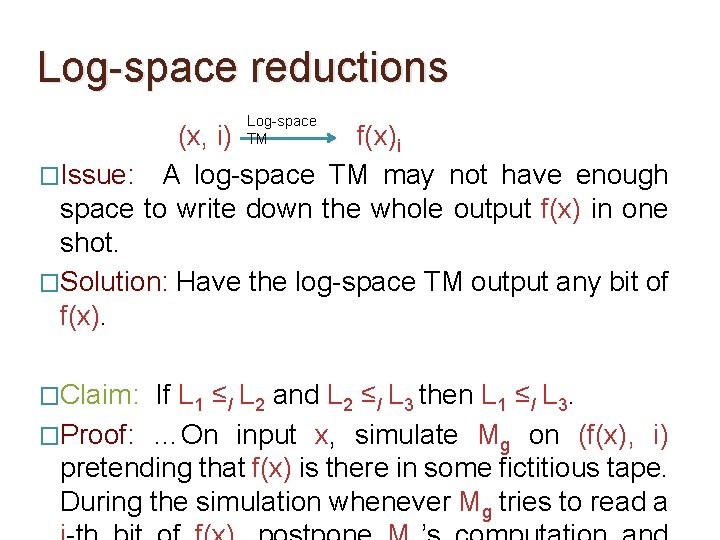
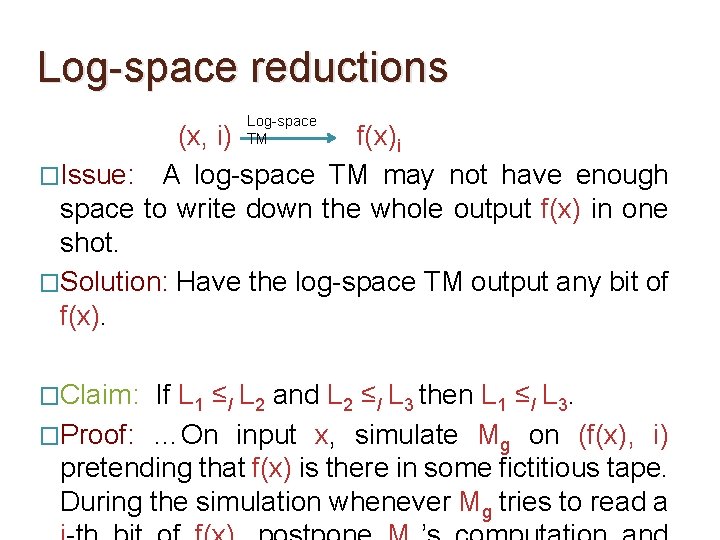
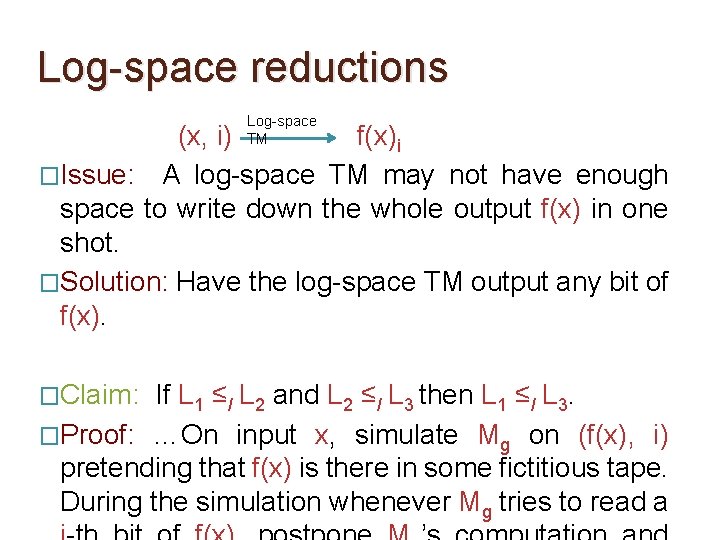
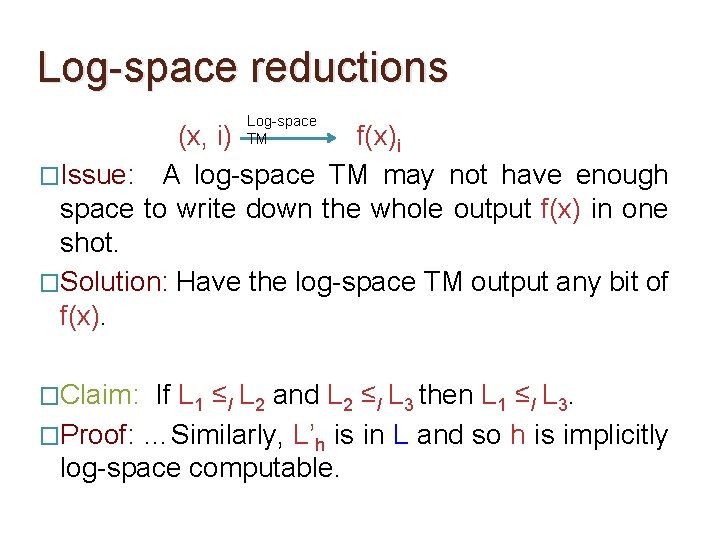
Log-space reductions Log-space TM (x, i) f(x)i �Issue: A log-space TM may not have enough space to write down the whole output f(x) in one shot. �Solution: Have the log-space TM output any bit of f(x).
Log-space reductions Log-space TM (x, i) f(x)i �Issue: A log-space TM may not have enough space to write down the whole output f(x) in one shot. �Solution: Have the log-space TM output any bit of f(x). �Definition: A function f : {0, 1}* is implicitly log-space computable if 1. |f(x)| ≤ |x|c for some constant c, Lf = {(x, i) : f(x)i = 1} and L’f = {(x, i) : i ≤ 2. The following two languages are in L : |f(x)|}
Log-space reductions Log-space TM (x, i) f(x)i �Issue: A log-space TM may not have enough space to write down the whole output f(x) in one shot. �Solution: Have the log-space TM output any bit of f(x). �Definition: A language L 1 is log-space reducible to a language L 2, denoted L 1 ≤l L 2, if there’s an implicitly log-space computable function f such that
Log-space reductions Log-space TM (x, i) f(x)i �Issue: A log-space TM may not have enough space to write down the whole output f(x) in one shot. �Solution: Have the log-space TM output any bit of f(x). �Claim: If L 1 ≤l L 2 and L 2 ≤l L 3 then L 1 ≤l L 3. �Proof: Let f be the reduction from L 1 to L 2, and g the reduction from L 2 to L 3. We’ll show that the function xh(x) log-space ∈ L 1 = g(f(x)) f(x) ∈ is. L 2 implicitly g(f(x)) ∈ L 3
Log-space reductions Log-space TM (x, i) f(x)i �Issue: A log-space TM may not have enough space to write down the whole output f(x) in one shot. �Solution: Have the log-space TM output any bit of f(x). �Claim: If L 1 ≤l L 2 and L 2 ≤l L 3 then L 1 ≤l L 3. �Proof: of the following log-space TM that Ø Mf …Think be the log-space TM that computes f(x)j from (x, j), computes h(x)i from (x, i). Let Ø Mg be the log-space TM that computes g(y)i from (y, i).
Log-space reductions Log-space TM (x, i) f(x)i �Issue: A log-space TM may not have enough space to write down the whole output f(x) in one shot. �Solution: Have the log-space TM output any bit of f(x). �Claim: If L 1 ≤l L 2 and L 2 ≤l L 3 then L 1 ≤l L 3. �Proof: …On input x, simulate Mg on (f(x), i) pretending that f(x) is there in some fictitious tape. During the simulation whenever Mg tries to read a
Log-space reductions Log-space TM (x, i) f(x)i �Issue: A log-space TM may not have enough space to write down the whole output f(x) in one shot. �Solution: Have the log-space TM output of stores M ’s any current bit configuration f(x). g �Claim: If L 1 ≤l L 2 and L 2 ≤l L 3 then L 1 ≤l L 3. �Proof: …On input x, simulate Mg on (f(x), i) pretending that f(x) is there in some fictitious tape. During the simulation whenever Mg tries to read a
Log-space reductions Log-space TM (x, i) f(x)i �Issue: A log-space TM may not have enough space to write down the whole output f(x) in one shot. �Solution: Have the log-space TM output any bit of f(x). �Claim: If L 1 ≤l L 2 and L 2 ≤l L 3 then L 1 ≤l L 3. �Proof: …On input x, simulate Mg on (f(x), i) pretending that f(x) is there in some fictitious tape. During the simulation whenever Mg tries to read a
Log-space reductions Log-space TM (x, i) f(x)i �Issue: A log-space TM may not have enough space to write down the whole output f(x) in one shot. �Solution: Have the log-space TM output any bit of f(x). �Claim: If L 1 ≤l L 2 and L 2 ≤l L 3 then L 1 ≤l L 3. �Proof: …On input x, simulate Mg on (f(x), i) pretending that f(x) is there in some fictitious tape. During the simulation whenever Mg tries to read a
Log-space reductions Log-space TM (x, i) f(x)i �Issue: A log-space TM may not have enough space to write down the whole output f(x) in one shot. �Solution: Have the log-space TM output any bit of f(x). �Claim: If L 1 ≤l L 2 and L 2 ≤l L 3 then L 1 ≤l L 3. �Proof: …Similarly, L’h is in L and so h is implicitly log-space computable.
Log-space reductions Log-space TM (x, i) f(x)i �Issue: A log-space TM may not have enough space to write down the whole output f(x) in one shot. �Solution: Have the log-space TM output any bit of f(x). �Claim: If L 1 ≤l L 2 and L 2 ∈ L then L 1 ∈ L. �Proof: Same ideas. (Homework)
NL-completeness �Definition: A language L is NL-complete if L ∈ NL and for every L’ ∈ NL, L’ is log-space reducible to L.
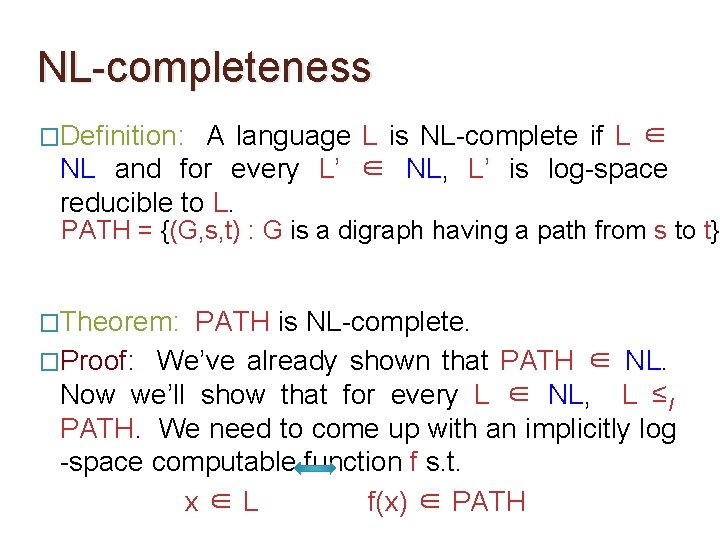
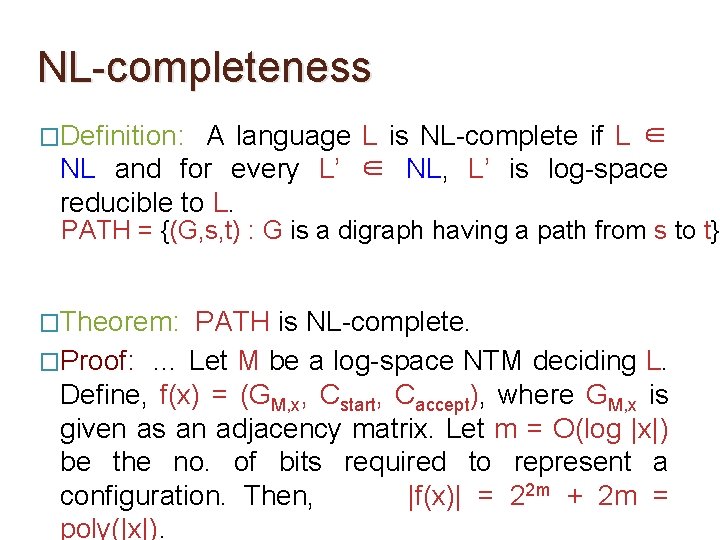
NL-completeness �Definition: A language L is NL-complete if L ∈ NL and for every L’ ∈ NL, L’ is log-space reducible to L. PATH = {(G, s, t) : G is a digraph having a path from s to t}. �Theorem: PATH is NL-complete. �Proof: We’ve already shown that PATH ∈ NL. Now we’ll show that for every L ∈ NL, L ≤l PATH. We need to come up with an implicitly log -space computable function f s. t. x∈L f(x) ∈ PATH
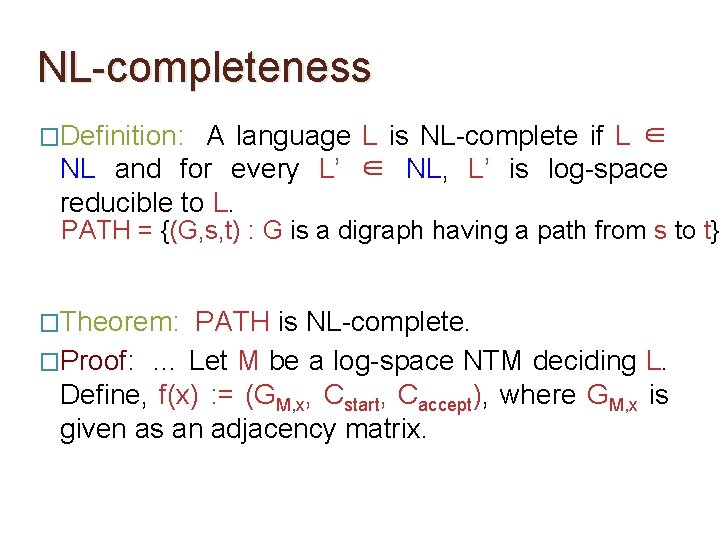
NL-completeness �Definition: A language L is NL-complete if L ∈ NL and for every L’ ∈ NL, L’ is log-space reducible to L. PATH = {(G, s, t) : G is a digraph having a path from s to t}. �Theorem: PATH is NL-complete. �Proof: … Let M be a log-space NTM deciding L. Define, f(x) : = (GM, x, Cstart, Caccept), where GM, x is given as an adjacency matrix.
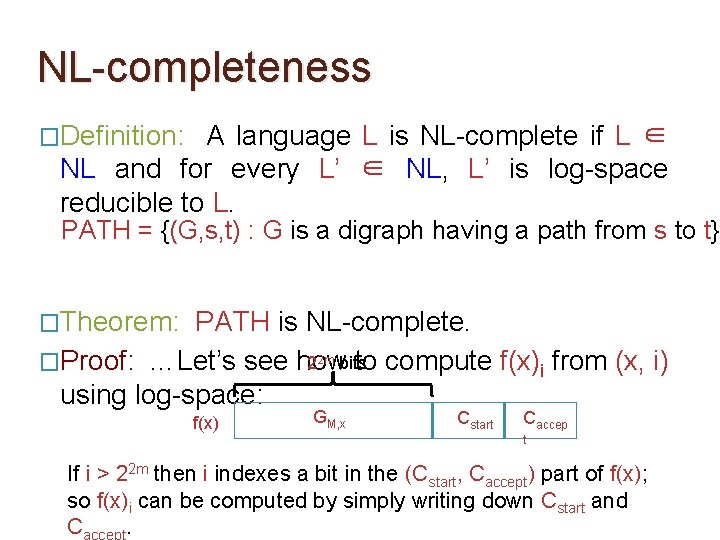
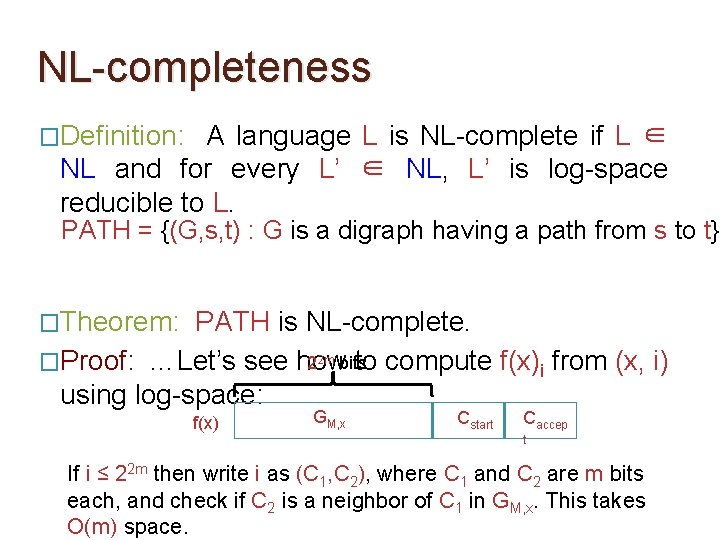
NL-completeness �Definition: A language L is NL-complete if L ∈ NL and for every L’ ∈ NL, L’ is log-space reducible to L. PATH = {(G, s, t) : G is a digraph having a path from s to t}. �Theorem: PATH is NL-complete. �Proof: … Let M be a log-space NTM deciding L. Define, f(x) = (GM, x, Cstart, Caccept), where GM, x is given as an adjacency matrix. Let m = O(log |x|) be the no. of bits required to represent a configuration. Then, |f(x)| = 22 m + 2 m = poly(|x|).
NL-completeness �Definition: A language L is NL-complete if L ∈ NL and for every L’ ∈ NL, L’ is log-space reducible to L. PATH = {(G, s, t) : G is a digraph having a path from s to t}. �Theorem: PATH is NL-complete. 22 m bits �Proof: …Let’s see how to compute f(x)i from (x, i) using log-space: f(x) GM, x Cstart Caccep t If i > 22 m then i indexes a bit in the (Cstart, Caccept) part of f(x); so f(x)i can be computed by simply writing down Cstart and Caccept.
NL-completeness �Definition: A language L is NL-complete if L ∈ NL and for every L’ ∈ NL, L’ is log-space reducible to L. PATH = {(G, s, t) : G is a digraph having a path from s to t}. �Theorem: PATH is NL-complete. 22 m bits �Proof: …Let’s see how to compute f(x)i from (x, i) using log-space: f(x) GM, x Cstart Caccep t If i ≤ 22 m then write i as (C 1, C 2), where C 1 and C 2 are m bits each, and check if C 2 is a neighbor of C 1 in GM, x. This takes O(m) space.
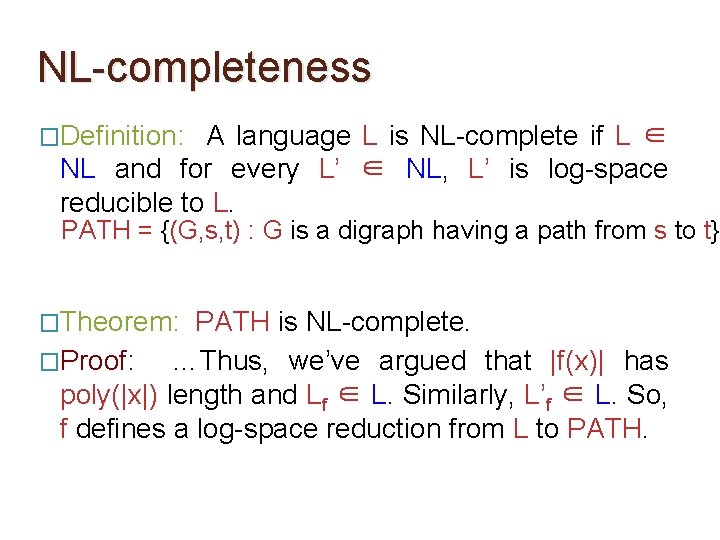
NL-completeness �Definition: A language L is NL-complete if L ∈ NL and for every L’ ∈ NL, L’ is log-space reducible to L. PATH = {(G, s, t) : G is a digraph having a path from s to t}. �Theorem: PATH is NL-complete. �Proof: …Thus, we’ve argued that |f(x)| has poly(|x|) length and Lf ∈ L. Similarly, L’f ∈ L. So, f defines a log-space reduction from L to PATH.
Another NL-complete problem � 2 SAT is NL-complete. (Exercise)