
Computational Biology Part 4 Protein Coding Regions Robert
Computational Biology, Part 4 Protein Coding Regions Robert F. Murphy Copyright 1996 -2001. All rights reserved.
Sequence Analysis Tasks Calculating the probability of finding a sequence pattern Calculating the probability of finding a region with a particular base composition Representing and finding sequence features/motifs using frequency matrices
Sequence Analysis Tasks Finding protein coding regions
Goal Given a DNA or RNA sequence, find those regions that code for protein(s) Direct approach: Look for stretches that can be interpreted as protein using the genetic code Statistical approaches: Use other knowledge about likely coding regions

Direct Approach
Genetic codes The set of t. RNAs that an organism possesses defines its genetic code(s) The universal genetic code is common to all organisms Prokaryotes, mitochondria and chloroplasts often use slightly different genetic codes More than one t. RNA may be present for a given codon, allowing more than one possible translation product
Genetic codes Differences in genetic codes occur in start and stop codons only Alternate initiation codons: codons that encode amino acids but can also be used to start translation (GUG, UUG, AUA, UUA, CUG) Suppressor t. RNA codons: codons that normally stop translation but are translated as amino acids (UAG, UGA, UAA)
Genetic codes
Genetic codes
Genetic codes Note additional start codons: UUA, UUG, CUG Note conversion of stop codon UGA (opal) to Trp
Modifying genetic codes in Mac. Vector Under Options select Modify Genetic Codes. . . Enter a name for new code in box Make changes by clicking on individual codons in table and selecting new values Click OK
Reading Frames Since nucleotide sequences are “read” three bases at a time, there are three possible “frames” in which a given nucleotide sequence can be “read” (in the forward direction) Taking the complement of the sequence and reading in the reverse direction gives three more reading frames
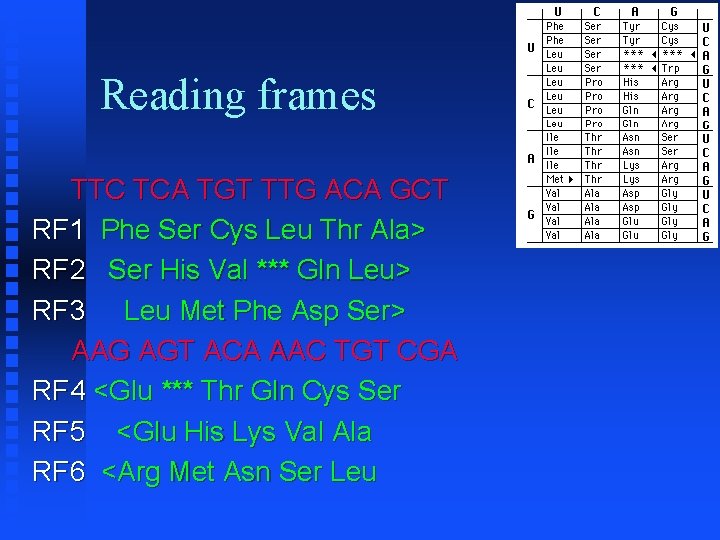
Reading frames TTC TCA TGT TTG ACA GCT RF 1 Phe Ser Cys Leu Thr Ala> RF 2 Ser His Val *** Gln Leu> RF 3 Leu Met Phe Asp Ser> AAG AGT ACA AAC TGT CGA RF 4 <Glu *** Thr Gln Cys Ser RF 5 <Glu His Lys Val Ala RF 6 <Arg Met Asn Ser Leu
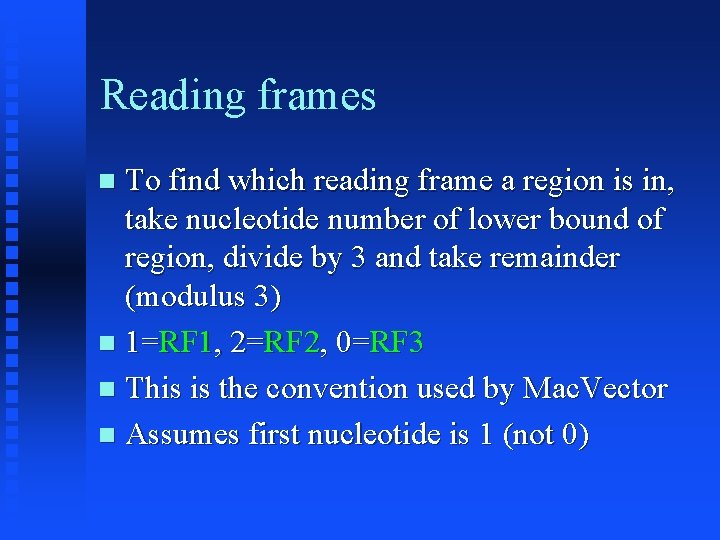
Reading frames To find which reading frame a region is in, take nucleotide number of lower bound of region, divide by 3 and take remainder (modulus 3) 1=RF 1, 2=RF 2, 0=RF 3 This is the convention used by Mac. Vector Assumes first nucleotide is 1 (not 0)
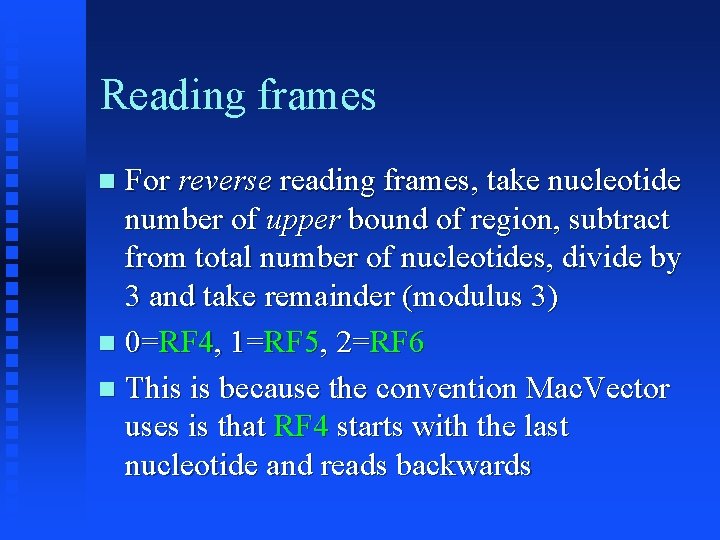
Reading frames For reverse reading frames, take nucleotide number of upper bound of region, subtract from total number of nucleotides, divide by 3 and take remainder (modulus 3) 0=RF 4, 1=RF 5, 2=RF 6 This is because the convention Mac. Vector uses is that RF 4 starts with the last nucleotide and reads backwards
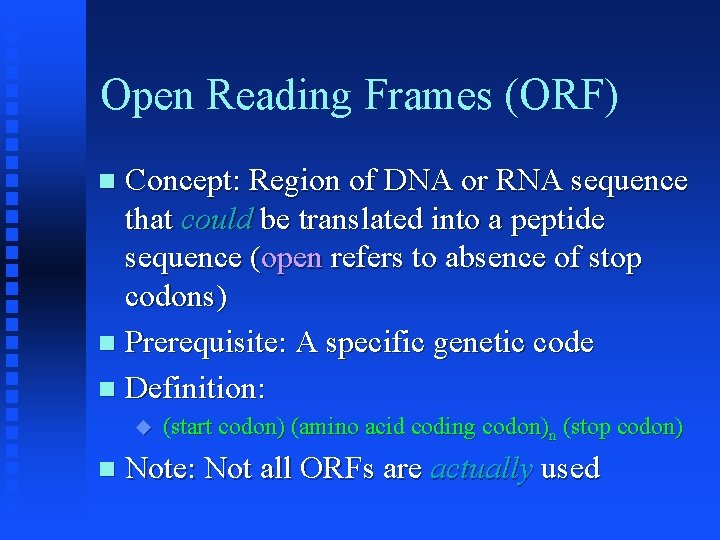
Open Reading Frames (ORF) Concept: Region of DNA or RNA sequence that could be translated into a peptide sequence (open refers to absence of stop codons) Prerequisite: A specific genetic code Definition: (start codon) (amino acid coding codon)n (stop codon) Note: Not all ORFs are actually used
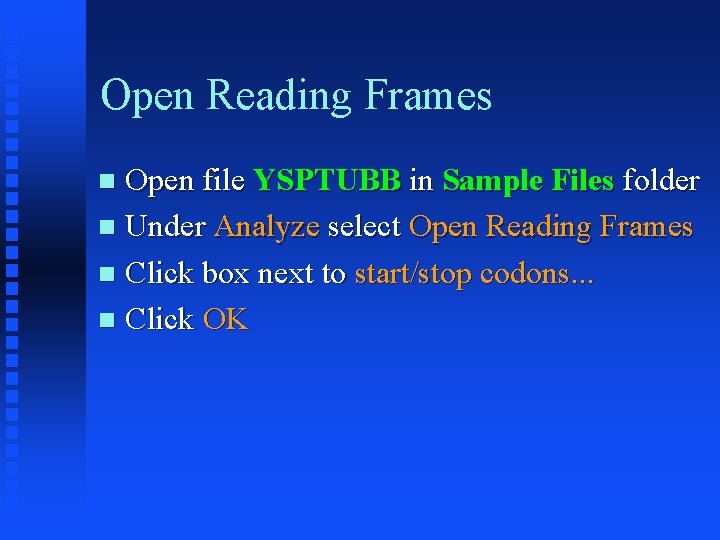
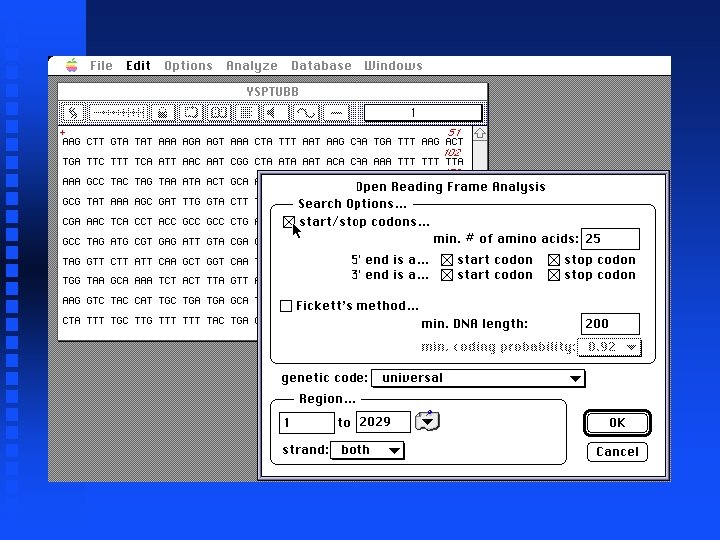
Open Reading Frames Open file YSPTUBB in Sample Files folder Under Analyze select Open Reading Frames Click box next to start/stop codons. . . Click OK
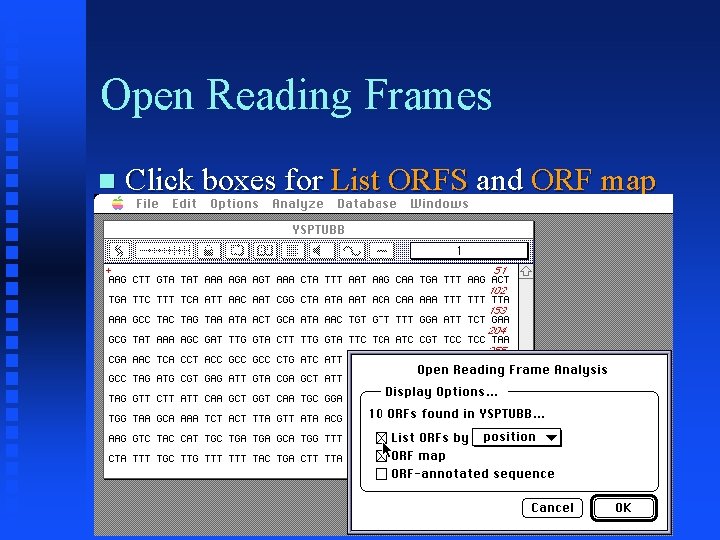
Open Reading Frames Click boxes for List ORFS and ORF map
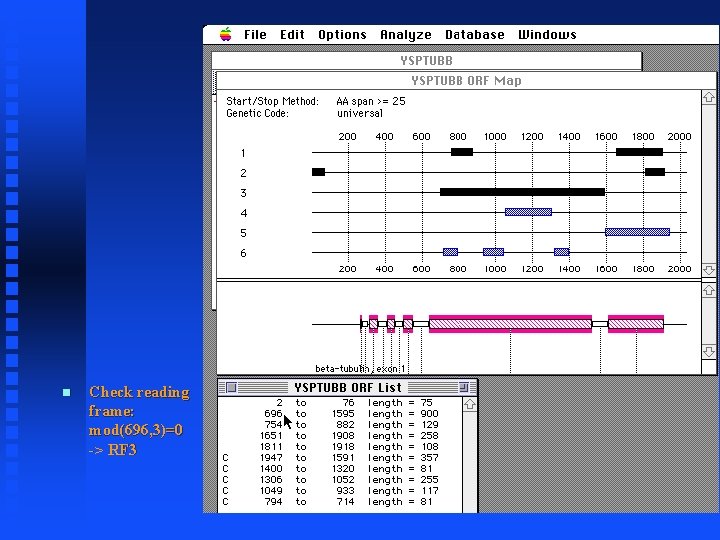
Check reading frame: mod(696, 3)=0 -> RF 3
Splicing ORFs For eukaryotes, which have interrupted genes, ORFs in different reading frames may be spliced together to generate final product ORFs from forward and reverse directions cannot be combined
ORFs and Exons Mac. Vector displays “annotations” to the sequence in a features table Open the feature table for YSPTUBB by clicking on the icon Note the six exons for the tubulin gene Does the large exon (exon 5) correspond to the large ORF in reading frame 3?
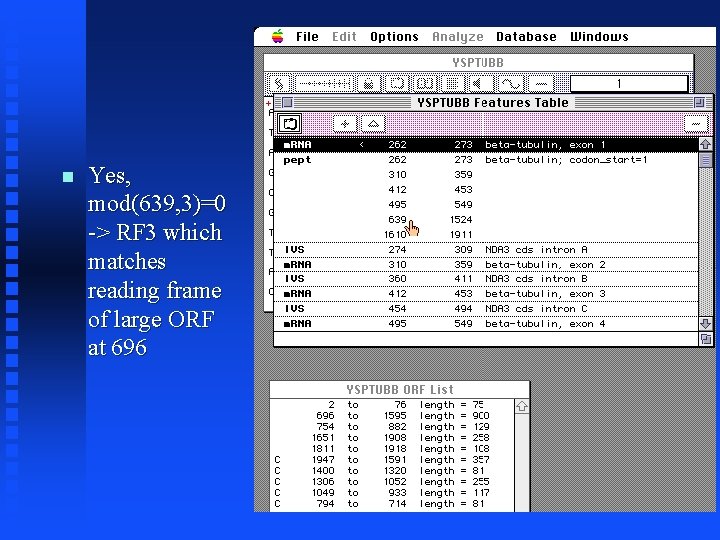
Yes, mod(639, 3)=0 -> RF 3 which matches reading frame of large ORF at 696
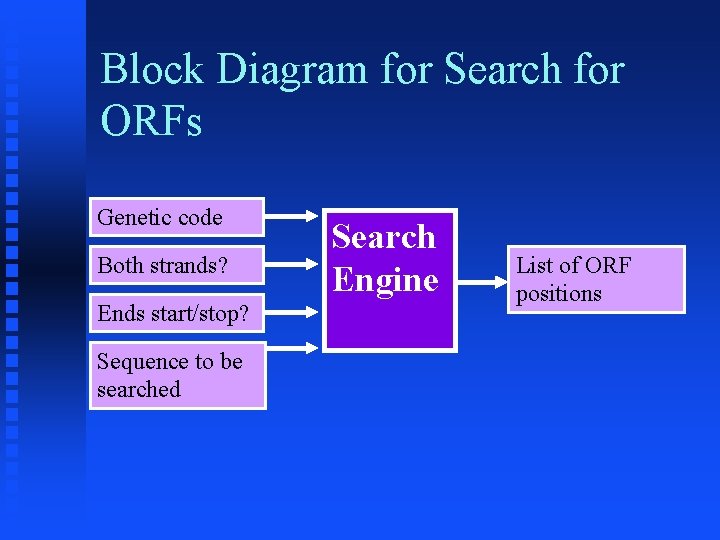
Block Diagram for Search for ORFs Genetic code Both strands? Ends start/stop? Sequence to be searched Search Engine List of ORF positions
Statistical Approaches
Calculation Windows Many sequence analyses require calculating some statistic over a long sequence looking for regions where the statistic is unusually high or low To do this, we define a window size to be the width of the region over which each calculation is to be done Example: %AT
Base Composition Bias For a protein with a roughly “normal” amino acid composition, the first 2 positions of all codons will be about 50% GC If an organism has a high GC content overall, the third position of all codons must be mostly GC Useful for prokaryotes Not useful for eukaryotes due to large amount of noncoding DNA
Fickett’s statistic Also called Test. Code analysis Looks for asymmetry of base composition Strong statistical basis for calculations Method: For each window on the sequence, calculate the base composition of nucleotides 1, 4, 7. . . , then of 2, 5, 8. . . , and then of 3, 6, 9. . . Calculate statistic from resulting three numbers
Codon Bias (Codon Preference) Principle Different levels of expression of different t. RNAs for a given amino acid lead to pressure on coding regions to “conform” to the preferred codon usage Non-coding regions, on the other hand, feel no selective pressure and can drift
Codon Bias (Codon Preference) Starting point: Table of observed codon frequencies in known genes from a given organism best to use highly expressed genes Method Calculate “coding potential” within a moving window for all three reading frames Look for ORFs with high scores
Codon Bias (Codon Preference) Works best for prokaryotes or unicellular eukaryotes because for multicellular eukaryotes, different pools of t. RNA may be expressed at different stages of development in different tissues may have to group genes into sets Codon bias can also be used to estimate protein expression level
Portion of D. melanogaster codon frequency table
Comparison of Glycine codon frequencies
Illustration of Fickett’s statistic and Codon Preference Plots Goal: Reproduce Figure 6 of Chapter 4 of Sequence Analysis Primer Use Entrez via Mac. Vector to get 5 files containing pieces of DNA sequence for the Drosophila Notch locus Combine 9 exons from 5 files Create Codon Preference Plot
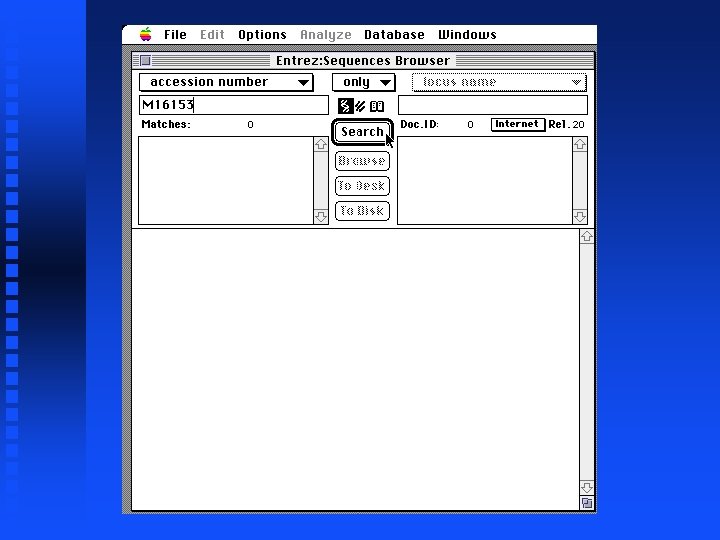
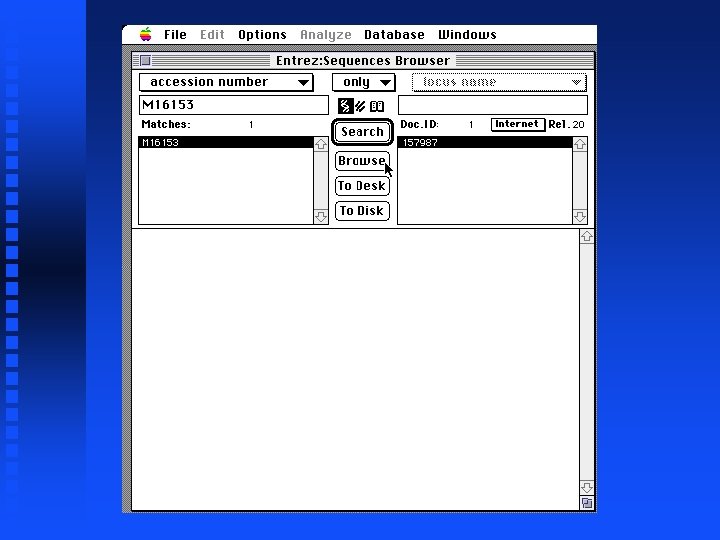
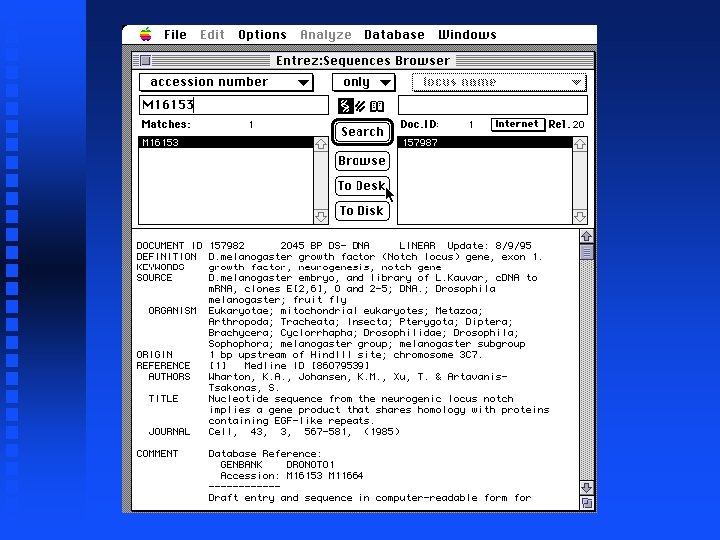
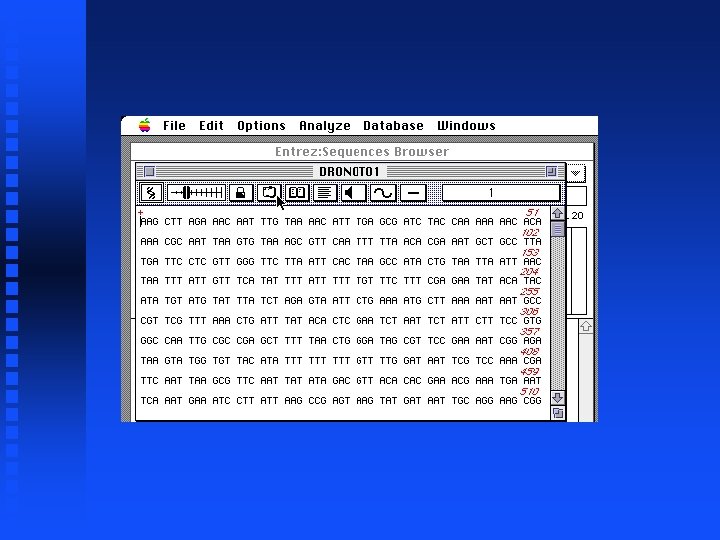
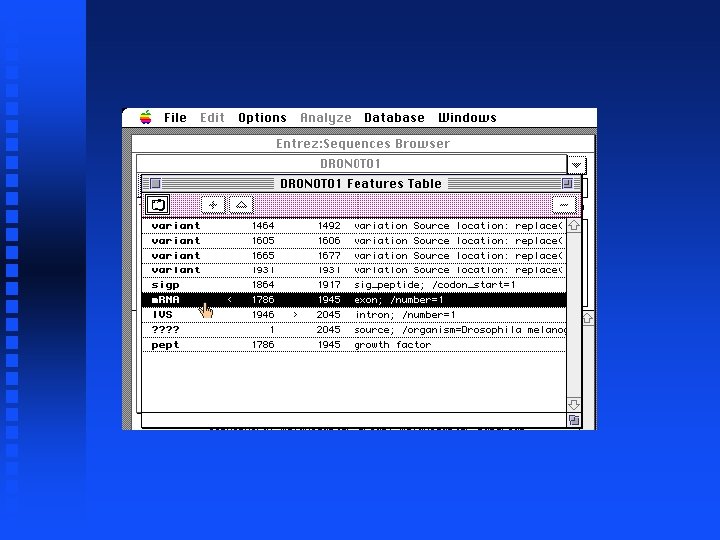
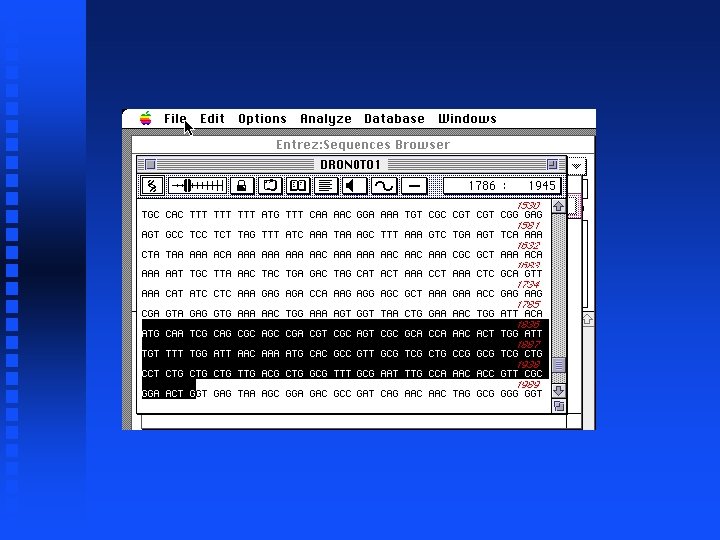
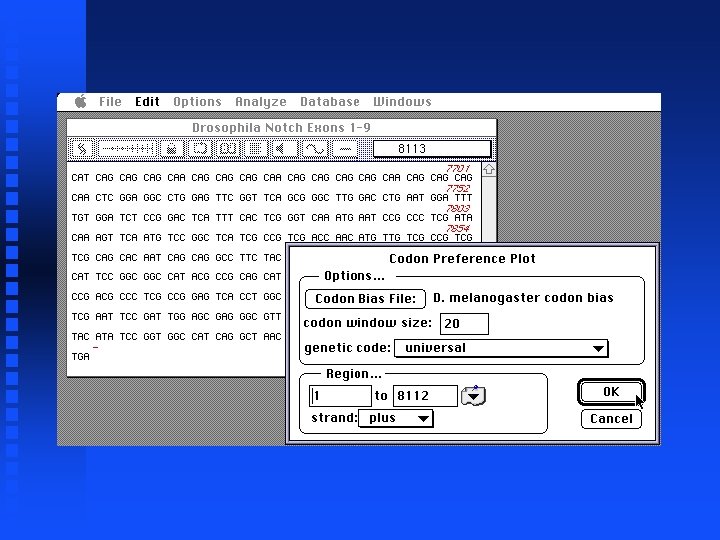
Creation of file containing Notch exons 1 -9 Open New sequence file and paste selected exon 1 into it Continue for exons 2 through 9 The result is in file Drosophila. Notch. Exons 1 to 9. gcg on Lecture Notes web page
Now generate Codon Preference Plot (for file containing just exons)

Analysis of Notch locus Now look at genomic sequence (exons and introns) Cut and paste entire sequences from 5 files into new file (not shown) The result is in file Drosophila. Notch. Locus. gcg on Lecture Notes web page Generate Codon Preference Plot
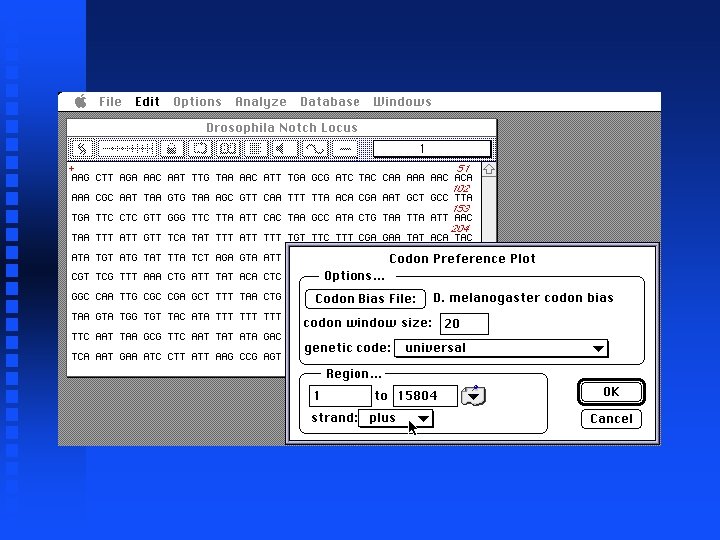
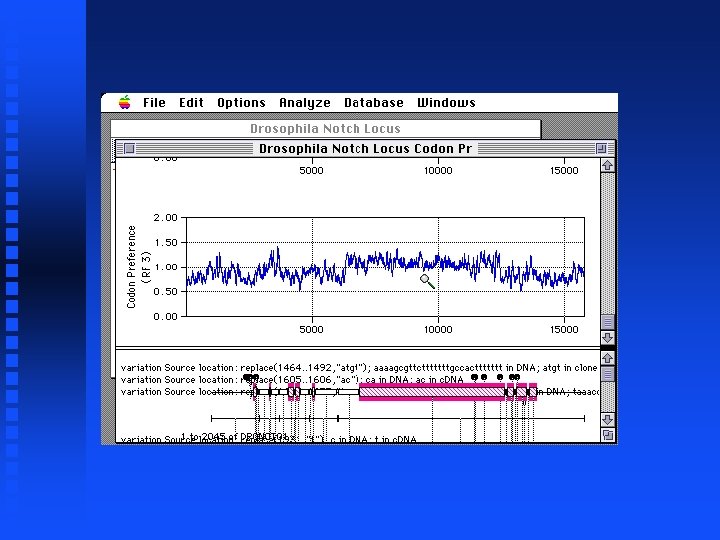

Note large region scoring above 1
Summary, Part 4 Translation of nucleic acid sequences into hypothetical protein sequences requires a genetic code Translation can occur in three forward and three reverse reading frames Open reading frames are regions that can be translated without encountering a stop codon
Summary, Part 4 The likelihood that a particular open reading frames is in fact a coding region (actually made into protein) can be estimated using third-codon base composition or codon preference tables This can be used to scan long sequences for possible coding regions
Assigned Readings Baxevanis & Ouellette, Chapter 2 Baxevanis & Ouellette, Chapter 5
- Slides: 51