
Computational Advertising And Comparison between Map Reduce and
Computational Advertising And Comparison between Map. Reduce and bulk-synchronous systems
Definition - Computational advertising ● Computational advertising, popularly known as Online advertising or Web advertising, refers to finding the most relevant ads matching a particular context on the web. ● It is a scientific sub-discipline at the intersection of information retrieval, statistical modeling, machine learning, optimization, large scale search and text analysis ● The central challenge of computational advertising is to find the "best match" between a given user in a given context and a suitable advertisement.
Online- Offline Algorithms OFFLINE ● Performed on static data ● See whole data set ● Find optimal function for the whole dataset ONLINE ● ● Performed on incomplete data Streaming data, with partial results Future data unknown Algorithms will always be less optimal than offline ● Make irrevocable decisions on imperfect data
Advertising on the Web ● Advertising is a form of marketing communication used to encourage, persuade, or manipulate an audience (viewers, readers or listeners; sometimes a specific group) to take or continue to take some action. ● Companies like Amazon, Alibaba use ads to increase the sales ● Ads may be based on the search results ● Billions of opportunities daily ● Open to personalization via rich context of impression ● Effectiveness is measurable: can measure click-through rates as % of impressions, and conversions as % of clicks
Greedy Algorithm ● A greedy algorithm is a simple, intuitive algorithm that is used in optimization problems. ● A greedy algorithm, as the name suggests, always makes the choice that seems to be the best at that moment i. e. it picks the best immediate output, but does not consider the big picture. ● This means that it makes a locally-optimal choice in the hope that this choice will lead to a globally-optimal solution. ● However, generally greedy algorithms do not provide globally optimized solutions.
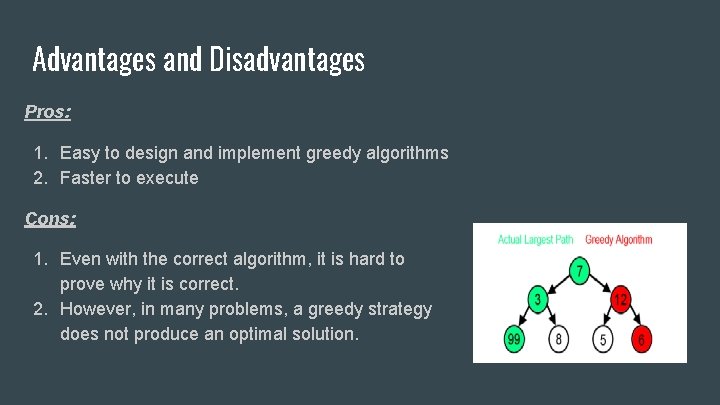
Advantages and Disadvantages Pros: 1. Easy to design and implement greedy algorithms 2. Faster to execute Cons: 1. Even with the correct algorithm, it is hard to prove why it is correct. 2. However, in many problems, a greedy strategy does not produce an optimal solution.
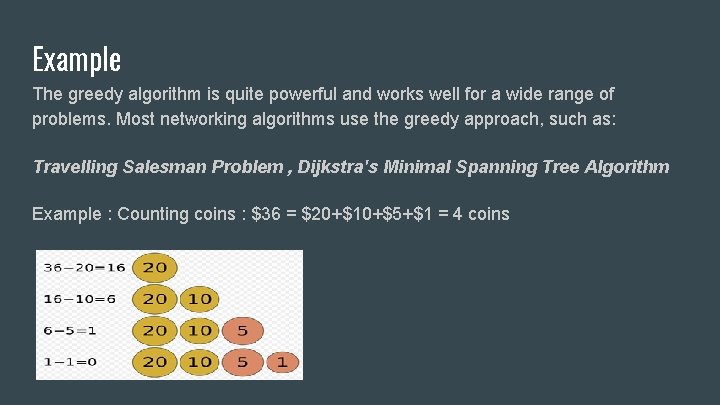
Example The greedy algorithm is quite powerful and works well for a wide range of problems. Most networking algorithms use the greedy approach, such as: Travelling Salesman Problem , Dijkstra's Minimal Spanning Tree Algorithm Example : Counting coins : $36 = $20+$10+$5+$1 = 4 coins
Competitive Ratio ● A comparison of an online algorithm with the best possible offline algorithm ● There will be some constant c < 1 such that for any input, the result of online algorithm is at least c times the result of optimum offline algorithm ● Competitive ratio = min all possible inputs I ( | M online | / | M opt| ) where | M online | = cardinality of online algorithm where | M opt| = cardinality of optimal offline algorithm
Adwords Problem ● Google's advertising system in which advertisers bid on certain keywords in order for their clickable ads to appear in Google's search results. ● Since advertisers have to pay for these clicks, this is how Google makes money from search. ● The price advertisers willing to pay for each click is called cost-per-click (CPC). ● Search engine selects and displays ads for a small subset of the bidders in a purpose of achieving the goal of maximizing search engine’s revenue. ● The decision regarding which ads to show must be made on-line.
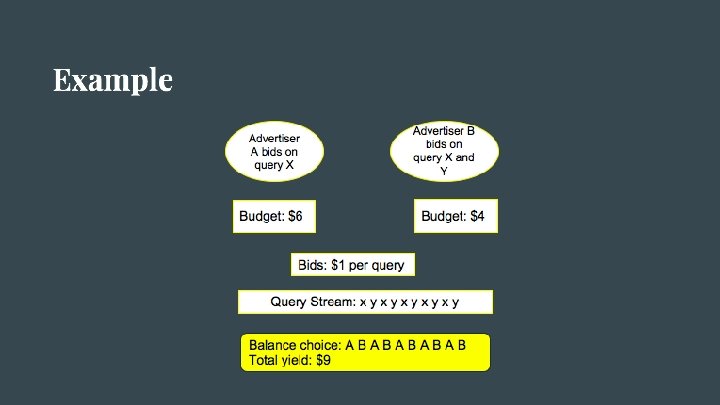
Adwords Problem ● Metric used: AD RANK = CPC BID X QUALITY SCORE ● The Quality Score is typically the relationship between ad group, keywords, ad and landing page and what a user is looking for and the likelihood that someone will click the ad. ● Advertisers: A and B; A bids on query x and B bids on queries x and y ● Sequence of queries: xxyy ● Query assigned to advertiser who has the maximum ad rank
Performance - based Advertising. Performance-based advertising is the business model by which referrers of the product or service are paid commissions for referring it. Crucial Elements: ● First is ads that will catch the attention of the public. ● Then, a second key point is placing ads on relevant topics or locations. Marketers call this targeting. ● A third key point is making user-friendly landing pages for click ads. ● Last, but not least is monitoring and adjustment to increase click responses.
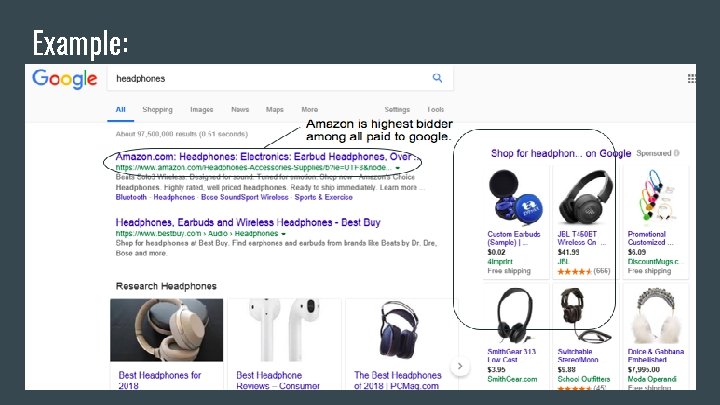
Example:
A more balanced Approach: ● Balance Algorithm ● Improvement to the Greedy Algorithm ● Queries are assigned to the advertisers that bid on the query with the largest remaining budget. ● Uses some of each advertisers budget
Generalized Balanced Algorithm Why generalization? : If we train the system with certain values of bids, then it will be able to identify the relevant data but when we apply different values of bids it produces terrible BALANCE and this is where generalization comes into the picture. It was designed to solve the problems of greedy algorithm, however, there are certain limitations in balanced algorithm. For the different values of bid(untrained data) it does not result expected balanced output. The competitive ratio for Generalized balanced algorithm is (1 -1/e)
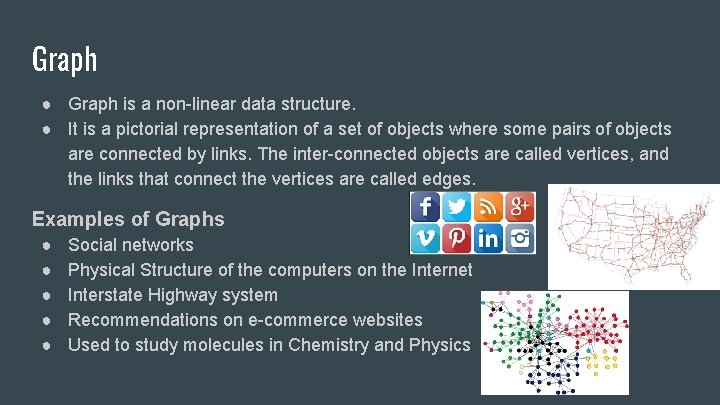
Graph ● Graph is a non-linear data structure. ● It is a pictorial representation of a set of objects where some pairs of objects are connected by links. The inter-connected objects are called vertices, and the links that connect the vertices are called edges. Examples of Graphs ● ● ● Social networks Physical Structure of the computers on the Internet Interstate Highway system Recommendations on e-commerce websites Used to study molecules in Chemistry and Physics
Graph Problem ●Finding Shortest Path - Routing Internet Traffic and Logistics ●Finding Minimum Spanning Trees - Telephone Network Design ●Maximum Flow Problem - Airline Scheduling ●Bipartite Matching - Monster. com, Match. com ●Page. Rank Processing Graph Data ●As the size of the graph data is very large, parallel processing has to be used for efficient computation. ●Techniques Used : Map. Reduce, Bulk-Synchronous Systems
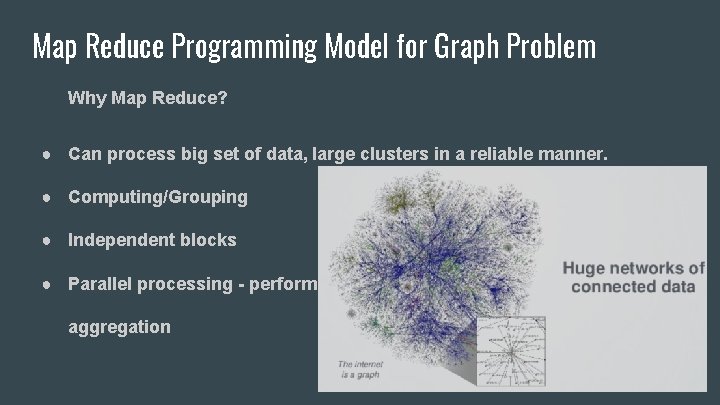
Map Reduce Programming Model for Graph Problem Why Map Reduce? ● Can process big set of data, large clusters in a reliable manner. ● Computing/Grouping ● Independent blocks ● Parallel processing - performs aggregation
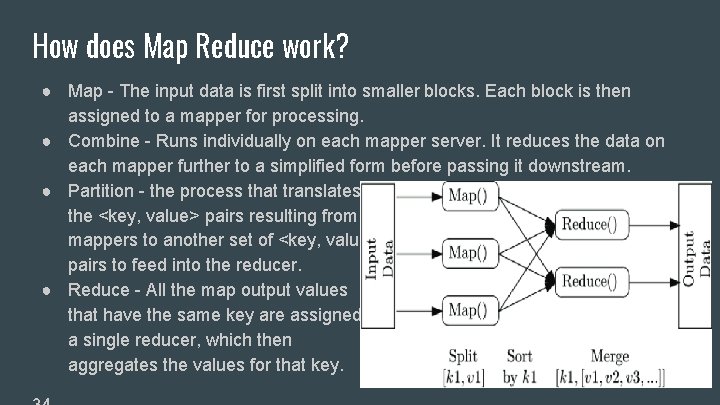
How does Map Reduce work? ● Map - The input data is first split into smaller blocks. Each block is then assigned to a mapper for processing. ● Combine - Runs individually on each mapper server. It reduces the data on each mapper further to a simplified form before passing it downstream. ● Partition - the process that translates the <key, value> pairs resulting from mappers to another set of <key, value> pairs to feed into the reducer. ● Reduce - All the map output values that have the same key are assigned to a single reducer, which then aggregates the values for that key.
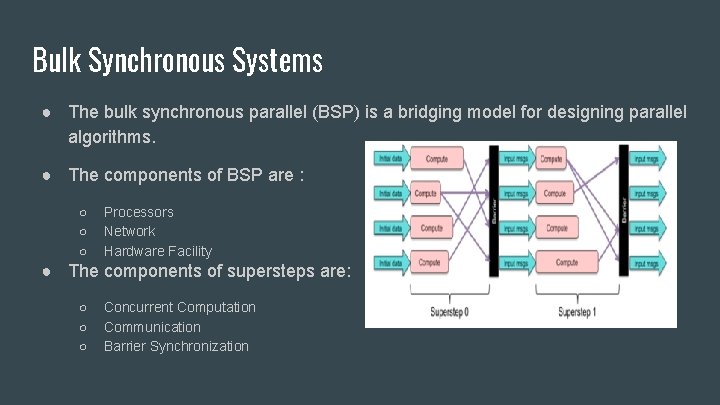
Bulk Synchronous Systems ● The bulk synchronous parallel (BSP) is a bridging model for designing parallel algorithms. ● The components of BSP are : ○ ○ ○ Processors Network Hardware Facility ● The components of supersteps are: ○ ○ ○ Concurrent Computation Communication Barrier Synchronization
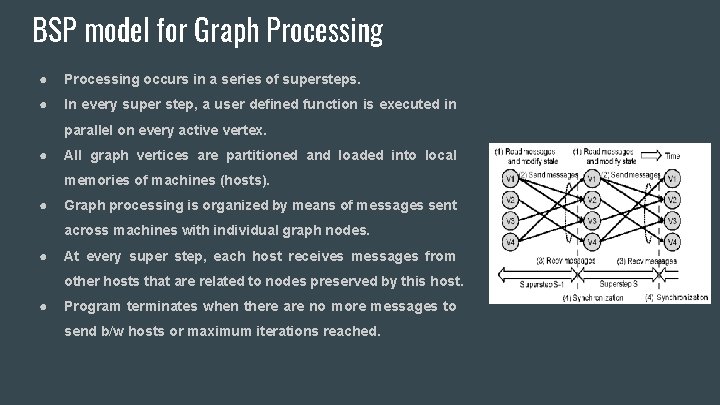
BSP model for Graph Processing ● Processing occurs in a series of supersteps. ● In every super step, a user defined function is executed in parallel on every active vertex. ● All graph vertices are partitioned and loaded into local memories of machines (hosts). ● Graph processing is organized by means of messages sent across machines with individual graph nodes. ● At every super step, each host receives messages from other hosts that are related to nodes preserved by this host. ● Program terminates when there are no more messages to send b/w hosts or maximum iterations reached.

THANK YOU
- Slides: 22