
Computation of Spatial Kernel of Carbon Nanotubes in
Computation of Spatial Kernel of Carbon Nanotubes in Non-Local Elasticity Theory Veera Sundararaghavan Assistant Professor of Aerospace Engineering Anthony Waas Felix Pawlowski Collegiate Professor of Aerospace Engineering University of Michigan, Ann Arbor MULTI-SCALE STRUCTURAL SIMULATIONS LABORATORY
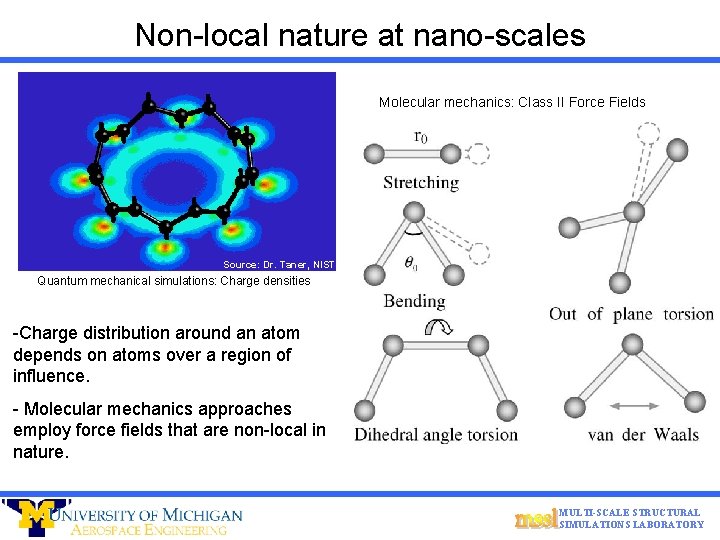
Non-local nature at nano-scales Molecular mechanics: Class II Force Fields Source: Dr. Taner, NIST Quantum mechanical simulations: Charge densities -Charge distribution around an atom depends on atoms over a region of influence. - Molecular mechanics approaches employ force fields that are non-local in nature. MULTI-SCALE STRUCTURAL SIMULATIONS LABORATORY
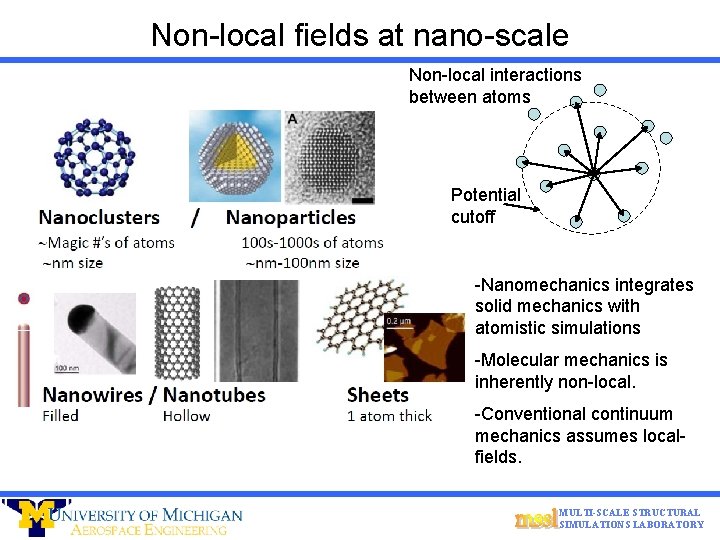
Non-local fields at nano-scale Non-local interactions between atoms Potential cutoff -Nanomechanics integrates solid mechanics with atomistic simulations -Molecular mechanics is inherently non-local. -Conventional continuum mechanics assumes localfields. MULTI-SCALE STRUCTURAL SIMULATIONS LABORATORY

Local versus Non-local theory • Non-local theory incorporates long range interactions between points in a continuum model. • Stress at a point depends on the strain in a region near that point (Works of Eringen, Aifantis, Kunin) Local kernel (delta function) Non-local kernel - Non-local elasticity - Local elasticity MULTI-SCALE STRUCTURAL SIMULATIONS LABORATORY
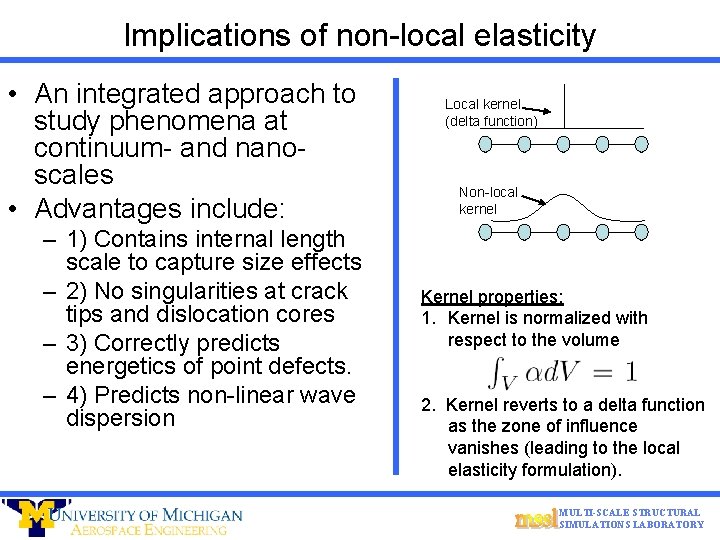
Implications of non-local elasticity • An integrated approach to study phenomena at continuum- and nano- scales • Advantages include: – 1) Contains internal length scale to capture size effects – 2) No singularities at crack tips and dislocation cores – 3) Correctly predicts energetics of point defects. – 4) Predicts non-linear wave dispersion Local kernel (delta function) Non-local kernel Kernel properties: 1. Kernel is normalized with respect to the volume 2. Kernel reverts to a delta function as the zone of influence vanishes (leading to the local elasticity formulation). MULTI-SCALE STRUCTURAL SIMULATIONS LABORATORY
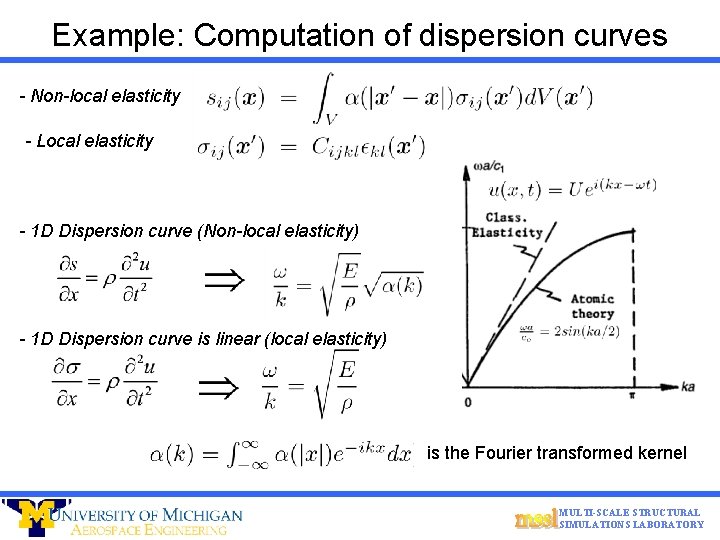
Example: Computation of dispersion curves - Non-local elasticity - Local elasticity - 1 D Dispersion curve (Non-local elasticity) - 1 D Dispersion curve is linear (local elasticity) is the Fourier transformed kernel MULTI-SCALE STRUCTURAL SIMULATIONS LABORATORY
Approaches to construct the non-local kernel • For pairwise potentials, a unique kernel can be derived (Picu, 2000). • Direct fitting with atomistic dispersion curves (Eringen) works for all interatomic potentials. The form of the kernel is assumed (usually Gaussian) • Simple forms of kernel (stress- and strain- gradient theories) use a single parameter that is fitted to a property of interest (eg. Critical buckling strain (Zhang, 2005), Elastic modulus (Wang, 2008)) MULTI-SCALE STRUCTURAL SIMULATIONS LABORATORY
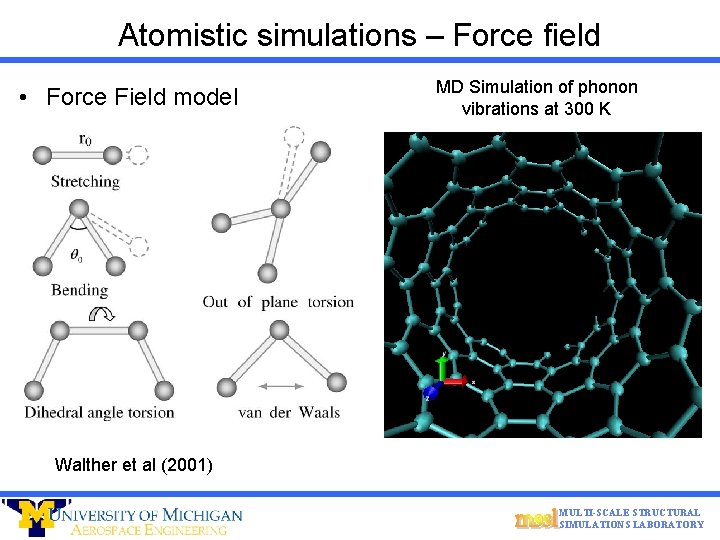
Atomistic simulations – Force field • Force Field model MD Simulation of phonon vibrations at 300 K Walther et al (2001) MULTI-SCALE STRUCTURAL SIMULATIONS LABORATORY
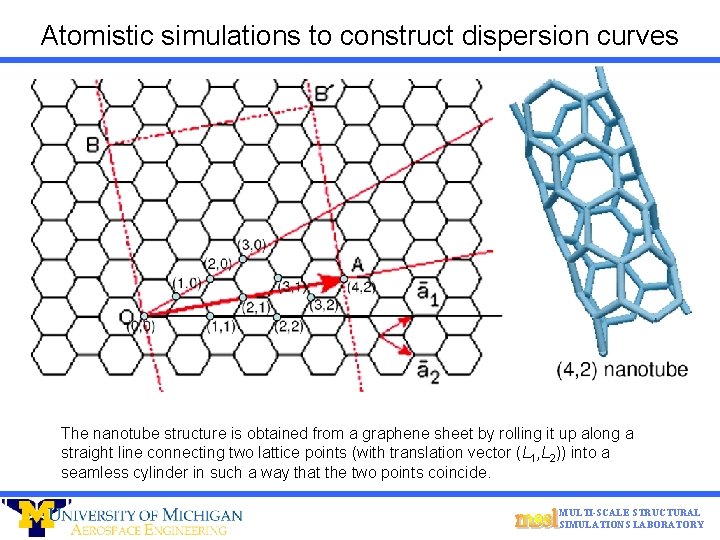
Atomistic simulations to construct dispersion curves The nanotube structure is obtained from a graphene sheet by rolling it up along a straight line connecting two lattice points (with translation vector (L 1, L 2)) into a seamless cylinder in such a way that the two points coincide. MULTI-SCALE STRUCTURAL SIMULATIONS LABORATORY
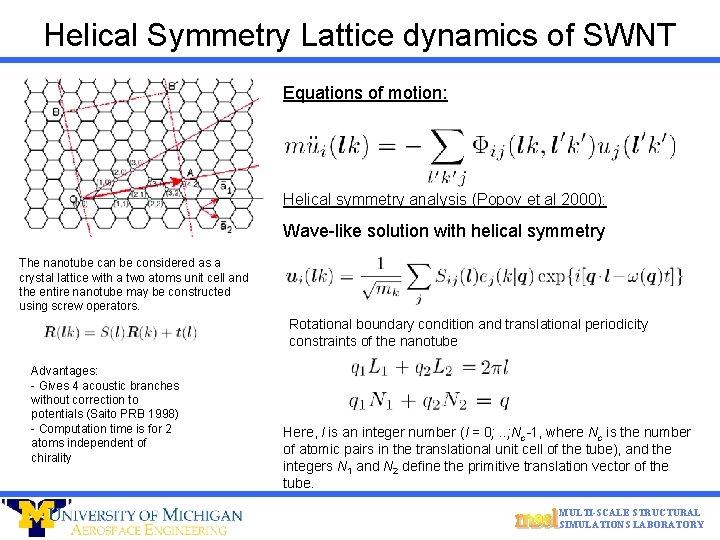
Helical Symmetry Lattice dynamics of SWNT Equations of motion: Helical symmetry analysis (Popov et al 2000): Wave-like solution with helical symmetry The nanotube can be considered as a crystal lattice with a two atoms unit cell and the entire nanotube may be constructed using screw operators. Rotational boundary condition and translational periodicity constraints of the nanotube Advantages: - Gives 4 acoustic branches without correction to potentials (Saito PRB 1998) - Computation time is for 2 atoms independent of chirality Here, l is an integer number (l = 0; . . ; Nc-1, where Nc is the number of atomic pairs in the translational unit cell of the tube), and the integers N 1 and N 2 define the primitive translation vector of the tube. MULTI-SCALE STRUCTURAL SIMULATIONS LABORATORY
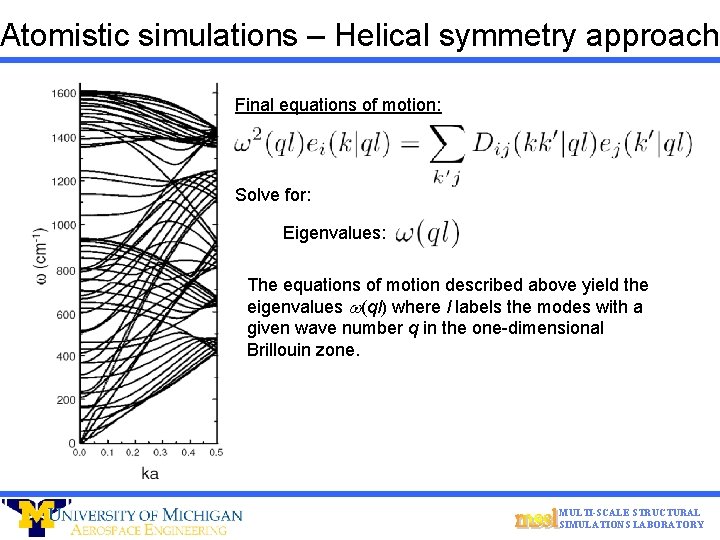
Atomistic simulations – Helical symmetry approach Final equations of motion: Solve for: Eigenvalues: The equations of motion described above yield the eigenvalues w(ql) where l labels the modes with a given wave number q in the one-dimensional Brillouin zone. MULTI-SCALE STRUCTURAL SIMULATIONS LABORATORY
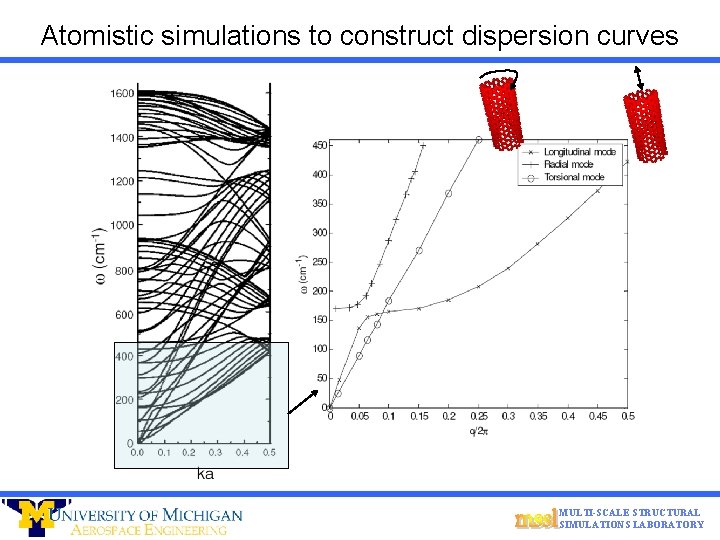
Atomistic simulations to construct dispersion curves MULTI-SCALE STRUCTURAL SIMULATIONS LABORATORY
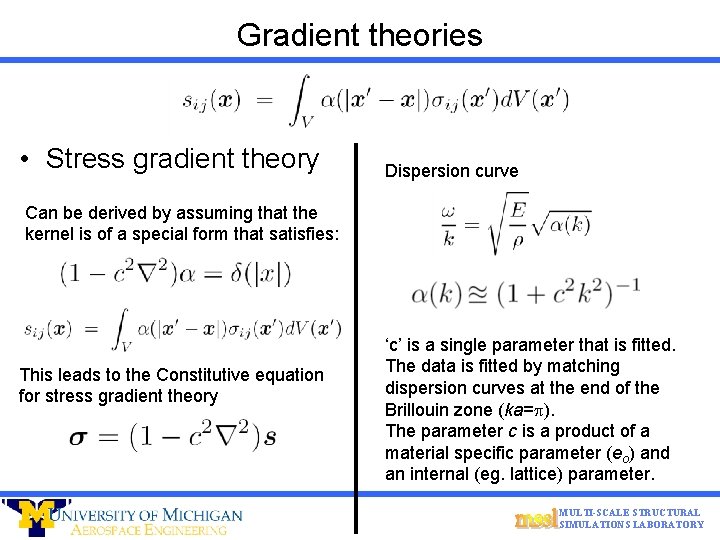
Gradient theories • Stress gradient theory Dispersion curve Can be derived by assuming that the kernel is of a special form that satisfies: This leads to the Constitutive equation for stress gradient theory ‘c’ is a single parameter that is fitted. The data is fitted by matching dispersion curves at the end of the Brillouin zone (ka=p). The parameter c is a product of a material specific parameter (eo) and an internal (eg. lattice) parameter. MULTI-SCALE STRUCTURAL SIMULATIONS LABORATORY
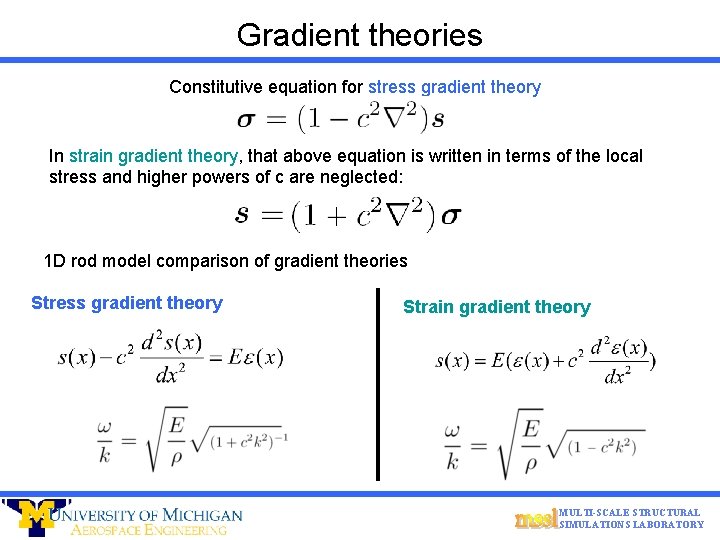
Gradient theories Constitutive equation for stress gradient theory In strain gradient theory, that above equation is written in terms of the local stress and higher powers of c are neglected: 1 D rod model comparison of gradient theories Stress gradient theory Strain gradient theory MULTI-SCALE STRUCTURAL SIMULATIONS LABORATORY
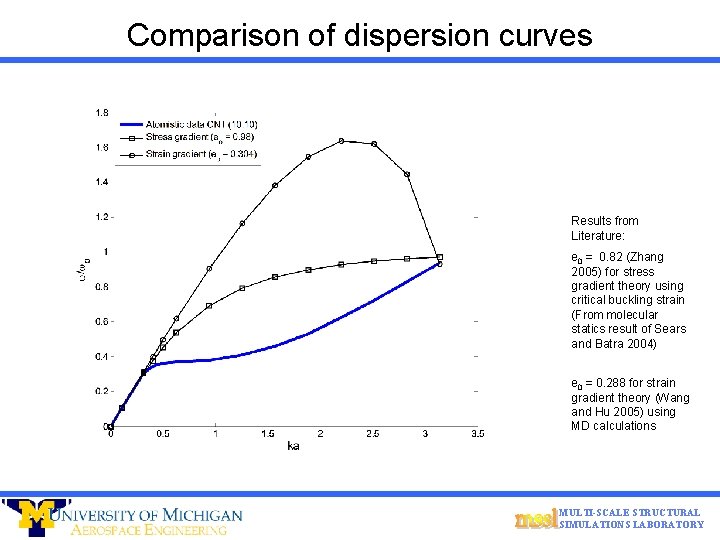
Comparison of dispersion curves Results from Literature: e 0 = 0. 82 (Zhang 2005) for stress gradient theory using critical buckling strain (From molecular statics result of Sears and Batra 2004) e 0 = 0. 288 for strain gradient theory (Wang and Hu 2005) using MD calculations MULTI-SCALE STRUCTURAL SIMULATIONS LABORATORY
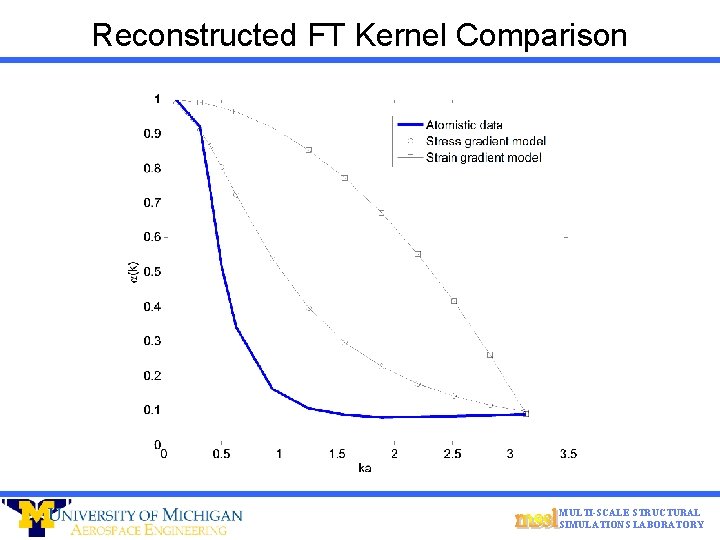
Reconstructed FT Kernel Comparison MULTI-SCALE STRUCTURAL SIMULATIONS LABORATORY
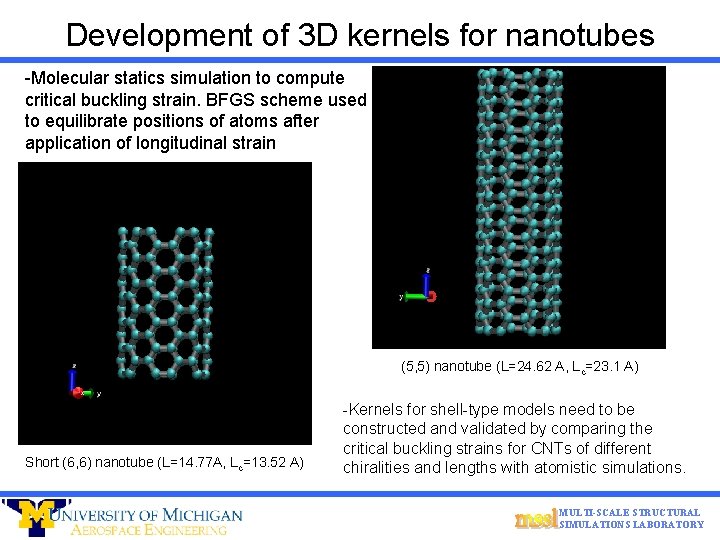
Development of 3 D kernels for nanotubes -Molecular statics simulation to compute critical buckling strain. BFGS scheme used to equilibrate positions of atoms after application of longitudinal strain (5, 5) nanotube (L=24. 62 A, Lc=23. 1 A) Short (6, 6) nanotube (L=14. 77 A, Lc=13. 52 A) -Kernels for shell-type models need to be constructed and validated by comparing the critical buckling strains for CNTs of different chiralities and lengths with atomistic simulations. MULTI-SCALE STRUCTURAL SIMULATIONS LABORATORY

Flugge’s shell theory – Kinematics Non-local forces and moments Local shell theory Stress gradient version in Wang and Varadan (2007) From force constants and Hu (2008) MULTI-SCALE STRUCTURAL SIMULATIONS LABORATORY
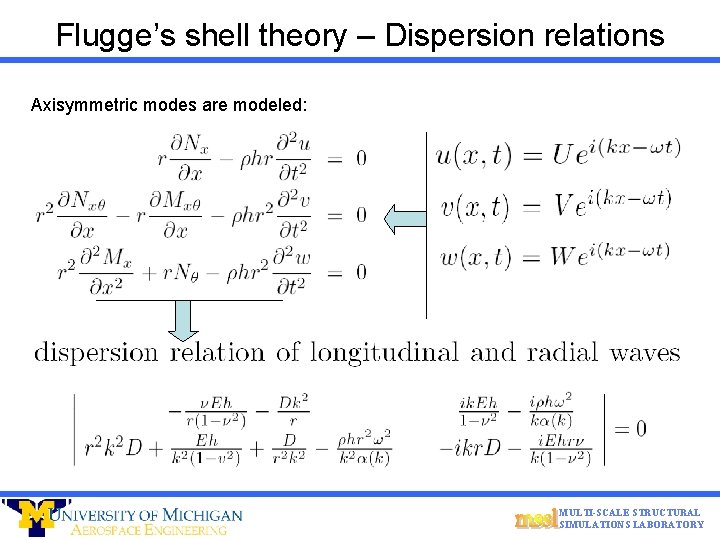
Flugge’s shell theory – Dispersion relations Axisymmetric modes are modeled: MULTI-SCALE STRUCTURAL SIMULATIONS LABORATORY
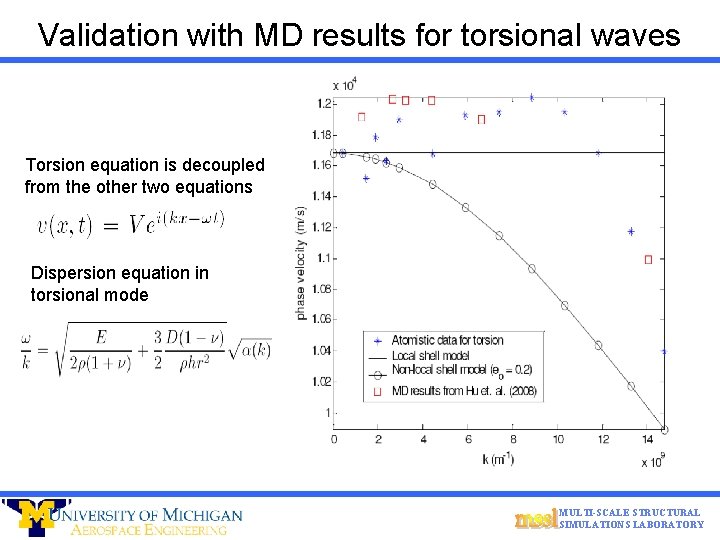
Validation with MD results for torsional waves Torsion equation is decoupled from the other two equations Dispersion equation in torsional mode MULTI-SCALE STRUCTURAL SIMULATIONS LABORATORY
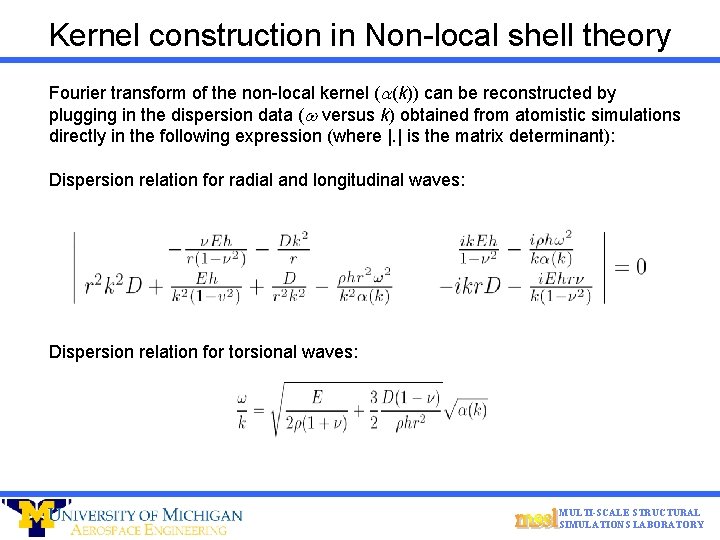
Kernel construction in Non-local shell theory Fourier transform of the non-local kernel (a(k)) can be reconstructed by plugging in the dispersion data (w versus k) obtained from atomistic simulations directly in the following expression (where |. | is the matrix determinant): Dispersion relation for radial and longitudinal waves: Dispersion relation for torsional waves: MULTI-SCALE STRUCTURAL SIMULATIONS LABORATORY
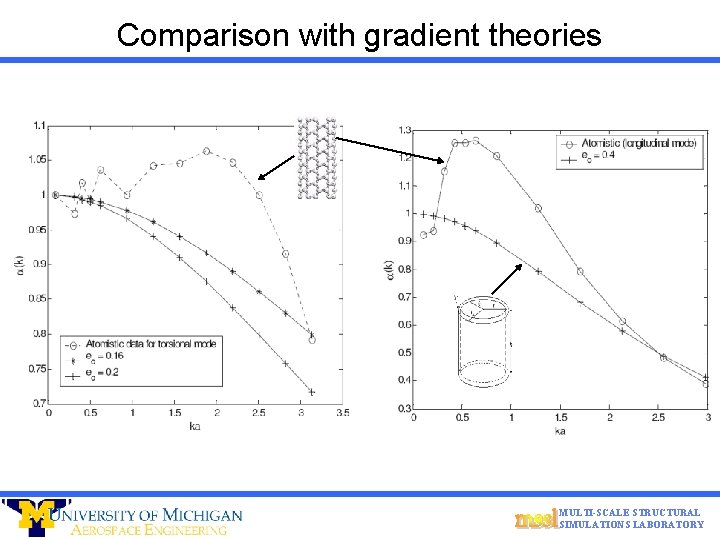
Comparison with gradient theories MULTI-SCALE STRUCTURAL SIMULATIONS LABORATORY
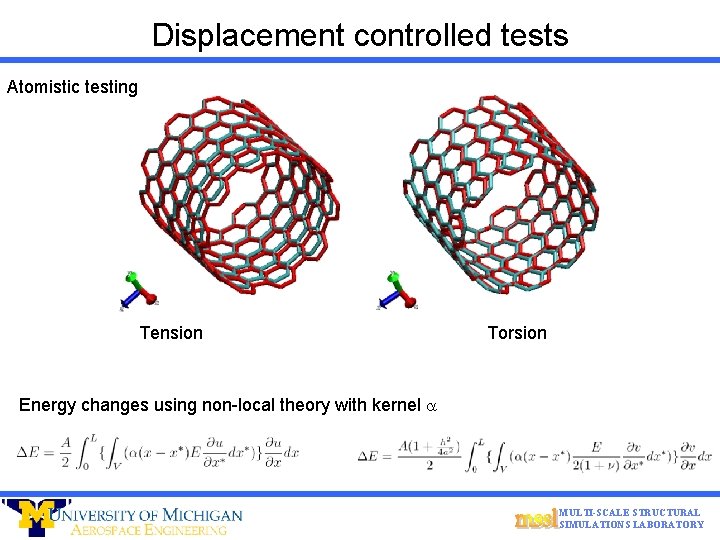
Displacement controlled tests Atomistic testing Tension Torsion Energy changes using non-local theory with kernel a MULTI-SCALE STRUCTURAL SIMULATIONS LABORATORY
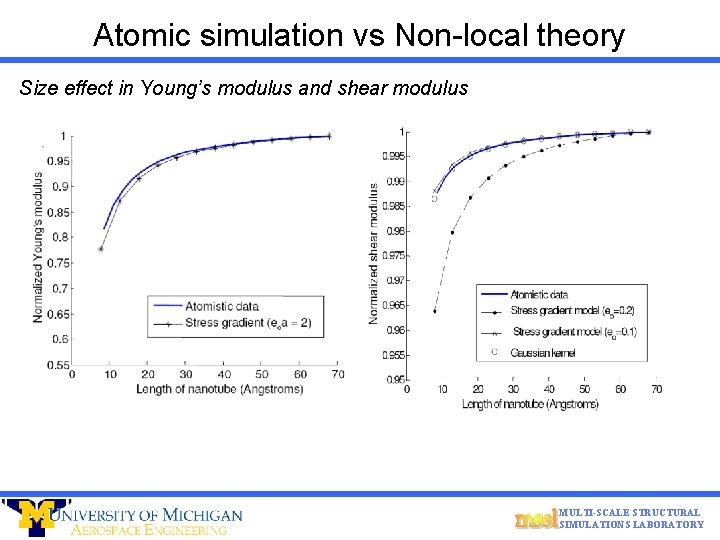
Atomic simulation vs Non-local theory Size effect in Young’s modulus and shear modulus MULTI-SCALE STRUCTURAL SIMULATIONS LABORATORY
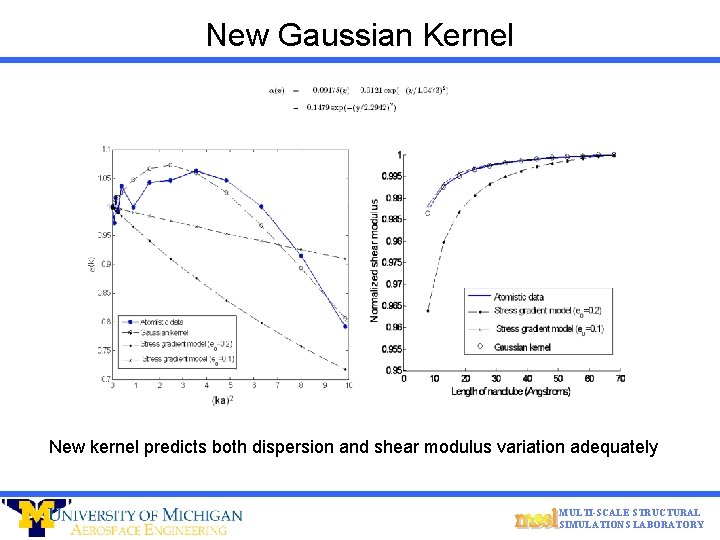
New Gaussian Kernel New kernel predicts both dispersion and shear modulus variation adequately MULTI-SCALE STRUCTURAL SIMULATIONS LABORATORY
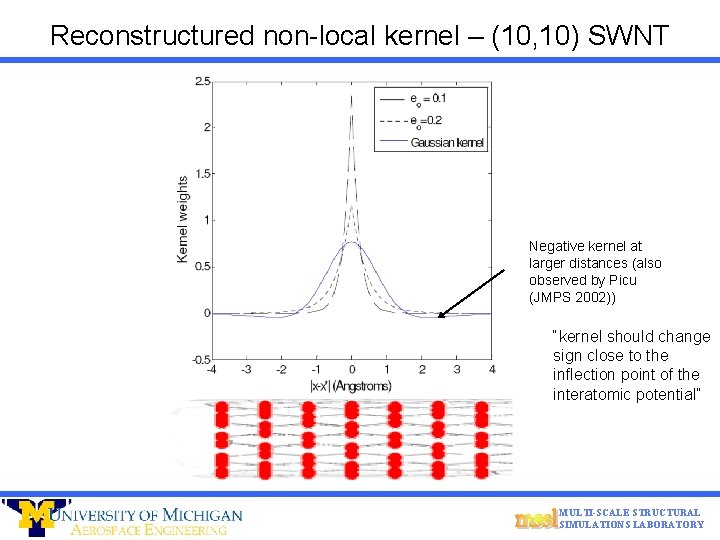
Reconstructured non-local kernel – (10, 10) SWNT Negative kernel at larger distances (also observed by Picu (JMPS 2002)) “kernel should change sign close to the inflection point of the interatomic potential” MULTI-SCALE STRUCTURAL SIMULATIONS LABORATORY
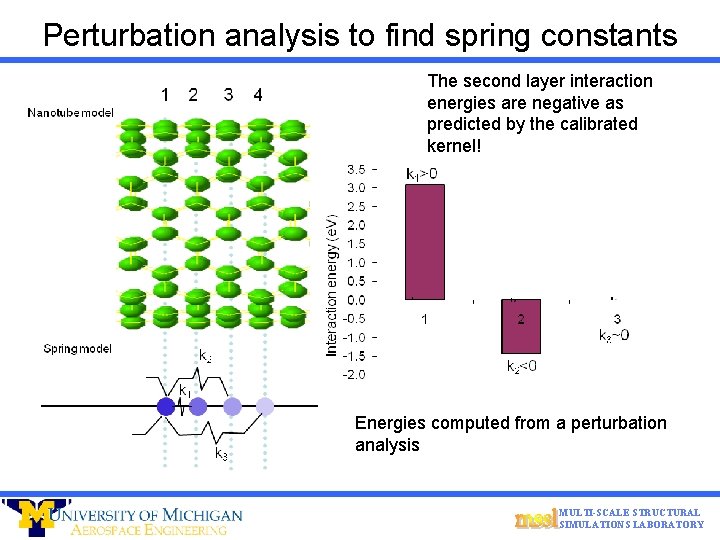
Perturbation analysis to find spring constants The second layer interaction energies are negative as predicted by the calibrated kernel! Energies computed from a perturbation analysis MULTI-SCALE STRUCTURAL SIMULATIONS LABORATORY
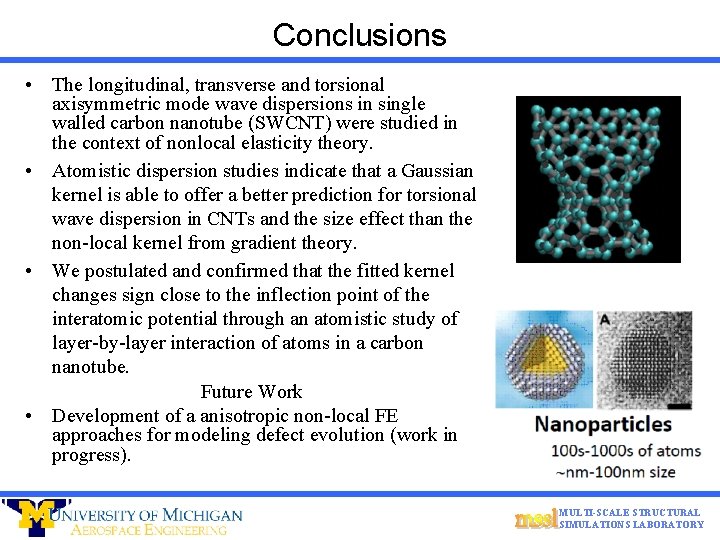
Conclusions • The longitudinal, transverse and torsional axisymmetric mode wave dispersions in single walled carbon nanotube (SWCNT) were studied in the context of nonlocal elasticity theory. • Atomistic dispersion studies indicate that a Gaussian kernel is able to offer a better prediction for torsional wave dispersion in CNTs and the size effect than the non-local kernel from gradient theory. • We postulated and confirmed that the fitted kernel changes sign close to the inflection point of the interatomic potential through an atomistic study of layer-by-layer interaction of atoms in a carbon nanotube. Future Work • Development of a anisotropic non-local FE approaches for modeling defect evolution (work in progress). MULTI-SCALE STRUCTURAL SIMULATIONS LABORATORY
- Slides: 28