
Computation in Real Closed Infinitesimal and Transcendental Extensions
![Examples msqrt 2, sqrt 2 = Mk. Roots([-2, 0, 1]) print(msqrt 2) >> root(x^2](https://slidetodoc.com/presentation_image_h/8c2dc2e03b22ca89b1babea11ab1ca07/image-45.jpg "Examples msqrt 2, sqrt 2 = Mk. Roots([-2, 0, 1]) print(msqrt 2) >> root(x^2")
![Examples [x] = Mk. Roots([-1, 0, 0, 0, 1]) [y] = Mk. Roots([-197, 3131,](https://slidetodoc.com/presentation_image_h/8c2dc2e03b22ca89b1babea11ab1ca07/image-49.jpg "Examples [x] = Mk. Roots([-1, 0, 0, 0, 1]) [y] = Mk. Roots([-197, 3131,")
![Same Example in Mathematica x = Root[#^5 - # - 1 &, 1] y](https://slidetodoc.com/presentation_image_h/8c2dc2e03b22ca89b1babea11ab1ca07/image-50.jpg "Same Example in Mathematica x = Root[#^5 - # - 1 &, 1] y")

- Slides: 51
Computation in Real Closed Infinitesimal and Transcendental Extensions of the Rationals Leonardo de Moura Grant Passmore
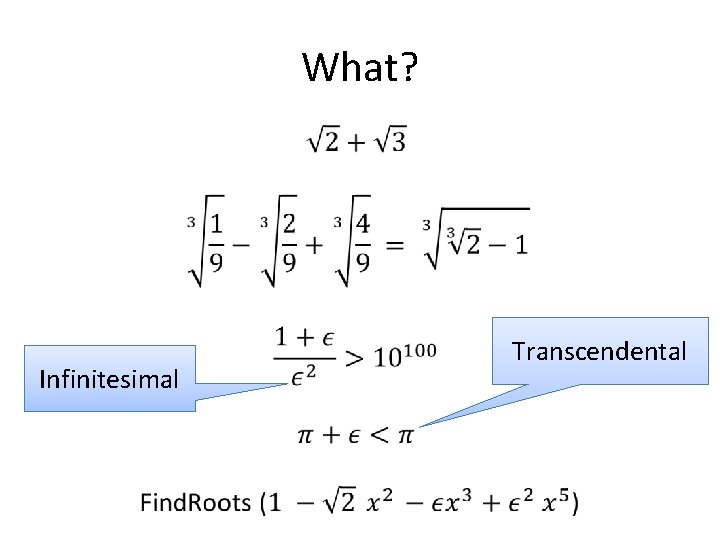
What? Infinitesimal Transcendental
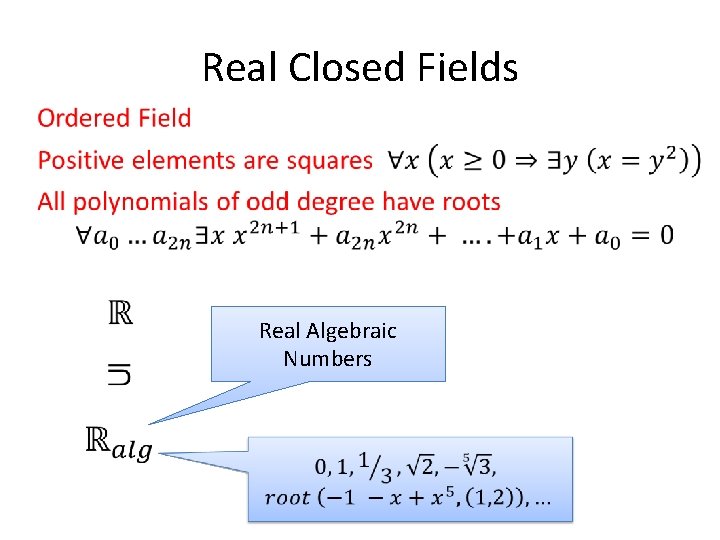
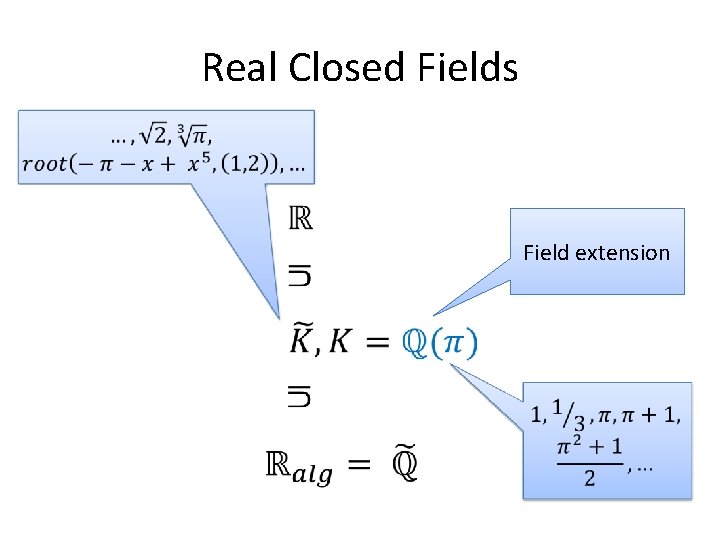
Real Closed Fields Real Algebraic Numbers
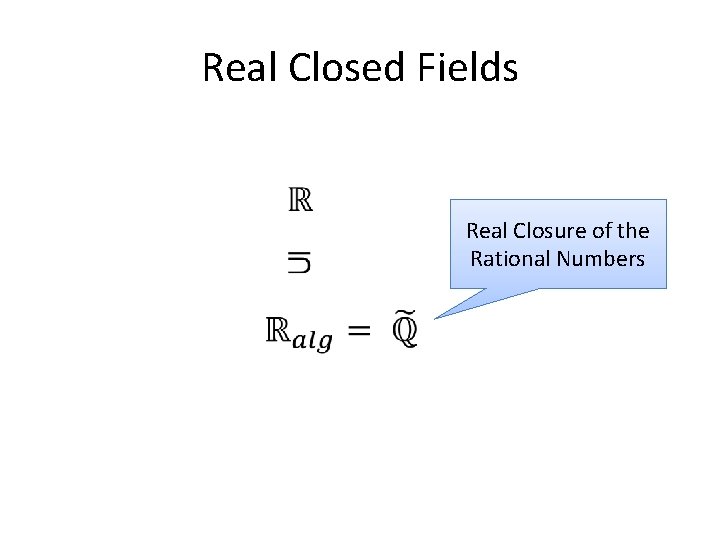
Real Closed Fields Real Closure of the Rational Numbers
Real Closed Fields Field extension
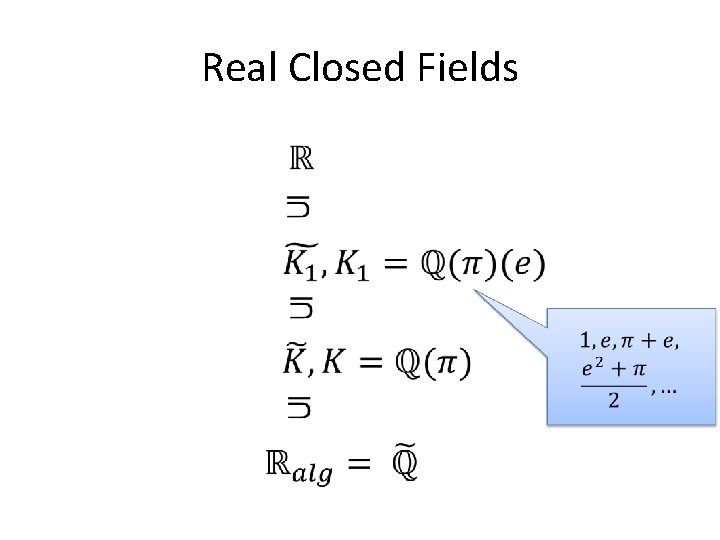
Real Closed Fields
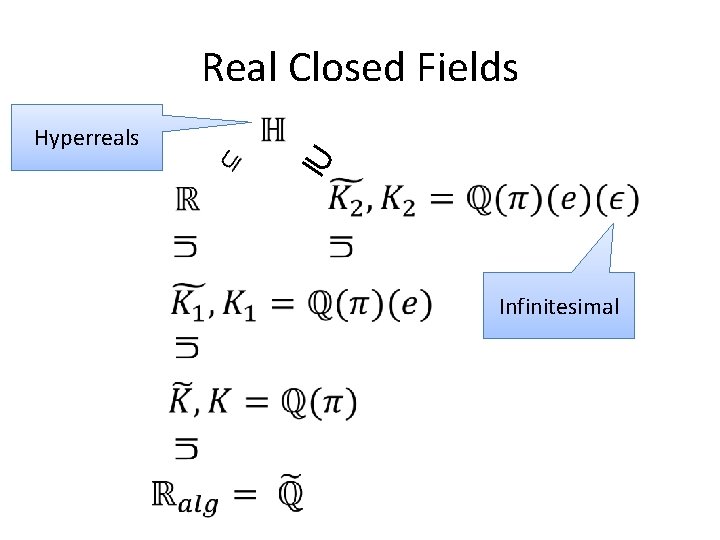
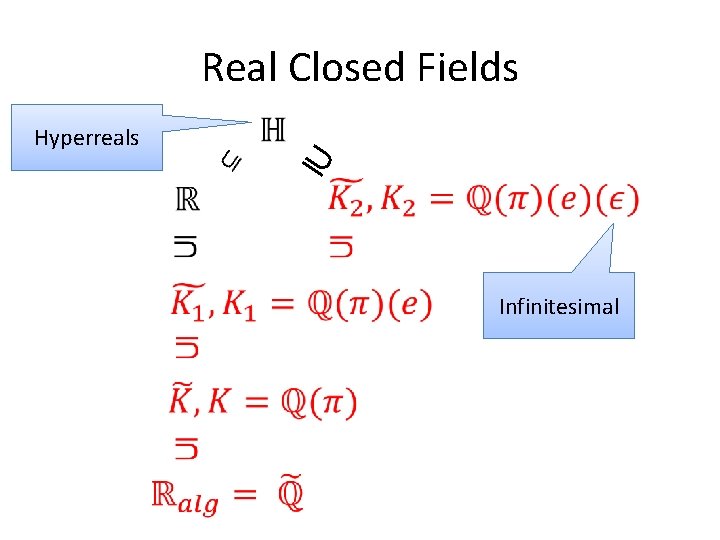
Real Closed Fields ⊇ Hyperreals Infinitesimal
Real Closed Fields ⊇ Hyperreals Infinitesimal
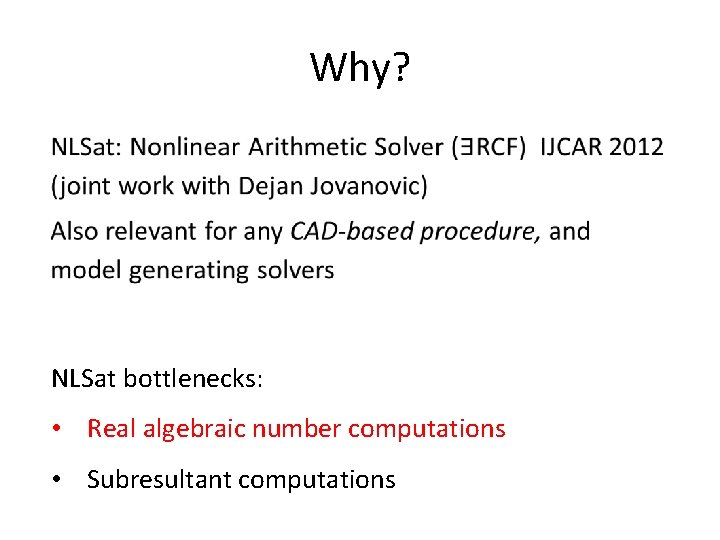
Why? NLSat bottlenecks: • Real algebraic number computations • Subresultant computations
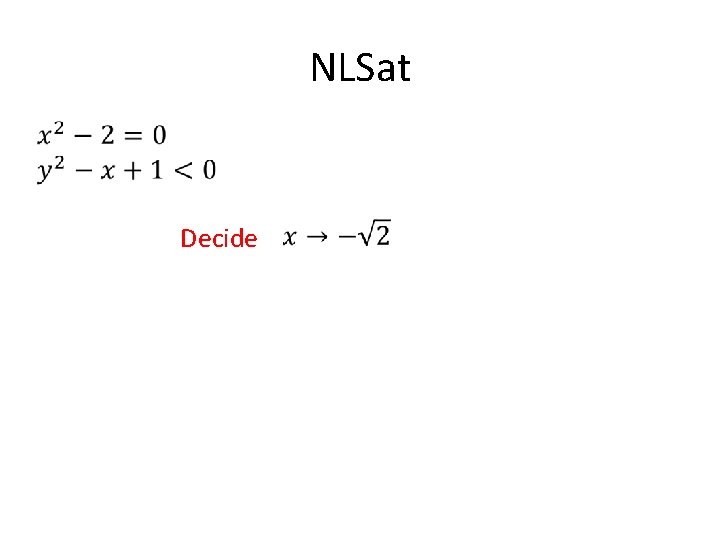
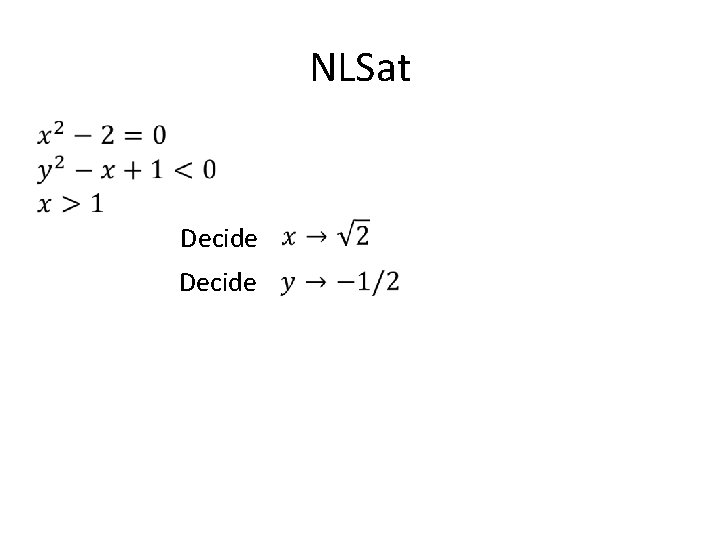
NLSat Decide
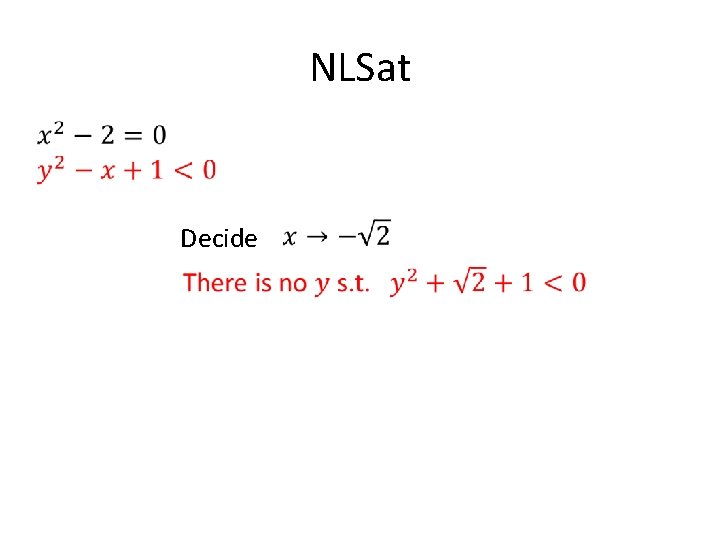
NLSat Decide
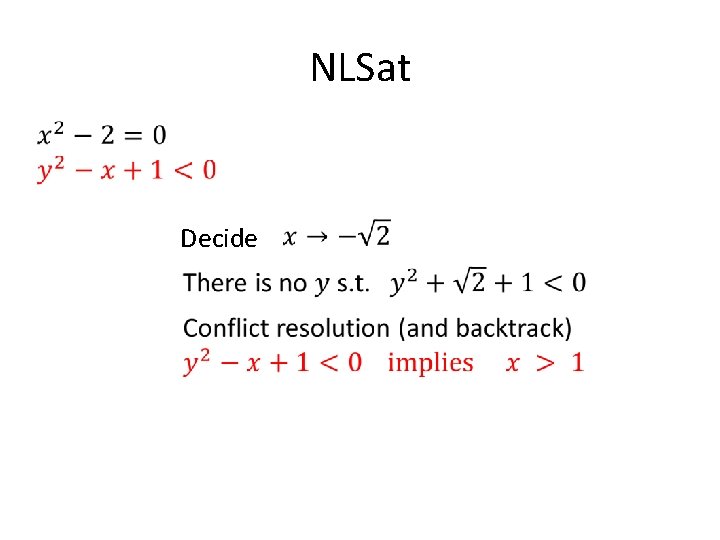
NLSat Decide
NLSat Decide
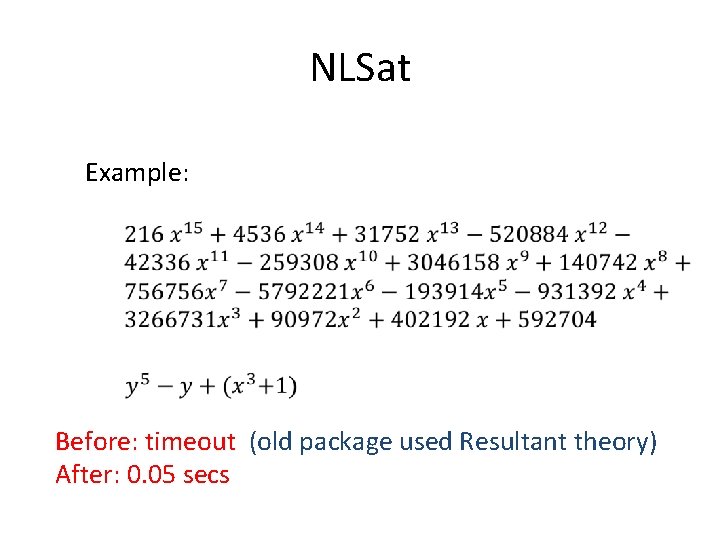
NLSat Example: Before: timeout (old package used Resultant theory) After: 0. 05 secs
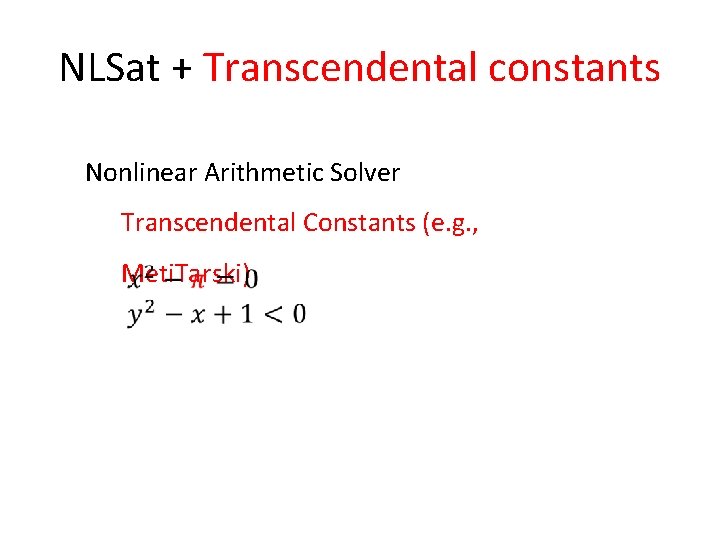
NLSat + Transcendental constants Nonlinear Arithmetic Solver Transcendental Constants (e. g. , Meti. Tarski)
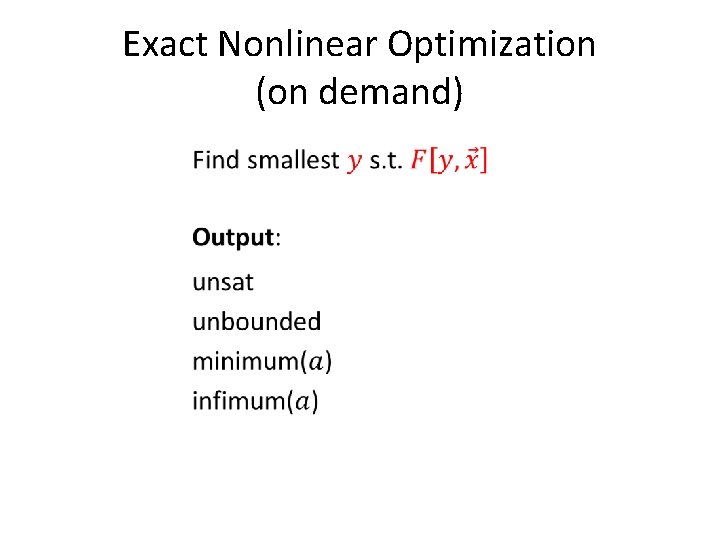
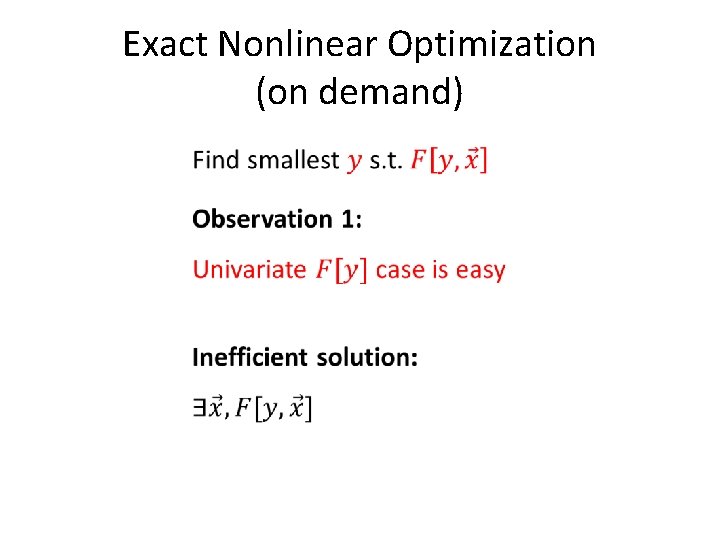
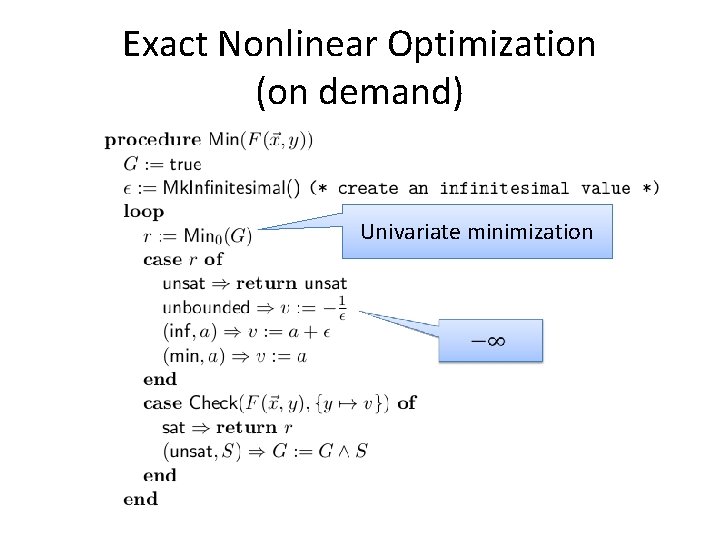
Exact Nonlinear Optimization (on demand)
Exact Nonlinear Optimization (on demand)
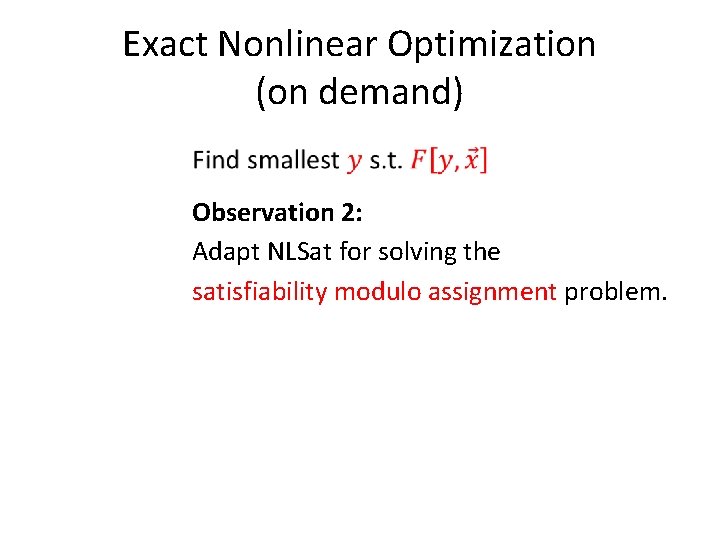
Exact Nonlinear Optimization (on demand) Observation 2: Adapt NLSat for solving the satisfiability modulo assignment problem.
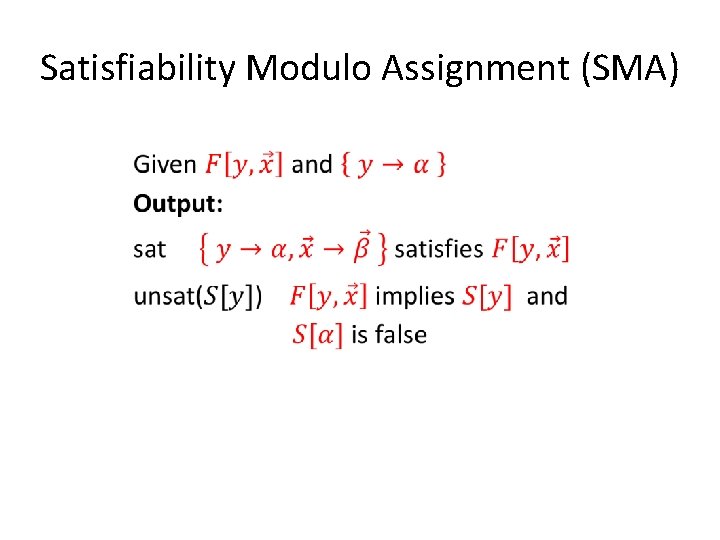
Satisfiability Modulo Assignment (SMA)
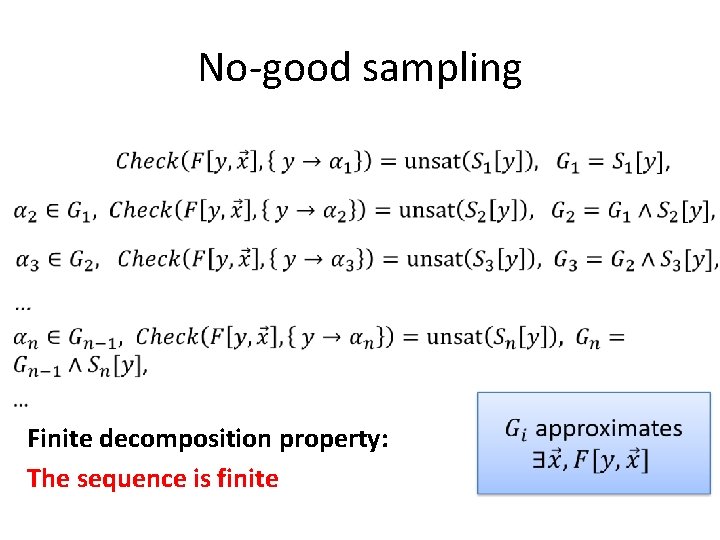
No-good sampling Finite decomposition property: The sequence is finite
Exact Nonlinear Optimization (on demand) Univariate minimization
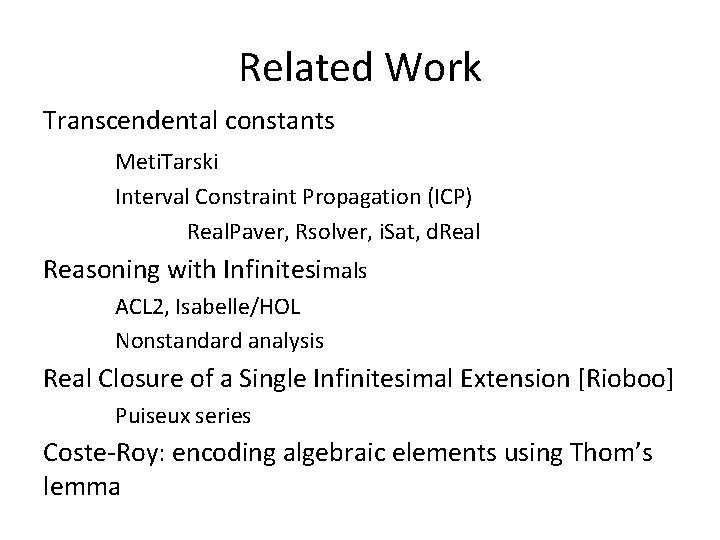
Related Work Transcendental constants Meti. Tarski Interval Constraint Propagation (ICP) Real. Paver, Rsolver, i. Sat, d. Real Reasoning with Infinitesimals ACL 2, Isabelle/HOL Nonstandard analysis Real Closure of a Single Infinitesimal Extension [Rioboo] Puiseux series Coste-Roy: encoding algebraic elements using Thom’s lemma
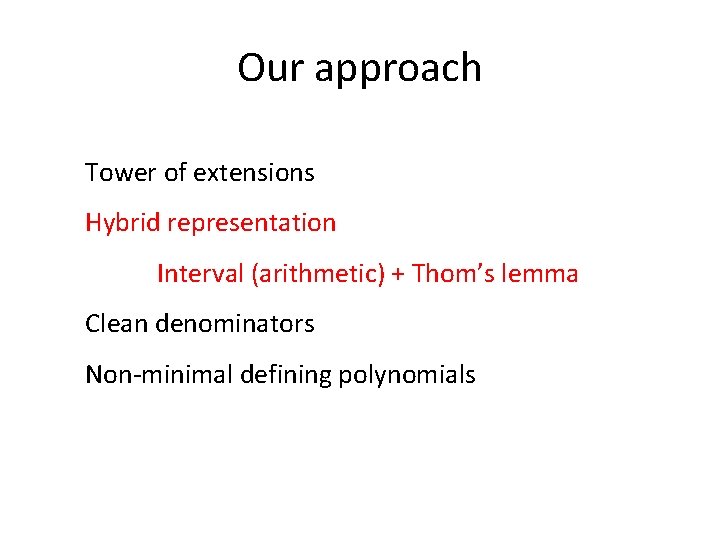
Our approach Tower of extensions Hybrid representation Interval (arithmetic) + Thom’s lemma Clean denominators Non-minimal defining polynomials
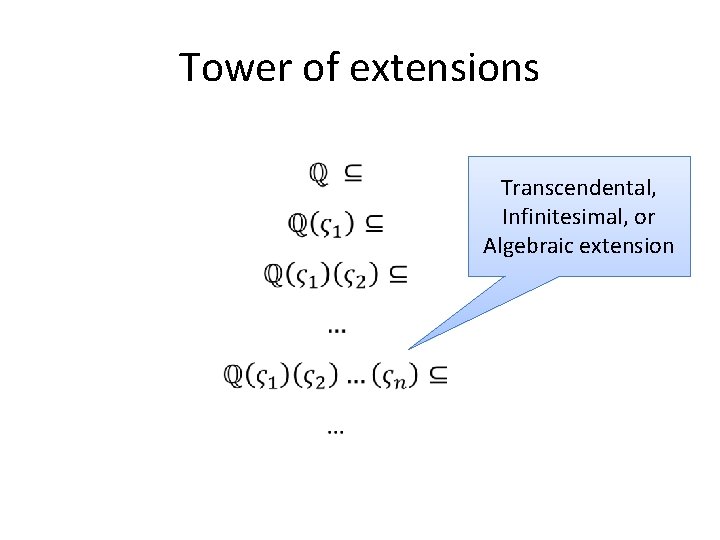
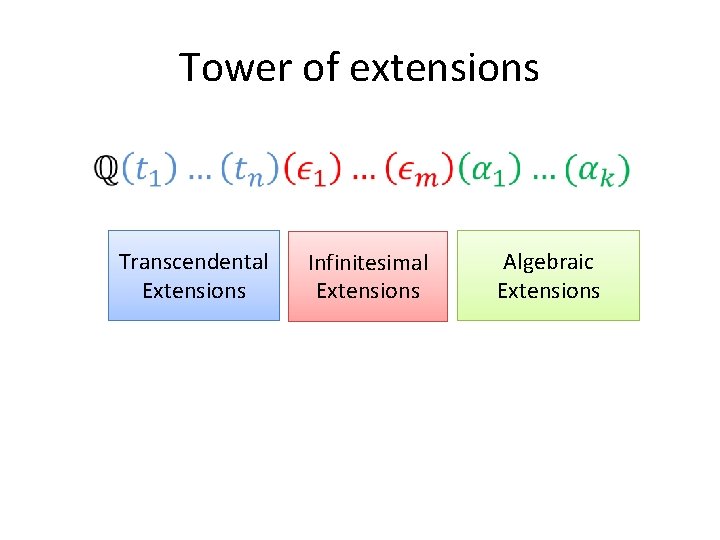
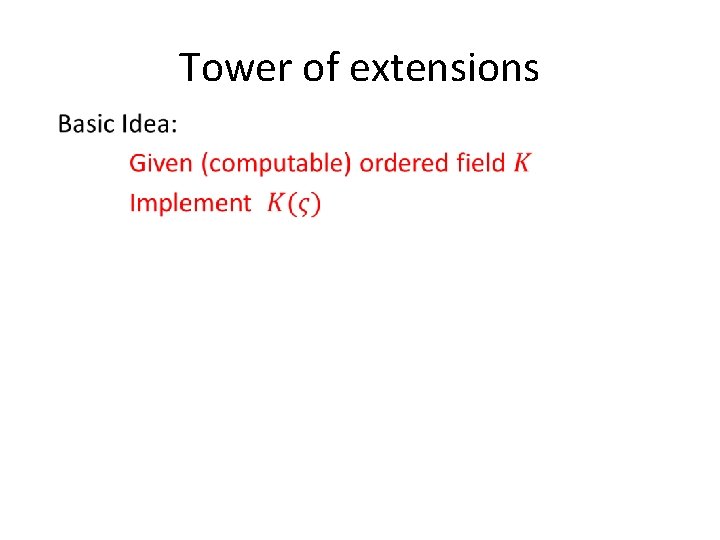
Tower of extensions Transcendental, Infinitesimal, or Algebraic extension
Tower of extensions Transcendental Extensions Infinitesimal Extensions Algebraic Extensions
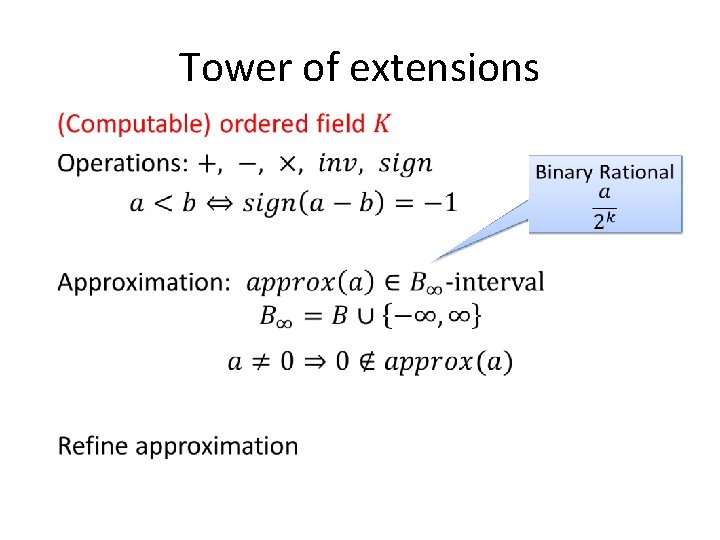
Tower of extensions
Tower of extensions
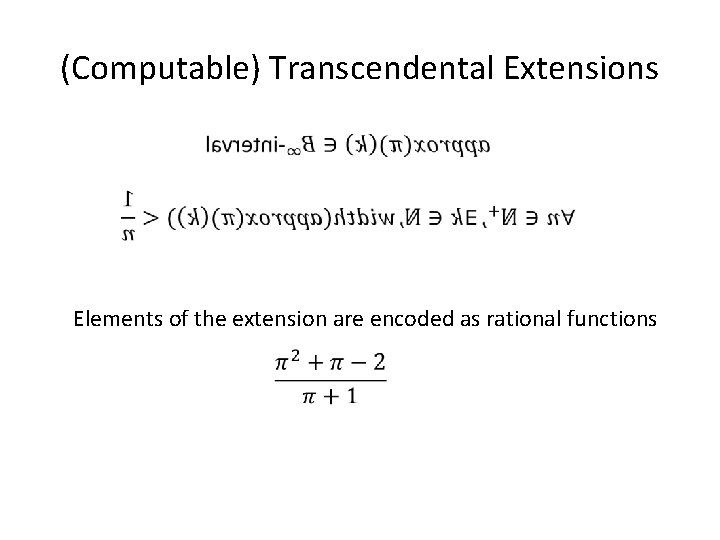
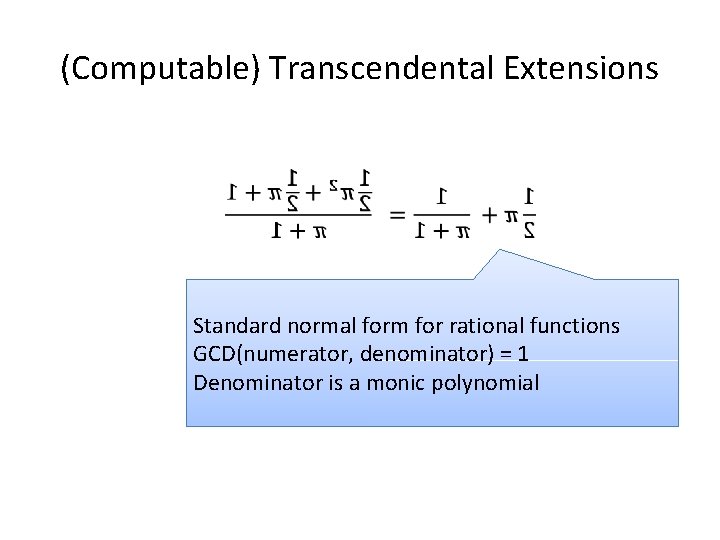
(Computable) Transcendental Extensions Elements of the extension are encoded as rational functions
(Computable) Transcendental Extensions Standard normal form for rational functions GCD(numerator, denominator) = 1 Denominator is a monic polynomial
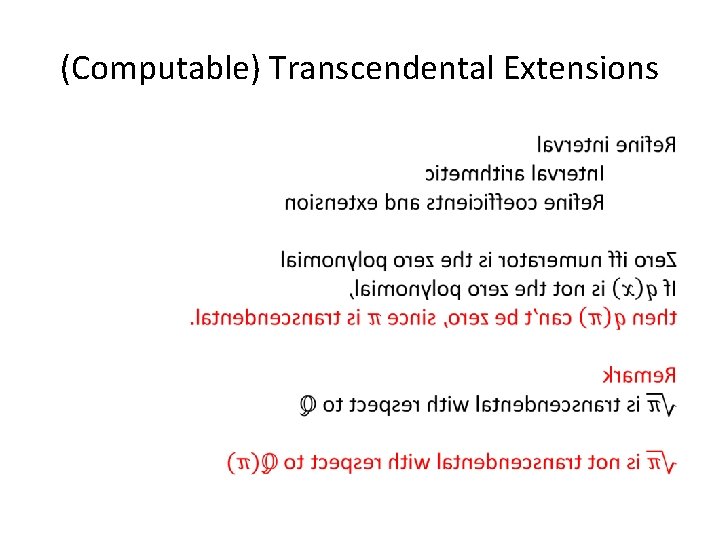
(Computable) Transcendental Extensions
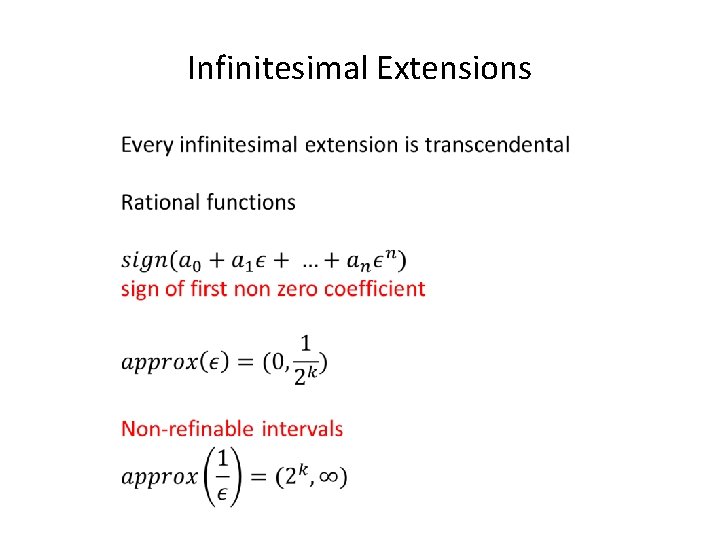
Infinitesimal Extensions
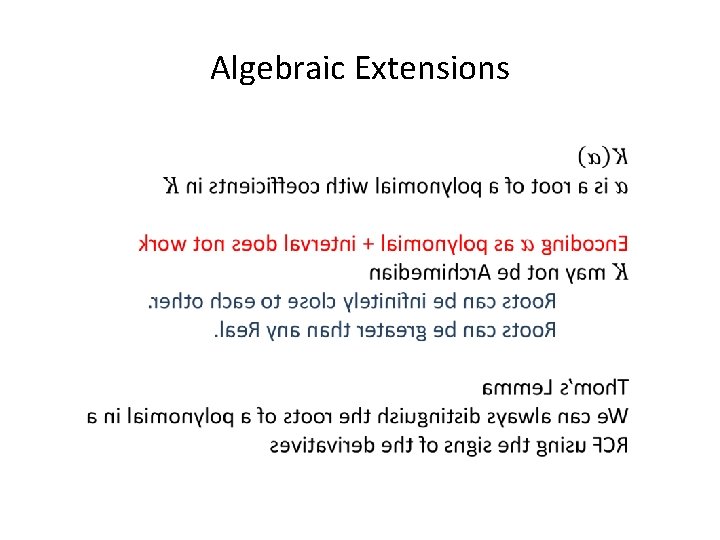
Algebraic Extensions
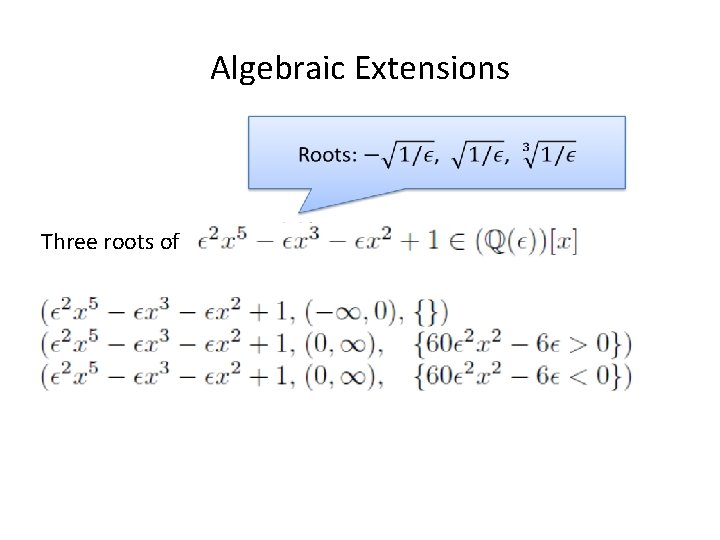
Algebraic Extensions Three roots of
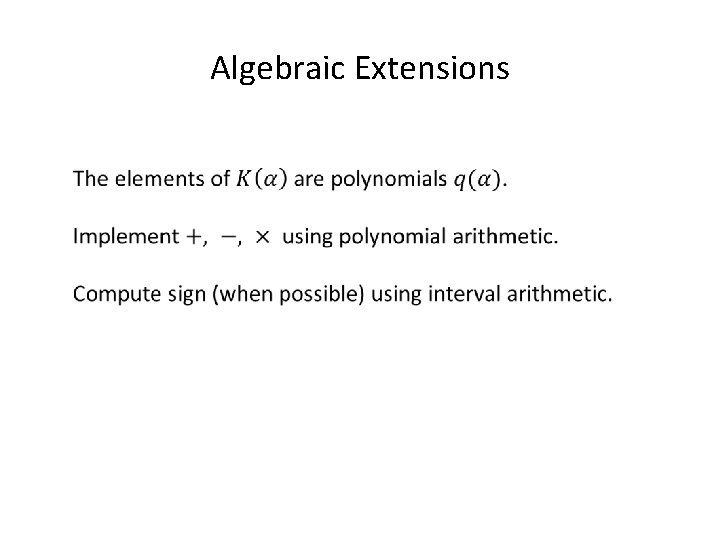
Algebraic Extensions
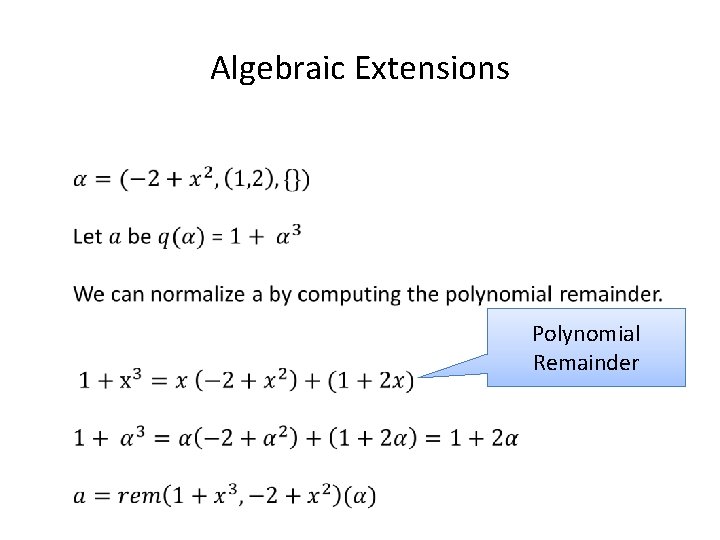
Algebraic Extensions Polynomial Remainder
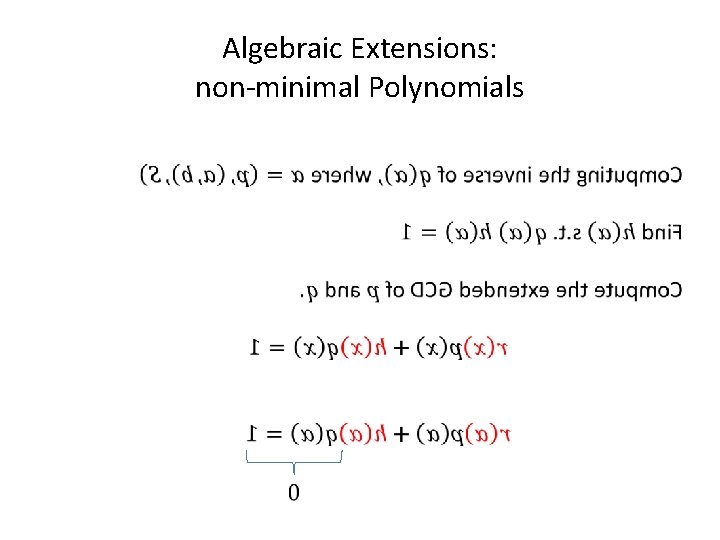
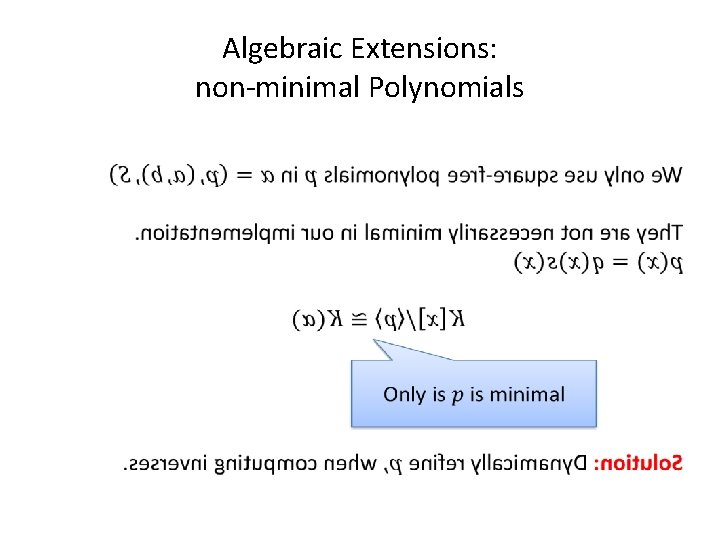
Algebraic Extensions: non-minimal Polynomials
Algebraic Extensions: non-minimal Polynomials
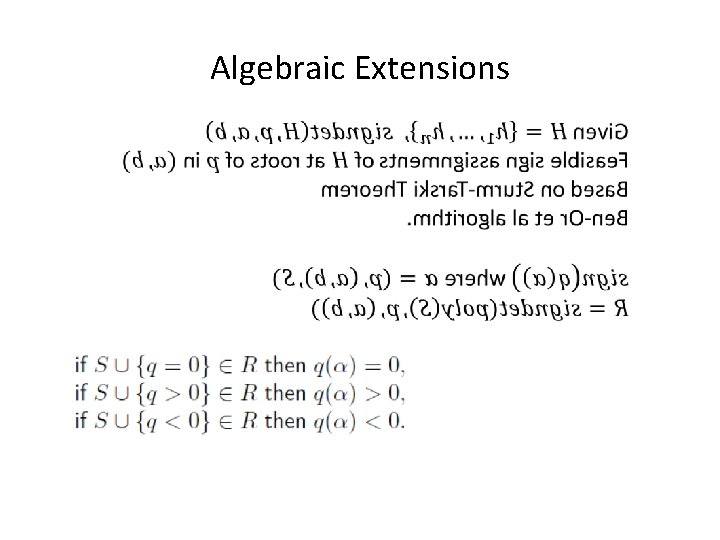
Algebraic Extensions
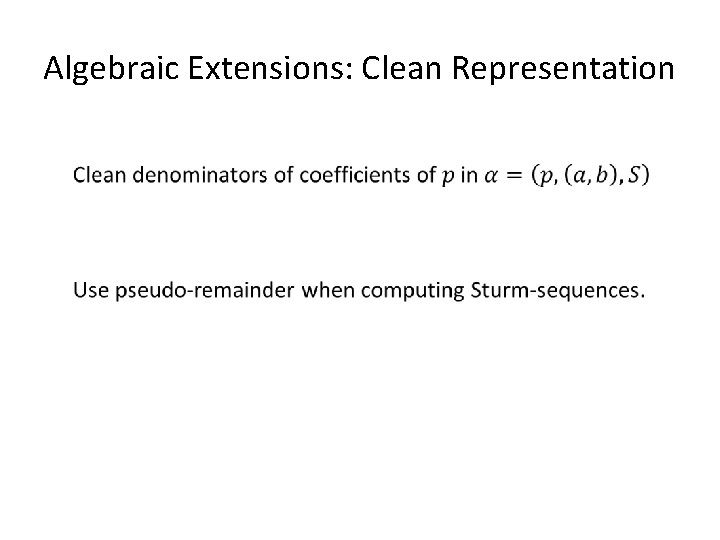
Algebraic Extensions: Clean Representation
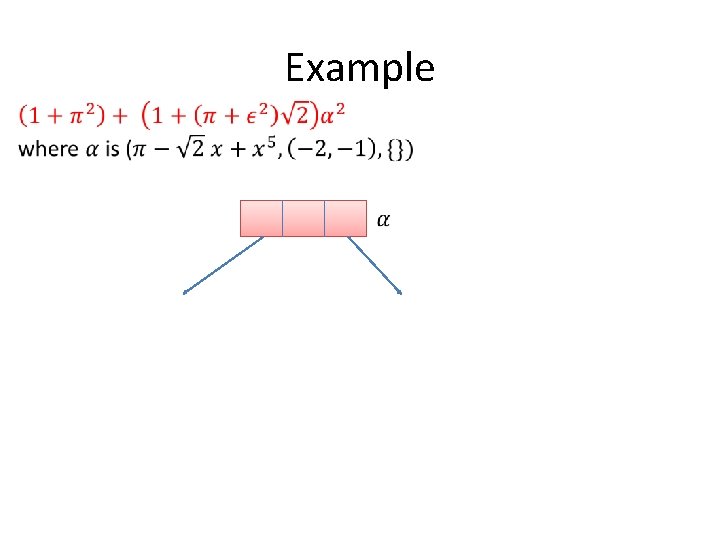
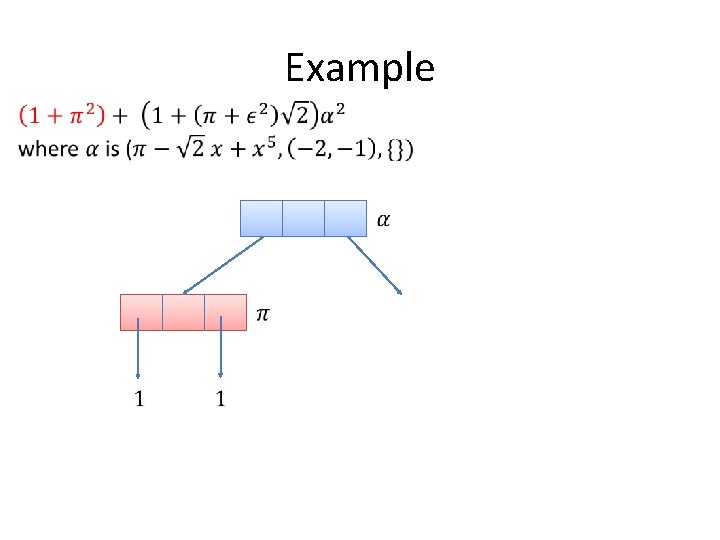
Example
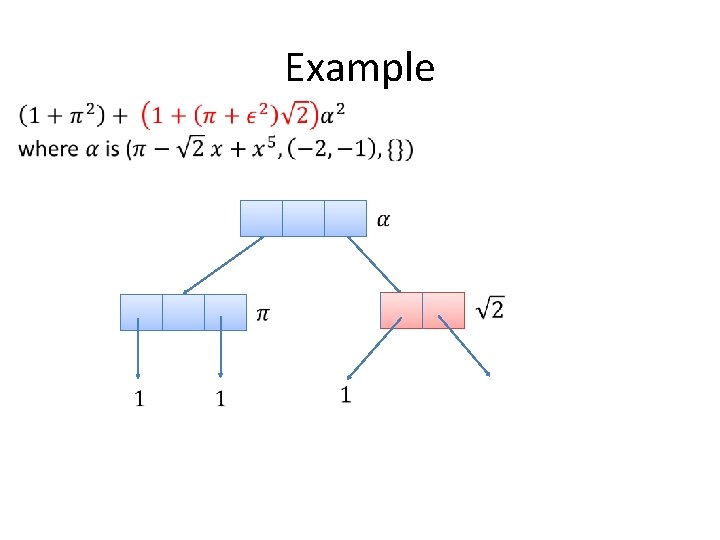
Example
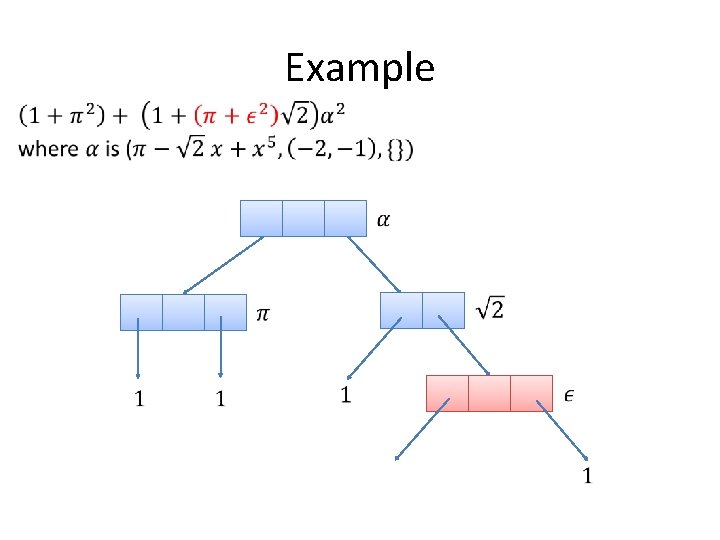
Example
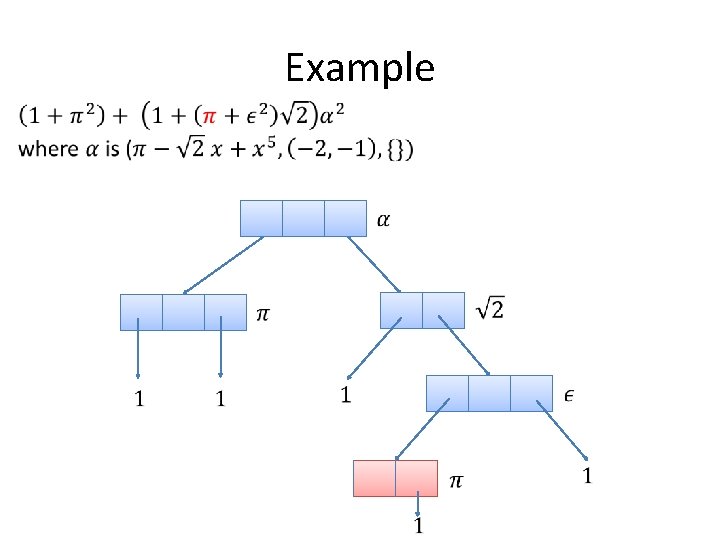
Example
Example
Examples msqrt 2, sqrt 2 = Mk. Roots([-2, 0, 1]) print(msqrt 2) >> root(x^2 + -2, (-oo, 0), {}) print(sqrt 2) >> root(x^2 + -2, (0, +oo), {}) print(sqrt 2. decimal(10)) >> 1. 4142135623?
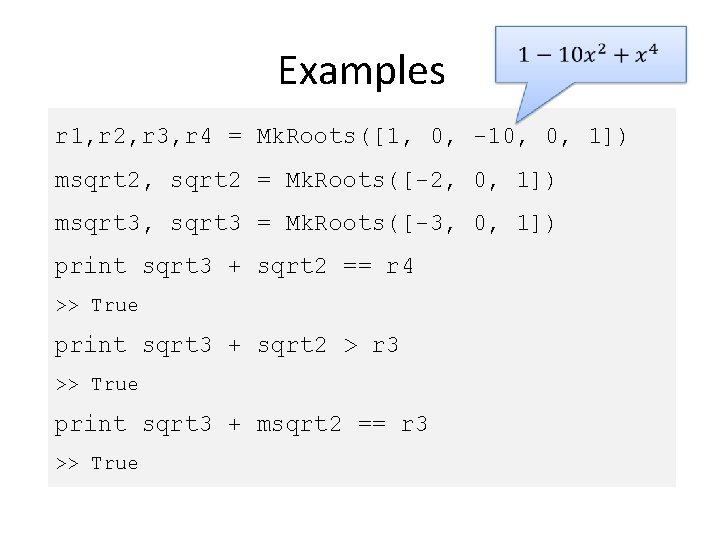
Examples r 1, r 2, r 3, r 4 = Mk. Roots([1, 0, -10, 0, 1]) msqrt 2, sqrt 2 = Mk. Roots([-2, 0, 1]) msqrt 3, sqrt 3 = Mk. Roots([-3, 0, 1]) print sqrt 3 + sqrt 2 == r 4 >> True print sqrt 3 + sqrt 2 > r 3 >> True print sqrt 3 + msqrt 2 == r 3 >> True
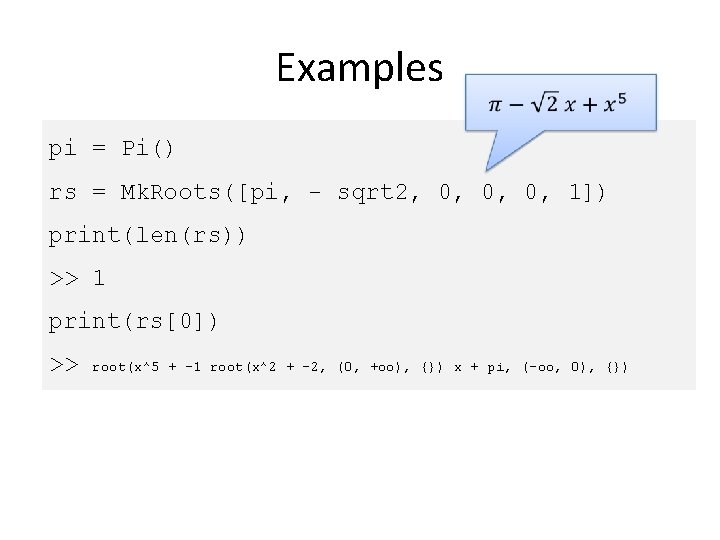
Examples pi = Pi() rs = Mk. Roots([pi, - sqrt 2, 0, 0, 0, 1]) print(len(rs)) >> 1 print(rs[0]) >> root(x^5 + -1 root(x^2 + -2, (0, +oo), {}) x + pi, (-oo, 0), {})
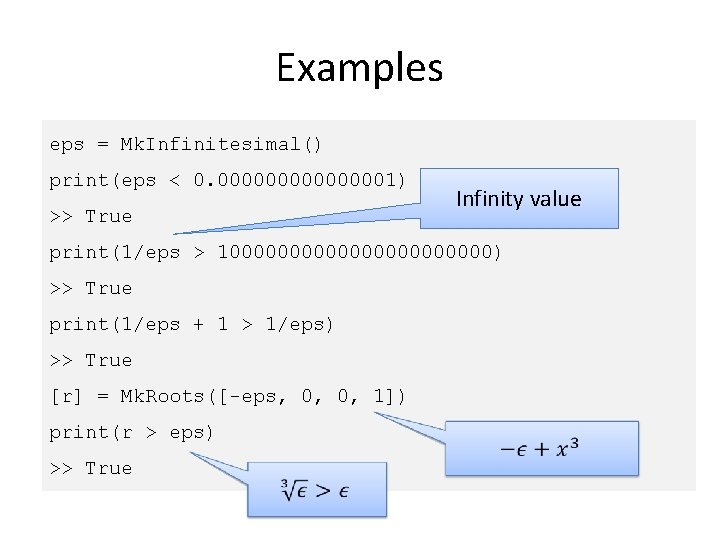
Examples eps = Mk. Infinitesimal() print(eps < 0. 00000001) Infinity value >> True print(1/eps > 100000000000) >> True print(1/eps + 1 > 1/eps) >> True [r] = Mk. Roots([-eps, 0, 0, 1]) print(r > eps) >> True
Examples [x] = Mk. Roots([-1, 0, 0, 0, 1]) [y] = Mk. Roots([-197, 3131, -31*x**2, 0, 0, x]) [z] = Mk. Roots([-735*x*y, 7*y**2, -1231*x**3, 0, 0, y]) print x. decimal(10), y. decimal(10), z. decimal(10) >> 1. 1673039782? , 0. 0629726948? , 31. 4453571397? instantaneously solved
Same Example in Mathematica x = Root[#^5 - # - 1 &, 1] y = Root[x #^7 - 31 x^2 #^2 + 3131 # - 197 &, 1] z = Root[y #^5 - 1231 x^3 #^2 + 7 y^2 # - 735 x y &, 1]
Conclusion Package for computing with transcendental, infinitesimal and algebraic extensions. Main application: exact nonlinear optimization. Code is available online. You can play with it online: http: //rise 4 fun. com/z 3 rcf More info: https: //z 3. codeplex. com/wikipage? title=CADE 24 PSPACE-complete procedures