
COMPUTABILITY THEORY THE CHURCHTURING THESIS TURING MACHINES Part
COMPUTABILITY THEORY THE CHURCH-TURING THESIS “TURING MACHINES” Part 1 – Pages 137 - 147 1
2
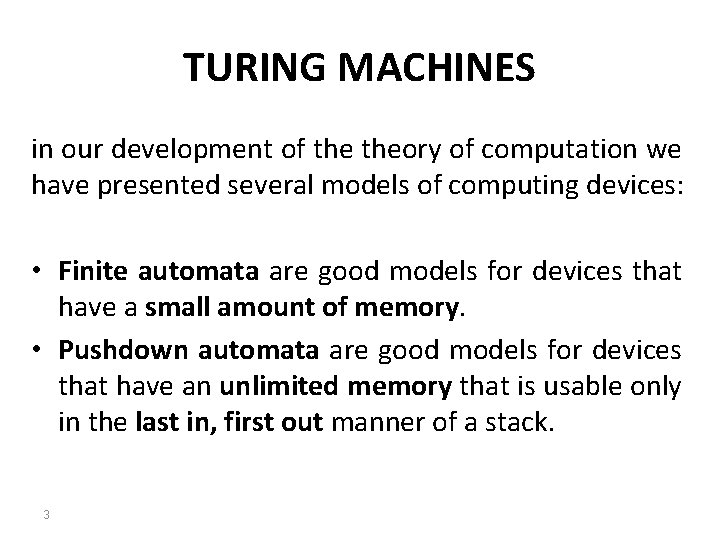
TURING MACHINES in our development of theory of computation we have presented several models of computing devices: • Finite automata are good models for devices that have a small amount of memory. • Pushdown automata are good models for devices that have an unlimited memory that is usable only in the last in, first out manner of a stack. 3
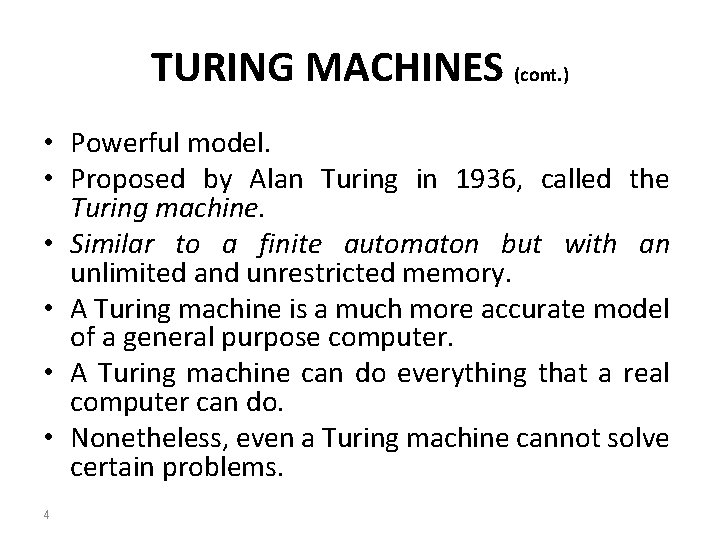
TURING MACHINES (cont. ) • Powerful model. • Proposed by Alan Turing in 1936, called the Turing machine. • Similar to a finite automaton but with an unlimited and unrestricted memory. • A Turing machine is a much more accurate model of a general purpose computer. • A Turing machine can do everything that a real computer can do. • Nonetheless, even a Turing machine cannot solve certain problems. 4
TURING MACHINES (cont. ) The Turing machine model uses an infinite tape as its unlimited memory. It has a tape head that can read and write symbols and move around on the tape. Initially the tape contains only: • the input string and is blank everywhere else. 5
TURING MACHINES (cont. ) • If the machine needs to store information, it may write this information on the tape. • To read the information that it has written, the machine can move its head back over it. The machine continues computing until it decides to produce an output. • The outputs accept and reject are obtained by entering designated accepting and rejecting states. • If it doesn't enter an accepting or a rejecting state, it will go on forever, never halting. 6
TURING MACHINES (cont. ) The differences between finite automata and Turing machines: 1. A Turing machine can both write on the tape and read from it. 2. The read-write head can move both to the left and to the right. 3. The tape is infinite. 4. The special states for rejecting and accepting take effect immediately. 7
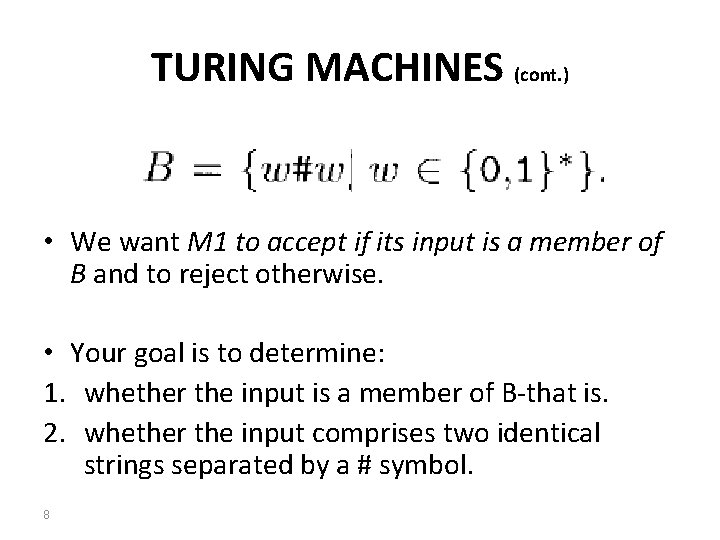
TURING MACHINES (cont. ) • We want M 1 to accept if its input is a member of B and to reject otherwise. • Your goal is to determine: 1. whether the input is a member of B-that is. 2. whether the input comprises two identical strings separated by a # symbol. 8
TURING MACHINES (cont. ) • The input is too long for you to remember it all, but you are allowed to move back and forth over the input and make marks on it. • strategy is to zig-zag to the corresponding places on the two sides of the # and determine whether they match. 9
TURING MACHINES (cont. ) • It makes multiple passes over the input string with the read-write head. • On each pass it matches one of the characters on each side of the # symbol. • To keep track of which symbols have been checked already, M 1 crosses off (x) each symbol as it is examined. • If it crosses off all the symbols, that means that everything matched successfully, and M 1 goes into an accept state. If it discovers a mismatch, it enters a reject state. 10
TURING MACHINES (cont. ) In summary, M 1’s algorithm is as follows M 1 = "On input string w”: 1. Zig-zag across the tape to corresponding positions on either side of the # symbol to check whether these positions contain the same symbol. If they do not, or if no # is found, reject. Cross off symbols as they are checked to keep track of which symbols correspond. 2. When all symbols to the left of the # have been crossed off, check for any remaining symbols to the right of the #. If any symbols remain, reject; otherwise, accept. " 11
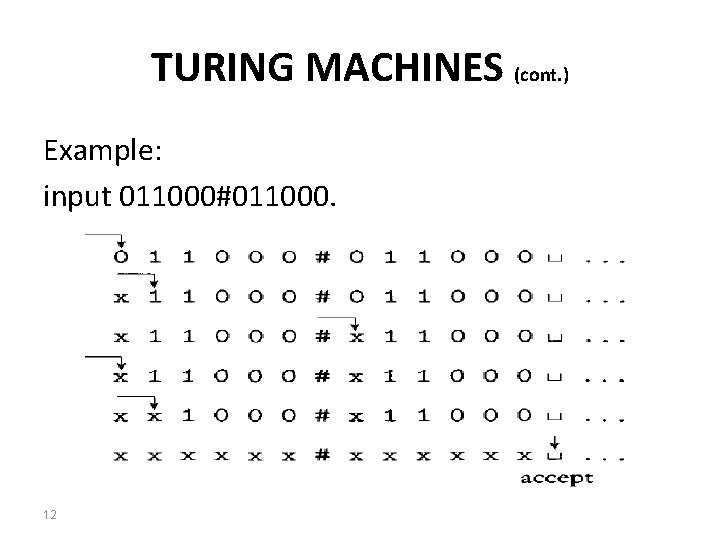
TURING MACHINES (cont. ) Example: input 011000#011000. 12
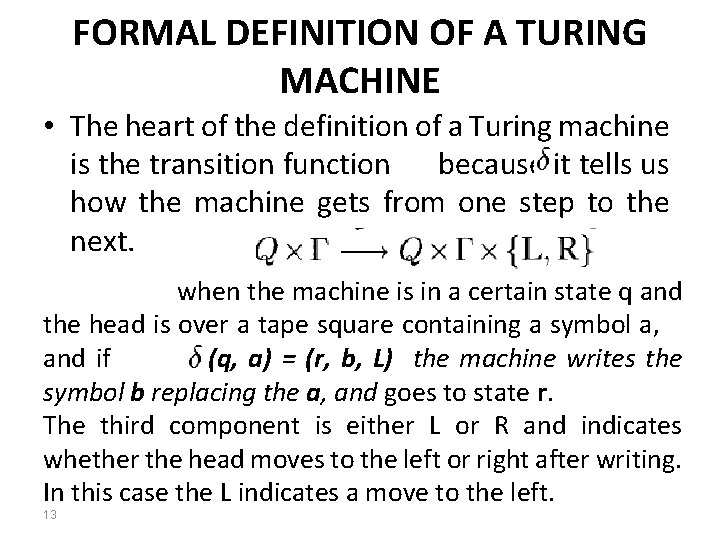
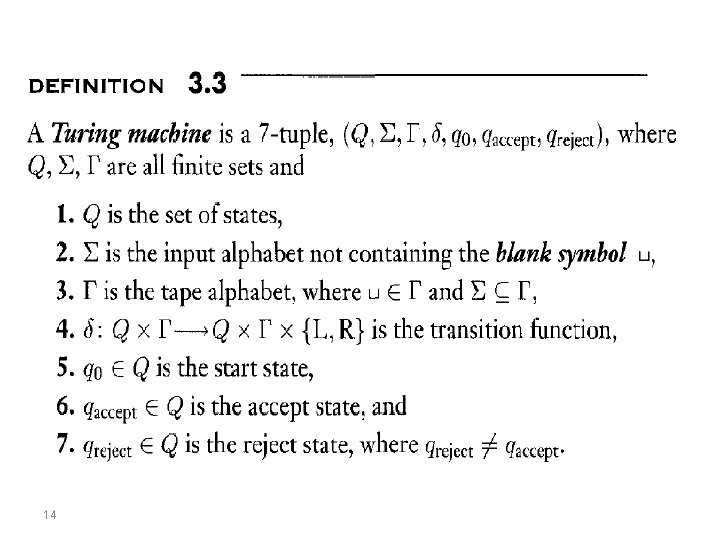
FORMAL DEFINITION OF A TURING MACHINE • The heart of the definition of a Turing machine is the transition function because it tells us how the machine gets from one step to the next. when the machine is in a certain state q and the head is over a tape square containing a symbol a, and if (q, a) = (r, b, L) the machine writes the symbol b replacing the a, and goes to state r. The third component is either L or R and indicates whether the head moves to the left or right after writing. In this case the L indicates a move to the left. 13
14
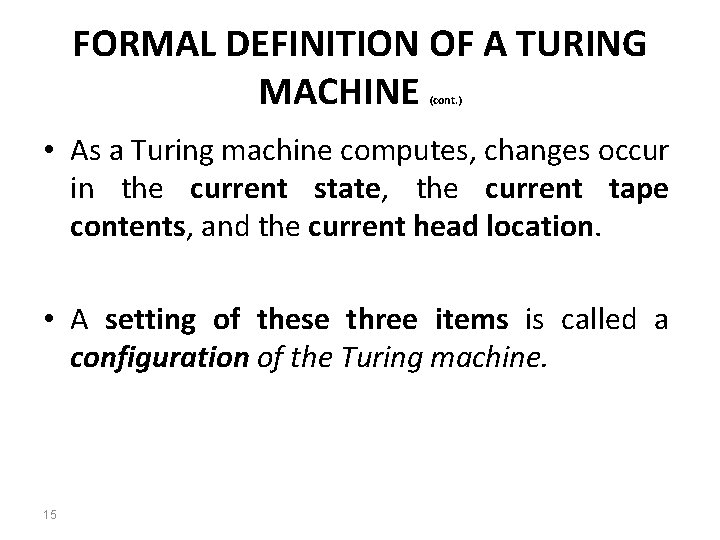
FORMAL DEFINITION OF A TURING MACHINE (cont. ) • As a Turing machine computes, changes occur in the current state, the current tape contents, and the current head location. • A setting of these three items is called a configuration of the Turing machine. 15
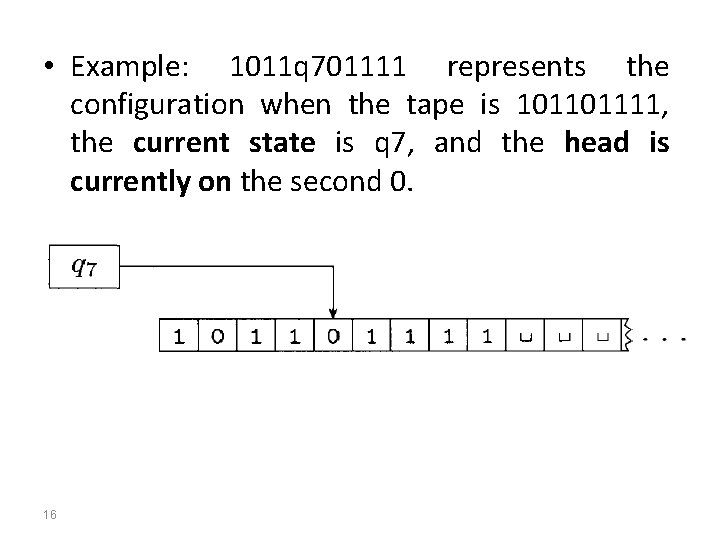
• Example: 1011 q 701111 represents the configuration when the tape is 101101111, the current state is q 7, and the head is currently on the second 0. 16
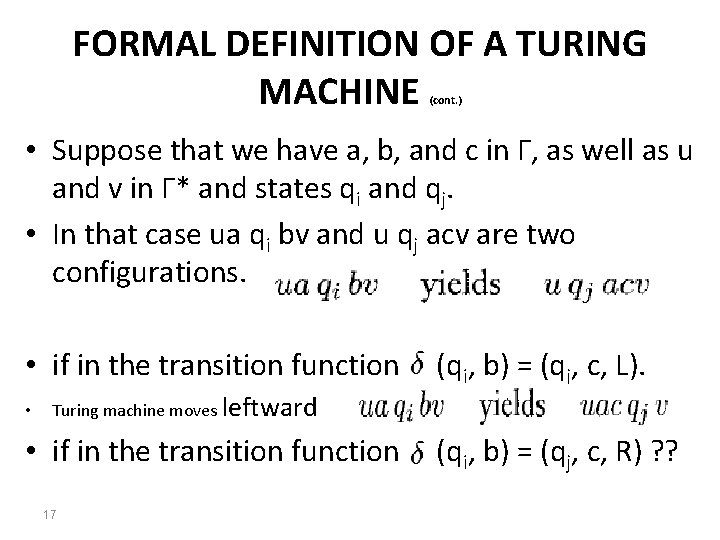
FORMAL DEFINITION OF A TURING MACHINE (cont. ) • Suppose that we have a, b, and c in Г, as well as u and v in Г* and states qi and qj. • In that case ua qi bv and u qj acv are two configurations. • if in the transition function • (qi, b) = (qj, c, L). Turing machine moves leftward • if in the transition function 17 (qi, b) = (qj, c, R) ? ?
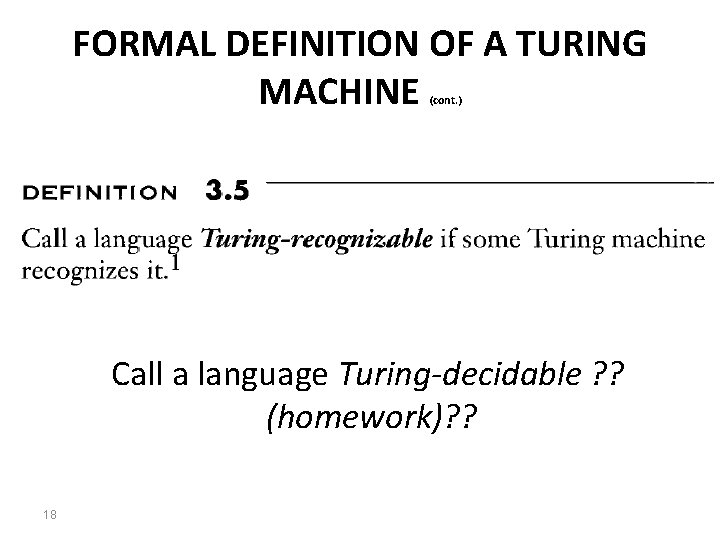
FORMAL DEFINITION OF A TURING MACHINE (cont. ) Call a language Turing-decidable ? ? (homework)? ? 18
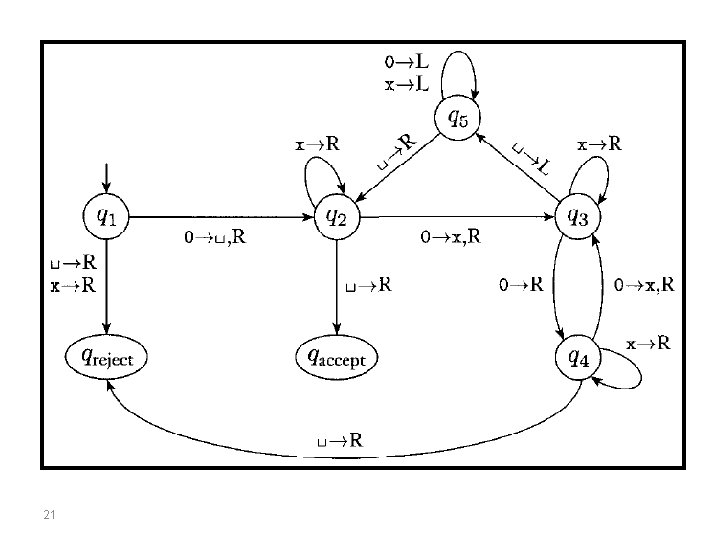
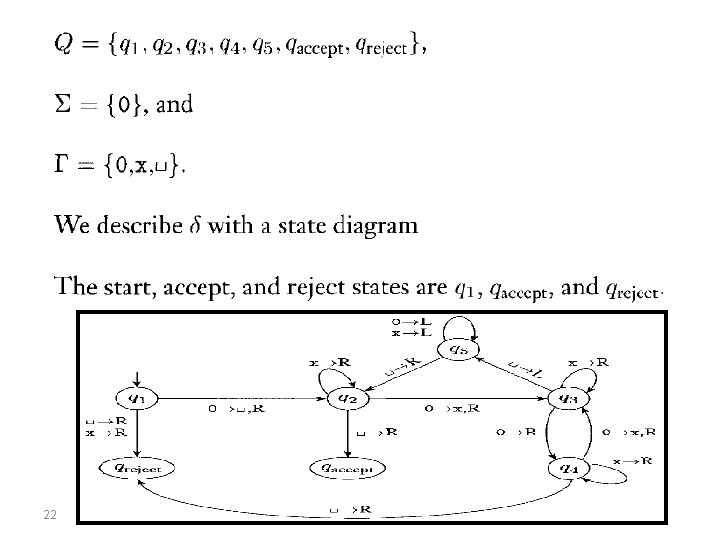
FORMAL DEFINITION OF A TURING MACHINE (cont. ) EXAMPLE • describe a Turing machine (TM) M 2 that n 2 decides A ={ 0 | n>= 0}, the language consisting of all strings of 0 s whose length is a power of 2. 19
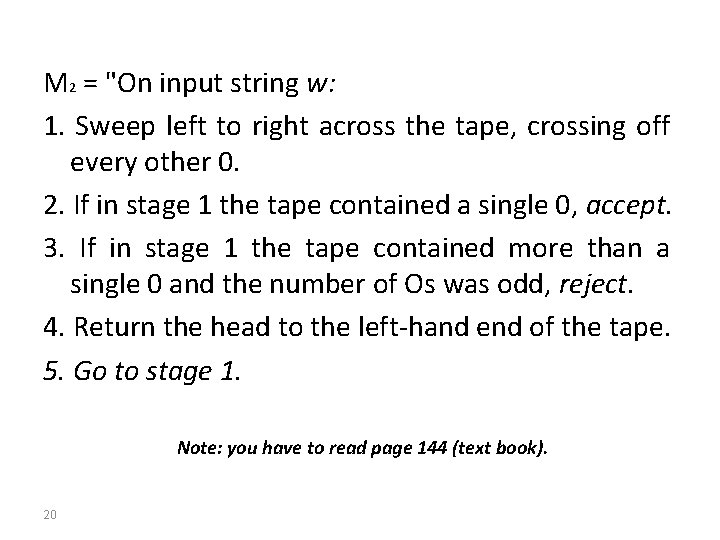
M 2 = "On input string w: 1. Sweep left to right across the tape, crossing off every other 0. 2. If in stage 1 the tape contained a single 0, accept. 3. If in stage 1 the tape contained more than a single 0 and the number of Os was odd, reject. 4. Return the head to the left-hand end of the tape. 5. Go to stage 1. Note: you have to read page 144 (text book). 20
21
22
- Slides: 22