
Computability and Complexity 19 1 NonDeterministic Space Computability
Computability and Complexity 19 -1 Non-Deterministic Space Computability and Complexity Andrei Bulatov
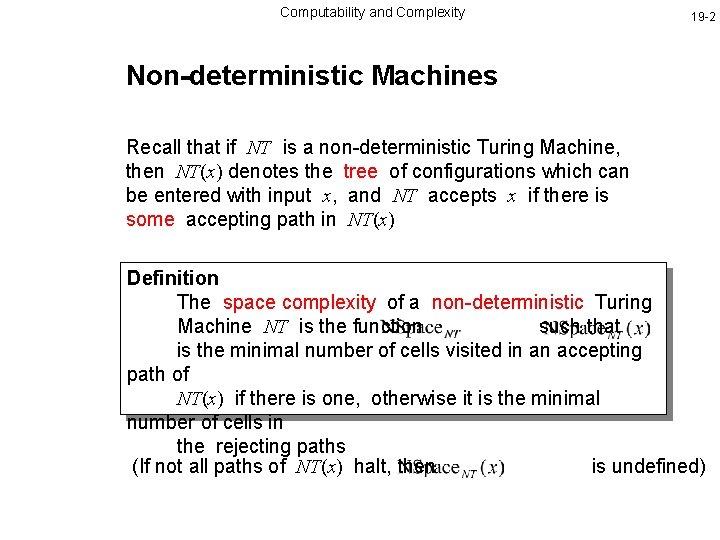
Computability and Complexity 19 -2 Non-deterministic Machines Recall that if NT is a non-deterministic Turing Machine, then NT(x) denotes the tree of configurations which can be entered with input x, and NT accepts x if there is some accepting path in NT(x) Definition The space complexity of a non-deterministic Turing Machine NT is the function such that is the minimal number of cells visited in an accepting path of NT(x) if there is one, otherwise it is the minimal number of cells in the rejecting paths (If not all paths of NT(x) halt, then is undefined)
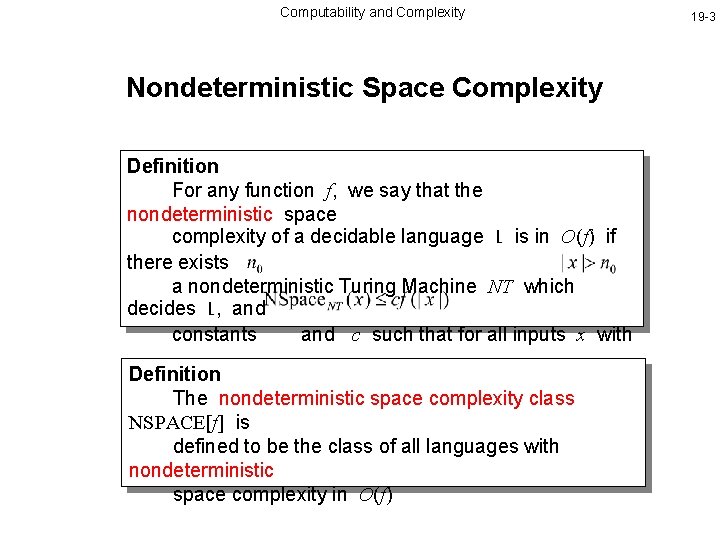
Computability and Complexity Nondeterministic Space Complexity Definition For any function f, we say that the nondeterministic space complexity of a decidable language L is in O(f) if there exists a nondeterministic Turing Machine NT which decides L, and constants and c such that for all inputs x with Definition The nondeterministic space complexity class NSPACE[f] is defined to be the class of all languages with nondeterministic space complexity in O(f) 19 -3
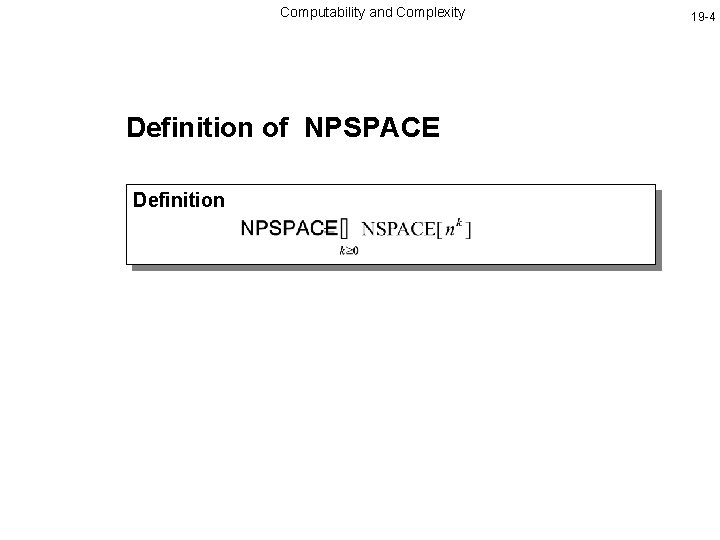
Computability and Complexity Definition of NPSPACE Definition 19 -4
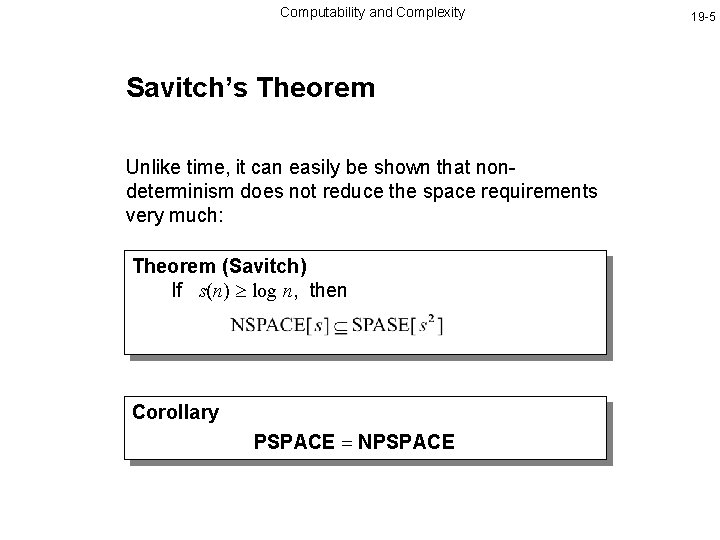
Computability and Complexity Savitch’s Theorem Unlike time, it can easily be shown that nondeterminism does not reduce the space requirements very much: Theorem (Savitch) If s(n) log n, then Corollary PSPACE NPSPACE 19 -5
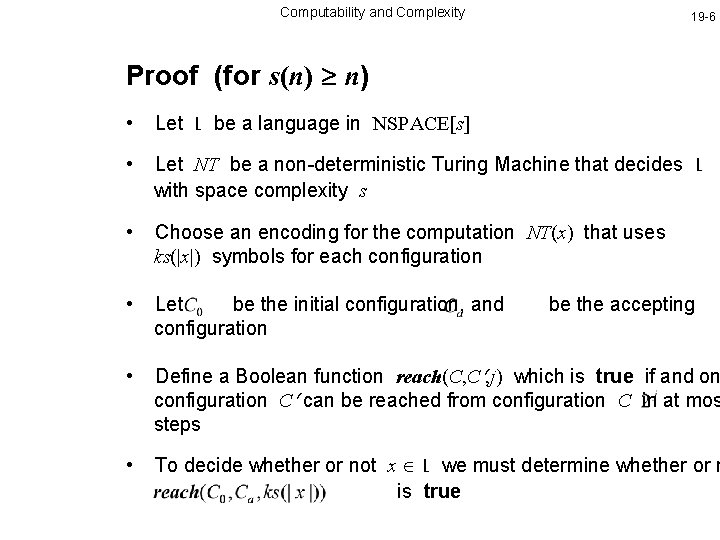
Computability and Complexity 19 -6 Proof (for s(n) n) • Let L be a language in NSPACE[s] • Let NT be a non-deterministic Turing Machine that decides L with space complexity s • Choose an encoding for the computation NT(x) that uses ks(|x|) symbols for each configuration • Let be the initial configuration, and configuration • Define a Boolean function reach(C, C , j) which is true if and on configuration C can be reached from configuration C in at mos steps • To decide whether or not x L we must determine whether or n is true be the accepting
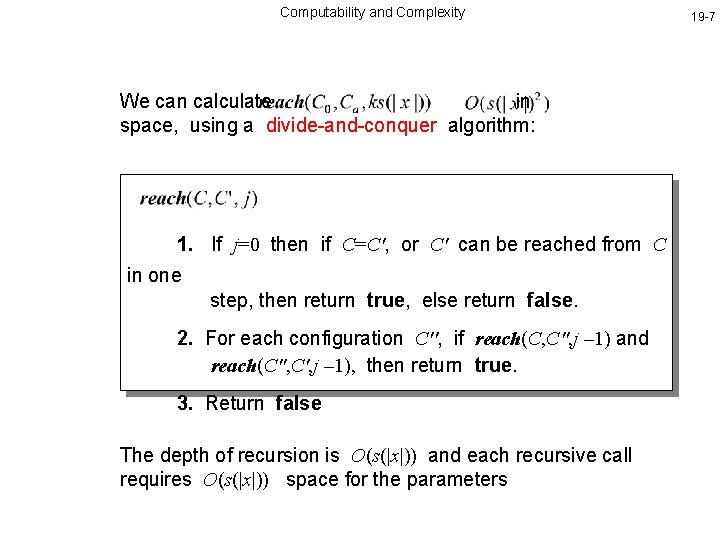
Computability and Complexity We can calculate in space, using a divide-and-conquer algorithm: 1. If j=0 then if C=C', or C' can be reached from C in one step, then return true, else return false. 2. For each configuration C'', if reach(C, C'', j – 1) and reach(C'', C', j – 1), then return true. 3. Return false The depth of recursion is O(s(|x|)) and each recursive call requires O(s(|x|)) space for the parameters 19 -7

Computability and Complexity 19 -8 Logarithmic Space Since polynomial space is so powerful, it is natural to consider more restricted space complexity classes Even linear space is enough to solve Satisfiability Definition
Computability and Complexity 19 -9 Problems in L and NL What sort of problems are in L and NL? In logarithmic space we can store: • a fixed number of counters (up to length of input) • a fixed number of pointers to positions in the input string Therefore in deterministic log-space we can solve problems that require a fixed number of counters and/or pointers for solving; in non-deterministic log-space we can solve problems that require a fixed number of counters/pointers for verifying a solution
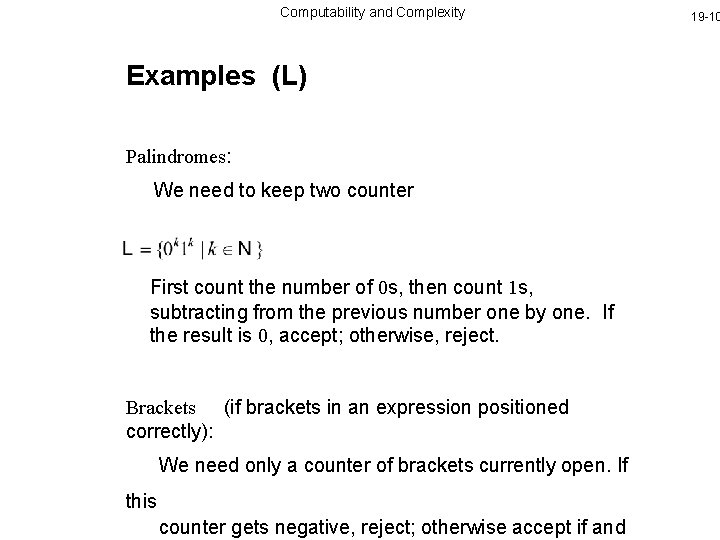
Computability and Complexity Examples (L) Palindromes: We need to keep two counter First count the number of 0 s, then count 1 s, subtracting from the previous number one by one. If the result is 0, accept; otherwise, reject. Brackets (if brackets in an expression positioned correctly): We need only a counter of brackets currently open. If this counter gets negative, reject; otherwise accept if and 19 -10
Computability and Complexity 19 -11 Examples (NL) The first problem defined on this course was Reachability¹ This can be solved by the following non-deterministic algorithm: • Define a counter and initialize it to the number of vertices in th • Define a pointer to hold the ``current vertex’’ and initialize it to the start vertex • While the counter is non-zero - If the current vertex equals the target vertex, return yes - Non-deterministically choose a vertex which is connected the current vertex Update the pointer to this vertex and decrement the counte - • Return no ¹Also known as Path
- Slides: 11