
Computability and Complexity 17 1 Strong NPCompleteness Computability
Computability and Complexity 17 -1 Strong NP-Completeness Computability and Complexity Andrei Bulatov
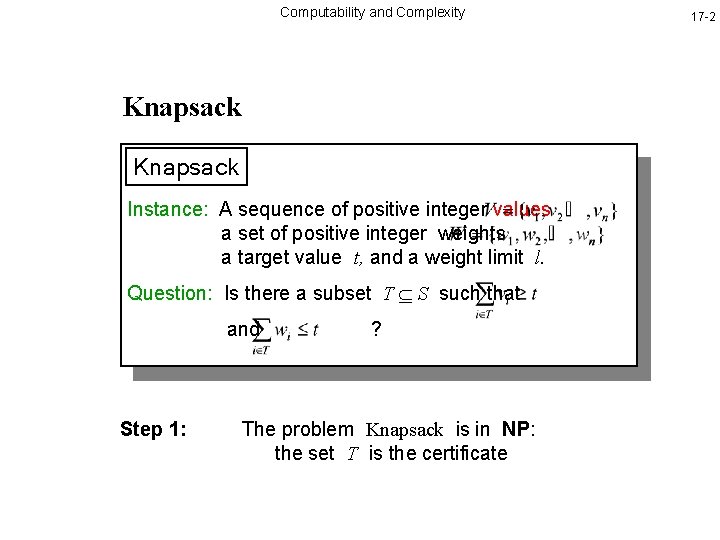
Computability and Complexity Knapsack Instance: A sequence of positive integer values a set of positive integer weights a target value t, and a weight limit l. Question: Is there a subset T S such that and Step 1: ? The problem Knapsack is in NP: the set T is the certificate 17 -2
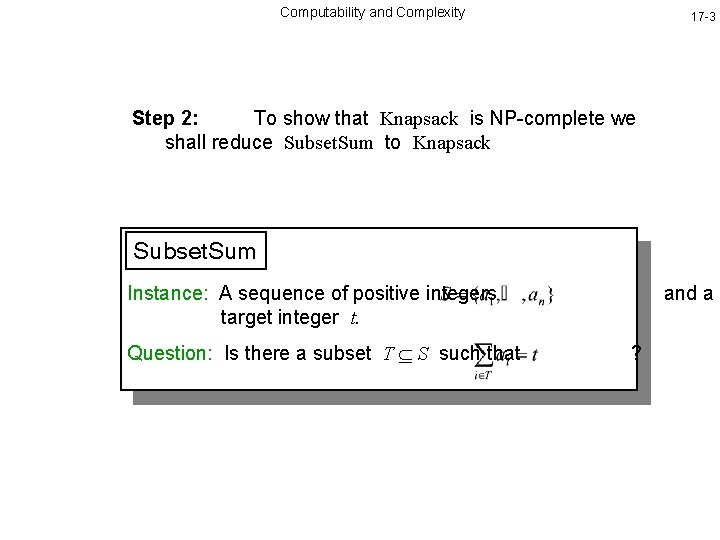
Computability and Complexity 17 -3 Step 2: To show that Knapsack is NP-complete we shall reduce Subset. Sum to Knapsack Subset. Sum Instance: A sequence of positive integers target integer t. Question: Is there a subset T S such that and a ?
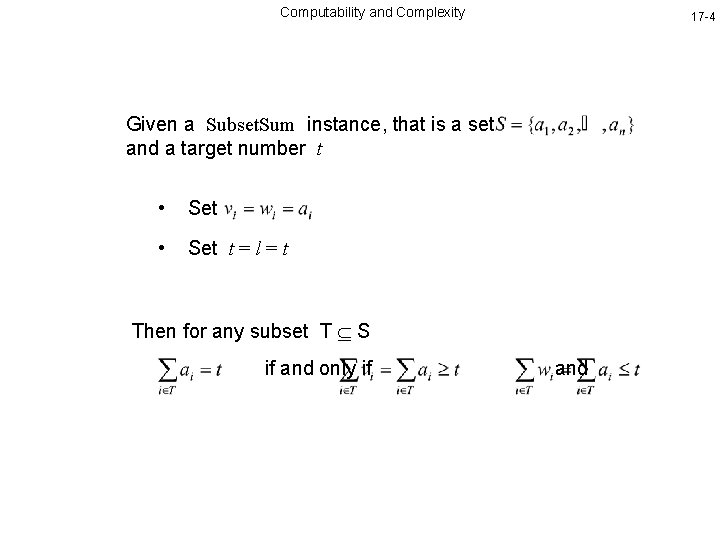
Computability and Complexity 17 -4 Given a Subset. Sum instance, that is a set and a target number t • Set t = l = t Then for any subset T S if and only if and
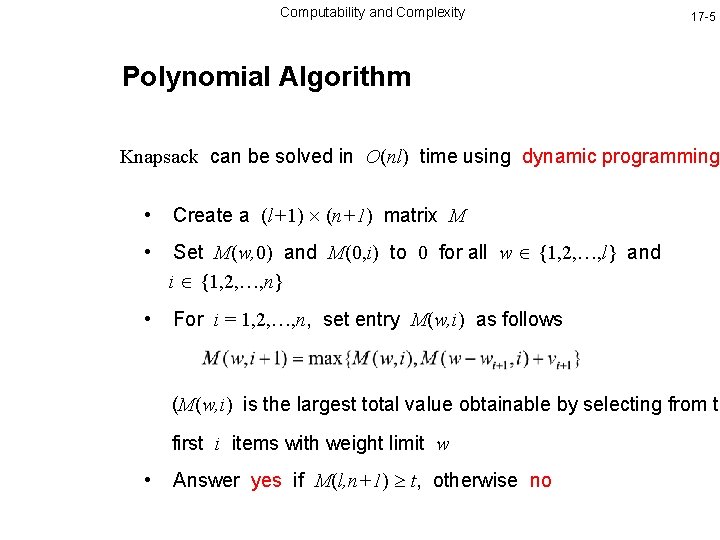
Computability and Complexity 17 -5 Polynomial Algorithm Knapsack can be solved in O(nl) time using dynamic programming • Create a (l+1) (n+1) matrix M • Set M(w, 0) and M(0, i) to 0 for all w {1, 2, …, l} and i {1, 2, …, n} • For i = 1, 2, …, n, set entry M(w, i) as follows (M(w, i) is the largest total value obtainable by selecting from th first i items with weight limit w • Answer yes if M(l, n+1) t, otherwise no
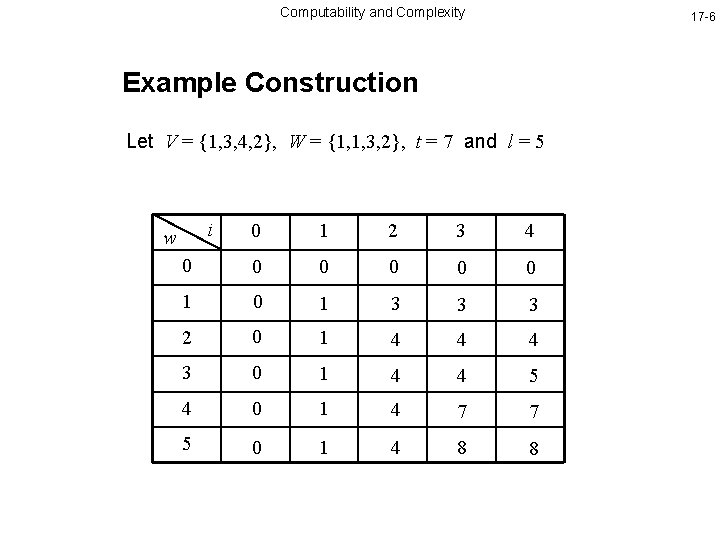
Computability and Complexity 17 -6 Example Construction Let V = {1, 3, 4, 2}, W = {1, 1, 3, 2}, t = 7 and l = 5 i 0 1 2 3 4 0 0 0 1 0 1 3 3 3 2 0 1 4 4 4 3 0 1 4 4 5 4 0 1 4 7 7 5 0 1 4 8 8 w
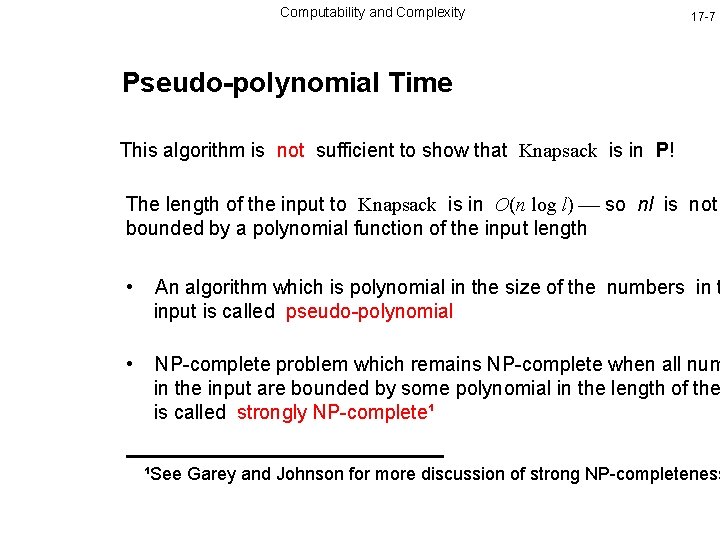
Computability and Complexity 17 -7 Pseudo-polynomial Time This algorithm is not sufficient to show that Knapsack is in P! The length of the input to Knapsack is in O(n log l) so nl is not bounded by a polynomial function of the input length • An algorithm which is polynomial in the size of the numbers in t input is called pseudo-polynomial • NP-complete problem which remains NP-complete when all num in the input are bounded by some polynomial in the length of the is called strongly NP-complete¹ ¹See Garey and Johnson for more discussion of strong NP-completeness
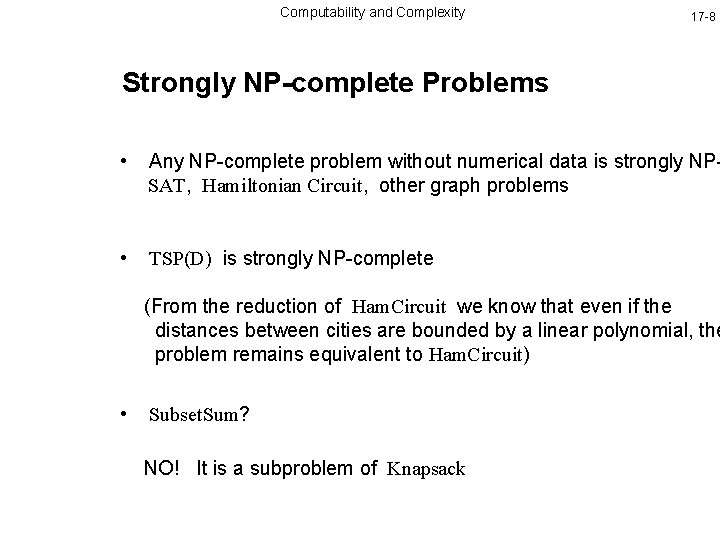
Computability and Complexity 17 -8 Strongly NP-complete Problems • Any NP-complete problem without numerical data is strongly NPSAT, Hamiltonian Circuit, other graph problems • TSP(D) is strongly NP-complete (From the reduction of Ham. Circuit we know that even if the distances between cities are bounded by a linear polynomial, the problem remains equivalent to Ham. Circuit) • Subset. Sum? NO! It is a subproblem of Knapsack
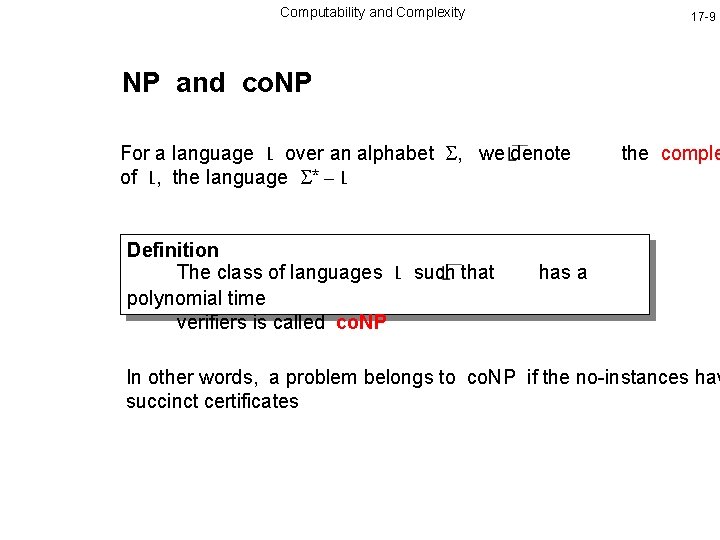
Computability and Complexity 17 -9 NP and co. NP For a language L over an alphabet , we denote of L, the language * – L Definition The class of languages L such that polynomial time verifiers is called co. NP the comple has a In other words, a problem belongs to co. NP if the no-instances hav succinct certificates
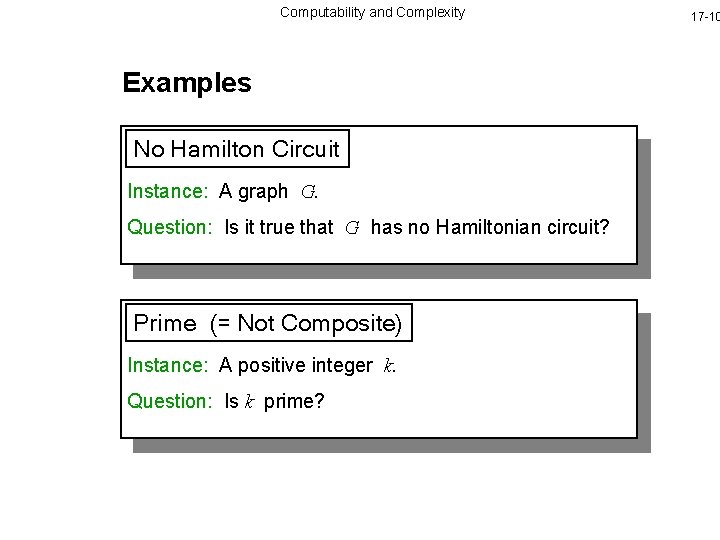
Computability and Complexity Examples No Hamilton Circuit Instance: A graph G. Question: Is it true that G has no Hamiltonian circuit? Prime (= Not Composite) Instance: A positive integer k. Question: Is k prime? 17 -10
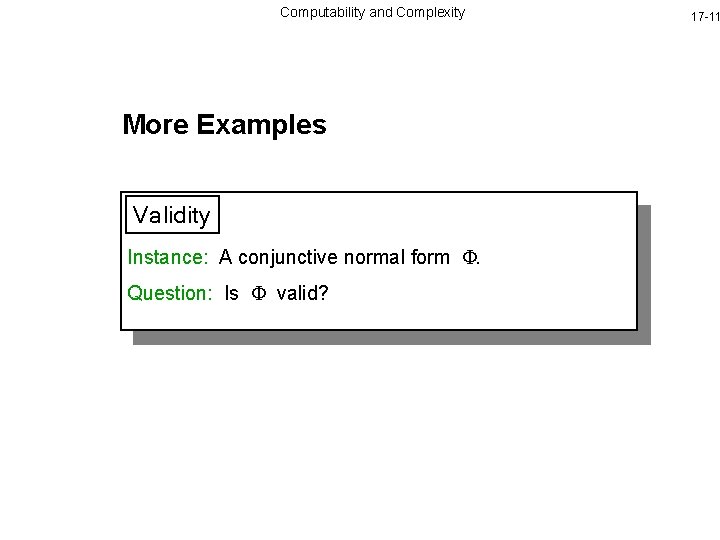
Computability and Complexity More Examples Validity Instance: A conjunctive normal form . Question: Is valid? 17 -11
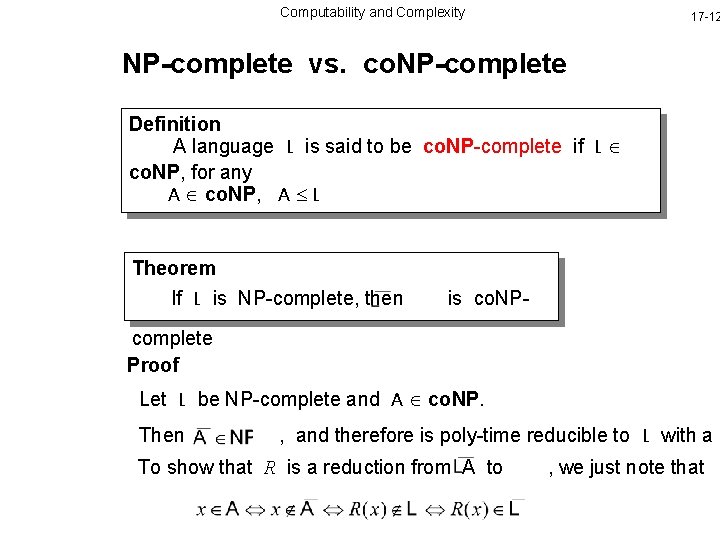
Computability and Complexity 17 -12 NP-complete vs. co. NP-complete Definition A language L is said to be co. NP-complete if L co. NP, for any A co. NP, A L Theorem If L is NP-complete, then is co. NP- complete Proof Let L be NP-complete and A co. NP. Then , and therefore is poly-time reducible to L with a r To show that R is a reduction from A to , we just note that
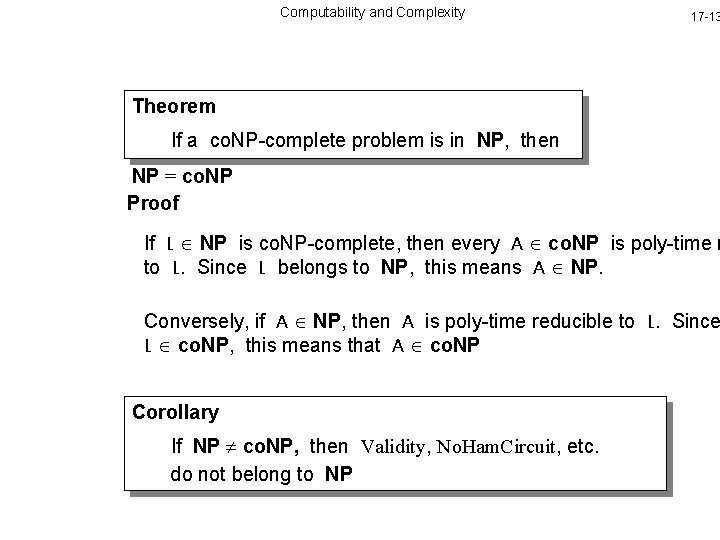
Computability and Complexity 17 -13 Theorem If a co. NP-complete problem is in NP, then NP = co. NP Proof If L NP is co. NP-complete, then every A co. NP is poly-time r to L. Since L belongs to NP, this means A NP. Conversely, if A NP, then A is poly-time reducible to L. Since L co. NP, this means that A co. NP Corollary If NP co. NP, then Validity, No. Ham. Circuit, etc. do not belong to NP
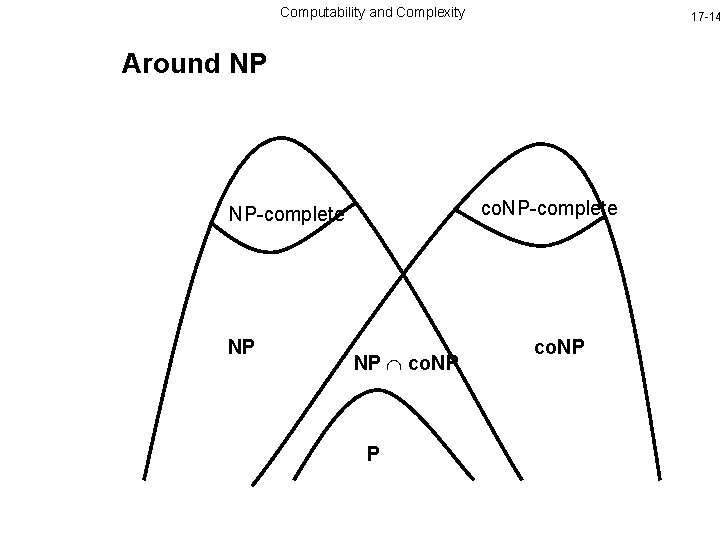
Computability and Complexity 17 -14 Around NP co. NP-complete NP NP co. NP P co. NP
- Slides: 14